












































































OCI Card Holders Getting Married in India: Complete Guide
For OCI card holders planning a wedding in India, the marriage documentation and registration process is more complex than most couples anticipate — and the consequences of getting it wrong extend well beyond the wedding day. This complete guide covers everything OCI card holders need to know: which marriage law applies, the full documentation checklist, the step-by-step registration process, the apostille and international recognition requirements for the UK, USA, Canada, Australia, and UAE, and the special scenarios that require additional care. The most thorough, legally intelligent OCI marriage guide written specifically for NRI couples worldwide.

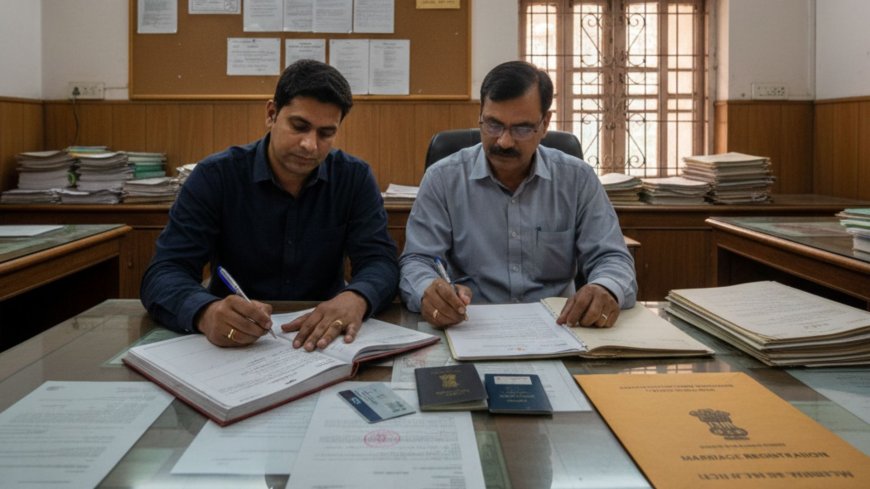
The Documents Nobody Warned You About
You have planned almost everything.
The venue is confirmed. The vendors are contracted. The guest list is finalised, the invitations are out, and the muhurat has been set by the family pandit after three weeks of calendar consultation. Your lehenga is in its third fitting. Your partner's sherwani has been delivered. The catering menu has been approved after a tasting session that your mother declared insufficient and your future mother-in-law declared excessive.
You are, by any reasonable measure, ready.
And then someone — a family member, a well-meaning friend, a relative who works in a government office — asks you a question that stops the planning conversation cold.
Have you sorted out the documentation for the marriage registration?
You look at your partner. Your partner looks at you. You both look at the family member with the particular expression that means you assumed this was simpler than it apparently is.
Because you are an OCI card holder. You live abroad. You hold the blue booklet with the lifetime visa stamped inside it that allows you to visit India freely, to own property, to open bank accounts, to exist in the Indian ecosystem in most of the ways that matter — but not to be a citizen. Not quite.
And that distinction — the gap between OCI card holder and Indian citizen — has specific, practical implications for the process of getting married in India that most OCI holders discover far later than they should.
The documentation required. The registration process. The legal validity of an Indian marriage in your country of residence. The apostille and authentication process. The timeline from ceremony to internationally recognised document. The specific situations where additional complexity arises — inter-religious marriages, marriages between two OCI holders, marriages between an OCI holder and a foreign national.
These are not bureaucratic technicalities. They are the legal foundation of your marriage. And getting them wrong — or getting them late — can create complications in your post-wedding life that the most beautifully planned ceremony cannot resolve.
This article is the complete guide to the marriage documentation and registration process for OCI card holders getting married in India. It covers the legal framework, the specific requirements for OCI holders, the registration process step by step, the post-registration authentication requirements for international recognition, and the specific scenarios that require additional care.
Read it before the planning is complete. The documentation process needs to begin long before the wedding day.
The Core Reality: What OCI Status Means for Your Indian Marriage
Before navigating the specifics of the documentation process, it is essential to understand what OCI status means legally — and what it does not mean — in the context of getting married in India.
What OCI Status Is
The Overseas Citizen of India card is a form of permanent residency status granted to people of Indian origin — and their spouses — who are citizens of other countries. It provides a lifetime, multi-entry visa to India, the right to live and work in India without a separate visa, and most of the rights available to Indian citizens except the right to vote, hold constitutional office, or acquire agricultural land.
OCI status is not dual citizenship, despite the name suggesting otherwise. The OCI card holder is a citizen of their country of residence — the UK, USA, Canada, Australia, UAE, or elsewhere — and is not an Indian citizen. This distinction matters in the marriage context.
How OCI Status Affects the Marriage Process
In most practical respects, OCI card holders getting married in India follow the same process as Indian citizens. They can marry under the same personal laws — Hindu Marriage Act, Special Marriage Act, or other applicable personal laws — and register their marriage through the same registration processes.
However, several OCI-specific considerations apply:
OCI card holders are required to present their OCI card and foreign passport — not an Indian passport — as their primary identity documents throughout the marriage and registration process. The documentation trail needs to be consistent with your foreign national identity, not an assumed Indian citizen identity.
For marriages involving foreign nationals — where one or both parties hold foreign passports with OCI status, or where one party is a foreign national without Indian origin — additional documentation and in some cases additional legal processes apply.
The post-registration authentication process — the steps required to have an Indian marriage certificate recognised in your country of residence — is more complex for OCI holders than the process of simply obtaining the Indian certificate itself. This post-registration process is where most OCI holders encounter their most significant documentation challenges.
The Legal Framework: Which Marriage Law Applies to You
India has multiple personal laws governing marriage, and the law that applies to your wedding depends on the religion and background of both parties. Understanding which law governs your marriage determines the registration process you follow.
The Hindu Marriage Act, 1955
Applies to: Hindus, Buddhists, Jains, and Sikhs — and to those who are not Muslim, Christian, Parsi, or Jewish.
The Hindu Marriage Act governs the majority of NRI and OCI holder weddings in India. It requires that both parties be Hindus at the time of marriage, that neither party has a living spouse at the time of marriage, that neither party is of unsound mind, and that the parties are not within the degrees of prohibited relationship unless the custom of either party permits such a marriage.
For OCI holders who are Hindu by background, the Hindu Marriage Act is the applicable framework regardless of their country of citizenship.
The Special Marriage Act, 1954
Applies to: All persons regardless of religion. Particularly relevant for: inter-religious marriages, marriages between an OCI holder and a foreign national, and marriages where one or both parties prefer a civil rather than religious ceremony.
The Special Marriage Act provides a secular framework for marriage in India and is the most commonly used law for marriages involving OCI holders who are marrying outside their religious community, marrying foreign nationals, or who want a marriage that is straightforwardly recognised internationally without questions about the religious law framework.
The Special Marriage Act requires a Notice of Intended Marriage to be given to the Marriage Officer at least 30 days before the wedding date. This 30-day notice period is one of the most significant practical planning implications for OCI holders — the notice must be filed in India, by one or both parties in person or through a specific procedural mechanism, at least 30 days before the ceremony. This timeline cannot be shortened in standard circumstances.
The Foreign Marriage Act, 1969
Applies to: Indian citizens marrying abroad at Indian consulates and embassies. Less directly relevant for OCI holders marrying in India, but relevant for the question of whether an OCI holder who has already married abroad needs to or can register that marriage in India.
Which Law Should You Choose?
For most OCI holders marrying in India, the practical choice is between the Hindu Marriage Act and the Special Marriage Act.
The Hindu Marriage Act is faster — there is no mandatory 30-day notice period — and is the standard framework for Hindu religious ceremonies. It is the appropriate choice for OCI holders having a traditional Hindu wedding.
The Special Marriage Act is the appropriate choice for inter-religious couples, for couples where one party is a foreign national, for couples who want the most internationally straightforward recognition of their Indian marriage, and for couples who prefer a civil ceremony structure.
Documentation Required for OCI Card Holders
This is the practical core of the article — the specific documents you need to have prepared before you can register your marriage in India.
For Both Parties
Proof of Identity: OCI card holders must present their foreign passport as their primary identity document. The OCI card itself is presented alongside the passport. Do not present an old Indian passport — particularly one that has been cancelled and surrendered — as a primary identity document.
Proof of Date of Birth: Birth certificate, or passport (which functions as proof of date of birth). Some registrars accept the passport alone. Others require a separate birth certificate. Have both available.
Proof of Address: For OCI holders, this typically means proof of address in your country of residence — a utility bill, bank statement, or official correspondence — alongside any address confirmation for your temporary address in India during the registration process.
Photographs: Passport-size photographs — typically four to six, though the specific requirement varies by registration office and state.
Affidavit of Single Status: A sworn affidavit declaring that you are not currently married to any other person. For OCI holders, this affidavit is typically executed before a notary in your country of residence and then apostilled — authenticated for international use — before you travel to India. The format requirements for this affidavit vary by state. Confirm the required format with the specific registration office in your wedding city before having the affidavit prepared.
Divorce Decree or Death Certificate (if previously married): If either party has been previously married, a certified copy of the divorce decree or the death certificate of the former spouse must be provided. For OCI holders whose previous marriage and divorce occurred outside India, these documents typically need to be apostilled as well.
Specific to OCI Card Holders
OCI Card: The physical OCI card, presented alongside the foreign passport. The name and date of birth on the OCI card must match the foreign passport exactly. Discrepancies — which sometimes occur due to name spelling variations between documents — need to be resolved before the registration process begins. Resolving OCI card discrepancies can take weeks. Identify any discrepancies early.
No Objection Certificate (NOC) from Embassy or Consulate: For marriages under the Special Marriage Act, and for some registrars under other acts, OCI holders may be required to obtain a No Objection Certificate from the embassy or high commission of their country of citizenship in India, confirming that there is no legal impediment to the marriage under the laws of their country of residence.
The requirement for an NOC varies by state, by registrar, and by the specific circumstances of the marriage. Check the specific requirement with the registration office in your wedding city well in advance. If required, allow a minimum of four to six weeks to obtain the NOC from the relevant embassy.
For the Witnesses
Two witnesses are required for the marriage registration. Witnesses must provide:
- Identity proof — Aadhar card, passport, or OCI card
- Address proof
- Passport-size photographs
Witnesses must be present at the time of registration. For OCI holder weddings where the witness pool may include other OCI holders or foreign nationals, ensure their documentation is prepared in advance.
The Registration Process: Step by Step
Step One: Identify the Appropriate Registration Authority
Marriage registration in India is a state subject — each state has its own registration authority, its own procedural requirements, and its own documentation checklist. The applicable registrar is typically the Sub-Registrar or the Marriage Officer in the district where the wedding ceremony takes place.
Research the specific requirements of the registration authority in your wedding city before finalising your documentation checklist. State-specific requirements can vary significantly — what is required in Maharashtra may differ from what is required in Rajasthan, Delhi, or Kerala.
Step Two: File the Notice of Intended Marriage (Special Marriage Act Only)
If you are marrying under the Special Marriage Act, one or both parties must appear before the Marriage Officer in the district where the wedding will take place and file a Notice of Intended Marriage. This notice is then publicly displayed for 30 days, during which any person may raise an objection to the marriage.
This 30-day notice period is a hard requirement — it cannot be shortened or waived in standard circumstances. This means that for OCI couples marrying under the Special Marriage Act, at least one party must be present in India at least 30 days before the wedding date to file the notice.
For NRI couples planning limited India visits, this requirement means that the Special Marriage Act notice filing must be built into your visit planning from the beginning. It cannot be left until the pre-wedding arrival trip.
Step Three: Prepare and Apostille Foreign Documents
Documents executed outside India — the affidavit of single status, the NOC from the embassy, divorce decrees from foreign courts — typically need to be apostilled before they are accepted by Indian registration authorities.
An apostille is an international authentication — issued under the Hague Convention — that certifies the authenticity of a document for use in another country. If your country of residence is a signatory to the Hague Convention (the UK, US, Canada, Australia, and most European countries are), your foreign documents can be apostilled by the designated authority in your country — typically the Foreign Commonwealth and Development Office in the UK, the Secretary of State's office in individual US states, or equivalent authorities elsewhere.
The apostille process takes time — allow a minimum of two to four weeks for standard processing, longer for urgent or peak periods. Begin this process well before your travel to India.
Step Four: Attend the Registration Appointment
The actual marriage registration appointment involves both parties appearing before the registrar with their complete documentation. The ceremony, if having a religious wedding, may have already occurred — the registration formalises the marriage legally.
Under the Hindu Marriage Act, registration typically occurs after the ceremony, often within a few days to a few weeks.
Under the Special Marriage Act, the marriage itself takes place at the Marriage Officer's office in a civil ceremony, with both parties and three witnesses present.
Step Five: Obtain the Marriage Certificate
Following registration, the marriage certificate is issued. This is the primary Indian legal document confirming your marriage. Retain multiple certified copies — you will need them for the subsequent authentication process.
The marriage certificate issued under the Hindu Marriage Act will reference the Hindu Marriage Act. The certificate issued under the Special Marriage Act will reference the Special Marriage Act. The applicable law is reflected on the certificate.
Getting Your Indian Marriage Recognised in Your Country of Residence
This is the step most OCI couples underestimate — and the step most likely to create post-wedding complexity if not properly executed.
An Indian marriage certificate is a valid legal document in India. Having it recognised for legal purposes in your country of residence requires additional authentication steps that go beyond simply presenting the Indian certificate to a foreign government office.
The Apostille of the Indian Marriage Certificate
For the Indian marriage certificate to be recognised in countries that are signatories to the Hague Convention, it needs to be apostilled by the designated Indian authority. In India, apostilles for marriage certificates are issued by the Ministry of External Affairs through its designated authentication offices.
The process involves submitting the original marriage certificate — or a certified copy — to the MEA authentication office, along with the applicable fee. Processing time varies — allow four to six weeks for standard processing.
Country-Specific Requirements
Beyond the apostille, each country has its own specific requirements for recognising a foreign marriage.
United Kingdom: A marriage in India that is valid under Indian law and properly certified is generally recognised in the UK. The apostilled Indian marriage certificate, accompanied by an official translation if necessary, is typically sufficient for UK administrative purposes — name changes, immigration applications, and financial registrations.
United States: The US recognises foreign marriages that are valid under the laws of the country where they took place. An apostilled Indian marriage certificate is the standard documentation for US administrative recognition. For immigration purposes — spousal visa applications — additional documentation from USCIS processes applies.
Canada: Canada generally recognises foreign marriages valid under the law of the place where the marriage occurred. Provincial requirements for using a foreign marriage certificate vary. An apostilled certificate with official translation where required is standard.
Australia: Australia recognises foreign marriages that meet certain validity criteria under the Marriage Act 1961. An apostilled Indian marriage certificate is standard documentation. For immigration purposes, the Department of Home Affairs has specific evidentiary requirements.
UAE: The UAE has specific requirements for recognising foreign marriages that go beyond a standard apostille — attestation through the Indian Embassy in the UAE, followed by attestation by the UAE Ministry of Foreign Affairs, is typically required. This process is more involved than the apostille process alone and requires specific attention for OCI couples based in the UAE.
Research the specific requirements for your country of residence well in advance of your wedding. The authentication and recognition process for your country may have specific timelines that need to be built into your planning.
Special Scenarios Requiring Additional Care
Two OCI Card Holders Getting Married
When both parties are OCI card holders — both holding foreign passports, both with Indian heritage — the documentation process follows the same framework described above, with both parties providing OCI-specific documentation. The specific complexity in this scenario typically arises from the affidavit of single status requirements, which need to be prepared and apostilled from potentially different countries, and from the requirement that documentation from both foreign jurisdictions be properly authenticated.
OCI Card Holder Marrying a Foreign National Without Indian Origin
This scenario — common in NRI communities where one partner is of non-Indian background — typically requires registration under the Special Marriage Act, as the foreign national party is not subject to any Indian personal law.
The foreign national party will need to provide documentation from their country — proof of identity, proof of single status, and potentially an NOC from their country's embassy in India. The NOC requirement for the foreign national party is particularly important and should be confirmed with the registration office early.
OCI Card Holder Marrying a Non-Resident Indian Citizen
Where one party is an OCI card holder and the other is an Indian citizen, the marriage follows the standard personal law framework applicable to the Indian citizen party. The OCI card holder provides their OCI-specific documentation. The Indian citizen party provides their standard Indian documentation. Registration proceeds under the applicable personal law.
Inter-Religious Marriages
Marriages between parties of different religions must be registered under the Special Marriage Act — not under any religious personal law. The 30-day notice requirement applies. Both parties provide their respective documentation. The marriage certificate issued is under the Special Marriage Act.
Marriages Where Previous Marriage Was Outside India
OCI holders who were previously married and divorced outside India need to have their foreign divorce decree recognised for the purposes of the Indian marriage registration. This typically requires:
The apostilled divorce decree from the foreign jurisdiction. In some cases, a declaratory judgment from an Indian court recognising the foreign divorce. The requirement for court recognition of foreign divorces varies — some Indian registrars accept apostilled foreign divorce decrees directly, others require court recognition. Confirm the specific requirement with your registration office and, if court recognition is required, begin the process well in advance.
Common Mistakes OCI Card Holders Make With Marriage Documentation
Starting the Documentation Process Too Late
The most consequential mistake — and the most common. The documentation process for OCI card holders involves multiple steps, each with its own timeline: preparing and apostilling foreign documents, obtaining NOCs from embassies, filing the 30-day notice under the Special Marriage Act, and completing the registration itself. Starting this process three weeks before the wedding — as many couples do — is insufficient. Start six months before.
Inconsistent Names Across Documents
Name spelling variations between an OCI card, a foreign passport, an Indian birth certificate, and other documents are common and are one of the most frequent causes of documentation delays. Check all your documents for name consistency well in advance. If discrepancies exist — even small ones, such as a middle name appearing on some documents and not others — resolve them before the documentation process begins.
Not Confirming State-Specific Requirements
Marriage registration requirements vary significantly across Indian states. A documentation checklist prepared for a Mumbai registration may be missing something required in Jaipur. Always confirm the specific requirements with the registration office in your wedding city — do not rely on general information that may not reflect the specific state's requirements.
Assuming the Indian Certificate Is Sufficient for Abroad
Obtaining the Indian marriage certificate is not the end of the process. The subsequent apostille and country-specific recognition steps are required for the marriage to be legally effective in your country of residence. Couples who return abroad with the Indian certificate and discover months later that it requires further authentication for the purpose they need it for — an immigration application, a name change, a joint mortgage — face delays and complications that proper advance planning would have avoided.
Not Retaining Enough Certified Copies
Marriage certificates get used — for immigration applications, for name changes, for financial registrations, for visa applications. Each use may require an original or certified copy. Obtain at least five to eight certified copies of your marriage certificate at the time of registration. Obtaining additional copies later, particularly from abroad, is a significantly more complex process.
Your OCI Marriage Documentation Timeline
Six Months Before the Wedding:
- Identify the applicable marriage law and registration authority
- Confirm state-specific documentation requirements with the registration office
- Check all documents for name consistency — resolve any discrepancies immediately
- Determine whether an NOC from your country's embassy is required
- Begin the NOC process if required — allow four to six weeks minimum
- Prepare the affidavit of single status in the required format
Four to Five Months Before:
- Apostille the affidavit of single status and any other foreign documents requiring apostille
- Apostille any foreign divorce decrees if applicable
- If marrying under Special Marriage Act — plan the India visit that allows the 30-day notice filing
- Begin researching the post-registration apostille and country recognition process
Three Months Before:
- Confirm all documentation is complete and consistent
- Brief your wedding planner on the registration timeline and any visit requirements
- Confirm witness documentation requirements and brief your witnesses
One to Two Months Before:
- File the 30-day notice if marrying under Special Marriage Act
- Confirm registration appointment date and time
- Prepare all documentation in an organised file for the registration appointment
At Registration:
- Attend with complete documentation
- Obtain marriage certificate on the day or confirm the collection timeline
- Obtain five to eight certified copies
Post-Wedding:
- Submit Indian marriage certificate for MEA apostille
- Complete country-specific recognition process in your country of residence
- Use apostilled certificate for name changes, immigration applications, and other administrative purposes
The Documentation Is the Foundation of Everything That Follows
The ceremony is the memory. The photographs are the record. The documentation is the foundation.
An Indian wedding without properly executed marriage documentation is, legally speaking, incomplete — not in its emotional or cultural significance, but in its capacity to support the administrative, immigration, and legal dimensions of your shared life that begin the moment the wedding week ends.
OCI card holders navigating the Indian marriage documentation process are navigating a system that is manageable and navigable — but only for those who start early, research specifically, and treat the documentation with the same seriousness they bring to every other dimension of their wedding planning.
The venue, the vendors, the décor, the food — all of these produce the experience of the wedding. The documentation produces the legal reality of the marriage. Both matter. Both deserve proper attention.
Start the documentation process six months before the wedding. Confirm the requirements in your specific state. Apostille everything that needs to be apostilled. Obtain enough certified copies. And complete the recognition process in your country of residence before the need for it becomes urgent.
The legal foundation of your marriage deserves the same care as every other element of the day you are building.
Give it that care. Everything that follows depends on it.
What's Your Reaction?
 Like
0
Like
0
 Dislike
0
Dislike
0
 Love
0
Love
0
 Funny
0
Funny
0
 Angry
0
Angry
0
 Sad
0
Sad
0
 Wow
0
Wow
0