





































































Delhi vs. Mumbai vs. Bangalore — Which City Is Right for Your NRI Wedding?
For NRI couples planning an Indian wedding, the city decision is the most foundational planning choice of all — determining the venue landscape, vendor ecosystem, international guest accessibility, cultural character, weather window, and social expectations that shape everything that follows. This complete comparison guide breaks down Delhi, Mumbai, and Bangalore across every dimension that matters for NRI couples — venue scale and availability, international air connectivity, design and aesthetic quality, cultural heritage, weather flexibility, budget reality, social pressure, and the specific NRI considerations that make each city the right choice for a different kind of couple — with a clear decision framework that replaces default assumptions with deliberate, informed city selection.

The City Decision That Shapes Everything
Before the venue. Before the vendor. Before the guest list is finalised or the function schedule is designed or the first rupee of budget is allocated.
Before almost any other planning decision — there is this one.
Which city?
For NRI couples planning an Indian wedding, the city selection is the foundational decision from which everything else flows. The city determines the venue landscape available to you. It determines the vendor ecosystem you are working within. It determines the accessibility for your international guests. It determines the weather window that governs your date selection. It determines the cultural character of the celebration — the particular flavour of Indian urban life that will surround your wedding and that your guests will experience.
It also determines, in ways that are less obvious but equally significant, the family dynamics, the social expectations, and the particular pressures that different Indian cities bring to the wedding planning process. A Delhi wedding carries specific expectations about scale, production value, and hospitality generosity that are embedded in Delhi's culture of celebration. A Mumbai wedding reflects the particular cosmopolitan energy and space constraints of India's commercial capital. A Bangalore wedding has its own character — more relaxed, more internationally oriented, more influenced by the tech culture that has made it India's most globally connected city.
For NRI couples, choosing between Delhi, Mumbai, and Bangalore — India's three largest metropolitan wedding markets — is a decision with practical, cultural, aesthetic, and relational dimensions that all need to be understood before the choice is made.
This article is the complete comparison guide — covering the venue landscapes, vendor ecosystems, guest accessibility, weather windows, budget structures, cultural characters, and NRI-specific considerations for each city — giving you the framework to make the city decision with full information rather than default assumptions.
Delhi: The Grand Capital of Indian Wedding Culture
The Character of Delhi Weddings
Delhi does not do anything quietly.
The capital of India is the capital of the Indian wedding in the most literal sense — the city where wedding scale, wedding production value, and wedding hospitality generosity are benchmarked at their most ambitious. The Delhi wedding is the Indian wedding at its most expansive — grand venues, elaborate décor, large guest counts, multi-function programmes that extend across multiple days, and a cultural expectation of hospitality that measures its success in the comprehensiveness of what is provided rather than the intimacy of how it is experienced.
This character is not superficial — it is deeply embedded in Delhi's culture of celebration, in the city's history as the seat of successive imperial capitals, and in the social dynamics of the community networks that have made Delhi's wedding market the largest and most commercially developed in India.
For NRI couples whose families are Delhi-based, or whose family cultural context aligns with the Delhi wedding tradition, the city provides what no other Indian city can: the full infrastructure for the grandest possible expression of Indian wedding culture, delivered within a metropolitan environment that has built its entire vendor ecosystem around this specific requirement.
The Delhi Venue Landscape
Delhi's wedding venue market is the most developed and most varied in India — spanning the full range from luxury five-star hotel ballrooms and heritage havelis in the old city to the farmhouse belt of South Delhi and the resort properties along the Yamuna Expressway.
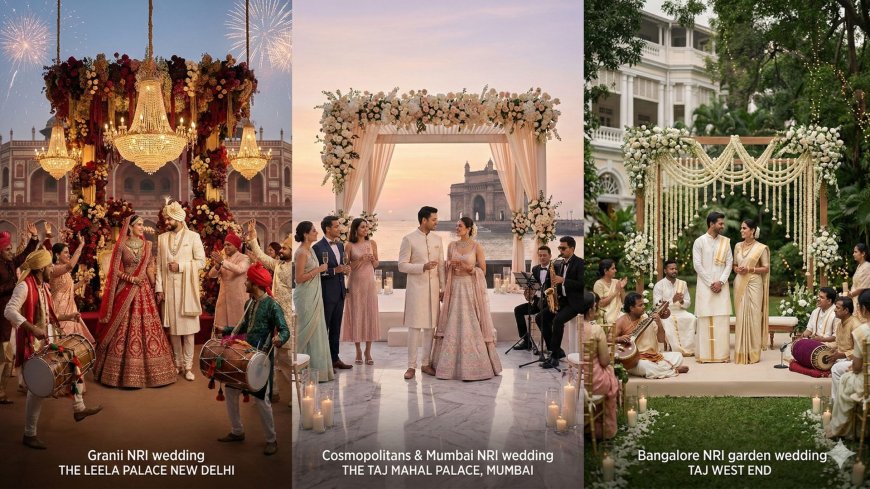
The five-star hotel circuit: Delhi's collection of five-star hotels — The Leela, The Oberoi, The Taj Mahal Hotel, The Imperial, the ITC Maurya — provides the backbone of the premium Delhi wedding venue market. These properties offer world-class event infrastructure, large ballroom capacities, exceptional catering standards, and the brand credibility that a certain segment of the Delhi wedding market specifically values.
The farmhouse belt: As discussed in the farm wedding article elsewhere in this series, Delhi's farmhouse belt — concentrated in the Chattarpur, Dera Mandi, and Gurugram corridors — provides the large outdoor venue infrastructure for Delhi's biggest and most production-intensive weddings. The farmhouses of South Delhi can absorb guest counts of 500 to 1,500 and the production infrastructure of large-format event companies.
The heritage circuit: Delhi's Lutyens zone and Old Delhi heritage areas have a limited but distinctive collection of heritage properties — colonial-era bungalows, Mughal-influenced structures, and the extraordinary monuments of Delhi's layered history that are available for private events. The Qutub area, Mehrauli's heritage precinct, and the Lutyens bungalow zone all produce wedding settings of genuine architectural distinction.
The NCR extension: Greater Delhi — encompassing Gurugram, Noida, and the broader NCR — has expanded the available venue landscape significantly. The luxury resort corridor along the Delhi-Gurugram border and the resort properties along the Yamuna Expressway add large-format destination-adjacent options to the metropolitan Delhi wedding market.
The Delhi Vendor Ecosystem
Delhi has India's most extensive wedding vendor ecosystem — the largest concentration of premium photographers, décor teams, catering companies, entertainment agencies, and wedding management firms of any Indian city.
The scale of the ecosystem means that Delhi couples — including NRI couples planning Delhi weddings — have access to more vendor choices at more price points than anywhere else in India. The competition within the vendor community is intense and generally keeps quality high across all categories.
The catering culture in Delhi is particularly strong — the city's food culture, shaped by the culinary traditions of Punjabi, Mughal, and North Indian communities, produces wedding catering of extraordinary variety and quality. Delhi weddings are known for their food — elaborate multi-cuisine spreads, live counter stations, dessert arrays that are themselves a production — and the catering vendor community reflects this cultural priority.
International Guest Accessibility
Delhi's Indira Gandhi International Airport is India's largest and best-connected international hub — with direct flights from virtually every major international city serving the NRI community: London, Birmingham, Manchester, New York, Chicago, Toronto, Vancouver, Sydney, Melbourne, Dubai, Abu Dhabi, and dozens of other destinations.
For NRI couples with guest bases across multiple international cities, Delhi is the most accessible Indian wedding destination available — the flights exist, they are frequent, and the connection options are abundant. No other Indian city matches Delhi's international air connectivity.
The Delhi Weather Window
Delhi's wedding season is governed by the extreme of its continental climate — the summer heat and the winter cold both create parameters that the monsoon further constrains.
October through February is the primary Delhi wedding season — post-monsoon, before the summer heat builds. December and January are the peak months — cool, dry, and genuinely pleasant for outdoor events. However, Delhi winters can surprise international guests from tropical climates — December and January evenings in Delhi can be genuinely cold, with temperatures dropping to 5 to 8°C. Fog is common in January and can affect flight schedules — relevant planning for NRI guests arriving by domestic connection.
November is the pre-peak shoulder month — still excellent weather, slightly lower pricing, and the post-Diwali festive energy that gives Delhi a particular warmth in this period.
February transitions toward spring — comfortable temperatures, gradually reducing crowd pressure at venues, and the beginning of the spring floral season.
The Budget Landscape in Delhi
Delhi weddings operate across a wide budget range — from accessible to extraordinary — but the cultural expectation of scale means that the base production level for a premium Delhi wedding is higher than in most other Indian cities.
The minimum viable premium: A genuinely premium Delhi wedding — five-star venue, quality vendors, appropriate guest count — requires a budget that reflects the city's production culture. Attempting to do a Delhi wedding at a budget that does not match the city's production expectations produces a wedding that feels under-resourced relative to its context.
The ceiling is essentially unlimited: Delhi has the vendor capability, the venue infrastructure, and the production culture to accommodate virtually any level of investment. The city's top-tier weddings are among the most elaborately produced private events anywhere in the world.
The Delhi NRI-Specific Considerations
Family dynamics: Delhi's wedding culture is intensely social and community-oriented — the guest list at a Delhi wedding carries significant social weight, and the expectation that the wedding will be seen and discussed within the community shapes the planning in ways that NRI couples need to understand and navigate.
For NRI couples whose families are Delhi-based: The family's social network and community expectations will be a primary factor in the guest count and the production level of the wedding. The conversation about scale — which is often the most contested conversation in Delhi wedding planning — is more likely to be challenging in Delhi than in any other Indian city.
For NRI couples whose families are not Delhi-based but who are choosing Delhi for its accessibility: The cultural expectations of the Delhi wedding may be less directly relevant — the couple has more freedom to define the scale and character of the event without the community context pressure that surrounds a home-city wedding.
Mumbai: The Cosmopolitan Capital of Creative Indian Weddings
The Character of Mumbai Weddings
Mumbai is a city that does not have much space — and the scarcity of space has shaped its wedding culture in specific and interesting ways.
The metropolitan density of Mumbai — 20 million people in one of the world's most compact urban geographies — means that the expansive farmhouse wedding culture of Delhi has no natural counterpart in Mumbai. The farm venues and outdoor spaces available in Delhi simply do not exist within the Mumbai metropolitan area in the same concentration.
What Mumbai has instead — and what Delhi's scale can sometimes obscure — is creativity. The Mumbai wedding market has developed in response to space and cost constraints in ways that have produced some of the most innovative and aesthetically distinctive Indian wedding experiences available. The compact venues of Mumbai's luxury hotel market, the outdoor spaces of the Alibaug coastal belt, and the growing resort landscape of the city's periphery have all been pushed toward greater creativity and greater design sophistication by the pressure of the city's constraints.
Mumbai weddings are, on average, more design-conscious, more internationally influenced, and more aesthetically specific than Delhi weddings at comparable price points. The city's fashion industry, film industry, and design community have permeated the wedding market — Mumbai's premium wedding vendors are more likely to have international training, international aesthetic references, and international design sensibilities than their counterparts in other Indian cities.
The Mumbai Venue Landscape
Mumbai's venue landscape is shaped by the city's geography — the peninsula configuration of south Mumbai, the suburban spread of the Western and Central suburbs, and the coastal access to the Konkan and Alibaug belts.
The south Mumbai luxury hotels: The Taj Mahal Palace at the Gateway of India, The Oberoi, The Four Seasons — south Mumbai's luxury hotels are among the most architecturally distinguished and most atmospherically distinctive event venues in India. The Taj Mahal Palace's ballrooms and outdoor spaces, with the gateway and the harbour as the backdrop, produce a specific Mumbai wedding aesthetic that is instantly recognisable.
The suburban hotel market: The Western and Central suburbs — Bandra, Juhu, Powai, BKC — have an extensive luxury hotel market that serves the majority of Mumbai weddings at the premium tier. These properties are more accessible for guests based in the suburbs but lack the iconic character of the south Mumbai properties.
The Alibaug coastal belt: As described in detail in the farm wedding article, Alibaug across the bay from Mumbai offers a destination wedding experience within approximately two hours of the city — beach-adjacent properties, coastal estates, and resort venues that produce a completely different aesthetic from the urban hotel market.
The periphery resort belt: Karjat, Lonavala, Khandala, and the Pune periphery offer the hill station and natural landscape venues that the Mumbai market uses when it wants a destination feel without Rajasthan distance.
The Mumbai Vendor Ecosystem
Mumbai's wedding vendor ecosystem is smaller than Delhi's but arguably more curated — the city's strong design culture and its connections to the fashion and film industries have attracted a concentration of premium-tier vendors whose work has a distinctive aesthetic quality.
Mumbai photographers are among India's most internationally sophisticated — the city's connection to the advertising and film industries has produced photographers with both technical excellence and visual intelligence that is evident in the quality of the best Mumbai wedding photography.
Mumbai décor teams tend toward cleaner, more contemporary, more internationally referenced aesthetics than Delhi teams — less maximalist in the traditional Indian sense, more likely to produce weddings that look at home in a global visual vocabulary.
Mumbai catering reflects the city's extraordinary food culture — the most diverse food city in India, with Parsi, Mughal, South Indian, Gujarati, Maharashtrian, and international cuisine traditions all present and all of high quality. Mumbai wedding food is characteristically varied and sophisticated.
International Guest Accessibility
Chhatrapati Shivaji Maharaj International Airport is India's second-busiest international hub — with direct connections to all major NRI community cities. The flight network is slightly less extensive than Delhi's but covers all the primary destinations: London, New York, Toronto, Sydney, Dubai, and beyond.
Mumbai's international connectivity is excellent and sufficient for the vast majority of NRI wedding guest travel requirements. For NRI couples with guest bases primarily in the UK, the Gulf, or Southeast Asia, Mumbai's connections are as good as Delhi's. For guest bases in North America or the southern hemisphere, Delhi's additional connection options provide marginal advantages.
The Mumbai Weather Window
Mumbai's coastal location — on the western coast of India, directly exposed to the Arabian Sea and the Southwest Monsoon — produces a more constrained and more specific wedding weather window than Delhi.
November through February is the primary Mumbai wedding season — the monsoon has completely withdrawn and the weather is genuinely excellent. Mumbai winters are mild — daytime temperatures of 28 to 32°C, evenings of 20 to 24°C — with negligible rainfall. The weather quality in November-February Mumbai is genuinely superb for outdoor events.
The monsoon constraint is more severe in Mumbai than in Delhi. The Southwest Monsoon arrives in Mumbai approximately June 1 — among the first of the mainland Indian cities to receive the monsoon — and the June-September rainfall is sustained, heavy, and entirely prohibitive for outdoor events. October sees the monsoon withdrawal and is viable from mid-month onward.
March and April are warm and manageable — the post-winter temperature build is gradual in Mumbai's coastal climate and March in particular remains comfortable for outdoor events.
The Budget Landscape in Mumbai
Mumbai is expensive. The cost of real estate, of operating a business, and of living in Mumbai is reflected in the pricing of every wedding service — venue hire, vendor rates, catering costs, and accommodation are all higher in Mumbai than in most other Indian cities.
The Mumbai wedding budget premium relative to Delhi is real — comparable production quality typically costs more in Mumbai, partly because of the higher operating costs of the city and partly because the city's premium vendor community prices its work at a premium that reflects genuine quality.
The space premium is specific to Mumbai — the relative scarcity of large outdoor event spaces means that the per-square-metre cost of event space in Mumbai is higher than in Delhi, and that the outdoor destination options (Alibaug, Karjat) involve transportation costs that urban venues do not.
The Mumbai NRI-Specific Considerations
The cosmopolitan context: Mumbai is the most internationally oriented of India's three major cities — its culture, its business ecosystem, and its social fabric are more globally connected than Delhi's or Bangalore's. For NRI couples whose guest base includes significant numbers of internationally mobile professionals, Mumbai's cosmopolitan character means that the cultural context of the wedding is more immediately familiar and accessible than a more culturally specific Indian city would be.
The film industry dimension: Mumbai's connection to Bollywood — India's film industry, whose visual language defines the global imagination of Indian celebration — means that some aspects of the Mumbai wedding aesthetic carry a specific cultural resonance that is genuinely specific to the city. For NRI couples whose cultural frame of reference includes Bollywood, Mumbai weddings have a layer of significance that no other city provides.
Space and scale: Mumbai's space constraints mean that the large-format, expansive Delhi-style wedding is less naturally at home in the city. NRI couples whose family context requires very large guest counts — 500 or more — may find Mumbai's venue landscape more constraining than Delhi's. The Alibaug and periphery options exist but add transportation complexity to the guest experience.
Bangalore: The Garden City's Emerging Wedding Destination
The Character of Bangalore Weddings
Bangalore is different.
Not different in a way that immediately announces itself — the weddings are beautiful, the vendors are professional, the venues are excellent. But the character of Bangalore's wedding culture is shaped by something specific to the city: its identity as India's technology capital, the home of a globally oriented, internationally educated professional community that has built one of the world's most significant tech ecosystems.
The Bangalore wedding reflects this identity. It is, on average, more relaxed in its formality than a Delhi wedding. More internationally referenced in its aesthetic. More likely to involve décor and programming that reflects the couple's individual sensibilities rather than the community's social expectations. More open to non-conventional formats — intimate gatherings, destination-adjacent properties, wellness-oriented wedding week programming — that the more socially prescribed cultures of Delhi and Mumbai are slower to adopt.
This character makes Bangalore particularly interesting for NRI couples who have strong preferences about how their wedding should feel — who want a celebration that expresses who they genuinely are rather than what their city's wedding culture expects — and who have the social context that allows them to make that choice.
The Bangalore Venue Landscape
Bangalore's venue landscape is characterised by a strong mid-tier luxury hotel market, a growing collection of destination-adjacent resort properties in the surrounding hills and countryside, and an interesting boutique venue market that reflects the city's design-forward culture.
The luxury hotel market: Bangalore's five-star hotel collection — The Leela Palace, The Oberoi, The ITC Windsor, The Taj West End — provides the premium event infrastructure for the city's top-tier weddings. The Taj West End's colonial heritage character and established gardens make it particularly distinctive — a heritage property of genuine charm in the middle of Bangalore's urban landscape.
The boutique and design-forward venues: Bangalore's design consciousness has produced a collection of boutique wedding venues — converted bungalows, design-forward independent properties, and architecturally distinctive spaces — that are more developed than in most other Indian cities. For NRI couples with specific aesthetic sensibilities, Bangalore's boutique venue market offers options that are genuinely distinctive.
The surrounding hills and countryside: Bangalore's position in the Deccan plateau — surrounded by gentle hills and agricultural countryside — provides a growing range of resort and estate properties within one to two hours of the city. The Nandi Hills corridor, the Coorg road, and the Mysuru corridor all have interesting venue options for couples who want a destination-adjacent experience within manageable distance.
The Mysuru corridor: Mysuru — 150 kilometres from Bangalore — offers the extraordinary heritage palace venues of the former Wodeyar royal capital, accessible as a destination wedding option for Bangalore-based NRI couples.
The Bangalore Vendor Ecosystem
Bangalore's wedding vendor ecosystem is smaller than Delhi's or Mumbai's — reflecting the city's smaller wedding market — but is concentrated at a high quality level, particularly in the premium and design-forward segments.
Bangalore photographers are among India's most technically accomplished and most aesthetically sophisticated — the city's connection to the tech industry has produced a community of photographers with high technical standards and a visual language that is internationally competitive.
Bangalore décor teams tend toward contemporary, internationally influenced aesthetics — the city's design culture and its international professional community have shaped a vendor aesthetic that is more globally referenced than the more traditionally rooted aesthetics of Delhi and Mumbai.
South Indian cuisine: For NRI couples with South Indian family backgrounds, Bangalore's catering ecosystem — with its deep knowledge of Karnataka, Tamil Nadu, and Kerala cuisine traditions — offers the most culturally specific and most authentically excellent South Indian wedding food of any major Indian city.
International Guest Accessibility
Kempegowda International Airport is India's fourth-busiest airport — with direct international connections to major Gulf destinations, Southeast Asian hubs, and several European cities. The connection to London is direct and frequent. Connections to North American cities typically require a hub transit.
Bangalore's international connectivity is good but not equivalent to Delhi or Mumbai — NRI couples with guest bases spread across North America, the UK, and the Gulf will find that more of their guests require connections through Delhi or Mumbai to reach Bangalore. The connectivity gap is manageable but real and relevant for large, geographically dispersed international guest groups.
The Bangalore Weather Window
Bangalore's climate is the most moderate of the three cities — the Deccan plateau location at 900 metres elevation produces a climate that is famously pleasant year-round. The city's traditional description as having "perpetual spring" is an overstatement but contains real truth.
The primary wedding season: October through March. Unlike Delhi's winters and Mumbai's monsoon constraints, Bangalore's climate is broadly hospitable across a wider range of months than either of the other cities.
October and November are excellent — post-monsoon, with the city's gardens and parks at their greenest and the temperature genuinely comfortable.
December through February are the coolest months — daytime temperatures of 22 to 27°C, evenings of 14 to 18°C. The coolest months in Bangalore — December and January — produce genuinely comfortable outdoor wedding conditions without the cold extremes of Delhi winters.
March and April extend the viable season beyond what Delhi or Mumbai can offer — the Bangalore temperature build is more gradual and the pre-monsoon heat less extreme than in the coastal cities.
The monsoon: June through September brings Bangalore's rainfall — the city receives a Northeast Monsoon as well as a Southwest Monsoon influence, making October one of the rainier months. October weddings in Bangalore require rain contingency planning that Delhi or Mumbai October weddings do not.
The Budget Landscape in Bangalore
Bangalore occupies a middle position in the Indian city wedding budget landscape — consistently more affordable than Mumbai, broadly comparable to Delhi at similar quality levels, with the advantage of a wider range of accessible-quality venue options in the mid-tier.
The cost of premium wedding production in Bangalore is genuinely more accessible than in Mumbai — reflecting the lower operating costs of the city and the smaller premium-vendor community's generally more accessible pricing. NRI couples with strong aesthetic priorities and moderate budgets may find Bangalore's combination of quality vendors and accessible pricing the most efficient of the three cities.
The Bangalore NRI-Specific Considerations
The tech community connection: A disproportionate share of India's NRI population — particularly those based in the US tech industry, in the UK financial sector, and in the Gulf's international business community — has family connections to Bangalore or the broader Karnataka-Andhra-Tamil Nadu South Indian corridor. For these couples, Bangalore is not simply a venue choice — it is a homecoming with specific cultural and family resonance that makes it the natural choice rather than a considered alternative.
The relaxed formality: For NRI couples who have been living internationally for years and who have absorbed international cultures of celebration — more relaxed, more personal, less hierarchically formal than traditional Indian wedding culture — Bangalore's relatively relaxed social expectations around wedding scale and formality are genuinely freeing. A Bangalore wedding can be smaller, more intimate, and more personally expressive without the social pressure that the same choice would carry in Delhi.
The South Indian ceremony: For NRI couples with South Indian Hindu family backgrounds — Tamil Brahmin, Kannadiga, Telugite — Bangalore's concentration of learned vedic priests with knowledge of South Indian ceremony traditions makes it the most appropriate city for a ceremony that is authentically rooted in the specific regional tradition. The difference between a South Indian ceremony performed by a pandit with deep knowledge of the tradition and one performed by a generalist is significant — and Bangalore is the city where the former is most readily available.
The Head-to-Head Comparison: Key Dimensions
International Guest Accessibility
Delhi > Mumbai > Bangalore
Delhi's international air connectivity is the best of the three — the most direct routes, the most frequent services, the widest range of airline options. Mumbai is close behind and adequate for most NRI wedding guest travel requirements. Bangalore is noticeably less connected for guests from North America and some European cities.
If your guest base is geographically diverse — UK, North America, Gulf, and Australia simultaneously — Delhi is the most accessible choice.
Venue Scale and Availability
Delhi > Mumbai > Bangalore
Delhi's venue landscape offers the widest range of large-format event spaces — farmhouses, five-star hotels, and heritage properties capable of absorbing very large guest counts. Mumbai's space constraints limit the large-format outdoor option. Bangalore's market is smaller and generally more limited at the largest scale.
For guest counts above 300, Delhi is the most naturally accommodating city.
Design and Aesthetic Quality
Mumbai ≥ Bangalore > Delhi
Mumbai and Bangalore's vendor communities tend toward more internationally referenced, more design-forward aesthetics than Delhi's larger but less uniformly design-conscious market. This is a generalisation — exceptional work is produced in all three cities — but as a market-level observation it holds.
For NRI couples with specific, internationally influenced aesthetic sensibilities, Mumbai and Bangalore's vendor markets are more naturally aligned.
Cultural Immersion and Heritage
Delhi > Mumbai > Bangalore
Delhi's density of historical and cultural heritage — the monuments, the Mughal architecture, the layered history of India's capital — provides a cultural context for the wedding experience that Mumbai and Bangalore cannot match. The Red Fort, Humayun's Tomb, Qutub Minar, and the Lutyens heritage architecture provide a cultural backdrop of extraordinary significance.
For NRI couples who want the wedding week to include cultural experiences of the deepest India heritage, Delhi's cultural landscape is unrivalled among the three cities.
Weather Window Flexibility
Bangalore > Mumbai > Delhi
Bangalore's moderate climate produces the widest comfortable wedding season of the three cities — October through March with few caveats. Mumbai's coastal climate is excellent in November-February but constrained by the monsoon's early arrival and late October rain. Delhi's extreme continental climate produces the most specifically defined weather window.
For NRI couples with date flexibility, Bangalore offers the most weather-forgiving planning environment.
Value for Money
Bangalore > Delhi > Mumbai
At comparable production quality levels, Bangalore consistently offers the most accessible pricing of the three cities. Delhi is broadly comparable but varies significantly by vendor and venue tier. Mumbai commands a consistent premium across all categories.
For NRI couples with specific budget constraints and high quality requirements, Bangalore often offers the most efficient quality-to-cost ratio.
Social Pressure and Cultural Expectations
Delhi (highest) > Mumbai > Bangalore (lowest)
The social expectations around wedding scale, production level, and community visibility are highest in Delhi and lowest in Bangalore. For NRI couples who want to define their wedding on their own terms without significant community context pressure, Bangalore's more relaxed social culture is genuinely advantageous.
The Decision Framework: Which City Is Right for Your Wedding?
Choose Delhi If:
Your guest count is large — 300 or more — and requires the farmhouse or large hotel infrastructure that Delhi uniquely provides. Your families are Delhi-based and the social context of a home-city wedding with full community involvement is important. Your international guests are geographically diverse and require the most accessible hub connectivity. You want the grandest possible expression of Indian wedding culture — the most elaborate production, the most comprehensive hospitality, the most recognisably Indian wedding in the global imagination. Heritage Delhi is important to you — you want the wedding week to include the Mughal monuments and the layered cultural history of the capital.
Choose Mumbai If:
Your families are Mumbai-based or have strong Mumbai cultural connections. Your aesthetic vision is cosmopolitan and design-forward — you want the most internationally sophisticated vendor community and the most creatively ambitious wedding production. Your guest count is moderate — under 300 — and the intimacy of Mumbai's more constrained venue landscape suits the scale you want. The Alibaug coastal option specifically appeals — the beach-adjacent destination wedding experience within two hours of a major city is a unique asset of the Mumbai wedding market. Your guest base is primarily UK and Gulf-based — Mumbai's connectivity to these regions is excellent.
Choose Bangalore If:
You have South Indian family connections — particularly Karnataka, Tamil Nadu, or Andhra Pradesh backgrounds — that give Bangalore specific cultural resonance. Your desired wedding scale is intimate to moderate — under 200 guests — and the relaxed social culture of Bangalore suits the personal, non-maximalist approach you want. Your aesthetic vision is design-forward and internationally influenced without needing the scale infrastructure of Delhi. Your date flexibility is limited — Bangalore's wider weather window gives you more viable months than Delhi or Mumbai. Budget efficiency matters — you want the highest quality to cost ratio available in a major Indian city. You want a wedding that feels genuinely yours rather than shaped by community expectations and traditional city-specific production culture.
The Hybrid Option: Using the City as a Hub for a Destination Wedding
For NRI couples who want the accessibility of a major city combined with the destination character of a distinctive venue location, all three cities offer viable hub-and-destination combinations.
Delhi as hub → Rajasthan destination: The most classic NRI wedding routing — guests fly to Delhi and are transferred to Jaipur, Udaipur, or Jodhpur. The combination of Delhi's international connectivity and Rajasthan's extraordinary venue landscape is the foundation of much of India's premium destination wedding market.
Mumbai as hub → Alibaug, Goa, or Pune destination: Mumbai's coastal and hill periphery provides excellent destination options within practical distance — Alibaug by ferry, Goa by short flight or overnight train, Lonavala and Pune by road.
Bangalore as hub → Coorg, Mysuru, or Ooty destination: The South Indian destination circuit — Coorg coffee estates, Mysuru's Wodeyar palace venues, or the Nilgiri hill stations — is most naturally accessed through Bangalore.
Common Mistakes NRI Couples Make With City Selection
Choosing the City by Default Rather Than by Decision
The most common mistake: choosing the city that seems most obvious — typically whichever city the majority of the Indian family happens to be in — without genuinely evaluating whether that city is the right choice for the specific wedding the couple wants to have. The default city choice is often the right choice for other reasons. But it should be a decision, not an assumption.
Not Understanding the Cultural Expectations of Each City
NRI couples who choose Delhi without understanding Delhi's wedding culture — the scale expectations, the community visibility dimension, the production value benchmark — often find that the planning process is more contested and more pressure-laden than they anticipated. Understanding what each city's wedding culture expects, and whether that aligns with what the couple wants, is essential before the city is confirmed.
Optimising for Family Base Without Considering International Guest Accessibility
For NRI couples whose families are in one city but whose international guest base is spread across multiple countries, the family-base city is not automatically the right choice. The city with the most accessible hub connectivity for the international guests — often Delhi — may serve the full guest community better than the family-base city even if it is not where most of the Indian family lives.
Ignoring the Vendor Ecosystem Quality in the Chosen City
The city determines the vendor ecosystem available to the couple — and vendor quality varies by city in ways that directly affect the wedding experience. Choosing a city without researching whether the specific vendor categories most important to the couple — photography, décor, catering — have the quality and aesthetic range the couple is looking for can produce a gap between the wedding vision and what the city's vendor market can deliver.
The Right City Is the One That Serves Your Wedding, Not the Other Way Around
Delhi, Mumbai, and Bangalore are each extraordinary cities with extraordinary wedding capabilities — each capable of producing weddings of genuine beauty, genuine hospitality, and genuine cultural meaning.
They are not interchangeable. Each has a specific character, a specific venue landscape, a specific vendor ecosystem, a specific cultural context, and specific practical attributes that make it the right choice for some NRI couples and the wrong choice for others.
The Delhi wedding is the grandest expression of Indian wedding culture — the most ambitious, the most comprehensively produced, the most recognisably Indian in the global imagination. For couples who want this, Delhi is irreplaceable.
The Mumbai wedding is the most cosmopolitan and the most creatively sophisticated — shaped by a design culture that brings international aesthetic intelligence to Indian celebration. For couples who want this, Mumbai is the right city.
The Bangalore wedding is the most personally expressive and the most culturally specific for South Indian families— shaped by a relaxed sophistication that allows the couple's own sensibilities to define the event rather than the city's cultural expectations. For couples who want this, Bangalore is the answer.
Make the city decision as deliberately as you make the venue decision. With full information, with clear priorities, and with the understanding that the right city is not the most obvious one or the most traditional one or the one that the family assumed — it is the one that is genuinely right for the wedding you actually want to have.
That city exists. This guide helps you find it.
What's Your Reaction?
 Like
0
Like
0
 Dislike
0
Dislike
0
 Love
0
Love
0
 Funny
0
Funny
0
 Angry
0
Angry
0
 Sad
0
Sad
0
 Wow
0
Wow
0