








































































How to Register Your Marriage in India as an NRI — The Complete Legal Guide
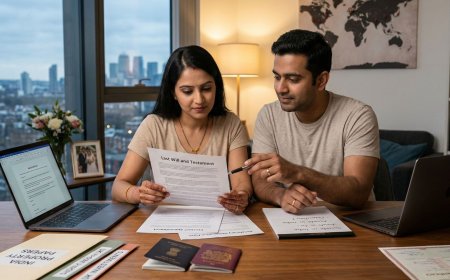
Most NRI couples discover too late that a religious wedding ceremony in India does not automatically produce a legally recognised marriage certificate — and that without one, visa applications, immigration processes, name changes, and dozens of other administrative requirements become significantly more complicated. This complete legal guide breaks down everything NRI couples need to know about marriage registration in India — covering the Hindu Marriage Act, the Special Marriage Act, and the Foreign Marriage Act, the step-by-step registration process, NRI-specific complications, apostille requirements, and the common mistakes that cause costly delays for couples living abroad.

The Certificate You Did Not Know You Needed Until You Did
The wedding is over.
The photographs are being edited somewhere in a studio in Mumbai. The guests have returned to their respective cities and countries. The families are slowly returning to the rhythm of ordinary life, still warm from the celebration, still processing the beautiful weight of what happened over those three extraordinary days.
You are back in London. Or Toronto. Or Dubai. Or Sydney. Back at your desk, back in your routine, back in the life you built abroad — except now you are building it together, as a married couple, with a future that has a different shape than it did three weeks ago.
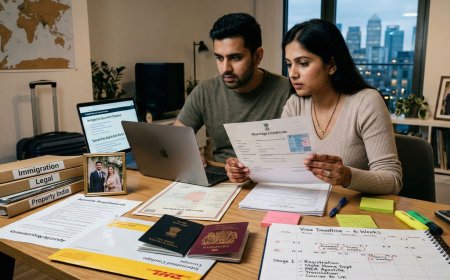
And then the letter arrives. Or the form. Or the HR email from your company asking for your marriage certificate for the dependent visa application. Or the bank that needs proof of marriage to update the joint account. Or the immigration lawyer who explains, with the particular calm of someone who has delivered this news many times before, that the beautiful wedding you had — the ceremony, the rituals, the pandit, the pheras, the families, the photographs — does not, by itself, constitute legal marriage in the jurisdiction where you now live.
You need a certificate.
Not the decorative one the pandit gave you. Not the beautifully designed wedding souvenir that your family had printed with your names and the date. A legal marriage certificate — issued by the Indian government, bearing an official seal, recognised by the international authorities who will be making decisions about your visa applications, your immigration status, your insurance beneficiaries, your joint property, and the dozens of other legal and administrative contexts where your marital status is not a personal fact but a documented one.
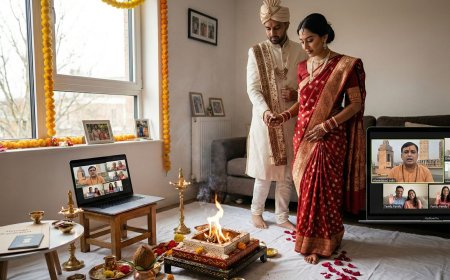
This is the moment most NRI couples discover that marriage registration in India is not automatic. That the ceremony and the legal record are two separate things. That the pheras are spiritually and personally binding but not administratively sufficient for the purposes of the British Home Office, the Canadian immigration authority, the UAE residency system, or the Australian Department of Home Affairs.
And it is, for many NRI couples, a moment of genuine surprise — because nobody in the wedding planning process thought to mention it. Not the pandit. Not the wedding planner. Not the parents who organised everything. Not the well-meaning relatives who had opinions about every other detail of the celebration.
This guide removes that surprise entirely.
It gives you the complete, current, honest picture of marriage registration in India for NRI couples — what the legal framework is, which acts apply to your situation, what the process involves, what documents are required, how long it takes, what happens when it goes wrong, and how to navigate the specific complexities that arise when one or both partners are resident abroad.
Because the certificate matters. In more contexts, with more consequences, than most couples realise until they need it.
And getting it right — early, correctly, with proper documentation — is one of the most practical acts of care you can give your marriage at the beginning of everything that follows.
The Core Reality: Why Marriage Registration Matters for NRI Couples
The Legal and Administrative Reality
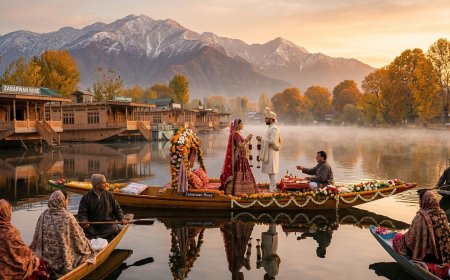
In India, religious wedding ceremonies — Hindu, Muslim, Christian, Sikh, or any other tradition — are recognised as valid marriages under the relevant personal law. But recognition as a valid marriage and possession of a registered marriage certificate are two different things.
A marriage certificate is the documentary proof of a legally registered marriage. It is issued by a government authority. It bears an official seal and registration number. And it is the document that virtually every international authority — immigration departments, embassies, consulates, employers, banks, insurance companies, and courts — requires when they need proof that two people are legally married.
Without a registered marriage certificate, NRI couples face recurring, significant administrative complications across the entire span of their married life together.
The Specific NRI Contexts Where the Certificate Is Required
Dependent Visa Applications When one partner joins the other abroad on a dependent or spouse visa — or when either partner applies for permanent residency or citizenship — a government-issued marriage certificate is a mandatory document. Photographs, wedding invitations, and the pandit's certificate do not substitute for it. They may be requested as supporting evidence. But the registered certificate is the primary document.
Immigration Status Updates Updating immigration records to reflect married status — changing visa categories, adding a spouse to residency applications, applying for family reunion — requires a registered marriage certificate in virtually every jurisdiction.
Name Change Applications For spouses who wish to change their name following marriage — updating passports, driving licences, bank accounts, professional registrations — a registered marriage certificate is the foundational document for every name change application in every country.
Joint Financial Accounts and Beneficiary Designations Banks, investment accounts, insurance policies, and pension funds in most countries require documentary proof of marriage to add a spouse as joint account holder or beneficiary. A registered marriage certificate is the standard required document.
Property and Inheritance Any legal matter involving jointly owned property, inheritance rights, or estate planning requires documented proof of marriage. In the absence of a registered certificate, establishing marital status in legal proceedings is significantly more complex and expensive.
Consular Registration Many NRI couples register their marriage with the Indian consulate or high commission in their country of residence — a process that requires a registered marriage certificate from India as its primary input document.
The Legal Framework: Which Act Applies to You
India has multiple legal frameworks for marriage registration — and which one applies to your situation depends on your religion, your community, and in some cases your personal preference.
The Hindu Marriage Act 1955
Applies to: Hindus, Buddhists, Jains, and Sikhs
The Hindu Marriage Act provides for the solemnisation and registration of marriages under Hindu personal law. Registration under this Act is handled at the state level — by the Sub-Divisional Magistrate or the Registrar of Hindu Marriages depending on the state.
Key features for NRI couples:
• The marriage must have been solemnised according to Hindu rites and ceremonies
• Registration can be done after the ceremony — there is no mandatory pre-registration requirement
• Both parties must personally appear before the registrar in most states
• Some states allow online application initiation with subsequent in-person appearance
The Special Marriage Act 1954
Applies to: All Indians regardless of religion — and the most commonly recommended option for NRI couples
The Special Marriage Act is a civil marriage act that applies to all Indian citizens regardless of religion, community, or personal law. It is the most internationally recognised form of Indian marriage registration and is strongly recommended for NRI couples for several reasons.
Why the Special Marriage Act is preferable for NRI couples:
• It produces a civil marriage certificate that is universally recognised internationally — more straightforwardly than religious act certificates in some jurisdictions
• It is not dependent on proof of religious ceremony — valuable for interfaith couples or couples whose ceremony documentation is incomplete
• The process is standardised across states — creating more predictable outcomes than the state-by-state variation of religious act registration
• It is the format most commonly accepted by foreign consulates and immigration authorities without question
The process under the Special Marriage Act:
The Special Marriage Act requires a notice of intended marriage to be filed with the Marriage Officer of the district where at least one party has resided for a minimum of thirty days. After a statutory waiting period — currently thirty days — during which the marriage can be objected to by any member of the public, the marriage is solemnised or registered by the Marriage Officer.
For couples who have already had a religious ceremony, the Special Marriage Act can be used to register an existing marriage through the certificate of marriage process — though the specific mechanism varies by state.
The Foreign Marriage Act 1969
Applies to: Indian citizens marrying abroad
For NRI couples whose marriage ceremony took place outside India — in the UK, USA, Canada, UAE, or Australia — the Foreign Marriage Act 1969 governs the registration of that marriage in Indian records.
Registration under this Act is handled through Indian Missions abroad — the Indian High Commission or Consulate in your country of residence. This process registers the foreign marriage in Indian government records and makes it officially recognised under Indian law.
When this Act is relevant:
• When the wedding ceremony took place abroad rather than in India
• When the couple wishes their foreign marriage to be recognised in Indian official records
• When one partner is an Indian citizen and the marriage needs to be recorded in Indian government databases
The Strategic Framework: Step-by-Step Registration Process
Step 1: Determine the Registering Authority in Your State
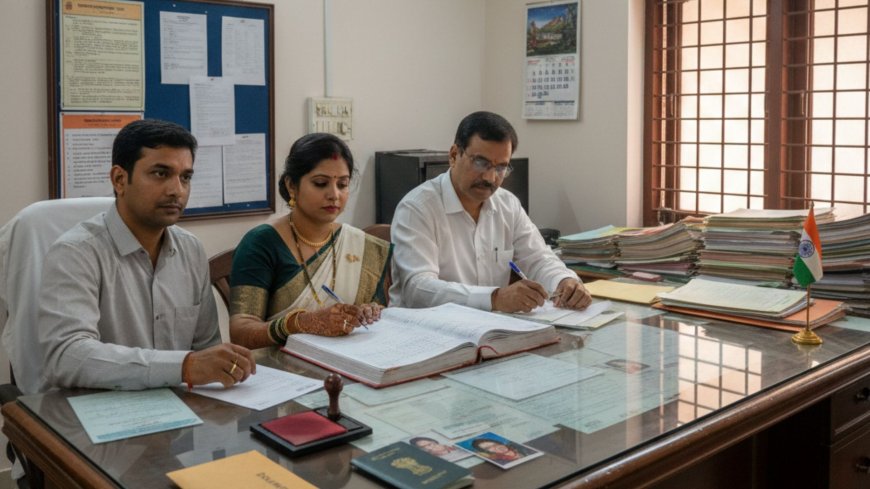
Marriage registration under the Hindu Marriage Act is administered at the state level. The registering authority varies by state — it may be the Sub-Divisional Magistrate, the District Registrar, the Sub-Registrar, or a specifically appointed Marriage Registrar. Identify the correct authority for the district where the marriage took place or where either party is domiciled.
Step 2: Gather Required Documents
• Completed application form — available from the registering authority or their website
• Age proof for both parties — passport, birth certificate, or school leaving certificate
• Address proof for both parties — Aadhaar card, passport, or utility bills
• Passport-sized photographs of both parties — typically four to six each
• Two witnesses with their identity and address proof documents
• Wedding photographs — typically two to four photographs from the ceremony
• The pandit's certificate or any ceremonial documentation from the wedding
• For NRI parties: valid passport and current visa documentation
Step 3: Submit Application
Applications can be submitted in person at the registering authority's office. Many states now allow online application initiation — check the specific state's official registration portal. Online initiation typically still requires in-person appearance for document verification and oath-taking.
Step 4: Verification and Appointment
The registering authority reviews submitted documents and schedules an appointment for in-person appearance. Both parties are typically required to appear in person. For NRI couples, timing this appearance around India visits requires advance planning — the appointment system does not always allow same-day or next-day scheduling.
Step 5: In-Person Appearance and Oath
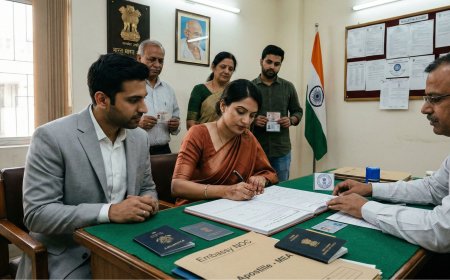
Both parties appear before the registering authority. The registrar verifies identity, confirms details, and records the marriage. Both parties sign the marriage register. Witnesses sign in their presence.
Step 6: Certificate Issuance
The marriage certificate is issued — either on the same day or within a specified processing period that varies by state. Some states issue the certificate immediately. Others have processing timelines of seven to thirty days.
Registration Under the Special Marriage Act — Step by Step
Step 1: File Notice of Intended Marriage
One or both parties must have resided in the district for at least thirty days before the notice can be filed. For NRI couples visiting India for the wedding, this thirty-day residency requirement is a significant logistical consideration — you must be in India for at least thirty days before the notice is filed, and the thirty-day notice period then runs from the filing date.
The notice is filed with the Marriage Officer of the relevant district. It is publicly displayed for thirty days — during which any person may raise an objection to the marriage.
Step 2: The Thirty-Day Notice Period
The marriage cannot be solemnised or registered under the Special Marriage Act until the thirty-day notice period has elapsed without upheld objection. This mandatory waiting period means that the complete process under the Special Marriage Act requires a minimum of sixty days from the initial thirty-day residency establishment — making it logistically challenging for NRI couples on short India visits.
Practical workaround for NRI couples: Many NRI couples who intend to use the Special Marriage Act begin the process during a pre-wedding visit to India — filing the notice during an earlier trip and completing the registration during the wedding visit. This requires advance planning but is entirely workable.
Step 3: Solemnisation or Registration
After the thirty-day notice period, the Marriage Officer solemnises the marriage or registers an existing marriage ceremony. Both parties and three witnesses must be present.
Step 4: Certificate Issuance
The Marriage Officer issues a marriage certificate under the Special Marriage Act. This certificate is internationally recognised and accepted by virtually all foreign authorities without additional verification requirements.
Registering a Foreign Marriage Under the Foreign Marriage Act — Step by Step
Step 1: Contact the Indian Mission in Your Country of Residence
The Indian High Commission or Consulate in your country of residence handles Foreign Marriage Act registrations. Contact them directly — procedures vary slightly by mission and are subject to periodic updates.
Step 2: Gather Required Documents
• Completed application form from the Indian Mission
• Proof of marriage in the country where the ceremony took place — a marriage certificate issued by the local authority
• Proof of Indian citizenship — passport
• Address proof in the country of residence
• Passport photographs
• Any supporting documents specified by the specific Mission
Step 3: Submit Application to the Indian Mission
Applications are submitted to the Indian Mission — either in person or by post depending on the Mission's current procedures. Many Indian Missions now handle routine consular services by post to reduce appointment requirements.
Step 4: Registration and Certificate
The Mission registers the marriage in Indian government records and issues a certificate of registration. The timeline varies by Mission — typically four to eight weeks from complete document submission.
NRI-Specific Complications and How to Navigate Them
The Thirty-Day Residency Requirement Under the Special Marriage Act
The most significant logistical challenge for NRI couples using the Special Marriage Act is the thirty-day residency requirement combined with the thirty-day notice period. Many NRI couples cannot spend sixty or more days continuously in India around the time of their wedding.
Navigation strategy:
• File the notice during a pre-wedding India visit — even a work trip or family visit that predates the wedding by two to three months
• Complete the registration process during the wedding visit itself — by which time the notice period will have elapsed
• Alternatively, use the Hindu Marriage Act for immediate post-wedding registration and subsequently obtain an additional Special Marriage Act registration if required by a specific authority
In-Person Appearance Requirements
Most registration processes require both parties to appear in person before the registering authority. For NRI couples who return abroad quickly after the wedding, scheduling this appearance requires either completing it before departure or making a return visit specifically for registration.
Navigation strategy:
• Build marriage registration into your India visit schedule — allow a specific day for the registration appointment rather than trying to fit it around other wedding events
• If both parties cannot appear together, consult with a local advocate about whether power of attorney arrangements are available for any portion of the process in your specific state and under the relevant act
Documents From Abroad
NRI parties typically need to present their passport as primary identity and address proof. For address proof in India — required by some registering authorities — parents' address or a family property address is generally acceptable with appropriate supporting documentation.
Navigation strategy:
• Carry certified copies of all international documents — passport, visa, overseas address proof
• Have documents apostilled if required — some Indian authorities request apostille certification on foreign documents
• Consult with a local advocate in advance to confirm exactly which documents the specific registering authority in your target district requires for NRI applicants
State-by-State Variation
Marriage registration in India is administered at the state level — and procedures, timelines, required documents, and fees vary significantly between states. What is straightforward in Maharashtra may be more complex in Uttar Pradesh or Rajasthan.
Navigation strategy:
• Research the specific procedures for the state where your marriage took place or where you intend to register — not generic India-wide information
• Engage a local advocate in that state who has current, specific knowledge of the registration process as it is actually administered — not as it theoretically should be
• Build more time buffer into your registration plan than you think you need — state-level bureaucratic timelines are frequently longer than officially stated
Common Mistakes NRI Couples Make With Marriage Registration
Assuming the Wedding Certificate From the Pandit Is Sufficient
The most common and most consequential mistake. The beautifully designed certificate provided by the pandit at the conclusion of the ceremony is a religious document — it is not a government-issued legal marriage certificate and it is not recognised as proof of marriage by most international authorities.
Correction: Treat the pandit's certificate as a ceremonial keepsake — which it is — and pursue formal government registration as a separate, essential process.
Leaving Registration Until It Is Urgently Needed
Many NRI couples deprioritise marriage registration in the weeks and months after the wedding — and discover its urgency only when a visa application, immigration process, or administrative requirement creates an immediate need. At this point, the couple is abroad, the registering authority is in India, and the urgency creates pressure that significantly complicates what should be a straightforward process.
Correction: Complete marriage registration during your India wedding visit or immediately after — before returning abroad. The process is significantly simpler when you are physically in India than when you are pursuing it remotely under deadline pressure.
Not Keeping Multiple Certified Copies of the Certificate
A single original marriage certificate, stored in one location, is a single point of failure. Marriage certificates are required for multiple simultaneous processes — visa applications, name changes, consular registration — and submitting the original to one authority while needing it for another creates significant logistical problems.
Correction: Obtain a minimum of five certified copies of the marriage certificate at the time of registration. Store originals and copies in separate secure locations — physical and digital. Scan all documents and store them in cloud storage accessible from abroad.
Not Apostilling the Certificate for International Use
Many international authorities — particularly in the UK, EU countries, and Australia — require Indian documents to be apostilled before they will accept them. An apostille is an internationally recognised certification that authenticates the document for use in countries that are signatories to the Hague Apostille Convention.
Without an apostille, an Indian marriage certificate may be rejected or require additional verification steps by foreign authorities — creating delays in time-sensitive processes.
Correction: After obtaining the marriage certificate, have it apostilled through the Ministry of External Affairs in India or through an authorised apostille service. This process is straightforward and relatively quick — and it future-proofs your certificate for use in any Hague Convention country.
Not Registering the Indian Marriage With Their Country of Residence
Many NRI couples obtain their Indian marriage certificate but do not take the additional step of registering or recording the marriage with their country of residence's relevant authority. In most Western countries, a foreign marriage is automatically legally recognised — but formally recording it with local authorities creates a domestic documentary record that simplifies future administrative processes.
Correction: After obtaining and apostilling the Indian marriage certificate, consult with a local solicitor, attorney, or immigration adviser about whether and how to formally record the marriage in your country of residence. This step varies by country — but in most cases it is simple, low-cost, and valuable.
The Emotional and Cultural Layer: The Certificate and What It Means
There is something worth saying about the relationship between the ceremony and the certificate — and why, for NRI couples especially, both matter.
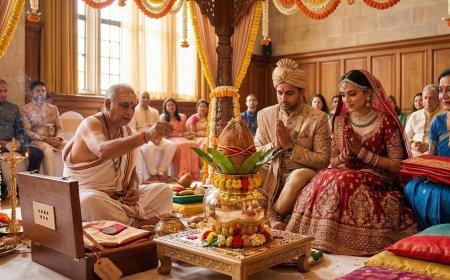
The ceremony is the expression. The pheras, the vows, the rituals, the fire, the witnesses, the blessings of two families — this is where the marriage becomes real in the ways that matter most. In the emotional truth of the commitment. In the spiritual dimension of the tradition. In the family and community witness of two people choosing each other.
The certificate is the protection. It is the document that ensures the legal systems of the countries where you live and the country of your origin recognise and protect your marriage — that it does not exist only in your hearts and in your family's memory, but in the official records of a state that has responsibilities to you as a married couple.
For NRI couples navigating life across two legal systems — the personal law of their Indian heritage and the civil law of their country of residence — having both the ceremony and the certificate is not a bureaucratic formality. It is the complete expression of a marriage that exists fully in both worlds.
The ceremony honours your tradition. The certificate protects your future.
Both deserve the care and attention you gave to every other aspect of your wedding.
Marriage Registration Checklist for NRI Couples
Before the Wedding
• Determine which registration act applies — Hindu Marriage Act, Special Marriage Act, or Foreign Marriage Act
• Research specific state procedures for the district where the wedding will take place
• If using Special Marriage Act, initiate thirty-day residency and notice process in advance
• Identify local advocate in the wedding district for registration assistance
• Confirm required documents for NRI applicants with the specific registering authority
During the India Wedding Visit
• Build a specific registration appointment day into the India visit schedule
• Carry all required documents — originals and certified copies
• Complete registration in person if possible — before returning abroad
• Obtain minimum five certified copies of the certificate at registration
Immediately After Registration
• Apostille the marriage certificate through MEA or authorised apostille service
• Scan and store all certificates and copies in cloud storage
• Distribute copies to secure storage locations — physical and digital
• Register marriage with Indian consulate in country of residence if applicable
Post-Registration Administrative Actions
• Submit marriage certificate for spouse visa or dependent visa applications if applicable
• Update insurance beneficiaries and investment account nominations
• Initiate name change process if applicable — using registered certificate as primary document
• Consult local solicitor about formally recording Indian marriage in country of residence
• Store apostilled original in secure, fire-safe location
The Document That Completes the Marriage
The wedding ceremony was the beginning. The moments of it will live in your memory and in your family's story for generations.
The marriage certificate is the continuation — the legal foundation that ensures your marriage is recognised, protected, and documented in every context where your life together will unfold. The visa applications and the immigration processes and the financial accounts and the property decisions and the dozen other contexts, large and small, where the question of whether you are legally married will be asked and where the answer will need to be more than a memory.
Get the certificate. Get it correctly. Get it early. Apostille it. Keep copies. And then file it away in the secure location it deserves — because you will need it, at various points across the entire span of your married life, in ways you cannot fully anticipate from where you stand right now.
The ceremony said yes. The certificate records it. Both are essential. Both deserve the same care.
Your marriage deserves to exist fully — in the tradition that celebrated it, in the hearts of the people who witnessed it, and in the legal records of the countries that will govern it.
All three. Completely. From the beginning.
Published by NRIWedding.com — The Premium Global Platform for Non-Resident Indians Planning Indian Weddings From Abroad.
What's Your Reaction?
 Like
0
Like
0
 Dislike
0
Dislike
0
 Love
0
Love
0
 Funny
0
Funny
0
 Angry
0
Angry
0
 Sad
0
Sad
0
 Wow
0
Wow
0