





































































The Biye Explained: The Modern NRI Couple's Complete Guide to Bengali Wedding Rituals and Traditions
The Bengali Hindu wedding — with its Saat Paak, Subho Drishti, Sampradaan, Shankha and Paula, Alta, Mukut, and the specific sound of the Dhak — is one of India's most ritual-rich and aesthetically distinctive wedding traditions. For NRI Bengali couples who carry this heritage at a distance and want to inhabit it fully rather than perform it partially, this guide delivers a complete explanation of every ceremony from the Aiburo Bhat and Gaye Holud through the wedding day rituals and post-wedding customs, with the aesthetic traditions, the planning challenges specific to NRI families, the Pandit sourcing guidance, and the ritual object preparation that allows the Bengali wedding to be genuinely and completely itself.


Bengali Wedding Rituals Explained for the Modern NRI Couple
A complete guide to understanding, planning, and genuinely inhabiting the extraordinary ritual world of the Bengali wedding — for NRI couples who carry this heritage at a distance and want to bring it home
The Wedding That Arrived in Pieces
The knowledge had come in fragments across her childhood. The conch shell that her mother kept in the prayer room and would not explain beyond saying it was important. The specific way her grandmother applied sindoor — not at the hairline exactly but in a specific gesture that she had never seen replicated elsewhere. The word Saat Paak, overheard at a family gathering when she was twelve and understood only years later as the seven circles that would constitute her own marriage when that time came.
She had grown up in Melbourne. Her Bengali was functional but not fluent. Her relationship to the specific ritual world of the Bengali Hindu wedding — its extraordinary sequence of ceremonies, its specific symbolic vocabulary, its particular quality of aesthetic beauty that is unlike any other Indian regional wedding tradition — was real but partial. She knew it was hers. She did not entirely know what it was.
The engagement was to a Bengali man from a family in Kolkata whose grandmother had very specific opinions about how the wedding should be conducted, and whose mother had sent a voice note of twelve minutes in rapid Bangla that the bride had played three times and understood approximately forty percent of.
What the bride needed — and what this guide provides — is a complete understanding of what the Bengali wedding actually is: its specific ceremonies, their sequence, their meaning, the specific aesthetic traditions that make it visually unlike any other Indian wedding, and the planning knowledge that allows an NRI couple to inhabit this tradition with genuine understanding rather than performed compliance.
Understanding the Bengali Wedding: The Philosophical Foundation
The Bengali Hindu wedding — the Biye in its everyday name, the Vivah in its formal Sanskrit — is one of the most ritual-rich and aesthetically distinctive wedding traditions in India. Its specific character emerges from the convergence of several elements: the deep Shakta tradition of Bengali Hinduism, in which the divine feminine — Durga, Lakshmi, Saraswati — is the primary form of the divine; the specific Bengali aesthetic sensibility that has produced one of India's great literary and artistic traditions; and the particular social and family structure of Bengali Hindu society, in which the extended family — the parivaar — is the primary unit of social identity.
The Bengali wedding's rituals are dense with meaning that operates simultaneously at multiple levels — the personal and the cosmic, the familial and the social, the practical and the spiritual. Understanding this multi-layered quality is the key to experiencing the rituals as more than a sequence of actions to be correctly performed.
The specific aesthetic of the Bengali wedding — the red and white of the bride's saree, the Shankha and Paula bangles, the Alta on the feet, the specific form of the Mukut worn by both bride and groom, the Dhak drums whose specific sound is inseparable from the Bengali wedding experience — is not decorative tradition. It is a visual language whose specific elements carry specific meaning within the Bengali cultural and spiritual framework.
The Pre-Wedding Rituals: The Days Before the Wedding
Adan Pradan — The Exchange of Gifts
The formal pre-wedding process begins with the Adan Pradan — the exchange of gifts between the two families, typically conducted at a formal family gathering attended by the senior members of both families.
The gifts exchanged reflect the specific conventions of Bengali wedding tradition — specific items that are part of the traditional exchange and that carry specific meaning within the family relationship being established. The saris sent from the groom's family to the bride, the specific sweets prepared according to family tradition, the fish — which carries specific auspicious significance in Bengali culture as a symbol of fertility and prosperity — that appears in virtually every pre-wedding Bengali exchange.
For NRI families, the Adan Pradan is often combined with a broader family gathering during the India visit rather than conducted as a standalone event — a practical adaptation that maintains the exchange tradition within a logistically manageable framework.
Aiburo Bhat — The Bachelor's Last Meal
The Aiburo Bhat — literally "the unmarried person's meal" — is one of the most specifically Bengali of all the pre-wedding ceremonies. On the day before the wedding, both the bride and the groom are hosted by their respective families for a special meal — a last ritual meal as an unmarried person within the family home. The meal is elaborate, prepared with specific dishes that are part of the tradition, and is attended by the close family members and the special friends whose relationship to the bride or groom is being specifically marked by this occasion.
The Aiburo Bhat has a specific emotional quality that is distinct from the celebratory energy of the sangeet or the ritual seriousness of the ceremony — it is a moment of intentional family intimacy, a gathering that acknowledges what is ending rather than only celebrating what is beginning.
For NRI brides and grooms who live at a distance from their family for most of the year, the Aiburo Bhat has an additional emotional dimension — the specific intimacy of being gathered for a family meal in the specific way that distance has made rare, and the awareness that after the wedding the nature of this specific family gathering changes.
Gaye Holud — The Turmeric Ceremony
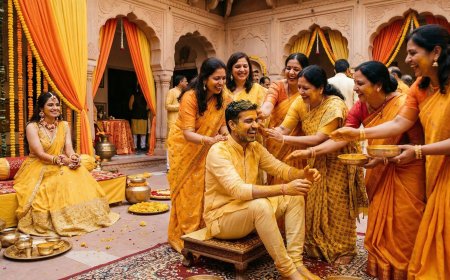
The Gaye Holud — literally "yellow on the body" — is the Bengali equivalent of the haldi ceremony, but with specific Bengali characteristics that make it distinct from its counterparts in other Indian regional traditions.
The Gaye Holud is typically conducted as two separate events — one at the bride's family home and one at the groom's family home, sometimes on the same day and sometimes on consecutive days. The specific Bengali tradition involves the exchange of the turmeric paste between the two families — the bride's family sends turmeric paste to be applied to the groom, and the groom's family sends turmeric paste to be applied to the bride, so that both are marked with the other family's blessing before the wedding day.
The Gaye Holud is also the occasion for the most vibrant and visually festive of the Bengali pre-wedding photography — the yellow of the turmeric against the specific Bengali wedding colors of red and white, the mustard yellow sarees traditionally worn by women at this event, and the specific aesthetic of the Bengali Gaye Holud create one of the most visually distinctive pre-wedding events in any Indian regional tradition.
The specific songs sung at the Gaye Holud — the Biye Bari songs that are specific to the Bengali wedding tradition — are one of the most important musical elements of the Bengali wedding experience. These songs, which narrate the emotional journey of the bride and her family through the wedding, are sung by the women of the family and carry a quality of folk tradition that formal musical performance cannot replicate. For NRI families who want to preserve this specific tradition, identifying the older women in the family who know the songs and organizing a moment for their singing at the Gaye Holud is one of the most culturally significant preservation acts available.
Dodhi Mangal — The Auspicious Dawn
The Dodhi Mangal is the early morning ritual that begins the wedding day — a gathering of close female family members at dawn for prayers, the distribution of sweets and yogurt, and the specific rituals that mark the auspicious beginning of the most significant day.
The Dodhi Mangal requires the specific early morning timing that its name describes — the "auspicious dawn" is not a figurative description but a literal requirement. The gathering happens before the full household is awake, in the specific quality of early morning light that is both practically and symbolically different from the light of the day that follows.
For NRI families managing the logistics of a wedding day that begins with a ceremony, the Dodhi Mangal requires specific advance planning — the gathering arranged, the sweets prepared, the family members who will attend confirmed the evening before.
The Wedding Ceremony: The Heart of the Bengali Biye
The Arrival of the Groom — Boron and Saat Paak
The Bengali wedding ceremony begins with the arrival of the groom — accompanied by his family — at the wedding venue. Before the ceremony proper begins, the bride's mother performs the Boron — a formal welcome ritual in which she receives the groom with a specific set of ritual actions: the placing of a tilak on his forehead, the circling of a conch shell around his head, the offering of specific auspicious items that are part of the Boron ritual.
The Saat Paak — the seven circles — is the moment that most distinctively marks the beginning of the Bengali wedding ceremony. The bride is carried on a wooden seat — the Piri — by her brothers, and she circles the seated groom seven times while covering her face with two betel leaves. The seven circles are completed while the Conch shell is blown and the Ululation — the Ululu sound produced by the women of the family — fills the ceremony space with the specific sonic signature of the Bengali wedding moment.
The Saat Paak is the Bengali wedding's most immediately recognizable visual and sonic element — and the element that most clearly distinguishes the Bengali ceremony from all other Indian regional wedding traditions. The bride elevated on the wooden seat, carried by her brothers, circling the groom while covering her face with betel leaves, surrounded by the ululation and the conch sound — this image is specifically and exclusively Bengali.
Subho Drishti — The Auspicious Gaze
After the Saat Paak, the bride lowers the betel leaves and the bride and groom see each other for the first time in the ceremony — the Subho Drishti, the auspicious gaze. In the traditional convention, this is understood as the couple's first direct gaze at each other in the ceremonial context — the moment at which they are first present to each other as bride and groom rather than as the individuals they were before the ceremony began.
The Subho Drishti is accompanied by the exchange of flower garlands — the Mala Badal — in which the bride and groom exchange garlands multiple times, with the family members playfully lifting the bride on the Piri to make the garland exchange more challenging for the groom. This element of playful difficulty — the family's gentle obstruction of the garland exchange, the groom's persistence in completing it — is one of the most joyful and most photogenic moments in the Bengali ceremony.
Sampradaan — The Giving Away
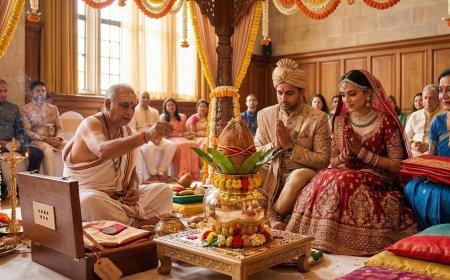
The Sampradaan is the central ritual of the Bengali wedding ceremony — the moment at which the bride's father formally gives his daughter to the groom, placing her hand in the groom's hand as the Pandit recites the specific Sanskrit verses of this most solemn ceremony moment.
The Sampradaan is accompanied by specific ritual actions: the bride's father pouring water over the joined hands of the bride and groom, the sacred thread being used to join their hands, and the specific Sanskrit mantras that constitute the formal giving and receiving of the bride. It is the moment of the ceremony's greatest emotional weight — the moment that the bride's family experiences most intensely as an ending, and the groom's family receives most deeply as a beginning.
For NRI brides whose relationship with their father carries the specific dimension of the NRI family's long-distance love — the years of sacrifice, the phone calls across time zones, the visits that were never quite long enough — the Sampradaan is often the ceremony's most emotionally overwhelming moment.
Yagna and Saat Paak — The Sacred Fire Ceremony
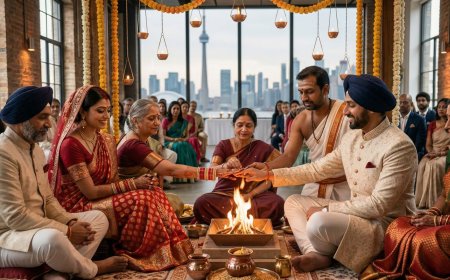
After the Sampradaan, the fire ceremony — the Yagna — begins. The sacred fire is lit and the bride and groom perform rituals around it, including the specific Bengali version of the Saptapadi — the seven steps taken together with the bride's right foot on a grinding stone at each step, taking the seven vows that constitute the marriage in the Vedic tradition.
The Bengali Saptapadi has its own specific form — different from the North Indian version in specific details of the steps, the vows, and the ritual actions that accompany each step — and the Pandit who conducts it should be specifically familiar with the Bengali ritual tradition rather than a generic North Indian ceremony specialist.
The fire ceremony also includes the Anjali — the offering of puffed rice into the sacred fire by the bride, with the groom's hands covering hers — and the specific ritual actions that are the Vedic ceremony's expression of the couple's commitment to each other and to the sacred fire as witness.
Sindoor Daan — The Application of Sindoor
The Sindoor Daan — the application of sindoor to the bride's hair parting by the groom — is the ceremonial moment that constitutes the marriage in the Hindu tradition and that is, in the Bengali context, an act of specific cultural and spiritual significance.
The Bengali Sindoor Daan has its own specific character. The sindoor is applied with the groom's right ring finger, in the specific gesture that the Pandit directs, at the bride's hair parting. The moment is accompanied by the blowing of the conch and the Ululation from the women of the family — the specific Bengali sonic celebration of the marriage's completion.
The sindoor that the bride wears from this moment forward — applied every morning as an act of daily renewal of the marital commitment — is one of the most visible and most continuous expressions of Bengali married identity. For NRI brides who will be wearing sindoor in countries where it is not familiar to the majority population, the decision about daily sindoor application is a personal one that many NRI Bengali women navigate in their own specific way.
Shubho Drishti — The Exchange of Garlands Revisited
After the Sindoor Daan, the newly married couple performs a second exchange of garlands — the Mala Badal after the marriage is constituted — that has a different quality from the first exchange at the beginning of the ceremony. This exchange is between two people who are now married, and the specific difference in its emotional register is palpable to anyone present who understands what has just occurred.
The Post-Wedding Rituals: The Customs That Close the Bengali Wedding
Bou Bhat — The New Bride's Rice Ceremony
The Bou Bhat — literally "bride's rice" — is the first formal event in the groom's home after the wedding, typically conducted the day after or several days after the wedding ceremony. The new bride cooks rice — or participates in a ritual that enacts her cooking — for the assembled family, an act that symbolizes her formal entry into the groom's family and her assumption of the specific role that Bengali family culture assigns to the daughter-in-law.
The Bou Bhat is accompanied by the new bride's formal introduction to the groom's extended family — the specific ritual of touching the feet of elders and receiving their blessings, the gifts presented by each family member to the new bride, and the specific meal that is the occasion's centerpiece.
For NRI couples whose post-wedding schedule does not allow for the traditional Bou Bhat timing, the ceremony can be adapted — conducted before the couple returns abroad, or celebrated in the diaspora city with the family members who are present there.
Phool Shajya — The Flower Bed
The Phool Shajya — the flower bed — is the ritual preparation of the couple's first shared night, in which the bedroom is decorated with flowers and the family observes specific rituals of blessing. It is a ceremony that is simultaneously intimate and communal — the family's collective blessing on the couple's private life together.
Bou Dibbi — Showing the New Bride
The Bou Dibbi — the ritual "showing" of the new bride to the sun, to the domestic objects of the new home, and to the neighbors and community — is the ceremony of formal introduction of the new family member to all the elements of the world she is now entering.
The Specific Aesthetic of the Bengali Wedding
The Bride's Saree and Jewelry
The Bengali bridal aesthetic is among the most specifically distinctive in any Indian regional tradition — the combination of the red and white Benarasi saree, the Shankha and Paula bangles, the specific forms of the jewelry, and the Alta on the feet creates a visual identity that is immediately and unmistakably Bengali.
The Shankha and Paula bangles — the white conch shell bangles and the red coral bangles worn by married Bengali Hindu women — are the most specifically Bengali of all the bridal accessories. They are worn together, alternating, and their specific combination — white and red, the colors of purity and auspiciousness in Bengali tradition — is the most visible marker of the Bengali married woman's status.
The Loha — the iron bangle that completes the set of three — is added after the Shankha and Paula and represents the strength and permanence of the marriage.
The Alta — the natural red dye applied to the feet in specific patterns — is one of the most beautiful and most specifically Bengali elements of the bridal aesthetic. The Alta's dark red patterns on the feet of the bride create a visual quality that is unlike anything in other Indian regional bridal traditions.
The Mukut — the tall, ornate headdress worn by both bride and groom during the ceremony — is the most visually distinctive element of the Bengali ceremony aesthetic. The Mukut is made of shola — the white sponge-wood that is the material of traditional Bengali ceremonial craft — and its specific form, decorated with foil and specific ornamental elements, creates the silhouette that is most closely associated with the Bengali wedding ceremony.
The Dhak
The Dhak — the large drum whose specific sound is inseparable from the Bengali wedding, Durga Puja, and the larger Bengali ceremonial life — is the auditory centerpiece of the Bengali wedding experience. The Dhak player — the Dhaki — whose instrument produces the specific rhythmic patterns that mark each phase of the ceremony, whose playing escalates at specific ceremonial moments and quiets at others, is one of the most important wedding vendors for any Bengali wedding that wishes to maintain the specific sensory world of the tradition.
For NRI weddings taking place in India, sourcing a skilled Dhaki is straightforward. For NRI Bengali weddings taking place in diaspora cities — where the Bengali wedding tradition is being practiced outside its native context — finding a Dhaki may require specific community searching but is worth the effort for the specific quality of authenticity that the Dhak brings to the ceremony.
The Shankha and Ululu
The blowing of the conch shell — the Shankha — at specific ceremony moments, and the Ululation — the Ululu sound produced by the women of the family — are the sonic markers of the Bengali ceremony that are most immediately recognizable and most emotionally charged for Bengali families.
The Ululu is not a performer's art — it is a collective expression produced by the women of the family, often spontaneously at specific ceremony moments, that signals the auspiciousness of the moment and the family's collective joy. It cannot be planned in the sense that other ceremony elements are planned — it arises from the family's genuine engagement with the ceremony. But it can be encouraged, by ensuring that the family members who know the tradition are present and by creating ceremony conditions in which the spontaneous expression can arise.
Planning the Bengali Wedding from Abroad: The Specific Challenges
Finding the Right Pandit
The Bengali Vedic ceremony requires a Pandit who is specifically trained in the Bengali ritual tradition — not simply a North Indian ceremony specialist who is willing to conduct a Bengali ceremony. The specific mantras, the specific ritual sequence, the specific form of each ceremony element in the Bengali tradition are different from their North Indian equivalents, and a Pandit without specific Bengali training produces a ceremony that is technically conducted but not specifically Bengali in its ritual character.
For NRI families planning a wedding in India, the Pandit search should be conducted through family networks and specifically within the Bengali community — asking for recommendations from families who have recently conducted Bengali weddings rather than simply booking through a general wedding vendor network.
For NRI Bengali weddings taking place outside India, finding a Bengali Pandit may be the most logistically challenging vendor search of the entire planning process, and may require either flying a Pandit from another city or country, or identifying a Bengali community in the wedding location that has a Pandit connection.
The Ritual Knowledge Gap
The NRI Bengali family's relationship to the specific ritual knowledge of the Bengali wedding is often partial — the older generation knows what was done at their own weddings and has general knowledge of the tradition, but the specific Sanskrit mantras, the specific sequence of each ritual, and the specific objects required for each ceremony are knowledge that was traditionally held by the Pandit and the ritual specialists rather than by the family.
For NRI families planning from abroad, the most important preparatory step is a series of conversations with the family's Pandit — asking specifically what is required for each ceremony, what objects must be gathered and when, what the family's specific role is at each stage, and what the specific timing of each ceremony element is.
A written ceremony brief — produced in collaboration with the Pandit and distributed to all family members who have specific roles in the ceremony — is the most effective planning document for managing the Bengali wedding's ritual complexity across a family group that may not share complete ritual knowledge.
The Objects and Materials
The Bengali wedding requires specific objects for each ceremony — objects that must be sourced in advance and that may not be available or easily sourced outside India. The specific items of the Shankha and Paula sourced from Bengal, the Mukut made of shola, the specific sweets prepared according to family tradition, the specific saree for the Gaye Holud, the Alta for the bride's feet — each of these requires specific sourcing that must be planned before the India visit rather than assumed to be available on arrival.
For families planning their wedding in Bengal, the sourcing of these items is integrated into the natural commerce of Bengali society — the specific shops and craftspeople who produce them are part of the community's fabric. For families planning elsewhere in India or outside India, specific sourcing must be planned explicitly.
The Specific Joy of the Bengali Wedding
The Bengali wedding has a specific emotional quality that is unlike any other Indian regional wedding tradition — a combination of deep ritual seriousness and specific Bengali aestheticism, of communal joy and individual emotional depth, that produces an experience of extraordinary richness.
The Ululu that erupts from the assembled women at the moment of the Subho Drishti. The Dhak that changes the atmosphere of the entire gathering when it begins. The specific beauty of the bride in her Benarasi and Mukut and Alta — a visual that is as much an aesthetic achievement as it is a personal one. The Sampradaan's specific quality of gravity — a father's tears, a daughter's stillness, a ceremony that has been enacted in the same form across generations of the same family.
For NRI couples who have grown up carrying this tradition at a distance — who know it in fragments and feel it as a birthright and understand it imperfectly and love it completely — the Bengali wedding is the opportunity to know it whole. To understand what each ceremony is doing, what each object signifies, what each moment means within the larger ritual framework that the wedding creates.
The knowledge in this guide is not the wedding. It is the preparation that allows the wedding's specific joy to be genuinely inhabited rather than only correctly performed.
Learn the tradition. Inhabit it fully. And let the Dhak begin.
NRIWedding.com — Expert guidance for Indian weddings planned across borders.
What's Your Reaction?
 Like
0
Like
0
 Dislike
0
Dislike
0
 Love
0
Love
0
 Funny
0
Funny
0
 Angry
0
Angry
0
 Sad
0
Sad
0
 Wow
0
Wow
0