










































































Every Guest Deserves a Full Plate: The NRI Couple's Complete Guide to Managing Dietary Restrictions at Indian Weddings
A guest who flew seven hours to attend your wedding should not spend the dinner service eating fruit because nobody asked about her celiac disease. Dietary restriction management at Indian weddings — across vegan, gluten-free, nut allergy, halal, Jain, and kosher requirements — demands a system, not a gesture. This guide gives NRI couples a complete framework covering data collection, caterer briefing, kitchen management protocols, buffet labeling systems, and the personal communication that transforms logistical provision into genuine hospitality. Every guest at your wedding deserves to eat safely, abundantly, and without having to ask awkward questions at the buffet.

The Guest Who Did Not Eat Anything
She had flown from Stockholm for the wedding. Seven hours, a connection through Dubai, and three days of leave from a job she could not easily take time away from. She had known the couple for eleven years — one of those friendships that survive distance and time zones and the gradual divergence of adult lives because the foundation was built well enough to hold.
She was also severely celiac. Not intolerant in the manageable, flexible sense — celiac in the medically serious sense where cross-contamination from shared cooking surfaces and utensils could make her genuinely unwell for days.
Nobody had asked. The couple had not thought to include dietary requirements on the RSVP. The caterer had not been briefed. And when she arrived at the wedding buffet — the beautiful, abundant, carefully planned wedding buffet — she found that almost nothing on the table was safe for her to eat with any confidence, because even the dishes that contained no gluten had been prepared in a kitchen where wheat flour moved freely through everything else.
She ate the fruit. She smiled through the dinner service. She danced at the reception and told the couple it was a wonderful wedding. She did not mention any of it until a year later, over a phone call where they were catching up and somehow the subject arose.
This is not a story about negligence. The couple had not known. The caterer had not been asked. The guest had not wanted to be difficult. Every person in this story had good intentions.
But good intentions did not give her a meal at a wedding she had traveled seven hours to attend.
Dietary restriction management at Indian weddings — at any large-scale event where food is central to the experience and where guests come from multiple cultural backgrounds with multiple relationships to food — is not a courtesy. It is a fundamental act of hospitality. It is the decision to treat every guest's ability to eat safely and well as a non-negotiable element of the planning process rather than an afterthought addressed when someone mentions it close enough to the date.
This guide gives you the system to ensure that nobody who attends your wedding goes hungry because you did not ask the right questions early enough.
Why Dietary Management Is More Complex at Indian Weddings
For NRI couples planning Indian weddings, the dietary management challenge is layered in ways that make it more complex than a standard event catering conversation.
Indian cuisine uses a wide range of ingredients that are common dietary restriction triggers — wheat flour in most breads and many preparations, dairy products in sauces, curries, and sweets, nuts in biryanis, curries, desserts, and garnishes, and shellfish in coastal preparations. The richness and complexity of Indian cooking — the very qualities that make it extraordinary — also create multiple potential points of contact with common allergens and dietary exclusions.
The multi-event structure of Indian weddings means dietary requirements need to be managed across four or five separate menus rather than a single meal. A guest who cannot eat gluten needs safe options at the mehendi lunch, the haldi breakfast, the sangeet dinner, and the wedding reception — not just at one carefully managed meal.
The kitchen infrastructure at large-scale Indian wedding catering — high-volume production, shared cooking surfaces, multiple preparations happening simultaneously — creates genuine cross-contamination risk that requires active management rather than passive menu labeling. A dish that contains no gluten as formulated may not be safe for a celiac guest if it was prepared on a surface where wheat flour was used earlier in the day.
And the guest demographic at NRI weddings is specifically diverse in ways that create a wider range of dietary requirements than a homogenous guest list would. International guests bring different dietary practices — veganism is significantly more common among British and American guests than among Indian guests of the same generation. Muslim guests have halal requirements. Jain guests have specific restrictions that go beyond vegetarianism. Jewish guests may have kosher considerations. Guests with serious allergies may come from backgrounds where the particular allergen is unusual in their native cuisine but common in Indian cooking.
Managing this complexity requires a system. Not a gesture — a system.
The Data Collection Problem: You Cannot Manage What You Have Not Asked
The most common dietary restriction management failure at Indian weddings is not a catering failure. It is a data collection failure. The dietary information was never gathered, so the caterer was never briefed, so the provisions were never made.
The solution is simple but requires earlier action than most couples take: include a dietary requirements question in your RSVP process and collect that information before the caterer finalizes the menu.
The RSVP Question That Works
The difference between a useful dietary restriction question and an unhelpful one is specificity. A question that asks "do you have any dietary requirements?" produces vague answers — "I don't eat much red meat" or "I try to avoid carbs" — that are preferences rather than requirements and that do not give your caterer actionable information.
A question that provides specific categories and asks for detail produces useful data.
Your RSVP dietary question should include: a yes/no question about whether the guest has any dietary requirements, followed if yes by a checklist of specific categories — vegetarian, vegan, gluten-free, nut allergy, dairy-free, halal, Jain, other — and a free-text field for the guest to provide additional detail, including the severity of their restriction for allergies.
Collect this information at least eight weeks before the wedding. This gives you time to analyze what you have received, brief your caterer with specific requirements, and follow up with guests whose responses require clarification.
Follow up directly with guests who have flagged serious allergies. A guest who marks "nut allergy" on an RSVP needs a personal conversation — you need to understand whether this is a preference-level sensitivity or an anaphylaxis-risk allergy, because those two scenarios require completely different catering responses.
Understanding the Restriction Categories: What Each Actually Requires
Veganism at Indian Weddings
Veganism requires the complete absence of all animal products — not just meat and fish, but dairy, eggs, honey, and any ingredient derived from an animal source. This is a more restrictive category than vegetarianism in ways that create specific challenges at Indian weddings, where dairy is woven deeply into the culinary tradition.
Ghee — clarified butter used for tempering, cooking, and finishing — is present in many Indian preparations including dishes that are otherwise plant-based. Yogurt marinades appear in vegetarian preparations as well as meat dishes. Paneer is dairy by definition. Many Indian sweets are built primarily on milk solids. The standard Indian wedding vegetarian menu, which would appear suitable for vegans at a glance, contains dairy at almost every point.
Managing veganism at your wedding requires identifying which dishes are genuinely vegan as formulated, substituting ghee with oil in preparations where that substitution does not fundamentally compromise the dish, and ensuring that vegan guests can identify safe options clearly at the buffet.
For vegan guests, the most important provision is not a token vegan dish added as an afterthought — it is a sufficient range of genuinely vegan options that allows a vegan guest to eat a complete, satisfying meal rather than assembling a plate from marginal items. Two substantial vegan mains, a vegan dal preparation, a vegan rice option, and a vegan dessert constitute a reasonable minimum for a wedding where vegan guests are present.
Communicate with vegan guests in advance about which items will be clearly labeled and which items they should approach with questions. This personal communication transforms a logistical provision into an act of genuine hospitality — the guest knows they were thought about.
Gluten-Free Requirements
Gluten is present in wheat, barley, rye, and derivatives of these grains. At an Indian wedding, this means: all wheat-based breads including naan, roti, paratha, and puri; preparations thickened with wheat flour; some prepared spice mixes that use wheat flour as a filler; and anything prepared in a kitchen environment with significant cross-contamination risk from wheat flour.
The distinction that matters most for Indian wedding management is the difference between preference-level gluten avoidance — where cross-contamination is not a significant concern — and medically necessary gluten-free eating for celiac disease — where cross-contamination from shared surfaces and utensils can trigger a serious physical response.
For preference-level gluten-free guests: identify and clearly label naturally gluten-free dishes on the menu. Most Indian rice dishes, most dal preparations, most vegetable-based curries, and most meat preparations are naturally gluten-free when made without wheat-based thickeners. A clear labeling system allows these guests to navigate the buffet confidently without needing to avoid the entire spread.
For celiac guests: the requirement goes beyond menu composition to kitchen management. Dedicated cooking surfaces, utensils, and preparation areas that have not come into contact with wheat are required for genuine celiac safety. This is a conversation that needs to happen with your caterer specifically and directly — not as a menu note but as a kitchen management brief. Some caterers have protocols for this. Others do not have the infrastructure to guarantee cross-contamination prevention in a high-volume wedding kitchen. Knowing which situation you are in before the wedding — not on the day — allows you to make appropriate provisions, including potentially sourcing specific dishes for celiac guests from a specialist provider if your main caterer cannot guarantee safety.
Nut Allergies
Nut allergies represent the highest-stakes dietary restriction category in terms of potential medical consequence. A severe nut allergy can produce anaphylaxis — a life-threatening allergic response that requires emergency intervention. Managing this at a large Indian wedding, where nuts appear extensively across the menu in multiple forms, requires specific and serious attention.
Tree nuts — almonds, cashews, pistachios — appear in biryanis, kormas, desserts, and garnishes across Indian cuisine. Peanuts, which are technically legumes but managed as tree nut allergies in terms of cross-reactivity risk for many allergy sufferers, appear in South Indian preparations, chutneys, and some regional dishes.
For guests with serious nut allergies, the provisions required are: a complete list of every dish on the menu that contains nuts in any form, clear labeling at the buffet identifying nut-containing dishes, a personal conversation with the guest to identify which specific nuts are the allergen and at what exposure level — ingestion, contact, or airborne — the allergy is triggered, and if the guest has an epinephrine auto-injector, confirmation with the venue and your coordinator that there is a designated safe space and that the venue is aware of the guest's medical requirement.
For anaphylaxis-risk nut allergy guests, providing a completely separate, guaranteed nut-free meal sourced from a dedicated preparation environment is the only genuinely safe provision. This is not excessive — it is appropriate management of a potentially life-threatening medical situation.
Halal Requirements
Halal requirements affect the sourcing and preparation of meat specifically — the animal must be slaughtered in the prescribed manner and blessed according to Islamic religious requirements. It does not restrict vegetarian food, so vegetarian dishes on the menu are halal-compliant without modification.
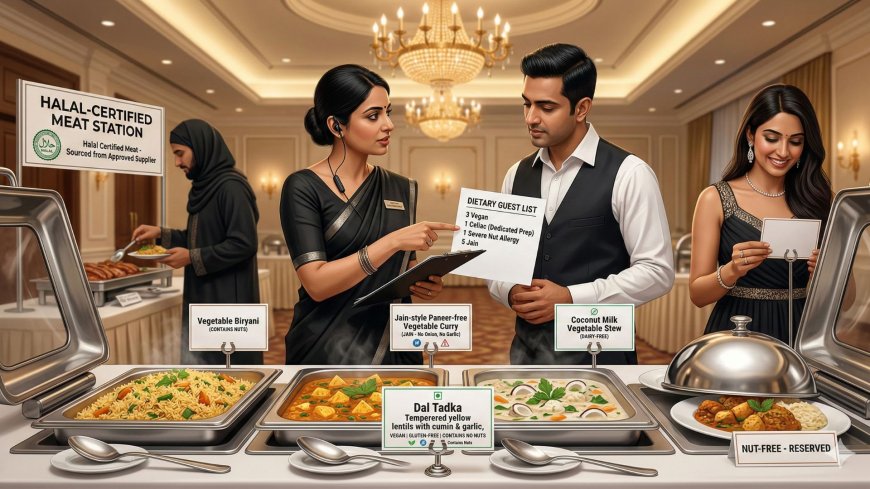
For weddings with Muslim guests, the halal question is: is the meat being served sourced from a halal-certified supplier? This is a procurement question as much as a preparation question. Confirming your caterer's halal sourcing before finalizing the booking is important — some caterers work exclusively with halal suppliers, others do not, and this is not something that can be resolved by labeling at the buffet.
For NRI weddings where the Muslim guest population is significant — either family members or members of the broader community — halal certification of the entire meat supply is the appropriate standard rather than a separate provision.
Jain Dietary Requirements
Jain dietary practice involves a more extensive set of restrictions than standard vegetarianism and is commonly misunderstood. Jain dietary requirements exclude all meat, fish, and eggs — but also root vegetables including onions, garlic, potatoes, carrots, and radishes, which are excluded because harvesting them involves destroying the entire plant. Some stricter Jain observances also exclude certain other vegetables.
At an Indian wedding where Jain guests are present, Jain-friendly dishes need to be prepared without the onion and garlic that are fundamental to most Indian cooking. This requires specific preparation — separate Jain preparations made without these ingredients — rather than identifying existing dishes on the menu as Jain-compliant.
A Jain-friendly preparation prepared with genuine respect for the practice — not simply with onion and garlic removed from a dish where they are fundamental to the flavor, but with proper Jain cooking technique and seasoning — is achievable with a caterer who understands the requirement. Brief the caterer specifically on the number of Jain guests and their dietary practice, and request that Jain preparations be clearly labeled at the buffet.
Dairy-Free Requirements
Dairy-free requirements — separate from veganism, which encompasses dairy-free as one component of a broader exclusion — affect guests with lactose intolerance, dairy protein allergies, or dietary preferences that exclude dairy without excluding other animal products.
At an Indian wedding, dairy appears extensively: paneer, ghee, yogurt marinades, cream sauces, milk-based sweets. Many dishes that are otherwise suitable for dairy-free guests are prepared with ghee as a default.
For dairy-free guests, the provisions are similar to vegan provisions in terms of ghee substitution and dairy-containing dish labeling — but the dessert situation requires specific attention, as the Indian mithai tradition is almost entirely dairy-based. A dairy-free dessert option should be specifically arranged rather than assumed to exist within the standard mithai selection.
The Labeling System That Serves Every Guest
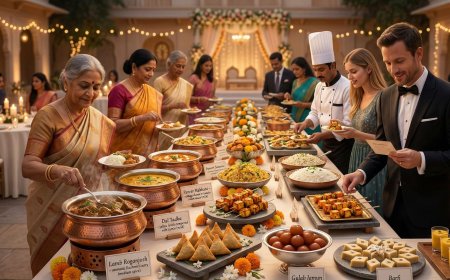
A comprehensive dietary labeling system at the buffet serves two purposes: it allows guests with restrictions to navigate the menu independently without needing to ask catering staff for clarification at every dish, and it communicates that dietary requirements were taken seriously in the planning rather than managed reactively on the day.
An effective Indian wedding dietary labeling system uses consistent visual indicators alongside dish names and descriptions. The indicators should be immediately recognizable and consistently applied across every dish on the menu.
A color-coding system — green for vegan, blue for gluten-free, yellow for contains nuts, red for contains dairy, with an orange V for vegetarian — creates a visual language that guests learn from the first label they read and can apply across the entire buffet without re-reading explanatory text for each dish.
Every label should include: the dish name in its regional language and in English, a two-line description of the primary ingredients and flavor profile, and the full set of applicable dietary indicators. A dish that is simultaneously vegan and gluten-free carries both the green vegan indicator and the blue gluten-free indicator. A dish that contains both nuts and dairy carries both indicators.
The "contains" labeling for allergens is more conservative than the "free from" labeling for dietary practices. A dish labeled "contains nuts" accurately informs nut allergy guests. A dish labeled "nut-free" is a claim that requires kitchen management verification to be made honestly — do not label anything as free from an allergen unless your caterer has specifically confirmed that cross-contamination prevention protocols were followed in the preparation.
The At a Glance Management Guide
| Restriction Type | Menu Accommodation | Kitchen Management Required | Labeling Approach | Guest Communication |
|---|---|---|---|---|
| Vegetarian | Full vegetarian section with substantial options | Separate utensils for vegetarian and non-vegetarian dishes | Green V symbol on all vegetarian dishes | Include in RSVP, confirm in final brief |
| Vegan | Minimum 2 substantial vegan mains, vegan dal, vegan dessert option, oil-based cooking | Separate ghee-free preparation for vegan dishes | Green VE symbol, confirm no dairy or honey | Personal confirmation with vegan guests on safe options |
| Gluten-free (preference) | Identify and label naturally gluten-free dishes | Standard care | GF symbol on confirmed gluten-free dishes | Direct to labeled dishes at buffet |
| Celiac disease | Dedicated preparation with no cross-contamination from wheat | Dedicated surfaces, utensils, cooking environment — confirm with caterer | GF symbol plus "prepared in dedicated area" note | Personal conversation essential — confirm caterer capability before booking |
| Nut allergy (mild) | Full nut-containing dish identification | Standard ingredient management | Contains nuts symbol on all nut-containing dishes | Direct to nut-free labeled options |
| Nut allergy (anaphylaxis risk) | Separate nut-free meal from dedicated preparation | Complete separation from nut-containing preparations | Separate service arrangement | Personal conversation essential — emergency protocol discussion |
| Halal | Halal-certified meat sourcing | Halal-certified supplier confirmation | Halal certification visible at meat stations | Confirm with caterer at booking stage |
| Jain | Dedicated Jain preparations without root vegetables, onion, garlic | Separate Jain preparation area and utensils | Jain symbol and ingredient list on Jain dishes | Confirm number of Jain guests, request dedicated preparation |
| Dairy-free | Oil-based cooking alternatives, dairy-free dessert option | Ghee substitution in relevant dishes | DF symbol on dairy-free dishes | Personal confirmation on dessert options |
| Kosher | Specialist kosher catering arrangement | Dedicated kosher-certified kitchen or caterer | Separate kosher service | Specialist caterer engagement required — standard caterer cannot provide |
| Low-spice / mild | Mild versions of key dishes or mild accompaniment options | Separate mild preparations for relevant dishes | Mild indicator on low-spice options | Brief MC to announce mild options at service opening |
Building the Dietary Management Brief for Your Caterer
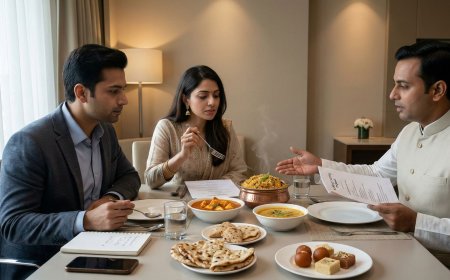
The dietary information you collect from guests needs to be translated into a specific, actionable brief for your caterer. A data dump of RSVP responses is not a brief — it is raw information that requires organization and prioritization before it becomes useful to the catering team.
Your dietary brief for the caterer should include: a summary count of each restriction category — seven vegan guests, three celiac, two nut allergy, one anaphylaxis-risk nut allergy, fifteen Jain — alongside the specific names of guests with anaphylaxis-risk allergies or other high-stakes requirements. For high-stakes guests, the brief should include a specific provision plan: what they will be served, how it will be prepared, how it will be identified at the event, and who the point of contact is for that guest on the day.
Send this brief at least six weeks before the wedding. Follow up at the four-week mark to confirm the caterer has reviewed it and has a preparation plan for every category. Request specific confirmation — in writing — on the kitchen management protocols for celiac and serious allergy provisions.
Brief your on-ground coordinator separately on the high-stakes guests. Your coordinator should know the names of guests with anaphylaxis-risk allergies, be aware of what they can and cannot eat, and be the point of contact for any issue that arises during the meal service. This is a delegation of responsibility that needs to be explicit — not assumed.
The Personal Touch That Makes the Difference
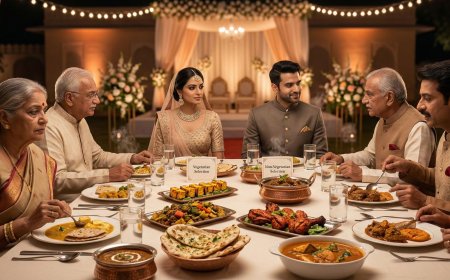
Beyond the systemic provisions — the labeling, the separate preparations, the kitchen management protocols — the dietary management element of your wedding that guests remember most often is not the system. It is the personal gesture.
The couple who reached out before the wedding to confirm exactly what their vegan guest could eat and to tell them specifically which dishes were prepared for them. The bride who personally introduced her celiac friend to the catering team lead when she arrived at the venue, ensuring the guest had a direct contact if she had any concerns during the meal. The family coordinator who checked in with the guest with the nut allergy at the beginning of dinner service to confirm they had found their designated safe meal and had everything they needed.
These gestures take minutes. They produce a quality of remembered care that no amount of labeling or preparation can replicate, because they communicate the thing that hospitality ultimately communicates: you were thought about. Your specific situation was in our minds before you arrived. You are not a complication in our planning — you are a person we wanted to take care of.
This is the standard that the best Indian wedding hospitality has always set. It is the standard that dietary restriction management, done properly, allows you to extend to every guest regardless of what they can and cannot eat.
Every guest at your wedding deserves a full plate and the confidence that what is on it is safe for them to eat. That is not a logistical target. It is an expression of the same fundamental care that brought them to the celebration in the first place.
NRIWedding.com — Expert guidance for Indian weddings planned across borders.
What's Your Reaction?
 Like
0
Like
0
 Dislike
0
Dislike
0
 Love
0
Love
0
 Funny
0
Funny
0
 Angry
0
Angry
0
 Sad
0
Sad
0
 Wow
0
Wow
0