

















































Destination Wedding in Jaisalmer — Sand Dune Ceremonies and Golden Fort Sunsets: Complete NRI Guide — The Complete NRI Wedding Planning Guide
Rahul had been to Jaisalmer once, on a college road trip at twenty-two, and the specific memory he had carried for eleven years was not the fort or the havelis or the camel safari. It was a private memory — the specific memory of having woken before dawn on the second morning, having walked away from the campsite alone, having climbed a dune in the dark, and having watched the sun come over the Thar Desert from the top of the dune as the first person to see it that morning. He had not told anyone about this memory for eleven years. Not because it was a secret but because the attempt to describe it always produced the frustration of the person trying to communicate a sensory experience through language — the specific quality of the Thar Desert at dawn, the colour of the sand in the moment before the light changes everything, the silence that is the absolute silence of the desert before the day begins, the particular quality of being the only person on the dune at the specific, unrepeatable, this-is-happening-now moment of the desert dawn. The words were always insufficient. He was thirty-three now and engaged to Pooja, from Mumbai, planning the wedding from Singapore. The conversation that finally produced the venue decision happened on a Sunday evening when Rahul said, without planning to say it: I want to take you to a dune at dawn. She said: in Jaisalmer? He said: for the wedding. She said: is there a sand dune ceremony? He said: there is if we design one. She said: the fort in the evening. The dune in the morning. He said: and the Thar in between. She said: this is the wedding. This guide gives NRI couples the complete framework for the Jaisalmer destination wedding — the four distinct settings, every principal venue with detailed pricing, the sand dune ceremony planning framework, the desert wind mandap brief, the Manganiyar commission, the dawn fort walk, the dal baati churma feast, and the specific mistakes that separate the couple who uses the desert's most extraordinary hours from the couple who schedules the ceremony at midday and wonders why the photographs look different from the ones that made them choose Jaisalmer.

Destination Wedding in Jaisalmer — Sand Dune Ceremonies and Golden Fort Sunsets: Complete NRI Guide — The Complete NRI Wedding Planning Guide
Rahul had been to Jaisalmer once, on a college road trip at twenty-two, and the specific memory he had carried from it for eleven years was not the fort or the havelis or the camel safari or the Sam Sand Dunes at the standard tourist hour. It was a private memory — the specific memory of having woken before dawn on the second morning of the trip, having walked away from the campsite at Sam without telling anyone where he was going, having climbed a dune alone in the dark, and having watched the sun come over the Thar Desert from the top of the dune as the first person to see it that morning.
He had not told anyone about this memory for eleven years. Not because it was a secret but because the attempt to describe it always produced the specific frustration of the person who is trying to communicate a sensory experience through language — the attempt to convey the specific quality of the Thar Desert at dawn, the colour of the sand in the moment before the light changes everything, the silence that is the specific, absolute silence of the desert before the day begins, the particular quality of being the only person on the dune at the specific, unrepeatable, this-is-happening-now moment of the desert dawn — and finding that the words were always insufficient.
He had stopped trying to describe it and had kept it instead as the private reference point for the specific quality of natural experience that he associated with the feeling of being completely present in a landscape — the feeling he had been trying to reproduce in various forms ever since and that he had found again, in different forms, in different landscapes, but never quite in the same completeness as the Jaisalmer dune at dawn.
He was thirty-three now and engaged to Pooja, who was from Mumbai and who had not been to Jaisalmer and who had been listening to the venue conversation for seven months from their flat in Singapore with the patient attention of someone who had a strong sense of what she wanted and was waiting for the venue research to find it.
What she wanted was the desert. Not the desert in the abstract — the specific desert of the Thar, the Golden City, the fort that glowed in the evening light. She had grown up with the specific, Rajasthan-romantic, fort-and-sand, golden-city imagination that the Jaisalmer photographs and the travel writing had produced in every person who had not been there and who had been forming their image of it from the accumulated, only-ever-photographed, never-visited impression of the place.
The conversation that had finally produced the venue shortlist had happened on a Sunday evening when Rahul had said, without planning to say it: I want to take you to a dune at dawn. She had said: in Jaisalmer? He had said: in Jaisalmer. She had said: for the wedding? He had said: for the wedding. She had been quiet for a moment. Then she had said: is there a sand dune ceremony? He had said: there is if we design one. She had said: then let's design one. He had said: the fort in the evening. The dune in the morning. She had said: and the Thar in between. He had said: and the Thar in between. She had said: this is the wedding. He had said: this is the wedding.
This guide is for every NRI couple who has been forming the Jaisalmer image for years from photographs that have never been sufficient — for Rahul and Pooja in Singapore and every couple who deserves the complete framework for the sand dune ceremony and the golden fort sunset in the city that has been waiting at the edge of the Thar since the twelfth century.
Understanding Jaisalmer: The Golden City at the Edge of India
Jaisalmer is the westernmost of the major Rajasthan destination wedding cities — the city that sits at the edge of the Thar Desert approximately three hundred kilometres from Jodhpur and approximately five hundred and fifty kilometres from Jaipur, at the specific, only-in-the-Thar, desert-frontier, medieval-fort, golden-sandstone, living-heritage, camel-route position that makes it different from every other Rajasthan city in character and in specific quality.
The city was founded in 1156 by Rawal Jaisal, the Bhati Rajput king whose dynasty chose the Trikuta Hill — the triangular rocky outcrop above the Thar Desert plain — as the foundation for the fort that would serve as the capital of the Jaisalmer State for the following eight centuries. The specific, golden-yellow, Jaisalmer sandstone from which the fort, the havelis, and the historic buildings of the city are constructed is the geological product of the Thar Desert's specific, sedimentary, limestone-and-sandstone formation — the specific, warm, golden, only-in-Jaisalmer colour that catches the desert light at the specific hours of the morning and the evening when the low-angle light transforms the stone from golden to the specific, amber-and-orange of the desert sunset.
The living fort — the Sonar Quila, the Golden Fort, the UNESCO World Heritage Site that contains within its walls a living community of approximately four thousand residents — is the most extraordinary urban heritage element in Rajasthan in the specific sense of being a fort that has been continuously inhabited for eight hundred and fifty years rather than the converted or the preserved monument of the heritage tourism circuit. The temples within the fort, the havelis, the narrow lanes of the internal settlement, the specific, only-in-the-living-fort, daily-life, children-playing-in-the-lanes, morning-puja-audible quality of the inhabited historic space — these are the qualities that make the Jaisalmer fort different from the Mehrangarh Fort's museum-standard presentation and the Amber Fort's tourist-circuit management.
The Thar Desert — the vast, sand-dune, scrub-bush, camel-herder, sparse-settlement landscape that surrounds Jaisalmer on every side — is the natural context within which the city's entire existence has been organised since Rawal Jaisal chose the Trikuta Hill. The desert is not merely the backdrop to the Jaisalmer wedding. It is the primary landscape — the landscape that created the fort, that determined the city's position on the medieval trade route, that shaped the specific, desert-adapted, water-conscious, wind-aware, light-extraordinary quality of the Jaisalmer aesthetic.
The Jaisalmer Wedding Landscape: Four Distinct Settings
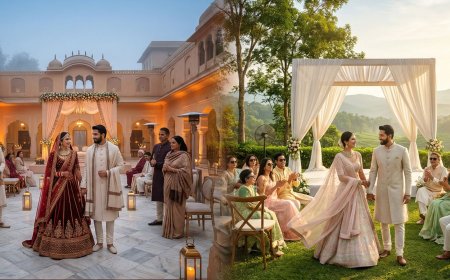
The Jaisalmer destination wedding has four distinct natural and architectural settings — each specific to the Jaisalmer location and each providing a different quality of experience — and the couple who understands these four settings as the building blocks of the three-day wedding program has the framework for designing the most complete and the most specifically Jaisalmer wedding available.
The Thar Desert and the Sam Sand Dunes
The Sam Sand Dunes — the specific, thirty-five kilometre, desert-road, Jaisalmer-to-Sam, most-extensive, most-photographed, most-wedding-appropriate sand dune landscape in the accessible Thar Desert — are the natural setting for the sand dune ceremony and the desert event that most completely uses the Jaisalmer location's most extraordinary natural asset.
The Sam Sand Dunes extend approximately twenty to twenty-five kilometres along the Pakistani border area of the Thar Desert, forming the continuous, wind-sculpted, ever-shifting, specific, golden-orange, only-in-the-Thar, high-dune landscape that produces the desert photograph of the Rajasthan wedding circuit and that provides the outdoor ceremony setting at the scale and the character of the genuinely wild landscape rather than the managed resort garden.
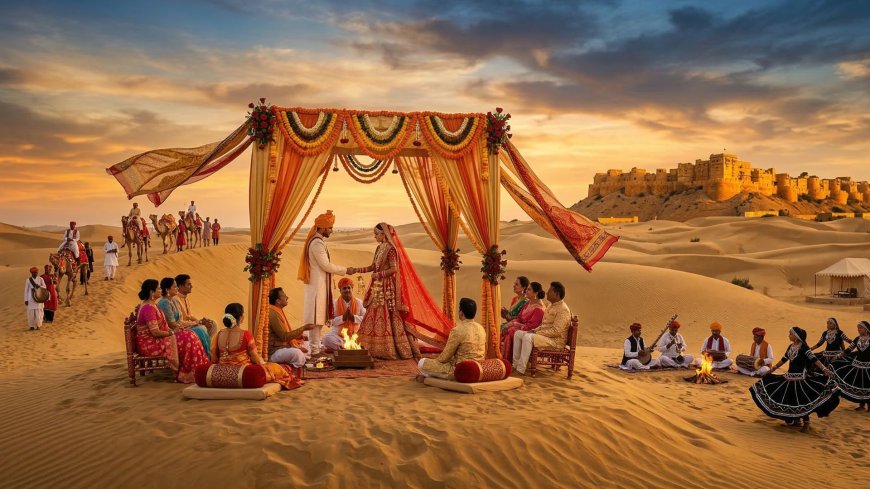
The dune ceremony — the mandap on the sand dune, the Thar Desert extending in every direction below the dune's crest, the ceremony in the specific, open, exposed, wind-present, vast quality of the desert ceremony space — is the ceremony that most completely uses the Jaisalmer location's most extraordinary and most irreplaceable element. The palace garden ceremony, however beautiful, is the ceremony in the managed landscape. The dune ceremony is the ceremony in the wild desert.
The timing of the dune ceremony is the most specific and the most consequential scheduling decision of the Jaisalmer wedding program: the sunset is the primary ceremony hour for the dune, when the low western sun turns the sand from the daytime yellow to the specific, amber-and-orange of the Thar sunset, when the shadow lines on the dune's surface create the specific, three-dimensional, deeply sculpted quality of the sand in the raking light. The sunrise is the secondary option for the Rahul who wants the dawn — the ceremony that requires the predawn departure from the hotel, the arrival at the dune before the light changes, the ceremony in the specific, only-at-this-hour, desert-dawn quality that most completely communicates what Rahul had been trying to describe for eleven years.
The Jaisalmer Fort: The Living Heritage
The Jaisalmer Fort — Sonar Quila, the Golden Fort, the UNESCO World Heritage living heritage monument — is the secondary architectural setting for the Jaisalmer wedding program and the heritage dimension that the beach resort and the hill station cannot provide in the same form.
The fort's specific quality for the wedding is the quality of the living monument — the lanes and the temples and the havelis of the internal settlement that are not preserved as museum spaces but lived in as the daily habitat of the four thousand residents who are the fort's contemporary community. The wedding party that walks the fort's lanes in the early morning — the small group, the narrow lanes, the daily life of the living heritage community — is the wedding party inside the most specific and the most continuously inhabited medieval monument in Rajasthan.
The fort's external walls — the specific, golden sandstone, bastioned, massive, only-in-Jaisalmer, Trikuta Hill perimeter that glows amber and orange in the evening light — are the most photographed single element of the Jaisalmer landscape and the heritage backdrop that the wedding photography session uses most completely. The evening photography session at the fort's exterior — the golden walls in the last of the desert sun, the shadows lengthening across the sandstone, the wedding couple against the eight-hundred-and-fifty-year heritage — is the photography session that produces the images specifically and permanently of Jaisalmer.
The Desert Camp: The Immersive Overnight
The desert camp — the luxury or mid-range tented camp in the Sam Dunes area whose permanent or seasonal installation provides the accommodation and the event infrastructure for the overnight desert experience — is the specific Jaisalmer event format that most completely immerses the wedding party in the Thar Desert experience.
The overnight desert camp wedding — the sunset ceremony on the dune, the camp dinner under the desert sky, the overnight in the desert tents, the sunrise on the dune the following morning — is the wedding format that most specifically uses the Jaisalmer location's most extraordinary quality: the desert night. The Thar Desert night sky — far from the light pollution of the city, the stars in the density and the brilliance that the dark desert sky produces — is the most extraordinary natural ceiling available at any outdoor event in this series. The wedding dinner under this sky is the dinner that no banquet hall illumination system replicate.
The Heritage Havelis and Palace Hotels
The Jaisalmer heritage hotels — the converted havelis and the palace properties within the city and in the fort area that provide the luxury accommodation and the event spaces for the city-based elements of the wedding program — are the architectural setting for the formal indoor events and the accommodation infrastructure for the full wedding party.
The Jaisalmer Hotels: The Principal Venues
Fort Rajwada: The Largest Palace Hotel
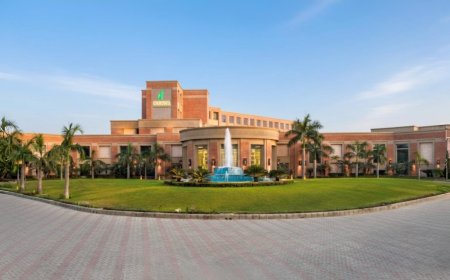
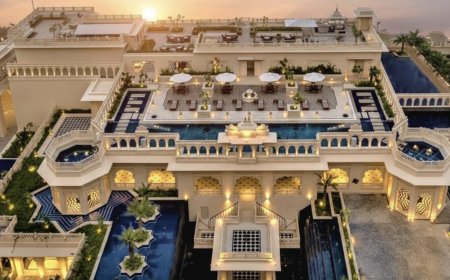
Fort Rajwada — described in the Fort Rajwada Jaisalmer article in this series — is the primary palace hotel for the large-format Jaisalmer wedding, with the rooftop event spaces, the palace ballroom, and the fort view that give it the specific, Jaisalmer-palace, large-capacity wedding standard.
Suryagarh Palace: The Desert Palace Beyond the City
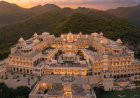
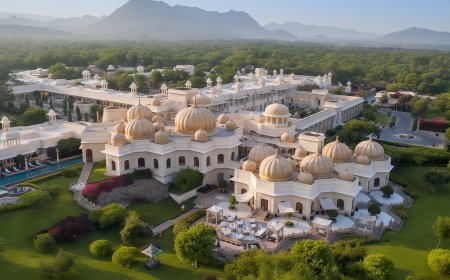
The Suryagarh Palace — the fortress-style, purpose-built heritage hotel on the eastern outskirts of Jaisalmer — is the Jaisalmer palace hotel that most dramatically expresses the desert fort aesthetic in the contemporary luxury hotel format. The crenellated battlements, the sandstone construction, the desert landscape surrounding the property — the Suryagarh is the hotel that most immediately communicates the Jaisalmer fort vocabulary to the guest who arrives from the Jaisalmer city road.
The event spaces of the Suryagarh — the outdoor courtyard, the terrace event space with the desert visible in every direction, the indoor hall — provide the palace setting for the city-based elements of the wedding program. The Suryagarh accommodates up to three hundred guests for the outdoor event and up to two hundred for the indoor ceremony.
The Serai: The Luxury Desert Camp
The Serai — the luxury tented camp in the Thar Desert outside Jaisalmer whose specific, permanent, luxury-tent, private-pool, desert-landscape, only-in-the-Thar, ultra-luxury camp character gives it the specific, desert-immersion, not-the-city-hotel, genuinely-in-the-desert quality — is the luxury accommodation option for the wedding party that wants the desert experience rather than the city hotel experience.
The Serai's tents — the permanent luxury structures with the private plunge pools and the specific, desert-facing, open-air bathing and the only-in-the-luxury-camp quality of the desert accommodation at the ultra-luxury standard — provide the wedding party with the most complete desert immersion available in the Jaisalmer destination wedding market.
The Serai's event spaces — the outdoor desert event area, the dining pavilion, the fire pit gathering space — provide the intimate desert wedding format for the couple whose guest list fits the camp's scale and whose vision is the desert experience rather than the palace setting.
Jawahar Niwas Palace: The Heritage City Hotel
The Jawahar Niwas Palace — the historic, former-maharajah's-residence, converted heritage hotel in the heart of Jaisalmer city — provides the within-the-city, heritage-building, royal-Jaisalmer-connection accommodation and event space for the couple whose vision includes the city and the fort proximity alongside the desert.
The Sand Dune Ceremony: The Complete Planning Framework
The sand dune ceremony is the most logistically specific event of the Jaisalmer wedding program and requires the most detailed planning framework of any single event in this series.
The Location Selection
The Sam Sand Dunes are the standard location for the sand dune ceremony — accessible, established, with the dune landscape of sufficient scale for the wedding ceremony's visual requirements. The Khuri Dunes — a smaller, less-visited dune area approximately fifty kilometres south of Jaisalmer — are the alternative for the couple whose vision includes the absence of the tourist infrastructure and the more intimate, less-visited quality of the smaller dune system.
The specific dune position within the Sam or the Khuri area requires the advance site visit — the pre-wedding reconnaissance by the wedding planner and the event team to identify the specific dune and the specific mandap position from which the ceremony views are most extraordinary and from which the sunset or the sunrise lands in the specific direction that the ceremony's orientation requires.
The Transport
The Sam Sand Dunes are thirty-five kilometres from Jaisalmer city. The transport from the city hotels to the dunes — the convoy of vehicles on the desert road at the specific arrival-before-light or arrival-before-sunset timing that the ceremony hour requires — is the transport logistics that the wedding planner coordinates as a single, coordinated, timeline-managed operation.
The camel procession — the groom's arrival at the ceremony by camel, the specific, only-in-the-Thar, camel-and-desert, baraat-by-camel format — is the arrival ceremony that most completely uses the Jaisalmer desert setting and that most directly references the historic transport tradition of the Rajputana desert trade route. Commission the camel procession through the established Jaisalmer desert safari operators. Brief the camel handlers on the ceremony timeline and the specific arrival route from the dune's approach to the mandap position.
The Mandap in the Desert
The mandap design for the sand dune ceremony requires the specific, desert-adapted, wind-aware, sand-stable, sunrise-or-sunset-oriented construction vocabulary that the standard wedding decorator's urban brief does not address.
The desert wind — the specific, consistent, directional, afternoon-intensifying, sand-carrying wind of the Thar that the Sam Dunes area experiences — is the most specific operational challenge of the sand dune ceremony. The mandap structure that has not been designed for the desert wind will be structurally compromised by it. Brief the mandap decorator specifically on the wind. Ask for the specific structural anchoring solution — the tent pegs, the weighted base, the wind-resistant fabric — that the desert wind requires. The desert wedding decorator who has done the Sam Dunes ceremony before knows this brief. The urban decorator who is doing it for the first time will learn it on the wedding day. Commission the experienced desert decorator.
The floral vocabulary for the desert mandap is the desert's own botanical vocabulary — the marigold and the rose and the desert flowers that the Rajasthan flower market provides, arranged in the specific, warm, golden, desert-palette vocabulary that acknowledges the Thar's colour rather than importing the cool palette of the hotel garden.
The Sand Guest Management
The sand — the specific, fine, Thar Desert sand that enters every item of clothing and every piece of footwear and every open food container and every musical instrument and every technical equipment case that the ceremony brings to the dune — is the operational reality of the sand dune ceremony that requires the specific, sand-management, sealed-equipment, covered-food, appropriate-footwear awareness.
Brief the guests on the footwear: flat sandals or bare feet. The formal heel shoes of the standard wedding reception are structurally inappropriate on the dune and will produce the specific, frustrating, heel-sinking-into-sand, ceremony-dignity-reducing experience of the guest who is wearing the wrong footwear for the landscape. Bare feet are the best option for many guests. Brief the guests before the day.
Comprehensive Pricing and Planning Reference
| Category | Detail | Approximate Range | Notes |
|---|---|---|---|
| Sam Sand Dunes ceremony | Sunset or sunrise dune | ₹8,00,000–₹18,00,000 per event | Desert permit; mandap; transport |
| Desert camp dinner | Under desert sky | ₹6,00,000–₹14,00,000 per event | Tented; fire pit; Thar night sky |
| Fort Rajwada rooftop | Fort view; large format | ₹10,00,000–₹20,00,000 per event | Palace rooftop; city view |
| Suryagarh Palace courtyard | Heritage; desert setting | ₹8,00,000–₹16,00,000 per event | Sandstone; fort vocabulary |
| The Serai tented camp | Ultra-luxury desert | ₹12,00,000–₹25,00,000 per event | Permanent luxury tents |
| Haveli venue hire | City heritage property | ₹3,00,000–₹8,00,000 per event | Mehendi; intimate gathering |
| Camel procession — baraat | Thar desert arrival | ₹1,50,000–₹4,00,000 | Camel handlers; timeline briefed |
| Accommodation — Heritage Hotel | City palace standard | ₹8,000–₹25,000 per night | Fort area; city centre |
| Accommodation — Suryagarh suite | Desert palace luxury | ₹20,000–₹45,000 per night | Desert fort aesthetic |
| Accommodation — Serai luxury tent | Ultra-luxury desert | ₹45,000–₹90,000 per night | Private pool; desert immersion |
| Accommodation — Fort area haveli | Heritage; within city | ₹5,000–₹15,000 per night | Within fort proximity |
| Catering per cover — Rajasthani feast | Dal baati churma | ₹2,500–₹5,000 | Desert kitchen tradition |
| Catering per cover — formal dinner | Contemporary Rajasthani | ₹4,000–₹7,000 | Palace hotel standard |
| Catering per cover — desert camp | Camp kitchen; outdoor | ₹3,000–₹6,000 | Open fire; desert ingredients |
| Catering per cover — daytime | Lunch or breakfast | ₹1,500–₹3,000 | Full service |
| Kalbelia or Manganiyar performance | Desert folk music | ₹80,000–₹2,50,000 | Thar musical tradition |
| Ghoomar dancers | Rajasthani folk dance | ₹60,000–₹2,00,000 | Traditional; wedding appropriate |
| Fort walk — guided heritage | Living fort; lanes | ₹20,000–₹50,000 | Early morning; community guide |
| Desert sunrise photography | Pre-dawn dune session | ₹50,000–₹1,50,000 | Specialist equipment; dark-adapted |
| Sand dune transport — convoy | Full guest group | ₹2,00,000–₹5,00,000 | Coordinated; timeline-managed |
| Décor and florals | Desert palette; sandstone | ₹5,00,000–₹20,00,000 | Wind-resistant; desert materials |
| Photography and videography | Full wedding | ₹3,50,000–₹12,00,000 | Desert light specialists essential |
| Sound and lighting | Desert outdoor | ₹2,50,000–₹7,00,000 | Wind acoustic; desert management |
| Wedding planner fee | Full service | ₹6,00,000–₹15,00,000 | Jaisalmer desert experience essential |
| Transport — Jodhpur Airport to Jaisalmer | Per vehicle | ₹8,000–₹14,000 | 5 hours; desert highway |
| Transport — Jaisalmer Airport to venue | Per vehicle | ₹500–₹1,500 | 15 minutes; direct |
| Total three-day wedding — 100 guests | Without buyout | ₹80,00,000–₹1,40,00,000 | Full desert program |
| Total three-day wedding — 200 guests | Full program | ₹1,30,00,000–₹2,30,00,000 | Complete Jaisalmer wedding |
| Total three-day wedding — 300 guests, buyout | Full palace | ₹2,00,00,000–₹3,50,00,000+ | Peak season; full desert exclusivity |
The Jaisalmer Cultural Tradition: The Manganiyar and the Kalbelia
The Jaisalmer cultural tradition — the specific, Thar Desert, living-heritage, musical and performance tradition of the Rajasthan desert community — is the cultural program element that gives the Jaisalmer wedding its most specific and most deeply rooted cultural dimension and that most directly communicates the living culture of the Thar to the international guests.
The Manganiyar — the hereditary Muslim musician community of the western Rajasthan and Sindh region whose specific, only-in-the-Thar, khamaicha-and-dholak, devotional-music, centuries-old, only-for-this-landscape musical tradition is one of the most specific and the most internationally celebrated folk music traditions in India — are the musicians whose performance at the Jaisalmer wedding most directly connects the occasion to the living cultural heritage of the desert.
The Manganiyar performance at the desert camp dinner — the musicians around the campfire, the specific, khamaicha-string, dholak-percussion, devotional-folk-music, only-in-the-Thar quality of the Manganiyar sound in the desert night — is the cultural performance that most completely communicates the spirit of the Jaisalmer landscape to the guests gathered around the fire. Not the Bollywood DJ. The living musical tradition of the people whose ancestors have been singing the desert's music for generations.
The Kalbelia — the snake-charmer community's specific, circular, fluid, ground-level dance tradition whose performance vocabulary is the most specifically, visually extraordinary of the Rajasthan folk dance traditions — is the dance performance that most immediately and most dramatically communicates the desert's performing arts heritage to the guests who witness it.
Brief the cultural program coordinator on both traditions. Commission the Manganiyar for the desert camp dinner. Commission the Kalbelia for the sangeet. Give the guests the living culture of the Thar rather than the generic Rajasthan entertainment package.
The Jaisalmer Food Tradition: The Dal Baati Churma Wedding Feast
The Jaisalmer and the Rajasthan desert culinary tradition — the specific, desert-adapted, water-efficient, ghee-rich, grain-based, only-in-the-Thar, desert-kitchen vocabulary whose most celebrated form is the dal baati churma — is the culinary element that most specifically communicates the food culture of the Thar Desert to the wedding guests.
The dal baati churma is the dal — the lentil preparation in the specific, desert-spice, Rajasthani form — served with the baati, the unleavened wheat bread baked in the desert sand or the clay oven and then dipped in the clarified butter, and the churma, the coarsely ground wheat preparation sweetened with jaggery and mixed with the ghee whose specific, only-in-the-Rajasthan-desert-kitchen, sweet-grain, celebration-food quality makes it the dessert of the Rajasthani feast.
The dal baati churma dinner at the desert camp — the traditional preparation served by the desert camp's kitchen, the baatis baked in the traditional sand oven, the dal in the clay pot, the churma in the specific, hand-ground, ghee-and-jaggery form of the desert kitchen — is the dinner that most completely places the wedding feast inside the culinary tradition of the Jaisalmer location.
The gatte ki sabzi — the gram flour dumplings in the yoghurt-based gravy that is the Rajasthani kitchen's most celebrated vegetarian preparation — and the ker sangri — the desert berry and the dried bean preparation of the Thar Desert's indigenous botanical vocabulary that is available nowhere else in India — are the specific, Jaisalmer, desert-botanical, only-in-the-Thar culinary elements that give the wedding dinner its most specific sense of place.
The Jaisalmer Weather: The Desert Calendar
The Jaisalmer wedding calendar has the most extreme seasonal variation of any venue in this series — the specific, Thar Desert, continental, intense-summer, cool-winter, monsoon-sparse, wind-variable climate whose understanding is essential to the outdoor ceremony planning.
The optimal window for the Jaisalmer outdoor wedding is October through February — the post-monsoon, winter-cool, pleasant-temperature, minimal-rain window whose climate most naturally supports the outdoor dune ceremony and the desert camp dinner. The January temperatures at the dune ceremony hour — the afternoon, the sunset, the evening — are the specific, fifteen-to-twenty-degree, desert-cool quality of the Rajasthan winter that makes the outdoor ceremony comfortable without the summer's extreme heat.
The November and February shoulder seasons are the most reliably comfortable — the temperatures neither the winter cold of January's coldest nights nor the heat that builds from March onward. The wedding couple who programs the outdoor dune ceremony for the March or the October edge of the season should be aware of the specific, temperature, transitional-season risk — the March heat building rapidly, the October residual heat from the monsoon season.
The Jaisalmer monsoon — the June through September season — is sparse by mainland Indian standards but present, and the outdoor dune ceremony in the monsoon window carries the rain risk that the desert's normally low annual rainfall does not always suggest. Avoid the monsoon for the dune ceremony.
The desert wind — the specific, afternoon, westerly, sand-carrying wind of the Thar — intensifies in the spring months of March and April. The March or April dune ceremony must specifically account for the wind's afternoon intensification in the mandap design and the program timing.
Common Mistakes NRI Couples Make With the Jaisalmer Wedding
The first mistake is scheduling the dune ceremony at the wrong hour. The sand dune ceremony's most extraordinary quality is the specific, desert light — the low-angle, warm-toned, shadow-rich, only-at-this-hour quality of the dune in the sunset or the sunrise. The ceremony at midday, when the desert sun is directly overhead and the dune surface is flat and washed-out, is not the ceremony that uses the dune's most extraordinary visual quality. Schedule the ceremony for the sunset or the dawn. The desert light will do what no decorator can.
The second mistake is not commissioning the desert-experienced wedding planner and the desert-experienced mandap decorator for the dune ceremony. The sand dune ceremony's specific operational challenges — the desert wind, the sand management, the transport convoy timing, the camel procession coordination, the sunrise timing precision — require the operational knowledge of the planner and the decorator who have managed these elements before. The mainland event professional who is doing the Jaisalmer dune ceremony for the first time will encounter the desert's specific challenges as surprises. Commission the experienced team.
The third mistake is not including the Manganiyar at the desert camp dinner. The Manganiyar musicians are the living cultural heritage of the Thar Desert — the hereditary musicians whose centuries-old tradition is specifically and irreplaceably of this landscape. The desert camp dinner without the Manganiyar is the desert dinner with a generic entertainment package in the landscape where one of India's most extraordinary living musical traditions is available from the community that has been singing it for centuries. Commission the Manganiyar. Give the guests the Thar's own music.
The fourth mistake is not briefing the guests on the footwear and the clothing for the dune ceremony. The formal heel shoes are structurally impossible on the sand dune. The heavy wedding outfit is physically uncomfortable in the desert heat and the desert wind. The guests who arrive at the dune ceremony in the wrong footwear — and there will be guests who arrive in the wrong footwear if they have not been briefed — are the guests who are distracted from the ceremony by the physical challenge of standing on sand in heels. Brief the guests specifically. Flat footwear or bare feet. Layers for the temperature change between the afternoon and the evening. Wind-appropriate hair management. These are the practical briefs that protect the ceremony's dignity.
The fifth mistake is not designing the fort walk as a specific early morning program element. The Jaisalmer Fort at dawn — the living heritage monument before the tourist circuit wakes, the lanes in the specific quality of the morning light, the temple bells and the daily-life activity of the four thousand residents — is the most specific and the most humanly extraordinary encounter available in the Jaisalmer wedding program. The wedding party that walks the fort at dawn with a knowledgeable guide from the community is the wedding party inside the living heritage of the eight-hundred-and-fifty-year-old fort in the moment of its most authentic daily character. Design the dawn fort walk. Brief the community guide. Wake the guests who want it. The fort has been waking up at this hour since the twelfth century.
Rahul's wedding was in January — the Jaisalmer January, the desert cool at the specific, fifteen-degree, dry, clear-sky, desert-winter quality that the Thar produces in this month and that the guests from Singapore and London found as extraordinary as the guests from Mumbai who had not expected the desert to be this cold.
The dune ceremony was at five in the afternoon — the specific, sunset-window, low-angle, only-at-this-hour hour that Rahul had scheduled the ceremony for with the specific knowledge of the person who had been on a Jaisalmer dune at dawn eleven years earlier and who knew what the desert light did when the sun was at the angle that produced the specific, amber-and-orange, shadow-rich, only-at-this-hour quality he had been trying to describe since he was twenty-two.
The Manganiyar musicians were at the camp from seven in the evening. The campfire was lit as the last of the desert light left the western sky. The desert night sky — the Thar Desert, the January clarity, the absence of light pollution — was the most star-dense sky most of the guests had seen since childhood or had never seen at all.
Pooja's mother — who was from Mumbai and who had never been to the Thar Desert and who had been the most concerned about the outdoor ceremony and the sand and the wind and the cold — sat at the campfire at nine in the evening with the Manganiyar playing the specific, khamaicha-string, desert-night sound of the Thar and the desert sky above and the Jaisalmer fort visible in the lit distance to the east.
She said to Rahul's father, who was sitting beside her: I did not understand what he was trying to describe. Rahul's father said: he has been trying to describe it for eleven years. She said: I understand now. He said: yes. She said: it cannot be described. He said: that is what he always said. She said: the photographs were never sufficient. He said: the photographs are never sufficient for this. She said: you have to be here. He said: yes. She said: that is why they brought us here. He said: yes. That is exactly why.
Schedule the dune ceremony for the sunset or the dawn. Commission the desert-experienced planner and the decorator. Commission the Manganiyar for the desert camp dinner. Brief the guests on the footwear and the clothing. Design the dawn fort walk into the program.
The Thar Desert has been producing this quality of light since before the fort was built. The Manganiyar have been singing the desert's music since before any of the guests were born. The fort has been waking up at dawn since the twelfth century.
Go to the dune. Watch the sun.
The photographs will never be sufficient. That is how you know it is real.
Published by NRIWedding.com — The Premium Global Platform for Non-Resident Indians Planning Indian Weddings From Abroad.
What's Your Reaction?
 Like
0
Like
0
 Dislike
0
Dislike
0
 Love
0
Love
0
 Funny
0
Funny
0
 Angry
0
Angry
0
 Sad
0
Sad
0
 Wow
0
Wow
0