







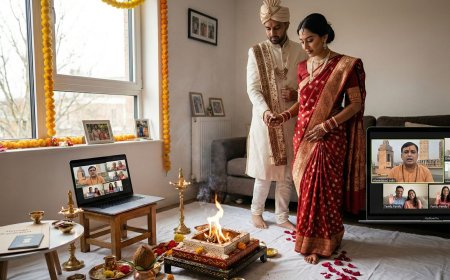





































































The NRI Engagement Announcement: How to Tell Your Family Across the World Without Getting the Order Wrong
For NRI couples, announcing an engagement is far more than a social media post — it is a carefully sequenced, culturally sensitive communication exercise spanning multiple countries, time zones, and family hierarchies. This expert guide covers the complete NRI engagement announcement strategy: who to tell first, how to coordinate calls across India, the USA, UK, Canada, UAE, and Australia, how to navigate Indian family cultural protocols, and when to go public on social media. The smartest, most thoughtful engagement announcement guide written specifically for Non-Resident Indian couples worldwide.


The Most Complicated Phone Call You Will Ever Make With a Ring on Your Finger
You said yes.
Or you asked, and they said yes. Either way, the moment happened. It was everything you hoped it would be — private, electric, completely yours. For a few hours, or maybe a whole evening, the news belonged only to the two of you. You ordered another glass of wine. You looked at the ring in the candlelight. You sent one photo to your closest friend with three words and a string of punctuation that communicated everything.
And then morning arrived.
And with morning came the realisation that you now had to tell approximately four hundred people — spread across six cities, three countries, and four time zones — in the right order, through the right channels, with the right tone, at the right moment, without anyone finding out before they were supposed to, without anyone feeling like they were an afterthought, and without inadvertently igniting the family dynamic that has been quietly simmering since your cousin's wedding three years ago.
Welcome to the NRI engagement announcement. One of the most emotionally loaded, logistically complex, culturally nuanced communication exercises you will ever undertake — and one that almost nobody prepares for properly.
Most couples think of the announcement as a single moment. A post. A call. A message. Something that happens once and then is done. For NRI couples, the announcement is not a moment. It is a sequenced, multi-phase communication operation that unfolds across days, sometimes weeks, and that sets the entire tone for how your families, your communities, and your planning process will unfold.
Get it right and you begin your engagement with warmth, unity, and the collaborative energy of families who feel honoured and included. Get it wrong — or get it partly wrong, which is the more common outcome — and you spend the first weeks of your engagement managing hurt feelings, navigating misunderstandings, and doing the relationship repair work that a more thoughtful announcement would have made unnecessary.
The time zone dimension adds a layer of complexity that is specific to NRI families and almost entirely absent from the engagement announcement advice that exists for domestic couples. Your mother in Delhi and your future mother-in-law in Ahmedabad. Your father's brother in New Jersey who will be deeply offended if he hears this from his daughter before he hears it from you. Your grandparents in Chennai who go to sleep at nine and wake at five and exist in a completely different daily rhythm from your life in Vancouver.
Coordinating all of this — deciding who hears first, how they hear it, through which channel, at what time of their day, and in what sequence relative to every other person on the list — is a genuine exercise in strategic communication. And it matters more than most couples realise until the first call goes slightly wrong.
This article is the guide that should exist for this moment. It covers the complete NRI engagement announcement strategy — the sequencing logic, the channel decisions, the time zone coordination, the family dynamic navigation, and the cultural protocols that shape how this news lands in Indian families across the world.
The Core Reality: Why the NRI Engagement Announcement Is Structurally Different
For a couple announcing an engagement within a single country, the announcement challenge is primarily social. Who do you tell first? How do you make it feel personal rather than broadcast? When do you post publicly?
For NRI couples, those questions sit on top of a structural complexity that transforms the announcement from a social exercise into a genuine coordination challenge.
You Are Operating Across Multiple Cultural Contexts Simultaneously
Your life in London or Toronto or Dubai operates on a set of social norms around announcements, privacy, and personal news that is shaped by the culture you live in daily. Your family in India operates on a different set of norms — ones where family hierarchy matters enormously, where the order in which people are told carries real social significance, and where the announcement of a child's engagement is not purely a personal moment but a family and community event with its own protocols.
Navigating both sets of norms simultaneously, without inadvertently violating either, is the core challenge of the NRI engagement announcement.
Time Zones Create Sequencing Problems That Do Not Exist for Domestic Couples
When you are ready to make your announcement, it is simultaneously morning in Sydney, afternoon in Dubai, evening in London, and the middle of the night in Toronto. The moment that feels right to you — the evening after the proposal, when the emotion is still fresh and you want to share it — may be a completely wrong moment for the people you most need to reach.
Calling your parents in India at the moment that feels natural to you may mean waking them at 3am. Waiting until a reasonable hour for them may mean that someone else — a mutual contact, a social media connection, a family member you told before you intended to — has already let the news slip.
The time zone problem is not just logistical. It is emotional. The people who matter most to you deserve to hear this news at a moment when they can receive it fully — not half-asleep, not mid-workday, not through a notification on a phone they check between meetings. Getting the timing right is an act of care.
Family Hierarchy in Indian Culture Is Not Optional Context
In Indian families — and this applies broadly, across regions and communities — the order in which people are told significant family news carries real social weight. Elders before younger relatives. Immediate family before extended. Close family before acquaintances, regardless of physical proximity.
For NRI couples, this hierarchy can create tension with the geographic reality of their lives. Your closest daily relationships may be with friends in your city of residence who find out almost immediately. Your most important family relationships — in the cultural hierarchy sense — may be with people in India who are geographically distant but who would feel genuinely hurt to hear this news after your university friends did.
Managing this tension — honouring the cultural hierarchy while also being authentic to your actual emotional relationships — is one of the most nuanced aspects of the NRI engagement announcement.
The Strategic Framework: A Complete NRI Engagement Announcement System
Phase One: The 48-Hour Private Window
Before any announcement to anyone — family, friends, social media — protect a minimum of 24 to 48 hours that belong exclusively to you and your partner.
This is not about being secretive. It is about being intentional.
The moment the announcement begins, it belongs to everyone. Your families will process it through their own emotional frameworks. Your friends will respond with their own energy. The social media moment will generate a momentum that is difficult to step back from. For a brief window before all of that — the news is just yours.
Use this window to make the decisions that will shape the announcement itself. Agree on the sequencing. Identify who calls who and when. Discuss how you want to handle the social media moment and what your timing preference is. Talk about anyone in either family whose emotional situation — health, a recent loss, a complicated relationship with either of you — requires a particularly careful approach.
Enter the announcement process with a shared plan, not just a shared excitement.
Phase Two: The Priority Tier — Parents First, Always
The first calls of your engagement announcement are to your parents and your partner's parents. This is not negotiable in any Indian family context, and it should not feel like a constraint. These are the people for whom this moment carries the deepest personal significance. They deserve to be first.
The time zone coordination for parent calls:
This is where the NRI complexity begins in earnest. If your parents are in India and you are in North America, the overlap window for a call that is a reasonable hour for both of you is narrow. Early morning your time — say, 7 to 9am EST — corresponds to early evening in India, which is typically an ideal time for family calls. Late evening your time corresponds to the middle of the night in India, which is not.
Map the time zone arithmetic before you are in the emotional rush of wanting to make the call. Know exactly what time it is in every city where your immediate family lives and identify the windows that work for both sides.
The sequencing between your family and your partner's family:
Ideally, both sets of parents hear the news at the same time — or as close to simultaneously as the logistics allow. The gap between one family knowing and the other family knowing is a window in which the news can travel through family networks in ways you cannot control. A parent who has just heard wonderful news may share it with a sibling before you have had a chance to call the other set of parents.
If simultaneous calls are not possible, keep the gap as short as possible — ideally within the same hour. The longer the gap, the more opportunity for the news to travel ahead of your announcements.
The channel for parent calls:
This should be a voice or video call. Not a WhatsApp message, regardless of how warm the message is. Not a voice note. Not a text with a photo of the ring attached.
Your parents have waited for this moment — in many cases, for years. They deserve to hear your voice when you tell them. They deserve the experience of responding in real time, of asking you questions, of expressing whatever they feel in the moment. A message, however thoughtful, cannot give them that. The call is an act of respect and love, and it will be remembered.
Phase Three: The Extended Immediate Family Tier
Within 24 to 48 hours of the parent calls, the announcement extends to what might be called the extended immediate family — siblings, grandparents, and any family elders who hold particular significance in your family structure.
Grandparents:
In Indian families, grandparents occupy a position of cultural and emotional significance that means they should hear this news early and directly. The time zone consideration for grandparents often requires more care than for parents — many elderly family members in India keep early hours and may not be reachable at the times that are convenient for you abroad.
Ask your parents to coordinate a time for you to call your grandparents, or to be present on the call as a bridge. A call that comes from you directly — even briefly — carries far more meaning than news that arrives through the family chain.
Siblings:
Siblings who are close — who are part of your daily life and would be genuinely hurt to find out through other channels — should receive direct calls or video messages around the same time as the extended family tier. Siblings living in different countries from both you and your family add another time zone variable to manage.
Family Elders and Significant Figures:
Every Indian family has specific individuals — an uncle who is a de facto family patriarch, a aunt who is your parent's closest confidante, a family friend who has known you since childhood and occupies a near-family status — whose position means they should hear this news directly rather than through the chain. Identify these people with your partner's input and ensure they receive calls, not forwarded messages.
Phase Four: The Extended Family and Community Tier
This phase typically unfolds over the first week following the engagement. It encompasses the broader family network — cousins, family friends, community connections — and is managed primarily through a combination of direct calls to key individuals and the natural flow of information through family networks.
The family WhatsApp group question:
Most Indian families have one or several WhatsApp groups that function as informal family communication channels. The question of whether, when, and how to use these groups for your engagement announcement is more nuanced than it might appear.
Posting in a family WhatsApp group before all the priority tier calls have been made is a sequencing error. The group post is visible to everyone simultaneously — including people who should have received individual calls first. If your announcement hits the family group before you have called your grandmother, your grandmother will see the post before she hears your voice.
Use the family group as a broadcast confirmation after the priority tier calls are complete — not as the announcement mechanism itself.
Managing the information flow:
Once the priority tier calls are done, information will travel through family networks independently of your control. This is normal and expected. What you can influence is the foundation — making sure the people who matter most heard it from you first, in the right way, with the care the moment deserved.
Phase Five: The Social Media Announcement
For NRI couples, the social media announcement carries more weight than it does for most because of the geographical spread of your community. An Instagram post or Facebook announcement is not just a social moment — it is the mechanism through which your wider network, spread across multiple countries, learns the news simultaneously.
The timing principle:
Post publicly only after everyone in your priority and extended family tiers has been notified directly. The risk of social media is that it removes your control over sequencing entirely. A family member in India who sees your Instagram post before you have called them has received the news in the worst possible way — impersonally, among hundreds of others, without the dignity of being told directly.
Map out your direct notification list and confirm that every person on it has been reached before you schedule your post.
The content and tone:
Your social media announcement is your first public expression of who you are as an engaged couple. It does not need to perform the relationship — it needs to reflect it. A genuine, personal, simply expressed announcement lands more meaningfully than an elaborate production. The ring photo is optional. The caption that sounds like you is not.
The Roka and Formal Engagement Ceremony Question
In many Indian families, particularly those with North Indian cultural backgrounds, a formal engagement or roka ceremony is the culturally recognised moment of official announcement — more significant, in some family contexts, than the private proposal itself.
For NRI couples, the question of how the private engagement relates to a future roka or formal ceremony creates a specific communication challenge. Do you announce the private engagement immediately and plan the ceremony separately? Do you keep the news within immediate family until the ceremony formalises it publicly?
There is no universal answer. The right approach depends on your specific family's expectations and the significance they attach to formal ceremonies. Have this conversation with your parents and your partner's parents in the priority tier calls — understand their expectations before the announcement spreads in ways that might pre-empt a ceremony that matters to them.
Families in Different Cities Within India
Many NRI couples have families spread across multiple Indian cities — parents in Mumbai, grandparents in a smaller city, extended family across different states. The physical proximity of Indian family members to each other means that news travels within India faster than you might expect.
Once your parents know, their siblings and close family friends may know within hours — not because your parents are indiscreet, but because sharing this kind of joyful news with people you love is a natural human impulse. Factor this reality into your sequencing. The gap between telling your parents and reaching the rest of the priority tier should be as small as possible.
Families With Complicated Dynamics
Almost every family has at least one relationship that requires extra care in the announcement process. A family member who has been estranged. A relative whose own difficult relationship situation makes receiving news of a happy engagement emotionally complex. A parent or grandparent whose health means the news needs to be delivered with particular gentleness.
Identify these situations in advance, during your 48-hour private window. Decide how you will handle each one — who makes the call, what the tone is, whether someone else should be present during the call to provide support. These are not complications to avoid. They are opportunities to show the care that distinguishes a thoughtful announcement from a broadcast.
Common Mistakes - Announcing on Social Media Before Calling Family
This is the most common and most damaging announcement mistake. No matter how strong the urge to post — the lighting is perfect, the moment is emotional, your friends are waiting — do not go public before the priority tier calls are complete.
A family member who discovers your engagement through Instagram has not just missed a call. They have been placed, in the most public way possible, outside the circle of people you considered important enough to tell directly. That experience is difficult to recover from quickly, and it casts a shadow over the early weeks of your engagement.
Sending a Message Instead of Making a Call to Priority Tier Contacts
A WhatsApp message — even a beautifully written one — does not carry the same meaning as a call for the people in your priority tier. The message can be reread but not responded to in real time. It does not convey your voice, your emotion, your presence. For parents and grandparents in particular, the call is not a formality. It is the moment they have been waiting for.
Forgetting the Time Zone Arithmetic Until the Last Minute
Working out what time it is in Delhi, Toronto, and Dubai simultaneously, in the emotional rush of wanting to share your news, is an exercise in frustration. Do the arithmetic in your 48-hour private window. Write it down. Know exactly when your optimal calling window is for each priority tier contact before you begin.
Allowing the Information Gap Between Families to Widen
The longer the gap between telling one set of parents and telling the other, the greater the risk of news travelling ahead of your announcements. Move through the priority tier as quickly as is practically possible. Same day, ideally within the same few hours.
Not Preparing for the Conversations That Follow the Announcement
The announcement call is not just a delivery of information. It opens a conversation. Your parents will have questions — about the timeline, about the wedding, about your partner's family, about what happens next. Be prepared for these conversations. You do not need answers to every question, but you should have a clear, calm response to the ones you know are coming.
The Emotional Dimension: What the Announcement Really Means
There is something worth pausing on in the middle of all this strategy and sequencing.
The engagement announcement is, beneath all of its logistical complexity, an act of love. Each call you make is a moment of saying: this person matters enough to me that I want them to hear this news from my own voice. This relationship is important enough that I thought about the right moment for this conversation, not just the convenient one.
For NRI families — families that have often navigated significant geographical and cultural distance — these moments of direct, personal connection carry an outsized emotional weight. Your parents in India are not just receiving information when you call them. They are receiving evidence that the distance has not changed what they mean to you.
The time zone coordination, the sequencing logic, the channel decisions — all of it is in service of that. The strategy exists to protect the emotion, not to replace it.
There will be calls that go unexpectedly. Parents who cry in ways you did not anticipate. Grandparents who go quiet on the line for a moment that stretches in a way that tells you everything. Family members who respond with a warmth that reminds you, across thousands of miles, exactly who you come from.
Let those moments be what they are.
Your NRI Engagement Announcement Checklist
The 48-Hour Private Window:
- Agree on full sequencing plan with your partner
- Map time zones for every priority contact
- Identify optimal calling windows for each family location
- Discuss any family situations requiring special care
- Agree on social media timing and content approach
Priority Tier Calls — Parents:
- Coordinate simultaneous or near-simultaneous calls to both sets of parents
- Use voice or video call — not messages
- Identify optimal time for Indian family calls (early evening India time)
- Be prepared for the conversation that follows the announcement
Priority Tier Calls — Extended Immediate Family:
- Grandparents — coordinate through parents if needed, call directly
- Siblings in all locations — direct calls or video messages
- Significant family figures — individual calls, not forwarded messages
Extended Family and Community:
- Complete all priority tier calls before any group messages
- Use family WhatsApp groups as confirmation broadcast, not primary announcement
- Allow natural information flow through family networks
Social Media:
- Confirm every priority and extended family contact has been reached
- Choose timing that reflects your communication, not social pressure
- Post when you are ready, not when the moment demands it
The Announcement Is the First Chapter of the Wedding Story
How you announce your engagement is the first thing your families and your community will know about how you intend to handle this wedding. It is a signal — about how much you value the relationships involved, how thoughtfully you are approaching this chapter, and what kind of couple you are going to be through the process ahead.
The strategy in this guide is not about managing people. It is about honouring them. The sequencing protects feelings. The channel decisions show care. The time zone coordination demonstrates that you thought about the moment from their perspective, not just yours.
NRI life asks a great deal of the relationships it stretches across geography. It asks families to love each other across distances that make presence difficult and communication imperfect. The engagement announcement is one of the moments where you can close that distance — not physically, but emotionally — by making every person feel that they were in the room with you when you shared the most personal news of your life.
That is worth the extra thought. That is worth the time zone mathematics. That is worth every moment of planning this guide has asked of you.
Make the calls. Have the conversations. Let the people who love you hear it in your voice.
Everything else can wait until tomorrow.
What's Your Reaction?
 Like
0
Like
0
 Dislike
0
Dislike
0
 Love
0
Love
0
 Funny
0
Funny
0
 Angry
0
Angry
0
 Sad
0
Sad
0
 Wow
0
Wow
0