





































































Raw Files vs Edited Photos: What NRI Couples Should Actually Request From Their Wedding Photographer
The raw files versus edited photographs conversation is one of the most technically misunderstood and contractually consequential discussions in the entire Indian wedding photography process — and most NRI couples either have it too late or not at all. This guide explains exactly what raw files are, what edited files contain, why photographers feel strongly about both, and what you should actually request based on your specific printing, archiving, and family sharing needs. Covers TIFF as a middle ground, resolution and colour space specifications, international file delivery logistics, backup systems, gallery expiry risks, and how to frame the conversation with your photographer before signing the contract. The most thorough raw files and edited photos guide written specifically for NRI couples worldwide.

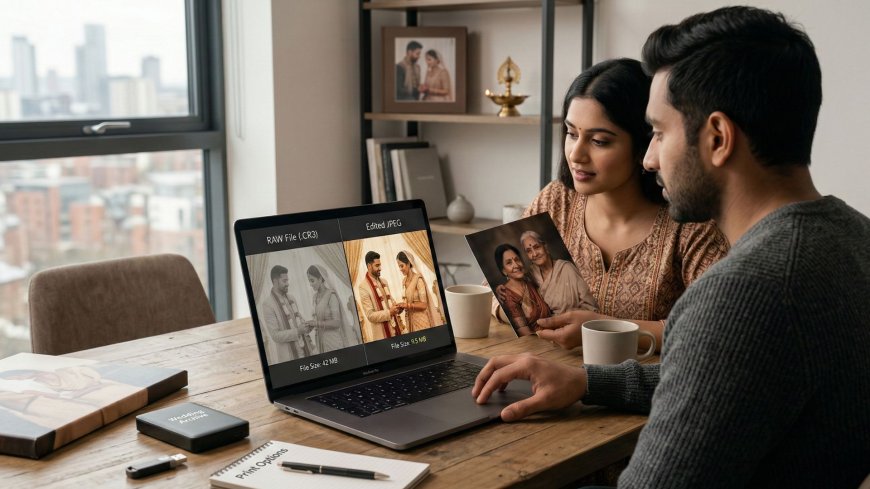
Raw Files vs. Edited Photos: What Should You Request?
Picture this: your wedding was three months ago. The photographs have arrived — a beautifully curated gallery of edited images, colour-graded with the warm, slightly golden tone you discussed with your photographer on that first video call from your flat in Manchester. They are, by any measure, gorgeous. You download them, share the link with your family, and spend an evening going through them with your partner.
Then your mother calls. She loves the photographs — she really does — but there's one image. The one where she's standing with your grandmother in the courtyard of the haveli, the late afternoon light falling across both of them. She wants a large canvas print for the living room wall. The image in the gallery is beautiful but she wants it slightly brighter, the background a little more defined, the colours a touch warmer than the photographer's grade. She wants to take it to a print shop and ask them to adjust it.
Can she? The answer depends entirely on a conversation you did or didn't have with your photographer eleven months ago, buried somewhere in a contract discussion about deliverables that felt less important at the time than the catering tasting and the décor brief.
The raw versus edited files conversation is one of the most technically misunderstood and most contractually consequential discussions in the entire wedding photography process. NRI couples navigating this from abroad — often without the technical background to understand what raw files actually are, and without the ability to sit across a table from their photographer and work through the implications — frequently arrive at this conversation either too late or not at all.
This guide is designed to give you the complete picture: what raw files are, what edited files are, why photographers feel strongly about both, what you should actually request given your specific situation, and how to frame the conversation with your photographer in a way that produces a clear, contractually documented outcome.
What Raw Files Actually Are
The word "raw" in photography does not mean unfinished in the casual sense. It is a specific technical term for a file format that contains the complete, unprocessed data captured by the camera's sensor at the moment the shutter was pressed.
The Technical Reality
When a digital camera takes a photograph, the sensor captures an enormous amount of information — light data, colour data, exposure data, white balance data — at a level of detail and latitude that far exceeds what any single JPEG image can contain. A raw file preserves all of this data in its original, unprocessed form. Think of it as the digital equivalent of an unprocessed film negative: it contains everything captured, but it requires processing before it becomes a viewable, usable image.
A JPEG, by contrast, is a processed file. The moment the camera creates a JPEG — or the moment a photographer exports an edited image as a JPEG or TIFF — a series of decisions have been baked into the file: white balance, exposure, contrast, colour rendering, sharpening, noise reduction. Some of that original sensor data is discarded in the compression process. The JPEG is a finished product. The raw file is the raw material from which finished products are made.
The difference in file size is significant. A raw file from a professional camera typically ranges from 25 to 50 megabytesper image. A high-quality JPEG from the same camera might be 5 to 15 megabytes. A full day of wedding photography — say 2,000 to 3,000 images — generates 50 to 150 gigabytes of raw data. For a three to five day NRI wedding programme across multiple events, the total raw file archive can reach 300 to 500 gigabytes or more.
What Makes Raw Files Valuable
Raw files offer three specific advantages over edited JPEGs that are relevant to wedding photography clients.
Exposure recovery latitude. A slightly overexposed or underexposed raw file can be corrected in post-processing with minimal quality loss because the full range of sensor data is preserved. The same correction applied to a JPEG — which has already discarded data in its compression — produces visible quality degradation. If an image from your wedding has potential that the edited JPEG doesn't fully realise, the raw file may contain the additional data needed to realise it.
White balance flexibility. White balance — the colour temperature of the light in an image — is fully adjustable in a raw file without quality loss. In a JPEG, white balance is baked in. For Indian wedding photography, where lighting conditions vary enormously across a multi-day programme, this flexibility can matter: an image shot in the warm tungsten light of a sangeet stage can be adjusted for natural skin tones from the raw file in ways that aren't possible from the processed JPEG.
Future-proofing. Post-processing software capabilities improve over time. A raw file opened in editing software five years from now will produce better results than the same file processed today, because the software will have more advanced algorithms for noise reduction, sharpening, and colour rendering. The raw file is the archival master — the JPEG is a point-in-time output.
What Edited Files Are — And What Goes Into Them
Understanding why photographers don't routinely hand over raw files requires understanding what the editing process actually involves — and why many photographers consider their edited files as much a creative product as the photographs themselves.
The Editing Process
Professional wedding photograph editing is not a simple matter of pressing a button. It involves a sequence of decisions and adjustments — applied consistently across thousands of images — that collectively constitute the photographer's visual signature.
A professional editing workflow typically includes: culling (selecting which images from thousands of captures are worth delivering), exposure and contrast adjustments, colour grading (the overall colour aesthetic that gives a photographer's work its recognisable look), skin tone correction, white balance adjustments, noise reduction (particularly important for images captured in low light at an Indian wedding), local adjustments (specific corrections to individual areas of an image — brightening a face in shade, reducing a blown highlight in a specific area), and sometimes retouching(removing blemishes, cleaning backgrounds, and similar).
For a full NRI wedding programme across multiple events, this process applied across 1,500 to 2,500 delivered images can represent three to six weeks of full-time post-production work by a skilled editor. This is where a significant portion of the photographer's fee is actually spent — not in the camera room during the ceremony, but in front of a calibrated monitor in the weeks that follow.
The Photographer's Perspective on Their Raw Files
Most professional photographers feel strongly about not delivering raw files, and their reasons deserve to be understood rather than dismissed.
The raw file is not a finished product. Handing over raw files is, from a photographer's perspective, like a chef handing over their uncooked ingredients at the end of a dinner party. The recipe, the technique, the seasoning — the creative work — hasn't happened yet. The raw file without the editing is not the photographer's work; it is the material from which their work is made.
The edited style is the intellectual property. Many photographers have developed distinctive editing styles — colour signatures, tonal approaches, skin tone treatments — through years of trial and refinement. This style is part of what you're purchasing when you book a photographer whose work you've admired in their portfolio. If their raw files are given to a third party to edit, the resulting images may bear no resemblance to the work that led you to book them. From the photographer's perspective, this misrepresents their work.
Unedited raw files look nothing like finished images. A raw file straight from the camera is flat, slightly grey, and unremarkable — because the camera deliberately captures a neutral, data-rich file rather than an aesthetically pleasing image. Clients who receive raw files and open them without understanding this are often dismayed by what they see, and the photographer bears the reputational consequence.
Volume creates practical problems. Delivering 300 to 500 gigabytes of raw files to an NRI client abroad is not a simple operation. It requires dedicated hard drives, significant delivery logistics, and creates ongoing storage obligations that most photographers are not contractually set up to manage.
The Honest Assessment: What Should You Actually Request?
This is where most guides on this topic become unhelpfully polarised — either arguing that clients should always demand raw files or that photographers should never provide them. The honest answer is more nuanced, and it depends on your specific situation.
Here is a framework for thinking about what to request:
| Scenario | What to Request | Why |
|---|---|---|
| You trust the photographer's editing style completely and it matches your aesthetic vision | Edited high-resolution JPEGs or TIFFs only | You've hired them for their complete creative vision — the edit is part of the product |
| You want flexibility to reprocess specific important images in the future | Edited files plus raw files for selected key images (ceremony shots, family portraits) | A compromise that gives you archival access without demanding the full raw archive |
| You're concerned about long-term archival and future reprocessing as technology improves | Full raw file archive plus edited deliverables | Maximum flexibility, but comes with storage obligations and typically higher cost |
| You have a specific family member or print shop that needs to make adjustments to delivered images | High-resolution TIFF exports of the specific images | TIFFs give significantly more editing latitude than JPEGs without requiring raw files |
| Your photographer's editing style is beautiful but very trendy and likely to date | Edited files plus raw files for key images | Allows future reprocessing in a more timeless style when the current trend ages |
| You're working with a newer or less established photographer whose editing you're less certain of | Edited files plus raw files as a contractual protection | Provides recourse if the editing quality disappoints |
The TIFF Option: The Middle Ground Most Couples Don't Know About
Between raw files and compressed JPEGs sits a third format that most couples in the raw versus edited debate don't know to ask about: the TIFF file.
A TIFF (Tagged Image File Format) is an edited file — the photographer's colour grade and corrections are applied — but it is saved without the lossy compression of a JPEG. It retains significantly more data than a JPEG while being an accessible, viewable file that doesn't require raw processing software to open and use.
For the specific scenario where you want to take a wedding photograph to a print shop for a large canvas print and need them to make adjustments — the scenario that opened this guide — a high-resolution TIFF export is often the right request. It gives the print shop and any editing professional meaningful latitude to work with the image without requiring access to the raw file and without the quality limitations of a heavily compressed JPEG.
Many photographers who are reluctant to provide raw files will readily provide TIFF exports of specific images on request — particularly for key images identified by the client as intended for large format printing. This is worth knowing before you frame a raw file request that meets resistance, because the underlying need — flexibility for high-quality large format output — can often be met by a TIFF without the philosophical conflict that raw file requests sometimes generate.
File Format and Resolution: The Questions That Actually Matter Day to Day
Beyond the raw versus edited debate, there are practical questions about file format and resolution that affect your day-to-day ability to use your wedding photographs in the ways you actually intend to use them.
Resolution and Print Size
Wedding photographers typically deliver images at the full resolution of their camera sensor — which for modern professional cameras means files that can produce large format prints without quality loss. A 45-megapixel camera (such as the Sony A7R V or the Nikon Z9, commonly used by premium Indian wedding photographers) produces files with enough resolution for print sizes up to approximately 40 x 50 inches at standard print resolution.
Your deliverables should always be full-resolution files — not web-optimised versions sized for screen viewing. Web-optimised images are typically 1 to 3 megapixels — enough for screen display and social media sharing, but completely inadequate for print. Confirm explicitly that your delivered files are full resolution, particularly if you intend to print any images at a large format.
JPEG Quality Settings
If your delivered files are JPEGs, they should be exported at maximum or near-maximum quality settings. JPEG compression is a sliding scale: at maximum quality, the file is large but the image data is almost entirely preserved. At lower quality settings, the file is smaller but visible compression artefacts appear, particularly in areas of fine detail and smooth gradients. Professional photographers always export client deliverables at maximum quality — but confirm this, particularly if you're working with a less established photographer.
Colour Space
Professional wedding photography is typically edited and delivered in the sRGB colour space, which is the standard for screen display and consumer printing. Some photographers work in Adobe RGB, which has a wider colour gamut and is preferable if you intend to have images printed on professional printing equipment. This is a technical detail that your print shop can advise you on, but it's worth asking your photographer which colour space they deliver in if you're planning any significant print investments.
Having the Conversation with Your Photographer
The raw versus edited conversation should happen during the booking process — not after the wedding, and not after the photographs have been delivered. This is a contractual discussion, and the outcome should be documented in your agreement.
How to Frame the Request
Approach this conversation from a place of understanding the photographer's perspective, not as a demand. The framing matters significantly in the Indian photographer-client relationship, particularly for NRI couples managing the relationship remotely.
Rather than: "We want all the raw files from our wedding."
Try: "We'd love to understand what you typically deliver in terms of file formats and resolution. We're particularly interested in ensuring we have the right files for large format printing, and we wanted to ask about your approach to raw files — we're happy to discuss what would work for both of us."
This framing invites a collaborative conversation rather than positioning the request as a challenge to the photographer's standard practice. Most professional photographers will engage openly with this approach and will often propose a solution that meets your underlying needs — TIFF exports for key images, or a specific set of raw files for ceremony moments — without the conflict that a blunt raw file demand sometimes generates.
What to Document in the Contract
Once the conversation has produced an agreed approach, document it specifically. Your contract or deliverables schedule should state:
The file format of delivered images (JPEG, TIFF, or both). The resolution at which images will be delivered (full sensor resolution, not web-optimised). The number of images to be delivered. Whether raw files will be provided, and if so, for which images or events and in what format. The delivery method — online gallery, hard drive, USB drive, cloud download link — and who bears the cost of physical delivery if applicable. The delivery timeline — when will the edited images be available? The archive period — how long will the photographer retain the original files after delivery?
That last point — the archive period — is particularly relevant for NRI couples. If your delivered files are lost, corrupted, or accidentally deleted, how long do you have to request a replacement? Professional photographers typically retain original files for one to three years after delivery, but this varies and should be specified in your contract.
Storage and Backup: Your Responsibility After Delivery
Receiving your wedding photographs is not the end of the file management process. It is the beginning of your own archival responsibility — and this is an area where NRI couples, managing files across multiple countries and devices, sometimes get into genuine difficulty.
The 3-2-1 Backup Rule
Adopt the standard archival approach: three copies of your files, in two different formats, with one copy stored offsite(or in cloud storage). For wedding photographs specifically:
Keep one copy on your primary computer or external hard drive. Keep a second copy on a separate external hard drive stored in a different physical location — at a family member's home, or in a fireproof storage box. Keep a third copy in cloud storage — Google Drive, iCloud, Amazon Photos, or Backblaze are all appropriate options for large file archives.
The total storage requirement for a delivered wedding gallery — typically 1,500 to 2,500 full-resolution JPEGs from a multi-day NRI wedding — is approximately 20 to 50 gigabytes. This is manageable on modern cloud storage plans and on affordable external hard drives.
If you have negotiated raw file delivery, the storage requirement is significantly larger — potentially 300 to 500 gigabytesfor a full multi-day programme. Budget for the storage infrastructure before you take delivery.
Sharing Files with Family
NRI families often want to share wedding photographs widely — with relatives in India, with family members across different countries, with friends who attended and those who couldn't. The practical approach is to share a curated selection of high-resolution files through a cloud sharing service rather than sharing your full deliverable archive. This protects the integrity of your archive while giving family members access to printable, high-quality images.
Google Photos and WeTransfer are widely used for this purpose. Many wedding photographers also deliver through gallery platforms like Pixieset or ShootProof that include client download capabilities and built-in sharing features. If your photographer uses one of these platforms, understand the expiry terms — most temporary gallery links expire after six to twelve months, and you need to download your files before the link expires.
The Specific NRI Considerations
Several aspects of the raw versus edited conversation carry specific dimensions for NRI couples that deserve direct attention.
The International Delivery Problem
Receiving physical hard drives across international borders — a standard delivery method for large file archives including raw files in the Indian market — creates logistical complications for NRI clients. Customs declarations for hard drives, import duties in certain countries, and the risk of damage or loss in international shipping all create friction that purely digital delivery avoids.
If you are negotiating raw file delivery, discuss the delivery method specifically. Cloud delivery — via services like WeTransfer Pro or Google Drive — is more reliable for international NRI clients than physical media, though it requires a reliable high-speed internet connection for files of the size that raw archives represent.
Family Print Requirements in India
Many NRI couples have family members in India who want physical prints made from wedding photographs — prints for the home, for framing, for distribution among relatives. These family members are typically taking files to local print shops in Indian cities, which may have varying calibration and colour management standards.
For this specific use case, high-resolution TIFF files of the images intended for printing are the most appropriate request. They provide the latitude needed for print adjustment without the complexity of raw files, and they perform significantly better than compressed JPEGs when large format prints are required.
The Long-Distance Editing Request
Some NRI clients, particularly those with design backgrounds or access to photo editing skills, want to process specific images themselves — applying their own colour grade, adjusting specific elements, or creating alternative versions of key photographs. This is a legitimate desire, and the appropriate request in this case is raw files for the specific images in question, framed clearly as a desire to produce personal creative variations rather than a replacement for the photographer's edited deliverables.
Most photographers respond more positively to a specific, bounded request — "We'd love the raw files for the pheras and the vidaai sequence specifically, so we can experiment with some alternative processing" — than to a blanket raw file demand that feels like a challenge to their professional authority over their own work.
Common Mistakes NRI Couples Make with Raw and Edited Files
Not asking about file formats during the booking conversation. By the time the photographs arrive, the contract is signed and the terms are fixed. This conversation needs to happen before you commit.
Assuming raw files are better without understanding what they actually are. Raw files are unprocessed data, not superior finished images. They require technical knowledge and software to use. Requesting raw files without the ability to process them produces a large archive of flat, grey, unremarkable images that you will never use.
Not downloading files from temporary gallery links before they expire. Online gallery links typically expire. If you don't download your full-resolution images before the expiry date, they may be permanently lost. Set a calendar reminder the moment you receive the gallery link.
Not making multiple backup copies of delivered files. A single copy of your wedding photographs on a single hard drive is one drive failure away from being gone forever. Implement the 3-2-1 backup system immediately upon receiving your files.
Requesting raw files for the wrong reason. If the underlying need is large format printing, request TIFF exports. If the underlying need is editing flexibility for specific images, request raw files for those images specifically. Match the request to the actual need.
Not specifying resolution in the deliverables agreement. "Digital images" is not a specification. Full-resolution JPEG at maximum quality is a specification. Make sure your contract is specific.
Confusing web-optimised preview images with full-resolution deliverables. Many gallery platforms show web-optimised previews while the full-resolution downloads sit behind a download button. Make sure you are downloading the full-resolution files, not saving the screen-optimised previews.
Not discussing the photographer's archive retention period. If your delivered files are lost and the photographer has already deleted their copies, there is no recourse. Confirm the retention period and use it as a window within which to verify your own backup system is working.
The conversation about raw files versus edited photographs is, at its core, a conversation about what you are actually purchasing when you book a wedding photographer. You are not purchasing unprocessed data. You are purchasing a photographer's vision — their eye, their technical skill, their editing aesthetic, and the months of post-production work that transforms thousands of raw captures into a curated gallery of finished images that represent your wedding as they have seen and interpreted it.
Understanding that distinction changes the conversation from a negotiation about file formats to something more like a genuine creative collaboration — one in which your needs (archival security, printing flexibility, family access) and your photographer's needs (creative integrity, professional representation of their work) can usually be reconciled into an agreement that serves both.
The couples who have this conversation early, document the outcome clearly, and implement a proper backup system the day their files arrive are the ones who will still have their wedding photographs — in full resolution, properly archived, accessible to their families — forty years from now.
That is the goal. Everything else is a means to it.
What's Your Reaction?
 Like
0
Like
0
 Dislike
0
Dislike
0
 Love
0
Love
0
 Funny
0
Funny
0
 Angry
0
Angry
0
 Sad
0
Sad
0
 Wow
0
Wow
0