









































































How to Split Your Wedding Shopping Between Jalandhar and Online — A Practical Hybrid Strategy
For the NRI bride planning a Jalandhar wedding from abroad, the question of which purchases belong in the physical market and which belong in the online channel is one of the most strategically important decisions in the entire shopping process — and most brides answer it by default rather than by design. This comprehensive guide from NRIWedding.com builds the complete hybrid shopping framework around five diagnostic questions that determine the correct channel for every purchase category. It maps the online Indian bridal market with precision — covering Kalki Fashion, Craftsvilla, Tanishq online, Cbazaar, Mirraw, and the major e-commerce platforms — alongside the categories that are firmly in Jalandhar, firmly online, and genuinely in the middle ground. It covers the delivery address strategy for pieces ordered to an India address, the return window management framework, the platform documentation requirements for international transit, the sequencing of online and physical purchases for pieces that must coordinate, and the five most consequential mistakes NRI brides make when treating the two channels as interchangeable rather than complementary.


How to Split Your Wedding Shopping Between Jalandhar and Online — A Practical Hybrid Strategy
The folder on Amandeep's laptop was called, with the optimistic tidiness of someone who had not yet understood the scale of what they were undertaking, Wedding Shopping. Inside it were eleven subfolders. Each subfolder contained screenshots, saved links, Instagram grabs, and in two cases actual PDF catalogues that she had requested from boutiques after finding them on Instagram at various hours of the night over the preceding five months. The folder had been created in April. It was now September. The wedding was in January. And the folder, which had started as an organisational tool, had become a record of the specific confusion that results when a person in Edinburgh has been simultaneously researching the Jalandhar bridal market and the online South Asian bridal market for five months without a framework for deciding which purchases belong in which channel.
Amandeep was not disorganised. She was, by profession, a project manager, which meant that her natural relationship with a complex task was to build a framework first and execute second. What she had done with the wedding shopping was the opposite: she had executed first — or rather, she had researched first, which in the absence of a framework had produced the same result as executing without one — and she had accumulated eleven subfolders of information that were not yet a plan.
The problem was a specific one. She had two shopping channels available to her: Jalandhar, where the wedding was happening and where her family was and where the physical market was, and the online market, which had expanded dramatically in the past five years and which now offered Indian bridal wear, jewellery, footwear, and accessories at an international scale that her mother's generation had not had access to. Both channels were genuine options for most of the categories on her list. Neither channel was obviously better for all categories. And the question of how to split the shopping between the two — which categories belonged in Jalandhar, which belonged online, and which could go either way depending on specific circumstances — was a question she had not yet answered systematically.
She opened a new document and wrote, at the top: which things require Jalandhar, which things require online, and why?
She stared at the question for a moment. Then she opened WhatsApp and called her friend Navneet, who had gotten married the previous year and who had, she knew, done the hybrid approach with a specific intentionality that she had mentioned in passing but never explained fully.
Navneet answered on the third ring. Amandeep said: can you tell me how you split the shopping?
Navneet said: yes. But it's going to take a while.
It took forty minutes. What Navneet described over those forty minutes was not a list of which items to buy where, but a framework for thinking about the question — a set of principles that, once understood, made the allocation decision for each category straightforwardly derivable. Amandeep took notes. She filled two pages. And when the call ended she opened the Wedding Shopping folder and looked at the eleven subfolders with a clarity she had not had before.
This guide is the complete version of that forty-minute conversation — the framework that allows the NRI bride planning a Jalandhar wedding to split her shopping between the physical market and the online channel with the intelligence the decision deserves, rather than the ad hoc accumulation of screenshots and saved links that the absence of a framework produces.
The Framework: Five Questions That Determine the Channel
Before any category-specific analysis, the five questions that determine which channel is appropriate for any given purchase. These questions are applied to each item on the shopping list, and the answers determine the allocation.
The first question is whether the item requires physical assessment before purchase. Some items — the primary ceremony garment, the jewellery that must be tried on, the footwear that must be assessed for fit and comfort — have physical properties that cannot be reliably evaluated from photographs, video calls, or fabric swatches alone. For these items, the physical market is required. For items whose key properties are visual and can be adequately assessed from high-quality photographs and detailed specifications, the online channel is viable.
The second question is whether the item has a fit requirement that necessitates in-person assessment and alteration. The lehenga blouse, the sherwani, the bandhgala — these are garments whose fit is determined by the specific proportions of the wearer's body and cannot be reliably achieved through size charts and remote measurement alone. They belong in Jalandhar. The saree, which is draped rather than constructed to measurement, the dupatta, which is not size-dependent, the footwear in standard sizes — these have fit requirements that the online channel can accommodate.
The third question is whether the Jalandhar market offers a specific quality advantage or price advantage over the online market for this category. For the phulkari dupatta, the Jalandhar craft cluster is the source from which the online market also sources — the online retailer is an intermediary between the buyer and the craft, and the Jalandhar market gives the buyer direct access to the craft. For the contemporary Indo-western accessories or the minimalist jewellery that certain NRI brides want, the online market aggregates a variety that no single physical market — including Jalandhar — can match.
The fourth question is whether the item has a timeline requirement that the online channel can serve within the wedding planning schedule. The online purchase requires transit time — four to seven days for domestic India shipping to a Jalandhar address, ten to twenty days for international shipping to an Edinburgh address — and this transit time must be factored into the purchase timeline. For items that need to be tried on with the primary garment before the final decision, the online purchase must arrive with enough lead time for this assessment and any subsequent alterations.
The fifth question is whether the purchase involves a value threshold that requires the in-person verification of quality that the online channel cannot provide. For a ₹2,000 set of glass bangles, the online risk is acceptable. For a ₹85,000 jewellery set, the inability to assess the gold quality, the embellishment integrity, and the actual colour in physical light is a risk that the purchase value does not justify.
These five questions, applied to each category on the shopping list, produce an allocation that is reasoned rather than assumed.
The Online Market: What It Actually Offers
Before the category allocation, a clear-eyed assessment of the online Indian bridal market — what it genuinely offers, where its limitations are, and which platforms are most relevant for the NRI bride planning a Jalandhar wedding.
The online Indian bridal market has expanded dramatically since 2018, and the platforms that serve it have developed sophisticated enough product photography, detailed enough specifications, and reliable enough logistics that the online channel is genuinely competitive with the physical market for specific categories. The platforms most relevant to the NRI bride planning a Jalandhar wedding are several.
Biba, Global Desi, and W for Woman carry ethnic wear through their own online platforms and through the major e-commerce aggregators, with the advantage of standardised sizing, documented return policies, and the logistics infrastructure of established retail brands. For mid-market ethnic wear in the pre-wedding event category, these platforms are reliable and accessible.
Craftsvilla and Tjori carry ethnic wear and accessories with a specific emphasis on craft-sourced pieces — the handloom sarees, the phulkari dupattas, the block-printed kurtas — that are sourced from the artisan clusters that also supply the Jalandhar physical market. For the bride who wants craft-sourced pieces but cannot be in Jalandhar to assess them, these platforms provide a more direct artisan connection than the general e-commerce aggregators.
Kalki Fashion and Cbazaar carry bridal ethnic wear — lehengas, anarkalis, sarees, sherwanis — at the mid-to-premium market level, with the specific advantage of international shipping to NRI addresses. These platforms have developed their NRI offering specifically and carry the documentation infrastructure — the valuation certificates, the fabric composition certifications — that the NRI buyer needs for customs and insurance purposes.
Tanishq and Malabar Gold carry gold jewellery through their online platforms with the BIS hallmark certification and the documented purchase receipts that the NRI buyer needs for international transit. For the student-budget or mid-budget NRI bride who wants certified gold pieces at accessible prices without the Jalandhar jewellery market navigation, the established chain jewellers' online platforms provide a reliable alternative.
Mirraw and IndiaRush are the aggregator platforms that carry the widest range of Indian ethnic wear from multiple vendors, at the lowest average price points in the online market. The quality is highly variable, the returns process is less reliable than the brand platforms, and the product photography is frequently more flattering than the product itself. These platforms are appropriate for low-stakes purchases — the event accessories, the backup footwear, the children's outfits — and are not appropriate for high-value or quality-critical purchases.
The Online Market's Genuine Limitations
The online Indian bridal market's limitations deserve as clear a statement as its strengths, because the NRI bride who overestimates the online channel's capability will make purchases that disappoint and that the physical market would have served better.
The colour accuracy of online product photography is the most consistently cited limitation by NRI brides who have shopped online for bridal wear. The combination of studio lighting, image processing, and screen calibration variation produces a colour on the buyer's screen that may differ significantly from the actual colour of the piece. The red that photographs as a deep burgundy may be a brighter tomato red in person. The champagne that looks ivory on screen may be closer to yellow in natural light. For colour-critical purchases — the lehenga, the saree that must coordinate with the jewellery — this limitation is decisive.
The fabric assessment limitation is the second most cited issue. The weight, the drape, and the texture of a fabric — the properties that determine how it moves and how it photographs in a wedding context — cannot be assessed from a photograph. The online market addresses this partially through fabric swatches, which some platforms offer on request, and through detailed fabric descriptions, which vary in accuracy. For the primary ceremony garment, these partial compensations are insufficient.
The returns process for high-value items is the third limitation. The NRI bride who is buying from India and shipping to the UK or Canada and who needs to return an item that is not as described faces a returns process that is expensive, slow, and not always successful. The item that is described as hand-embroidered and arrives with machine embroidery cannot always be successfully returned through the dispute resolution processes of the aggregator platforms. The purchase of high-value items online from unfamiliar vendors is therefore a risk that the physical Jalandhar market's accountability — the ability to return to the shop, to involve the family network, to exercise the consumer protection framework of a local transaction — mitigates more effectively.
The Category Allocation: Jalandhar vs Online
Firmly in Jalandhar: The Non-Negotiable Physical Market Categories
The primary ceremony lehenga or bridal suit belongs in Jalandhar. The colour assessment, the fabric assessment, the fit requirement, the alteration process, and the quality verification of a piece at this price point all require the physical market. The online channel can support the research process — identifying styles, developing the brief, shortlisting aesthetics — but the final purchase of the primary ceremony garment should happen in Jalandhar.
The bridal jewellery set — particularly any piece with real gold or real stones — belongs in Jalandhar. The physical assessment of gold quality, the verification of hallmark certification, the assessment of stone quality and setting integrity, and the ability to try the pieces on in natural light and assess their appearance on the specific wearer's body all require physical market access. The Jalandhar jewellery market — the family jeweller relationships, the Null Bazaar specialist vendors — provides the quality verification infrastructure that the online channel does not.
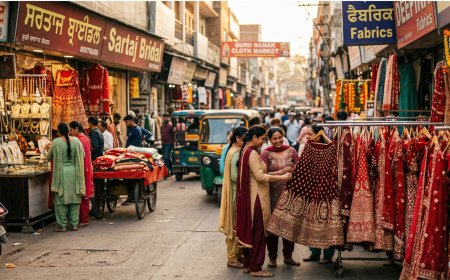
The chope and the traditional phulkari pieces belong in Jalandhar — specifically in Basti Sheikh and the craft cluster sources described in the dupatta guide. The online market carries phulkari pieces, but the ability to assess whether a piece is genuinely hand-embroidered or commercially produced requires handling the piece in person, and this assessment is not available remotely.
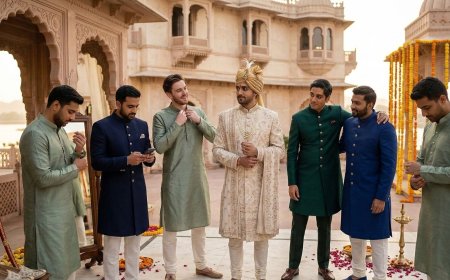
The groom's sherwani — specifically the made-to-measure or custom option that provides the fit precision a sherwani requires — belongs in Jalandhar. The physical fitting, the construction assessment, and the alteration process that a sherwani requires are not manageable through the online channel. The ready-to-wear sherwani at a standard size is a partial exception: if the groom's measurements fall within the standard size range and the platform's size chart is reliable, a ready-to-wear sherwani from a reputable online platform can be purchased online and collected at the Jalandhar address, tried on, and returned if the fit is not adequate.
The chooda belongs in Jalandhar — specifically from the specialist vendors in the Null Bazaar area or from the community network sources described in the second-hand guide. The cultural specificity of the chooda and the physical assessment required to evaluate the lac quality and the sizing make the physical market the appropriate channel.
Firmly Online: The Categories Where the Online Channel Excels
The pre-wedding event outfits — the haldi, mehndi, and sangeet outfits — are the category where the online channel is most straightforwardly appropriate. The stakes are lower, the fit requirements are less demanding, the colour accuracy requirements are less critical, and the price points are within the range where the online risk is acceptable. Buying the mehndi outfit from Biba's online platform or the sangeet lehenga from Kalki Fashion online frees the Jalandhar physical market time for the primary garment and the jewellery, which is exactly the exchange that serves the NRI bride's constrained time budget.
The fashion accessories — the contemporary clutches, the embellished hairpins, the statement earrings for the reception that are not part of the primary jewellery set — are the category where the online market's aggregated variety most clearly exceeds the Jalandhar physical market's range. The platforms that carry contemporary Indian fashion accessories carry a breadth of option that no single physical market can match, and the price points in this category are accessible enough that the online risk is proportionate.
The children's outfits for the wedding — described in the earlier guide in the Mumbai context but equally applicable to the Jalandhar wedding — are the category where the online platforms' standardised sizing, documented returns policies, and mid-market price points make them the most efficient purchasing channel. Buying the children's outfits from Firstcry or Hopscotch online, delivered to the Jalandhar family address before the wedding, eliminates an entire category of physical market shopping without compromising the outcome.
The shapewear, the fashion tape, the heel grips, the pharmacy kit — the home category described in the Mumbai vs home guide — are items that should be bought online or at home before departure, not in Jalandhar. These are commodity items available on any UK or Indian e-commerce platform and should not consume Jalandhar physical market time.
The reception sarees for the extended family — the pieces that are being purchased as gifts or as coordinated family contributions — are items where the online platform's variety and the ability to have pieces delivered directly to the Jalandhar family address reduces the logistical complexity of managing multiple purchases across a compressed visit. For sarees in the mid-market range where the colour can be adequately assessed from platform photography and where the fabric type is specified accurately in the product description, the online channel is appropriate.
The Considered Middle Ground: Either Channel Depending on Circumstance
The bridal dupatta — specifically the non-phulkari pieces, the zardozi and gota patti pieces in the standard embellishment vocabulary — sits in the middle ground. The physical Jalandhar market offers the best quality and the best price for the phulkari dupatta. For the zardozi dupatta or the gota patti piece, the online platforms carry a range comparable to the Jalandhar physical market, and the platform photography for embellished textiles is accurate enough that the colour and embellishment assessment is manageable remotely. The decision depends on whether the bride needs the physical assessment to be confident in the purchase or whether the platform's sample dispatch service — which the better platforms offer — provides sufficient information.
The artificial jewellery for pre-wedding events sits in the middle ground. The Jalandhar physical market carries better quality at lower prices than most online platforms for equivalent pieces. But the online platforms — particularly the mid-market platforms that carry the wedding accessories category with standardised quality and documented returns — are adequate for the event jewellery category where the quality standard is lower. The decision depends on whether the Jalandhar visit has time allocated for pre-wedding event jewellery shopping, and whether the online platform's convenience justifies the slight quality trade.
The men's accessories — the pocket square, the mojdi, the turban fabric — are items where the online market's variety and convenience make it a legitimate alternative to the physical market for all but the most quality-critical pieces. The turban fabric specifically is available through online platforms that carry the full range of Punjabi turban textiles and can deliver to a Jalandhar address with the lead time required for the family's turban-tying tradition.
The Hybrid Logistics: Making It Work in Practice
The practical execution of the hybrid strategy requires a logistics framework that manages the online and physical purchases as a single, coordinated process rather than as two separate shopping activities. The failure mode of the hybrid approach is the purchase that was supposed to arrive at the Jalandhar address before the wedding and did not, or the piece that arrived but turned out to require an alteration that the compressed Jalandhar visit could not accommodate.
The Delivery Address Strategy
For the NRI bride who is buying online pieces for delivery to the Jalandhar wedding, the delivery address management requires specific attention. Pieces purchased online should be delivered to the Jalandhar family address well before the bride's arrival — not the week of the bride's arrival, when the Jalandhar address is likely to be occupied by the multiple logistics of a wedding week and the specific family dynamics that make tracking a courier delivery in the wedding week genuinely challenging.
The online purchases that need to be assessed against the primary garment — the dupatta that needs to be held against the lehenga to assess the colour coordination, the jewellery that needs to be tried on with the complete bridal look — should be delivered at least three weeks before the bride's arrival. This allows the family to receive and store the piece, allows the bride to assess it on arrival with adequate time to reorder if the piece is not right, and prevents the specific anxiety of the wedding-week delivery that may or may not arrive in time.
The Return Window Management
The online purchase's return window — the period within which the buyer can return a piece that does not meet the specification — is the most important logistical element to track for the NRI bride buying online for delivery to an India address. Most Indian e-commerce platforms offer a seven to fourteen-day return window from delivery. For the NRI bride whose arrival in Jalandhar is within or close to this window, the return needs to be managed quickly — the piece assessed immediately on arrival, the return initiated within the window, and the replacement ordered with enough lead time to arrive before the wedding.
The return window management for pieces delivered to the Jalandhar address and assessed remotely — where the family member receives the piece and assesses it via video call with the bride — requires a family member who is competent to assess the piece against the brief and confident enough to initiate a return if the piece does not meet the specification. Not all family members are positioned for this role. Identify the right person before the pieces begin arriving.
The Platform Documentation for International Transit
For the NRI bride who is purchasing pieces online for delivery to her Edinburgh or Toronto address — shipping them directly to her home country rather than to the Jalandhar wedding address — the customs and documentation implications described in the shipping and luggage guides apply. The online platform's purchase documentation — the invoice, the product description, the declared value — forms the basis of the customs declaration, and the accuracy of this documentation is the bride's responsibility to verify before the shipment leaves India.
The specific complication for online purchases shipped internationally is that the platform's declared value may not reflect the actual value of the piece — some platforms under-declare for competitive customs reasons, and the NRI bride who accepts an under-declared shipment is accepting a customs risk that the previous guide described in detail. Check the declared value on the shipping documentation before the piece leaves India and request a correction if it does not accurately reflect the purchase price.
Managing the Timeline: When to Buy What
The hybrid strategy's effectiveness depends significantly on the sequence in which the purchases are made, because the online and physical purchases interact with each other through their delivery timing, their alteration requirements, and the assessments that must happen with multiple pieces together.
The sequence that works is as follows. Begin the online research phase at the earliest point in the planning process — the eleven subfolders of screenshots are the right output for this phase, and the research should run in parallel with the Jalandhar physical market research rather than sequentially. The research phase produces the shortlists for both channels simultaneously.
Confirm the primary garment commission in Jalandhar on the earliest physical market visit — the five-to-six month lead time requirement for a custom piece makes this the most time-critical decision in the entire shopping plan, and it anchors the subsequent decisions in both channels.
Place the online orders for the pre-wedding event outfits and the children's outfits two to three months before the wedding, for delivery to the Jalandhar address. These are the pieces with the lowest time sensitivity and the highest return risk — the earlier they arrive, the more time there is to manage any issues.
Purchase the physical market pieces — the jewellery, the chooda, the dupatta, the footwear — on the Jalandhar visit that is four to six weeks before the wedding. This is the visit where the primary garment's alteration and collection also happens, and it is the visit where the physical market shopping is most efficiently concentrated.
Purchase the online accessories and final pieces — the fashion accessories, the reception earrings, the belt or waistband piece that was decided upon after seeing the primary garment — in the final four weeks before the wedding, for delivery either to the Jalandhar address or directly to the Edinburgh address depending on the customs calculation described in the logistics guides.
The Research Integration: How to Use Online Research to Improve Physical Market Purchases
The hybrid strategy's most underappreciated benefit is not the pieces purchased online but the research capability the online market provides for the physical market purchases. The online market, with its aggregated photography and its breadth of option, is the most efficient tool available for developing the brief that the physical market will then execute.
The bride who arrives in Jalandhar with eleven subfolders of screenshots has done the research. The bride who arrives with eleven subfolders of screenshots organised into a brief — specific references for the colour, the silhouette, the embellishment level, the fabric — uses those screenshots as the communication tool with the physical market vendor that converts the research into an accurate commission. The online market makes the brief specific. The Jalandhar physical market executes the specific brief.
This integration — online research that creates brief specificity, physical market that executes with the quality and the craft access that Jalandhar offers — is the core value of the hybrid strategy. It is not about buying some things online and some things in person. It is about using each channel for what it does best, in a coordinated sequence that produces a better outcome than either channel alone would generate.
Common Mistakes NRI Brides Make With the Hybrid Strategy
The first and most consequential mistake is treating the online and physical channels as interchangeable rather than complementary. The bride who decides to buy the lehenga online because the online market is convenient and the Jalandhar visit is stressful is using the convenience of the online channel to avoid the effort that the quality of the primary garment requires. The channels are not interchangeable. They have different strengths and different limitations, and the hybrid strategy works because it respects those differences rather than ignoring them.
The second mistake is managing the online and physical shopping as separate, uncoordinated processes. The online pieces that are supposed to coordinate with the physical pieces — the dupatta that must match the lehenga palette, the reception earrings that must work with the maang tikka — cannot be confirmed until the physical pieces they are coordinating with have been confirmed. The online purchases that depend on the physical purchases must be sequenced after those physical purchases, not before.
The third mistake is underestimating the online delivery timeline to an India address. The NRI bride who orders a piece from an Indian e-commerce platform expecting two-day delivery to a Jalandhar address and receives a realistic estimate of seven to ten working days has not accounted for the reality of domestic Indian courier logistics, which vary significantly by the platform, the vendor's location, and the Jalandhar delivery infrastructure. Add buffer to every online delivery estimate, and order early enough that the buffer does not consume the assessment and alteration time.
The fourth mistake is not reading the return policy before purchasing. The return policies of Indian e-commerce platforms vary significantly by platform, by product category, and by vendor — some platforms offer free returns, some charge return shipping, some do not accept returns on sale items or on customised items. Reading the return policy before purchase rather than after the piece arrives and needs to be returned is the discipline that prevents the specific frustration of a return that the policy does not support.
The fifth mistake is using the online research phase as a substitute for the physical market visit rather than as preparation for it. The bride who has done extensive online research and who believes that this research means she knows the market is the bride who arrives in Jalandhar with confidence that the physical market will quickly calibrate. Online photographs are not the physical market. The research is preparation. The physical market visit is the education. Both are required.
The Resolution
Amandeep reorganised the eleven subfolders on a Thursday evening, three days after the call with Navneet. She did not reduce the number of subfolders — the research was all still there, all still useful. She reorganised them by channel rather than by category: what was going to happen in Jalandhar, what was going to happen online, and what she had not yet decided.
The Jalandhar folder was smaller than she expected. The primary garment and the jewellery and the chooda and the phulkari dupatta and the ceremony footwear. The things that required her body or her hands or the specific craft access of the Jalandhar market. The things that the online channel could not give her.
The online folder was larger than she expected. The pre-wedding event outfits. The children's outfits. The reception accessories. The fashion pieces for the extended family. The items that the online market could serve reliably, with the right platform selection and the right logistics management.
The undecided folder contained three items that the five questions had not resolved cleanly. She sent them to Navneet in a message that said: still not sure about these three.
Navneet replied within the hour with the specific, patient intelligence of someone who had been through the process and who understood that the hybrid strategy was not a formula but a framework — and that the three items in the undecided folder were the items where her specific circumstances, her specific family context, and her specific Jalandhar visit timeline would determine the answer.
Amandeep read the reply and understood that the framework was working. The undecided items were undecided not because the framework had failed but because the framework had correctly identified them as the items that required her specific judgment rather than a general principle.
She made the coffee. She opened the undecided folder. She applied the five questions again, this time with the specific information about her timeline and her family context that she had not fully incorporated in the first pass.
By the time the coffee was finished, two of the three items had moved. One to Jalandhar. One to online. The third remained in the undecided folder, which was, she decided, acceptable — three items resolved, one requiring more information, and a framework that had turned eleven subfolders of accumulated screenshots into something that looked, at last, like a plan.
She renamed the folder. Not Wedding Shopping. The new name was the one that the framework had made possible: Wedding Shopping — Allocated.
The allocated folder was not the shopping. It was better than the shopping. It was the clarity that makes the shopping possible.
Apply the five questions to every item on the shopping list before allocating it to a channel — the allocation should be derived, not assumed.
Use the online research phase to build the brief that the Jalandhar physical market will execute — the screenshot is preparation, not purchase.
Order online pieces for Jalandhar delivery at least three weeks before your arrival — not the week of the wedding.
Sequence the online purchases that coordinate with physical pieces after the physical pieces are confirmed, not before.
Read the return policy before every online purchase — the policy varies enough between platforms to determine whether the online purchase is low-risk or high-risk for the specific item.
The hybrid strategy is not about buying some things in Jalandhar and some things online. It is about using each channel for what it does best, in a sequence that is coordinated rather than chaotic, and arriving at a bridal wardrobe that is the product of intelligent allocation rather than the accumulated consequence of eleven unorganised subfolders.
Published by NRIWedding.com — The Premium Global Platform for Non-Resident Indians Planning Indian Weddings From Abroad.
What's Your Reaction?
 Like
0
Like
0
 Dislike
0
Dislike
0
 Love
0
Love
0
 Funny
0
Funny
0
 Angry
0
Angry
0
 Sad
0
Sad
0
 Wow
0
Wow
0