
















































Designer Look Without Designer Price — Jalandhar's Best High-Street Bridal Options for the Modern NRI Bride
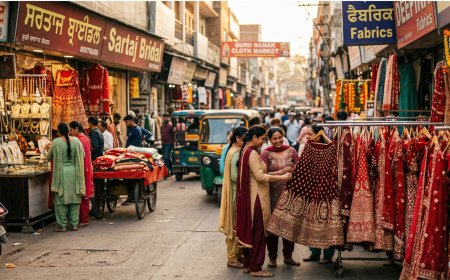
For many NRI brides, the bridal aesthetic begins on Pinterest — hundreds of carefully collected references featuring Sabyasachi embroidery placement, Anita Dongre silhouettes, Rahul Mishra textiles, and the subtle design language that defines the modern Indian designer look. The challenge is rarely the aesthetic vision. The challenge is translating that vision into a real bridal garment within a real budget. This guide explores how Jalandhar’s evolving high-street bridal market has quietly developed the capability to recreate the considered designer aesthetic at a fraction of the designer label’s price. From boutique studios in the Cantt area that specialise in embroidery placement and contemporary silhouettes to emerging designers along Phagwara Road producing photograph-perfect bridal pieces, the city now offers multiple pathways to achieving the designer look without the designer price tag. Learn how fabric selection, embroidery placement, silhouette construction, and colour precision define the true designer aesthetic, which boutiques in Jalandhar most successfully replicate these characteristics, and how NRI brides can use reference boards and precise briefs to guide boutique designers toward the intended result. Discover the strengths of Studio Niharika, Atelier Ambar, Roop Bridal Studio, and Preet’s Couture, explore the workshop-direct model that removes retail markup entirely, and understand how the Gur Mandi fabric market allows brides to source designer-quality textiles at wholesale prices. For brides balancing a strong aesthetic vision with a realistic bridal budget, this guide reveals the knowledge that transforms inspiration into a beautifully executed bridal garment — without paying the designer premium.

Designer Look Without Designer Price — Jalandhar's Best High-Street Bridal Options
The Pinterest board had four hundred and twelve pins. Jasleen had been adding to it since the engagement in March — not obsessively, she would have said if asked, but consistently, in the way that a person with a clear aesthetic vision and a finite budget adds to a reference collection that is doing the work of communicating the vision to the vendors and boutiques and family members who will be involved in making the vision real. The board had sections. The lehenga section. The colour palette section. The embroidery detail section. The dupatta draping section. The jewellery reference section. The overall aesthetic section, which she had labelled "the feel" and which contained twenty-three photographs whose common thread was the specific quality she had been trying to name since the engagement and had finally named as: considered. Not maximalist. Not the Bollywood excess that a certain strain of Punjabi wedding aesthetic defaults to. Considered. Every element deliberate. The embroidery placed where it needs to be and not where it can be. The silhouette clean. The colour doing one thing well rather than several things simultaneously.
The aesthetics of four hundred and twelve pins had been assembled with the reference in mind. The reference, in most of its most specific expressions, was designer. The lehenga detail in pin number forty-seven was from a Sabyasachi collection. The embroidery placement in pin number one hundred and twelve was from an Anita Dongre. The silhouette in pin number two hundred and thirty-one was from a Rahul Mishra. These were not aspirational pins in the sense of pins the bride expected to purchase — they were reference pins, the visual vocabulary of a specific aesthetic that the Pinterest board was articulating rather than proposing as a shopping list.
Jasleen was in Coventry. She was a secondary school teacher. Her budget for the bridal lehenga was sixty-five thousand rupees — approximately six hundred and sixteen pounds at the current exchange rate — which was a number she had arrived at after a conversation with her parents in Jalandhar that had been honest and specific and which had produced a number that was real rather than aspirational. Sixty-five thousand rupees. Not the one lakh twenty thousand that the Sabyasachi reference suggested. Not the two lakh that the Anita Dongre reference implied. Sixty-five thousand, which in the Mumbai boutique market was a budget that accessed the lower end of the established design tier and in the Delhi market was similar, and which in both cities was a budget that the aesthetic of the four hundred and twelve pins would significantly strain.
She had shown the Pinterest board to her cousin Navneet in Leicester — the cousin whose own Jalandhar bridal shopping trip had produced the results described in the previous guide, and whose experience with the Jalandhar market's specific capability had given her a perspective on what the market could produce that the fashion media's coverage had not provided. Navneet had looked at the board for a long time. She had looked at it with the specific attention of someone who is matching what she sees to what she knows, running the reference images against a mental inventory of the boutiques and market zones whose work she had encountered in her own shopping.
She had said: most of this is achievable in Jalandhar. Not from the boutiques I went to. From the boutiques that do the high-street version of this. The places that have understood what the designer aesthetic is and are producing it in a different cost structure.
Jasleen had said: those places exist?
Navneet had said: they exist. You just need to know which ones they are.
This guide is the knowledge that Navneet had and that the fashion media has not covered — the complete, specific account of where the Jalandhar high-street bridal market produces the considered designer aesthetic at a price point that the designer's own label cannot approach, and how the NRI bride with a clear aesthetic vision and a real-world budget finds the boutiques whose work closes the gap between the reference board and the achievable reality.
Understanding the Designer Look: What It Actually Means
Before the boutiques can be identified, the aesthetic needs to be understood with the precision that the shopping requires, because the "designer look" is not a single aesthetic — it is a collection of specific characteristics whose presence or absence distinguishes the considered bridal garment from the commercial one, and whose replication in the high-street context is what the best Jalandhar boutiques have learned to produce.
The first characteristic is the embroidery placement. The designer lehenga's embroidery is placed with intentionality — the density is highest where the eye is intended to go, the motif placement follows the garment's structure rather than covering it uniformly, and the negative space — the unembroidered areas — is as considered as the embroidered ones. The commercial lehenga's embroidery covers the surface because covering the surface is what the market expects and what the production process produces most easily. The distinction between these two approaches is visible immediately to the eye that has been trained to see it, and four hundred and twelve Pinterest pins train the eye effectively.
The second characteristic is the fabric handling. The designer garment's fabric is chosen for its specific behaviour in the silhouette — the weight that produces the drape the design requires, the hand that interacts with the embroidery in the way the design intends. The commercial garment's fabric is chosen for its price point and its visual similarity to the designer's choice, and the similarity that photographs produce does not survive the in-person assessment of how the garment moves and drapes. The bride whose reference board is full of Sabyasachi's Bengal tussars and Rahul Mishra's hand-woven silks is a bride who needs to understand what characteristic of those fabrics her aesthetic is actually seeking — the texture, the weight, the drape — so that she can find the fabric in the Jalandhar market that replicates the characteristic without requiring the designer's specific sourcing.
The third characteristic is the silhouette construction. The designer lehenga's silhouette is the product of a construction process that has been refined across multiple iterations — the specific inner structure, the hem weight, the skirt's fullness at the hip versus the hem, the blouse's boning and shaping — whose cumulative effect is a garment that holds its shape across the full event day without the wilting that the poorly constructed garment shows after the first two hours. The high-street replication of this construction is achievable in Jalandhar's tailoring ecosystem if the right tailor is engaged, and it is not achievable if the construction is treated as a secondary consideration to the embroidery and the fabric.
The fourth characteristic is the colour precision. The designer's colour is specific — not "dusty rose" but the particular shade of dusty rose whose grey undertone sits at a specific saturation, whose interaction with the gold of the zari reads in a specific way in the wedding's ambient light. The high-street colour is approximate — the dusty rose whose pink is slightly too pink or whose grey is slightly too grey. The bride whose aesthetic reference is colour-specific needs to assess the colour in natural light at the purchase stage rather than under the boutique's interior lighting, because the interior lighting's warmth flatters every colour's approximation.
The Jalandhar High-Street Bridal Landscape: How It Has Developed
The Jalandhar high-street bridal market's current quality level is the product of a development that has occurred over the past decade, driven by three converging forces whose interaction has produced a market that was not present ten years ago and that is not fully visible in the fashion media's coverage today.
The first force is the Instagram education of the Jalandhar boutique owner. The boutique owners and their designers who have spent the past decade consuming the same designer aesthetic content that their clients consume have developed a fluency in the designer vocabulary — the placement, the palette, the silhouette — that their production process increasingly reflects. The boutique in the Cantt area whose designer graduated from NIFT Delhi in 2016 and whose Instagram is as carefully curated as any Mumbai atelier's is a boutique whose aesthetic ambition is not limited by the Jalandhar address that the fashion media ignores.
The second force is the embroidery workforce's craft development. The phulkari tradition that is indigenous to the Punjab region has been augmented, in Jalandhar's production ecosystem, by the zardozi, the mirror work, and the contemporary embroidery techniques whose artisans have established workshops in the city's production districts. The boutique whose production is done in Dharavi workshops — the Mumbai production geography that the established designer ateliers use — has a different embroidery standard from the boutique whose production is done in Jalandhar's own workshops, and the Jalandhar workshop's quality, at the upper end of its output, is not the inferior product that the geography implies.
The third force is the NRI market's demand signal. The Jalandhar boutiques that have developed the highest-street capability are boutiques that have been serving the NRI bride market for long enough to understand what that market's aesthetic references are. The NRI bride's Pinterest board, the reference photographs from the UK and Canadian wedding media, the WhatsApp-shared designer content — these have educated the Jalandhar boutique about the specific aesthetic characteristics that the NRI bride is seeking, and the boutiques that have responded to this education have developed a product that the local market's demand alone would not have generated.
The Boutiques: Where the Designer Look Lives in Jalandhar
The Cantt Area's Premium High-Street Tier
The Cantonment area's boutiques represent the highest expression of the Jalandhar high-street bridal offering — the studios whose design literacy, production quality, and aesthetic ambition most closely approach the designer atelier experience at a price point that the atelier cannot match.
Studio Niharika, in the upper Cantt area, is the boutique whose name appears most consistently in the NRI bride community's recommendations for the designer aesthetic at a Jalandhar price. The founder, who trained in fashion design in Chandigarh and spent three years assisting at a Delhi boutique before returning to Jalandhar to establish her own studio in 2018, has built a practice whose embroidery placement, fabric sourcing, and silhouette construction reflect the training rather than the market average. The price range for a bridal lehenga at Studio Niharika runs from forty-five thousand to one lakh twenty thousand rupees, and the middle of this range — the sixty to eighty thousand rupee lehenga — is the boutique's strongest offering: the garment whose considered embroidery placement and fabric quality most clearly justify the premium over the corridor boutiques.
The specific characteristic that distinguishes Studio Niharika's work from the comparable price point in the Phagwara Road corridor is the embroidery placement conversation — the design consultation at which the bride's aesthetic references are reviewed and the embroidery's placement is determined by the brief rather than by the standard template. This conversation is the characteristic of the designer atelier experience that the high-street boutique most frequently omits and that Studio Niharika most consistently provides. The bride who brings the four-hundred-and-twelve-pin Pinterest board to this boutique will find the board's vocabulary understood rather than translated into the standard Phagwara Road lehenga with the embroidery where the embroidery always goes.
Atelier Ambar, also in the Cantt area, occupies a slightly different position in the high-street tier — a boutique whose strength is the contemporary minimal aesthetic rather than the rich traditional that Studio Niharika serves, and whose client is the NRI bride whose aesthetic references include the Anamika Khanna sensibility rather than the Sabyasachi maximalism. The price range of thirty-five thousand to ninety thousand rupees covers a bridal offering whose silhouette is cleaner, whose embroidery is more restrained, and whose fabric choices lean toward the textured — the raw silk, the dupion, the linen blends — rather than the heavy zari-embroidered silks of the traditional Punjabi bridal aesthetic.
The bride whose Pinterest board's "considered" aesthetic is the restraint of negative space and structural embroidery rather than the richness of layered traditional work will find Atelier Ambar's offering more aligned with her reference than any other boutique in the Jalandhar market. The sixty-five-thousand-rupee budget at Atelier Ambar accesses the boutique's strongest work — the garments whose construction and fabric quality justify the position in the market's upper tier.
The Phagwara Road's Emerging Design Tier
The Phagwara Road corridor's boutiques have been described in the previous guides as the market zone for the mid-range and budget-conscious purchase, and this description remains accurate for the corridor's majority. Within the corridor, however, a subset of boutiques has emerged over the past five years whose design ambition exceeds the corridor's average and whose price point sits at the intersection of the corridor's accessibility and the Cantt's premium — the forty thousand to seventy thousand rupee lehenga that aspires to the designer aesthetic without the designer's full production infrastructure.
Roop Bridal Studio is the Phagwara Road boutique whose work most consistently receives the designer aesthetic attribution in the bride community's recommendations. The studio's founder has spent significant time studying the design vocabulary of the established Indian designers — the Sabyasachi Instagram, the Manish Malhotra runway, the Tarun Tahiliani aesthetic — and has developed a production approach whose embroidery placement and silhouette construction reflect this study more directly than the corridor's average boutique. The price range of thirty thousand to seventy-five thousand rupees covers a bridal offering whose strongest pieces — in the forty-five to sixty-five thousand range — have been described by previous brides as "looking like a designer piece in photographs" with the specific caveat that the construction standard, at close range, shows the cost structure that produces the price differential.
This caveat is worth understanding rather than dismissing. The photograph-quality equivalence between a high-street piece and a designer piece is the equivalence that matters most for the NRI bride whose wedding documentation is primarily photographic and whose guests experience the garment at the distance that a wedding event creates rather than at the close range that reveals the construction. The bride whose wedding photographs are the primary legacy of the event is the bride for whom the photograph-quality equivalence is the relevant assessment, not the close-range construction comparison.
Preet's Couture, at the southern end of the Phagwara Road, has built a specific reputation for the contemporary bridal lehenga whose point of distinction is the hand embroidery — not the full hand embroidery of the cooperative's phulkari work, but the hand-finished machine embroidery whose combination of production efficiency and hand detailing produces a surface that the fully machine-embroidered piece cannot replicate. The price range of twenty-eight thousand to sixty thousand rupees covers bridal pieces whose embroidery quality, at the forty to fifty-five thousand range, consistently surprises brides who have calibrated their expectations to the Phagwara Road corridor's average.
The Workshop-Direct Model: Where the Production Premium Disappears
The most significant gap between the designer label's price and the high-street price is not the design — it is the brand premium, the retail markup, and the distribution cost that the established designer's price incorporates and that the Jalandhar market's workshop-direct model eliminates. The workshop-direct model — purchasing from the production workshop rather than from the boutique that sells the workshop's output at retail — is the route that eliminates the retail layer entirely and accesses the garment at the production price plus the workshop's margin.
The Jalandhar production ecosystem's embroidery workshops — whose output is sold to boutiques across the market at wholesale prices and then retailed to the bride at the boutique's marked-up price — are accessible to the bride whose local contact has the workshop relationships that convert the wholesale buyer's access into the retail buyer's opportunity. The bride who purchases a lehenga panel from the workshop at the wholesale price and takes it to a trusted tailor for construction is the bride who accesses the designer embroidery quality at the production cost rather than the retail cost.
The workshop-direct purchase requires knowledge — the specific workshops whose embroidery quality is at the level the bride's aesthetic requires, the assessment skills to evaluate the embroidery at the workshop stage rather than in the finished garment, and the tailor relationship whose construction quality matches the embroidery's standard. Without this knowledge, the workshop-direct route is not navigable. With it — with the local contact whose relationships unlock the access — it is the route that produces the closest approximation to the designer quality at the furthest distance from the designer price.
The Fabric Equation: Finding the Designer Fabric in the Jalandhar Market
The designer aesthetic's fabric characteristics — the Bengal tussar, the hand-woven Banarasi, the Chanderi silk — are fabrics whose specific qualities the Jalandhar market does not always stock at the depth the Mumbai or Delhi fabric markets provide, but whose closest equivalents in the Jalandhar market are accessible to the buyer who knows what characteristic of the fabric she is seeking.
The Gur Mandi fabric market's silk range covers the fabric categories that the designer aesthetic most frequently requires, at prices that the Mumbai equivalents do not approach. The raw silk in the Gur Mandi's upper quality range — the fabric whose texture and weight most closely approximate the designer's Bengal tussar — runs from five hundred and fifty to nine hundred rupees per metre. The hand-woven silk categories that the Gur Mandi carries at the wholesale end — the Banarasi brocade, the Chanderi silk, the Maheshwari silk whose texture and drape approximate the designer references — are fabrics whose Gur Mandi price is thirty to forty percent below the Mumbai equivalent.
The fabric assessment at the Gur Mandi requires the specific knowledge of what characteristic of the designer reference fabric is being sought. The bride who knows that the Sabyasachi reference is using Bengal tussar for its specific texture and drape is the bride who can find the Gur Mandi fabric whose texture and drape replicate those qualities — not identical, but equivalent in the way that matters for the garment's final performance. The bride who is simply looking for "the fabric Sabyasachi uses" will not find Bengal tussar in the Gur Mandi and will conclude that the designer aesthetic's fabric is not accessible, when the aesthetic's fabric characteristic is entirely accessible in the equivalent.
The Embroidery Conversation: Getting the Placement Right
The embroidery placement is the single most important characteristic that distinguishes the designer look from the commercial look, and it is the characteristic that the high-street boutique is most capable of replicating if the bride's brief is specific enough to direct the production toward the intended outcome rather than the default template.
The default template in the Jalandhar bridal market — the embroidery placement that the boutique uses when the bride does not specify otherwise — is the full coverage pattern whose density is consistent across the skirt's surface and whose placement follows the convention of the Punjabi bridal aesthetic. This template produces a beautiful garment that is not the considered designer aesthetic. It is the maximalist aesthetic, and the bride whose reference board is the considered placement will not find it in the default template.
The conversation that redirects the production toward the considered placement requires the bride to articulate specifically what she does and does not want. She wants the embroidery at the hem. She does not want the embroidery uniform across the skirt. She wants the motif placement to follow the skirt's movement — concentrated at the hem where the drape emphasises it, reducing in density toward the waist where the fabric is flat against the body. She wants the negative space — the unembroidered silk — to be visible as a design element rather than as a production economy.
This conversation is possible at Studio Niharika and at Atelier Ambar. It is possible at Roop Bridal Studio and at Preet's Couture. It is less possible at the boutiques whose production template is fixed and whose customisation capability is limited by the production process's standard workflow. The first question the bride should ask at every boutique is: can the embroidery placement be customised to a specific brief? The answer to this question is the filter that distinguishes the boutiques that can produce the designer aesthetic from the boutiques that produce the commercial aesthetic at a designer-adjacent price.
The Complete High-Street Bridal Assessment Table
| Boutique | Price Range (Bridal Lehenga) | Aesthetic Strength | Embroidery Customisation | Designer Aesthetic Proximity | Best For |
|---|---|---|---|---|---|
| Studio Niharika (Cantt) | ₹45,000 – ₹1,20,000 | Rich traditional, considered placement | Yes — full brief consultation | Very high | Sabyasachi/Anita Dongre reference brides |
| Atelier Ambar (Cantt) | ₹35,000 – ₹90,000 | Contemporary minimal, textured fabric | Yes — speciality | Very high | Anamika Khanna/Rahul Mishra reference brides |
| Roop Bridal Studio (Phagwara Road) | ₹30,000 – ₹75,000 | Contemporary Punjabi, designer-influenced | Partial — standard templates adaptable | High — photograph quality | Instagram aesthetic brides, photography-focused |
| Preet's Couture (Phagwara Road) | ₹28,000 – ₹60,000 | Hand-finished embroidery, mid-premium | Partial | Moderate to high | Quality embroidery at mid budget |
| Workshop-Direct + Tailor | ₹25,000 – ₹55,000 | Fully customisable | Yes — complete control | Highest at price point | Brides with local contacts and clear brief |
| Gur Mandi Commission | ₹18,000 – ₹45,000 | Dependent on tailor and embroidery choice | Yes — full control | Variable — depends on execution | Experienced buyers with strong brief |
The NRI Bride's Specific Advantage in This Market
The NRI bride approaching the Jalandhar high-street bridal market has a specific advantage that the local bride does not always deploy: the designer reference vocabulary. The bride whose Pinterest board contains four hundred and twelve designer references has a brief that is more specific, more visually articulated, and more useful to the high-street boutique's designer than the local bride's brief, which is more likely to be expressed in terms of colour and occasion than in terms of embroidery placement and silhouette construction.
The high-street boutique whose designer has been educated by the same Instagram content as the NRI bride's Pinterest board responds to the NRI bride's reference vocabulary with a recognition that the production can match when the brief is specific enough. The conversation between a bride who shows Studio Niharika's designer a pin of a Sabyasachi embroidery placement and says "I want this proportion of negative space, this hem weight, this motif scale" and the designer who has studied the same reference is a conversation whose output is closer to the reference than the conversation that begins with "I want something beautiful."
The brief is the tool. The more specific the brief, the more closely the high-street boutique's output approaches the designer reference it is working toward.
Common Mistakes NRI Brides Make When Seeking the Designer Look
The first mistake is confusing the designer label with the designer aesthetic and dismissing the high-street boutique because it is not the designer label. The Sabyasachi label is a brand. The Sabyasachi aesthetic is a set of specific characteristics — the embroidery placement, the fabric choice, the silhouette construction — that the Jalandhar high-street boutique can replicate in significant measure if the brief is specific and the boutique's capability is adequate. The bride who dismisses the high-street option because it is not the label is the bride who conflates the brand premium with the aesthetic quality, and the conflation costs her the purchasing power differential that the Jalandhar market provides.
The second mistake is not bringing the reference board to the boutique appointment. The designer aesthetic is a visual vocabulary, and the visual vocabulary requires visual communication. The bride who describes her reference in words and does not show the images is the bride whose description the boutique interprets through its own visual vocabulary, which may not match hers. The Pinterest board should be shown at the opening of every boutique appointment, before any garments are presented, as the brief that directs the selection.
The third mistake is assessing the high-street garment against the designer original at close range rather than at photograph range. The construction difference between a sixty-five-thousand-rupee Jalandhar lehenga and a two-lakh-rupee designer piece is real and visible at close range. It is not visible in the wedding photographs that constitute the primary legacy of the event, and the assessment standard should match the use context. The bride who dismisses the high-street option because the inner seam finish does not match the designer's is the bride whose assessment standard is not calibrated to the context in which the garment will be experienced.
The fourth mistake is not requesting the embroidery customisation conversation at the boutique. The boutique whose production template does not match the reference board's placement is the boutique that, when asked, may reveal a customisation capability that the standard presentation did not show. The question "can the embroidery placement be adjusted to a specific brief?" is the question that reveals whether the boutique is capable of the designer aesthetic's most important characteristic, and it should be asked at every boutique regardless of whether the standard presentation suggests the capability.
The fifth mistake is allocating the budget to the garment and not to the fabric. The high-street boutique whose garment construction is excellent but whose fabric is the synthetic approximation of the designer's natural fibre is the boutique that produces a garment which photographs well and performs differently. The fabric is the component whose quality most directly affects the wearing experience and whose quality most rewards the budget allocation that the garment's price does not always make explicit. The bride should ask specifically about the fabric's composition and should assess it in natural light before the garment's other qualities determine the purchase decision.
What Jasleen's Sixty-Five Thousand Rupees Purchased
The appointment at Studio Niharika had been on a Thursday morning in August. Jasleen had arrived with the Pinterest board open on her phone — not the phone-in-hand anxiety of someone who does not trust their own brief, but the prepared clarity of someone who has spent six months articulating an aesthetic and wants to communicate it precisely.
The designer — a woman in her early thirties whose own aesthetic was visible in the studio's carefully edited interior — had looked at the board for five minutes. She had asked two questions. The first was: what is the one element in these images that cannot be compromised? Jasleen had said: the negative space. I don't want the embroidery to cover everything. I want the silk to be visible as a design choice. The second question was: what is the colour? Jasleen had shown the twenty-three pins in the "feel" section. The designer had looked at them and said: antique gold on ivory. Not yellow gold. Antique. There is a specific tonal quality in these images that is about the gold's age rather than its brightness.
Jasleen had said: yes. That is exactly what I mean.
The designer had said: I have a fabric. I sourced it six weeks ago from a Varanasi weaver whose raw silk has the specific texture of old gold that your reference is showing. I have been waiting for the right brief to use it.
The lehenga had been commissioned at sixty-two thousand rupees — three thousand under the budget ceiling. The embroidery placement had been specified at the consultation and was documented in the commission sheet whose copy Jasleen had kept. The hem weight, the skirt's fullness, the blouse's boning structure — all specified, all documented.
The finished garment had arrived at her parents' home in Jalandhar eight weeks later. Jasleen had tried it on in her mother's bedroom on the afternoon of her arrival from Coventry, in the specific October light of the post-monsoon Punjab afternoon that the bedroom's south-facing window admitted.
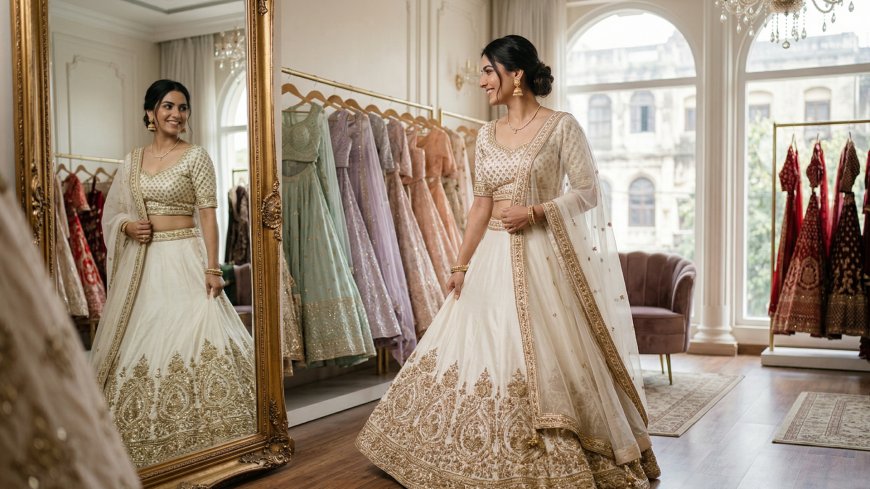
The negative space was visible. The silk was visible as a design choice. The antique gold on the ivory was the specific tonal quality of the twenty-three pins in the "feel" section. The embroidery was where she had said she wanted it and was not where she had said she did not.
She had sent Navneet a photograph.
Navneet had replied: Sabyasachi would have charged three lakh for this.
Jasleen had said: I know. And Studio Niharika charged sixty-two thousand.
Navneet had said: that is what Jalandhar is.
Bring the reference board to every appointment. Ask for the embroidery customisation conversation at every boutique. Assess at photograph range, not close range. Allocate the budget to the fabric quality before the garment's other qualities. Ask what the one non-negotiable element is — and tell the boutique exactly what it is.
The designer look is a set of characteristics, not a label. The characteristics are achievable in the Jalandhar market at a price that the label is not. The knowledge that converts the one into the other is the knowledge of which boutiques have understood this and built their practice around it.
Published by NRIWedding.com — The Premium Global Platform for Non-Resident Indians Planning Indian Weddings From Abroad.
What's Your Reaction?
 Like
0
Like
0
 Dislike
0
Dislike
0
 Love
0
Love
0
 Funny
0
Funny
0
 Angry
0
Angry
0
 Sad
0
Sad
0
 Wow
0
Wow
0