







































































Taj Fateh Prakash Palace, Udaipur — A Wedding Inside the City Palace Complex: The Royal NRI Guide
The groom had been standing in front of the crystal gallery for eleven minutes. His fiancée had timed it — not deliberately, but because at the three-minute mark he had not moved, and at the eleven-minute mark he was still there. She said: what are you doing? He said, without turning: I am trying to understand how we get married in the building that contains this. The crystal furniture. The crystal fountains. The crystal dinner service. The single largest order the Bohemian crystal manufacturers had ever received from a single patron — commissioned by the Maharana of Mewar in 1877 and placed here, in this palace, on the bank of the Lake Pichola, inside the City Palace complex that the Mewar dynasty has been building since 1553. He said: I am trying to understand what that means. This complete guide gives NRI couples everything needed to plan a wedding inside the walls of Udaipur's four-century royal seat — covering the Mewar dynasty's continuous lineage and what the Eternal Mewar Foundation's living heritage stewardship means for the wedding, the Durbar Hall built for the important occasion, the Sunset Terrace view from inside the palace rather than beside the lake, the crystal gallery private viewing as the arrival evening's welcome, the unrepeatable baraat by boat across the Lake Pichola to the palace ghat, one comprehensive table covering all venue costs, catering, accommodation from ₹30,000 to ₹4,00,000 per night, and complete budget from ₹4.35 crore to ₹8.97 crore, the Mewar decorator brief imperative, the twenty-four month inquiry timeline, and the five mistakes that cost couples the inside's full potential.


Taj Fateh Prakash Palace, Udaipur — A Wedding Inside the City Palace Complex: The Royal NRI Guide
The Gallery
The groom had been standing in front of the crystal gallery for eleven minutes.
His fiancée had timed it — not with the deliberate timing of the person who is monitoring the attention, but with the incidental timing of the person who had noticed at the three-minute mark that he had not moved, had checked the phone at the seven-minute mark to confirm the site visit's next appointment, and had looked up at the eleven-minute mark to find him still in front of the glass cases whose contents were the specific, extraordinary collection of the Mewar royal family's crystal — the crystal furniture, the crystal fountains, the crystal dinner service, the specific, Victorian-era commissioned glasswork whose quantity and whose quality represented the single largest order the Bohemian crystal manufacturers had ever received from a single patron.
She had said: what are you doing?
He had said, without turning: I am trying to understand how we get married in the building that contains this.
She had said: what do you mean?
He had said: I mean — the Maharanas of Mewar commissioned this. Specifically. They said to the Bohemian craftspeople: make us these things, in crystal, to the standard of the finest you can produce. And the craftspeople made them. And the Maharanas put them here, in this palace, in this building, on the bank of the Lake Pichola, in Udaipur. And the building is still here. The crystal is still here. And we are being offered the possibility of getting married inside this building.
He had paused.
Then he had said: I am trying to understand what that means.
It means the Taj Fateh Prakash Palace — the heritage hotel within the City Palace complex of Udaipur, the specific, astonishing property whose location inside the walls of the royal seat of the Mewar kingdom and whose contents include the Durbar Hall, the crystal gallery, the lake-facing dining rooms, and the specific, accumulated presence of the four-century royal tradition — is the wedding venue whose credential is not the award, not the rating, not the number of acres or the championship golf course or the hilltop panorama.
It is the four hundred years.
The Mewar maharanas who built the City Palace from the sixteenth century onward, who accumulated the courts and the temples and the apartments and the specific, layered architectural complexity of the royal seat that never stopped being built, who commissioned the crystal gallery and the Durbar Hall and whose portraits line the corridors of the building whose guests are now, by the specific grace of the Taj Hotels' management agreement, the wedding couple and their guests.
This guide is for the NRI couple who stood in front of the crystal gallery — or who is standing in front of it now, in these pages, for the first time — and who is trying to understand what it means to get married inside this building.
The Palace: Within the City Palace Complex
The City Palace: Four Centuries of Mewar
The City Palace of Udaipur — the Udaipur City Palace, the Shahi Mahal, the specific, accumulated complex of the Mewar maharanas whose construction began under Maharana Udai Singh II in 1553 and continued without interruption through the successive reigns of the Mewar rulers for four centuries — is the largest palace complex in Rajasthan.
Not the most famous — that distinction is contested. Not the most photographed — the Amber Fort and the Umaid Bhawan and the Lake Palace have their own claims. The largest. The specific, physical, accumulated scale of the palace complex that was built without the single patron's single vision — that was built instead by the successive accumulation of the individual maharana's addition to the predecessor's work, each reign adding the courtyard or the apartment or the temple or the ceremonial hall — is the largest in the state whose palaces are themselves the largest in India.
The Mewar dynasty: the Mewar dynasty — the Sisodia Rajputs whose seat at Chittorgarh was the seat before the move to Udaipur and whose specific, documented genealogy the Mewar royal family traces to the seventh century — is the dynasty whose continuous, unbroken lineage and whose specific, institutional resistance to the Mughal authority made Mewar the Rajput kingdom whose independence was the independence of the principle rather than the pragmatism. The Mewar maharanas did not submit to Akbar. They fought. The specific, historical stubbornness of the Mewar tradition — the tradition that the crystal gallery and the Durbar Hall and the City Palace itself are the material expression of — is the tradition that gives the Taj Fateh Prakash Palace its specific, irreplaceable character.
The City Palace complex today: the City Palace complex of Udaipur is the complex whose different wings serve the different contemporary functions — the City Palace Museum managed by the Mewar royal family's Eternal Mewar Foundation, the Shiv Niwas Palace hotel, and the Fateh Prakash Palace hotel, the last two managed by the Taj Hotels under the management agreement with the Eternal Mewar Foundation whose stewardship of the complex is the stewardship of the living heritage rather than the preserved exhibit.
The Fateh Prakash Palace: Within the Complex
The Fateh Prakash Palace — the specific wing of the City Palace complex that the Taj Hotels manages as the Taj Fateh Prakash Palace heritage hotel — was built in the early twentieth century by Maharana Fateh Singh, the Mewar ruler whose reign spanned the late nineteenth and the early twentieth centuries and whose specific, distinguished legacy in the Mewar tradition includes the palace whose construction and whose furnishing — the crystal gallery, the Durbar Hall's specific appointments — are the material expression of the royal patron's ambition applied to the early twentieth-century building in the four-century-old complex.
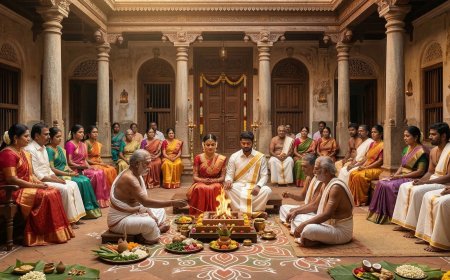
The Durbar Hall: the Taj Fateh Prakash Palace's Durbar Hall — the formal audience chamber whose specific function in the palace's operational history was the ceremonial reception of the significant — is the wedding event space whose quality is the quality of the room that was built for the important occasion and whose use for the important occasion is therefore the most natural, the most historically continuous, the most architecturally appropriate use the room can be put to. The wedding in the Durbar Hall is the wedding in the room that was built for the occasion that mattered. It continues the room's purpose rather than departing from it.
The crystal gallery: the Maharana of Mewar's crystal collection — commissioned from F&C Osler of Birmingham in 1877, one of the largest single crystal commissions in the company's history, including the crystal furniture, the crystal fountains, the crystal dinner service, the crystal bed, the crystal chairs — is the collection that the Taj Fateh Prakash Palace preserves within the hotel's public spaces and that the groom had been standing in front of for eleven minutes. The crystal gallery's presence within the hotel makes the Taj Fateh Prakash Palace the hotel that is simultaneously the luxury accommodation and the working museum — the property whose public spaces contain the museum-grade collection of the Mewar royal family's most extraordinary commission.
The Eternal Mewar Foundation and the Living Heritage
The Eternal Mewar Foundation — the institution established by the current scion of the Mewar dynasty, Shriji Arvind Singh Mewar, for the preservation and the promotion of the Mewar heritage — manages the City Palace complex with the specific philosophy of the living heritage: the heritage that is not the preserved museum but the active, functioning, continuously engaged tradition whose ceremonies, whose cultural programmes, whose educational mission, and whose specific, institutional relationship to the Mewar past are the engagement of the living rather than the commemoration of the dead.
For the wedding: the Eternal Mewar Foundation's management of the complex means that the wedding at the Taj Fateh Prakash Palace happens within the institutional context of the living Mewar heritage — the complex where the Mewar ceremonial calendar continues, where the Gangaur festival and the Mewar festival are the active, publicly celebrated occasions rather than the heritage performances, and where the specific, continuous engagement with the Mewar tradition is the ambient condition of the property rather than the managed tourist experience.
The Location: Inside the Walls
The City Palace Position
The Taj Fateh Prakash Palace's specific, extraordinary locational advantage — the advantage that distinguishes it from every other Udaipur wedding venue including the Oberoi Udaivilas and the Taj Lake Palace — is not the lake view or the Aravalli Hills backdrop or the hillside panorama.
It is the inside.
The Taj Fateh Prakash Palace is inside the City Palace complex — within the walls of the four-century-old royal seat of the Mewar dynasty, on the bank of the Lake Pichola, in the specific, historically continuous location that the Mewar maharanas chose for their residence in 1553 and that has been the seat of the Mewar royal tradition since.
What inside means: the guest who arrives at the Taj Fateh Prakash Palace does not approach the hotel through the standard hotel approach — the porte-cochère, the luggage trolley, the uniformed doorman at the entrance. The guest approaches through the City Palace's gates — the specific, historic, ceremonial gateways whose passage is the passage from the city into the royal complex, from the public Udaipur into the private Mewar. The approach is the approach of the person entering the palace rather than checking into the hotel, and the distinction is not the semantic but the experiential — the specific, physical change of the passage through the gates whose four-century-old stone is the stone of the tradition the guest is entering.
The Lake Pichola from inside the complex: the Lake Pichola view from the Taj Fateh Prakash Palace is the Lake Pichola view from inside the City Palace complex — the view that the Mewar maharanas had from their palace windows, the view whose specific angle and whose specific foreground — the palace's own architecture in the foreground, the lake in the middle distance, the Aravalli Hills beyond — is the view of the person who is inside the tradition rather than the person who is looking at it from the outside.
The Approach by Boat
The Taj Fateh Prakash Palace's access across the Lake Pichola — the boat approach from the City Palace ghat whose crossing of the lake is the crossing that arrives at the palace's water gate — is the arrival whose character is the character of the royal arrival: the lake crossing, the palace's facade rising above the water, the specific, ceremonial quality of the approach that cannot be replicated by the road approach and that the wedding baraat most powerfully exploits.
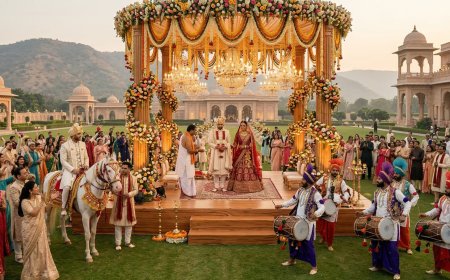
The baraat by boat: the groom's arrival at the Taj Fateh Prakash Palace by boat across the Lake Pichola — the decorated boat, the lake crossing, the arrival at the palace ghat, the City Palace complex rising above — is the baraat whose setting is unlike any other baraat in the Indian wedding landscape. It is not the procession through the streets. It is not the arrival at the hotel entrance. It is the lake crossing to the royal palace — the specific, historically resonant arrival whose poetry is the poetry of the occasion that understands exactly where it is happening.
The Wedding Spaces
The Durbar Hall
The Durbar Hall is the Taj Fateh Prakash Palace's defining wedding event space — the formal audience chamber whose four-century-old function as the room of the important occasion makes it the most historically appropriate wedding setting in the Udaipur destination wedding landscape.
The Durbar Hall's architecture — the high ceilings, the ornamental plasterwork, the specific decorative vocabulary of the Mewar court's formal interior — is the architecture of the room that was built to impress and whose capacity to impress has not diminished in the century since the Maharana Fateh Singh's construction. The sangeet in the Durbar Hall, the reception dinner in the Durbar Hall, the specific wedding function whose indoor grand setting the Durbar Hall most completely provides — these are the occasions whose setting is the Mewar court's formal chamber applied to the celebratory function whose dignity the space most naturally accommodates.
The Durbar Hall accommodates up to three hundred guests for the standing reception and up to one hundred and eighty for the seated dinner — the moderate to substantial scale that the Taj Fateh Prakash Palace's primary event space provides.
The Sunset Terrace
The Sunset Terrace — the elevated outdoor space whose position within the City Palace complex provides the specific, Lake Pichola-facing view at the angle that the complex's architecture frames — is the Taj Fateh Prakash Palace's most celebrated event space for the outdoor cocktail reception and the sunset occasion.
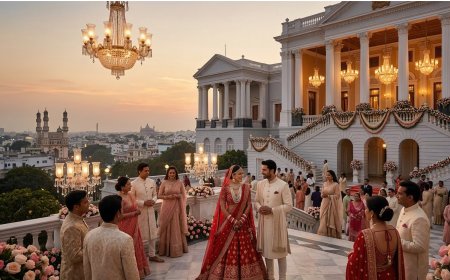
The Sunset Terrace's view — the Lake Pichola, the Jag Mandir island palace in the lake's centre, the Jag Niwas island whose Taj Lake Palace occupies it, the Aravalli Hills on the far shore, the Udaipur sky — is the view from inside the City Palace complex, which is the view that no other Udaipur property can provide. The Oberoi Udaivilas's lakeside view is the view from beside the lake. The Radisson Blu's view is the view from above the city. The Taj Fateh Prakash Palace's view is the view from within the royal complex — the view through the lens of the four-century-old palace whose walls frame the water and the sky.
The Sunset Terrace accommodates up to one hundred and fifty guests for the standing reception — the intimate to moderate scale that makes it the space for the cocktail gathering and the sunset occasion rather than the large formal dinner.
The Courtyard Spaces
The Taj Fateh Prakash Palace's courtyard spaces — the enclosed outdoor spaces within the City Palace complex whose architectural vocabulary is the vocabulary of the Rajput royal courtyard, the organised outdoor space whose walls are the walls of the four-century-old palace — are the wedding spaces for the ceremony, the intimate reception, and the outdoor occasion whose character the enclosed heritage courtyard most specifically provides.
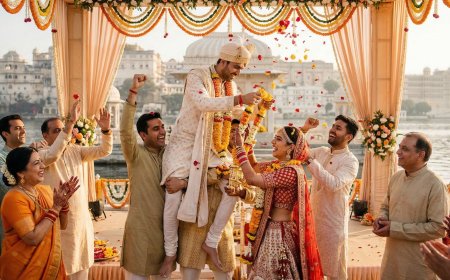
The ceremony in the Taj Fateh Prakash Palace's courtyard — the mandap installed in the enclosed space whose walls are the walls of the Mewar royal palace, the guests seated in the courtyard whose sky is the Udaipur sky framed by the four-century-old architecture — is the ceremony whose setting is the specifically royal, the specifically Mewar, the specifically inside-the-complex quality that only the Taj Fateh Prakash Palace can provide.
The courtyard accommodates up to two hundred guests for the ceremony and reception — the intimate to moderate scale that the enclosed courtyard's proportions most naturally produce.
The Crystal Gallery Reception
The crystal gallery — the specific, museum-grade collection whose contents the groom had spent eleven minutes in front of — is the reception space for the intimate pre-wedding or post-wedding gathering whose character the extraordinary collection most uniquely frames.
The crystal gallery reception at the Taj Fateh Prakash Palace — the guests gathered among the Mewar royal family's Victorian crystal commission, the champagne and the canapes in the rooms whose display cases contain the crystal furniture and the crystal fountains — is the reception whose setting is the living museum of the Mewar heritage. It is the reception that happens nowhere else in the world because the collection exists in no other building and the building is the Taj Fateh Prakash Palace.
The crystal gallery reception accommodates up to sixty guests — the intimate scale that makes it the space for the inner circle, the specific gathering of the people whose presence at the most distinctive occasion requires the most distinctive setting.
The Lake-Facing Dining Rooms
The Taj Fateh Prakash Palace's lake-facing dining rooms — the private dining spaces whose windows frame the Lake Pichola at the specific, inside-the-complex angle whose foreground is the palace's own architecture — are the spaces for the intimate family dinner, the rehearsal dinner, the post-wedding morning gathering whose character the private dining room's lake view and whose heritage quality most fully serve.
The private dining at the Taj Fateh Prakash Palace — the family dinner in the room whose window is the window the Maharana of Mewar looked from — is the private dining whose setting is the specific, incomparable quality of the inside.
The Taj Hotels Management: The Royal Standard Applied
The Taj Heritage Hotels Programme
The Taj Hotels' management of the Fateh Prakash Palace — under the Taj Heritage Hotels programme whose specific focus is the authentic, sensitively managed heritage property rather than the contemporary luxury hotel — is the management whose philosophy most directly serves the Mewar complex's character: the preservation of the historical fabric, the service standard whose warmth is the warmth of the Indian hospitality tradition rather than the international corporate standard, and the specific, professional management whose operational capability gives the heritage property the service consistency that the self-managed heritage property occasionally struggles to deliver.
The Taj Gateway to India: the Taj Hotels' position within the Tata Group and the specific, institutional understanding of the Indian cultural heritage that the group's century of operation has produced — is the management context whose depth most directly serves the City Palace complex's specific requirements. The Taj Fateh Prakash Palace is not managed as the international luxury hotel that happens to be in a heritage building. It is managed as the heritage hotel whose institutional character is the character of the Mewar tradition and whose guest experience is the experience of being inside that tradition.
The Complete Planning and Pricing Table
Comprehensive Wedding Planning Table: All Spaces, Costs, Accommodation, and Budget
| Category | Detail | Capacity / Scope | Approx. Cost (INR) | Approx. Cost (USD) | Notes |
|---|---|---|---|---|---|
| WEDDING SPACES AND VENUE COSTS | |||||
| Durbar Hall – Sangeet | Mewar court's formal chamber | Up to 180 seated / 300 standing | ₹25,00,000 – ₹45,00,000 | $30,000 – $54,000 | Grand indoor sangeet, heritage |
| Durbar Hall – Reception Dinner | Formal seated dinner | Up to 180 seated / 300 standing | ₹30,00,000 – ₹55,00,000 | $36,000 – $66,000 | Most prestigious indoor space |
| Courtyard – Ceremony | Royal courtyard pheras | Up to 200 seated / 280 standing | ₹20,00,000 – ₹38,00,000 | $24,000 – $45,600 | Inside the palace walls |
| Courtyard – Reception | Enclosed heritage reception | Up to 200 seated / 280 standing | ₹25,00,000 – ₹45,00,000 | $30,000 – $54,000 | Palace courtyard dinner |
| Sunset Terrace – Cocktails | Lake Pichola from complex | Up to 100 seated / 150 standing | ₹15,00,000 – ₹28,00,000 | $18,000 – $33,600 | Signature sunset occasion |
| Sunset Terrace – Welcome Drinks | Arrival evening reception | Up to 100 seated / 150 standing | ₹12,00,000 – ₹22,00,000 | $14,400 – $26,400 | First evening, lake view |
| Crystal Gallery – Intimate Reception | Museum-grade heritage setting | Up to 60 guests | ₹8,00,000 – ₹16,00,000 | $9,600 – $19,200 | Most distinctive space globally |
| Lake-Facing Dining – Family Dinner | Private dining, palace window | Up to 30 seated | ₹4,00,000 – ₹10,00,000 | $4,800 – $12,000 | Rehearsal or family dinner |
| Lake-Facing Dining – Mehendi | Heritage interior function | Up to 40 seated / 60 standing | ₹4,00,000 – ₹8,00,000 | $4,800 – $9,600 | Pre-wedding intimate function |
| Palace Ghat – Baraat by Boat | Lake crossing to palace | Procession / all guests | ₹5,00,000 – ₹12,00,000 | $6,000 – $14,400 | Unrepeatable arrival experience |
| Haldi – Heritage Interior | Morning ritual, inner circle | Up to 30 seated / 50 standing | ₹3,00,000 – ₹6,00,000 | $3,600 – $7,200 | Intimate pre-wedding |
| Full 3-Day Wedding Package | All functions, full programme | 150–250 guests | ₹2,00,00,000 – ₹4,00,00,000 | $2,40,000 – $4,80,000 | Complete royal programme |
| GUEST PROGRAMME COSTS | |||||
| City Palace Museum Tour | Mewar heritage guided tour | Up to 200 guests | ₹1,50,000 – ₹4,00,000 | $1,800 – $4,800 | Within complex, five minutes |
| Crystal Gallery Private Viewing | Pre-wedding guest experience | Up to 60 guests | ₹1,00,000 – ₹3,00,000 | $1,200 – $3,600 | Exclusive viewing arrangement |
| Jag Mandir Boat Excursion | Island palace, Lake Pichola | Up to 150 guests | ₹2,50,000 – ₹6,00,000 | $3,000 – $7,200 | 15-min boat from palace ghat |
| Mewar Cultural Evening | Traditional arts performance | Up to 200 guests | ₹3,00,000 – ₹8,00,000 | $3,600 – $9,600 | Living Mewar tradition |
| CATERING PER HEAD | |||||
| Welcome Cocktails | Heritage setting canapes | Per head | ₹5,000 – ₹8,000 per head | $60 – $96 per head | Taj standard, palace setting |
| Buffet Dinner | Full dinner service | Per head | ₹12,000 – ₹18,000 per head | $144 – $216 per head | Taj culinary quality |
| Seated Dinner | Formal Taj full service | Per head | ₹18,000 – ₹28,000 per head | $216 – $336 per head | Royal dinner standard |
| ACCOMMODATION | |||||
| Heritage Room | City Palace complex, lake view | Per night | ₹30,000 – ₹50,000 per night | $360 – $600 per night | Inside palace walls |
| Deluxe Heritage Room | Enhanced lake view, larger room | Per night | ₹45,000 – ₹70,000 per night | $540 – $840 per night | Upgraded position |
| Heritage Suite | Separate sitting, palace view | Per night | ₹75,000 – ₹1,20,000 per night | $900 – $1,440 per night | Key family, senior guests |
| Royal Suite | Premier suite, full lake view | Per night | ₹1,30,000 – ₹2,00,000 per night | $1,560 – $2,400 per night | VIP family, close relatives |
| Presidential Suite | Finest suite, Maharana's wing | Per night | ₹2,50,000 – ₹4,00,000 per night | $3,000 – $4,800 per night | Wedding couple, wedding night |
| Total Rooms Available | Approximately 70–80 rooms | Group rate negotiated | Group rate negotiated | Group rate negotiated | Boutique heritage scale |
| OVERFLOW ACCOMMODATION | |||||
| Taj Lake Palace | Island palace, same group | Per night | ₹45,000 – ₹2,50,000 per night | $540 – $3,000 per night | Premium Taj overflow, iconic |
| Leela Palace Udaipur | Five-star lake-facing | Per night | ₹35,000 – ₹1,80,000 per night | $420 – $2,160 per night | Premium overflow option |
| Trident Udaipur | Four-star quality standard | Per night | ₹15,000 – ₹40,000 per night | $180 – $480 per night | Mid-range overflow |
| Radisson Blu Udaipur | Hillside panoramic view | Per night | ₹8,000 – ₹1,10,000 per night | $96 – $1,320 per night | Accessible overflow, lake view |
| COMPREHENSIVE BUDGET SUMMARY | |||||
| Venue hire – all functions (3 days) | All spaces, full programme | All events | ₹1,20,00,000 – ₹2,40,00,000 | $1,44,000 – $2,88,000 | Heritage premium, royal setting |
| Catering – all functions (200 guests) | Taj in-house, all meals | Three events | ₹1,20,00,000 – ₹2,20,00,000 | $1,44,000 – $2,64,000 | Full Taj culinary programme |
| Decoration and florals | Three-event installation | Full programme | ₹60,00,000 – ₹1,20,00,000 | $72,000 – $1,44,000 | Heritage-responsive design |
| Photography and videography | Heritage and lake specialist | Full programme | ₹16,00,000 – ₹35,00,000 | $19,200 – $42,000 | Crystal gallery and Durbar Hall |
| Entertainment | Sangeet, Mewar folk, DJ | Full programme | ₹20,00,000 – ₹45,00,000 | $24,000 – $54,000 | Mewar cultural tradition |
| Destination wedding planner | Udaipur City Palace specialist | Full service | ₹12,00,000 – ₹25,00,000 | $14,400 – $30,000 | Complex access experience req |
| Bridal and groom's clothing | Full trousseau | Personal | ₹18,00,000 – ₹50,00,000 | $21,600 – $60,000 | Personal to couple |
| Hair and makeup | Premium bridal team | On-site | ₹4,00,000 – ₹10,00,000 | $4,800 – $12,000 | Udaipur premium artists |
| Accommodation (50 rooms, 3 nights) | Group rate, on-site | Full block | ₹40,00,000 – ₹90,00,000 | $48,000 – $1,08,000 | Heritage premium rate |
| Guest transport | Udaipur airport, boat transfers | All guests | ₹5,00,000 – ₹12,00,000 | $6,000 – $14,400 | Include boat arrival option |
| Guest programme | City Palace, crystal, Jag Mandir | All days | ₹4,00,000 – ₹11,00,000 | $4,800 – $13,200 | Within complex priority |
| Invitations and stationery | Mewar royal design language | Full suite | ₹3,00,000 – ₹8,00,000 | $3,600 – $9,600 | Crystal and Durbar Hall motif |
| Pandit and religious requirements | Udaipur officiant | Ceremony | ₹1,00,000 – ₹3,00,000 | $1,200 – $3,600 | Courtyard ceremony protocol |
| Miscellaneous and contingency (10%) | Heritage venue premium | Standard | ₹12,00,000 – ₹28,00,000 | $14,400 – $33,600 | Higher for heritage complexity |
| TOTAL ESTIMATED RANGE | 200 guests, 3-day wedding | Full programme | ₹4,35,00,000 – ₹8,97,00,000 | $5,22,000 – $10,76,000 | Premium heritage, City Palace |
| PLANNING TIMELINE | |||||
| Initial inquiry | Taj Fateh Prakash events team | 20–24 months | 20–24 months before | City Palace dates extremely limited | |
| Contract and deposit | Date confirmed, complex protocol | 18–20 months | 18–20 months before | Eternal Mewar Foundation approval | |
| Destination planner engaged | City Palace experience essential | 18 months | 18 months before | Complex access protocol required | |
| Approved vendor confirmation | Taj and complex approved list | 14–16 months | 14–16 months before | Strict heritage site requirements | |
| Baraat boat arrangement | Lake crossing logistics | 8 months | 8 months before | Boat, decoration, timing plan | |
| Crystal gallery arrangement | Private viewing coordination | 6 months | 6 months before | Confirm with Taj events team | |
| City Palace Museum tour | Heritage guide booking | 6 months | 6 months before | Coordinate with EternMewar Found | |
| Mewar cultural programme | Traditional arts booking | 6 months | 6 months before | Living heritage performers | |
| Guest communications | Invitation, complex access guide | 6 months | 6 months before | Include boat arrival information | |
| Final guest count | Confirmed to Taj events team | 6–8 weeks | 6–8 weeks before | Heritage spaces, precise numbers | |
| Final payments | All vendors and venue | 4 weeks | 4 weeks before | Confirm in writing |
The Taj Fateh Prakash Palace's total budget range places it in the guide series' premium tier — below the Oberoi Udaivilas and the Six Senses Fort Barwara at the comparable scale, above the Radisson Blu Udaipur and the mid-range properties — reflecting the City Palace complex's heritage premium, the Taj catering and accommodation standard, and the specific, irreplaceable credential of the inside: the wedding that happens within the walls of the Mewar royal seat.
The Honest Assessment
What the Taj Fateh Prakash Offers That No Other Udaipur Property Does
The Taj Fateh Prakash Palace's credential — the inside — is the credential that no other Udaipur wedding venue in this guide series or outside it possesses.
The Oberoi Udaivilas is beside the lake. The Taj Lake Palace is on the lake. The Leela Palace faces the lake. The Radisson Blu Udaipur is above the lake.
The Taj Fateh Prakash Palace is inside the palace that the lake was made to reflect. The specific, extraordinary inversion of the relationship — not the hotel that has the lake view but the palace that the lake was built to complement — is the credential whose depth no lakeside property, however magnificently positioned, can approach.
The Durbar Hall is the room that was built for the important occasion. The crystal gallery is the collection that the Maharana commissioned from Bohemia in 1877. The Sunset Terrace is the terrace from which the Mewar royal family watched their lake. The courtyard is the courtyard whose walls are the walls of the four-century-old palace.
No other Udaipur wedding venue is inside these things. Only the Taj Fateh Prakash Palace.
The Scale Consideration
The Taj Fateh Prakash Palace's scale — the seventy to eighty room boutique heritage hotel whose event spaces accommodate the moderate rather than the large guest count — is the scale that the NRI couple should confirm against the guest list before the planning begins.
The couple whose guest list is one hundred and fifty to two hundred and fifty — whose intimate to moderate destination wedding scale fits the Durbar Hall's capacity and the courtyard's dimensions — will find the Taj Fateh Prakash Palace the most appropriate and the most completely realised wedding venue in the Udaipur market.
The couple whose guest list is three hundred and fifty and whose programme requires the large outdoor lawn's full scale and the large ballroom's standing capacity will find the Taj Fateh Prakash Palace's boutique scale the constraint that the Oberoi Udaivilas's thirty acres most generously resolves.
Common Mistakes NRI Couples Make When Planning the Taj Fateh Prakash Palace Wedding
The first mistake is not beginning the inquiry at twenty-four months for the peak December and January dates. The Taj Fateh Prakash Palace's specific, irreplaceable credential — the wedding inside the City Palace complex — is the credential that the global destination wedding market has discovered and that the global competition for the peak dates reflects. The December wedding whose inquiry begins at eighteen months will find the apologetic unavailability of the preferred date already booked. The twenty-four-month inquiry is the minimum. The couple with the flexibility to consider the October or February shoulder period will find the availability and the pricing more favourable without the sacrifice of the Udaipur winter season's specific, beautiful quality.
The second mistake is not engaging the destination planner with the specific City Palace complex experience before the approved vendor navigation begins. The Taj Fateh Prakash Palace's location within the City Palace complex — the heritage-listed, Eternal Mewar Foundation-managed, historically significant complex whose access protocols and whose vendor requirements are the protocols and the requirements of the institution that has been managing the complex's integrity for four centuries — imposes the specific operational constraints whose navigation requires the experienced professional rather than the general Udaipur planner. The approved vendor list, the complex's access requirements for the large decorator truck's entry, the specific sound level restrictions whose enforcement the Eternal Mewar Foundation oversees, the timing constraints of the complex's public areas — these are the operational specifics whose experienced navigation begins with the planner who has been here before.
The third mistake is not using the baraat by boat as the wedding's arrival statement. The Lake Pichola boat approach to the palace ghat — the decorated boat, the lake crossing, the City Palace complex rising above the water, the arrival at the gateway through which five centuries of the Mewar royal tradition has passed — is the baraat that the Taj Fateh Prakash Palace's location uniquely enables and that the road arrival most completely fails to exploit. The groom whose baraat arrives by car at the City Palace's road entrance has used the heritage venue for the ceremony and not for the arrival whose specific, royal, lake-crossing character is the Taj Fateh Prakash Palace's most distinctive individual programme element. Plan the boat baraat from the planning's beginning. It requires the coordination, the decoration, the timing management, and the specific logistics whose early planning most smoothly provides.
The fourth mistake is not arranging the crystal gallery's private viewing as the guest programme's welcome experience on the arrival evening. The crystal gallery — whose contents the groom spent eleven minutes in front of, whose specific, extraordinary quality the arriving guest should encounter with the full attention rather than the passing observation — is the guest programme element whose private, guided, exclusive evening viewing most directly gives the arriving international guest the understanding of where they are. The crystal gallery private viewing on the Thursday arrival evening — before the welcome dinner, as the specific, distinctive welcome to the property and the heritage it contains — is the programme element that most completely introduces the Taj Fateh Prakash Palace's specific character to every guest whose subsequent three days at the property are enriched by the knowledge the viewing provides. Arrange the private viewing with the Taj events team at six months.
The fifth mistake is not designing the wedding's decorative aesthetic with the specific, disciplined reference to the Mewar heritage rather than the generic Rajasthani wedding decoration. The Durbar Hall whose ceiling is the ceiling of the Maharana Fateh Singh's formal audience chamber, the courtyard whose walls are the walls of the four-century-old palace, the Sunset Terrace whose view is the view from inside the Mewar royal seat — these are the spaces whose decoration most rewards the decorator whose brief is the Mewar-responsive, the heritage-referencing, the specifically-of-this-place aesthetic rather than the generic marigold and rose installation whose identical execution could be delivered in any Rajasthan ballroom. The decorator whose brief includes the Mewar colour palette — the specific, warm, deep tones of the Mewar miniature painting tradition — the crystal-referencing table setting whose echo of the gallery's collection is the deliberate design decision, the floral installation whose restraint allows the Durbar Hall's own architecture to be the room's dominant visual statement — this is the decorator whose work is worthy of the room. Give the decorator the Mewar brief. The room's own character is the decoration's foundation. Build from it.
What It Means
The groom had been standing in front of the crystal gallery for eleven minutes.
He had said: I am trying to understand what it means to get married in this building.
It means the Durbar Hall whose high ceilings and whose ornamental plasterwork are the room the Maharana built for the important occasion — and whose use for the wedding is the continuation of the room's purpose rather than the departure from it.
It means the Sunset Terrace whose view of the Lake Pichola is the view the Mewar royal family had from their palace — the inside view, the view through the four-century-old walls, the view that is not the tourist's view of the City Palace but the palace's own view of its lake.
It means the courtyard whose walls are the walls of the palace — the ceremony whose setting is the enclosed space of the royal residence rather than the hotel's managed outdoor event space.
It means the crystal gallery reception — the sixty guests among the Maharana's 1877 Bohemian commission, the champagne and the canapes in the rooms whose display cases contain what the Mewar royal family considered worth commissioning from the finest craftspeople in Europe.
It means the baraat by boat across the Lake Pichola — the lake crossing to the palace ghat, the City Palace rising above the water, the arrival through the gate that five centuries of the Mewar tradition have passed through.
It means the inside.
And the inside is what the groom had been trying to understand for eleven minutes in front of the crystal gallery — the specific, accumulated, four-century, irreplaceable quality of being inside the tradition rather than looking at it from the lakeside or the hillside or the island.
Begin the conversation at twenty-four months.
Engage the City Palace-experienced planner before the vendor navigation begins.
Plan the baraat by boat from the planning's beginning.
Arrange the crystal gallery private viewing on the arrival evening.
Give the decorator the Mewar brief.
And stand in front of the crystal gallery on the site visit — for as long as it takes, seven minutes or eleven or whatever the understanding requires — until you know what it means to get married in this building.
When you know, the planning can begin.
The four centuries have been waiting.
They will wait a little longer.
Published by NRIWedding.com — The Premium Global Platform for Non-Resident Indians Planning Indian Weddings From Abroad.
What's Your Reaction?
 Like
0
Like
0
 Dislike
0
Dislike
0
 Love
0
Love
0
 Funny
0
Funny
0
 Angry
0
Angry
0
 Sad
0
Sad
0
 Wow
0
Wow
0