





































































Destination Weddings in Karnataka: From Coffee Plantation Hills to Palace Cities — The Complete NRI Planning Guide
Planning a destination wedding in Karnataka from abroad? This complete NRI guide covers everything the globally-located Indian couple needs — from Coorg's working coffee estate buyouts and the critically time-sensitive March blossom window to Mysuru's Lalitha Mahal Palace heritage and Dasara festival context, Hampi's Vijayanagara boulder-field ruins and Tungabhadra riverside ceremonies, Chikmagalur's Baba Budangiri plantation hills and Hoysala temple photography, Kabini's wildlife reserve lodges and elephant crossing season, and the Hoysala temple country's thousand-year Kannada cultural depth. Learn how to navigate Karnataka's six distinct destination characters, leverage the Bengaluru gateway's unmatched logistical advantages across all destinations, manage ASI monument regulations at Hampi and the Hoysala temples, incorporate Kodava martial dance and pandi curry feast traditions, source Mysore silk and sandalwood craft aesthetics, and brief photographers on the estate morning mist, boulder golden hour, and palace Sunday illumination conditions. Understand forest department Kabini permissions, coffee blossom booking timelines, Mysuru Dasara logistical implications, NRI payment frameworks, and the five specific planning mistakes that turn Karnataka's extraordinary diversity into avoidable crisis. This is the complete, expert, non-generic guidance that a Karnataka destination wedding demands.


Destination Weddings in Karnataka — From Coffee Plantation Hills to Palace Cities: The Complete NRI Planning Guide
The conversation began, as the most important planning conversations often do, not in a scheduled call but in a car.
Rohit's father was driving. They were on the Mysuru-Bengaluru expressway, returning from a site visit to a farmhouse that everyone had agreed, in the polite, non-committal way of people who do not want to be the first to say no, was not quite right. The farmhouse had been beautiful in the photographs. In person it had been adequate, which is the specific disappointment that follows the specific hope that destination wedding venue photographs reliably produce.
Rohit was in the back seat with his phone, going through the photographs he had taken during the visit with the clinical attention of someone looking for evidence either for or against a decision that has not yet been made. His father was driving in the silence of a man who has something to say and is deciding whether to say it. Rohit's fiancée Priyanka was in London, had been shown the farmhouse photographs on video call the previous evening, and had said — very carefully, very diplomatically — that she thought there might be other options worth looking at.
They had passed Channapatna — the toy-making town, the specific, brightly painted, lacquered wooden toys visible in the roadside shops — when Rohit's father said, without taking his eyes off the road:
"You know what you have not looked at."
Rohit looked up from his phone.
"Coorg," his father said.
A pause.
"Or Mysuru," his father continued. "Or Hampi. Or Chikmagalur. You have been looking at Bengaluru farmhouses for three months and you have not looked at what Karnataka actually has."
Rohit put his phone down.
His father had grown up in Coorg — in Madikeri, in a family that had been growing coffee in those hills for four generations. He had left at twenty-two for an engineering degree in Bengaluru and had not returned to live, but he spoke about it the way people speak about places that formed them — not with sentimentality but with a specific, matter-of-fact authority, the authority of someone who knows a place from the inside rather than from a visit.
"What does Coorg have?" Rohit asked. Not dismissively. With genuine curiosity, the kind that surfaces when you realise you have been looking in the wrong direction.
His father was quiet for a moment. He was choosing between all the things Coorg has and the one or two that would land.
"It has coffee," he said finally. "Not a coffee theme. Actual coffee, growing on actual estates, in actual hill mist, in the actual Western Ghats. It has the smell of coffee blossom in March that you cannot describe to someone who has not been there. It has the Kodava people and their culture, which is unlike any other culture in India — the warriors who cook better than anyone, the women who are the most independent in the country, the oral tradition that goes back further than anyone can document. It has rivers — not the decorative water features of resort pools but actual rivers coming down from the hills. And it has the specific quality of being inside a forest that is still alive."
He paused.
"And Mysuru," he said. "Your great-grandmother was from Mysuru. The palace. The Dasara lights. The silk. There is nothing in India like the Mysuru palace at Dasara."
Rohit called Priyanka from the car. She was at her desk in London at four-forty in the afternoon, in the tail end of a Tuesday.
He said: "We have been looking at the wrong state. Not the wrong country — the right country. But the wrong part of the right state."
She said: "Tell me."
He said: "Karnataka."
She said: "I know Karnataka is Bengaluru."
"Karnataka," he said, "is also Coorg, Mysuru, Hampi, Chikmagalur, Kabini, Dandeli, the Tungabhadra riverbed, the Hoysala temple complex at Belur and Halebidu, the Nagarhole forest, the specific quality of coffee blossom in the Western Ghats in March."
There was a silence from London.
Then: "How complicated is it."
"Complicated in specific ways that are manageable if you plan for them," Rohit said. "Not complicated in the way that the Andamans are complicated. Complicated in the way that choosing between very different, very specific, very extraordinary places is always complicated."
"And worth it?"
His father, who had heard the whole conversation and who was still driving and who had not said anything since his initial speech, said, without being asked: "Tell her about the coffee blossom."
"My father says to tell you about the coffee blossom," Rohit said.
"What about it?"
"You have to smell it," Rohit said. "That is the whole answer. You have to go and smell it."
She booked the tickets to Bengaluru that evening.
What neither of them understood — what the car conversation had clarified in terms of direction without answering in terms of specifics — was that Karnataka, like Himachal Pradesh, is not a single destination. It is a state of profound internal variety whose distinct destination characters are separated not just by geography but by culture, altitude, historical period, and the specific kind of beauty that each landscape produces. The choice between Coorg's coffee estates, Mysuru's palace culture, Hampi's boulder-field ruins, Chikmagalur's plantation hills, Kabini's wildlife reserve, and the Hoysala temple country is not the choice between aesthetic preferences. It is the choice between fundamentally different Karnataka experiences, each of which produces a fundamentally different wedding.
This guide is for that couple — the ones who have understood that Karnataka is more than Bengaluru, and who need to understand, completely and without assumption, what each of the state's distinct destination characters offers and requires for the NRI couple planning from abroad.
Why Karnataka Demands a Destination Selection Conversation Before a Venue Search
The Indian destination wedding conversation about Karnataka defaults to Bengaluru — the city guide, covered in its own complete treatment in this series, with its palace properties and farmhouse estates and five-star hotel weddings and the specific, practical, deeply logical case for the city that the grandmothers already live in. Bengaluru is the Karnataka default, and it is a good default, and the guide that covers it has made its case completely.
This guide is about the Karnataka that exists outside Bengaluru — the Karnataka of the Western Ghats and the Deccan Plateau's eastern edge, the Karnataka of the ancient Vijayanagara Empire's boulder-field capital and the Mysore kingdom's silk-and-sandalwood city and the Kodava coffee growers' hill country and the Hoysala kings' temple-building dynasty. It is a Karnataka whose wedding destination diversity is, if anything, greater than Himachal Pradesh's, because it combines the hill station character of the Western Ghats with the forest and wildlife character of the Kabini and Nagarhole reserves, with the palace city character of Mysuru, with the ancient ruins character of Hampi, with the plantation character of Coorg and Chikmagalur — and all of it within a state whose primary city is a three to five hour drive from every single one of these destinations.
For the NRI couple based abroad, Karnataka's proximity to Bengaluru is its single most operationally significant advantage over every other multi-character destination state. The couple whose families are in Bengaluru — or who is planning the Bengaluru city wedding and is considering the option of a destination component, the pre-wedding or the honeymoon or the smaller intimate ceremony in the hills before the large Bengaluru reception — will find that every Karnataka destination is accessible from Bengaluru within a driving day. Coorg is five to six hours. Mysuru is three. Hampi is five to six. Chikmagalur is four to five. Kabini is four. The Hoysala temple towns of Belur and Halebidu are four to five. This proximity changes the logistics of every Karnataka destination wedding in ways that the similar diversity of Himachal Pradesh, ten to fourteen hours from Delhi, cannot match.
The Six Distinct Destination Characters of Karnataka
Coorg — Kodagu — The Coffee Estate Wedding
Coorg — the district of Kodagu in the official Karnataka geography, the Coorg of the popular imagination, the Scotland of India as the colonial-era description had it, though the mist and the hills and the forest are more specifically, more distinctly themselves than any European comparison can convey — is the Karnataka destination wedding at its most specifically, most irreducibly, most completely itself.
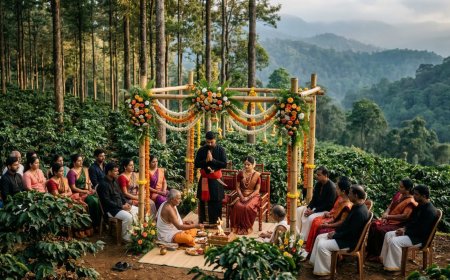
The coffee estate is the Coorg wedding's foundational venue category, and it is unlike any other venue category in the entire Indian destination wedding landscape. A working coffee estate in the Kodagu hills — the arabica and robusta plants growing between the silver oak shade trees, the pepper vines climbing the silver oaks, the cardamom in the understorey, the specific, layered, living architecture of a spice and coffee plantation that has been growing for a hundred and fifty years — is not a venue that has been designed for weddings. It is a place of extraordinary, layered, agricultural beauty that happens to have a bungalow at its centre and grounds that accommodate a wedding programme of forty to eighty guests with a naturalness and an intimacy that purpose-built venues cannot approach.
The Coorg coffee estate wedding has a specific seasonal logic that the NRI couple must understand from the first planning conversation. The coffee blossom — the white jasmine-scented flowers that cover the arabica plants for two to three weeks in March, transforming the estate into something that smells as extraordinary as it looks, producing the specific sensory experience that Rohit's father said could not be described to someone who has not been there — is the most coveted and most constrained seasonal window in the Coorg wedding calendar. March is the month, and it is approximately three weeks, and the estate properties that can offer the blossom experience are few and in high demand during these weeks for reasons that have everything to do with the agricultural calendar and nothing to do with the wedding industry.
The monsoon in Coorg — from June through September — is one of the most intense in India, with Madikeri receiving approximately two thousand seven hundred millimetres of rainfall annually. This is not a gentle monsoon. It is a dense, sustained, forest-sustaining rainfall that renders outdoor event planning genuinely impractical and that closes many of the estate properties' access roads for extended periods. The Coorg wedding season is October through May, with October through February and March being the primary and secondary windows respectively.
The Kodava people — the indigenous community of Kodagu whose culture is the most specifically, distinctively unique in Karnataka — are the cultural context of the Coorg wedding, and the couple who does not engage with this context is holding a wedding in one of the most culturally specific places in India without acknowledging what makes it specific. The Kodava tradition includes the Bolak-Nalknad martial dance performed at celebrations, the Pandi curry and Kadambuttu of the Kodava feast, the Kodava language with its distinct Dravidian grammar, the Ainmane ancestral home tradition, and the specific, dignified independence of Kodava women — a culture in which women have traditionally held property rights, carried weapons, and participated in the martial and social traditions of the community with an equality that has few equivalents in the Indian subcontinent's social history.
Mysuru — The Palace City Wedding
Mysuru is the most formally, most historically, most institutionally beautiful city in Karnataka — the seat of the Wodeyar dynasty, the city that the Mysore kingdom's three centuries of sophisticated patronage of art, architecture, music, and craft has produced, the place where the Dasara festival's ten days of royal ceremony have been held continuously since the fourteenth century with an elaboration and a grandeur that is among the most extraordinary public spectacles in India.
The Mysuru wedding is built around two defining assets: the Mysuru Palace and the silk. The Mysuru Palace — the Amba Vilas Palace, rebuilt in 1912 in the Indo-Saracenic style by Henry Irwin for the Wodeyar maharaja — is not available for private event hire in the manner of a commercial wedding venue. It is a national monument, a royal property, and the seat of an ongoing royal family, and its event use is governed by the palace administration rather than the commercial hospitality market. What the palace offers the wedding couple is its presence — the most photographically extraordinary royal palace in South India, visible from large areas of Mysuru, illuminated on Sundays and during Dasara with ninety-seven thousand bulbs, forming the architectural backdrop for any wedding held within visual range of its walls.
The wedding that is strategically positioned in relation to the Mysuru Palace — that is held at one of the palace-adjacent heritage properties, that times its outdoor functions to the palace illumination on a Sunday evening, that uses the palace's presence as the frame rather than attempting to possess it — is working with one of the most powerful architectural backdrops available at any Indian wedding destination.
The heritage hotels and properties of Mysuru that make this positioning possible include the Radisson Blu Plaza Hotel Mysore, the Lalitha Mahal Palace Hotel — the former guest palace of the Mysore maharajas, now managed as a heritage hotel by the Taj group's subsidiary — and a range of boutique properties in the old palace city area. The Lalitha Mahal Palace, set on a hilltop overlooking the city with the Chamundi Hills behind it, is the most specifically, historically resonant of these options — a Edwardian-era palace with the Corinthian columns and the domed entrance hall of the guest palace tradition, converted to hotel use after independence and retaining enough of its original architectural character to make the wedding experience genuinely distinct from any purpose-built hotel.
The Mysuru silk wedding deserves treatment as an aesthetic framework rather than merely a cultural note. Mysore silk — the Mysore crepe silk woven in the traditional workshops of the city, the specific lustre and weight of the silk that the Mysore Sals (traditional silk weavers) have been producing since the Wodeyar patronage established the tradition — is the most famous and most specifically Karnataka textile, and its integration into the wedding's decor language, its gifting programme, and the bridal and family attire choices connects the celebration to a craft tradition of genuine historical depth.
Hampi — The Vijayanagara Wedding
Hampi is the most historically extraordinary landscape in Karnataka — the capital of the Vijayanagara Empire from the fourteenth to sixteenth centuries, the city that was at its peak the second largest in the world after Beijing, now a UNESCO World Heritage Site scattered across a landscape of granite boulders, ruined temples, market streets, royal enclosures, and the Tungabhadra River, all of it existing in the specific, dream-like quality of a civilisation that was at the height of its power and then, after the Battle of Talikota in 1565, simply stopped.
The Hampi wedding is not for every couple, and this guide states that directly. It is for the couple whose aesthetic is the ancient ruin, the boulder landscape, the river at sunset, the sense of being in a place where the human scale of the wedding is made magnificent by the non-human scale of the centuries that precede it. The couple who wants the manicured lawn and the chandelier and the five-star service will not find it at Hampi. The couple who wants to be married in the presence of the Vittala Temple complex, in the shadow of the musical pillars, with the Tungabhadra flowing below the Hemakuta Hill and the boulders rising behind in the specific, orange, geological grandeur of the Deccan Plateau — this couple will find that Hampi is not a compromise destination but a positive, deliberate, extraordinarily specific choice.
The hospitality infrastructure at Hampi has grown substantially in the last decade, with several boutique heritage properties and glamping-style resorts that understand the specific, boulder-landscape aesthetic of the destination and that have developed event infrastructure in relationship to the site rather than in contradiction to it. The Evolve Back Hampi — formerly the Orange County Hampi — is the most developed of these properties, with cottages set in a royal-enclosure landscape and event spaces that work with the Vijayanagara architectural references rather than ignoring them.
The regulatory framework at Hampi is the ASI-governed framework that the Mahabalipuram guide has addressed — the UNESCO World Heritage Site's protected monuments cannot be used for private events, and the wedding at Hampi takes place in proximity to the ruins rather than within them. The Tungabhadra riverside ceremony — at one of the ghat steps, with the ancient stone stairways descending to the river and the boulders rising on both banks — is the Hampi ceremony format that most completely uses the landscape without transgressing its protections.
Chikmagalur — The High-Altitude Plantation Wedding
Chikmagalur — the district at the northern end of the Western Ghats coffee belt, whose name translates approximately as the younger daughter's town in the Kannada tradition — is Coorg's quieter, less commercially developed northern cousin. At slightly lower altitudes than the Kodagu heartland but with a similar plantation character — the arabica and robusta estates, the silver oak shade trees, the cardamom and pepper interplanting, the mist that sits in the valley mornings and burns off by mid-morning — Chikmagalur offers the coffee estate wedding experience in a setting that is less visited and in some ways more specifically intact than the more famous Coorg.
The Baba Budangiri range — the hills named for the Sufi saint who is credited with bringing coffee to India in the seventeenth century, carrying seven coffee beans from Yemen to the Chikmagalur hills, establishing in the process the Indian coffee tradition — is the specific, historically resonant landscape of the Chikmagalur wedding, and the couple whose pre-wedding shoot happens on the Baba Budangiri ridge, with the coffee estates visible below and the cloud forest above, is doing something that has a specific historical depth — the acknowledgement of the specific human act of carrying seven seeds across an ocean — that no other Indian destination can offer.
The Hoysala temple complex at Belur and Halebidu, approximately forty kilometres from Chikmagalur town, is the most significant architectural heritage in the vicinity — the twelfth and thirteenth-century star-shaped temples of the Hoysala dynasty, whose exterior walls are covered in continuous friezes of carved figures executed in a quality and a density of detail that has no equivalent in Indian temple sculpture outside of Khajuraho. The Belur Channakeshava Temple and the Halebidu Hoysaleshwara Temple are both protected monuments whose event use is governed by the ASI framework, but the pre-wedding shoot in their courtyards, at the permitted hours, with a photographer who understands the specific quality of the Hoysala stone carving's light — the way the afternoon light rakes across the relief figures — produces images of extraordinary quality.
Kabini and Nagarhole — The Wildlife Reserve Wedding
The Kabini backwater — the reservoir formed by the Kabini River dam at the edge of the Nagarhole Tiger Reserve, the boundary between the reserve's protected forest and the lodges that line the reservoir's southern shore — is the Karnataka destination that most directly parallels the Jim Corbett proposition in this guide series: the wedding held at the edge of a tiger reserve, in relationship to a wildlife landscape of extraordinary richness, governed by the forest department's operational parameters and producing, for guests who attend it, an experience that extends significantly beyond the ceremony itself.
The Kabini wildlife lodge properties — the Taj Kabini River Lodge, the Evolve Back Kuruba Safari Lodge, the JLR Orange County Kabini — are the established luxury lodge market, with event infrastructure, accommodation density, and wildlife safari programming built into the guest experience as a matter of operational standard. The Kabini elephant crossing — the annual phenomenon in which large herds of elephants cross the Kabini reservoir backwater during the summer months, visible from the lodge banks in concentrations that no other site in India produces — is the wildlife programme element that gives the Kabini wedding its most specifically, non-reproducibly extraordinary experience dimension.
The seasonal constraint at Kabini is the monsoon closure: most Kabini lodges close or significantly reduce operations from June through September when the forest department closes the reserve and the backwater levels rise. The primary wedding season is October through May, with March and April offering the specific wildlife concentration that the dry season's reduced water sources produce.
The Hoysala Country — The Temple Heritage Wedding
The Hoysala temple towns of Belur, Halebidu, and Somnathpur constitute a heritage wedding destination character that is distinct from every other Karnataka option and that is, in certain specific and non-negotiable ways, the most culturally specific and most historically grounded destination available in the state.
The wedding that is designed in relationship to the Hoysala temple tradition — that uses the star-shaped temple's geometric motif in its invitation design, that sources the black schist stone material of the temple carvings as a decor texture reference, that engages the Carnatic music tradition that the Hoysala courts patronised as the ceremony's musical context — is making a wedding that belongs to a specific, thousand-year-old, specifically Kannada cultural tradition. This is not the generic Indian heritage wedding. It is specifically, only, the Hoysala wedding, and it is available at this specific geography and nowhere else.
The boutique properties in the Hassan district — the closest city to the Hoysala temple towns — and the heritage homestays in the farming villages of the Malnad region have developed a wedding hospitality offering in the last decade that, while more limited in scale than the Coorg or Mysuru markets, offers the most specifically, historically intimate Karnataka wedding experience available.
The Seasonal Framework — Karnataka's Varied Calendar
Karnataka's internal diversity produces an equally varied seasonal calendar, and the framework that applies to one destination character does not apply to all.
The coffee blossom season — March, two to three weeks, Coorg and Chikmagalur specifically — is the most coveted and most constrained window, requiring the earliest booking timeline. The post-monsoon October to February period is the primary window for Coorg, Chikmagalur, Kabini, Hampi, Mysuru, and the Hoysala country simultaneously — the most universally applicable Karnataka wedding season. The Mysuru Dasara festival in October — specifically the Vijayadasami day, the tenth and final day of the festival, when the palace illumination is at its most elaborate and the royal procession provides an extraordinary backdrop for the wedding week — is the most specifically, historically significant seasonal event available at any Karnataka destination, and the couple whose wedding week coincides with Mysuru Dasara has access to a public ceremony of extraordinary grandeur that no production budget can manufacture.
The monsoon from June through September affects all Karnataka destinations to varying degrees — most intensely in Coorg and the Western Ghats, less intensely in the drier eastern districts of Hampi and the Deccan Plateau — and is not recommended for outdoor wedding programming at any Karnataka destination.
NRI-Specific Logistics — The Bengaluru Gateway and Its Advantages
The Bengaluru gateway is the Karnataka destination wedding's defining logistical asset, and it operates differently from the gateway city of any other multi-destination state in this guide series because Bengaluru is not simply the nearest major airport — it is a destination in its own right, with family infrastructure, vendor depth, and the operational support that the NRI couple's planning process requires.
The NRI couple whose families are in Bengaluru is planning every Karnataka destination wedding from a city that is simultaneously the coordination hub, the vendor base, and the family support system. The coordinator in Bengaluru who drives to the Coorg estate for the reconnaissance visit is making a five to six hour round trip, not a two-day expedition. The decorator in Bengaluru whose truck takes the fresh flowers from the wholesale market to the Kabini lodge is making a four-hour journey, not a twelve-hour logistics operation. The elderly grandmother whose mobility limitations make a remote destination impractical can be based in Bengaluru and join the wedding programme at the ceremony day, returning to the city the same day on a road that is four to six hours of manageable, well-maintained highway.
The Kempegowda International Airport's direct international connectivity — London, Frankfurt, Singapore, Dubai, Kuala Lumpur — makes the NRI guest's journey to a Karnataka destination wedding competitive with any Indian destination in this guide series, with the added advantage that the final leg from Bengaluru to the destination is a road journey of three to six hours through landscapes of genuine beauty rather than a mountain road or a ferry or a domestic connection.
The Three-Visit Protocol for Karnataka
The reconnaissance visit for a Karnataka destination wedding must include the specific, physical experience of the chosen destination character — the walk through the coffee estate at six in the morning before the mist burns off, the approach to the Mysuru Palace on a Sunday evening when the illumination begins, the arrival at the Hampi riverside at sunset. This is the visit that confirms or revises the decision made from Bengaluru, and it is the visit that cannot be adequately substituted by video calls and website photographs.
For the Coorg coffee estate wedding specifically, the reconnaissance visit must happen during the specific season the wedding is targeting. The estate in October is not the estate in March. The October reconnaissance that confirms the venue for a March blossom wedding has not confirmed the venue for the blossom — it has confirmed the infrastructure. The blossom season reconnaissance must happen in March, even if it requires an additional visit.
The NRI Wedding Planning Master Reference Table
| Planning Parameter | Karnataka-Specific Detail | NRI Action Required | Recommended Timeline |
|---|---|---|---|
| Destination Selection | Six distinct characters: Coorg coffee estate, Mysuru palace city, Hampi Vijayanagara ruins, Chikmagalur plantation, Kabini wildlife reserve, Hoysala temple country | Select specific destination character before venue shortlisting; each character has fundamentally different experience, season, capacity, and vendor requirements | First planning decision — before all others |
| Bengaluru Gateway Advantage | Coorg 5–6 hrs, Mysuru 3 hrs, Hampi 5–6 hrs, Chikmagalur 4–5 hrs, Kabini 4 hrs, Hoysala towns 4–5 hrs from Bengaluru; all via well-maintained highways | Route all international guests via Bengaluru KIA; design Bengaluru assembly day before convoy to destination; use Bengaluru vendor market for all specialist sourcing | Built into logistics from planning outset |
| Coorg Estate Venues | Working coffee estate buyouts (40–80 guests), Ainmane ancestral home events, Madikeri boutique heritage properties | Confirm estate's coffee crop calendar and wedding use permissions; walk estate grounds at ceremony hour on reconnaissance visit; confirm road access for vendor vehicles | 16–20 months before wedding |
| Coffee Blossom Window | March only, 2–3 weeks; arabica blossom; most coveted and most constrained seasonal window in Karnataka calendar | Begin estate conversations at 18 months for March target; confirm blossom timing with estate manager; book immediately upon confirmation — blossom estates commit early | 18–20 months before wedding |
| Mysuru Heritage Venues | Lalitha Mahal Palace Hotel Taj, Radisson Blu Plaza Mysore, palace-adjacent boutique properties; Dasara October festival context | Confirm palace illumination Sunday timing for outdoor function scheduling; assess palace sightline from venue event spaces on reconnaissance visit; check Dasara dates if October wedding | 14–16 months before wedding |
| Hampi Venue and ASI Framework | Evolve Back Hampi primary luxury property; ASI protected ruins cannot be used for private events; Tungabhadra riverside ceremony at permitted ghats | Confirm ASI prohibited area boundaries with coordinator; design ceremony at Tungabhadra riverside ghat rather than within monument zone; obtain ASI-compliant event permissions | 12–14 months before wedding |
| Chikmagalur and Hoysala | Plantation estate buyouts near Baba Budangiri; Belur and Halebidu temples ASI protected; Hassan district boutique properties | ASI photography guidelines apply at Hoysala temples; brief photographer on Hoysala stone carving light conditions; confirm plantation estate road access | 14–16 months before wedding |
| Kabini Wildlife Lodge Venues | Taj Kabini River Lodge, Evolve Back Kuruba, JLR Orange County; forest department wildlife reserve regulations; elephant crossing season March–May | Confirm forest department event permissions with venue; design safari programme as wedding week element; confirm monsoon closure dates for target season | 12–14 months before wedding |
| Best Wedding Season | October to February primary across all characters; March for Coorg blossom specifically; avoid June to September monsoon; Dasara October for Mysuru | Match season to destination character; Dasara context for Mysuru requires October booking 18+ months ahead; Kabini elephant crossing requires March–May window | 16–20 months for peak and special dates |
| Kodava Cultural Integration | Bolak-Nalknad martial dance, Kodava pandi curry and kadambuttu feast, Kodava language oral tradition, Ainmane ancestral home tradition | Engage Bolak-Nalknad ensemble for evening programme; commission Kodava feast for one function; source Kodava handcraft elements for decor and gifting | 8–10 months before wedding |
| Mysuru Silk and Craft | Mysore silk saree weaving tradition, sandalwood carving, Mysore painting tradition, Mysore pak confectionery | Source Mysore silk for mandap draping and gifting; commission Mysore painting motif for invitation design; arrange sandalwood carving workshop visit as guest programme element | 8–10 months before wedding |
| Hampi Cultural Context | Vijayanagara Empire history, Kannada inscriptional tradition, Tungabhadra river ritual importance, Vitthala temple music tradition | Engage heritage guide for group monument orientation; design Vitthala Temple complex visit as wedding programme element; brief photographer on boulder landscape golden hour | 6–8 months before wedding |
| Vendor Ecosystem | Bengaluru primary vendor hub for all Karnataka destinations; destination-specific local coordinators essential; Coorg has established estate wedding coordinator community | Bengaluru vendors service all Karnataka destinations without scenic destination premiums; require destination-specific local coordinator alongside Bengaluru creative leads | 12–14 months before wedding |
| Photography Conditions | Coorg coffee estate morning mist burns off 9–10 AM, shoot before; Mysuru palace illumination Sunday evenings; Hampi boulder landscape golden hour exceptional; Kabini backwater sunrise | Brief photographer on each destination's specific light conditions and timing; schedule Mysuru palace illumination couple shoot for Sunday evening; Hampi sunrise on Hemakuta Hill | 6–8 months before wedding |
| Legal and Payments | Indian Contract Act 1872; Consumer Protection Act 2019; FEMA 1999; Karnataka forest department permits for Kabini events; ASI regulations for Hampi and Hoysala | Use NRO/NRE account; confirm forest department and ASI permissions through coordinator; require full scope, milestones, and cancellation clauses in all contracts | Before first vendor payment |
| Communication Protocol | IST gap: UK +4.5 hrs, US East +9.5 hrs, Australia East −5.5 hrs; Bengaluru vendor market digitally sophisticated; Coorg and Kabini cellular connectivity variable | Schedule weekly coordinator call; test estate and lodge cellular connectivity on reconnaissance visit; establish backup communication plan for remote estate wedding days | From first vendor engagement |
Common Mistakes NRI Couples Make With Karnataka Destination Weddings
The first and most consequential mistake is choosing Karnataka without choosing which Karnataka — arriving at the planning conversation with the state selected but the destination character unresolved, and then attempting to evaluate Coorg estate photographs alongside Hampi ruined-temple photographs alongside Mysuru palace-adjacent hotel photographs as though they are options within the same aesthetic category. They are not. They are fundamentally different wedding experiences, and the couple who has not decided which experience they are choosing cannot coherently evaluate venues, cannot brief vendors, and cannot design a programme, because each destination character requires a different approach to every one of these tasks. The destination selection must precede all other planning, and it must be made with genuine understanding of what each character offers — not from website photographs but from the physical experience of at least one reconnaissance visit to the shortlisted destination.
The second mistake is treating the Coorg coffee blossom window as a planning preference rather than an absolute seasonal fact. The blossom happens in March. It happens for approximately two to three weeks. The date varies slightly by year and by elevation within Kodagu — lower elevation estates blossom slightly earlier than higher ones — and the variation is predictable within a range but not to the specific date. The couple who targets the blossom window must begin estate conversations at eighteen months, must confirm the blossom timing with the estate manager as a specific data point rather than an assumption, and must build the programme around the estate's agricultural calendar rather than around their preferred wedding date. The estate that offers a guaranteed blossom experience in exchange for a flexible date commitment — the couple confirms the date three months out when the blossom timing is predictable — is making the only honest offer available. The estate that guarantees the blossom on a specific date booked fourteen months in advance is offering a guarantee it cannot keep.
The third mistake is neglecting the Kodava cultural dimension of a Coorg wedding in favour of a generic South Indian or pan-Indian wedding format. The Kodava people are one of the most culturally specific communities in India, and the Coorg wedding that is held on a Kodava estate without any acknowledgement of the culture whose land it is — the food, the music, the martial tradition, the ancestral home custom — is a wedding that treats the landscape as a set rather than as a place with a living culture. The Pandi curry and Kadambuttu of the Kodava feast, the Bolak-Nalknad martial dance, the Kodava language's presence in the ceremony's welcome — these are not decorative cultural gestures. They are the acknowledgement of a debt to the place and its people that every Coorg wedding owes.
The fourth mistake is failing to assess the Hampi venue's proximity to the ASI protected monument zone before booking and discovering on the day of the ceremony that the planned setup is within the prohibited area. The Hampi UNESCO World Heritage Site's boundary is extensive and complex — it covers not just the major temple complexes but the entire ancient city's area, including the royal enclosures, the market streets, and the riverside ghats — and the boundary is not always visually obvious on the ground. The coordinator without specific Hampi experience may not know exactly where the ASI's event restrictions apply, and the couple who has not confirmed the precise boundary in relation to their ceremony site may arrive at Hampi to find that the most beautiful ceremony position is also the most legally problematic one. The ASI compliance confirmation must be specific, documented, and obtained from the coordinator at the planning stage rather than assumed from a general statement that the venue is "outside the protected area."
The fifth mistake is underestimating the Mysuru Dasara festival's logistical implications for the October wedding couple. Mysuru Dasara is the largest public festival in Karnataka, drawing hundreds of thousands of visitors to the city over its ten-day duration and producing accommodation scarcity, traffic congestion, and vendor unavailability that can significantly affect the wedding programme if they have not been planned for. The couple whose Mysuru wedding overlaps with Dasara without having planned specifically for the festival's logistical conditions — the accommodation block booked two years in advance, the traffic buffers built into every programme transfer, the vendor confirmations obtained before the festival period's demand peak — will encounter the Dasara logistics as a crisis rather than as the extraordinary cultural backdrop that it can be for the couple who has prepared for it correctly.
The Aesthetic Language of a Karnataka Wedding
Karnataka's aesthetic vocabulary is the richest and the most varied of any state covered in this guide series, because the state's internal cultural diversity — the Kodava, the Wodeyar, the Vijayanagara, the Hoysala, the Havyaka Brahmin, the Tulu, the Kannada mainstream — has produced multiple distinct aesthetic traditions, each of which constitutes a complete and sophisticated visual and material language.
The Coorg wedding's aesthetic begins with the estate itself — the specific, layered, agricultural beauty of the coffee plantation — and builds from the materials the estate produces: the coffee wood, the silver oak, the pepper vine's twist, the cardamom pod's deep green, the brass vessels of the Kodava kitchen, the specifically woven cotton of the Kodava woman's ceremonial dress. The decorator who works with these materials — who finds the aesthetic of the wedding in the estate's own vocabulary rather than importing the Delhi wedding market's standard palette — will produce something that is recognisably, irreducibly of this specific place.
The Mysuru wedding's aesthetic is the Wodeyar court tradition: the Mysore silk's specific lustre, the rosewood furniture of the palace interiors, the Mysore painting's jewel-tone palette and its characteristic flat perspective, the sandalwood incense that is the olfactory signature of the city, the specific gold of Mysore's traditional jewellery. The invitation designed in the Mysore painting tradition, the mandap draped in Mysore silk, the reception fragrant with sandalwood — this is the aesthetic of a city that has been beautiful for three hundred years.
The Hampi wedding's aesthetic is geological and ancient: the orange granite of the boulders, the black schist of the Hoysala carvings, the river sand's pale grey, the Vijayanagara architectural geometric — the corbelled stone archway, the carved pillar, the open pavilion's relationship with the landscape. The wedding decor that references these forms — the geometric rangoli in ochre and red, the oil lamps in stone niches, the mandap whose proportions reference the stone mandapa of the Vitthala Temple complex — is making an aesthetic statement that belongs to the oldest culture this landscape has produced.
Resolution
The ceremony was in the coffee estate at six-forty-five in the morning, in the second week of March, which was the week that Rohit's father had identified from forty years of accumulated knowledge as the week when the Nagara Hole valley's mid-altitude arabica estates were most likely to be in full blossom.
He had been right.
The blossom had opened two days before the ceremony, which was the specific grace of a working landscape's indifference to the wedding schedule — it had not opened for the wedding, it had opened because the temperature and the humidity and the light had crossed the threshold that the arabica plant responds to, which is a threshold that agriculture has been tracking for two hundred years and that a wedding coordinator's brief cannot influence. It had opened because it was time. The wedding had arrived at the right moment by the specific, non-romantic mechanism of good information applied at the right planning stage.
The smell arrived before the light had fully come. Meera was awake at five-thirty, and the smell came through the open window of the estate bungalow's bedroom at five-forty-five — the specific, white, jasmine-adjacent but not jasmine, coffee-blossom smell that Rohit's father had said could not be described to someone who had not been there, and which could not be described to someone who had not been there, because the description always reduces to the words white and sweet and clean and none of those words is the thing.
She went outside in the dark.
The blossom was invisible in the darkness but the smell was everywhere — the entire estate breathing it out, two hundred years of arabica plants in simultaneous flower, the silver oaks above them still and dark against the sky.
Aarav found her there at six. He had smelled it too, through his own window on the other side of the bungalow.
They stood in the estate in the pre-dawn dark and breathed the coffee blossom and did not say anything.
At six-forty-five, when the light had come enough to see the white flowers on the plants and the mist still sitting in the valley below and the Western Ghats above the estate going from dark to green in the early morning, the pandit began, and Rohit's father — who had driven to the estate the previous day from Bengaluru, who had not been back to Kodagu in eleven years, who had stood at the estate's edge the evening before and looked at the hills in a way that Rohit had not seen him look at anything for a long time — sat in the front row with his hands on his knees and his eyes on the mandap and the blossoming plants behind it.
After the ceremony, in the quiet that follows the ceremony when everyone is present before the photographs begin and the programme resumes, Rohit found his father at the edge of the estate, looking down the valley.
"Was it what you remembered?" Rohit asked.
His father was quiet for a moment.
"More," he said. "It is always more when you come back."
He looked at the blossoming plants, the mist, the hills.
"This is the thing about Karnataka," he said. "You can spend your whole life in Bengaluru and think you know the state. And then you come to the hills and you understand that you have been knowing the city and the state has been here the whole time, being what it is, waiting for you to come back."
He turned to Rohit.
"Tell Priyanka," he said. "Tell her she chose the right place."
Rohit looked at the estate in the morning light — the blossom, the mist, the mountains.
"She knows," he said.
Choose the Karnataka character before the venue. Book the blossom estate at eighteen months if March is the target — it will not be there at twelve. Confirm the ASI boundaries at Hampi before the ceremony position is finalised. Include the Kodava feast at one Coorg function. Use the Mysuru silk for the mandap draping. Walk the venue at ceremony hour on the reconnaissance visit — the estate in the morning mist will tell you everything the photographs cannot.
Karnataka contains the coffee estate and the palace city and the ancient ruins and the wildlife reserve and the temple country. It contains more distinct and more extraordinary wedding destination characters than any other state in peninsular India, and all of them within a day's drive of a city whose families and vendors and infrastructure make the planning achievable.
Choose with intention. Plan for the specific place. Arrive early enough to smell the blossom before the ceremony begins.
The place will do the rest.
Published by NRIWedding.com — The Premium Global Platform for Non-Resident Indians Planning Indian Weddings From Abroad.
What's Your Reaction?
 Like
0
Like
0
 Dislike
0
Dislike
0
 Love
0
Love
0
 Funny
0
Funny
0
 Angry
0
Angry
0
 Sad
0
Sad
0
 Wow
0
Wow
0