
















































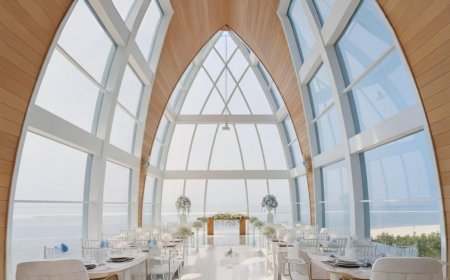

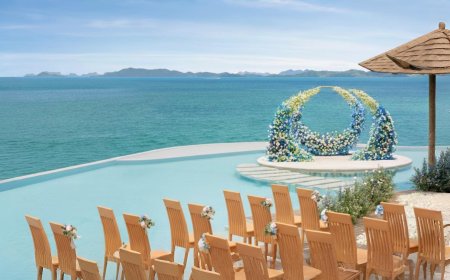



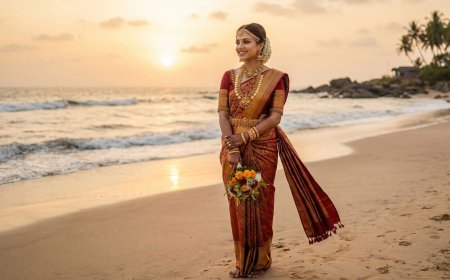








Andaman Islands Wedding — Tropical Paradise Logistics Every NRI Couple Must Know
An Andaman Islands wedding offers something no other Indian destination can — a genuine tropical archipelago nine hundred kilometres from the mainland, with turquoise water, primary rainforest, world-class coral reefs, and the specific emotional quality of a celebration at the edge of the familiar world. But the same remoteness that makes the Andamans extraordinary makes the logistics genuinely complex — from guest travel sequences across multiple flights and sea crossings, Restricted Area Permit requirements for foreign passport holders, mainland vendor travel costs, limited local supply chains, marine environment permissions, and the premium pricing of the few luxury resorts that can deliver a quality destination wedding in this extraordinary setting. This complete guide covers everything NRI couples need to know to plan an Andaman wedding well.


The Islands at the Edge of Everything
There is a moment on the flight from Chennai or Kolkata to Port Blair when the Indian subcontinent disappears behind you and there is nothing below the aircraft but the Bay of Bengal — the deep, specific blue of a sea that has no coast visible in any direction, stretching to every horizon with the particular clarity of water that is very deep and very clean and very far from the nearest industrial shoreline.
And then, after two hours of that blue, the islands appear.
Not gradually. Not as a coastline approaching. But suddenly — a scattering of green on deep blue, as if someone had placed pieces of a forest on the surface of the ocean and watched them hold their position there through the specific grace of coral and rock and geological time. The green is the green of a rainforest that has never been cleared — primary forest, some of the last in India, covering islands that rise from the sea with the specific abruptness of volcanic formations that have not been worn smooth by millennia of human habitation.
This is the approach to the Andaman Islands.
And it is, for the NRI couple sitting in that aircraft seat watching it happen, the first moment of understanding what it means to get married here. Not in the logistical sense — the logistics come later, in this guide, in the detail that the approach from above does not reveal. But in the experiential sense. The understanding that this is genuinely far away. Genuinely other. Genuinely — in a way that Goa and Kerala and Jaipur, beautiful as they all are, are not — at the edge of the familiar Indian world and at the beginning of something else.
The Andaman Islands are Indian territory — administered as a Union Territory, connected to the mainland by regular flights, governed by Indian law, and celebrating the same festivals and cultural events as the rest of India. But they are also something that no other part of India is — a tropical archipelago of over five hundred islands in the Bay of Bengal, nine hundred kilometres from the nearest Indian coastline, with a marine ecosystem that is among the healthiest in the Indian Ocean, beaches that have not been developed into the tourist infrastructure that has transformed Goa, and a quality of natural isolation that is genuinely rare in the twenty-first century world.
For NRI couples for whom every other Indian destination has been considered and found — not inadequate, but familiar — the Andaman Islands are the proposal that changes the frame of reference entirely. Not a better version of what already exists. Something categorically different.
This guide tells you everything about what that difference actually means — in logistical terms, in seasonal terms, in regulatory terms, in budget terms, and in the specific, honest terms of what an Andaman wedding can and cannot deliver.
The Core Reality: What an Andaman Wedding Actually Involves
The Distance Is Real
The most important thing to understand about an Andaman Islands wedding — before the venues, before the beaches, before the photographs of turquoise water and white sand — is that the distance is real.
Nine hundred kilometres of open ocean from the nearest Indian mainland coast. Two to two and a half hours by air from Chennai or Kolkata. No road connection. No rail connection. The only ways in and out are aircraft and the government ferry service — the latter taking fifty to sixty hours from Chennai and not relevant for wedding guest logistics.
What this means practically:
Every guest who attends an Andaman wedding is making a specific, non-trivial travel commitment. International flights to Chennai or Kolkata. A connecting domestic flight to Port Blair. The transfer from Port Blair to the specific island or resort where the wedding is happening — which may involve another ferry or speedboat journey.
For NRI guests flying from the UK, USA, or Canada, the total travel time to an Andaman wedding destination is typically twenty-four to thirty-six hours — comparable to the travel time to a destination wedding in the Caribbean or Southeast Asia.
This distance has a specific implication for the guest list: An Andaman wedding is, by its geographical nature, a destination wedding for everyone — not just for the NRI guests, but for mainland Indian family guests as well. There are no local guests who drive thirty minutes to the venue. Everyone has traveled significantly to be there. This shared investment in the journey creates a specific quality of guest presence and commitment that destination weddings elsewhere do not always produce.
The Permit Requirement
The Andaman and Nicobar Islands have specific permit requirements for visitors that are unlike any other Indian destination — a legacy of the islands' restricted access history and the ongoing protection of the indigenous Andamanese communities.
For Indian citizens:
Indian citizens do not require a Restricted Area Permit for the main Andaman Islands — Port Blair, Havelock Island, Neil Island, and most of the tourist-accessible islands. However, the Nicobar Islands and some other islands remain restricted and require specific permits that are not relevant for wedding planning purposes.
For foreign nationals — including NRI guests holding foreign passports:
Foreign nationals require a Restricted Area Permit for the Andaman Islands. This permit is issued on arrival at Port Blair airport for most nationalities — a relatively straightforward process. However, NRI guests holding foreign passports — UK, USA, Canadian, Australian passports — need to be aware of this requirement and should confirm current permit procedures before travel.
The permit requirement for the wedding itself:
For the wedding event — particularly if it involves any beach or marine environment — there may be specific permissions required from the local administration. Engage a local Andaman wedding coordinator who understands the current permit landscape before planning any specific event format.
The Island Landscape: Where Andaman Weddings Happen
Port Blair — The Gateway
Port Blair is the administrative capital of the Andaman Islands and the arrival point for all flights. It is a working town rather than a resort destination — with the infrastructure of government administration, local commerce, and the specific character of a frontier outpost at the edge of Indian territory.
Port Blair is not typically the wedding destination itself. It is the gateway through which guests arrive before transferring to the island where the wedding will take place. However, it contains useful pre-wedding programme elements — the Cellular Jail and its history of the Indian independence movement, the Anthropological Museum, the local markets — that can enrich the programme for guests who arrive early.
Havelock Island — The Primary Wedding Destination
Havelock Island — officially renamed Swaraj Dweep in 2018, though commonly still referred to as Havelock — is the primary tourism and destination wedding island in the Andaman archipelago.
What makes Havelock the dominant wedding island:
• Radhanagar Beach: Consistently ranked among Asia's finest beaches — a long arc of white sand, calm shallow water of extraordinary clarity, and a beach environment that has been protected from the commercial development that has transformed comparable beaches elsewhere. Radhanagar Beach photographs are the images that make people want to get married in the Andamans.
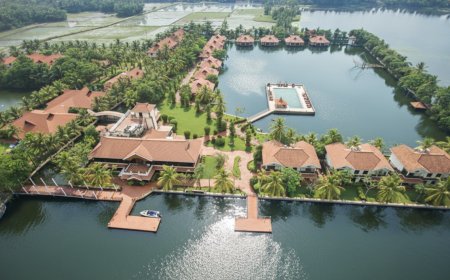
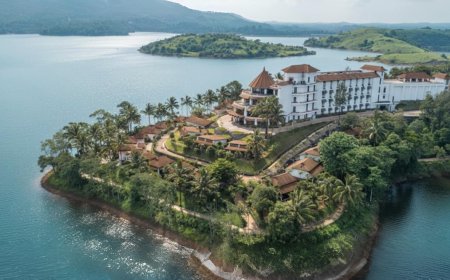
• Resort quality: Havelock has developed a resort landscape — anchored by the Taj Exotica Resort and Spa, the Barefoot Resort, and several boutique properties — that provides the luxury infrastructure a destination wedding requires.
• Ferry connectivity from Port Blair: Havelock is accessible by government ferry and private speedboat from Port Blair — the speedboat journey takes approximately ninety minutes and is the primary guest transfer method for wedding programmes.
The ferry logistics:
Every guest transfer between Port Blair and Havelock involves a sea crossing. This has specific implications for guests with seasickness sensitivity, for elderly guests, and for very young children. The Bay of Bengal can be rough — particularly during the pre-monsoon and monsoon seasons — and the speedboat journey is not uniformly comfortable for all passenger profiles. Consider anti-seasickness medication availability and brief guests on the crossing before they travel.
The Taj Exotica Resort and Spa, Havelock
The Taj Exotica on Havelock is the most significant luxury property in the Andaman wedding landscape — and the property that has defined what a high-end Andaman destination wedding can look like.
What the Taj Exotica offers:
• Beach access: The resort's beach — while not Radhanagar itself, which is a public beach some distance away — provides the resort's own beachfront event capability • Villa accommodation: The resort's beach villas and pool villas accommodate the wedding party in genuine luxury • Wedding event infrastructure: The Taj group's established wedding management capability applied to an Andaman setting • Brand accountability: The institutional reliability of the Taj brand in a location where independent property quality is highly variable
The limitation: The Taj Exotica Havelock is among India's most expensive resort properties — and its Andaman remoteness amplifies the cost of everything, from catering supplies that must be brought from the mainland to vendor travel that adds to every quote.
Neil Island — The Intimate Alternative
Neil Island — officially renamed Shaheed Dweep — is smaller, quieter, and less developed than Havelock. Its beaches — Bharatpur, Laxmanpur, Natural Bridge — are beautiful in a different way from Havelock's Radhanagar — less dramatically wide, more intimate in scale.
For NRI couples seeking a smaller, more intimate Andaman wedding — with a guest count below 50 and a preference for genuine remoteness over luxury resort infrastructure — Neil Island offers an alternative that the more developed Havelock cannot provide.
The tradeoff: Neil Island's resort infrastructure is significantly less developed than Havelock's. Luxury accommodation options are limited. Catering quality is more variable. The coordinator and vendor ecosystem is less established.
The Logistical Framework: What Every Element Requires
Guest Travel Management
The Andaman wedding requires more active guest travel management than any other Indian destination wedding — because the travel complexity is genuinely greater.
The guest travel sequence:
• International flight to Chennai or Kolkata: The two mainland Indian airports with the most frequent Andaman connections.
• Domestic flight Chennai/Kolkata to Port Blair: Typically one to two hours. Multiple daily flights on IndiGo, Air India, and SpiceJet.
• Transfer in Port Blair: Guests may need to stay overnight in Port Blair if the speedboat departure time does not align with the flight arrival. Port Blair overnight accommodation should be pre-arranged for guests with this transfer pattern.
• Speedboat to Havelock: Approximately ninety minutes. Pre-bookable through resort or through the government ferry service for budget guests.
• Transfer on Havelock to resort: Typically by resort vehicle or auto-rickshaw.
The total elapsed time from international departure to resort arrival: Typically twenty-four to thirty-six hours for NRI guests, twelve to eighteen hours for mainland Indian guests.
What this requires from the host couple:
• A detailed guest travel guide: A document that walks every guest through every step of the journey — flights to book, permit requirements, Port Blair overnight options, speedboat booking instructions, resort arrival logistics. This document should be shared three to four months before the wedding.
• A guest travel coordinator: Designate a specific person — within the wedding coordinator team or specifically — who manages guest travel queries and coordinates group transfers where possible.
• Port Blair overnight arrangements: Pre-book a block of rooms at a quality Port Blair hotel for guests who require an overnight stopover.
• Group speedboat transfer coordination: Rather than each guest booking independently, coordinate a group speedboat booking for the primary arrival day — which is more efficient, more cost-effective, and creates the first collective experience of the wedding programme.
Vendor Logistics: Everything Comes From Somewhere Else
The Andaman Islands do not have a wedding vendor ecosystem comparable to Jaipur, Goa, or Kerala. Most vendors — photographers, decorators, DJs, makeup artists — must be brought from the mainland. This has direct cost and logistics implications.
What mainland vendor travel adds to every quote:
• Return flights from mainland city to Port Blair
• Accommodation in Port Blair if overnight required
• Speedboat to Havelock
• Accommodation on Havelock for the duration of the assignment
• Per diem allowances for travel days
For a wedding with ten vendors traveling from the mainland, the total vendor travel and accommodation cost can add ₹3–8 lakhs to the overall budget — a cost that is often not fully visible in initial vendor quotes that do not include travel.
The catering supply chain:
Fresh produce for catering — quality meat, specialty vegetables, specific ingredients for an NRI wedding menu — must largely be sourced from the mainland and brought to Havelock. This has implications for menu planning, for food freshness, and for catering cost. Work with resort catering or an Andaman-experienced caterer who understands the supply chain and plans the menu accordingly.
What is available locally:
• Seafood: The Andaman sea is extraordinarily rich in seafood — fresh fish, lobster, crab, and other marine species are available at quality and freshness that mainland venues cannot match. An Andaman wedding that does not feature Andaman seafood prominently is missing its most compelling culinary opportunity.
• Tropical fruits: Coconut, banana, papaya, and other tropical fruits are available fresh and at quality.
• Local vegetables: Some local produce is available — though the variety is more limited than on the mainland.
Power and Infrastructure
The Andaman Islands' power infrastructure is more limited than mainland India — and resort power backup is not uniformly reliable across all properties.
What to confirm with the resort:
• Generator backup capacity — what does it cover and for how long?
• Whether the generator has been recently serviced
• Power supply for vendor equipment — sound, lighting, catering equipment — and whether additional power provision is required
The sound and lighting vendor challenge:
Specialist outdoor wedding sound and lighting vendors from the mainland are bringing equipment on aircraft — with the weight and dimension limitations that implies. The elaborate lighting installations that are standard at mainland destination weddings may need to be simplified for an Andaman event where equipment transport is a genuine constraint.
The Marine Environment: Ceremonies, Coral, and Responsibility
Beach and Marine Permissions
The Andaman Islands' marine environment is one of the most protected in India — for good reason. The coral reefs of the Andaman Sea are among the healthiest in the Indian Ocean, and the regulatory framework that protects them is more actively enforced than in many other Indian coastal destinations.
What this means for beach wedding events:
• Beach events require permissions from the Forest Department and/or the local administration — the specific authority depends on the beach and its classification
• Any event that involves structures, decorations, or activities on or near the beach requires advance permission
• Certain beaches — particularly those adjacent to protected marine parks — may not be available for private events
• Coral-safe sunscreen and no-touch-coral protocols should be briefed to all guestswho will be in the water
The forest and marine experience as a programme element:
The Andaman Islands' marine environment is the most compelling programme element available — and the one that most reliably converts initially uncertain guests into enthusiastic Andaman advocates.
What to build into the wedding programme:
• Snorkelling at Elephant Beach or North Bay: The underwater world of the Andaman reef — the specific colours of the coral, the specific species of fish, the clarity of the water — is an experience that changes people's reference point for what beautiful means
• Glass-bottom boat experience: For guests who cannot or prefer not to snorkel, glass-bottom boat tours provide access to the reef's visual world without water entry
• Sea walking: A guided walking experience on the seabed — available at several Havelock locations — that requires no swimming ability and produces the specific wonder of walking through water breathing normally
• Sunrise at Radhanagar Beach: The sunrise at Radhanagar Beach — before the day-trippers arrive — is among the most beautiful morning experiences available in India. Building a pre-wedding morning at Radhanagar into the programme is the single most powerful guest experience the Andaman programme can offer
The Seasonal Reality: When to Plan an Andaman Wedding
November to April — The Optimal Window
November to January: The northeast monsoon affects the Andaman Islands less severely than the southwestern mainland — making this period generally suitable for outdoor events, though November can carry some residual moisture. December and January are the clearest, most reliably beautiful months for an Andaman wedding — warm days, calm seas, extraordinary water clarity.
February to April: The optimal Andaman wedding window. The sea is at its calmest — important for the guest ferry transfer and for any marine programme elements. Water clarity is at its maximum — important for the snorkelling and diving programme elements. Temperatures are warm without being oppressive — 27°C to 32°C. February and March are arguably the finest months in the entire Andaman calendar for a destination wedding.
May — The Transition
May brings the beginning of the pre-monsoon period — rising winds, building swells, and the early signs of the southwest monsoon approaching. Late May is the effective end of the practical Andaman wedding season.
June to October — The Monsoon
The Andaman Islands receive significant southwest monsoon rainfall from approximately late May through October. Seas can be very rough during this period — ferry services are occasionally suspended. Outdoor events are not advisable. This period is not suitable for destination wedding planning.
The Andaman Wedding Decor: Tropical Minimalism
The Principle
Like the Kerala backwater and Jim Corbett settings, the Andaman Islands are most honestly served by a decor approach that integrates with rather than contradicts the natural environment.
The Andaman visual vocabulary:
• The turquoise and white palette: The specific colours of Andaman water and Andaman sand are the most powerful visual elements available. A decor concept that incorporates rather than competes with this palette — using whites, creams, soft turquoises, and natural textures — creates visual coherence between the setting and the celebration.
• Tropical botanicals: Hibiscus, frangipani, bird of paradise, tropical palm — the flowers and plants of the Andaman landscape used in their natural forms
• Natural materials: Driftwood, sea glass, shells, coral-toned fabrics, natural rope and coir — materials that belong to a coastal tropical environment
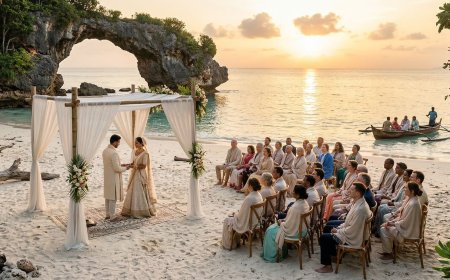
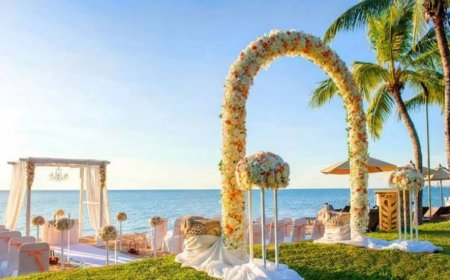
• The sunset: The Andaman sunset — over the Bay of Bengal, from a west-facing beach — is one of India's most extraordinary natural light events. The ceremony timing that captures this sunset as its backdrop is the most powerful decor decision available on a Havelock beach.
What to avoid:
• The elaborate floral installation that looks spectacular in a Jaipur haveli but is incongruous against a tropical beach
• Heavy, structured décor that competes visually with an environment whose beauty is precisely its openness and lightness
• Synthetic materials in an environment whose appeal is natural authenticity
Common Mistakes NRI Couples Make With Andaman Weddings
Underestimating the Total Cost
The Andaman Islands wedding is consistently more expensive than couples initially budget — because the remoteness adds cost to every element. Vendor travel, supply chain logistics, limited local vendor competition, and the premium pricing of the limited luxury resort options all push the total cost above the initial estimate.
Correction: Add a thirty to forty percent premium over the equivalent mainland destination wedding budget when building the initial Andaman cost estimate. Get fully itemised quotes from every vendor that include travel and accommodation, not just service fees.
Not Managing Guest Travel Proactively
The complexity of the Andaman guest travel sequence — international flight, domestic connection, Port Blair transfer, speedboat — is more than most guests have navigated independently for a wedding. Without proactive management, guests make suboptimal travel decisions that create arrival timing problems and stress.
Correction: Build a comprehensive guest travel guide and share it three to four months before the wedding. Coordinate group travel where possible. Designate a travel coordinator within the wedding team.
Ignoring the Permit Requirements for Foreign Passport Holders
NRI guests holding foreign passports need Restricted Area Permits for the Andaman Islands. The process is straightforward — permits are issued on arrival — but guests who are unaware of the requirement arrive unprepared for the additional formality.
Correction: Include clear permit information in the guest travel guide. Confirm current procedures with the Andaman administration or with the resort before communicating to guests — requirements can change.
Planning a Large Wedding for a Setting That Suits an Intimate One
The Andaman Islands' destination wedding landscape is optimised for intimate events — typically 30 to 80 guests. The resort infrastructure, the guest travel logistics, and the intimate quality of the setting all support smaller, more personal celebrations more effectively than large ones.
A wedding of 200 guests in the Andamans is logistically feasible but misses the point — the intimacy is the experience, and scaling beyond it reduces the quality of what the setting delivers.
Correction: Plan an Andaman wedding for the guest count that the setting genuinely suits — typically below 100. For larger families, consider whether the Andaman programme works better as an intimate core celebration, supplemented by a larger reception in a more accessible Indian city.
Not Engaging a Specialist Andaman Coordinator
The Andaman wedding ecosystem is small and specific. A general India wedding planner who handles the Andamans occasionally does not have the local vendor relationships, the permit knowledge, the resort management relationships, or the supply chain understanding that an Andaman-specialist coordinator possesses.
Correction: Identify a coordinator with a specific Andaman portfolio — not just India destination wedding experience generally. References from previous Andaman wedding clients are essential.
The Andaman Wedding Budget Framework
The following gives a realistic budget framework for an Andaman destination wedding of 40 to 70 guests over three days in the February to March optimal season.
Venue hire — Havelock resort, three days: • ₹5–20 lakhs depending on property tier
Catering — per plate, emphasis on local seafood: • ₹3,000–₹7,000 per plate — higher than mainland due to supply chain premium
Vendor travel and accommodation — mainland vendors: • ₹3–8 lakhs for ten to fifteen vendors traveling from mainland
Décor — tropical natural aesthetic: • ₹3–8 lakhs across all events — simpler than mainland equivalent due to transport constraints
Photography and videography: • ₹4–12 lakhs including travel — Andaman underwater and beach photography
Marine programme — snorkelling, glass bottom, sea walking: • ₹1–3 lakhs for group marine experiences
Guest accommodation — Havelock resort: • ₹8,000–₹30,000 per room per night depending on property
Port Blair to Havelock transfers — group speedboat: • ₹1–2 lakhs for coordinated group transfers
Wedding planner — Andaman specialist: • ₹2–6 lakhs
Total realistic budget for a quality Andaman destination wedding of 40 to 70 guests: ₹30–80 lakhs with significant variation by resort tier and vendor choices.
The Emotional and Cultural Layer: The Edge of the World
The Andaman Islands were, for most of Indian history, the edge of the known world.
The place where the empire sent its most dangerous political prisoners — the Cellular Jail in Port Blair, where the heroes of the independence movement were incarcerated in solitary confinement, is a reminder that these islands were chosen for their remoteness, for the impossibility of escape, for the specific quality of isolation that nine hundred kilometres of open ocean provides.
That isolation is now the gift.
The world that pursues NRI couples — the professional world, the immigration bureaucracy, the administrative complexity of lives lived across multiple countries and multiple time zones — cannot follow them here. Not practically. Not emotionally. The distance that makes the Andaman wedding logistically challenging is the same distance that makes it experientially liberating.
There is something that happens at the edge of the familiar world — in the specific blue of the Bay of Bengal seen from the aircraft, in the first morning on Havelock when the only sounds are the sea and the forest and the specific birds of the Andaman archipelago — that does not happen anywhere closer to the centre.
A clarity. A simplicity. The specific quality of attention that remoteness and beauty together produce — where the things that are not important become obviously unimportant, and the things that are important become obviously important.
Two people choosing each other. Their family gathered from the corners of the world they have spread into. A celebration that required genuine effort to reach — and is therefore, in its very difficulty of access, a statement of how much this beginning matters.
That is what the Andaman Islands offer. Not just beautiful photographs. Not just turquoise water and white sand. But the specific emotional quality of a wedding that happened at the edge of everything — where the familiar world ended and something true began.
Plan it carefully. Manage the logistics completely. Bring the people who matter most.
And then stand on that west-facing beach as the sun goes down over the Bay of Bengal — in the specific light that exists nowhere else — and begin.
Andaman Wedding Planning Checklist
Twelve to Eighteen Months Before
• Confirm February to April target season for optimal conditions
• Research Havelock versus Neil Island options based on guest count and budget
• Identify Andaman-specialist wedding coordinator — essential for this destination
• Begin resort shortlisting — confirm wedding event capability and permit history
• Build initial budget with thirty to forty percent remoteness premium
Nine to Twelve Months Before
• Confirm resort and sign contract
• Begin guest travel coordination — identify Port Blair overnight hotel
• Confirm mainland vendors willing to travel — get fully itemised quotes including travel
• Begin permit research — current RAP requirements for foreign passport guests
• Develop three-day programme including marine experience elements
Six to Nine Months Before
• Confirm all vendor contracts with travel and accommodation included
• Prepare comprehensive guest travel guide — flight options, permits, transfer sequence
• Coordinate group speedboat transfer booking for primary arrival day
• Confirm marine programme bookings — snorkelling, glass bottom, sea walking
• Begin catering planning with supply chain awareness — local seafood focus
Three to Six Months Before
• Share guest travel guide with all guests
• Confirm Port Blair overnight block bookings
• Finalise decor concept — tropical natural aesthetic appropriate to setting
• Confirm power and infrastructure provisions with resort
• Brief guests on permit requirements for foreign passport holders
Final Month
• Final vendor travel confirmation — flights and accommodation booked
• Guest travel check — confirm all guests have flights and transfers arranged
• Weather monitoring — sea conditions forecast from two weeks before
• Final resort walkthrough — event space confirmation, backup provisions
• Marine programme final confirmation — conditions and safety briefing
The Wedding Nine Hundred Kilometres From Everything
The Andaman Islands are nine hundred kilometres from the nearest Indian mainland coast.
That distance is, simultaneously, the greatest challenge and the greatest gift of an Andaman wedding.
The greatest challenge: Every guest has traveled significantly to be there. Every vendor has been brought from somewhere else. Every element of the catering supply chain has crossed an ocean. The logistics are real, the cost is significant, and the planning required is more intensive than for any other Indian destination wedding.
The greatest gift: Because of that distance, everyone who is there chose to be there. The casual guest — the family acquaintance who attends out of obligation, the colleague who comes because they were invited — is not there. The people who are there are the people for whom this beginning matters enough to cross nine hundred kilometres of ocean.
That changes what the wedding is.
It makes it smaller — in guest count, almost certainly — and larger in every other dimension. Larger in presence. Larger in commitment. Larger in the quality of attention that everyone brings to a celebration that required genuine effort to reach.
The Andaman wedding is not for every NRI couple. It is for the couple that has looked at every other beautiful option and found that what they want is not just beauty but remoteness — not just a setting but an experience — not just a wedding that photographs well but one that produces a memory with the specific quality of having been genuinely, completely, unreservedly somewhere else.
If that is what you want — it is here. Nine hundred kilometres from everything. At the edge of the known Indian world. Where the Bay of Bengal meets islands that were chosen, once, for their isolation — and now offer that isolation as a gift.
Plan it well. It is worth every logistical challenge it presents.
Published by NRIWedding.com — The Premium Global Platform for Non-Resident Indians Planning Indian Weddings From Abroad.
What's Your Reaction?
 Like
0
Like
0
 Dislike
0
Dislike
0
 Love
0
Love
0
 Funny
0
Funny
0
 Angry
0
Angry
0
 Sad
0
Sad
0
 Wow
0
Wow
0