





































































Rann of Kutch Desert Weddings: The Complete Guide to India's Most Extraordinary Landscape Celebration
The Rann of Kutch — the vast white salt desert of Gujarat, one of Asia's most surreal and extraordinary natural landscapes — offers NRI couples a destination wedding experience that is genuinely impossible to replicate anywhere else on earth. This complete guide covers everything: the white salt flat character and full moon imperative, the Kutchi craft cultural context from Ajrakh printing to Rogan art, the luxury desert camp venue landscape, the extraordinary ceremony-on-the-salt-flat creative possibility, the month-by-month seasonal calendar, the Rann Utsav festival infrastructure, the Dholavira UNESCO World Heritage opportunity, the operational challenges of a remote desert wedding, and the honest framework for deciding whether the Rann's specific combination of planetary landscape, living craft tradition, and irreplaceable natural atmosphere is genuinely right for your wedding. The most thorough Rann of Kutch wedding guide written specifically for NRI couples worldwide.

The Wedding at the Edge of the World
There is a moment, driving into the Rann of Kutch at dusk, when the landscape does something extraordinary.
The road has been running through scrubland and salt flats for an hour — flat, vast, occasionally interrupted by a distant settlement or a grazing herd of wild ass. And then the sun begins its final descent, and the white salt desert catches the light, and the colour of everything changes simultaneously. The salt turns pink, then gold, then deep amber. The sky above does the same, in a different register — the blues and purples of the higher atmosphere, the crimsons and oranges of the horizon, the particular clear darkness of the desert sky beginning to assert itself above. The horizon is so flat and so far that you can see the curvature of the earth.
And in the middle of all of this — nothing. No mountains, no forest, no river, no architecture. Just the white desert and the enormous sky and the silence that only genuinely remote landscapes produce.
This is the Rann of Kutch. And it is unlike anywhere else in India.
The Great Rann — a vast salt marsh and seasonal wetland that spans approximately 7,500 square kilometres across the northern edge of the Kutch district in Gujarat — is one of the most extraordinary natural landscapes in Asia. For most of the year it is dry — a flat expanse of crystallised salt that stretches to the horizon in every direction. During the monsoon months, it floods with shallow water, becoming a seasonal home to millions of migratory birds including the flamingo colonies that are among the largest in Asia. After the monsoon, as the water retreats, it leaves behind the white salt crust that defines the Rann's most iconic character — a landscape of such surreal, planetary otherness that photographs of it consistently surprise people who assumed they already knew what India looks like.
For NRI couples — particularly those with Gujarati family connections, but increasingly for couples from any background who want their wedding to be genuinely unlike any other — the Rann of Kutch offers a destination that is impossible to replicate anywhere else on earth. The combination of the extraordinary natural landscape, the rich Kutchi craft and cultural tradition, the specific atmosphere of the desert, and the annual Rann Utsav festival infrastructure that has developed around the destination creates a wedding setting of genuine and irreplaceable character.
This article is the complete guide to Rann of Kutch desert weddings for NRI couples — covering the character of the destination, the venue landscape, the Kutchi cultural context, the practical planning considerations, the seasonal calendar, and the honest assessment of what makes this destination genuinely extraordinary and what makes it genuinely demanding.
Understanding the Rann of Kutch: The Destination in Full
The Physical Landscape
The Rann of Kutch comprises two primary areas — the Great Rann in the north and the Little Rann to the east — separated by the elevated Banni grasslands that form the transitional zone between the salt desert and the inhabited areas of Kutch.
The Great Rann is the primary wedding destination landscape — the vast white salt flat that extends from the edge of the Banni grasslands northward to the India-Pakistan border. The viewing point at Dhordo — the small village that has become the base for the Rann Utsav and the primary gateway to the white desert experience — provides access to the most iconic salt flat landscape and is the location of the primary tent city and resort infrastructure.
The Little Rann — to the east — is the habitat of the Indian wild ass, the last wild population of this extraordinary animal. The Wild Ass Sanctuary that covers much of the Little Rann provides wildlife experiences of a specific character — the wild ass herds, the raptors, and the seasonal bird life — that complement the salt flat experience of the Great Rann.
The Banni grasslands — the transitional zone between the salt desert and the inhabited Kutch — are one of India's most significant pastoral landscapes, home to the Maldhari communities who have grazed their cattle and buffalo on the seasonal grasslands for centuries.
The Kutchi Cultural Context
The Kutch district — of which the Rann is a part — is one of India's most extraordinary cultural landscapes. The communities of Kutch have developed, over centuries of relative isolation in this challenging terrain, craft traditions of extraordinary refinement and beauty.
Kutchi embroidery — the hand-embroidered textiles produced by the various communities of Kutch, each with their own distinctive style, colour palette, and stitchwork — is among India's finest textile traditions. The embroidery of the Rabari, the Banjara, the Mutwa, and a dozen other Kutchi communities is collected internationally and represents a living craft tradition of the highest quality.
Rogan art — a rare form of fabric painting using a castor oil-based paint applied with a stylus — is one of the rarest craft traditions in India, practiced by a single family in the Kutch village of Nirona. The extraordinary flowing patterns of Rogan art, produced entirely freehand without stencils, are among the most distinctive Indian art forms.
Ajrakh printing — the ancient resist-print textile tradition of the Khatri community of Kutch — uses natural dyes and hand-carved wooden blocks to produce textiles of geometric complexity and deep, rich colour that are among the most sophisticated in the Indian craft tradition.
Pottery, leatherwork, and metalwork traditions of equal quality and distinctiveness complete a craft landscape that makes Kutch one of the richest artisanal destinations in Asia.
For NRI couples planning a Rann wedding, this craft context is not a peripheral attraction. It is a central opportunity — to use authentic Kutchi craft in the wedding décor, to integrate craft community visits into the wedding week programme, to give international guests access to living traditions of extraordinary cultural significance, and to connect the wedding aesthetically with the specific cultural identity of the landscape in which it is held.
The Rann Wedding Season: Understanding the Calendar
The Rann of Kutch has one of the most specifically defined wedding seasons of any Indian destination — shaped by the extreme climate of the desert and the specific seasonal transformation of the salt flat landscape.
The Rann Utsav Window: November Through February
The Rann Utsav — the annual cultural festival organised by the Gujarat Tourism Corporation — runs from approximately October-November through February, coinciding with the period when the salt flat is at its most accessible and most visually spectacular after the monsoon floods have receded.
This is the primary and essentially the only viable window for Rann wedding celebrations. The combination of accessible white salt desert, cool desert temperatures, and the festival infrastructure that has developed around the Rann Utsav creates the conditions for the wedding experience that the destination is capable of producing.
November: The Rann Utsav typically begins in November — the salt flat is dry and accessible, the temperatures are beginning to drop from the post-monsoon warmth, and the festival infrastructure is being established. Early November Rann weddings have the advantage of lower crowd pressure than the peak December-January period.
December and January: The peak Rann Utsav period — the festival is in full operation, the tent cities and resort camps are fully occupied, and the destination is at its busiest. The temperatures in December and January are genuinely cool — cold at night — which is ideal for outdoor evening celebrations. The full moon nights of December and January are among the most extraordinary natural phenomena available anywhere in India — the white salt desert under a full moon produces an atmosphere of otherworldly luminosity that is genuinely impossible to describe to someone who has not experienced it.
February: The festival is entering its final weeks — the crowds are beginning to thin and the pricing is beginning to relax from the peak. The weather remains excellent. February is an undervalued month for Rann weddings — slightly less competitive for venue and vendor availability than December-January with equivalent weather quality.
Outside the Utsav Window: The Rest of the Year
March through May: The desert temperature climbs dramatically after the Utsav season ends. March is still manageable for early morning and evening events. April and May are extremely hot — daytime temperatures regularly exceeding 40°C, making outdoor events genuinely dangerous rather than merely uncomfortable.
June through October: The monsoon floods the Rann — the salt flat becomes a shallow seasonal lake, inaccessible for the white desert experience. The flooded Rann has its own extraordinary beauty — particularly when the flamingos arrive in their hundreds of thousands — but it is not accessible for wedding events in the conventional sense.
The practical conclusion: November through February is the wedding window. Outside this period, a Rann wedding is either logistically challenging or physically impossible.
The Full Moon Imperative: Timing Your Wedding
For couples planning a Rann of Kutch wedding, the single most important timing consideration — beyond month selection — is the lunar calendar.
The full moon night in the Rann of Kutch is one of the most extraordinary natural phenomena available anywhere on earth as a wedding setting.
The logic is simple and powerful: the salt flat is white. The full moon over a white desert produces an illumination effect that is entirely unlike anything that occurs in any other landscape. The salt reflects the moonlight with extraordinary efficiency — the Rann at full moon is luminous, almost phosphorescent, bright enough to walk without artificial light, yet with the blue-silver quality of moonlight rather than the yellow warmth of artificial illumination.
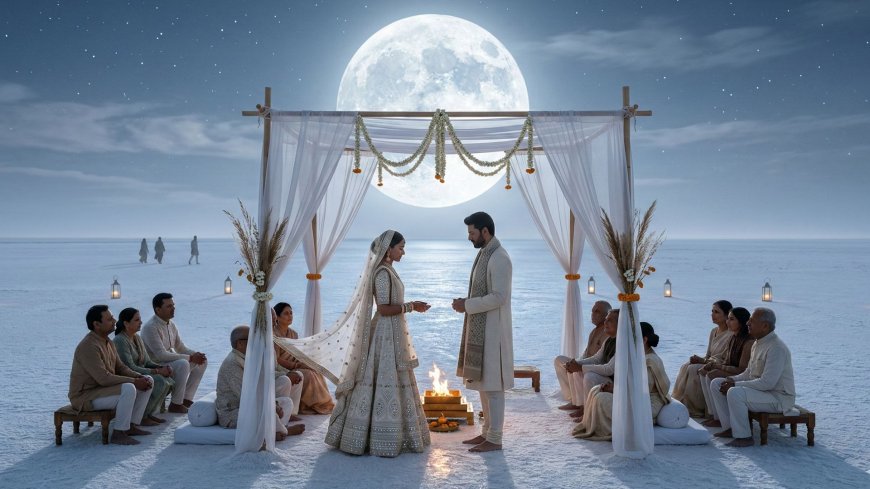
A wedding ceremony on the salt flat at full moon — the couple standing in the moonlit desert, the white salt stretching to the horizon in every direction, the desert sky overhead with its extraordinary density of stars in the gaps between moonlit clouds — is a ceremonial setting of absolute uniqueness. There is nothing else like it available in India or, arguably, anywhere in the world.
The practical implication: Identify the full moon dates within your preferred month window and build the primary ceremony around the full moon night. The logistical flexibility required to align the wedding date with the lunar calendar is one of the most valuable planning decisions you can make for a Rann wedding.
The full moon date changes each month — it is worth consulting a lunar calendar for the specific year of the wedding and identifying the full moon dates that fall within the November-February window to find the optimal ceremony date.
The Venue Landscape: Where to Stay and Celebrate
The Rann of Kutch wedding venue landscape is entirely distinct from any other Indian destination wedding venue market — shaped by the remote location, the specific character of the desert setting, and the festival infrastructure that has developed around the Rann Utsav.
The Tent City: Rann Utsav Infrastructure
The Gujarat Tourism Corporation operates the official Rann Utsav tent city at Dhordo — a large-scale temporary luxury camp that provides accommodation and event space during the Utsav season.
The tent city character: Air-conditioned luxury tents with attached bathrooms, dining facilities, cultural programme spaces, and access to the salt flat viewing areas. The tent city infrastructure is substantial — it can accommodate several hundred guests — and provides the operational foundation for the Rann experience.
For NRI weddings: The tent city can be used as the accommodation base for guest groups, with private event infrastructure arranged separately or in conjunction with the tent city facilities. Full buyout of a section of the tent city for a wedding group provides a degree of exclusivity within the festival infrastructure.
The limitation: The tent city is a government tourism operation — it is not specifically designed for private wedding events and its aesthetic, while appropriate to the festival context, may not meet the production quality expectations of premium NRI weddings.
Private Luxury Desert Camps
Several private luxury camp operators have established desert camp properties in and around the Dhordo area — properties that offer a higher-quality, more exclusive alternative to the government tent city.
The character of private luxury camps: Premium tented accommodation — larger tents, better-quality furnishings and bathroom facilities, more personal service — in a private compound that provides the exclusivity that the tent city cannot. The best private camps in the Rann area offer accommodation that genuinely competes with quality boutique hotel standards.
For NRI weddings: A full buyout of a private luxury camp — 20 to 40 tents accommodating 40 to 80 guests — provides the most complete and most exclusive Rann wedding experience available. The camp is entirely the wedding's own for the duration, the service is personal and attentive, and the event infrastructure is designed around the specific requirements of the wedding rather than the general requirements of festival tourism.
The leading private camp operators in the Dhordo area have developed specifically in response to the growth of the destination wedding market — their facilities, their event management capability, and their understanding of the NRI wedding requirement have improved significantly in recent years.
Heritage Properties in Bhuj
For NRI couples who want the Rann experience as part of a broader Kutch cultural immersion, Bhuj — the cultural and administrative capital of Kutch, approximately 85 kilometres from Dhordo — offers heritage hotel and haveli properties that can serve as the base for a wedding programme that combines desert events with urban cultural exploration.
Bhuj's heritage properties — including restored havelis in the old city that have been developed as boutique hotels — provide a different quality of accommodation from the desert camps while maintaining proximity to the Rann experience. A Bhuj-based wedding programme might involve guests staying in Bhuj's heritage properties, with day and evening excursions to the Rann for specific wedding events and ceremonies.
The earthquake context: The 2001 Bhuj earthquake caused catastrophic damage to the city's historic fabric — many of Bhuj's most significant heritage buildings were destroyed or severely damaged. The city has been substantially rebuilt and the surviving and restored heritage properties represent a remarkable story of cultural resilience and reconstruction.
The Rann Wedding Aesthetic: Designing for the Desert
The Rann wedding aesthetic is perhaps the most specific and most demanding of any Indian destination wedding — because the landscape is so powerful, so distinctive, and so potentially overwhelming that décor that does not consciously engage with the landscape rather than competing with it will always produce a lesser result.
The White and Earth Palette
The primary visual palette of the Rann — the white of the salt flat, the ochre and terracotta of the Kutchi earth, the deep indigo and madder of the Kutchi textiles, the silver of the moonlit desert night — provides the foundation of the most coherent Rann wedding aesthetic.
Décor that works with this palette — that uses white, sand, ochre, and indigo as its primary colours rather than imposing the deep reds and golds of a conventional Indian wedding colour scheme — produces a visual coherence with the landscape that makes the wedding feel genuinely of its place.
Decor that works against this palette — that brings the generic Indian wedding colour vocabulary to the white desert without adaptation — produces the visual equivalent of a conventional hotel wedding transplanted to an extraordinary landscape. The setting is doing all the work and the décor is neither contributing nor harmonising.
The Kutchi Craft Integration
The most creatively rich opportunity in Rann wedding design is the integration of authentic Kutchi craft — not as decorative souvenirs or as ethnic touches in an otherwise generic wedding aesthetic, but as the primary material vocabulary of the entire wedding design.
Practical integrations of Kutchi craft:
Table linens and textile décor: Ajrakh-printed tablecloths, Kutchi embroidered cushions and throws for the seating areas, Rogan art panels as ceremony backdrop elements. The textile richness of Kutchi craft used as the primary décor fabric rather than generic rentals from an event supplier.
Guest gifts: Authentic pieces from Kutchi artisan communities — a small piece of embroidery, an Ajrakh-printed fabric, a piece of Rogan art — given as wedding gifts with the story of the craft tradition and the artisan community that produced them.
Invitation design: Ajrakh-printed fabric invitation envelopes, Rogan art motifs in the invitation graphics, or invitations presented in hand-embroidered Kutchi cloth pouches. The physical invitation as the first piece of Kutchi craft the guest encounters.
Craft community visits in the programme: The most authentic integration — taking guests to Nirona to meet the Rogan art family, to a Rabari embroidery village to see the needlework being produced, to the Ajrakh printing workshop in Ajrakhpur. These visits are among the most profound and memorable experiences available anywhere in India's destination wedding landscape and distinguish a Rann wedding from every other wedding experience in the most meaningful possible way.
The Ceremony on the Salt Flat
The ceremony on the white desert itself — not in a tent, not at a camp, but on the salt flat, with the Rann extending to the horizon in every direction — is the defining creative possibility of the Rann wedding and the experience that no other Indian destination can replicate.
Designing the desert ceremony:
The ceremony space on the salt flat is created entirely from brought-in elements — there is no permanent structure, no existing architecture. The ceremony is designed as a pavilion in the desert — seating, a ceremony structure, lighting (for evening ceremonies), and whatever symbolic elements the couple wants to incorporate — placed on the white salt with the Rann as the context.
The minimal approach works best. An over-designed ceremony structure — elaborate tent, excessive floral installation, complex lighting rig — competes with the landscape rather than framing it. The landscape is so powerful that the ceremony design should support and reference it rather than attempting to overpower it. A few white drapes, a fire, a minimal seating arrangement, and the full moon or the desert sunset — this is more powerful than any elaborate production installed in this setting.
The Practical Planning Challenges
The Rann of Kutch is one of India's most operationally challenging destination wedding locations. NRI couples who choose this destination need to approach the planning with clear eyes about what the challenges are.
The Infrastructure Reality
The Rann Utsav infrastructure — while substantially developed compared to a decade ago — is temporary by design and remote by location. Everything that a hotel venue provides as a permanent fixture must be brought to or installed at the Rann. Generator power, water supply for catering, the full catering infrastructure, all décor elements, all audio-visual equipment — the desert provides only the extraordinary landscape. Everything else is logistics.
The quality of the event infrastructure — the tent quality, the generator reliability, the catering setup, the bathroom provision — depends entirely on the capability and the investment of the operators you engage. Premium private camp operators who have hosted multiple NRI weddings understand this infrastructure requirement and have invested in the equipment and logistics capability to meet it. Operators without this specific experience may underestimate the infrastructure requirement.
The Access and Transportation Challenge
Dhordo — the gateway to the white desert experience — is approximately 85 kilometres from Bhuj, the nearest city with a functional airport. The journey from Bhuj to Dhordo takes approximately one and a half to two hours by road.
For NRI couples with international guests, the travel chain is: international flight to Ahmedabad or Mumbai, domestic connection to Bhuj, and road transfer to Dhordo. The Bhuj airport handles domestic flights and the journey from either Ahmedabad (approximately five hours by road) or Mumbai (approximately six hours by road plus flight option) is substantial.
For large guest groups, the transportation logistics — vehicle allocation, journey timing, comfort provision for the desert road — require thorough planning. The journey from any major city to the Rann is long enough to require specific management rather than improvisation.
The Dust and Wind Reality
The desert wind is a genuine planning consideration for a Rann wedding. The Rann is exposed — there are no windbreaks, no topography to deflect the wind, nothing between the salt flat and the horizon in any direction. Wind in the desert means dust — the fine salt dust of the Rann can become uncomfortable in sustained wind conditions and can affect catering, florals, and the comfort of outdoor events.
Seasonal wind patterns need to be understood for the specific wedding date. The desert wind is typically most active in the afternoon and earliest evening — building a wind buffer into the ceremony timing (early morning or later evening rather than the windy late afternoon) reduces this exposure.
The Cold Desert Night
December and January nights in the Rann are genuinely cold — temperatures can drop to 5°C or below after midnight. For guests from warm climates — South India, the Gulf countries, Southeast Asia — this cold requires specific advance briefing and specific event provision. Heating provision for outdoor evening events is not optional — it is essential for guest comfort during the coldest months of the Rann season.
The cold is also one of the distinctive pleasures of the Rann experience for guests accustomed to cold climates — the cold, clear desert night with the extraordinary star field overhead is an experience of genuine beauty. Brief guests appropriately — warm clothes, layering, the specific character of the desert night — so that the cold is experienced as a feature rather than a surprise.
The Rann Wedding Week Programme
The extraordinary asset richness of the Rann and Kutch region makes a multi-day wedding week programme not merely possible but genuinely compelling — a sequence of experiences that introduces guests to one of India's most distinctive cultural and natural landscapes.
Day One — Arrival and the First Desert Experience
Guest arrivals in Bhuj or Dhordo. The journey from Bhuj to Dhordo as the first Rann experience — briefed and narrated, introducing guests to the Kutchi landscape. Evening arrival at the desert camp — the first sight of the salt flat in the late afternoon or evening light. A welcome gathering around a fire pit as the desert night establishes itself.
Day Two — Cultural Immersion
Morning — craft village visits. The Rogan art family at Nirona, an Ajrakh printing workshop, a Rabari embroidery community. These visits are the cultural heart of the Kutch experience — genuine encounters with living craft traditions of extraordinary quality.
Afternoon — the Banni grasslands, the wild ass sanctuary, or a visit to the archaeological sites of Kutch — the extraordinary Indus Valley Civilization site at Dholavira, one of the largest and best-preserved cities of the ancient world.
Evening — pre-wedding functions at the camp — mehendi, sangeet, or a cultural performance evening featuring Kutchi folk musicians.
Day Three — The Wedding
Morning: The couple's private preparation. A sunrise walk on the salt flat for those who want it — the Rann at sunrise is among the most beautiful natural spectacles available in India.
Late afternoon: The ceremony on the salt flat — timed for the golden hour before sunset, or for the full moon rising if the date aligns. The ceremony in the desert, with the extraordinary light of the Rann and the enormous sky overhead.
Evening: The desert reception — around fire pits, under the stars, with Kutchi folk musicians providing the soundtrack, the white desert extending beyond the firelight in every direction.
Day Four — Integration and Departure
A final morning on the desert. Coffee around the campfire as the sun rises over the salt flat. The quiet of the desert morning as the context for the last conversations and the genuine farewells that a multi-day shared experience produces.
NRI-Specific Considerations
The Gujarati Family Context
For NRI couples from Gujarati families — particularly families with Kutchi connections — the Rann wedding carries a cultural resonance that transcends its general appeal. Kutch is a place that many Gujarati families know personally — as a place of family origin, as a cultural homeland, as the source of the embroidery and craft that has been present in family homes for generations.
For couples whose families have this connection, a wedding in the Rann is a homecoming of a specific and deeply meaningful kind. The marriage happens in the landscape that shaped the family — in the culture that produced the textiles in their homes, the food in their kitchens, the religious and cultural practices that have been transmitted across generations.
This specific resonance makes the Rann particularly powerful as a wedding destination for Gujarati NRI couples and is worth articulating explicitly in the guest communication and the wedding programme.
The International Guest Experience
For international guests with no prior connection to Gujarat or Kutch, the Rann of Kutch is one of the most surprising and most memorable experiences available anywhere in India. The combination of the extraordinary landscape, the extraordinary craft traditions, and the specific cultural character of Kutch introduces guests to an India that is entirely outside the generic imagery of the subcontinent.
International guests at a Rann wedding frequently report it as the most distinctive and most memorable India experience they have had — more surprising than Rajasthan's palaces, more unfamiliar than Goa's beaches, more culturally specific than Delhi's monuments. The Rann's sheer otherness — the planetary quality of the white desert, the living richness of the Kutchi craft tradition — produces encounters that guests carry with them for years.
Common Mistakes NRI Couples Make With Rann Weddings
Not Aligning the Date With the Full Moon
The full moon night on the white salt desert is the most powerful ceremony setting available anywhere in Indian destination wedding planning. NRI couples who choose a Rann wedding date without checking the lunar calendar and prioritising a full moon alignment are missing the most extraordinary single element the destination offers.Build the ceremony date around the full moon. Everything else can be adjusted.
Bringing Generic Wedding Décor to the Desert
The Rann is not a backdrop for a conventional Indian wedding production. Décor that ignores the landscape — generic floral installations, standard banquet-style table settings, conventional Indian wedding colour schemes — wastes the extraordinary setting and produces a wedding that could have been held anywhere. Design specifically for the desert.Use the Kutchi craft vocabulary. Work with the white palette. Let the landscape do what it does.
Not Engaging a Planner With Rann Experience
The Rann of Kutch is one of the most operationally demanding and most logistically complex Indian destination wedding locations. A planner without specific Rann or desert event experience is not equipped to manage the infrastructure challenges, the logistics complexity, and the specific vendor relationships that this destination requires. The gap between a Rann wedding planned by an experienced specialist and one planned by a generalist is larger here than at almost any other Indian destination.
Underestimating the Journey for All Guests
The combination of international flights, domestic connections to Bhuj, and the road transfer to Dhordo makes the arrival journey for international guests genuinely long and potentially exhausting. Design the first day of the wedding programme with arrival fatigue in mind — a restorative welcome rather than an intensive first event, and accommodation that is genuinely comfortable rather than merely atmospheric.
Ignoring the Dholavira Opportunity
Dholavira — the extraordinary Indus Valley Civilization site on the Khadir island within the Rann, now a UNESCO World Heritage Site — is one of the most significant archaeological sites in Asia and one of the most compelling and least-visited places in India. NRI couples who include a Dholavira visit in their wedding week programme give their guests an encounter with a 5,000-year-old city that most of the world has never heard of and that reframes the entire conversation about the antiquity and sophistication of Indian civilization. It is one of the most intellectually and emotionally powerful experiences available in the Rann region and is almost universally included in wedding programmes by couples who know about it.
Is the Rann Right for Your Wedding?
The Rann of Kutch is genuinely right for your wedding if: You are specifically drawn to the extraordinary and the irreplaceable — the landscapes and experiences that exist nowhere else. Your desired guest count is within the intimate range — 20 to 80 — that the desert camp format serves best. You or your partner have Gujarati or Kutchi family connections that give the destination personal cultural resonance. Your guest group is genuinely adventurous — willing to travel to a remote destination, sleep in luxury tents in the desert, and fully engage with the extraordinary landscape and cultural programme. You want to use authentic Kutchi craft as the foundation of your wedding aesthetic. You are willing to plan with the full moon as a primary timing constraint.
The Rann is not right for your wedding if: Your guest count requires a venue capacity that exceeds what the desert camp format provides. Your guest group includes significant numbers of guests who need urban-standard hospitality, who would be genuinely uncomfortable in a remote desert setting, or who have mobility limitations that make desert terrain challenging. You are not willing or able to engage a planner with specific Rann experience. Your budget does not accommodate the premium infrastructure costs that an excellent remote desert event requires.
The Wedding at the Edge of Everything
The Rann of Kutch does not offer comfort. Not in the conventional sense.
It offers something else — something that is harder to name and more difficult to describe to someone who has not stood on the white salt flat at full moon, with the desert extending in every direction and the sky doing what the desert sky does when there is nothing between it and the earth for fifty kilometres in every direction.
It offers perspective. The particular perspective that comes from being in a landscape so vast and so otherworldly that the ordinary preoccupations of daily life — the inbox, the commute, the accumulated anxieties of modern existence — become genuinely, physically impossible to maintain. The Rann dissolves them. The white desert and the enormous sky reduce everything to its essential scale.
And in that essential scale, a wedding. Two people, making a commitment to each other, in one of the most extraordinary natural settings on earth. Witnessed by the people they love most. Accompanied by the living craft traditions of one of India's most extraordinary cultures. Under a full moon that turns the white desert luminous.
There is no equivalent. Nowhere in India — and very few places in the world — offers a wedding setting of this specific, irreplaceable quality.
For the couple that chooses it, the Rann does not just host the wedding. It becomes part of the wedding — part of the memory, part of the story, part of what the marriage began with.
At the edge of the world, the beginning.
What's Your Reaction?
 Like
0
Like
0
 Dislike
0
Dislike
0
 Love
0
Love
0
 Funny
0
Funny
0
 Angry
0
Angry
0
 Sad
0
Sad
0
 Wow
0
Wow
0