












































































Nose Piercing as a Lifelong Identity Marker in Indian Tradition: The Complete NRI Guide to the Nath and Its Meaning
The Indian nose piercing is not jewellery. It is a civilisational declaration — of community, femininity, religious lineage, and cultural identity carried on the body across a lifetime. This complete guide explores the nose piercing as a lifelong identity marker across India's regional traditions, from the Kolhapuri nath of Maharashtra and the Tamil mukhutti to the Mughal court tradition and the Ayurvedic framework. For the NRI woman wearing her nose ring in Berlin, London, or Vancouver, this is the authoritative resource for understanding what the ornament carries, where it comes from, and why it matters more than it has ever been asked to explain.

Nose Piercing as a Lifelong Identity Marker in Indian Tradition
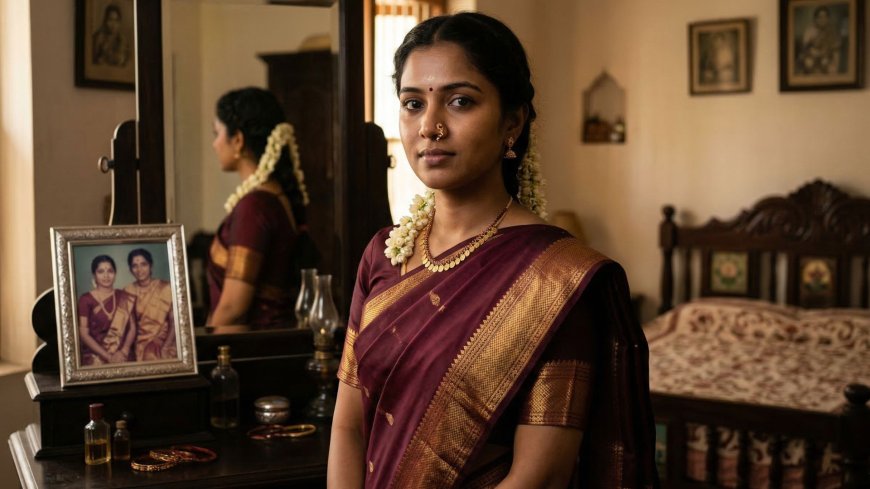
The photograph sits in a silver frame on the dressing table in her mother's bedroom in Coimbatore — a wedding portrait, taken in 1974, the colours slightly faded in the way that photographs from that decade fade, toward the warm and the amber. Her mother is twenty-two in the photograph, dressed in a Kanjivaram silk of deep burgundy, the gold border catching the studio light. And at her nostril, a small gold nath — a nose ring of such delicate proportion that it is easy to miss in the first glance but impossible to miss in the second, because once you see it you understand that it is not decoration. It is declaration. It is the piece that completes the portrait not aesthetically but culturally — the piece that says, without words, who this woman is, which community she belongs to, what occasion this is, and what it means.
Meenakshi had grown up looking at that photograph. She had grown up watching her mother wear the nath — not the wedding nath, which was kept in the locker, but the everyday version, a small gold stud in the left nostril that her mother had worn since her own nose was pierced at age five in a ceremony that her grandmother had organised with the same seriousness that she organised every rite of passage. Meenakshi had had her own nose pierced at seven — she remembered the moment with a clarity that she attributed partly to the mild discomfort and partly to the sense, even at seven, that something was being marked. That she was being placed inside something larger than herself.
She was thirty-three now and lived in Berlin, where she worked in urban planning and where she had spent the last decade being the person in the room who wore a nose stud and who received, from colleagues and acquaintances and the occasional stranger, a range of responses — the appreciative, the curious, the occasionally baffled — that had collectively served as an ongoing education in how differently cultures read the body. In Berlin, the nose piercing was read as aesthetic, as subcultural, as personal expression. Sometimes as South Asian, by people who knew enough to recognise it. Rarely as what it actually was to Meenakshi: a continuous thread connecting her to the photograph on her mother's dressing table in Coimbatore, to the grandmother who organised the ceremony at five, to the tradition that had been placing this specific mark on the faces of women in her community for longer than anyone in the room could reliably document.
She had been thinking about this more specifically since her engagement — since the conversation with her fiancé Tobias, who was German and genuinely curious and who had asked, with the honest directness that she admired in him, what the nose ring meant. Not what it looked like. What it meant. And she had found, sitting across from him at their kitchen table in Kreuzberg, that the answer was longer and more layered and more personally significant than she had previously articulated. That the nose ring was not one thing but many things simultaneously — a religious marker, a community identifier, a marital signal in some traditions and a pre-marital rite in others, a piece of aesthetic inheritance, and, for her specifically, living in Berlin thirty years after the photograph was taken, a daily act of continuity with a lineage that the distance and the years had not severed.
This article is for Meenakshi — and for every NRI woman who wears the nose ring in a city that reads it differently from the city it came from, and who has found that explaining it is the beginning of understanding it more completely herself.
The Nose Piercing in Indian Tradition: Not One Tradition But Many
The first thing to establish about the nose piercing in Indian tradition is that there is no single Indian tradition of nose piercing — there are many, distributed across communities, regions, religions, and historical periods, each with its own specific practices, its own ritual significance, and its own relationship to the broader cultural frameworks of gender, identity, marriage, and belonging. The attempt to reduce the Indian nose piercing to a single meaning is the attempt to reduce India to a single culture, which the subcontinent's extraordinary diversity does not permit.
What can be said, with confidence, is that the nose piercing has been present in the Indian subcontinent for at least four thousand years and that its presence across so many communities, regions, and religious traditions suggests that it touches something fundamental in the way the subcontinent has understood the marked body — the body that carries, on its surface, the signs of its cultural and social identity. The Vedic texts reference ornamental nose piercing. Medieval temple sculptures depict goddesses and apsaras with nose ornaments of various forms. The Mughal court elevated the nose ring to an art form of extraordinary elaboration. The colonial period changed the meaning of the practice in complex ways. And the post-independence period, with its diaspora and its globalisation and its ongoing negotiation between tradition and modernity, has produced the current landscape — in which the nose piercing means different things to different women in different contexts and carries, for many, the specific weight of a tradition that is being actively chosen rather than passively inherited.
The Ayurvedic and Medical Foundation
The longevity of the nose piercing tradition in India is partly explained by the Ayurvedic framework that has historically supported it. The left nostril, in the Ayurvedic system, is associated with the female reproductive system through the ida nadi — the energy channel that runs along the left side of the body and is connected to the lunar, feminine principle in yogic anatomy. The piercing of the left nostril is understood, in this framework, to ease menstrual pain, to facilitate childbirth, and to support the broader reproductive health of the woman who wears it.
This is not, by contemporary biomedical standards, a claim that the evidence base fully supports. What is significant is not whether the Ayurvedic claim is verifiable by the standards of a Berlin hospital but that the claim has provided, for thousands of years, a medical and philosophical rationale that has made the nose piercing not merely decorative but functionally significant within its own epistemological framework. The Indian mother who had her daughter's left nostril pierced was not doing so purely for aesthetic reasons. She was doing so within a system of understanding that connected the physical act to the health of the woman's body and the wellbeing of her future family.
The Regional Traditions: A Geography of the Nath
The regional diversity of the Indian nose piercing tradition is one of its most extraordinary features — the way a single practice has produced, across the subcontinent's different communities, an almost infinite variety of forms, names, materials, and meanings. A survey of the major regional traditions reveals not a unified practice but a family of related practices, each inflected by the specific cultural, religious, and aesthetic inheritance of its community.
The Nath of Maharashtra and North India
The nath is the most elaborate form of the Indian nose ring and is most strongly associated with the Marathi tradition and the broader North Indian wedding aesthetic. The Marathi bridal nath — worn on the left nostril, connected by a chain to the hair or the ear — is one of the most visually distinctive pieces of bridal jewellery in India, a large ring of gold set with pearls or precious stones that transforms the face of the bride with a completeness that no other single ornament achieves. The Kolhapuri nath, from the Kolhapur region of Maharashtra, is one of the most celebrated regional variations — large, elaborately worked, with a specific floral design that has been in continuous production for centuries.
In Rajasthan and the broader North Indian plain, the nose ring takes forms that range from the small gold stud to the large, elaborate wedding ornaments — the besar, the laung, the phul — that have their own regional names and their own specific ritual contexts. The Rajasthani tradition includes nose rings worn on the septum as well as the nostril, adding another dimension to the regional diversity. The Punjabi tradition favours the nath for the wedding but is more varied in its everyday practice, with the gold stud being common in the communities where the nose piercing is part of the standard feminine identity marker.
The Mukhutti and the South Indian Traditions
In the Tamil, Telugu, Kannada, and Malayalam traditions, the nose ornament takes forms that are distinct from the North Indian nath. The mukhutti — a small gold or diamond ornament worn in the left nostril — is the standard form in many South Indian communities, and its relative smallness compared to the Marathi nath reflects a different aesthetic philosophy rather than a different level of significance. The Tamil Brahmin tradition, which values restraint and precision in its ornamental vocabulary, tends toward the small, well-made mukhutti rather than the elaborate statement piece. The Tamil Chettiar tradition, whose mercantile wealth was expressed through the quality and quantity of gold, might favour a more substantial piece.
The nose ring in the South Indian tradition carries a specific connection to the goddess — the Meenakshi of Madurai, the Kamakshi of Kanchipuram, the Padmavathi of Tirupati — all depicted with nose ornaments of various forms. The ornament on the goddess is not a contemporary styling choice. It is the visual language of the divine feminine in the South Indian iconographic tradition, and the woman who wears the nose ornament is, in a sense, participating in that tradition of marking the feminine body as auspicious, as powerful, as connected to the divine.
The Tribal and Folk Traditions
The nose piercing traditions of India's tribal communities — the Naga tribes of the northeast, the Gond communities of central India, the various communities of the Himalayan belt — represent a parallel lineage of nose ornamentation that predates the Sanskrit textual tradition and that carries its own specific system of meanings around identity, status, spiritual power, and community belonging. The large septum rings of certain Naga communities, the elaborate nose ornaments of the Rabari pastoralists of Gujarat and Rajasthan, the specific forms used by different tribal communities across the subcontinent — these are not variations of the same tradition as the brahminical or Mughal court practice. They are independent traditions that have developed their own aesthetic vocabularies and their own systems of meaning over millennia.
The tribal nose piercing tradition is worth acknowledging in this context not because it directly informs the experience of the urban NRI woman wearing a gold stud in Berlin, but because it establishes the extraordinary depth and diversity of the nose piercing as a cultural practice across the subcontinent — a practice that has been meaningful, in many different ways, for many different communities, for longer than any single textual tradition can fully account for.
The Marriage and the Marking: What the Nose Ring Signals
In many Indian communities, the nose piercing is one of the markers of marital status — not in all communities, and not in the way that the mangalsutra or the sindoor carry that specific meaning, but in the sense that the nose ring's form and scale may change at marriage in ways that signal the transition from unmarried to married woman. The bridal nath, worn for the first time at the wedding, is the most dramatic version of this transition — the ornament that is specifically for the married state, that the unmarried woman does not wear, and that the married woman wears on occasions of ceremonial significance.
But the relationship between the nose piercing and marriage is more complex than the simple marker-of-marital-status framing suggests. In many communities, the nose is pierced in childhood — at five, at seven, at the time of the first menstruation — as a rite of passage that marks the girl's identity before marriage is a consideration. In these traditions, the nose ring is not a marital marker but an identity marker that precedes marriage and continues through it — the married woman wears the same piercing she had as a child, perhaps with a different ornament, perhaps with the addition of the wedding nath on ceremonial occasions, but the piercing itself is not the marriage. It is something deeper and earlier.
The nose piercing in the Indian tradition is not primarily a declaration of marital status. It is a declaration of identity — of community, of femininity, of participation in a specific cultural lineage. The marriage adds a layer to that declaration. It does not create it.
This distinction matters particularly for the NRI woman who navigates the question of whether to wear her nose ring and what it means. The woman who was pierced at seven is not waiting for marriage to give the piercing its meaning. The meaning was conferred at seven, by the grandmother who organised the ceremony, by the community that understood the act, by the lineage that had been making this mark for generations. The marriage will bring the nath. But the stud has always meant something on its own terms.
The Nose Ring and the Goddess: Religious Dimensions
The relationship between the nose ornament and the divine feminine in Indian religious tradition is one of the most significant dimensions of the practice and one of the least discussed in the secular, aesthetic conversations that the nose ring tends to generate in the Western contexts where many NRI women live. The goddess in the Indian tradition — across her many forms, across the many regional traditions that have developed her iconography — is depicted with nose ornaments that are not incidental to her appearance. They are part of the visual grammar of the divine feminine.
The Devi Mahatmya, the primary Sanskrit text of the goddess tradition, describes the goddess's ornaments as part of her power — the jewellery is not decoration but armour, not aesthetic but functional in the cosmic sense. The tradition of adorning the goddess image in the temple — the sringar, the daily dressing of the deity — includes the placement of the nose ornament as one of the sixteen adornments of the auspicious woman, the solah sringar, which the goddess receives and which the auspicious married woman is also said to embody.
The Meenakshi Amman Temple in Madurai is perhaps the most powerful single example of this tradition — the goddess whose nose ornament is one of the most carefully crafted and most ritually significant elements of her daily adornment, and whose devotees across South India wear their own nose ornaments partly in the consciousness of the goddess who wears hers. This is not a conscious theological statement that every Tamil woman wearing a mukhutti makes every morning. It is the deep structure of a tradition that has connected the feminine ornament to the divine feminine for long enough that the connection persists below the level of explicit articulation.
The Nose Ring and the NRI Experience: Identity Across Distance
For the NRI woman who grew up wearing a nose ring in India and who now wears it in Amsterdam or Toronto or London or Berlin, the ornament carries a specific weight that it did not carry in the country of origin. In India, the nose ring is read within its own context — it is part of the visual landscape of Indian femininity, unremarkable in the sense that it is entirely familiar, significant in the sense that it carries all the meanings that this article has been describing. In the diaspora, the nose ring becomes visible in a different way — it is noticed, it is read as a cultural marker, it is the subject of questions and comments and appreciations that the woman in India rarely receives about an ornament that is simply part of the normal visual world.
This visibility can be experienced as burden or as gift, depending on the day and the context. The burden is the requirement to explain — to translate the complex, layered meaning of a practice that took thousands of years to develop into a two-sentence answer to a well-meaning colleague's curious question. The gift is the opportunity that the explanation creates — the chance to articulate something that, in India, might never need to be articulated because it is simply understood.
Many NRI women report that the experience of explaining the nose ring to non-Indian partners, colleagues, and friends has deepened their own understanding of what the ornament means. The question what does it mean? forces an engagement with the tradition that the unreflective inheritance of a practice does not require. Meenakshi, sitting across the kitchen table from Tobias in Kreuzberg, found in the attempt to answer his question a clarity about her own relationship to the ornament that she had not previously had. The nose ring had always been there. The conversation gave it words.
The Choice Dimension: When the Inherited Becomes the Chosen
For many NRI women, the nose ring represents a specific form of cultural continuity that is worth distinguishing from mere habit or passive inheritance. The woman who was pierced at seven in India and who continues to wear the ornament in Berlin at thirty-three is not simply doing what was done to her. She is, with every year that passes in a context where the nose ring is not the norm, making an ongoing choice — the choice to carry this specific marker of identity in a context where it would be easy and socially frictionless to let it go.
This is the dimension of the nose piercing that is most specific to the NRI experience and that has no real equivalent in the experience of the woman who has never left India. The choice to continue wearing the nose ring in the diaspora is the choice to remain visible as a person with a specific cultural inheritance, to accept the questions and the visibility that the ornament generates, and to place the continuity with the tradition above the social comfort of blending in. It is, in the small and daily way that identity choices are made, an act of cultural commitment.
The women who make this choice are not all making it for the same reasons. Some wear it for religious reasons — the connection to the goddess, the participation in the sringar tradition. Some wear it for community reasons — the desire to remain recognisably part of their specific cultural lineage. Some wear it for personal reasons — the attachment to the grandmother who organised the ceremony, to the mother in the photograph, to the specific feeling of continuity that the ornament provides. And some wear it simply because it is theirs — because it was placed on their body before they were old enough to choose, and because they have, in the years since, decided that it belongs there.
Common Misunderstandings About the Indian Nose Piercing
The first misunderstanding is that the nose piercing is primarily or exclusively a marital marker — that it signals the same thing that the wedding ring signals in the Western tradition. This misunderstanding is widespread in the Western contexts where NRI women live and produces questions — are you married? — that miss the actual complexity of the tradition. As this article has described, the nose piercing in many Indian communities precedes marriage and carries meanings that are independent of marital status. The unmarried woman's nose ring is not a mistake or an anomaly. It is the tradition operating correctly.
The second misunderstanding is that the nose ring is a Hindu practice and therefore not relevant to Muslim Indian women or Christian Indian women. The nose ring in India crosses religious boundaries in ways that reflect the subcontinent's cultural mixing over millennia. The Mughal court — Muslim — elevated the nose ring to an art form and made it a central element of elite feminine identity in North India. Christian communities in Goa, Kerala, and Tamil Nadu have their own nose ring traditions that reflect the pre-Christian cultural substrate of their communities. The nose ring is not a Hindu ornament that happens to have spread to other communities. It is a subcontinental practice that different communities have adopted and adapted within their own cultural frameworks.
The third misunderstanding is that the contemporary Western nose piercing — the nostril stud that has been part of Western youth culture since the 1980s — and the Indian nose ring are the same practice with the same meaning. They are not. They share a physical form but they carry entirely different cultural histories and entirely different systems of meaning. The Western nose piercing emerged from a specific subcultural context — the punk movement, the body modification community — and carries meanings around individual expression, subcultural identity, and aesthetic choice that are quite different from the community, religious, and identity meanings that the Indian tradition carries. This does not make one more valid than the other. It makes them different things that happen to look similar.
The fourth misunderstanding is that the nose ring is being abandoned by educated, modern, globally-oriented Indian women, and that its continued presence in the NRI community is a form of cultural conservatism. The evidence does not support this reading. The nose ring is worn by Indian women across the full range of educational, professional, and cultural contexts — the Supreme Court justice and the software engineer and the artist and the professor. Its presence does not signal a relationship to modernity or to tradition that can be read from the outside. It signals a relationship to a specific cultural inheritance that each woman holds in her own way.
The fifth misunderstanding is that explaining the nose ring to non-Indian people requires either simplification — reducing the complex tradition to a single sentence — or defensiveness — justifying the practice against an implied criticism. Neither is required. The tradition is rich enough to be explained with complexity. It is confident enough to require no defence.
The Complete Reference Table: The Indian Nose Piercing Across Traditions
| Tradition / Region | Common Name | Typical Form | Nostril / Septum | Ritual Occasion | Primary Significance |
|---|---|---|---|---|---|
| Maharashtra | Nath | Large ring with pearl chain | Left nostril | Wedding | Bridal identity; marital marker |
| Kolhapur, Maharashtra | Kolhapuri Nath | Large floral gold ring | Left nostril | Wedding | Regional bridal tradition |
| Rajasthan | Besar / Laung / Phul | Various; stud to large ring | Left nostril and septum | Wedding and everyday | Community identity; marital status |
| Punjab | Nath / Koka | Ring or stud | Left nostril | Wedding and everyday | Community identity |
| Tamil Nadu | Mukhutti | Small gold or diamond stud | Left nostril | Childhood piercing; everyday | Community identity; goddess tradition |
| Andhra Pradesh / Telangana | Mukkera | Small ornamental stud | Left nostril | Childhood and wedding | Auspicious feminine identity |
| Karnataka | Mugutti | Small gold stud | Left nostril | Everyday and ceremonial | Cultural identity marker |
| Kerala | Mookuthi | Small gold stud | Left nostril | Everyday | Cultural and community identity |
| Bengal | Nolak / Bessar | Ring or elaborate piece | Left nostril | Wedding | Bridal identity; marital marker |
| Odisha | Nathuni | Ring form | Left nostril | Wedding and ceremonial | Marital and community marker |
| Gujarat | Nath / Chhalla | Ring; varies by community | Left nostril | Wedding and everyday | Community and marital identity |
| Mughal Court Tradition | Laung / Elaborate Nath | Pearl and gem-set; elaborate | Left nostril | Ceremonial | Elite feminine identity; aesthetic |
| Rajasthani Tribal (Rabari) | Large septum ring | Large decorative ring | Septum | Community ceremony | Tribal identity; status marker |
| Naga Tribal Communities | Various | Large ornamental forms | Septum and nostril | Community ceremony | Tribal identity; spiritual status |
| Ayurvedic Framework | N/A (functional context) | Left nostril placement | Left nostril | Health practice | Reproductive and feminine health |
The Nose Ring at the Wedding: The NRI Moment of Convergence
For the NRI woman whose nose has been pierced since childhood, the wedding is the occasion on which the everyday ornament and the ceremonial tradition converge most completely. The stud that she wears in Berlin every day is joined, for the wedding, by the nath — the large, elaborate piece that the tradition reserves for the wedding and for the ceremonial occasions that follow it. The two ornaments exist simultaneously: the permanent, quotidian mark of identity, and the ceremonial statement of the wedding occasion. They are not in contradiction. They are in conversation — the everyday and the ceremonial versions of the same fundamental declaration.
For the NRI woman marrying outside her community — marrying Tobias in Berlin, or James in London, or Michael in Sydney — the nose ring at the wedding carries an additional layer of meaning. It is the element of the bridal aesthetic that is most distinctively, most visibly from the tradition. The Kanjivaram silk can be explained as textile. The mehendi can be explained as art. The nath, in its full ceremonial form, is harder to explain without explaining the entire tradition that produced it. And that explanation — the conversation it generates, the curiosity it satisfies, the understanding it creates — is the gift that the nath gives to the intercultural wedding.
The NRI woman who wears the nath at her wedding in Berlin is not performing her culture for an audience. She is being, completely and without apology, what she has always been — a woman whose left nostril has carried a mark of identity since she was seven years old, and who has chosen to mark the most significant transition of her adult life with the full expression of that inheritance.
Meenakshi Wore the Nath
The wedding was in Coimbatore — not Berlin, though they had considered Berlin, and not a compromise between the two, which they had also considered. It was Coimbatore because her mother's photograph was in Coimbatore and because her grandmother, who was eighty-four and had organised the ceremony at five and who was not going to Berlin under any circumstances, was in Coimbatore. Tobias had agreed with the kind of straightforward clarity that Meenakshi had known, from the kitchen table conversation, was one of the things she had chosen correctly about him.
The jeweller in Coimbatore who made the nath had been making naths for brides in the city for forty years. He took the measurements with a seriousness that Tobias, who was present, found both impressive and moving. The nath took three weeks. It was gold, set with small pearls, and it connected by a chain to a hook above the left ear. When Meenakshi put it on for the first time, the morning of the wedding, her grandmother sat in the corner of the room and did not say anything for a long moment. Then she said, in Tamil: Now you look like the photograph.
Tobias did not speak Tamil. Meenakshi's mother translated. He looked at the photograph on the dressing table and then at Meenakshi and then at the grandmother and said, in the German-English hybrid that he used when he was most sincere: I understand now. And the grandmother, who had never been to Berlin and who had organised a nose piercing ceremony in 1997 with the same seriousness she brought to every rite of passage, nodded as though she had known he would.
Understand the tradition before the wedding conversation requires you to explain it. Wear the everyday stud with the consciousness of what it carries. Have the conversation with the non-Indian partner early enough that the nath at the wedding is understood rather than surprising. Find the jeweller who has been making them for forty years.
And on the morning of the wedding, when the nath is placed for the first time, understand that you are not wearing jewellery. You are wearing four thousand years of a civilisation's understanding of what it means to mark a woman's body as auspicious, as powerful, as connected to the lineage that made her.
Published by NRIWedding.com — The Premium Global Platform for Non-Resident Indians Planning Indian Weddings From Abroad.
What's Your Reaction?
 Like
0
Like
0
 Dislike
0
Dislike
0
 Love
0
Love
0
 Funny
0
Funny
0
 Angry
0
Angry
0
 Sad
0
Sad
0
 Wow
0
Wow
0