


























































The Channi's Secret: Why Looking Through a Sieve at the Moon Is the Most Sacred Moment of Karwa Chauth
The channi — a simple metal sieve used during Karwa Chauth — carries centuries of sacred symbolism rooted in Vedic tradition and Indian folklore. Observed by millions of women across India and the global diaspora, this ritual moment of viewing the moon through a latticed sieve holds deep cultural and spiritual significance. This guide unpacks the channi's origins, its meaning across Punjabi, Rajasthani, and other communities, and offers practical advice for NRI women observing Karwa Chauth in cities including Toronto, London, Melbourne, Houston, and Dubai.


For NRI women fasting from Sydney to Scarborough, the channi — that simple metal sieve — carries the weight of centuries. Here's why the ritual of looking at the moon and your husband through a lattice filter is far more profound than any Instagram reel can capture.
You grew up watching your mother do it. She'd stand in the courtyard or lean out of a window, holding that small metal sieve up to the night sky with a solemnity that made you go quiet without knowing why. The fast had lasted all day. She'd had nothing to eat, nothing to drink. And yet there was something in the way she held that channi — not with exhaustion, but with ceremony — that told you this was the moment she had been waiting for.
Now you are the one fasting. You're in Mississauga or Melbourne or somewhere in East London, and the moon has finally risen behind a cloud and you're holding a sieve in your kitchen, and your husband is looking at you with that particular expression — equal parts love and helplessness — and you realise you don't fully know why you're doing this. You just know you have to. You know your mother did. And her mother before her. And that's enough. But it deserves more than enough. It deserves the full story.
The channi [sieve] is not a prop. It is not a photogenic accessory for the Karwa Chauth grid post, though it has certainly become that too. It is a ritual instrument layered with folklore, domestic philosophy, and an ancient understanding of how human beings should receive the sacred: not directly, never without a filter, always through something that separates and sanctifies.
🌟 DID YOU KNOW?
Karwa Chauth is observed by an estimated 15–20 million women annually across India and the global diaspora, making it one of the most widely practised women's vratas [vows/fasts] in Hindu tradition — yet its core ritual objects, the karwa [earthen pot] and the channi, trace back to domestic household implements, not temple iconography.
The tradition of viewing sacred or auspicious things through a filter or lattice — cloth, a veil, a perforated vessel — appears across multiple women's rituals in North India, including certain forms of solah shringar [sixteen adornments] ceremonies, suggesting a deep-rooted cultural grammar around mediated sacred sight.
In diaspora communities across the UK, Canada, and the UAE, Karwa Chauth celebrations have grown significantly in the last decade, with community centres and mandirs in cities like Brampton, Leicester, and Dubai hosting collective moonrise gatherings where hundreds of women lift the channi to the sky together — a phenomenon that did not exist in the same form in India.
What Is the Channi Ritual?
The festival of Karwa Chauth takes its name from two words: karwa, the small clay pot that serves as the central ritual vessel, and chauth, meaning the fourth day of the dark fortnight in the Hindu lunar month of Kartik. Married women — and increasingly, engaged women and those in committed partnerships — fast from sunrise to moonrise without food or water, praying for the long life, health, and prosperity of their husbands.
The puja [ritual worship] follows a precise sequence. It begins with the recitation of the katha [sacred story], most commonly the tale of Queen Veeravati, a beautiful queen who breaks her fast prematurely after being deceived by her brothers, who hold a lamp behind a sieve to simulate the moonrise. Her husband dies immediately. Through devotion and penance, she restores him to life. The story is not incidental. It is the theological foundation of the entire ritual — and the sieve appears within it, first as an instrument of deception and later, in the ritual's corrective resolution, as an instrument of truth.
After the katha, as the moon rises, women gather near a window or an open space, hold the karwa filled with water, and offer arghya [sacred water offering] to Chandradev [the moon deity, Lord of calm, emotional balance, and fertility in the Vedic tradition]. Then comes the channi moment. The woman lifts the sieve toward the sky and peers at the moon through its latticed surface. She then lowers the sieve and looks at her husband through the same mesh. Only after this mediated exchange of sight does she receive water and food from his hands to break her fast.
The sequence matters. Moon first, husband second, through the same sacred filter. The ritual confers upon the marital bond the same cosmic witness status as the moon itself.
Community Comparison Table: The Mediated Gaze Across Indian Traditions
| Community / State | Local Name for Fast / Ritual | Key Tradition Around the Channi or Equivalent | How NRIs Abroad Adapt It |
|---|---|---|---|
| Punjabi | Karwa Chauth | Central to ritual — channi used to view moon and husband sequentially; thali [plate] decorated with diya, flowers, and karwa | Celebrated in community halls; NRIs source steel chaanni from Indian grocery stores on Gerrard Street, Toronto or Southall Broadway, London |
| Rajasthani | Karwa Chauth / Gangaur[spring equivalent] | Sieve or embroidered veil used as mediating filter; ghoonghat [veil] analogy common in oral traditions | Women often use a dupatta with embroidered lattice-work if a traditional channi is unavailable |
| Himachali | Karva Chauth observed in lower Himachal; higher regions observe Sairfestival instead | Ritual objects more tied to nature — river water and pine branches; moon viewed through cupped hands or woven baskets in some valleys | NRIs from Shimla or Kangra communities recreate the ritual with steel sieves and video-call pandits from home regions |
| Garhwali | Hartalika Teej observed with greater prominence; Karwa Chauth adopted in urban Garhwali families | Moon viewed through folded cloth or dupatta as the channi equivalent; husbands offer water from a copper lota [vessel] | NRIs maintain the cloth-filter tradition; Garhwali cultural associations in cities like Vancouver host joint teej-karwa celebrations |
| Kumaoni | Karwa Chauth less universal; Karvachauthobserved in families with Punjabi inter-marriages | Kumaoni women adapt using brass or steel sieve; jhangora [barnyard millet] offered to moon in some families | NRIs source jhangora from South Asian specialty stores; Kumaoni diaspora in Melbourne tends to merge traditions with Punjabi neighbours |
| Ladakhi | Buddhist majority; Lo-sar[Ladakhi New Year] is the primary community festival; Karwa Chauth not traditional | Muslim and Hindu Ladakhi minorities observe modified Karwa Chauth; filtering motif not native but adopted in cross-community marriages | NRIs from Leh with Hindu heritage often participate in Punjabi-led Karwa Chauth circles in diaspora cities |
| Kashmiri Pandit | Gagur Puja [spring festival for marital prosperity] is the closer equivalent; Karwa Chauth adopted post-migration | No traditional channi ritual in classical Kashmiri Pandit practice; moon viewed directly during Gagur; some families adopted the channi after migrating to Delhi | NRI Kashmiri Pandits in the US and UK often fully incorporate the Punjabi channi ritual, integrating it as a diaspora-formed hybrid custom |
| Marathi | Vat Pournima [banyan tree full moon fast] for married women in Maharashtra | A thread is wound around a banyan tree; no sieve; but the protective encircling motif is philosophically parallel to the channi's framing role | NRIs from Maharashtra in Houston recreate Vat Pournima in parks; some families have begun observing Karwa Chauth with channi in cross-regional marriages |
| Tamil | Karthigai Deepam and Varalakshmi Vratam for married women's prosperity; no Karwa Chauth equivalent | No sieve tradition; but the kolam [rice flour threshold pattern] acts as a similar filter between domestic and sacred space | Tamil NRIs in the UK sometimes participate in Karwa Chauth in inter-community marriages; the channi ritual is approached with curiosity and adopted warmly |
| Bengali | Lokkhi Puja [Lakshmi worship] for household prosperity; no Karwa Chauth in classical tradition | Women observe through a shankha[conch shell] in certain rituals; the idea of sacred mediation through objects exists | Bengali NRIs married into North Indian families observe Karwa Chauth fully; channi sourced from Bengali sweet shops or South Asian stores in Newham, London |
The Meaning Behind the Ritual
In Hindu Vedic cosmology, direct encounters with the divine are rarely straightforward. The gods are approached through mantras [sacred sound formulas], through murti [consecrated icons], through fire, through water — never simply through an unmediated gaze. The channi belongs to this vast grammar of sacred intermediaries.
Chandradev, the moon deity, governs not just tides but minds. He is the lord of manas [the mental-emotional body], of cycles, of fertility, of the gentle rhythms that hold a household together. To look at him through a sieve is to acknowledge that even beauty this profound requires a frame. It is an act of humility as much as devotion. The lattice does not diminish the moon. It consecrates the moment of seeing.
There is also a deeply feminine philosophy embedded in the channi. The sieve was, for centuries, a woman's tool — used to separate grain from chaff, nourishment from waste. By elevating it into a ritual instrument, the tradition honours the domestic wisdom of Indian women. It says: the tools of your everyday labour are sacred enough to mediate between you and the heavens.
For a non-Indian partner or family member trying to understand this moment, here is perhaps the simplest way to say it: she is not hiding from the moon — she is framing it, the way you frame everything you love, so that you may truly see it.
Doing the Channi Ritual Abroad: The Practical Reality
Here is where your midnight Googling finally meets its match, because doing Karwa Chauth properly in London or Toronto or Houston requires more logistical intelligence than most wedding rituals — precisely because it is time-sensitive, moon-dependent, and requires specific objects that you won't find in a supermarket.
The first practical challenge is sourcing the channi itself. In India, any kitchen store stocks them in abundance. Abroad, the good news is that the Indian grocery ecosystem has this covered. In London, Southall Broadway (Western Avenue, UB1) has multiple housewares shops that stock traditional steel chaannis year-round. In Toronto, try the cluster of South Asian stores along Gerrard Street East or the larger stores in Brampton's Chinguacousy Road area. In Houston, Hillcroft Avenue — the city's South Asian commercial corridor — has what you need. In Sydney, Harris Park in Parramatta has Indian grocery stores that stock puja supplies including chaannis. In Dubai, the Meena Bazaar area in Bur Dubai and the Indian shops of Karama are your best bets. Order at least two weeks in advance if you're outside these areas, and check Amazon UK or Canada for shipped steel sieves — they're often listed under "puja thali sets."
The second challenge is the moon itself. Moonrise times vary dramatically by city. In Vancouver, the moon may rise at a completely different hour than in Calgary — and neither matches Mumbai. Use a reliable moonrise calculator specific to your postal code. WhatsApp your family in India well in advance to share your local moonrise time; they will likely be breaking their fast hours before you, and it helps to coordinate a video call at your moonrise so the katha, the arghya, and the channi moment can be shared across time zones. A 9 PM moonrise in Toronto corresponds to roughly 6:30 AM IST the following morning — plan accordingly for who on the India side is staying up or waking early to be with you on screen.
The third challenge is the pandit. Karwa Chauth does not require a pandit in the way a wedding does — the katha can be recited by any elder woman in the family, or listened to via a trusted audio or video recording. However, if your family observes a region-specific version of the ritual — with particular mantras, specific thali [plate] arrangements, or community-specific additions — NRI.Wedding's network of regional pandits can be engaged for a remote video session to guide the ritual in real time. This is particularly useful for first-time brides doing Karwa Chauth without their mothers present.
Venue is rarely a challenge for this ritual since it is home-based — but apartment dwellers who cannot see the sky should identify their building's rooftop access in advance, or arrange to be at a friend's home with a garden or large window. The channi moment requires seeing the actual moon. No substitutes.
Doing Karwa Chauth as a Destination Experience in India
For NRI couples who choose to be in India for Karwa Chauth — whether newly married and visiting family, or deliberately planning their first post-wedding festival in the motherland — the experience is transformative in ways that no diaspora recreation can fully replicate.
Cities with large North Indian populations offer the richest communal experience: Delhi, Chandigarh, Jaipur, and Lucknow all have neighbourhoods where women gather on rooftops and terraces in the evening, and the sight of hundreds of chaannis lifted toward one rising moon is genuinely moving. For Rajasthani families, Jaipur's old city offers the added magic of the channi ritual set against Mughal-era havelis. For Punjabi families, Amritsar provides a deeply rooted experience.
If non-Indian guests or a non-Indian partner is joining, brief them warmly before the ritual begins. Assign a family member to quietly explain each step as it unfolds — the katha, the arghya, the channi, the husband's role in handing food to break the fast. Non-Indian guests almost universally find the ritual beautiful; the key is giving them the vocabulary to understand what they are witnessing. NRI.Wedding's bilingual ceremony guide cards can be printed and distributed if you are hosting a larger mixed gathering.
What You Need: The Ritual Checklist
Ritual Items — a steel or brass channi, a decorated puja thali containing a small diya [oil lamp], kumkum [vermilion powder], rice grains, flowers, and the karwa filled with clean water, a second vessel to receive arghya water, incense sticks, and traditional sweets to break the fast.
People Required — the fasting woman, her husband for the final food-offering, an elder woman (mother, mother-in-law, aunt, or trusted senior) to lead the katha recitation, and optionally a pandit for families observing extended regional rituals. A video-call connection to family in India is not required but is deeply recommended.
Preparation Steps — identify your local moonrise time at least a week before; source all ritual items and confirm they have arrived; prepare or source the katha text or recording; inform your husband of his role in the moonrise sequence and the food-offering; set up your viewing spot (window, rooftop, or garden) and do a trial run to confirm the moon will be visible.
NRI.Wedding connects couples with verified regional pandits, authentic puja samagri [ritual supply] vendors, and photographers who specialise in capturing ritual moments with the sensitivity they deserve. Visit nri.wedding to explore your options before the next Karwa Chauth.
5 Questions NRI Couples Always Ask
Can I do the channi ritual if I can't see the moon from my apartment?
This is the single most common Karwa Chauth distress call, and the answer is: plan ahead. Check your building's rooftop access weeks before the date. If that is genuinely impossible, some families use a mirror placed at an angle to reflect the moon into a visible space — though traditionalists prefer a direct sightline. The most practical solution is to arrange to be at a friend or family member's home with outdoor access, or to drive to a nearby park at moonrise. The ritual requires the real moon; the channi is the mediator, not the moon itself.
My husband is not Indian. He doesn't understand why he has to hand me the water. How do I explain his role?
Tell him this: in the ritual, he is not just a husband — he is a witness and a nourisher. The fast was observed for his long life. The breaking of the fast by his hand is the completion of a vow. Many non-Indian partners find this profoundly moving once they understand it is not a passive role but a sacred one. Rehearse the sequence with him in advance — he should hold the karwa, offer water, and then offer food. His presence and his intention are what matter, not his familiarity with the Sanskrit.
How do I find a Punjabi or Rajasthani pandit in a city like Auckland or Calgary?
Start with your local mandir — most North Indian temples maintain a database of visiting or resident pandits and can refer you to one familiar with regional traditions. NRI.Wedding's pandit network includes region-specific priests who offer remote video sessions for Karwa Chauth guidance, which is often more appropriate than an in-person pandit for a home-based ritual. Reach out at least a month before the festival, as demand spikes significantly in the weeks prior.
My family in India wants to be part of the ritual via video call. How do we coordinate this?
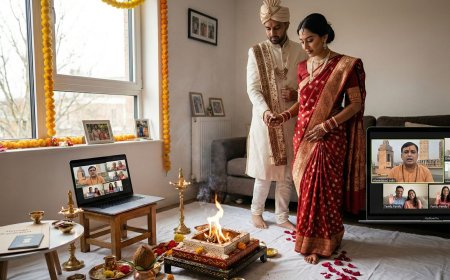
Set up the call well before moonrise so any technical issues can be resolved. Share your local moonrise time with them in IST. Position your phone or tablet so the elder leading the katha on screen can see the thali, and so you can be seen clearly during the channi moment. Many NRI families now have a dedicated video call "seat" built into their thali setup — a small stand for the phone so that the elder in India can see everything without someone having to hold a camera. This hybrid form of the ritual has become genuinely beautiful in its own right.
Should I register my civil marriage before or after Karwa Chauth if we're marrying this year?
For most NRI couples, the civil registration happens either before or well after the religious wedding ceremonies. Karwa Chauth is a festival observed by married women — traditionally those married in the religious sense — so if your religious wedding ceremony has taken place, you are considered married for the purposes of the ritual regardless of civil registration timing. Check with your family's customs, as different communities have different views on this, and when in doubt, your regional pandit can advise.
The Emotional Angle
There is a kind of grief that NRI women carry quietly to Karwa Chauth, and it has nothing to do with the fast. It is the grief of doing this without the women who taught them how.
Your mother is in Ludhiana or Kanpur or Hyderabad. Your mother-in-law is in Jaipur. The aunt who used to tie your maang tikka [forehead ornament] before the ritual is in a house you visit once every two years. And you are in your kitchen in Mississauga or Melbourne, setting up a thali by yourself for the first time, checking YouTube to make sure the diya is on the correct side, texting your mother to ask how much water goes in the karwa.
The channi, when you finally lift it, is heavier than it looks. Not because of its weight, which is almost nothing. But because of everything it carries — the women who held it before you, the moonlit courtyards you will never stand in, the mothers and grandmothers and great-grandmothers who fasted through harder years than yours, who held up this same lattice and looked through it and found the moon and found their husbands and decided: this is enough. This love is worth this.
When you look through the channi at your husband, you are not just seeing him. You are framing him. The way your mother framed yours. The way hers framed her. You are saying: I see you through the thing that filters and sanctifies. I see you the way I see the sacred.
A Moment to Smile
In Southall, west London, during Karwa Chauth three years ago, a young Punjabi bride named Harleen was doing the ritual for the first time at her in-laws' terraced house on a residential street. Everything was perfect — the thali, the karwa, the diya, the family assembled on the first-floor landing with a clear view of the garden below where Harleen stood ready to view the moon.
The moon rose. Harleen lifted the channi. Looked through it at the sky. Then turned to look at her husband Rajanpreet through the same sieve.
Rajanpreet was not where he was supposed to be. He had been sent, mid-ceremony, by his mother to fetch the sweets from the kitchen. Harleen looked through the channi at the kitchen window instead, through which Rajanpreet could be seen eating a ladoo he had sampled on the way back.
The entire family dissolved. The ritual resumed thirty seconds later, with Rajanpreet back in position, ladoo consumed, sheepish. Harleen still tells this story every year. "I looked at the moon, then I looked at my husband, and all I saw was a man eating my sweets."
Quotes from the Diaspora
"The first time I did Karwa Chauth after moving to Toronto, I didn't have a channi. I was in a panic until my neighbour — a Gujarati aunty who had lived here for thirty years — handed me a small steel sieve she'd brought from Surat in 1991. She said, 'Beta, some things you carry from home because you know you'll need them.' I cried for ten minutes before I remembered I hadn't eaten all day." — Simranpreet Dhaliwal, Punjabi, Brampton, Ontario
"My son's wife is Irish. When she fasted for the first time for Karwa Chauth, I was in Amritsar on video call. She held the channi up and said, 'Am I doing this right?' and my son was standing behind her smiling, and I thought — this is what culture actually is. Not the ritual itself, but the love that makes someone learn it." — Saroj Malhotra, Punjabi, mother of groom, calling from Amritsar to Houston
"I used to think the channi was just a photogenic moment. Then my dad died two years after my wedding, and that Karwa Chauth I stood at my window in Melbourne holding the sieve and I realised I was doing something my mother had done every year of her married life, and her mother before her, all the way back to women whose names I'll never know. The channi suddenly felt less like a kitchen object and more like a chain — and I was the newest link." — Divya Sharma, Rajasthani, Melbourne, Australia
Your Roots Travel With You
The channi is perhaps the most ordinary-looking sacred object in all of Indian ritual culture. It sifts grain. It drains water. It sits in kitchen drawers between uses. And yet, once a year, in the hands of a woman who has fasted since dawn and waited all day for the moon, it becomes something else entirely — a frame for the divine, a filter for the marital bond, a latticed window between the ordinary and the eternal.
For NRI couples, this ritual is especially precious because it requires nothing spectacular. No venue. No photographer (though NRI.Wedding's ritual photographers know exactly how to capture this light). No pandit if you have an elder to lead the katha. Just a sieve, a moon, and a husband standing where he is supposed to stand. NRI.Wedding's Karwa Chauth planning checklist, regional pandit network, and puja vendor directory are available to help you get every detail right, wherever in the world that moon rises for you.
Lift the channi. Find the moon. Find the one you fasted for. Let the lattice hold all of it.
This article explores the cultural significance and ritual practice of the channi [sieve] in Karwa Chauth, examining its use among Punjabi, Rajasthani, Himachali, Kashmiri Pandit, Marathi, Tamil, and Bengali communities, and offering practical guidance for NRI couples observing the festival in diaspora cities including Toronto, London, Melbourne, Houston, and Dubai.
What's Your Reaction?
 Like
0
Like
0
 Dislike
0
Dislike
0
 Love
0
Love
0
 Funny
0
Funny
0
 Angry
0
Angry
0
 Sad
0
Sad
0
 Wow
0
Wow
0