







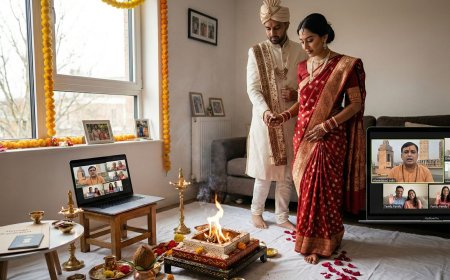





































































Couples Therapy Before Marriage: The NRI Couple’s Honest Guide to Premarital Counselling and Whether It Is Really Necessary
The groom had raised it on an ordinary Sunday evening in the kitchen — not during a serious planning meeting, not in the middle of a conflict, but in the quiet domestic moment when dinner plates were being cleared and the week ahead was beginning to take shape. They had been engaged for eight months and the wedding was four months away. Most of the major decisions had been made, leaving the smaller but relentless stream of details that defines the final stage of wedding planning. He had been thinking about premarital counselling for weeks and finally mentioned it gently: that perhaps they should consider couples therapy before marriage. The bride’s first response was the question most partners instinctively ask — do you think we have a problem? The answer reframed the entire idea: not a problem, but preparation. This guide explores what premarital therapy actually is, why modern couples increasingly consider it before marriage, and why NRI couples in particular may benefit from it. It explains what these sessions typically cover — communication patterns, expectations around money, family roles, cultural differences, long-term life plans, and conflict resolution — while also addressing research findings, structured programs like PREPARE/ENRICH and Gottman-based counselling, the cultural hesitation many Indian families still feel toward therapy, and the practical ways couples can introduce the idea to each other. Rather than presenting therapy as a response to relationship trouble, the guide reframes it as thoughtful preparation for one of life’s most significant commitments.


Couples Therapy Before Marriage: Is It Necessary?
The Question Nobody Asked
The groom had brought it up on a Sunday evening.
They were in the kitchen — the specific domestic ordinariness of the Sunday evening, the dinner being cleared, the week ahead beginning to assert itself in the background of the conversation. They had been engaged for eight months. The wedding was four months away. The planning was at the stage where the major decisions had been made and the remaining decisions were the specific, accumulating minor ones that the planning generates in its final phase.
He had been thinking about it for three weeks. He had not known how to raise it. He had raised it the way that the things that are difficult to raise are often raised — sideways, in the middle of something else, without the specific framing that would have made it easier.
"I've been reading about premarital counselling," he said.
The bride looked up from the counter she was wiping.
"What about it?" she said.
"I think we should do it," he said.
There was a pause. Not a hostile pause — the pause of the person who has received something unexpected and who is taking the moment to understand what they have received before responding.
"Do you think we have a problem?" she said.
"No," he said. "I think we're going to get married and I want to do it well."
This is the conversation that the premarital therapy question most often begins with — the partner who raises it and the partner who receives it as the implication that something is wrong, and the clarification that reframes it as the preparation for something that is important.
The reframing is the most important thing this guide is trying to do.
The question of whether couples therapy before marriage is necessary — the title's question — is the question that contains the wrong framing. The word necessary implies the crisis, the deficit, the problem that requires the professional intervention. The couple who has no crisis and no deficit and no problem they are aware of reads the necessary as the disqualifier: we don't need it because nothing is wrong.
The better question is not whether it is necessary. It is what it is for and whether the couple wants what it offers.
This guide is the honest, complete answer to that question.
What Premarital Therapy Actually Is
The Clarification
Premarital therapy — also called premarital counselling, marriage preparation, or couples therapy before marriage — is the professional support provided to couples in the period before the marriage. It is not the crisis intervention. It is not the treatment of the existing problem. It is, in its most accurate description, the preparation — the specific, structured engagement with the questions, the patterns, and the potential difficulty that the marriage will encounter before the marriage encounters them.
The distinction is important. The couple who goes to premarital therapy is not the couple whose relationship is in trouble. It is the couple who understands that the marriage is a significant undertaking whose success is not guaranteed by love alone, and who wants the preparation that the professional support provides.
The analogy that some therapists use: the athlete who trains before the competition is not the athlete who has been told they will lose. They are the athlete who wants to perform at the level the competition requires. The premarital therapy is the training rather than the treatment.
What It Covers
The premarital therapy covers the terrain that the couple's ordinary conversations — however loving, however honest — rarely cover completely or systematically.
The communication patterns:
The specific ways the couple communicates — the patterns of the conflict, the patterns of the repair, the specific communication habits that each person has developed across their life that are now operating in the relationship without the couple's full awareness. The couple who has never fought is not the couple whose communication is perfect — it may be the couple whose conflict avoidance is the pattern that the marriage will eventually need to address. The premarital therapist works with the couple's actual communication patterns rather than the couple's perception of them.
The expectations:
The specific expectations that each partner carries about the marriage — about the division of domestic labour, about the frequency and the form of intimacy, about the role of the families in the couple's life, about the financial management, about the parenting approach, about the relative priority of the career and the relationship — are the expectations that are most often the source of the marriage's significant conflicts. The expectations that are not surfaced before the marriage are the expectations that surface in the marriage as the disagreements that the couple did not know they were carrying.
The family of origin:
The specific ways that each partner's family of origin has shaped their understanding of what the marriage looks like — what the roles are, what the conflicts are handled like, what the emotional availability is, what the financial management is — are the patterns that enter the marriage without being declared and that operate in the relationship in ways that the couple may not recognise until the patterns have been producing difficulty for some time.
The non-negotiables:
The specific issues that are non-negotiable for each partner — the values, the life decisions, the fundamental questions about the kind of life the couple is going to live together — that have not been explicitly and completely discussed. The children question — whether, when, how many, how raised. The location question — where the couple lives, with what relationship to each families' geographies. The religious practice question — what role the tradition plays in the couple's daily life and in the raising of the children. The financial question — how money is managed, how the individual and the shared financial lives are configured.
These are the questions that many couples believe they have answered and that the premarital therapy most frequently reveals to be partially answered — the questions where both partners believe they have agreed and where the agreement turns out to have been at a level of generality that obscures the specific differences.
The conflict:
The couple's approach to conflict — how each partner handles disagreement, what the specific patterns of the escalation and the de-escalation are, what the repair practices are, what the specific topics are whose approach most reliably produces the difficulty — is the terrain that the premarital therapy provides the specific tools for navigating.
The Gottman Method — one of the most widely used and most extensively researched frameworks in couples therapy — provides specific, evidence-based tools for the conflict navigation whose effectiveness has been demonstrated across decades of research. The Four Horsemen — the criticism, the contempt, the defensiveness, and the stonewalling that predict the relationship's deterioration — are the patterns that the premarital therapy teaches the couple to recognise and to replace with the specific antidotes.
The NRI Couple's Specific Case for Premarital Therapy
The Unique Pressures
The NRI couple's case for premarital therapy is stronger than the domestic couple's case — not because the NRI relationship is more troubled but because the NRI marriage faces the specific, structural pressures that the domestic marriage does not, and whose navigation benefits from the specific preparation.
The cross-cultural navigation:
The NRI couple — whether both partners are of Indian origin or whether one partner is from a different cultural background — is navigating the specific complexity of the cross-cultural marriage. The different cultural frameworks for the marriage's form, the family's role, the emotional expression, the financial management, and the conflict navigation are the frameworks that the premarital therapy helps the couple to articulate, to compare, and to integrate into a shared understanding of the marriage they are building.
The couple from different regional Indian traditions — the Tamil and the Gujarati, the Punjabi and the Bengali — is the couple whose cultural frameworks may be more similar than the intercultural couple's but whose specific differences are real and whose navigation benefits from the explicit attention that the premarital therapy provides.
The geographical complexity:
The NRI couple's geographical situation — the question of where the couple will live, with what relationship to the families in India, with what plan for the parents' eventual care needs — is the specific complexity that the domestic couple does not face in the same form. The premarital therapy that addresses the geographical question explicitly — that surfaces each partner's actual expectations about the international location, the India visits, the parental care — is the therapy that prevents the specific conflicts that the geographical question produces when it is not addressed before the marriage.
The immigration and the legal complexity:
The NRI couple's immigration and legal situation — the visa status, the citizenship, the specific legal framework that governs the couple's life in the country of residence — is the complexity whose management requires the specific alignment that the premarital therapy helps to produce. The couple who has not explicitly discussed the implications of the immigration situation for the marriage's decisions — where to live if the visa is not renewed, what happens to the career if the location must change — is the couple who has left the most significant practical questions of the marriage to the implicit assumption.
The family pressure:
The NRI wedding's specific family pressure — the two families whose expectations about the marriage, the family's role, and the couple's post-wedding life are being managed simultaneously with the planning — is the pressure that the premarital therapy helps the couple to navigate as a united team rather than as two individuals managing their own families separately. The therapist who works with the couple on the family management — who helps the couple to develop the shared position on the specific family questions — is the therapist whose work directly addresses the NRI couple's most immediate planning stress.
The planning's relationship impact:
The NRI wedding planning's specific impact on the couple's relationship — the decision fatigue, the communication overload, the asymmetric load, the accumulated stress — is the impact that the premarital therapy directly addresses. The couple who is in premarital therapy during the planning period has the professional support for the relationship's navigation of the planning's demands that the self-management alone may not provide.
The Indian Family's Relationship to Premarital Therapy
The Indian family's relationship to the premarital therapy concept is shaped by the specific cultural context — the framework that has historically located the marriage preparation in the family and the community rather than in the professional's office, and that has understood the marriage's success as the product of the right match, the families' blessing, and the individual's character rather than the couple's preparation.
This framework is not wrong in everything it contains. The family's role in the Indian marriage is genuine and significant. The community's support for the couple is real and valuable. The individual's character is the foundation of the relationship's quality.
The framework is incomplete in what it does not address: the specific skills of the communication and the conflict navigation, the explicit surfacing of the expectations that the family and the community have not necessarily prepared the individual to articulate, and the professional support for the couple's navigation of the specific, structural pressures of the NRI marriage.
The premarital therapy does not replace what the family and the community provide. It addresses what they do not — and the couple who understands this distinction is the couple most able to approach the premarital therapy without the feeling that the seeking of professional support is the implicit criticism of what the family has provided.
The Research: What the Evidence Actually Shows
The Outcomes
The research on premarital therapy's outcomes is one of the stronger bodies of evidence in the relationship science literature — more consistent, and more encouraging, than the evidence on couples therapy for relationships already in significant distress.
The meta-analyses of premarital therapy research — the studies that aggregate the findings across multiple individual studies — consistently find that couples who complete premarital therapy programmes show meaningfully better relationship outcomes than couples who do not, across the measures of relationship satisfaction, communication quality, conflict navigation, and the probability of the relationship's sustained quality over time.
The effect sizes are meaningful rather than dramatic — the premarital therapy is not the guarantee of the successful marriage, and the research does not suggest it is. It is the preparation that meaningfully improves the probability of the outcomes the couple is hoping for.
The specific findings:
The couples who complete the Gottman Method's premarital programme — one of the most widely researched specific frameworks — show improvements in the communication patterns, the conflict navigation skills, and the relationship satisfaction scores that persist at follow-up assessments conducted months and years after the completion of the programme.
The couples who complete the PREPARE/ENRICH programme — the assessment-based premarital programme that surfaces the specific areas of strength and growth in the relationship — report that the programme surfaced topics they had not previously discussed and that the surfacing of these topics was the preparation the marriage needed.
The caveat:
The research on premarital therapy's long-term outcomes is complicated by the selection bias — the couples who seek premarital therapy may be the couples who are more committed to the relationship's quality and who would have had better outcomes regardless of the therapy. The research design challenges make the causal claim — that the premarital therapy itself causes the better outcomes — more difficult to establish definitively than the correlation suggests.
The honest position: the evidence is encouraging rather than definitive. The premarital therapy appears to be genuinely useful for many couples. It is not the guarantee of the successful marriage, and its absence is not the predictor of the marriage's failure.
The Specific Formats: What the Options Are
The Structured Programme
The structured premarital programme — the PREPARE/ENRICH, the Gottman Seven Principles Programme, the Relationship Enhancement programme — is the evidence-based preparation whose structure provides the systematic coverage of the terrain that the free-form conversation might miss.
PREPARE/ENRICH:
The PREPARE/ENRICH programme begins with an online assessment that each partner completes individually — the assessment that measures the couple's responses across the specific domains of the relationship: the communication, the conflict resolution, the financial management, the leisure activities, the sexual relationship, the family and friends, the relationship roles, and the spiritual beliefs. The assessment produces the couple's specific profile — the areas of strength and the areas of growth — that the trained facilitator uses as the basis for the couple's sessions.
The PREPARE/ENRICH is the most widely used premarital assessment programme in the world and is available through trained facilitators in most countries. For the NRI couple, the online format of the assessment and the availability of trained facilitators through telehealth make the programme accessible regardless of the couple's geographical location.
The Gottman Method:
The Gottman Method's premarital work is based on the four decades of research that John and Julie Gottman have conducted on what makes relationships succeed and fail. The premarital application of the Gottman Method focuses on the specific skills — the fondness and admiration, the turning toward rather than away, the accepting influence, the managing conflict, the making life dreams come true, the creating shared meaning — that the research identifies as the predictors of the relationship's sustained quality.
The Gottman Certified Therapist — the therapist trained in the Gottman Method's specific framework — is the practitioner whose work with the premarital couple is most closely aligned with the research evidence.
The Religious Preparation:
The religious premarital preparation — the Catholic Pre-Cana, the Protestant marriage preparation, the Hindu Vivah Sanskar preparation — is the preparation that the religious community provides and that addresses the spiritual and the religious dimensions of the marriage that the secular premarital therapy does not.
For the NRI couple whose religious practice is a significant dimension of the marriage's meaning, the religious preparation is the complement to the secular premarital therapy rather than its alternative — the preparation that addresses the spiritual and the community dimension alongside the psychological and the relational.
The Individual Couples Therapy Format
The individual couples therapy — the sessions with the therapist whose work with the couple is tailored to the couple's specific situation rather than the structured programme's framework — is the format that is most flexible and most able to address the specific complexity of the NRI couple's situation.
The individual couples therapist who works with the NRI couple on the specific questions of the cross-cultural navigation, the geographical complexity, the family pressure, and the planning's relationship impact is the therapist whose work is most directly responsive to the couple's specific needs.
The individual format requires the finding of the therapist whose experience includes the specific domains the NRI couple needs — the cross-cultural experience, the experience with the immigration complexity, the experience with the Indian family's specific dynamics. The therapist whose experience is primarily the domestic, monocultural couple may not have the specific knowledge to address the NRI couple's most significant questions.
The Online Format
The online premarital therapy — the sessions conducted via video call, the online programme completed asynchronously, the assessment-based programme whose completion is remote — is the format that the NRI couple's geographical situation and scheduling demands most benefit from.
The NRI couple whose two partners are in different cities during the planning period — who sees each other on weekends and manages the relationship across the week's distance — can complete the premarital therapy in the online format that the physical separation does not prevent.
The online therapy's specific value for the premarital context: the flexibility of the scheduling, the removal of the travel requirement, and the availability of the programme across the couple's distributed geography. The couple in London and the partner who visits from India on a planning trip can complete the session from the same location without the requirement that the location be near the therapist's office.
The Conversation: How to Raise It With the Partner
The Framing
The premarital therapy conversation's most important element is the framing — the specific language and the specific context in which the suggestion is made that determines whether it is received as the preparation the couple is making together or the implication that something is wrong.
The framing that works:
"I've been thinking about how much this marriage means to me and how much I want us to be good at it — not just at the wedding but across the years. I read about premarital therapy and I think it could give us the tools and the conversations that would make us better at the marriage we're starting. I want to do it with you."
This framing positions the therapy as the investment in the marriage's quality rather than the response to the marriage's problem. It communicates the positive intention — the wanting to be good at the marriage — rather than the deficit framing that the word necessary implies.
The framing that does not work:
"I think we need couples therapy." The need implies the problem. The couples therapy without the premarital qualifier implies the crisis intervention. The framing that begins with the deficit is the framing that the partner receives as the assessment of the relationship's inadequacy.
The Partner Who Is Reluctant
The partner who receives the premarital therapy suggestion with reluctance — whose response is the "do you think we have a problem?" of the guide's opening — is the partner who has received it within the deficit framing and who needs the reframing before the conversation can progress.
The response to the reluctance:
"I don't think we have a problem. I think we have something worth protecting, and I want to protect it as well as I can. The premarital therapy is the preparation — it's what I want to do because I take this seriously."
The partner whose reluctance is about the cultural stigma — whose understanding of the therapy is shaped by the cultural framework that associates it with the weakness or the problem — needs the specific reframing of the therapy as the preparation rather than the treatment.
The partner whose reluctance is about the practical demands — the time, the cost, the scheduling complexity of the NRI planning period — needs the specific acknowledgment of the practical reality and the specific conversation about how the practical demands can be managed. The online format, the short programme, the specific time-limited commitment — these are the practical accommodations that address the practical reluctance.
The partner who remains reluctant after the reframing:
The partner who remains reluctant after the honest reframing deserves the honest conversation about why — the specific exploration of what the reluctance is protecting, what the therapy's suggestion is activating, and what the partner would need to be willing to engage. This conversation is itself the kind of conversation that the premarital therapy is designed to facilitate — and its difficulty is the argument for the therapy rather than the argument against it.
The Honest Limitations
What Premarital Therapy Cannot Do
The honest assessment of premarital therapy's limitations is the assessment that the promotional literature most frequently omits and that the couple most needs to hear.
Premarital therapy cannot fix the fundamental incompatibility. The couple whose values are genuinely incompatible — whose fundamental positions on the non-negotiable questions are genuinely different — will not find that the premarital therapy resolves the incompatibility. The therapy may surface the incompatibility more clearly, which is the service — the incompatibility known before the marriage is the incompatibility that can be addressed before the marriage rather than discovered within it. But the therapy does not resolve what is genuinely irresolvable.
Premarital therapy cannot guarantee the outcome. The couple who completes the premarital therapy is the couple who has prepared more thoroughly than the couple who has not. The preparation improves the probability of the outcome. It does not guarantee it.
Premarital therapy cannot substitute for the ongoing work. The premarital therapy is the preparation for the marriage's beginning. The marriage's sustained quality requires the ongoing work — the continued application of the skills, the continued investment in the relationship's health, the willingness to return to the professional support when the marriage encounters the difficulty that the preparation has not fully equipped the couple for. The couple who completes the premarital therapy and believes the work is done has misunderstood the preparation's scope.
Is It Necessary? The Honest Answer
The guide's title question — is premarital therapy necessary — deserves the honest answer that the framing has been building toward.
It is not necessary in the sense that the marriage cannot happen without it. Millions of marriages have been and will be conducted without the premarital therapy and many of them have been and will be good marriages, sustained by the couple's character, their love, their family and community support, and the life they build together.
It is valuable in the sense that it offers something the alternatives do not. The systematic surfacing of the expectations that have not been articulated. The specific tools for the communication and the conflict navigation whose absence is the most common source of the marriage's difficulty. The professional perspective on the couple's patterns that the couple's own perspective cannot provide. The explicit preparation for the specific pressures that the NRI marriage faces.
It is particularly valuable for the NRI couple — whose cross-cultural complexity, geographical pressure, family dynamics, and planning stress create the specific conditions that the premarital therapy is specifically equipped to address.
The honest answer to the question: premarital therapy is not the emergency that the word necessary implies. It is the investment that the couple who takes the marriage seriously should consider making — not because the relationship requires the repair but because the marriage deserves the preparation.
The groom who raised it on the Sunday evening in the kitchen was not the groom whose relationship was in trouble.
He was the groom who understood that the relationship he had was worth the preparation the marriage required.
That is the answer to the question nobody asked.
And it is, on balance, the right answer.
Common Mistakes NRI Couples Make About Premarital Therapy
The first mistake is framing the premarital therapy as the response to a problem rather than the preparation for the marriage. The framing determines whether the partner receives it as the investment or the diagnosis. Frame it as the preparation — the specific, deliberate investment in the marriage's quality that the couple is making together because the marriage matters.
The second mistake is waiting until the planning is over to begin the therapy. The premarital therapy that happens during the planning period is the therapy whose work is most immediately relevant — the communication tools, the conflict navigation skills, the family management — to the specific demands the couple is currently navigating. The therapy that waits until after the wedding is the therapy that has missed the planning period's specific application.
The third mistake is choosing the therapist without the specific consideration of the NRI couple's needs. The therapist whose experience is primarily the domestic monocultural couple may not have the specific knowledge to address the cross-cultural navigation, the geographical complexity, and the Indian family dynamics that the NRI couple most needs. Choose the therapist whose experience includes the NRI couple's specific terrain.
The fourth mistake is treating the premarital therapy as the completed preparation rather than the beginning of the ongoing investment. The skills learned in the premarital therapy require the ongoing application — the communication tools that are not used do not maintain their availability. The couple who completes the premarital therapy and considers the preparation complete is the couple who has understood the therapy as the certificate rather than the beginning.
The fifth mistake is not having the honest conversation with the partner about why the therapy is being suggested and what the couple hopes to get from it. The premarital therapy that begins without the shared understanding of its purpose is the therapy whose sessions are navigated with the misaligned expectations. Have the conversation first — the reframing, the honest articulation of what the therapy is for, the shared intention — and then begin the therapy from the shared starting point.
The Sunday Evening, Revisited
The bride had said: "Do you think we have a problem?"
The groom had said: "No. I think we're going to get married and I want to do it well."
They had talked for an hour. Not the planning conversation — the conversation about the marriage itself. The kind of conversation that the planning's logistical demands most frequently crowded out. The conversation about what they each expected, what they each feared, what they each wanted from the marriage that they had not fully articulated to the other.
The conversation had surprised them both — not because the surprises were large but because the surprises were present. The expectation that one had not known the other carried. The fear that one had not known the other had. The specific hope about the kind of life they were going to build together that had been assumed rather than expressed.
By the end of the conversation they had agreed to do it.
Not because something was wrong.
Because the conversation had revealed that the preparation was the thing the marriage deserved — that the relationship they had was worth the specific investment of the systematic, professional preparation.
They found a Gottman Certified therapist who offered the online sessions on Thursday evenings. They completed eight sessions in the three months before the wedding. They did not resolve every question — some of the questions the sessions surfaced were the questions whose resolution the marriage itself would provide. But they arrived at the wedding with the specific tools, the specific shared understanding, and the specific language for the things they had not previously had the language for.
The groom who had raised it on the Sunday evening was not wrong.
The reframing was not the deflection of the bride's question — it was the honest answer to it.
They did not have a problem.
They had a marriage worth preparing for.
And the preparation was the thing that the Sunday evening conversation had made possible.
Published by NRIWedding.com — The Premium Global Platform for Non-Resident Indians Planning Indian Weddings From Abroad.
What's Your Reaction?
 Like
0
Like
0
 Dislike
0
Dislike
0
 Love
0
Love
0
 Funny
0
Funny
0
 Angry
0
Angry
0
 Sad
0
Sad
0
 Wow
0
Wow
0