















































Cruise Weddings Departing from Indian Ports — The Complete NRI Wedding Planning Guide
A groom carefully planned a cruise wedding with clear instructions: guests must board by 4:30 PM because the ship would depart at 6:00 sharp. Despite reminders in the invitation, contract, and personal messages, two guests arrived moments too late and watched the ship leave without them. Cruise weddings are beautiful and unique, but they operate on strict schedules that cannot be delayed. This guide helps NRI couples plan cruise weddings from Indian ports, covering venue options, cruise lines, guest logistics, ceremony arrangements, legal considerations, and timing strategies—ensuring the celebration at sea runs smoothly and guests fully experience the unforgettable journey together. 🌊🚢💍


Cruise Weddings Departing from Indian Ports
The Ship That Left Without Waiting
The invitation had said six o'clock.
The groom had specified this to the cruise line's events coordinator three times across the planning — six o'clock departure, ceremony at five, guests aboard by four thirty, the ship leaves at six and it does not wait for anyone. The coordinator had put this in the contract. The invitation had put this in bold. The groom had sent a WhatsApp message to every guest individually in the week before the wedding reminding them that the ship did not wait.
Forty-three of the forty-five guests were aboard by four fifteen. The two who were not were the groom's maternal uncle and his wife, who had been in Mumbai for three days and who had spent those three days navigating the specific combination of South Mumbai traffic and a relative's insistence on one more cup of tea before leaving for the port.
At five fifty-eight, the groom was on the deck watching the gangway. At five fifty-nine, a car arrived at the terminal. At six oh one, the gangway was raised.
The uncle and his wife watched the ship leave from the terminal building. They watched it for a long time.
The groom, who had warned them seven times, felt two things simultaneously: the specific relief of a person whose most anxious logistical concern has been resolved, and the specific guilt of a person whose most anxious logistical concern has been resolved at his uncle's expense.
The wedding proceeded. The ship sailed. The ceremony happened at the time it was planned to happen. The dinner was on the upper deck as the Mumbai coastline receded into the evening.
The uncle and his wife attended the post-cruise celebration in Pune, where they were received with the specific warmth that the family extended to people who had become, through their misfortune, the most memorable detail of the wedding story.
The ship that does not wait is the most important thing to understand about the cruise wedding departing from an Indian port. Everything else — the beauty of the occasion, the extraordinary setting, the specific quality of being married at sea — is real and is significant and is the reason the cruise wedding exists as an option. But the ship leaves when the ship leaves. The planning must be built around this fact rather than around the hope that the ship will accommodate the guest who is one more cup of tea away from the terminal.
This guide is the complete framework for the couple who wants to marry at sea — departing from the ports that serve India's coastline, aboard the cruise ships that offer wedding packages, in the specific and extraordinary setting of the ocean at the hour of departure.
The Indian Cruise Wedding: The Overview
The Appeal
The cruise wedding departing from an Indian port occupies a specific and distinctive position in the NRI wedding landscape — it is neither the destination wedding in Rajasthan nor the intimate ceremony in a boutique property nor the large traditional wedding in the family's home city. It is its own thing entirely, with its own specific character, its own specific advantages, and its own specific requirements.
What makes it distinctive:
The setting is moving. The wedding happens on a vessel that is, during and after the ceremony, traveling through the Arabian Sea or the Bay of Bengal or the Indian Ocean — the specific quality of the ocean as the ceremony's backdrop, the horizon that is visible in every direction, the light that changes as the ship moves through the departure hour. No static venue produces this.
The guest experience is a journey rather than an event. The guests who board the ship for the wedding are not attending an occasion and going home — they are embarking on a voyage that begins with the wedding and continues for the duration of the cruise. The wedding is the beginning of a shared experience rather than the occasion itself.
The logistics are defined by the ship's schedule rather than the couple's preferences. The ship's departure time, the ship's facilities, the ship's catering, the ship's entertainment — these are the parameters within which the wedding is designed rather than the variables that the couple chooses freely. This is simultaneously the cruise wedding's most significant limitation and its most significant simplification.
The Indian Port Options
The cruise weddings departing from India are served by a small number of ports that have the infrastructure to handle international cruise vessels and the cruise line presence to offer wedding packages.
Mumbai — Ballard Pier and Mumbai Cruise Terminal:
Mumbai is India's primary cruise port — the largest, the most internationally connected, and the one with the greatest variety of cruise lines and cruise itineraries available. The Mumbai Cruise Terminal at Indira Dock handles the major international cruise lines, and the cruise wedding departing from Mumbai has the widest range of ship options, itinerary options, and wedding package options of any Indian port.
Mumbai's accessibility — the international airport, the road connections, the accommodation options for out-of-town guests — makes it the most practical embarkation point for the NRI wedding guest list whose members are arriving from multiple cities and countries.
The Mumbai port's specific challenge: the city's traffic. The guest who underestimates the time required to reach Ballard Pier from South Mumbai's hotels, or from the international airport, in Mumbai's specific traffic conditions is the groom's uncle of the guide's opening — watching the ship leave from the terminal building. Build the transit time conservatively and communicate it to every guest.
Goa — Mormugao Port:
Goa's Mormugao Port serves the cruise lines that include Goa on their Indian itineraries, and the cruise wedding departing from Goa has the specific advantage of Goa's existing wedding infrastructure — the hotels, the pre-wedding event venues, the established wedding vendor ecosystem that makes the days before the cruise departure easy to programme.
The Goa embarkation is particularly well-suited to the cruise wedding that is part of a larger celebration — the couple who wants the pre-wedding events in Goa's beaches and venues and the wedding itself at sea, combining two of India's most distinctive wedding settings in a single occasion.
Kochi — Cochin Port:
Kochi's cruise port serves the vessels operating Kerala itineraries and the cruise lines that include South India in their Indian Ocean programmes. The Kochi embarkation is geographically suited to the South Indian couple and the guest list that is primarily South India-based — closer, more accessible, and connected to the Kerala wedding tradition that many South Indian families maintain.
The Kochi port's specific advantage for the interfaith or multi-tradition couple: Kerala's extraordinary religious plurality — the Hindu, Christian, and Muslim traditions that coexist in the state — makes Kochi a natural embarkation point for the interfaith cruise wedding whose pre-wedding events draw on multiple traditions.
Chennai — Chennai Port:
Chennai's port serves a smaller range of cruise departures than Mumbai or Goa but is the most accessible embarkation point for the Tamil Nadu-based family and guest list. The Chennai cruise wedding is the option for the couple whose family is primarily Tamil and whose guest list does not want to travel to Mumbai or Goa for the embarkation.
The Cruise Lines and Their Wedding Packages
The Package Structure
The major international cruise lines operating from Indian ports offer wedding packages whose structure varies by line but whose general elements are consistent.
The ceremony:
The onboard ceremony is conducted either by the ship's captain — whose authority to perform a legally recognised marriage ceremony varies by the ship's flag state and the jurisdiction in which the ceremony takes place — or by a licenced officiant arranged by the cruise line. The legal validity of the onboard ceremony is the specific question that must be resolved before the wedding package is booked.
The legal reality:
The marriage ceremony performed aboard a cruise ship is not automatically legally recognised in India or in the couple's country of residence. The ship's captain's authority to solemnise a legally valid marriage depends on the flag under which the ship operates, the waters in which the ceremony takes place, and the specific laws of the jurisdictions involved. Many couples who marry aboard cruise ships do so in a ceremonial sense — the ceremony is the celebration — and register the marriage legally before or after the cruise through the civil registration process in India or their country of residence.
The couple who wants the cruise ceremony to be their legally recognised marriage must research the specific legal validity of the specific cruise line's ceremony in the specific jurisdictions before booking. This research requires legal advice from a solicitor familiar with maritime and cross-border marriage law.
The package inclusions:
The standard cruise wedding package typically includes the ceremony space and its decoration, the officiant, a cake, a small floral arrangement, a bottle of champagne or sparkling wine, a limited photography package, and a wedding menu for a specified number of guests. The package's specific inclusions vary by cruise line, by ship, and by the package tier selected.
The package's limitations are as important as its inclusions — the standard package's photography allowance, its floral budget, its cake specification, and its guest count limit may not match the couple's vision, and the upgrades and additions required to close the gap between the standard package and the couple's vision add significantly to the package's cost.
The Major Cruise Lines Operating from Indian Ports
Costa Cruises:
Costa Cruises operates regular itineraries from Mumbai and other Indian ports and has an established presence in the Indian cruise market. Costa's wedding packages are available on their India-departing ships and can be customised with the assistance of the onboard wedding coordinator.
MSC Cruises:
MSC Cruises operates from Indian ports and offers wedding packages that can be arranged through their dedicated groups and events team. MSC's ships offer multiple ceremony venues — from the dedicated chapel to the outdoor deck — with different package options for each.
Celebrity Cruises and Royal Caribbean:
These lines occasionally include Indian ports in their itineraries and offer wedding packages through their dedicated wedding planning services. The availability of wedding packages on specific sailings from Indian ports should be confirmed with the cruise line directly — the Indian port departures are not always on the standard wedding package availability list.
The charter option:
For the couple who wants the cruise wedding experience without the constraints of the scheduled sailing's other passengers — the ship shared with several thousand other guests whose holiday is happening simultaneously with the wedding — the private charter is the alternative. A private charter of a small yacht or a boutique vessel from an Indian port provides the intimacy of the private occasion on the water without the large cruise ship's shared environment. The private charter is significantly more expensive than the cruise line package but provides a level of customisation and exclusivity that the large cruise ship cannot.
The Planning: What the Cruise Wedding Requires
The Timeline
The cruise wedding's planning timeline is determined by two factors — the cruise line's booking requirements and the Indian port's administrative procedures.
Twelve to eighteen months before:
Select the cruise line, the sailing date, the ship, and the itinerary. Contact the cruise line's wedding coordinator or groups team to confirm the wedding package's availability on the specific sailing. Book the cruise cabins for the wedding party and the guest group — the guest cabin block should be booked simultaneously with the wedding package because the ship's availability for a wedding is contingent on the guest group's booking volume.
Nine to twelve months before:
Confirm the wedding package details — the ceremony time, the ceremony venue on the ship, the menu, the decoration, the photography package, and the specific inclusions and exclusions. Begin the process of resolving the legal marriage question — whether the cruise ceremony will be the legal marriage or whether the legal registration will happen separately.
Six to nine months before:
Communicate the embarkation logistics to the guest list — the port, the check-in time, the transit recommendations from the nearest accommodation, the specific departure time and the specific instruction that the ship does not wait. Begin the pre-wedding event planning for the days before embarkation.
Three to six months before:
Finalise the menu with the cruise line's catering team. Confirm the photographer — whether the cruise line's package photographer or a private photographer arranged by the couple. Brief the onboard wedding coordinator on the specific requirements of an Indian wedding — the garlands, the specific ritual elements, the music, the cultural context that the coordinator must understand to serve the couple appropriately.
One month before:
Send the final embarkation reminder to every guest. Individual reminders, with the specific transit time from their accommodation to the port, the specific check-in deadline, and the specific and reiterated instruction that the ship leaves at the scheduled time regardless of who has not yet boarded.
The Guest Experience: Before the Ship
The cruise wedding's guest experience begins before the ship — in the days before the embarkation that the pre-wedding events fill, and in the transit to the port that the embarkation day requires.
The pre-wedding events:
The cruise wedding is particularly well-suited to the couple who wants pre-wedding events in the embarkation city — the mehndi and the sangeet in Goa's beachside venues before the cruise departs from Mormugao, the rehearsal dinner in Mumbai's restaurants before the ship leaves from Ballard Pier. The embarkation city's wedding infrastructure becomes the pre-wedding event venue, and the cruise becomes the ceremony and the honeymoon commencement.
The accommodation block:
The out-of-town guests — and the international guests whose arrival timing varies — need accommodation in the embarkation city for the nights before the cruise. A hotel room block in a property close to the port, or close to the pre-wedding event venues, should be arranged as part of the wedding planning. The accommodation block's proximity to the port is the specific variable that determines the ease of the embarkation day transit.
The embarkation day logistics:
The embarkation day is the most logistically complex day of the cruise wedding — the day when all the guests must travel from their various accommodation points to the port, check in, pass through the port's security and immigration procedures, and board the ship with sufficient time before the departure.
The couple should arrange dedicated transport for the embarkation day — coaches from the hotel block to the port, timed to arrive at the port two to three hours before departure. The couple should not rely on guests making their own way to the port on the embarkation day without specific guidance on the transit time and the check-in process.
The Ceremony on the Ship
The ceremony venue:
The large cruise ship offers multiple potential ceremony venues — the dedicated wedding chapel, the outdoor deck at the bow or the stern, the pool deck, the atrium, the specialty restaurant taken exclusively for the occasion. The outdoor deck at the departure hour — with the port visible behind and the sea ahead — is the specific setting that the cruise wedding offers and that no land-based venue can replicate.
The outdoor deck ceremony requires the weather to cooperate and the ship's schedule to allow the ceremony to take place at the right moment — close enough to departure that the coastline is still visible, early enough in the voyage that the sea conditions are typically calm. Confirm the ceremony timing with the onboard coordinator based on the specific sailing's departure port and departure time.
The Indian ceremony elements:
The standard cruise wedding package is designed for a Western ceremony format. The NRI couple who wants Indian ceremony elements — the garlands, the specific rituals, the cultural content that makes the ceremony theirs rather than a generic cruise ship ceremony — must negotiate these elements with the cruise line's wedding coordinator and with the officiant.
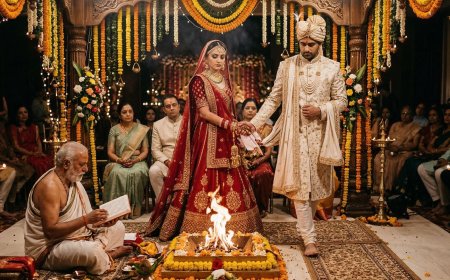
The garland exchange — the jaimala — is typically manageable in any ceremony venue. The havan kund — the sacred fire that the Hindu ceremony requires — is not manageable on a ship, for the specific reason that open fires aboard a cruise vessel are not permitted. The Hindu couple who wants the sacred fire must address this specific constraint — either by registering the religious marriage on land before or after the cruise and treating the onboard ceremony as the celebration, or by finding an officiant and a format that honours the Hindu tradition without the fire.
The music:
The ship's house band or DJ is available for the reception, but the ceremony's music — the specific Indian classical compositions, the specific devotional music, the specific songs that the couple wants — requires either the ship's sound system with the couple's own playlist or the arrangement of a live musician who boards with the guests and performs during the ceremony. The live musician's boarding requires an additional guest booking on the ship, which should be confirmed and paid for as part of the planning.
The food:
The cruise ship's catering is the wedding's catering — with the specific limitations and specific opportunities that the ship's galley and menu offer. The standard cruise wedding package's menu is Western in its orientation. The NRI couple who wants Indian food at their wedding reception must negotiate the Indian menu with the cruise line's catering team — who may or may not have the galley capacity and the specialist kitchen staff to produce the specific regional Indian dishes that the couple wants.
The conversation with the catering team should happen early — at least nine months before the sailing — and should be specific: the exact dishes the couple wants, the dietary requirements of the guest list including the vegetarian, Jain, and halal requirements, and the presentation standard that the couple expects. The catering team's honest assessment of what they can and cannot produce is more useful than the optimistic commitment that falls short on the day.
The Photography
The cruise wedding's photography has specific requirements and specific opportunities.
The specific opportunity:
The departure from the Indian port — the ship pulling away from the dock, the coastline receding, the city visible in the background as the ship moves into open water — is one of the most extraordinary photography settings that any wedding format offers. The golden hour light on the Arabian Sea, the Mumbai skyline in the background, the wedding party on the deck in bridal dress — this is the photograph that the cruise wedding uniquely produces.
The specific requirement:
The photographer must board with the guests — must have a cabin booking or a day pass arrangement with the cruise line. The cruise line's standard wedding package photographer is the photographer who is already aboard and who knows the ship's specific photography opportunities. The private photographer who the couple brings from their own selection must have the cruise line's permission and must have the appropriate boarding arrangement.
The golden hour calculation:
Check the specific departure time of the specific sailing and calculate the golden hour — the hour before sunset — relative to the departure. The ceremony that is timed to end at golden hour, with the photography happening as the light is at its most beautiful and the ship is in open water, is the ceremony whose photographs are most extraordinary. The ceremony that ends after dark has missed the setting's specific gift.
The Guest Experience Aboard
The Wedding as the Beginning of the Voyage
The cruise wedding's most distinctive quality is the guest experience that follows the ceremony — the voyage itself, which the wedding community shares as a continuation of the occasion.
The days at sea:
The guests who attended the wedding are aboard the ship for the duration of the cruise — the sea days, the port calls, the meals, the entertainment. The wedding community's shared experience across the cruise's duration produces a specific quality of communal closeness that the single-event wedding cannot. The conversations at dinner, the shared excursion at the port call, the morning at the pool deck — the wedding becomes the beginning of a week or more of shared experience rather than the occasion that the community disperses from.
The structured events:
The couple can arrange additional events aboard the ship — a group dinner in a specialty restaurant, a group excursion at a port call, a private cocktail hour on the deck — that continue the wedding community's shared experience beyond the ceremony itself. These events should be arranged with the cruise line's groups coordinator as part of the initial booking rather than organised informally aboard.
The Budget: What the Cruise Wedding Actually Costs
The Cost Structure
The cruise wedding's cost structure is different from the land wedding's cost structure — and understanding the difference prevents the specific disappointment of the couple who books the wedding package without understanding the full cost of the occasion.
The package cost:
The cruise line's wedding package is the starting point — typically ranging from one lakh to five lakh rupees for the basic package, depending on the cruise line and the package tier. This covers the ceremony elements described above but does not cover the guests' cruise fares.
The cruise fares:
Every guest aboard the ship is paying for a cruise fare — the cabin, the meals, the ship's facilities. The cruise fare for the wedding guest is the guest's own cost in many cruise wedding arrangements, but some couples choose to subsidise or fully cover the guests' fares as part of the wedding budget. The decision about who pays the guests' cruise fares — and the communication of this decision to the guests — is the specific budget conversation that must happen early.
The upgrades:
The gap between the standard package and the couple's vision is filled by upgrades — the photography upgrade, the floral upgrade, the menu upgrade, the venue upgrade. Each upgrade adds to the package cost, and the total of the upgrades can exceed the package cost itself. Budget for the upgrades specifically rather than assuming the standard package will be sufficient.
The pre-embarkation costs:
The accommodation block in the embarkation city, the pre-wedding events, the transport to the port — these costs are separate from the cruise line's wedding package and should be budgeted for independently.
Common Mistakes Couples Make With Cruise Weddings
The first mistake is not communicating the ship's departure time with sufficient clarity, sufficient repetition, and sufficient specificity to every guest. The ship leaves at the scheduled time. This is not a preference or an aspiration — it is the operating reality of the international cruise vessel. Every guest must know the departure time, the check-in deadline, the transit time from their accommodation to the port, and the specific consequence of missing these — the ship leaves without them. Communicate this in writing, in person, and repeatedly.
The second mistake is not resolving the legal marriage question before booking the wedding package. The ceremony aboard the ship may or may not be legally recognised in India or in the couple's country of residence. This is a legal question that requires legal advice and that must be resolved before the booking is made — not after the ceremony has happened and the couple discovers that the marriage is not legally recognised in their jurisdiction.
The third mistake is not negotiating the Indian ceremony elements with the cruise line before the booking is confirmed. The cruise line's standard wedding package is a Western ceremony. The Indian couple who assumes that the garlands, the Indian music, the regional ceremony elements can be accommodated without specific negotiation and specific confirmation will discover on the ship that the assumption was incorrect. Negotiate every Indian element specifically and confirm it in writing before signing the wedding package contract.
The fourth mistake is not arranging dedicated transport from the guest accommodation block to the port for the embarkation day. The guests who make their own way to the port in the embarkation city's traffic — particularly in Mumbai — are the guests who produce the groom's uncle scenario. Arrange coaches, confirm the departure time from the hotel, build significant traffic contingency into the transit time, and make the transport arrangement the guests' only responsibility rather than an independent logistics exercise.
The fifth mistake is not calculating the golden hour relative to the departure time before choosing the ceremony timing. The ceremony whose timing misses the golden hour has missed the cruise wedding's most distinctive photographic opportunity. Check the departure time, check the sunset time on the specific date, and time the ceremony to end as the golden hour begins.
The Ship That Carries the Marriage Forward
The forty-three guests who were aboard watched the Mumbai coastline recede from the upper deck. The ceremony had happened as the ship moved into the open water — the garlands exchanged, the words spoken, the couple photographed with the city in the background as the evening light changed the colour of the sea.
The groom had spent the ceremony being genuinely present — which surprised him, given the preceding months of planning and the preceding hour of watching the gangway. The specific quality of the setting — the moving ship, the horizon in every direction, the specific sound of the water against the hull — had produced in him a clarity of attention that the static venue might not have. There was nothing to manage. The ship was managing itself. The sea was managing itself. His only job, for the duration of the ceremony, was to be married.
That is the specific gift of the cruise wedding departing from the Indian port — the moment when the planning is behind you, the gangway is up, the ship is moving, and the ocean is the only venue there is.
The logistical complexity is real.
The departure time is non-negotiable.
The legal question must be resolved before the booking.
The Indian ceremony elements must be negotiated specifically.
And the uncle who missed the ship will, eventually, become the best story from the wedding.
But the ship that moves through the departure hour, with the coastline receding and the ocean ahead and the marriage just made — that ship is carrying something that no static venue can hold.
It is carrying the beginning.
Plan the logistics with precision.
Communicate the departure time relentlessly.
And stand on the deck as the city disappears — married, at sea, with the people you love most aboard the same vessel.
The ship does not wait.
But the marriage travels with you wherever it goes.
Published by NRIWedding.com — The Premium Global Platform for Non-Resident Indians Planning Indian Weddings From Abroad.
What's Your Reaction?
 Like
0
Like
0
 Dislike
0
Dislike
0
 Love
0
Love
0
 Funny
0
Funny
0
 Angry
0
Angry
0
 Sad
0
Sad
0
 Wow
0
Wow
0