





































































Sacred Drums, Living Forests, and Dances Older Than Sanskrit: The Truth About a Gondi Tribal Wedding No One Has Written About
The Gondi tribal wedding of Central India — practised across the forests and hills of Madhya Pradesh, Chhattisgarh, Maharashtra, and Telangana — is one of the oldest living wedding traditions on the subcontinent, rooted in a cosmology that predates Sanskrit, the Vedas, and every organised religion that followed. Built around the Mandwa pavilion, Pujari-led Gondi Dharma prayers, the sacred Muthwa post, and the extraordinary Karma and Sela dances, this tradition carries the living memory of thirteen million people's worth of history. This guide covers every ritual, every cultural element, and every practical step for NRI couples with Gondi heritage planning their wedding in the UK, Australia, Canada, or the US, or as a destination wedding in the forests of Bastar and Mandla.


The Gondi tribal wedding of Central India — practised across the forests and hills of Madhya Pradesh, Chhattisgarh, Maharashtra, and Telangana — is one of the oldest living wedding traditions on the subcontinent, rooted in a cosmology so ancient it predates the arrival of Sanskrit, the Vedas, and every organised religion that followed. For NRI couples with Gondi heritage planning their wedding from Birmingham to Brisbane, this tradition is not a footnote in Indian cultural history — it is the original chapter.
You grew up knowing you came from somewhere older than most people understood. Not older in the way that gets celebrated — not the kind of old that fills museum galleries and gets written into school textbooks — but older in a quieter, more rooted sense. The kind of old that lives in the way your grandmother moved through a forest, naming every tree. The kind of old that lives in songs that have never been written down because they were never meant to be — they were meant to be sung, generation after generation, by people who understood that the voice carrying forward is itself the act of preservation.
You are in Birmingham now, or Brisbane, or somewhere in the greater Toronto area, and you are planning your wedding. The Gondi tradition is in your blood even if its specifics were never fully explained to you — because the explanation was always meant to happen in the village, by the fire, with the elders present. You didn't grow up with that. But the heritage is still yours, and this article will give you the fullest picture of it that has ever been written for an NRI audience.
This is your tradition. Let's begin.
🌟 DID YOU KNOW?
The Gond people are one of the largest tribal groups in the world, with a population estimated at over thirteen million people across Central India. The Gondi language belongs to the Dravidian family — making it linguistically related to Tamil, Telugu, and Kannada — and predates the arrival of Indo-Aryan languages in the subcontinent. This means that Gondi wedding prayers and ritual songs are spoken in a linguistic tradition older than Sanskrit itself.
Gondi art — particularly the Gond painting tradition from Madhya Pradesh — has achieved international recognition, with artists like Jangarh Singh Shyam bringing Gondi visual culture to galleries in Europe and Japan. The same cosmological imagery that appears in these celebrated paintings — the interlocking patterns of animals, trees, birds, and divine figures — is present in the ritual decorations and sacred objects used at Gondi weddings, making every Gondi wedding a living gallery of one of the world's great visual traditions.
The Gondi people follow Gondi Dharma — also called Koyapunem [the Gondi indigenous religious tradition] — which centres on the worship of Persa Pen [the supreme Gondi deity, understood as the divine force that permeates all living things] and a pantheon of nature deities associated with specific forests, rivers, mountains, and animals. This tradition has no founding prophet, no written scripture, and no organised clergy — it is sustained entirely through oral transmission, ritual practice, and the living memory of the community's Pujari [priest] and Syana [elder ritual specialist].
What Is a Gondi Tribal Wedding?
A Gondi wedding is a community event of several days' duration in which the natural world — the forest, the river, the earth beneath the village — is understood to be a participant in the ceremony alongside the human community. In Gondi cosmology, a marriage is not simply an agreement between two families. It is a realignment of relationships within the web of life — a moment when the community acknowledges that two threads of the living world are being woven together, and that this weaving requires the blessing of every form of life that surrounds the human settlement.
The wedding sequence begins with the Lagna Patrika [the auspicious letter or formal announcement of the marriage] being sent from the groom's family to the bride's family. Unlike the formal printed invitations of urban weddings, the Lagna Patrika in Gondi tradition is delivered in person by a respected elder — a physical journey that itself carries ceremonial weight, because the act of one family sending a representative to another is the first gesture of the union being formed between them.
The Dev Puja [worship of the community deities] precedes all other ceremonies. The Pujari — the Gondi community priest, whose knowledge of ritual sequences and deity names has been accumulated over a lifetime of oral learning — performs prayers at the community's sacred site, which is typically a Dev Sthan [sacred grove or deity seat, always situated among trees or at a significant natural feature]. The deities invoked include Bada Dev [the great deity, understood as the supreme divine force in many Central Indian tribal traditions] alongside the specific clan deities of both the bride's and groom's families. The marriage cannot proceed until these deities have been formally informed and their blessing sought.
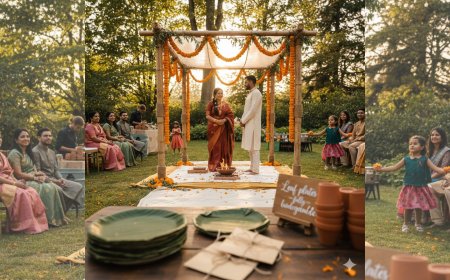
The Mandwa [the ceremonial wedding pavilion] is constructed by the men of the community from bamboo, sal wood, and forest leaves — specifically the leaves of trees considered sacred in Gondi cosmology. The construction follows specific rules about which wood can be used, which direction the pavilion must face, and which prayers must be spoken as each pole is erected. The Mandwa is not merely a decorative structure. It is a temple built for the occasion, a temporary sacred space that will be dismantled after the wedding is complete and its materials returned to the forest.
The central marriage ceremony takes place within the Mandwa and is conducted entirely by the Pujari in the Gondi language. The Saat Phere equivalent in Gondi tradition involves the couple circling a sacred post — the Muthwa [the central ritual post, carved from specific sacred wood and planted at the centre of the Mandwa] — rather than a fire, though fire is present and honoured throughout the ceremony. Each circumambulation invokes a specific deity or ancestral blessing, and the Pujari chants the invocations in Gondi while the community responds in call and answer.
The Karma dance and the Sela dance — two of the central folk dances of the Gondi community — are performed throughout the wedding celebration. The Karma dance, named after the Karma tree [a tree considered sacred across many Central Indian tribal traditions, associated with prosperity and good fortune] involves men and women dancing in pairs and groups around a branch of the Karma tree that has been planted in the wedding ground. The Sela dance — performed specifically by young women — is a circle dance of extraordinary grace and complexity, involving bamboo poles and synchronised footwork that takes years to learn properly.
The wedding feast features the community's specific food traditions — red rice, wild forest greens, river fish where available, and specific preparations that vary by clan and region. The feast is communal in the truest sense — every family in the village contributes, and every person present eats together regardless of status or relationship to the couple.
Community Comparison Table
| Community/State | Local Wedding Name / Key Ritual | Key Tradition | How NRIs Abroad Adapt It |
|---|---|---|---|
| Gondi (Central India) | Mandwa ceremony + Pujari-led rites | Multi-day forest-blessed celebration, Karma and Sela dances, Muthwa post, Gondi language prayers | Find Gondi community networks abroad, hire folk musicians, recreate Mandwa at venue |
| Baiga (MP/Chhattisgarh) | Similar tribal structure | Baiga-specific deity worship, community priest, forest offerings | Baiga community associations in diaspora maintain cultural connections |
| Korku (MP/Maharashtra) | Community-led ceremony | Korku tribal priest, specific dance traditions, community feast | Connect with Korku heritage networks through Central Indian diaspora associations |
| Muria Gond (Bastar) | Ghotul-influenced wedding traditions | Youth dormitory tradition influences wedding social structure, Bastar folk music | Bastar arts networks can connect with musicians |
| Rajasthani Bhil | Mandav ceremony + Badwa-led rites | Multi-day celebration, dhol procession, Ghoomar dance | Rajasthani folk musicians available in UK, US, Canada, Australia |
| Santali (Jharkhand/Bengal) | Bapla [Santali wedding ceremony] | Community elder-led ceremony, Santali language prayers, Sohrai folk art | Santali diaspora associations in UK and US maintain cultural programmes |
| Oraon (Jharkhand) | Community ceremony with Sarna tradition | Nature worship-based ceremony, community priest, harvest-linked rituals | Jharkhand tribal diaspora networks maintain connections |
| Ho (Jharkhand) | Andi Bapla [Ho community wedding] | Ho language ceremony, elder-led rituals, community music | Ho community associations in diaspora cities |
| Warli (Maharashtra) | Community ceremony with Warli art | Sacred Warli paintings at ceremony, community priest, nature deity invocations | Commission Warli artists internationally; art widely available |
| Punjabi | Anand Karaj | Four laavans around Guru Granth Sahib | Conducted at local Gurdwara worldwide |
The Meaning Behind the Ritual
Gondi Dharma — the indigenous religious tradition of the Gond people — rests on a philosophical foundation that the contemporary world is only beginning to rediscover through environmental philosophy and indigenous rights movements: that the human community is not separate from the natural world but is a part of it, and that every significant human event must therefore be conducted in full acknowledgement of that relationship.
The Persa Pen — the supreme Gondi divine force — is not understood as a deity sitting outside the world in judgment of it. Persa Pen is understood as the life force that moves through every living thing — the same energy that is in the river, in the sal tree, in the hawk overhead, in the human being standing at the centre of the Mandwa. When the Pujari invokes Persa Pen at a wedding, he is not petitioning a distant power. He is acknowledging a presence that is already there, in the wood of the Mandwa posts and the breath of every person present.
The Muthwa post at the centre of the ceremony encodes this understanding physically. The sacred wood from which it is carved carries the living energy of the forest. When the couple circles it, they are circling the forest itself — acknowledging that their marriage exists within a larger living system and accepting the responsibility of caring for that system as one of the duties of their union.
The Karma tree around which the wedding dances are performed is not merely decorative. The Karma tree in Gondi cosmology represents prosperity, good fortune, and the continuity of life across generations — its presence at the wedding is an invocation of everything the couple hopes to grow.
For any non-Gondi guest or partner trying to understand what they are witnessing, the truest explanation is this: this wedding is not asking God to bless the marriage — it is asking the entire living world to witness it, and the entire living world has come.
Doing a Gondi Tribal Wedding Abroad: The Practical Reality
Planning a Gondi tribal wedding abroad is among the most complex tasks in the NRI wedding landscape, for reasons that are simultaneously practical and philosophical: the tradition is entirely oral, the priests are extremely rare outside India, the community abroad is small and geographically dispersed, and the rituals are intimately connected to specific natural environments — forests, rivers, sacred groves — that do not exist in Birmingham or Brisbane. But the tradition is adaptable, and the core of it — the community, the music, the dance, the intention — can travel.
Finding a Pujari: Gondi Pujaris are community-specific ritual specialists whose knowledge is passed down within families over generations. They do not travel internationally in the way that Hindu pandits sometimes do. For NRI couples abroad, the most workable approach is a layered ceremony: engage a sympathetic Hindu pandit for the formal religious elements that require a priest, while conducting the Gondi-specific cultural elements — the Mandwa construction, the Karma and Sela dances, the community feast structure, the Gondi songs — as the cultural heart of the celebration. For those planning a destination wedding in India, a Pujari from the Gondi heartlands of Bastar, Mandla, or Gadchiroli can be engaged through community connections.
The Music and Dance: Central Indian tribal folk music — featuring the mandar [a barrel drum central to Gondi and other Central Indian tribal music traditions], the tudubudi [a small clay pot drum], the bansuri [bamboo flute], and specific percussion instruments unique to the region — is not as widely available in diaspora cities as Rajasthani or Punjabi folk music. However, Central Indian folk music ensembles do exist in cities with significant MP and Chhattisgarh communities. In the UK, Leicester and Coventry have communities with Central Indian heritage. In the US, Chicago and the Houston metro area have MP and Chhattisgarh diaspora populations. Contact Central Indian cultural associations and specifically ask for tribal folk music performers rather than mainstream folk musicians.
For the Karma and Sela dances, the most practical approach is to involve family members who know the steps — even partially — and supplement their knowledge with online resources, video calls with elders in India, and ideally a few sessions with a folk dance teacher before the wedding. The Sela dance in particular — with its bamboo poles — requires practice and coordination but is achievable with committed participants.
The Mandwa: A simplified version of the Mandwa can be constructed at most outdoor or marquee venues. Source bamboo from garden supply companies, sal leaves or substitute forest leaves from South Asian grocers or florists, and marigold garlands from Indian flower suppliers. The sacred post at the centre — the Muthwa — can be carved in advance from an appropriate wood, ideally by a family member with carving skill, and brought to the venue. The intention behind the construction matters as much as the materials.
Gondi Art: Gondi painting — with its intricate dot-and-line patterns depicting animals, trees, and cosmic forces — is increasingly available internationally through galleries and online platforms. Commission a Gondi painting for display at the wedding venue from an artist in Madhya Pradesh — many now ship internationally. This visual element transforms the atmosphere of any venue and gives non-Gondi guests a point of entry into the tradition's cosmological world.
The Feast: Red rice is available at most South Asian grocery stores in diaspora cities. Wild forest greens can be approximated with bitter greens available at South Asian or African-Caribbean grocers. River fish can be substituted with fresh water fish from fishmongers. The communal feast structure — every family contributing, everyone eating together — is achievable anywhere with willing community members and sufficient advance planning.
Sourcing Items in Diaspora Cities: In London, Wembley and Southall carry most Indian grocery items needed. In Toronto, Gerrard Street and the Brampton South Asian corridor are your primary sources. In Sydney, Harris Park in Parramatta. In Houston, Hillcroft Avenue. In Brisbane, the Sunnybank area has a growing South Asian grocery presence.
Time Zone Coordination: For family joining from Bastar, Mandla, or Gadchiroli via live stream, internet connectivity in rural Central India can be variable. Test the connection multiple times, have a phone call as backup, and brief the family member managing the connection on your end to be patient and persistent. Aim for a ceremony start that corresponds to comfortable evening hours in India — late afternoon UK time or mid-morning US East Coast time works well.
Doing a Gondi Wedding as a Destination Wedding in India
For NRI couples choosing to marry in India with Gondi heritage at the centre of the celebration, the Gondi heartlands of Central India offer settings of profound natural beauty and cultural authenticity that mainstream Indian wedding destinations cannot match.
Bastar in Chhattisgarh is the spiritual heartland of Gondi culture — a region of ancient forests, sacred waterfalls, and living tribal traditions that has produced some of India's most extraordinary art and music. A wedding in Bastar, conducted with community participation and a genuine Pujari, surrounded by the landscape that gave birth to Gondi cosmology, is an experience of irreplaceable depth. Jagdalpur, the district headquarters, provides the logistical base, with heritage accommodation increasingly available in the region.
Mandla in Madhya Pradesh — in the heart of the Satpura range, surrounded by sal forests and the Narmada river — is the other great Gondi centre. The landscape here is extraordinary, and the community's artistic traditions are among the most celebrated in all of tribal India. Pench and Kanha areas also have Gondi community presence, with the added dimension of being among India's most beautiful wildlife landscapes.
When working with local planners, insist on genuine community involvement rather than a staged tribal performance for tourist consumption. The distinction matters enormously. NRI.Wedding can connect you with local coordinators who have genuine relationships with Gondi community leaders and understand the difference between authentic cultural celebration and cultural performance.
For non-Indian and non-Gondi guests, prepare a detailed ceremony programme explaining every element. The visual beauty of a Gondi wedding in its natural setting will be immediately apparent to any guest — but the meaning behind each element will transform their experience from aesthetic appreciation to genuine understanding.
What You Need: Ritual Checklist
Ritual Items: Bamboo and sal wood for Mandwa construction, forest leaves for decoration, sacred wood for Muthwa post, marigold and flower garlands, sacred fire materials, Karma tree branch or substitute for dance ceremony, bamboo poles for Sela dance, Gondi painting for venue display, red rice and feast ingredients including wild or bitter greens and fresh water fish, community contribution dishes, mahua [a forest flower used in Central Indian tribal food and ritual traditions] if available and appropriate to your family's tradition.
People Required: Gondi Pujari if available or Hindu pandit for formal ceremony, mandar and folk percussion players, Sela and Karma dance leaders, senior community elders for Dev Puja, family members for Mandwa construction, AV team for live streaming to village family, photographer briefed on Gondi art and tribal wedding traditions.
Preparation Steps: Connect with Gondi and Central Indian diaspora associations six months ahead. Book Central Indian folk musicians six months ahead. Commission Gondi painting for venue two to three months ahead. Source Mandwa construction materials two months ahead. Organise Karma and Sela dance rehearsals with family one to two months ahead. Source feast ingredients through South Asian grocers three weeks ahead. Test live stream to India one week ahead. Brief all non-Gondi guests on ceremony significance in advance.
NRI.Wedding connects couples with Central Indian folk musicians, Gondi heritage photographers, tribal wedding specialists, and destination wedding planners in Bastar and Mandla who understand the profound difference between a Gondi wedding and a generic tribal aesthetic. Your heritage is specific. Your wedding should be too.
5 Questions NRI Couples Always Ask
Can we have an authentic Gondi wedding ceremony without a Pujari, since there are none in our country?
Yes, and the honest answer is that the authenticity of a Gondi wedding abroad comes primarily from the cultural elements rather than the priestly ones. The Pujari's role can be partially addressed by a knowledgeable Hindu pandit for the formal ceremony, but the Gondi soul of the wedding — the Mandwa, the Karma and Sela dances, the community feast structure, the Gondi songs, the Gondi painting — does not require a Pujari. If you have an elder in your family or community who holds Gondi ritual knowledge, their involvement is more meaningful than any external substitute. Focus your energy on the cultural elements that can genuinely be recreated, and honour the priestly elements through a return visit to India for a community blessing if that is possible.
My partner has no connection to tribal Indian culture and has never encountered anything like a Gondi wedding. Where do I start?
Start with the art. Gondi painting is visually extraordinary and immediately accessible to anyone who encounters it — its interlocking patterns of animals, trees, and cosmic forces speak across cultural barriers in a way that ritual explanation often cannot. Show your partner Gondi paintings, explain the cosmological world they depict, and let the visual language be the door through which your partner enters the tradition. From there, introduce the music — the mandar drum, the bamboo flute — and let the sound create its own understanding. By the time the wedding arrives, your partner will have been living alongside Gondi culture for months, and their participation in the ceremony will come from genuine familiarity rather than polite compliance.
How do we find Central Indian tribal folk musicians in a diaspora city where the community is very small?
Broaden your search beyond community-specific networks to South Asian cultural organisations, world music promoters, and university ethnomusicology departments, which often maintain connections to folk musicians from across the subcontinent. In the UK, organisations like the Darbar Music Festival network have connections to tribal and folk musicians from across India. In the US, the Association for Cultural Equity and similar organisations maintain folk musician databases. Online platforms connecting South Asian musicians with international clients are increasingly useful. When you make contact, be specific: you want Central Indian tribal folk music, mandar drum, Gondi or Bastar music tradition. Any musician with genuine knowledge will respond with recognition.
We want to include Gondi painting as a central element of our wedding decoration. How do we commission this from abroad?
Several Gondi artists now work with international clients, and the process is straightforward: contact an artist through a gallery or online platform representing Gondi art — search specifically for artists from Madhya Pradesh or Chhattisgarh — describe the dimensions and setting of your venue, share photographs of the space, and commission a piece or series of pieces that will be shipped to you. Budget for shipping costs and allow six to eight weeks for creation and delivery. NRI.Wedding can connect you with Gondi artists who have experience with wedding commissions.
We completed our civil registry in our country of residence. Does this affect the status of the Gondi ceremony in India?
Not at all, and this is a common and entirely workable arrangement. The civil registry in your country of residence is a legal formality that secures your rights under that country's law. The Gondi ceremony in India is the wedding your family, your community, and your own heart will recognise as real. Many NRI couples with tribal heritage complete the civil registry quietly at home and then travel to India for the full community ceremony, which is understood by everyone present — and by the couple themselves — as the true wedding. The two ceremonies serve different purposes and neither diminishes the other.
The Emotional Angle
There is a particular quality of loss that comes with being the generation furthest from the source. Your grandparents left the village carrying everything they could — the language, the songs, the knowledge of which trees were sacred and which rivers carried the ancestors' blessings — but the distance was long and the decades were many and by the time the inheritance reached you, some of it had thinned. You grew up knowing you were Gondi without fully knowing what that meant. The meaning was always somewhere else — in a village in Bastar, in an elder's memory, in the Pujari's chanting that you heard once at a cousin's wedding in India and never forgot.
And then you plan your own wedding and you find, to your astonishment, that more has survived than you knew.
Your mother remembers a Sela dance she learned as a girl — not all of it, but enough to teach you the beginning. Your uncle knows two Gondi songs, the ones his father taught him on the condition that they never be forgotten. There is a Gondi painter in Mandla who ships internationally and whose work, when you hang it at your venue in Birmingham or Brisbane, makes the room feel like it is standing in a forest. The mandar drum, when the musician plays it, produces a sound that your body recognises before your mind does — because this sound was in you before you had a word for it.
The Gondi tradition has survived thirteen million people's worth of history. It will survive your diaspora wedding. But it needs you to choose it first.
A Moment to Smile
At a Gondi-heritage wedding in a community hall in Coventry two years ago, the couple had commissioned a magnificent Gondi painting — a large canvas depicting the Karma tree surrounded by animals and birds in the characteristic dot-and-line style — to hang as the central backdrop behind the wedding table.
The painting arrived, was unwrapped, was declared magnificent by every family member present, and was then discovered to be precisely four centimetres too wide for the wall space that had been allocated for it.
What followed was a two-hour family negotiation about whether to rehang a mirror, remove a fire exit sign that the venue coordinator confirmed was non-negotiable, or simply tilt the painting very slightly. The slight tilt option won. The painting hung at a three-degree angle for the entire wedding. Every photograph shows it. Nobody who was not told about the tilt has ever noticed it. The painting now hangs, perfectly level, in the couple's living room in Coventry, where it has been for eighteen months and will presumably remain forever.
Quotes From the Diaspora
"I grew up knowing I was Gondi but not knowing what that meant in practice — what we believed, what our ceremonies looked like, what the songs were. Planning my wedding was the first time I really went looking. What I found was so much older and so much more beautiful than I had imagined." — Sunita Markam, Gondi heritage, Birmingham
"When my daughter asked me to help her plan a Gondi wedding in Australia, I was afraid I had forgotten too much. But when we started talking about it, things came back — songs I hadn't thought about in thirty years, the way the Mandwa should face, the names of the deities my father used to invoke. The wedding gave me my memory back." — Ramkali Usendi, Gondi heritage, resident of Brisbane for eighteen years, mother of the bride
"We had the Gondi painting at our wedding in Toronto. My husband's Canadian family stood in front of it for a long time. His mother asked me what each animal meant. I told her everything I knew, and then I called my grandmother in Bastar on video and she told her the rest. That conversation, between my Canadian mother-in-law and my Gondi grandmother, happened because of a painting at a wedding in Toronto. I think about it all the time." — Meena Tekam, Gondi heritage, Toronto
Your Forest Is Still There
The Gondi wedding tradition is the oldest living wedding culture discussed anywhere on this platform — a tradition so ancient it was old when the Vedas were being composed, so rooted that no amount of displacement has been able to fully sever it from the people who carry it. It lives in songs that have never been written, in dances that have been passed from body to body across generations, in a cosmological understanding of the world that the twenty-first century is slowly, humbly beginning to recognise as wisdom.
If you are planning your Gondi wedding — in a community hall in Coventry or a marquee in Brisbane, in the forests of Bastar or the riverside plains of Mandla — NRI.Wedding is here to help you do it with the full depth of knowledge and care it deserves. From Central Indian folk musicians and Gondi heritage photographers to destination wedding planners who have genuine relationships with Gondi communities, we are here for the real thing.
Build the Mandwa. Plant the Muthwa. Start the mandar.
Your forest is still there. Walk back into it.
This article covers Gondi tribal wedding traditions of Central India including the Mandwa ceremony, Pujari-led Gondi Dharma rituals, Karma and Sela dances, Gondi painting traditions, and practical planning guidance for NRI couples in the UK, Australia, Canada, and the US, with destination wedding guidance for Bastar in Chhattisgarh and Mandla in Madhya Pradesh.
What's Your Reaction?
 Like
0
Like
0
 Dislike
0
Dislike
0
 Love
0
Love
0
 Funny
0
Funny
0
 Angry
0
Angry
0
 Sad
0
Sad
0
 Wow
0
Wow
0