



































































Decoding the Haldi Ceremony: The Complete NRI Guide to India's Most Ancient Pre-Wedding Ritual
The haldi ceremony is not a photo opportunity. It is one of the most ancient, most medically grounded, and most spiritually significant pre-wedding rituals in the Indian tradition — the preparation of the body and the spirit for the most important transition of adult life. This complete guide decodes the haldi ceremony across every regional tradition — from the Punjabi pithi and Bengali gaye holud to the Tamil nalangku, Telugu nalugu, and Maharashtrian halad — covering the Ayurvedic foundation, the paste composition, the folk songs at risk of loss, the ritual significance, and the specific planning requirements for NRI couples conducting the ceremony from Melbourne, London, Toronto, and beyond.

Decoding the Haldi Ceremony — The Complete NRI Guide to India's Most Ancient Pre-Wedding Ritual
The tin arrived from Amritsar on a Tuesday, which was three weeks before the wedding, which was exactly when her mother had said it would arrive and which was, Simran reflected, one of the few elements of the wedding planning that had proceeded precisely according to the stated timeline. She had been in Melbourne for nine years and had learned, in those nine years, to hold the India-based logistical promises with a certain affectionate scepticism that the tin's punctual arrival briefly disrupted. She opened it at the kitchen table. Inside, packed in layers of clean cloth, was the haldi — not the supermarket turmeric that she cooked with, the kind that came in a plastic jar with a brand name and a nutritional information panel, but something else entirely. Something that had a smell that hit her before the tin was fully open and that placed her, with the completeness of olfactory memory, in her grandmother's kitchen in Amritsar in 1997, the year she was six, the year her parents' wedding anniversary had been marked with a puja that her grandmother had prepared the haldi for in the same tin.
Her grandmother had sent a note with it. The note was in Punjabi, in the script that Simran could read slowly and with effort, which she did, standing at the kitchen table with the tin in one hand and the note in the other. The note said, in the particular combination of the practical and the profound that her grandmother managed with the ease of a woman who had never considered them separate registers: This is the haldi I have been keeping. Raw, not processed. Mixed with the mustard oil from the press in Sultanwind. A little sandalwood. A little besan. Your great-grandmother had this mixture on her skin the morning before her wedding. I had it. Your mother had it. You will have it. The yellow does not wash off the same day. This is how it should be. The wedding should mark you.
Simran set the note down. She looked at the tin for a long time. She had been planning the haldi ceremony with the same project management intelligence she brought to everything — the venue, the caterer, the decorators who were doing the marigold installation, the photographer who was coming from Sydney for the day. She had been thinking about the haldi as an event. Her grandmother's note had just told her it was something else. Something that preceded the event, that the event was in service of. Something that her great-grandmother had known and her grandmother had known and her mother had known and that she was now being given the specific knowledge of, three weeks before she needed it, in a tin that had crossed the distance between Amritsar and Melbourne because a woman of eighty-one had packed it herself and taken it to the post office and trusted the international postal service with the thing she considered most important.
The wedding should mark you.
This article is for Simran — and for every NRI bride and groom who has planned the haldi as an event and is now ready to understand it as something that the event cannot fully contain.
The Haldi Ceremony: Not What the Instagram Grid Has Made It
The haldi ceremony is, in the contemporary Indian wedding landscape, one of the most visually celebrated pre-wedding rituals — the photographs of brides and grooms covered in yellow turmeric paste, the flower-strewn settings, the laughing families, the matching outfits in yellow and white that the wedding industry has made into a specific sub-genre of Indian wedding aesthetic. These photographs are beautiful. They are also, taken alone, significantly incomplete as a representation of what the haldi ceremony actually is — where it comes from, what it does, why it has been a part of the Indian wedding tradition for longer than any living person can verify from personal memory, and what it means to the body and the spirit of the person it is applied to.
The haldi ceremony — called haldi in the Hindi, Punjabi, and Marathi traditions, called pithi in some North Indian community variations, called mangal snan or tel baan in others, called nalangku in the Tamil tradition, called nalugu in the Telugu tradition — is the pre-wedding ritual in which a paste of turmeric is applied to the skin of the bride and, in many traditions, the groom, by the women of the family and the close female community, in the days or hours before the wedding ceremony. It is conducted across virtually every Hindu community in India, with regional and community variations in the specific preparation of the paste, the specific ritual sequence, the specific day and time of the ceremony, and the specific participants who apply the paste. It is also observed in the Sikh tradition, and in modified forms in some Muslim and Christian Indian communities, reflecting the extent to which the turmeric application tradition has spread beyond its specifically Hindu ritual origins into the broader cultural practice of the subcontinent.
The ceremony's universality across the extraordinary diversity of the Indian cultural landscape is itself the first and most important thing to understand about it. A ritual practice that has been adopted and maintained by so many different communities, across such different religious and cultural frameworks, over such a long period of time, is not a practice that persists by inertia or by mere social convention. It persists because it does something — because it addresses a genuine human need, answers a genuine question about the transition it marks, and produces in the people who undergo it a genuine experience that the tradition has identified as necessary rather than merely decorative.
The Deep History: Turmeric in the Indian Tradition
The use of turmeric — Curcuma longa, the rhizome whose dried and powdered form produces the intense yellow that has coloured the Indian textile, culinary, and ritual tradition for millennia — predates the specific wedding ritual that the haldi ceremony represents and is embedded in the Indian tradition at a depth that makes it one of the most fundamental sacred substances in the subcontinent's cultural vocabulary.
The Sanskrit texts reference haridra — the Sanskrit name for turmeric — in contexts that span the culinary, the medicinal, the cosmetic, and the ritual, establishing it as a substance of extraordinary versatility and multiple significances. The Atharvaveda, the fourth of the Vedic texts and the one most concerned with the practical and the magical dimensions of human life, references turmeric in the context of purification and protection. The Ayurvedic tradition — the medical system of the subcontinent that is contemporary with the Vedic texts — treats turmeric as one of its most important medicinal plants, a substance whose anti-inflammatory, antimicrobial, and healing properties were documented in the classical texts with a specificity that contemporary biomedical research has, in significant measure, confirmed.
The ritual use of turmeric in the Indian tradition builds on this foundation. A substance that is simultaneously food, medicine, dye, and purifier — that has demonstrated effects on the body's healing and the skin's health — is a substance that the tradition has recognised as carrying a power that transcends its immediate practical effects. The yellow of turmeric is not merely the yellow of a dye. It is the yellow of the sacred, the yellow of the sun, the yellow of the goddess Lakshmi's complexion in the iconographic tradition, the yellow of the auspicious that the tradition reaches for when it wants to mark a moment or a person as set apart from the ordinary.
The Medicinal Foundation of the Ritual
The Ayurvedic understanding of turmeric is worth engaging with seriously rather than treating as a cultural curiosity, because it provides the most concrete explanation for why the turmeric application specifically — rather than some other ritual substance — became the pre-wedding ritual across such a diverse range of Indian communities.
Turmeric contains curcumin — the compound responsible for its yellow colour and for the majority of its documented biological effects. Curcumin is a potent anti-inflammatory agent, an antimicrobial substance with demonstrated effects against a range of bacteria and fungi, and a compound with specific effects on the skin — improving circulation to the skin's surface, reducing the appearance of blemishes and marks, promoting the healing of minor wounds and irritations, and producing, after repeated application over several days, a specific luminosity of the skin that the Indian tradition describes as the haldi ki chamak — the glow of the turmeric.
The pre-wedding application of turmeric to the bride's skin — in the days and weeks before the wedding — is, in the Ayurvedic framework, a skin treatment of genuine efficacy. The bride who has had the haldi applied over several days, in the traditional mixture of turmeric with mustard oil or coconut oil and besan and sandalwood, arrives at the wedding ceremony with skin that is genuinely different from the skin of someone who has not had the treatment — clearer, more luminous, with the specific warmth of colour that the turmeric produces in the skin of the person who has been using it consistently.
The haldi ceremony is not a ritual that has a medical basis as a coincidental feature. The ritual is the medical practice elevated to the sacred — the recognition that the preparation of the body for the most significant transition of its life is itself a sacred act, worthy of the full attention of the tradition's ritual knowledge.
The Ritual Significance: What the Haldi Is Actually Doing
The medicinal foundation of the haldi ceremony is real and important, but it does not fully account for the ceremony's sacred significance or for the specific ritual elements that surround the application of the paste. These elements point to a dimension of the ceremony that goes beyond skin care and into the territory of spiritual preparation — the preparation of the self for the fundamental transition that the wedding represents.
Purification and the Liminal State
The period immediately before the wedding — the days and hours in which the haldi ceremony takes place — is understood in the Indian ritual tradition as a liminal time. Liminality, the concept developed by the anthropologist Victor Turner from the earlier work of Arnold van Gennep, describes the state of being between two defined social and spiritual identities — the state of the bride who is no longer the unmarried daughter of her natal family and not yet the married woman of her new household. It is a state of maximum vulnerability and maximum potential — the moment when the identity is most fluid and therefore most open to the transformative power of the ritual.
The haldi ceremony addresses this liminal state directly. The turmeric paste is applied to the skin of the person in transition — the bride, the groom — as a substance of protection and purification. The tradition understands the liminal state as a state of heightened vulnerability to the negative forces that the ritual language describes as nazar — the evil eye, the envious attention, the negative energy that concentrates around occasions of great joy and great significance. The yellow of the turmeric on the skin is, in this framework, a form of spiritual armour — the visible mark that says this person is under the protection of the sacred, that the joy they are experiencing is acknowledged and guarded.
The purification dimension of the haldi is equally significant. The Sanskrit tradition understands the body as requiring purification before the performance of the most sacred rites — the bath before the puja, the ritual cleansing before the entry into the temple, the specific preparations before the wedding ceremony. The haldi ceremony is the most elaborate of these pre-wedding purifications — the full treatment of the body's surface with a substance that the tradition understands as purifying not only in the physical sense but in the energetic and spiritual sense.
The Unmarried State and the Closing of a Chapter
The haldi ceremony marks the closing of the bride's or groom's life as an unmarried person with a specificity that no other pre-wedding ritual quite matches. The yellow of the turmeric on the skin is, in many communities, understood as the mark of the unmarried state — the mark that will be washed off in the ritual bath that immediately precedes the wedding ceremony, signalling the transition from the unmarried to the married state. The yellow goes on as the closing of one chapter. The washing off is the opening of the next.
This understanding gives the haldi ceremony a specific emotional weight that the joyful, flower-strewn Instagram version sometimes obscures. The haldi ceremony is not only a celebration. It is a farewell — the farewell to the self that has existed up to this point, the acknowledgment that the person who emerges from the ritual bath before the wedding is a different person from the one on whom the turmeric was applied. The laughter and the tears that both appear at the haldi ceremony are appropriate responses to the same truth: that what is happening is both joyful and genuinely significant in the sense of being genuinely final.
The Community of Women and the Transfer of Knowledge
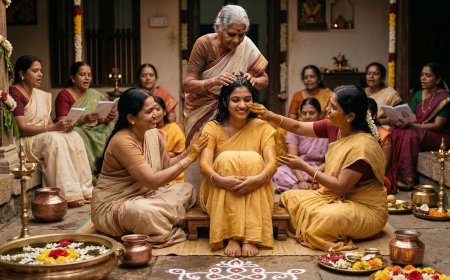
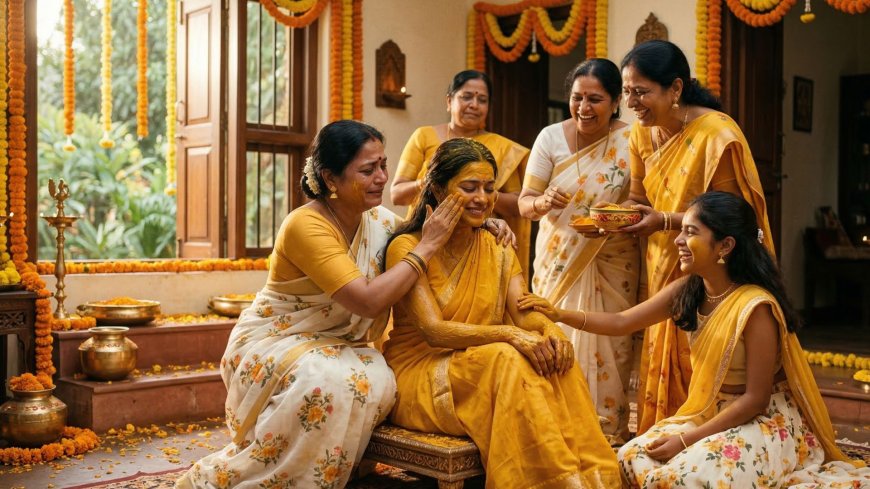
In the traditional form of the haldi ceremony, the application of the paste is done by the women of the family and the close female community — the mother, the aunts, the sisters, the female friends whose relationship to the bride is close enough to give them the right to participate in this intimate preparation. The act of applying the haldi is an act of care — the hands of the women who love the bride most directly touching her skin, anointing her with the substance that the tradition has identified as most sacred for this purpose.
This community of women gathered around the bride carries, in its gathering, the transmission of knowledge that the tradition has always moved through the female line — the specific knowledge of how the paste is prepared, which ingredients are added in what proportion, what the correct sequence of application is, which parts of the body receive the haldi and which do not, what the words are that are spoken during the application. This knowledge has been passed from mother to daughter and from aunt to niece for longer than any written record documents, and it is knowledge that moves specifically through the physical gathering of the women around the bride — knowledge that cannot be transmitted by a YouTube tutorial or a wedding planning blog, because it requires the presence, the touch, and the voice of the women who carry it.
The Regional Traditions: A Geography of the Yellow
The haldi ceremony exists across virtually every Hindu community in India, but it exists in forms that are sufficiently distinct to merit specific attention to the regional variations. Understanding which tradition applies to the specific community of the bride and groom is essential for the NRI couple planning the ceremony from abroad.
The Punjabi and North Indian Pithi
In the Punjabi tradition — and in the broader North Indian tradition that shares many of its pre-wedding practices — the haldi ceremony is often called the pithi or the haldi. The pithi ceremony in Punjab is typically conducted separately for the bride and the groom, at their respective family homes, and is a community occasion of significant scale — all the women of the mohalla, the neighbourhood, may participate, and the ceremony has the character of a collective celebration rather than an intimate family ritual.
The Punjabi haldi paste is prepared with turmeric as the primary ingredient, mixed with mustard oil — the specific oil of the Punjab agricultural tradition — and besan, the chickpea flour that gives the paste its texture and its additional skin-conditioning properties. The sandalwood powder that Simran's grandmother added is a common addition in the more elaborate preparations, contributing both to the paste's fragrance and to its skin-smoothing effects. The application in the Punjabi tradition is typically vigorous — the women apply the paste with the flat of the hand, working it into the skin with the energy that reflects the celebratory character of the occasion.
The Punjabi pithi is conducted in the morning, often to the accompaniment of the gidda — the women's folk dance tradition of Punjab — and the specific folk songs of the pre-wedding period that have been sung at Punjabi weddings for generations. These songs — about the leaving of the father's house, about the transition to the new household, about the love and the longing and the hope that the wedding contains — are among the most emotionally direct expressions of the wedding's significance in the entire Indian musical tradition.
The Maharashtrian Halad
In the Maharashtrian tradition, the pre-wedding turmeric ceremony is called the halad, and it is conducted as part of the broader sequence of pre-wedding rituals that includes the kelvan — the pre-wedding feast — and the specific ritual preparations that are particular to the Maharashtrian tradition. The halad paste in Maharashtra is prepared with turmeric and coconut oil — the oil of the coastal tradition — and the application follows a specific sequence that the family priests and the family women know and maintain.
The Maharashtrian halad has a specific connection to the coconut that reflects the coconut's central place in the Maharashtrian ritual vocabulary — the coconut is one of the most auspicious offerings in the Maharashtrian tradition, and its oil in the halad paste connects the pre-wedding ritual to the broader sacred geography of the tradition.
The Tamil Nalangku
The Tamil pre-wedding turmeric ceremony — the nalangku — is one of the most elaborate regional variations of the haldi tradition and deserves specific attention both for its ritual complexity and for the specific community of women that it requires. The nalangku is conducted on the morning of the wedding day or in the days before it, depending on the specific community tradition, and it involves not simply the application of the turmeric paste but an elaborate sequence of ritual acts that include the application of oil, the combing and arranging of the hair, the application of the turmeric, and a set of playful ritual games between the bride and the groom's family that formalise the relationship between the two families in the specific vocabulary of the Tamil wedding tradition.
The Tamil nalangku paste is prepared with turmeric and gingelly oil — the sesame oil that is the specific oil of the Tamil culinary and ritual tradition — and may include neem leaves, which carry their own specific purifying and protective properties in the Ayurvedic framework. The application in the nalangku is more ceremonially structured than the vigorous Punjabi application — each act of the nalangku is a specific ritual act with a specific meaning and a specific sequence.
The songs of the nalangku — the nalangku paadalgal, the songs specific to this ceremony — are a distinct genre of Tamil women's folk music, sung by the women gathered for the ceremony and carrying the specific emotional content of the pre-wedding liminal state. These songs are one of the most significant elements of the nalangku tradition that is at risk of loss in the diaspora context, where the women gathered for the ceremony may not know the songs and where the specific musical knowledge that the tradition requires may not have been transmitted to the generation that is now getting married.
The Bengali Gaye Holud
The Bengali pre-wedding turmeric ceremony — the gaye holud, literally the yellow on the body — is one of the most elaborate and most publicly celebrated versions of the haldi tradition in India. The gaye holud is typically conducted on the evening before the wedding, separately for the bride and the groom at their respective family homes, and it has the character of a major pre-wedding event — with music, with dance, with food, with the elaborate decoration of the ceremony space with marigolds and other flowers that has become one of the distinctive visual signatures of the Bengali wedding tradition.
The Bengali gaye holud has a specific cultural dimension that adds to its complexity — the turmeric paste applied to the bride and groom is typically brought from the other family's home, in a ceremonial procession called the holud bari, in which the groom's family brings the turmeric to the bride's home and vice versa. This exchange of turmeric is one of the most significant acts of the pre-wedding period in the Bengali tradition — it is the first formal exchange between the two families, the first crossing of the boundary between the two households, and the first act of the reciprocal relationship that the wedding will formally establish.
The Telugu Nalugu
The Telugu pre-wedding ceremony — the nalugu — shares its name and its basic structure with the Tamil nalangku, reflecting the shared Dravidian cultural substrate of the two traditions, but has its own specific character and its own specific ritual elements. The nalugu is conducted on the morning of the wedding day in many Telugu communities, and it involves the application of a turmeric and oil paste by the women of the family in a ritual sequence that is specific to the Telugu tradition.
The nalugu in the Telugu tradition is often conducted with the accompaniment of the specific folk music of the ceremony — the jaanpada geethalu, the folk songs that carry the emotional and ritual content of the pre-wedding period in the Telugu tradition. The music, like the nalangku paadalgal of the Tamil tradition, is a specific and specialised genre that the diaspora risks losing if it is not actively transmitted.
The Haldi Paste: What Goes Into It and Why
The composition of the haldi paste is one of the most significant variables across the regional traditions, and the NRI couple planning the haldi ceremony from abroad must pay specific attention to the paste rather than treating it as a commodity that can be sourced from any Indian grocery store.
The Core Ingredient: Quality Turmeric
The turmeric used in the haldi ceremony matters in ways that the supermarket plastic-jar variety does not address. The ideal turmeric for the haldi is raw — the fresh rhizome, grated or pounded, which has a different texture, a different smell, and a different effect on the skin than the dried and processed powder. In communities where fresh turmeric is available — in the areas of South Asia and Southeast Asia where it is grown — the haldi ceremony uses fresh grated turmeric as the primary ingredient, and the experience of having fresh turmeric applied to the skin is qualitatively different from the dried powder version.
For the NRI couple in Melbourne or London or Toronto, fresh turmeric rhizomes are increasingly available in the Asian grocery stores that serve the South and Southeast Asian communities in these cities. The investment in sourcing fresh turmeric for the haldi ceremony is not a luxury. It is the form of the ingredient that the tradition was built on and that produces the specific effect — the smell, the texture, the skin contact — that the dried powder approximates but does not replicate.
The Carrier Oil: The Regional Specificity
The oil in which the turmeric is mixed is as significant as the turmeric itself, and the specific oil varies by regional tradition in ways that reflect the agricultural and culinary landscape of each region. Mustard oil in Punjab — pungent, warm, deeply familiar to the North Indian skin and palate. Coconut oil in Maharashtra, Kerala, and the coastal traditions — lighter, cooler, with the specific fragrance of the coconut that carries its own ritual associations. Gingelly oil in Tamil Nadu and the other South Indian traditions — the sesame oil that is the specific sacred oil of the South Indian ritual vocabulary, used in the post-death ritual bath and the pre-wedding bath in a continuity that the tradition understands as the oil that marks the most significant transitions of the body's life.
The NRI couple planning the haldi ceremony must use the oil of their specific regional tradition, not the oil that is most easily available or most familiar from the general cooking context. The oil is not incidental. It is the carrier of the tradition's specific relationship to the body being prepared.
The Additional Ingredients: Sandalwood, Besan, and Neem
The additional ingredients that the different regional traditions add to the turmeric and oil base reflect the Ayurvedic understanding of the specific skin-preparation function of the haldi ceremony. Besan — chickpea flour — is the most widely added ingredient across the North Indian traditions, providing a gentle exfoliant action that removes the dead skin layer and allows the turmeric to penetrate more effectively. Sandalwood powder — chandan — adds a cooling, calming effect that counteracts the warming action of the turmeric and the mustard oil, and adds the specific sacred fragrance that the sandalwood tradition carries throughout the Indian ritual vocabulary. Neem — the leaves or the oil — adds the antimicrobial dimension that is particularly significant in the Ayurvedic framework as a skin purifier. Rose water, added in some traditions, softens the paste and adds the rose's specific association with the feminine and the sacred in the Indian floral tradition.
The NRI Haldi Ceremony: Planning From Abroad
The NRI couple planning the haldi ceremony from Melbourne or London or Toronto faces a specific set of challenges that the domestic ceremony does not encounter, and these challenges require specific planning attention rather than the assumption that the ceremony will organise itself in the way that the domestic ceremony, embedded in the community that knows how to do it, tends to organise itself.
The Paste: Sourcing and Preparation
The preparation of the haldi paste is the first planning responsibility, and it is one that the NRI couple must address with enough lead time to source the ingredients properly. The fresh turmeric rhizome is available in the Asian grocery stores of most major NRI-populated cities — Melbourne, London, Toronto, Singapore, Dubai — and should be sourced fresh rather than purchased processed. The specific oil of the regional tradition — mustard, coconut, or gingelly — is also available in Asian grocery stores in these cities. The besan, the sandalwood powder, and the other additional ingredients are available in Indian grocery stores and online.
The paste should be prepared by the women of the family who know the specific preparation of the tradition — who know the proportions, the consistency, the specific additions that the family's version of the paste requires. The grandmother's recipe, transmitted in a note with a tin of prepared haldi, is the ideal form of this transmission. The YouTube tutorial is the fallback for the family whose transmission has been interrupted by distance and time, and it is better than nothing while being significantly less than the real thing.
The Songs: The Most Urgent Transmission
The folk songs of the haldi ceremony — the gidda songs in Punjab, the nalangku paadalgal in Tamil Nadu, the gaye holud songs in Bengal — are the element of the ceremony most at risk of loss in the diaspora context and the element that most requires active effort to preserve. These songs are not available on streaming services. They are not written down in books that are easily found. They exist in the memories of the women who were taught them by the women who were taught them, and they travel only through the specific act of transmission — the elder singing to the younger, the younger learning by repetition in the presence of the elder.
The NRI couple planning the haldi ceremony must identify, early in the planning process, the women in the family or the community who know the specific songs of their tradition and must arrange for those songs to be present at the ceremony — either through the physical presence of the women who know them, or through the recording of the songs in the elder's voice that can be played at the ceremony while the words are learned. This is not a nice-to-have element of the ceremony planning. It is the cultural substance of the ceremony itself, and a haldi ceremony conducted without the specific folk songs of the tradition is a ceremony that has lost its most intimate and most culturally specific dimension.
The Women: Who Should Apply the Haldi
The question of who applies the haldi is a ritual question that carries social significance, and the NRI couple must address it with the same seriousness that the tradition brings to it. The traditional form — the women of the family, the aunts and sisters and female friends whose relationship is close enough to justify the intimate act of applying the paste to the skin — is the form that the ceremony should aspire to maintain in the diaspora context. This means that the haldi ceremony should be planned around the actual relationships of the people who will participate, not around the aesthetic of the ceremony as a photographic event.
The professional makeup artist who is hired to apply the haldi paste for the photographs is not the tradition. She is a skilled professional doing her job, and her presence at the ceremony is not a violation of anything, but her hands on the bride's skin are not the hands of the women who love her. The tradition understands this difference as significant.
Common Mistakes NRI Couples Make With the Haldi Ceremony
The first mistake is planning the haldi as a photo opportunity rather than as a ritual. The haldi ceremony is one of the most photographed elements of the contemporary Indian wedding, and the photographs it produces are genuinely beautiful. But the planning orientation that begins with the photographs — the colour palette of the outfits, the flower installations, the lighting setup — and treats the ritual as the content that fills the photographic frame has reversed the correct order of priorities. The ritual is the point. The photographs are the record of the ritual. The ceremony planned primarily for the photographs is a ceremony that will be beautiful in the images and thin in the actual experience.
The second mistake is using processed turmeric powder when fresh turmeric rhizomes are available. This mistake is understandable — the processed powder is convenient, it is what the supermarket stocks, and it produces the yellow colour that the ceremony requires. But the fresh rhizome is the form that the tradition was built on, that carries the specific smell and texture that constitute the sensory experience of the ceremony, and that produces the more effective skin treatment that the Ayurvedic framework identifies as the ceremony's medicinal foundation. In the cities where NRI communities are concentrated, fresh turmeric is available. The effort to source it is small relative to the difference it makes.
The third mistake is separating the bride and groom's haldi ceremonies entirely and losing the connection between them. Many regional traditions conduct the haldi ceremonies separately — at the respective family homes, on the same day, with the paste sometimes being sent from one household to the other. This separation is part of the tradition and should be maintained where it applies. But the NRI couple who separates the ceremonies for logistical convenience rather than ritual reason, who conducts them on different days or in different contexts without the conscious connection that the tradition provides, has allowed the logistical tail to wag the ritual dog.
The fourth mistake is not preserving the used haldi. In many traditions, the turmeric paste that has been applied to the bride's skin is not simply washed away as waste — it is collected, or the water of the ritual bath in which it is washed off is used in specific ways that the tradition prescribes. Some traditions apply the used haldi from the bride to the groom, or vice versa, as an act of connection between the two. Some traditions use the water of the ritual bath to water the plants of the household, returning the sacred substance to the earth. The NRI couple who washes the haldi off under the shower and thinks nothing further of it has not necessarily violated the tradition, but has missed an opportunity to honour its completeness.
The fifth mistake is conducting the haldi ceremony on the same day as the wedding when the tradition of the specific community calls for it to be conducted on a separate day before the wedding. The skin needs time to absorb the turmeric and to show the specific glow that the ceremony produces. The haldi applied on the morning of the wedding day and washed off two hours later has not had the time to do what the tradition understands it as doing. The haldi applied the day or the days before the wedding, washed off in the pre-wedding ritual bath, has prepared the skin in the specific way that the tradition intends and that the ceremony's Ayurvedic foundation requires.
The Complete Reference Table: The Haldi Ceremony Across India's Regional Traditions
| Region / Community | Local Name | Timing | Paste Composition | Carrier Oil | Key Additional Ingredients | Ceremony Character | Specific Folk Music | NRI Consideration |
|---|---|---|---|---|---|---|---|---|
| Punjab / North India | Haldi / Pithi | Morning before wedding | Turmeric, besan, oil | Mustard oil | Sandalwood, rose water | Community celebration; vigorous application | Gidda songs; suhag songs | Songs most at risk of loss in diaspora |
| Haryana | Pithi | Day before wedding | Turmeric, besan, curd | Mustard oil | Sandalwood, neem | Family-centred; women of mohalla | Specific Haryanvi folk songs | Separate bride and groom ceremonies |
| Rajasthan | Haldi / Ubtan | Day before wedding | Turmeric, besan, sandalwood | Mustard oil | Rose water, saffron | Elaborate; merchant community additions | Rajasthani folk tradition | Saffron addition in affluent families |
| Gujarat | Pithi / Haldi | Day before wedding | Turmeric, besan, curd | Sesame or coconut | Sandalwood, rose water | Family ceremony; moderate scale | Garba tradition adjacent | Chopda Pujan tradition context |
| Maharashtra | Halad | Morning of or day before | Turmeric, besan | Coconut oil | Sandalwood, neem | Structured ritual sequence | Specific Marathi folk songs | Coconut oil is tradition-specific |
| Bengal | Gaye Holud | Evening before wedding | Turmeric, mustard paste | Mustard oil | Sandalwood, vermillion | Large community event; holud bari procession | Bengali wedding songs; baul tradition | Holud exchange between families |
| Tamil Nadu | Nalangku | Morning of wedding | Turmeric, neem | Gingelly oil | Neem leaves, rice flour | Elaborate ritual sequence; playful games | Nalangku paadalgal (specific genre) | Songs most specific and most at risk |
| Andhra Pradesh / Telangana | Nalugu | Morning of wedding | Turmeric, besan | Gingelly oil | Neem, rice flour | Ritual sequence; family women | Jaanpada geethalu folk songs | Telugu specific folk music tradition |
| Karnataka | Haldi / Arishina | Morning of or day before | Turmeric, besan | Coconut oil | Sandalwood, neem | Moderate ritual; family-centred | Specific Kannada folk tradition | Regional variation by sub-community |
| Kerala | Haldi / Manjal Neerattu | Morning of wedding | Turmeric, coconut paste | Coconut oil | Neem, rice flour | Ritual bath emphasis; temple tradition | Kerala folk music tradition | Coconut emphasis throughout |
| Odisha | Haldi | Day before wedding | Turmeric, besan | Mustard oil | Sandalwood, neem | Family ceremony | Odia wedding folk songs | Regional sub-community variations |
| Sikh (Punjab) | Haldi / Vatna | Day before wedding | Turmeric, besan, curd | Mustard oil | Sandalwood, rose water | Community celebration; gurdwara context | Gidda songs; shabad adjacent | Sikh tradition alongside Hindu elements |
| NRI Diaspora | Haldi | Variable | Variable; often simplified | Variable; often coconut | Variable; often reduced | Photographic emphasis risk | Often absent; urgent preservation need | Fresh turmeric and regional oil essential |
What the Yellow Carries That the Photograph Cannot Show
There is something that happens in the haldi ceremony that the photographs cannot fully capture, and it is the thing that Simran's grandmother was pointing to when she wrote that the wedding should mark you. The marking is not only the yellow on the skin — though the yellow on the skin is real and visible and the specific glow of the haldi-treated skin on the wedding day is something that every person who has witnessed it in person describes with a specificity that photographs approach but do not quite reach. The marking is internal. It is the transformation that the ceremony produces in the person who undergoes it — the shift in their relationship to themselves, to the transition they are about to make, to the body that is being prepared for the most significant event of its life.
The women gathered around the bride, applying the paste with their hands, singing the songs of the pre-wedding period, weeping and laughing with the particular simultaneity that the haldi ceremony produces — these are the women who know what is coming. They have been through the wedding, or they will go through it, or they have watched it from close enough to understand its magnitude. Their hands on the bride's skin are carrying all of this knowledge — the knowledge of what it means to be the person being prepared, the knowledge of what the preparation is preparing for, the knowledge that the yellow on the skin is the mark of the threshold and that the person on whom it is being applied is, in this moment, at the most significant threshold of their adult life.
The bride who allows herself to be fully present in this moment — who lets the ceremony be the ceremony rather than managing it as an event, who lets the women's hands and the women's songs do what the tradition designed them to do — undergoes something that the photographs cannot fully capture because it is happening inside rather than on the surface. The glow that the photographs show is real. But the transformation that the glow is the outward sign of is the thing that the ceremony is actually producing, and it is the thing that the grandmother in Amritsar was insisting on when she packed the tin with the specific mixture that four generations of women in the family had used, and wrote the note that said the wedding should mark you.
It should. And the haldi ceremony, done with the full seriousness of the tradition that produced it, does exactly that — marks the person in a way that the day's other preparations do not, leaves a trace that is not only yellow and not only on the skin, and sends the bride and the groom to the wedding ceremony as people who have been seen and anointed and prepared by the hands and the songs of the women who love them most.
Simran Sat Still While the Women Applied the Paste
The haldi ceremony was on the Friday, the day before the wedding, in the Melbourne flat that had been transformed by the women of her family — her mother, two aunts, three cousins, and the four friends from the Punjabi community who had known Simran long enough to have the right to be there — into something that was not quite the Amritsar of her grandmother's kitchen and not quite Melbourne and was perhaps, for the duration of the ceremony, a third thing that the distance between them had made possible.
Her grandmother's paste was in the bowl. The gidda songs had been downloaded from a recording that her mother's cousin in Chandigarh had made on her phone at the last family wedding, sung by the women of the mohalla who still knew them, and played through the speaker in the corner with the specific imperfection of a phone recording that made it feel more real rather than less. Two of the women present knew some of the words and sang along. The others followed the melody. Simran's mother, who knew all the words, sang clearly and without self-consciousness in the way that people sing when they are not performing but remembering.
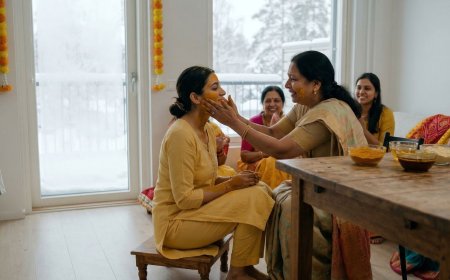
The paste was applied for forty-five minutes. At a certain point, Simran stopped managing it and started experiencing it — stopped thinking about the photographs and the sequence and started feeling the specific warmth of the mustard oil and the turmeric on her skin and the specific quality of the attention of the women around her, which was not the attention of an audience but the attention of care. Her mother applied the paste to her face with the flat of her fingers, slowly, with the expression of a woman doing something she had been waiting to do for thirty-one years. Simran cried at that point, which was appropriate, and several of the other women cried with her, which was also appropriate.
The next morning her skin had the specific glow that her grandmother had described — not the glow of the filter but the glow of the thing itself, the glow that the four generations before her had had on their wedding mornings, the glow that the tin from Amritsar had been keeping for exactly this purpose.
Source the fresh turmeric rhizome before you source the photographer. Find the women in the family or the community who know the folk songs and make sure they are in the room. Use the oil of your specific regional tradition. Prepare the paste from the grandmother's recipe or the closest available equivalent. Set aside the full morning or the full evening — not the hour that the schedule permits but the time that the ceremony requires.
And then sit still while the women apply the paste, and let the ceremony do what four thousand years of the tradition have designed it to do — mark you, completely and with their hands, as a person who is loved and prepared and standing at the threshold of everything that comes next.
Published by NRIWedding.com — The Premium Global Platform for Non-Resident Indians Planning Indian Weddings From Abroad.
What's Your Reaction?
 Like
0
Like
0
 Dislike
0
Dislike
0
 Love
0
Love
0
 Funny
0
Funny
0
 Angry
0
Angry
0
 Sad
0
Sad
0
 Wow
0
Wow
0