










































































Grand Hyatt Goa — A 45-Acre Portuguese Estate Wedding with the Largest Event Space in the State: NRI Guide — The Complete NRI Wedding Planning Guide
Preethi had been looking for something that Goa was not supposed to have. She had eliminated Rajasthan — not her heritage, not her family's geography, not the landscape that two hundred and thirty guests from both families had any specific connection to. Kerala was her mother's home state and the Kerala wedding was the wedding her parents had had, and she wanted something that was hers rather than a reproduction of theirs. She had come to Goa because of Kiran, who had grown up there — not the tourist Goa of the northern beaches but the residential Goa of the laterite houses and the Catholic feast days and the specific mixture of the Portuguese architectural heritage and the Konkan landscape. He wanted the wedding to be in Goa because Goa was where he came from, specifically the Goa of the Portuguese estate, the laterite wall, the azulejo tile, the colonial garden. The standard Goa venue research had not produced what Kiran was looking for. The beach resorts were beautiful and they were not the Portuguese estate. The heritage properties of the interior were too small for two hundred and thirty guests. Then Preethi found the Grand Hyatt Bambolim in an event industry article that described it as having the largest ballroom in the state of Goa on a forty-five acre site developed with the specific consciousness of the Portuguese estate tradition — the laterite stone walls, the arched colonnades, the formal garden layout, the specific palette of the Goa Portuguese architectural vocabulary. She sent the photographs to Kiran. He looked at them for seven minutes. He said: this is what I was trying to describe. This guide gives NRI couples the complete framework for the Grand Hyatt Goa wedding — every event space with detailed pricing, the Portuguese estate décor vocabulary, the Goan Catholic cultural integration, the Mandovi river cruise program, the largest ballroom in the state at full production scale, and the specific mistakes that separate the couple who uses the Portuguese estate fully from the couple who holds a wedding in Goa without ever really being of it.

Grand Hyatt Goa — A 45-Acre Portuguese Estate Wedding with the Largest Event Space in the State: NRI Guide — The Complete NRI Wedding Planning Guide
Preethi had been looking for something that Goa was not supposed to have.
She had been looking for it for six months from her flat in Singapore, moving through the standard Goa venue research with the systematic patience of someone who had already looked at Rajasthan and Kerala and had understood, by the end of those searches, that neither landscape was the right answer for her wedding. Rajasthan was extraordinary and it was not hers — not her heritage, not her family's geography, not the landscape that her parents and her fiancé Kiran's parents and the two hundred and thirty guests from both families' lives had any specific connection to. Kerala was her mother's home state and it was beautiful in the way that only your own landscape is beautiful, but the Kerala wedding — the intimate ceremony, the sadya, the specific ritual vocabulary of the Malayali tradition — was the wedding her parents had had, and she wanted something that was hers rather than a reproduction of theirs.
She had come to Goa because of Kiran. He had grown up in Goa — not the tourist Goa of the northern beaches but the residential Goa of the educated professional family, the Goa of the laterite houses and the Catholic feast days and the specific mixture of the Portuguese architectural heritage and the Konkan landscape and the particular quality of the Goa resident's relationship to the place that the visitor never quite achieves. He had grown up between two cultures and he had come to understand both of them with the specific depth of someone for whom the cultural mixture was personal rather than observed. He wanted the wedding to be in Goa because Goa was where he came from and because Goa — specifically the Goa of the Portuguese estate, the laterite wall, the azulejo tile, the colonial garden — was the specific cultural landscape that he wanted the wedding to be inside.
The standard Goa venue research had not produced what Kiran was looking for. The beach resorts were beautiful in the way that beach resorts are beautiful and they were not the Portuguese estate. The heritage properties of the Goa interior were intimate and extraordinary and they were too small for two hundred and thirty guests. The large city hotels of Panaji were adequate and they were not in any meaningful sense of Goa.
Then Preethi had found the Grand Hyatt Bambolim.
She had found it through a specific piece of information — not a wedding planning resource but an event industry article that described the Grand Hyatt Goa as having the largest ballroom in the state of Goa and one of the largest outdoor event spaces in western India, on a forty-five acre site in Bambolim that had been developed with the specific consciousness of the Portuguese estate architectural tradition that Kiran had been describing. The article mentioned the laterite stone. It mentioned the colonial arcade. It mentioned the gardens.
She had looked up the property immediately. The photographs showed a resort that had been built with the Portuguese Goa aesthetic as its primary architectural reference — the laterite stone walls, the arched colonnades, the formal garden layout, the specific palette of the Goa Portuguese architectural tradition that was different from the Rajput palace and the Mughal court and every other Indian architectural vocabulary in the heritage hotel landscape. The aesthetic was specifically Goan. Not generically Indian. Not the approximation of Goa that a resort built without architectural conviction produced. The specific vocabulary of the Goa that Kiran had grown up in.
She sent the photographs to Kiran. He looked at them for seven minutes. Then he called her. He said: this is what I was trying to describe. She said: I know. He said: the laterite wall. She said: the laterite wall. He said: the arcade. She said: the arcade. He said: how large is the event space? She said: the largest in the state. He said: and the gardens? She said: forty-five acres of them. He said: book the site visit immediately.
This guide is for every NRI couple who has been looking for the Goa wedding that is specifically of Goa rather than merely in Goa — for Preethi in Singapore and every couple who deserves the complete framework for the Portuguese estate wedding on the largest event platform in the state.
Understanding Grand Hyatt Goa: The Portuguese Estate at Bambolim
The Grand Hyatt Goa is situated at Bambolim on the Mandovi River estuary, in North Goa — not on the coastline of the tourist beach corridor but at the inland edge of the Goa landscape where the Mandovi River widens toward the Arabian Sea and the specific character of the Goa interior — the laterite soil, the coconut palms, the specific vegetation of the Konkan coastal strip — is most clearly present.
The property was developed on a forty-five acre site with the specific architectural intention of creating a resort that engaged with the Portuguese estate tradition of Goa — the tradition of the large, formally organised colonial properties that the Portuguese administration and the Goan Catholic elite had built across the territory from the sixteenth century onward, characterised by their laterite stone construction, their formal garden layouts, their arched colonnades, their specific relationship to the Goa landscape that made them unlike the architecture of any other part of India.
The laterite stone is the fundamental material of this tradition and the most immediately legible element of the Grand Hyatt's architectural identity. Laterite — the iron-rich, reddish-brown stone that is the primary building material of the Goa region — is the material from which the Portuguese colonial buildings, the Goan Catholic churches, the estate houses of the Goa interior have been built for four centuries. The Grand Hyatt's use of laterite throughout the property's construction connects it to this tradition in the most direct material sense — the building is made of the same stone as the heritage it references, and the quality of the laterite in its characteristic colour and texture gives the property the specific visual character of the Goa Portuguese estate.
The arched colonnade — the formal arcade that organises the resort's primary architectural sequence from the entrance through the central spaces to the garden and the event areas — is the most recognisable element of the Portuguese colonial architectural vocabulary and the element that most immediately communicates the resort's aesthetic intent to anyone who knows the Goa architectural tradition. The arcade at the Grand Hyatt is not decorative pastiche. It is a functional architectural element, as the arcade always was in the Portuguese estate — the covered walkway that connects the buildings and provides shade in the Goa climate — applied to a contemporary resort with the conviction and the scale that genuine architectural engagement produces.
The forty-five acres of the Bambolim site provide the physical scale for a property that is genuinely resort-like in the most complete sense — not a hotel with gardens attached but a landscape property of significant extent within which the hotel buildings and the event spaces and the accommodation are distributed across a varied terrain of gardens, water features, and the specific Goa landscape of laterite outcrops and coconut palms that the site contains.
The Portuguese Estate Aesthetic: Why It Matters for the NRI Wedding
The Portuguese estate aesthetic that the Grand Hyatt Goa embodies is not merely an architectural style. It is a specific cultural landscape that carries its own history and its own specific meaning for the communities that grew up within it — the Goan Catholic families whose ancestral homes were the laterite-walled estate houses of the Goa interior, the families that have been navigating the Portuguese-Indian cultural synthesis for four centuries and that have produced, in that navigation, a specific and extraordinary cultural identity that is found nowhere else in India.
For Kiran and for the significant number of NRI couples from Goan Catholic backgrounds who are planning weddings in the context of their heritage — the heritage that includes the Portuguese church, the Latin mass, the Goan feast, the specific culinary tradition of the sorpotel and the bebinca, and the specific architectural tradition of the laterite house and the colonial garden — the Grand Hyatt Goa's Portuguese estate aesthetic is not a design choice. It is a homecoming.
For the NRI couple from other backgrounds — the Tamil or Marathi or Gujarati families for whom Goa is a chosen destination rather than a heritage one — the Portuguese estate aesthetic provides the specific quality that the Rajasthan venues provide through their palace architecture: a sense of place, a sense of historical depth, a sense of being in a landscape that has accumulated meaning across centuries rather than merely providing a beautiful backdrop. The Goa Portuguese estate tradition is four hundred years old. It is as specific and as historically layered as the Rajput palace tradition, and it is less visited and less known by the NRI wedding market — which means that the couple who chooses it is choosing something that their guests are unlikely to have encountered in the same form at another wedding.
The Largest Event Space in Goa: Understanding the Scale Advantage
The Grand Hyatt Goa's claim to the largest event space in the state of Goa is a specific and verifiable fact, and it matters in a specific way for the NRI couple whose wedding requires large-format capacity within the Goa destination context.
The Grand Ballroom of the Grand Hyatt Goa is the largest hotel ballroom in Goa — a formally configured indoor event space of approximately four thousand square metres that accommodates up to three thousand guests for a standing reception and up to two thousand for a seated dinner. There is no other hotel property in Goa that provides an indoor event space of this capacity, and the NRI couple whose guest list exceeds the capacity of the standard Goa beach resort ballroom has, until the Grand Hyatt, been forced to choose between the Goa destination and the large-format event. The Grand Hyatt resolves this choice.
The outdoor event spaces complement the indoor capacity — the Grand Hyatt's lawns and gardens can extend the reception capacity to several thousand guests for the events where the outdoor format is appropriate. The combination of the largest indoor ballroom and the forty-five acre outdoor landscape gives the Grand Hyatt Goa the most complete large-format event infrastructure available in the state, and for the NRI wedding that has outgrown the boutique beach property without wanting to leave the Goa context, the Grand Hyatt is the specific solution.
The Event Spaces: Portuguese Estate Architecture at Wedding Scale
The Grand Ballroom: The Largest Indoor Space in Goa
The Grand Ballroom is the centrepiece of the Grand Hyatt Goa's event infrastructure — a ballroom of exceptional scale with the technical infrastructure and the architectural vocabulary of a space designed for the largest and most ambitious events. The ballroom accommodates up to three thousand guests for a standing reception and up to two thousand for a seated dinner, making it not merely the largest ballroom in Goa but one of the largest hotel ballrooms in western India.
The ballroom's technical infrastructure — the professional sound system, the lighting grid, the staging platforms, the kitchen adjacency for banquet service, the air conditioning — is the contemporary Hyatt Hotels standard applied at the scale that the ballroom's capacity requires. The sangeet for a thousand guests, the wedding dinner for fifteen hundred seated covers, the elaborate ceremony with full professional production — these are events that the Grand Ballroom accommodates as a matter of operational routine.
The ballroom can be subdivided into sections for simultaneous events — the wedding ceremony in the main section, the children's entertainment in the pre-function area, the vendor setup in the secondary section — providing the operational flexibility that the complex large-format wedding program requires.
The Grande Lawn: The Outdoor Ceremony and Reception Space
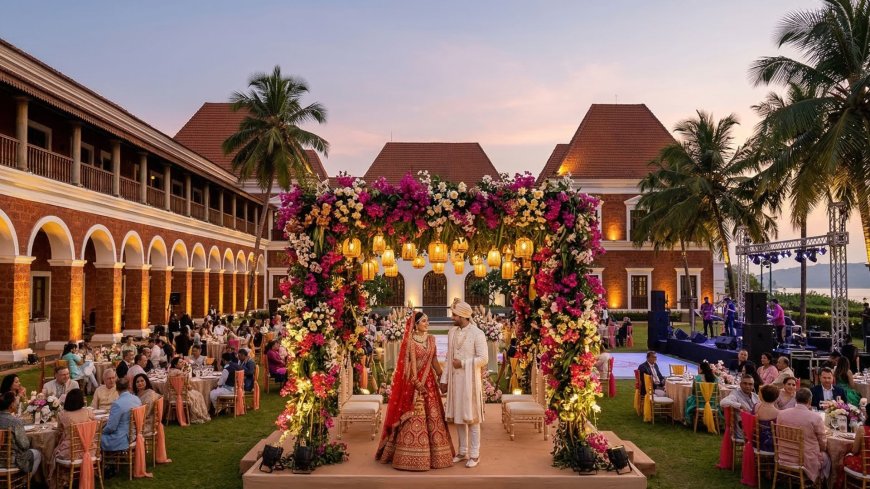
The Grande Lawn — the primary outdoor event space of the Grand Hyatt Goa, a large, level lawn within the resort's garden landscape — accommodates up to two thousand guests for a standing reception and up to twelve hundred for a seated ceremony or dinner. The lawn is bordered by the resort's laterite architecture and the formal garden planting that reflects the Portuguese estate landscape design vocabulary.
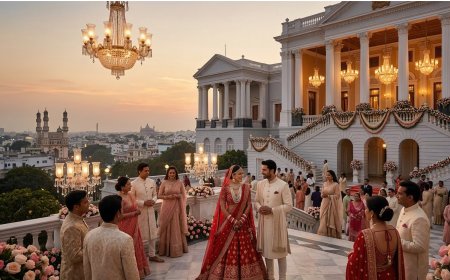
The ceremony on the Grande Lawn — the mandap positioned within the formal garden framework, the laterite arcade visible at the lawn's edge, the coconut palms providing the Goa landscape context, the Goa sky above — is a ceremony setting that is immediately and specifically of Goa rather than of a generic destination. The reception dinner on the Grande Lawn at night — the laterite walls illuminated in the warm tones that the stone receives, the formal garden lit with the lantern and torch vocabulary that belongs to this architectural tradition — is the Goa Portuguese estate evening in its most complete outdoor form.
The Pool Deck: The Social Heart
The Grand Hyatt Goa's pool complex — one of the largest pool areas of any Goa hotel, with multiple interconnected pools at different levels and the pool deck providing a substantial social gathering space — is the social heart of the wedding stay. The pool deck accommodates up to four hundred guests for a standing reception and up to two hundred for a seated event, and its multiple levels and orientations provide the variety of gathering spaces that the large wedding group requires for its informal social time.
The mehendi ceremony at the pool deck — with the laterite architecture visible above the pool level and the Goa landscape providing the context — is the daytime event that most directly uses the resort's specific architectural character as its setting. The morning breakfast gathering, the afternoon gathering before the evening events, the post-ceremony relaxation of the wedding party — these are the occasions that the pool deck accommodates with the combination of social infrastructure and architectural beauty that the Portuguese estate setting provides.
The Riverside Garden: The Intimate Event Space
The resort's riverside garden — the landscaped outdoor space at the property's edge closest to the Mandovi River estuary, with the river and the specific quality of the Goa tidal landscape visible from the garden's outer boundary — is the intimate event space for the smaller, more personal events of the wedding program. The rehearsal dinner, the family gathering on the arrival evening, the post-wedding breakfast — these are the events that the riverside garden accommodates with the specific intimacy of a garden that is not the main event space and that has its own particular quality of place.
The riverside garden accommodates up to one hundred and fifty guests for a standing reception and up to eighty for a seated dinner. The evening dinner in the riverside garden — with the Mandovi estuary visible beyond the garden's edge, the tidal landscape of the Goa interior providing the backdrop, the resort's laterite architecture providing the enclosure — is the most specifically Goan of the intimate event options at the Grand Hyatt, the event that most directly connects the wedding to the specific landscape that Kiran had been describing when he talked about the Goa he had grown up in.
The Chapel: The Christian Ceremony Option
The Grand Hyatt Goa has a chapel within the resort property — a small, formally designed Christian ceremony space that provides the option for the NRI couple who wants a Christian ceremony within the Portuguese estate context. The chapel accommodates up to one hundred guests for a seated ceremony and is used for the blessing ceremony that many Goan Catholic families incorporate alongside the civil and the Hindu ritual elements of the contemporary NRI wedding.
The chapel's specific quality is its cultural authenticity within the Portuguese estate context — the Christian ceremony space within the Catholic estate tradition is not an addition or an adaptation. It is the original use, the form that gives the Portuguese estate its primary ritual identity, and the ceremony that takes place within it is the ceremony that the estate was always designed to host.
The Pre-Function Lawns and Garden Terraces
The pre-function lawns and the various garden terraces distributed across the forty-five acre property provide the transition spaces and the intimate gathering areas that the large wedding program requires at every scale. The arrival cocktail on the colonnade terrace, the transition from the ceremony to the dinner across the formal garden, the post-event gathering of the family under the laterite arcade — these are the experiences that the property's physical extent and its architectural vocabulary make available as natural consequences of moving through the space.
Comprehensive Pricing and Planning Reference
| Category | Detail | Approximate Range | Notes |
|---|---|---|---|
| Grand Ballroom venue hire | Up to 2,000 seated / 3,000 standing | ₹18,00,000–₹35,00,000 per event | Largest ballroom in Goa; full production |
| Grande Lawn venue hire | Up to 1,200 seated / 2,000 standing | ₹12,00,000–₹25,00,000 per event | Primary outdoor ceremony and reception |
| Pool Deck venue hire | Up to 200 seated / 400 standing | ₹5,00,000–₹10,00,000 per event | Mehendi, social gathering, cocktail |
| Riverside Garden venue hire | Up to 80 seated / 150 standing | ₹3,00,000–₹6,00,000 per event | Intimate dinner, family gathering |
| Chapel ceremony | Up to 100 seated | ₹2,00,000–₹4,00,000 per event | Christian ceremony; Goan Catholic tradition |
| Pre-function lawns and terraces | Up to 300 standing | ₹3,00,000–₹6,00,000 per event | Arrival, cocktail, transition events |
| Full Resort Exclusive Buyout | All spaces combined | ₹60,00,000–₹1,20,00,000 per day | Complete Portuguese estate exclusivity |
| Accommodation — Deluxe Room per night | Standard resort | ₹18,000–₹30,000 | Laterite character; garden or pool views |
| Accommodation — Club Room per night | Superior position | ₹26,000–₹40,000 | Club lounge access; enhanced amenities |
| Accommodation — Suite per night | Full suite | ₹45,000–₹80,000 | Estate suites; river or garden facing |
| Accommodation — Presidential Suite per night | Flagship accommodation | ₹1,20,000–₹2,00,000+ | Full butler service; panoramic views |
| Accommodation — Full Resort Buyout per night | All rooms | ₹20,00,000–₹38,00,000 | Complete exclusivity; all rooms |
| Catering per cover — multi-course dinner | Wedding dinner | ₹4,000–₹7,000 | Hyatt culinary team; Goan and contemporary |
| Catering per cover — daytime event | Lunch or breakfast | ₹2,500–₹4,500 | Full service; multiple venues |
| Décor and florals per event | Wedding decoration | ₹8,00,000–₹30,00,000+ | Portuguese estate palette; laterite vocabulary |
| Photography and videography | Full wedding | ₹3,00,000–₹10,00,000 | Colonial architecture specialists preferred |
| Sound and lighting per event | Indoor and outdoor | ₹3,50,000–₹10,00,000 | Full production; estate lighting vocabulary |
| Wedding planner fee | Full service | ₹6,00,000–₹16,00,000 | Grand Hyatt Goa experience preferred |
| Transport — Dabolim Airport to Grand Hyatt | Per vehicle | ₹1,500–₹2,500 | 20 minutes; Bambolim proximity |
| Transport — Mopa Airport to Grand Hyatt | Per vehicle | ₹3,500–₹6,000 | 60 minutes; North Goa road |
| Total three-day wedding — 200 guests | Without buyout | ₹1,00,00,000–₹1,80,00,000 | Full estate program |
| Total three-day wedding — 500 guests | Full program | ₹1,80,00,000–₹3,20,00,000 | Large-format Goa wedding |
| Total three-day wedding — 1,000+ guests, buyout | Full resort | ₹3,00,00,000–₹6,00,00,000+ | Maximum scale; complete estate exclusivity |
The Goan Catholic Wedding at Grand Hyatt: The Cultural Integration Framework
The Grand Hyatt Goa's Portuguese estate aesthetic makes it the natural venue for the NRI couple from a Goan Catholic background who wants their wedding to be embedded in the specific cultural landscape of their heritage. The laterite architecture, the chapel, the formal garden layout — these are not decorative elements. They are the material expression of the Goan Catholic cultural tradition, and the wedding that takes place within them is a wedding inside its own heritage rather than inside a borrowed one.
The Goan Catholic wedding at the Grand Hyatt integrates two ceremony traditions — the Christian ceremony in the chapel and the civil and reception events in the resort's event spaces — in a physical and cultural framework that accommodates both without compromise. The chapel ceremony for the immediate family and the closest friends, the outdoor reception dinner for the full guest list, the formal Catholic prayers that begin the wedding dinner, the Goan folk music — the mando, the dekhni, the folk traditions of the Goa Catholic community — performed in the courtyard after the dinner — these are the elements of the Goan Catholic wedding at the Grand Hyatt that are available nowhere else in the Goa venue landscape with the same architectural authenticity.
The culinary integration of the Goan Catholic wedding at the Grand Hyatt is the specific dimension that the kitchen team's knowledge of the local tradition makes possible. The sorpotel — the spiced pork offal dish that is the signature Goan Catholic feast food, present at every significant occasion in the tradition — on the wedding menu alongside the standard wedding buffet. The bebinca — the layered coconut and egg yolk cake that is the Goan Catholic dessert tradition's most specific achievement — served at the wedding dinner as the dessert that is specifically of this community and this occasion. The chouriço — the Goan pork sausage spiced with vinegar and chilli in the Portuguese tradition — as the cocktail appetiser that the guests from outside the tradition encounter for the first time and that the guests from within it encounter as home. Brief the kitchen team on the Goan Catholic culinary tradition from the first menu planning conversation.
The Mandovi Estuary: Designing the Water Experience
The Grand Hyatt Goa's proximity to the Mandovi River estuary — the tidal waterway that flows between the Goa interior and the Arabian Sea, on whose banks Panaji the state capital is built — provides the wedding program with a water experience that is different in character from the beach experience of the Taj Exotica and that is specifically of the Goa landscape rather than of the general Indian coast.
The Mandovi estuary at Bambolim has the specific quality of the tidal Goa landscape — the mangrove margins, the fishing boats, the specific birds of the estuarine ecosystem, the quality of the water and the light in this specific geographical transition between the freshwater river and the saltwater sea. The evening cruise on the Mandovi — the traditional Goa river cruise that has been the signature leisure experience of the state for decades, with the folk music and the Goa sunset and the river landscape providing the experience — is available from the Bambolim waterfront adjacent to the Grand Hyatt and can be designed into the wedding program as the pre-wedding evening event that gives the international guests the encounter with the Goa water landscape that the resort's inland position does not provide directly.
The boat party on the Mandovi for the wedding eve — the entire wedding group on the traditional Goa river vessel, the mando singers performing the folk tradition, the Goa sunset over the river, the state capital's skyline visible on the northern bank — is the event that most specifically uses the Grand Hyatt's Bambolim location as a cultural and geographical asset. It is not available at the beach properties of South Goa in the same form. It is the specific gift of the Mandovi estuary location.
Décor at the Grand Hyatt Goa: The Portuguese Estate Vocabulary
The décor philosophy at the Grand Hyatt Goa is shaped by the Portuguese estate architectural vocabulary that the property embodies, and the decorator who works with this vocabulary produces event spaces of a specific and extraordinary beauty that the decorator who ignores it cannot achieve.
The laterite stone's warm reddish-brown is the dominant colour of the architectural palette, and the décor must respond to it rather than competing with it. The colours that work against laterite are the warm, earthy tones that the Portuguese colonial tradition used in its interior decoration — the specific terracottas, the warm whites, the deep greens of the Goa garden vegetation, the specific blues and yellows of the azulejo tile tradition that the Portuguese brought to Goa and that appears in the finest colonial buildings of the state as the decorative counterpoint to the laterite's warm brown.
The floral vocabulary of the Portuguese estate garden tradition — the bougainvillea, the frangipani, the specific tropical flowering plants that the Goa climate produces — is the floral vocabulary that belongs at the Grand Hyatt's event spaces. The bougainvillea installation against the laterite arcade, the frangipani on the dinner tables, the specific tropical fragrance of the Goa garden in the evening air — these are the décor elements that are of the place rather than imposed upon it.
The lighting design for the Portuguese estate evening event is lantern and torch and the warm uplighting that brings out the laterite's specific colour in the dark — the warm orange-brown of the stone deepening in the artificial light, the arcades casting the specific shadow pattern of the colonial architecture, the formal garden lit with the vocabulary of the estate garden at night. The event designer who uses cold white lighting on the Grand Hyatt's laterite surfaces has made the most fundamental décor mistake at this venue. The stone requires warmth. Give it warmth.
Common Mistakes NRI Couples Make With the Grand Hyatt Goa Wedding
The first mistake is not using the Portuguese estate architectural vocabulary in the décor brief. The Grand Hyatt Goa's laterite stone, its colonial arcade, its formal garden layout — these are the architectural elements that make this venue different from every other Goa resort and that must be the primary references of the décor brief. The decorator who brings the standard tropical beach resort décor vocabulary — the palm leaves, the seashells, the blue-and-white nautical palette — to the Grand Hyatt is decorating the wrong venue. Brief the decorator specifically on the Portuguese estate vocabulary. The laterite, the azulejo, the bougainvillea, the warm lighting. The decorator who understands this brief produces work that belongs at the Grand Hyatt.
The second mistake is not integrating the Goan culinary tradition into the wedding menu. The Grand Hyatt's kitchen team has the knowledge and the access to the local culinary tradition to produce a wedding menu of genuine Goan character alongside the standard luxury hotel banquet. The sorpotel, the bebinca, the chouriço, the fish curry of the Goa coast, the specific Goan Catholic feast foods that the community recognises as their own — these are the elements that the Goan Catholic wedding must include and that the non-Goan couple can include to give their guests the encounter with the place's culinary heritage. Brief the kitchen team from the first menu planning conversation.
The third mistake is not designing the Mandovi river cruise as part of the wedding program. The Grand Hyatt's Bambolim location gives it the proximity to the Mandovi estuary that makes the traditional Goa river cruise — the folk music, the sunset, the river landscape, the encounter with the state's specific water geography — available as a wedding program event. This experience is not available at the South Goa beach properties. Use it.
The fourth mistake is not using the chapel for the couples for whom it is culturally appropriate. The Goan Catholic NRI couple who has chosen the Grand Hyatt for its Portuguese estate aesthetic and who then holds the Christian ceremony at an external church, missing the opportunity to use the chapel within the estate, is not using the venue's most culturally specific and most architecturally appropriate ceremonial space. The chapel is there. It is specifically of the tradition. Use it.
The fifth mistake is treating the Bambolim location as a disadvantage rather than an asset. The Grand Hyatt is not on a beach. This is its most frequently cited limitation and it is the limitation that the previous section's river cruise discussion has already addressed from one angle. The additional angle is this: the Bambolim location, on the Mandovi estuary rather than on the beach, gives the property the forty-five acres of estate grounds that a beachside property cannot provide in the same form, the laterite landscape character that is specific to the Goa interior rather than the Goa coast, and the proximity to Panaji and Old Goa that gives the wedding's cultural program access to the most historically rich portion of the state. Old Goa — the Basilica of Bom Jesus, the Se Cathedral, the Church of St Francis of Assisi — is fifteen minutes from the Grand Hyatt. The Fontainhas Latin Quarter of Panaji, with its Portuguese tile houses and its specific quality of the preserved colonial city — is twenty minutes. The Bambolim location is not a compromise. It is the position that gives the Grand Hyatt its specific and irreplaceable character.
Preethi's wedding was in November, on a day when the Goa post-monsoon weather was producing the specific quality of warm, clear air and the particular green of the Goa landscape after the rains — the laterite soil a deeper red than in the dry season, the garden vegetation a richer green, the light on the stone of the arcade at the late afternoon angle that brought out the specific warm colour of the laterite in the way that only the November light produces.
The ceremony was in the chapel for the sixty immediate family members. The reception dinner was on the Grande Lawn for the full two hundred and thirty guests, the laterite arcade illuminated at the lawn's edge, the bougainvillea installations against the stone of the arched colonnade, the Goa evening providing the specific quality of warmth and fragrance that the November air and the garden vegetation together produce.
At the dinner, the sorpotel arrived at the table in the specific form that the Grand Hyatt's kitchen team had prepared it — the Goan Catholic feast food in the context of the estate that had always been the setting for the feast. Kiran's grandmother, who had grown up in a laterite house in Aldona and who had not been back to Goa in eleven years, tasted it and said nothing for a moment. Then she said, in Konkani, the sentence that his aunt translated as: it tastes like home.
Brief the decorator on the Portuguese estate vocabulary from the first conversation. Include the sorpotel and the bebinca on the menu. Design the Mandovi river cruise for the wedding eve. Use the chapel. Understand the Bambolim location as the asset it is.
The laterite has been the colour of Goa since before the Portuguese arrived and quarried it for their churches. It will be the colour of the Grand Hyatt on your wedding day. Let it be the frame that was always meant for this celebration.
It tastes like home. It looks like home. For the couple who is from here, or who has chosen here, it is home.
Published by NRIWedding.com — The Premium Global Platform for Non-Resident Indians Planning Indian Weddings From Abroad.
What's Your Reaction?
 Like
0
Like
0
 Dislike
0
Dislike
0
 Love
0
Love
0
 Funny
0
Funny
0
 Angry
0
Angry
0
 Sad
0
Sad
0
 Wow
0
Wow
0