








































































How Much Does a Banquet Hall in Jalandhar Actually Cost in 2025? A Real Budget Breakdown
The Jalandhar banquet hall quote you receive at the enquiry stage is rarely the number on the final invoice — and for NRI families managing a high-stakes wedding budget from London, Toronto, or Dubai, the gap between the two can run into several lakh rupees. This comprehensive editorial breaks down every real cost component of a Jalandhar banquet hall wedding in 2025 — from base hall rental and catering minimum guarantees to generator charges, decoration budgets, lighting packages, and the eleven hidden costs that standard quotes routinely exclude. Includes a full fifteen-category budget framework across economy, mid-range, and premium tiers, FEMA-compliant payment guidance, local negotiation advantage analysis, and the five most costly budgeting mistakes NRI families make when planning a Jalandhar wedding from abroad.

How Much Does a Banquet Hall in Jalandhar Actually Cost in 2025? A Real Budget Breakdown
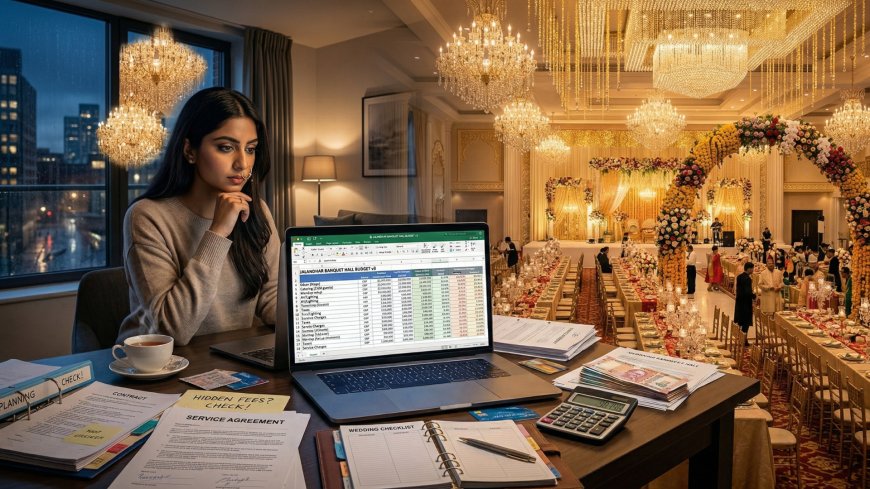
The spreadsheet had forty-three rows. Preetinder had built it over three weekends in the autumn, sitting at the dining table in her flat in East London with her laptop and a notepad and the specific focused energy she brought to problems that required solving rather than feeling. The wedding was in February. The venue was in Jalandhar. The budget was, as budgets for Punjabi weddings tend to be, a number that had begun as a firm ceiling and had since become a negotiating position between what the family had agreed to spend and what the market had informed them things actually cost.
The forty-three rows covered everything she could think of. The hall rental. The catering. The decoration. The lighting. The sound system. The DJ. The photography. The accommodation for the guests flying in from Birmingham and Toronto and Dubai. The transportation between the hotel and the venue. The welcome gifts. The mehendi setup. The baraat logistics. The priest. The flowers. The cake. The invitations that her mother had insisted on printing in Jalandhar rather than ordering from the stationery company in London whose designs Preetinder had spent four hours selecting.
Forty-three rows. Each row had a column for the budgeted amount, a column for the quoted amount, and a column she had labelled "variance" in the spreadsheet's formal language and "the gap between what I thought and what it costs" in her private understanding of what the column represented.
The variance column, by the time the spreadsheet was complete, contained numbers that were predominantly positive — meaning the quoted amounts were higher than the budgeted amounts — in thirty-one of the forty-three rows. The total variance was not a number she had expected to arrive at. It was not a catastrophic number. It was a significant number, and its significance was compounded by the fact that several of the quotes she had received were not final quotes but indicative quotes, which in the Jalandhar wedding market's vocabulary meant that they were the number the vendor was comfortable giving her in October for an event in February, and that the number in January might look different from the number in October for reasons that the vendor would explain sympathetically and that the contract, if there was a contract, might or might not prevent.
She had called her friend Gurleen in Mississauga, who had married in Jalandhar the previous year and whose wedding Preetinder had attended and whose budget conversations she had been peripherally aware of. She had asked Gurleen a direct question: what did the hall actually cost, in total, when everything was included?
Gurleen had laughed. Not unkindly. The laugh of someone who has been through a thing and who recognises the specific moment in the thing that the person calling her is currently at.
Then Gurleen had talked for forty minutes. The forty minutes had covered everything the quotes had not — the charges that appear after the booking is confirmed, the costs that are bundled into packages whose contents are not itemised, the difference between what is included in the venue's stated price and what is charged separately, and the specific ways that the Jalandhar banquet hall market's pricing structure is designed to present one number at the enquiry stage and produce a different number at the invoice stage.
By the end of forty minutes, Preetinder had added eleven new rows to the spreadsheet.
This guide is Gurleen's forty minutes, documented and expanded into the complete, honest budget breakdown that every NRI family planning a Jalandhar banquet hall wedding in 2025 needs before the first quote is requested, not after the deposit is paid.
Why Jalandhar Wedding Costs Are Harder to Budget Than They Appear
The Jalandhar banquet hall wedding has a pricing structure that is genuinely more complex than the equivalent event in London or Toronto, and the complexity is not accidental. It is the product of a market that has developed its commercial practices over decades of serving a wedding culture whose scale, whose social significance, and whose family dynamics produce a buyer who is emotionally committed before the financial negotiation begins — and whose commitment the market has learned to price accordingly.
The first complexity is the unbundling of costs that the initial quote bundles. The hall rental quote that the owner presents at the first conversation is rarely the complete cost of using the hall. It is the base rental figure whose additions — the generator charge, the parking management fee, the security deposit, the cleaning fee, the equipment charges for items whose inclusion the family assumed — accumulate through the booking process in ways that the initial quote does not represent. The family that budgets on the basis of the initial quote and does not ask specifically what the initial quote excludes will discover the exclusions progressively, at stages where their ability to renegotiate has been reduced by the emotional and financial commitments already made.
The second complexity is the in-house service tie-in whose pricing is not transparent at the enquiry stage. The hall that requires in-house catering as a condition of the booking has a catering price whose per-head rate at the enquiry stage is the rate for a standard menu that the family will not ultimately choose, and the rate for the menu the family actually wants — the one with the live cooking stations, the additional courses, the non-vegetarian spread that a Punjabi wedding requires — is a rate that the enquiry-stage figure does not represent. The decoration package whose inclusion in the booking price sounds like a saving is a package whose contents, when itemised, represent a fraction of the decoration outcome the family intends, and whose upgrade to the actual intended outcome is a cost that the initial package price does not anticipate.
The third complexity is the NRI premium that the Jalandhar market applies to families booking from abroad — not always as a conscious strategy, but as the natural result of the information asymmetry between a family in East London whose knowledge of the Jalandhar market's pricing comes from quotes and WhatsApp groups, and a vendor whose daily operation gives him current, precise knowledge of the market floor. The NRI family that does not have a local advisor or a trusted local proxy negotiating on its behalf is a family that is paying the tourist rate in a market where the relationship rate is significantly lower.
The Real Cost of a Jalandhar Banquet Hall in 2025: The Complete Breakdown
The Hall Rental
The hall rental in Jalandhar in 2025 covers a range that the market's diversity produces. The base rental for a mid-range standalone hall with a comfortable seated capacity of five hundred to six hundred guests runs from two lakh to three lakh fifty thousand rupees for a full-day booking that includes the setup day and the event day. The premium halls — the Grand Imperial tier, the newly constructed convention centres whose infrastructure and aesthetic represent the upper end of the current market — run from four lakh to seven lakh rupees for the equivalent booking.
These figures are the base rental before the additions that the contract will specify and that the enquiry-stage quote will not. The generator charge — the additional fee for backup power usage during the event — is charged separately at most halls and runs from twenty-five thousand to fifty thousand rupees depending on the hall's generator capacity and the duration of use. The parking management fee, where the hall employs a parking management service for large events, runs from fifteen thousand to thirty thousand rupees. The security deposit, typically one to two lakh rupees, is refundable but its refund timeline varies and should be specified in the contract.
The setup timing matters for the rental calculation in ways that the NRI family booking from abroad does not always account for. The decoration setup for a significant Punjabi wedding requires access to the hall from the morning of the day before the event at the latest, and many decoration teams require two days for the scale of installation that the premium Punjabi wedding involves. The hall that charges for each day of access — rather than including the setup day in the event rental — is charging a daily rate of fifty thousand to one lakh rupees for the additional access, and this charge should be established at the booking stage rather than discovered at the decoration briefing.
The Catering Costs
The catering cost is the largest single component of the Jalandhar wedding budget and the component whose final figure is most likely to differ from the figure the family had in mind at the booking stage. The per-head rate for in-house catering at a mid-range Jalandhar hall in 2025 runs from one thousand two hundred to two thousand rupees per head for a standard vegetarian menu. The non-vegetarian menu adds three hundred to six hundred rupees per head depending on the protein selections. The live cooking stations — the tawa sabzi, the tandoor counter, the chaat station, the dessert live counter — are charged as additions to the per-head rate at five hundred to one thousand two hundred rupees per station per service period.
The minimum guarantee — the number of covers the family commits to paying for regardless of actual attendance — is the catering contract's provision that the NRI family must understand before the booking is confirmed. The standard minimum guarantee in the Jalandhar market in 2025 is seventy to eighty percent of the booked hall capacity. A family booking a hall for six hundred guests is typically committing to a minimum of four hundred and twenty to four hundred and eighty covers, regardless of attendance. The Punjabi wedding whose invitation list is optimistic and whose attendance is uncertain carries a specific risk in this structure, and the minimum guarantee calculation should be part of the budget planning from the beginning.
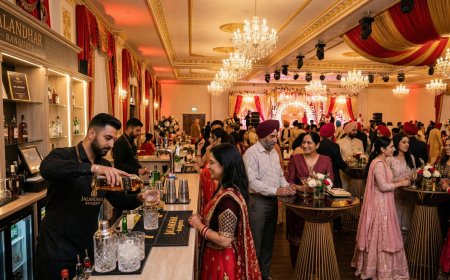
The welcome drinks and the cocktail hour service — the pre-dinner service that the Punjabi wedding's extended arrival period requires — is charged separately from the dinner per-head rate at most halls, at two hundred to four hundred rupees per head for the soft beverage service and significantly more where the bar service is included. The bar service question — whether alcohol is permitted, how it is priced, and who supplies it — is a question whose answer varies by hall, by event date, and by the family's own preferences, and it is a question that should be asked directly rather than assumed.
The Decoration Costs
The decoration cost for a Jalandhar banquet hall wedding in 2025 is the budget component whose range is widest and whose final figure is most dependent on the family's aesthetic ambition rather than the market's standard pricing. The base decoration package that most halls include in their booking price — or offer as a standard add-on at forty thousand to eighty thousand rupees — represents a decoration outcome that is adequate for a modest event and insufficient for the premium Punjabi wedding whose reference photographs the NRI family has been collecting for eight months.
The decoration budget for a full premium Punjabi wedding in a Jalandhar hall in 2025 runs from three lakh to eight lakh rupees for the hall decoration alone — the stage backdrop, the ceiling installation, the table centrepieces, the entrance arch, the aisle decoration, and the mandap for the ceremony if the ceremony is in the hall. The outdoor ceremony setup, where the venue has a lawn or garden space, adds one lakh to two lakh fifty thousand rupees for the mandap, the aisle, and the seating arrangement.
The flowers are the decoration budget's most variable component. Fresh flower decoration at the premium end of the Jalandhar market in 2025 — the marigold-heavy traditional aesthetic or the rose-and-orchid contemporary aesthetic — runs from one lakh fifty thousand to four lakh rupees for the full hall decoration. Artificial or mixed fresh-and-artificial decoration is available at fifty to sixty percent of the all-fresh cost and is visually indistinguishable in photographs, which is the relevant assessment for the NRI bride whose wedding documentation is primarily photographic.
The Lighting Costs
The lighting cost is the budget component that the family most frequently underestimates because it is the component whose contribution to the event's visual quality is least visible until the event itself and whose cost is least visible in the hall's quoted rental. The standard lighting that the hall's infrastructure provides — the general ceiling illumination — is not the lighting that the premium Punjabi wedding's photography and videography requires.
The event lighting package — the uplighting, the pin spotting on the centrepieces and the stage, the gobo projections, the dance floor lighting — is a separately quoted service in the Jalandhar market whose cost runs from seventy-five thousand to two lakh rupees for a full event lighting package at a six-hundred-cover event. The LED wall behind the stage, which has become a near-standard feature of the premium Punjabi wedding in 2025, is a separately quoted item at forty thousand to eighty thousand rupees for the panel rental and setup.
The Sound and DJ Costs
The sound system for a Jalandhar hall event is either the hall's in-house system — where it exists and is adequate — or a separately hired system whose rental and setup is an additional cost. The in-house sound system at the mid-range and premium halls is generally adequate for the background music and the ceremony, and is sometimes adequate for the DJ set, but the professional DJ whose equipment requirements are specific will frequently specify an external system whose rental adds thirty thousand to sixty thousand rupees to the DJ cost.
The DJ cost in Jalandhar in 2025 runs from twenty-five thousand rupees for the local market DJ whose equipment is modest and whose repertoire is standard, to one lakh fifty thousand rupees for the professional event DJ whose equipment, lighting rig, and performance quality represent the upper end of what the Punjabi wedding market considers premium. The NRI family whose wedding guests include a significant diaspora contingent whose musical expectations are formed by the UK or Canadian event market should budget toward the upper range of this scale.
The Hidden Costs: What the Quote Does Not Tell You
The hidden costs of a Jalandhar banquet hall wedding are not hidden in the sense of being concealed by dishonest vendors. They are hidden in the sense of being costs that the enquiry-stage conversation does not cover, that the initial quote does not include, and that the family discovers progressively as the planning advances and the specifics of the event replace the generalities of the initial discussion.
The crockery and linen charge is the hidden cost that surprises the most families. The hall whose rental includes the tables and chairs does not always include the crockery, glassware, and linen whose quality the family's event requires. The standard crockery and linen that the hall's in-house inventory provides is adequate for the standard event and is insufficient for the premium event whose table setting the family's decoration brief specifies. The upgrade crockery and linen rental — the charger plates, the crystal glassware, the quality linen — runs from two hundred to four hundred rupees per head and adds one lakh to two lakh forty thousand rupees to the budget for a six-hundred-cover event.
The valet parking service, where the family chooses to offer it for the convenience of guests arriving in private vehicles, runs from forty thousand to eighty thousand rupees for a full event deployment. It is not a standard inclusion and is not mentioned in most hall rental quotes, but it is a cost that the family whose guest profile includes elderly relatives and guests unfamiliar with the venue's location will find difficult to omit once the decision has been made.
The security and crowd management service — the professional security deployment that the larger halls require for events of five hundred guests or more — runs from twenty thousand to forty thousand rupees and is sometimes included in the hall rental and sometimes charged separately. The family should establish which applies before the contract is signed.
The waste management and post-event cleaning charge, where it is not included in the rental, runs from fifteen thousand to thirty thousand rupees. It is a small cost relative to the total budget but it is one that appears on the final invoice of families who did not know to ask about it.
The tentage and weather protection for outdoor ceremony spaces — the structure that protects the mandap and the seating from the February cold or the March heat — runs from fifty thousand to one lakh twenty thousand rupees for a standard outdoor ceremony setup. The hall that offers an outdoor lawn as a ceremony space does not always include this infrastructure in the lawn rental, and the family that books the outdoor space without establishing what weather protection is provided and at what cost is the family that discovers the answer when the decorator is briefing the event setup.
The Complete 2025 Jalandhar Banquet Hall Budget Framework
| Budget Component | Economy Range | Mid-Range | Premium Range | Notes |
|---|---|---|---|---|
| Hall Rental (full day) | ₹1.5L – ₹2.5L | ₹2.5L – ₹4.5L | ₹4.5L – ₹7L | Excludes generator, parking, security deposit |
| Generator Charge | ₹15,000 – ₹25,000 | ₹25,000 – ₹40,000 | ₹40,000 – ₹60,000 | Often charged separately |
| Catering Per Head (veg) | ₹900 – ₹1,200 | ₹1,200 – ₹1,800 | ₹1,800 – ₹2,800 | Minimum guarantee 70–80% of capacity |
| Catering Per Head (non-veg add-on) | ₹200 – ₹400 | ₹400 – ₹600 | ₹600 – ₹1,000 | Per head addition to veg base rate |
| Live Cooking Stations | ₹30,000 – ₹50,000 | ₹50,000 – ₹80,000 | ₹80,000 – ₹1.5L | Per station per service period |
| Hall Decoration (full) | ₹1.5L – ₹2.5L | ₹2.5L – ₹5L | ₹5L – ₹10L | Fresh flowers at premium end |
| Outdoor Ceremony Setup | ₹75,000 – ₹1.2L | ₹1.2L – ₹2L | ₹2L – ₹4L | Mandap, aisle, seating, weather cover |
| Event Lighting Package | ₹40,000 – ₹75,000 | ₹75,000 – ₹1.2L | ₹1.2L – ₹2.5L | Uplighting, pin spots, dance floor |
| LED Wall / Stage Screen | ₹25,000 – ₹40,000 | ₹40,000 – ₹65,000 | ₹65,000 – ₹1L | Increasingly standard at premium tier |
| Sound System | ₹20,000 – ₹35,000 | ₹35,000 – ₹60,000 | ₹60,000 – ₹1L | In-house may be adequate at mid-range |
| DJ | ₹25,000 – ₹50,000 | ₹50,000 – ₹1L | ₹1L – ₹1.5L | Diaspora events benefit from upper range |
| Crockery and Linen Upgrade | ₹100 – ₹200 ph | ₹200 – ₹300 ph | ₹300 – ₹450 ph | Per head; often omitted from initial quote |
| Valet Parking | ₹25,000 – ₹40,000 | ₹40,000 – ₹65,000 | ₹65,000 – ₹90,000 | Optional but recommended for large events |
| Security and Crowd Management | ₹15,000 – ₹25,000 | ₹25,000 – ₹40,000 | ₹40,000 – ₹60,000 | Sometimes included, often separate |
| Tentage / Weather Protection | ₹30,000 – ₹50,000 | ₹50,000 – ₹80,000 | ₹80,000 – ₹1.5L | For outdoor ceremony spaces |
| Total Estimated (500 guests) | ₹18L – ₹25L | ₹28L – ₹42L | ₹48L – ₹75L | Before photography, accommodation, transport |
The NRI-Specific Budget Considerations
The Currency and Payment Structure
The NRI family booking a Jalandhar banquet hall from abroad is making payments in Indian rupees from foreign currency accounts, and the mechanics of this transaction have cost implications that the budget planning must account for. The FEMA regulations governing outward remittances for wedding expenses permit the transaction but require documentation — the booking confirmation, the vendor invoice, the purpose declaration — that the NRI family should prepare before the payment is initiated rather than assembling under the pressure of a payment deadline.
The exchange rate between the pound, the Canadian dollar, or the UAE dirham and the Indian rupee at the time of the deposit payment is not the exchange rate at the time of the balance payment, and for a total wedding cost in the thirty to fifty lakh rupee range, a two or three percent exchange rate movement between the booking and the event represents a meaningful cost variance. The family that is budgeting in its home currency should build a currency movement buffer into the budget rather than converting the rupee total at the current rate and treating the result as the final foreign currency cost.
The payment schedule that the Jalandhar hall market typically requires — a deposit of twenty to thirty percent at booking, a second instalment of thirty to forty percent three to four months before the event, and the balance at or before the event — aligns badly with the NRI family's financial planning cycle and the remittance documentation requirements. The family should establish the full payment schedule before the contract is signed and should initiate the remittance documentation process for each payment well in advance of the payment date.
The Local Negotiation Advantage
The price differential between the quote given to the NRI family booking from East London and the price available to a local Jalandhar family with market knowledge and a vendor relationship is real and significant. For a full wedding budget in the thirty to forty lakh rupee range, the NRI premium across all vendors can represent five to eight lakh rupees — the cost of having less market knowledge and less negotiating leverage than the local buyer.
The mitigation for this premium is the local advisor or negotiator whose market relationships and price knowledge allow the NRI family to access the relationship rate rather than the tourist rate. The cost of a competent local wedding coordinator in Jalandhar in 2025 runs from one lakh to two lakh fifty thousand rupees for full vendor coordination across all event components. Against a potential NRI premium saving of five to eight lakh rupees, this cost represents a return that the budget arithmetic consistently supports.
Common Mistakes NRI Families Make With the Jalandhar Wedding Budget
The first mistake is budgeting from the initial quote rather than from the complete cost structure. The initial quote is the starting position of a negotiation and the beginning of a cost discovery process, not the complete statement of the event's cost. The family that fixes its budget at the initial quote level and does not build a thirty to forty percent contingency for the costs that the initial quote excludes is the family whose final invoice produces the specific anxiety that the wedding month does not need.
The second mistake is not separating the minimum guarantee from the expected attendance in the catering budget calculation. The family that expects five hundred guests, books a hall for six hundred, and signs a catering minimum guarantee for four hundred and twenty covers is committing to the cost of four hundred and twenty covers regardless of attendance. The family whose actual attendance falls below the guarantee — the relatives from Chandigarh who send their apologies, the Canada-based friends whose flights were cancelled — pays for the absent guests at the full per-head rate. The minimum guarantee should be negotiated as close to the expected attendance as the hall will accept, not accepted as the standard percentage of the hall capacity.
The third mistake is not getting the per-head catering rate fixed in the contract at the booking stage. The Jalandhar catering market's per-head rates have increased between eight and twelve percent year-on-year over the past three years, and the family that books in October for a February wedding and accepts an indicative per-head rate rather than a contractually fixed one is exposed to the rate increase that the four months between booking and event may produce. The fixed per-head rate in the contract is the protection against this exposure.
The fourth mistake is treating the decoration budget as a residual — the amount left after the hall rental and catering costs have been fixed — rather than as a primary budget allocation that should be established before the hall is selected. The decoration cost for the premium Punjabi wedding is the second largest cost component after the catering, and the family that selects a hall at the upper end of the rental range and then discovers that the remaining budget is insufficient for the decoration outcome it intends has made the hall selection and the decoration budget as separate decisions that should have been made together.
The fifth mistake is not accounting for the costs that occur outside the hall — the guest accommodation, the transportation, the pre-wedding events at separate venues, the post-wedding hospitality — in the total wedding budget. The Jalandhar banquet hall cost is the largest single line item in the NRI family's wedding budget but it is not the complete wedding budget, and the family that arrives at the hall cost's final figure without having budgeted the surrounding costs is the family whose total wedding spend significantly exceeds the number it had in mind when the planning began.
What Preetinder's Spreadsheet Looked Like at the End
She had added the eleven rows that Gurleen's forty minutes had told her about. She had updated the variance column with the revised figures that the complete cost picture produced. She had spent a Saturday morning going through every vendor quote and asking the specific questions about exclusions that she had not known to ask the first time.
The total had increased. That was not a surprise, by the time the spreadsheet was complete. What had surprised her was how much of the increase was costs she could have anticipated with the right information at the right time — the generator charge, the crockery upgrade, the minimum guarantee calculation, the decoration budget that the initial hall rental quote had caused her to underestimate by treating the included package as a complete solution rather than a starting point.
She had hired a Jalandhar-based wedding coordinator in November. The coordinator's fee had been one lakh twenty thousand rupees. The coordinator had renegotiated the catering per-head rate, the decoration package, and the hall's additional charges in ways that had saved the family three lakh eighty thousand rupees against the quotes Preetinder had received independently. The net saving after the coordinator's fee had been two lakh sixty thousand rupees.
The forty-three rows had become fifty-four by the time the planning was complete. The variance column, by the end, was a document of every assumption that the market had revised and every cost that the initial quotes had not contained. It was also, by the time the event was over, a document of a wedding that had come in within five percent of the revised budget — which, in the Jalandhar wedding market, with a Punjabi guest list and an NRI family managing it from East London, was the outcome that the spreadsheet had been trying to produce all along.
Build the contingency into the budget before the first quote is requested. Fix the per-head catering rate in the contract at booking stage. Negotiate the minimum guarantee as close to expected attendance as the hall will accept. Hire the local coordinator whose fee the negotiation saving will recover. Get every cost in writing before the deposit is paid.
The forty-three-row spreadsheet is not pessimism. It is the document that makes the wedding possible at the cost you intended, rather than the cost you discovered.
Published by NRIWedding.com — The Premium Global Platform for Non-Resident Indians Planning Indian Weddings From Abroad.
What's Your Reaction?
 Like
0
Like
0
 Dislike
0
Dislike
0
 Love
0
Love
0
 Funny
0
Funny
0
 Angry
0
Angry
0
 Sad
0
Sad
0
 Wow
0
Wow
0