







































































Is It Bad Luck to Get Married During Shraadh? What NRIs Living Abroad Actually Do — The Complete Guide
Planning an Indian wedding in September and worried about Shraadh? This complete NRI guide answers the question every globally-located Indian couple eventually faces — what the Pitru Paksha wedding prohibition actually is, why it exists, and what real NRI families with real international constraints actually do when the calendar's sacred period meets the global logistics of planning a wedding from abroad. Learn the full theology of Shraadh and the Pitru Paksha — the fifteen-day fortnight of the ancestors in the dark half of Ashvin, the Pitru Rin ancestor's debt and how it is discharged through Pinda Daan and Tarpan, and why the prohibition on auspicious ceremonies is rooted in philosophical coherence rather than superstition. Understand the complete spectrum of approaches that NRI families take — from the full observance that changes the date regardless of logistical cost, to the specific pandit consultation that identifies permitted days within the Pitru Paksha, to the regional inapplicability position for South Indian, Bengali, Gujarati, and Punjabi communities whose traditions differ, to the civil registry plus later ceremony separation, to the Shraadh Puja first approach in which the complete Tarpan and ancestor offering is performed before the wedding ceremony on the same date. Learn why NRI couples face this challenge disproportionately due to the global calendar's non-negotiability, the destination wedding market's competition for post-monsoon dates, and the diaspora transmission gap that means many NRI couples simply do not know Shraadh exists until the pandit raises it at eight months. Understand how to consult the family's own community pandit rather than a generic source, conduct the explicit family consensus meeting before any date is communicated to vendors, protect vendor contracts with calendar-based rescheduling clauses, and understand the positive philosophical dimension of the Pitru Paksha as the period in which the ancestors are most available — the lineage that made the couple possible, acknowledged and honoured before the new family branch is opened. This is the complete, theologically honest, NRI-specifically applicable guidance that every couple whose wedding date touches September deserves.

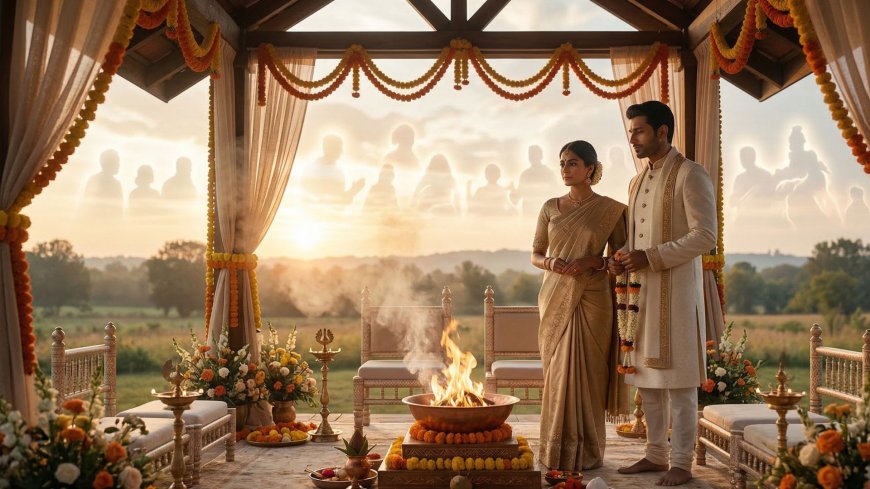
Is It Bad Luck to Get Married During Shraadh? What NRIs Living Abroad Actually Do: The Complete Guide for the Globally-Located Indian Couple
The message came in at seven-fourteen on a Tuesday evening, which was the kind of hour when Deepa's mother sent the messages that required the most careful reading — not too late to be urgent, not early enough to be casual, the specific, deliberate hour of someone who has composed the message several times before sending it.
It said: I need to talk to you about the wedding date. I have been checking with the pandit and I am worried that you may not have considered something important. Please call when you can.
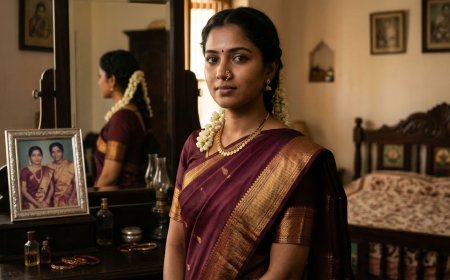
Deepa was in her flat in Melbourne. She called immediately, because the specific, measured quality of her mother's message had produced the specific, low-level, impossible-to-ignore alarm that her mother's measured messages always produced.
Her mother answered on the second ring. There was the background sound of the Chennai evening — the specific, warm, traffic-and-bird quality of the hour after sunset in that city — and then her mother's voice, which had the carefully modulated quality of someone who is about to say something they expect will be difficult to hear.
"The date you have chosen," her mother said, "falls in Shraadh."
Deepa looked at her laptop. The date was in September. She had chosen it because Kiran's parents were available, because the venue had the date, because both of them could take the time off work, because the September weather at their chosen destination was the best of the available months. She had checked the date with three different wedding planning resources. None of them had mentioned Shraadh.
"Tell me about Shraadh," Deepa said.
Her mother told her. The fifteen days of the dark fortnight of Ashvin — the Pitru Paksha, the fortnight of the ancestors — the period in the Hindu calendar during which the souls of the departed are believed to be closest to the living world and during which the tradition prescribes specific ritual practices for the living: the Shraadh rituals of food offering, the Tarpan of water offering to the ancestors, the abstention from auspicious ceremonies including — and this was the specific, practically significant part — weddings.
"The tradition says," her mother said, carefully, "that no auspicious ceremony should be performed during Shraadh. That the fortnight belongs to the ancestors and not to the living's celebration. The pandit says the date is not auspicious for a wedding."
Deepa was quiet for a moment.
Then she said: "Is this something that everyone in India observes? Because I have attended weddings in September. I have been to weddings during what must have been this period."
"It varies," her mother said. "Some families are very strict. Some families do not observe it at all. Some communities do not consider it applicable to all ceremonies. I am not telling you what to do. I am telling you what the pandit said, and I am asking you to consider it."
Deepa looked at the date on her laptop. The venue. The vendor confirmations. The guests who had already bought flights.
"I need to understand this properly," she said. "Not the fear version. The actual version. What is Shraadh, what does it mean, why is it the tradition, and what do people — real people, specifically NRI people managing real constraints — actually do?"
Her mother was quiet for a moment.
Then she said: "That is a very good question. I am not sure I can answer all of it. But I know someone who can."
This guide is the answer to Deepa's question — the actual, complete, non-fear-based, NRI-specifically-applicable explanation of what Shraadh is, what the tradition's prohibition on weddings during Shraadh means, what the theological and philosophical basis for that prohibition is, and what the full range of approaches that real NRI families take when the calendar's constraints meet the global logistics of planning a wedding from abroad.
What Shraadh Actually Is — The Full Picture
Shraadh — from the Sanskrit word Shraddha, meaning faith or sincere feeling — is the collective term for the ritual practices by which the living honour and nourish the souls of the departed. It is observed during the Pitru Paksha — the fortnight of the ancestors — which falls in the dark fortnight of Ashvin, the lunar month that typically corresponds to September or October in the Gregorian calendar.
The Pitru Paksha is the period in the Hindu calendar during which the ancestors — the Pitrus, the souls of those who have died and who exist in the Pitru Loka, the realm of the ancestors — are believed to descend closer to the living world and to be most receptive to the offerings of the living. The proximity of the dead to the living during this fortnight is not presented in the tradition as ominous or threatening. It is presented as an opportunity — the specific, annual occasion on which the debt that the living owe to the dead can be most directly discharged.
The debt is called the Pitru Rin — the ancestor's debt — one of the three fundamental debts that the Hindu tradition identifies as the obligations that every human being is born with. The other two are the Deva Rin — the debt to the gods — and the Rishi Rin — the debt to the sages and teachers. The Pitru Rin is the debt to the ancestors who gave the living their bodies, their genes, their family name, their cultural transmission. It is discharged through the Shraadh rituals — the specific, annual, food and water offerings that acknowledge the ancestors' contribution and nourish their continued journey in the realm they inhabit.
The Shraadh rituals themselves — the Pinda Daan, the offering of rice balls to the ancestors; the Tarpan, the offering of water and sesame seeds; the Brahmin bhojan, the feeding of the Brahmins who represent the ancestors in the living world — are not funerary rituals in the grief sense. They are maintenance rituals — the ongoing, annual, cheerfully obligatory maintenance of the relationship between the living and the dead that the Hindu tradition considers as natural and as necessary as the maintenance of any other relationship that one values.
The prohibition on auspicious ceremonies — including weddings — during Shraadh is rooted in the same logic that governs all of the Pitru Paksha's prescriptions: the fortnight belongs to the ancestors, not to the living's celebration. The ancestors are present. Their presence demands attention, gratitude, and the specific, focused ritual activity that the Shraadh prescribes. To hold a wedding — the most thoroughly auspicious ceremony in the Hindu calendar, the celebration of the new beginning, the gathering of joy and abundance and the invocation of Lakshmi — during the fortnight that has been reserved for the ancestors is, in the tradition's framework, to misdirect the energies of the period. Not dangerous, exactly. Not unlucky in the Western black-cat sense. But inauspicious in the specific, Hindu-cosmological sense: the wrong activity in the wrong period, the mismatch between the sacred timing and the sacred purpose.
The Theological Nuance — What the Tradition Actually Prohibits and What It Does Not
This section is the most important section of the guide for the NRI couple, because the tradition's position on weddings during Shraadh is considerably more nuanced than the simple "no weddings during Shraadh" that the pandit's initial advice typically communicates.
The prohibition in its strictest form applies to the Griha Pravesh — the entering of a new home — and to the Vivah — the wedding ceremony itself, specifically the ceremony's auspicious elements: the Ganesh Puja, the Saptapadi, the mangalsutra tying. These are the ceremonies that the tradition considers incompatible with the Pitru Paksha's orientation toward the ancestors.
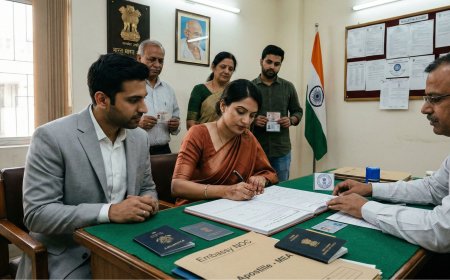
The prohibition does not, in most interpretations, apply to the registration of marriage — the civil ceremony, the court marriage, the documentation of the legal relationship. It does not apply to the engagement. It does not apply to the ring ceremony or the roka or the other pre-wedding ceremonies that different communities practice. The civil marriage and the religious ceremony are distinct in the tradition's framework, and the civil ceremony's timing is governed by the civil calendar rather than the Hindu sacred calendar.
The regional variation in the prohibition's application is significant and should be explicitly addressed. The prohibition is observed most strictly in certain North Indian Hindu communities — particularly the Brahmin communities of UP, Bihar, Madhya Pradesh, and Rajasthan — and less strictly, or not at all, in several other communities. The South Indian traditions have their own Pitru Paksha practices but the specific application to weddings varies by community. The Bengali tradition observes the Mahalaya — the end of Pitru Paksha — as one of the most important cultural events of the year, but the Bengali tradition's wedding calendar constraints are governed by a different set of auspicious and inauspicious periods than the Shraadh prohibition specifically. The Gujarati community's position varies by family. The Punjabi community's position varies by family. The community whose tradition's pandit is being consulted will determine the application.
The most honest and the most practically useful statement of the tradition's position is this: the Shraadh prohibition on weddings is a real and significant traditional prescription in many Hindu communities, it is not universally observed, it is not observed in the same form across all communities, and the specific question of whether it applies to the NRI couple's wedding must be answered with reference to the specific community's tradition and the specific family's practice — not with reference to a generic "Hindu tradition" that flattens the enormous variety of the tradition's actual practice.
Why NRIs Specifically Face This Challenge More Than Domestic Couples
The Shraadh calendar challenge is not unique to NRI couples, but it is disproportionately difficult for them, and the reasons for the disproportionate difficulty are worth naming explicitly because they are the reasons that this guide exists.
The domestic Indian couple planning a wedding in September has the full range of the Hindu sacred calendar available to them and can, if the family's tradition observes the Shraadh prohibition, simply avoid the Pitru Paksha's fifteen days when selecting a date. The September calendar has fifteen days before and fifteen days after the Pitru Paksha that are available. The domestic couple's constraint is manageable.
The NRI couple's constraint is categorically different for three specific reasons.
The first reason is the global calendar's non-negotiability. The NRI couple's wedding date is constrained by the intersection of multiple international calendars simultaneously: the academic calendar that governs when guests in educational institutions can travel, the financial year calendar that governs when professionals in investment banking or consulting or law can take extended leave, the school holiday calendar that governs when guests with children can attend, the visa application timelines that govern when guests from certain countries need to begin the application process for an Indian visit visa, and the direct flight availability calendar that governs whether the specific international connections the guest list requires are available at the target dates. These constraints are not trivial and they are not flexible. They exist independently of the Hindu sacred calendar and they frequently produce a small number of viable dates in any given year. If those dates fall in September, the probability of Pitru Paksha overlap is meaningful.
The second reason is the limited number of permissible dates in the destination wedding calendar. The destination wedding's ideal dates — the post-monsoon clarity of October, the pleasant November temperatures, the mild December and January — are the dates that every other NRI couple is also targeting at the same venues with the same vendors. The September date is sometimes the date that remains after the preferred dates are taken. Removing September entirely from the available calendar, for the NRI couple who has already been squeezed by the global constraints and the destination wedding market's competition, is sometimes the removal of the last available option.
The third reason is the diaspora transmission gap. The Shraadh prohibition is one of many pieces of traditional calendar knowledge that the NRI community's diaspora transmission has not reliably carried. The NRI couple who grew up in the United Kingdom or Canada or Australia may simply not know that Shraadh exists, what its calendar position is, and what its implications for the wedding date selection are. The discovery — often made by the grandmother or the pandit when the date has already been communicated to vendors and guests — comes at a point in the planning process where the change cost is high and the anxiety is correspondingly elevated.
What Real NRI Families Actually Do — The Full Spectrum
This is the section that Deepa was asking for — the actual, non-judgmental account of what real NRI families facing real constraints actually do when the Shraadh question arises. It is presented as a spectrum rather than a hierarchy because the tradition's nuance supports a spectrum of approaches and the NRI couple deserves to understand the full range rather than receiving only the most conservative position.
The Full Observance
Some NRI families — those whose community tradition is the most observant of the Shraadh prohibition, whose pandit's guidance is unambiguous, and whose family consensus is aligned with the traditional position — change the wedding date when the Shraadh conflict is identified, regardless of the logistical cost of the change. This approach is taken more often than the planning community tends to acknowledge, because the families who take it tend not to publicise the disruption. The vendor contracts are revised, the guest communications are updated, the flights are changed, and the wedding is moved. The cost is real and sometimes substantial. The family considers it the correct decision and does not regret it.
The NRI couple whose family holds this position should understand it as a genuine and consistent expression of a living tradition, not as an arbitrary restriction imposed by an out-of-touch authority. The Pitru Paksha's theology is real, the ancestors' claim on the fortnight is real in the tradition's framework, and the family that honours this claim is doing something that has internal coherence and genuine spiritual integrity.
The Pandit Consultation and the Specific Day
A second approach — and the most commonly taken approach among the NRI families who observe the tradition but also face significant logistical constraints — is the specific pandit consultation in which the question is not "can we get married during Shraadh" but "is there a specific day within the Shraadh period that the tradition permits?"
The answer to this question, which many families do not know to ask, is that the tradition itself acknowledges specific exceptions within the Pitru Paksha. The Mahalaya Amavasya — the new moon that ends the Pitru Paksha — is itself an auspicious day in certain traditions, not a day of prohibition. The Matri Navami — the ninth day of Pitru Paksha — is traditionally the day on which women who died as Sumangalis, as married women, are remembered, and certain traditions permit ceremonies adjacent to this day. The Sarvapitri Amavasya — the final day — has its own specific status. The pandit who knows the family's community tradition in sufficient depth can often identify a specific day within the Pitru Paksha on which the family's specific tradition does not prohibit a wedding, or permits the ceremony with specific ritual preparations that address the period's concerns.
The NRI couple should ask this question specifically and should ask it of a pandit who knows the community tradition in depth rather than a pandit whose position is the generic prohibition. The answer varies by community, by family tradition, and by the specific days within the Pitru Paksha.
The Regional Inapplicability Position
A third approach is the honest acknowledgement that the Shraadh wedding prohibition simply does not apply in the same form to the family's specific community tradition. South Indian families of certain communities, Bengali families, Gujarati families, and Punjabi families whose pandit and whose family elders confirm that the specific prohibition the questioner is referencing is not part of their community's practice have the legitimate basis to proceed with the September date without the prohibition's concern.
This position requires honest research rather than wishful thinking — the question must be asked of the family's actual community pandit and the family's actual senior members, not assumed from the desire for the answer to be convenient. But where the honest research confirms inapplicability, the couple can proceed with confidence rather than with the anxiety of an unresolved doubt.
The Civil Registry Plus Later Ceremony Approach
A fourth approach — increasingly common among NRI couples whose global constraints are most severe — is the legal registration during the Shraadh period paired with the religious ceremony at a later, unambiguously auspicious date. The civil marriage at the registry office or the court is the legal establishment of the marriage. The religious ceremony — the Saptapadi, the mangalsutra, the full ceremonial programme — is held at the post-Shraadh date when the Hindu calendar is unambiguously auspicious.
This approach requires the family's explicit agreement to treat the civil registry and the religious ceremony as two distinct occasions, which most families can accommodate but which some families resist on the grounds that the marriage, in the tradition's framework, begins with the religious ceremony rather than the civil one. The NRI couple considering this approach should have the explicit family conversation rather than assuming agreement.
The Shraadh Puja First Approach
A fifth approach, recommended by certain pandits for the NRI couple whose constraints make the date change impossible, is the performance of the complete Shraadh Puja — the full Pitru Paksha ritual including the Pinda Daan and the Tarpan — before the wedding ceremony, on the same date. The logic is the most theologically coherent of all the exception approaches: the prohibition is rooted in the ancestors' claim on the fortnight. If the couple discharges the Pitru Rin before the wedding — if the ancestors receive their offerings and their acknowledgement before the auspicious ceremony begins — the conflict between the period's orientation and the ceremony's orientation is resolved rather than overridden.
The Shraadh Puja first approach requires a pandit who is willing to conduct both ceremonies on the same day, who understands the specific logic of the approach, and who has the family's confidence. It is not universally accepted — some pandits hold that the Pitru Paksha's prohibition is categorical and admits no exception. But it is a coherent traditional approach rather than a workaround, and the families who have used it have done so with genuine theological grounding.
The NRI Planning Reference Table
| Planning Parameter | Shraadh-Specific Detail | NRI Action Required | Recommended Timeline |
|---|---|---|---|
| Pitru Paksha Date Identification | Fifteen days of dark fortnight of Ashvin; date varies annually by lunar calendar; typically September to early October in Gregorian calendar | Check the Pitru Paksha dates for the wedding year before any venue or vendor booking; confirm exact dates with the Hindu calendar for the specific year | Before any date commitment |
| Community Tradition Research | Shraadh prohibition varies significantly by community; North Indian Brahmin most observant; South Indian, Bengali, Gujarati, Punjabi vary; family practice determines | Consult family's specific community pandit — not a generic pandit — about whether and how the prohibition applies to the family's tradition | 14–18 months before wedding |
| Family Consensus Meeting | Both families' position on Shraadh must be established before date is set; inter-community couples may have different positions | Conduct explicit family consensus meeting on Shraadh position before any date is communicated to venue or vendors; document the agreed position | 14–16 months before wedding |
| Specific Day Consultation | Some days within Pitru Paksha have different status; pandit with deep community knowledge can identify permitted days | Ask pandit specifically whether any days within the Pitru Paksha are permitted in the family's tradition; do not assume the prohibition is categorical without asking | 12–14 months before wedding |
| Shraadh Puja First Option | Performing complete Shraadh Puja before wedding ceremony on same date; theologically coherent approach for unavoidable date conflicts | If date change is impossible, discuss Shraadh Puja first approach with pandit; confirm pandit's willingness to conduct both; confirm family's acceptance of the approach | 10–12 months before wedding |
| Civil Registry Separation | Legal registration during Shraadh paired with religious ceremony at later auspicious date; requires family agreement on distinction between civil and religious ceremonies | If considering civil-plus-later-ceremony approach, have explicit family conversation about the distinction's acceptability before proceeding | 12–14 months before wedding |
| Vendor Contract Protection | If date is subsequently changed due to Shraadh, vendor contracts must have clear rescheduling provisions | Include force majeure and rescheduling clause in all vendor contracts specifically referencing calendar-based date changes; confirm rescheduling cost implications | Before first vendor payment |
| Guest Communication Protocol | If date is changed after guests have been notified, early and clear communication essential; NRI guests with international flights need maximum notice | Communicate date change to all guests simultaneously; international guests with booked flights need direct personal contact rather than group message | Immediately upon date change decision |
| Diaspora Family Briefing | NRI family members who did not grow up in India may not know about Shraadh; their confusion or resistance to the tradition's authority requires patient explanation | Prepare brief, clear explanation of Shraadh for diaspora family members who are unfamiliar; frame as the tradition's context rather than a restriction | When issue is first raised |
| Alternative Date Research | Post-Shraadh October dates are the immediate alternative; November and December are the next available window | Research venue availability for post-Shraadh October dates as the first alternative; confirm vendor availability for revised dates before committing to date change | When Shraadh conflict is identified |
| Regional Inapplicability Confirmation | If family tradition genuinely does not observe the prohibition, this must be confirmed by the family's own pandit and senior members | Get written or recorded confirmation from family pandit of the prohibition's inapplicability to the specific community; do not rely on generic online resources | 12–14 months before wedding |
| Photography and Documentation | If Shraadh Puja first approach is used, both ceremonies should be documented | Brief photographer on both ceremonies' significance if conducting Shraadh Puja before wedding ceremony; treat both as primary programme elements | 4–6 weeks before wedding |
| Emotional Management | Discovery of Shraadh conflict after date announcement produces specific, high-anxiety planning crisis; management required | Approach Shraadh conflict as a planning problem with a spectrum of solutions rather than a catastrophe; resist the anxiety escalation that late discovery produces | When issue is first raised |
| Long-Term Record | Family's decision on Shraadh position should be documented for future generations; NRI families benefit from explicit tradition documentation | Document the family's specific Shraadh position and the reasoning behind it; this prevents the same question arising at the next family wedding | After decision is made |
| Communication Protocol | Shraadh discussions across IST gap: UK +4.5 hrs, US East +9.5 hrs, Australia East −5.5 hrs; pandit consultations best done by family member in India on couple's behalf | Designate a trusted family member in India to conduct the pandit consultation on behalf of the NRI couple; brief them with specific questions | 12–14 months before wedding |
Common Mistakes NRI Couples Make With the Shraadh Question
The first and most consequential mistake is not checking the Pitru Paksha dates before selecting the wedding date — discovering the conflict after the venue is booked, the vendors are engaged, and the guests have been notified. This mistake is the result of the diaspora transmission gap: the NRI couple who grew up outside India may genuinely not know that Shraadh exists or that it has implications for the wedding calendar. The solution is simple in principle and requires only the inclusion of the Hindu sacred calendar check in the very first planning step — before any date is communicated to anyone. The check takes fifteen minutes. The conflict, discovered at eight months, takes considerably longer to resolve.
The second mistake is treating the Shraadh question as a binary — either the prohibition applies categorically and the date must change, or it does not apply and the concern can be dismissed entirely. The actual tradition's position is more nuanced than either pole of the binary, and the couple who reaches the nuanced middle — the specific day consultation, the Shraadh Puja first approach, the regional inapplicability confirmation — will find that the tradition's actual wisdom is more accommodating of real-world constraints than the initial "no weddings during Shraadh" communication suggests. The binary is the anxious version. The nuance is the actual tradition.
The third mistake is consulting the wrong pandit — the pandit who is available rather than the pandit who knows the family's specific community tradition in depth. The Shraadh prohibition's application is community-specific, and the pandit whose knowledge is the generic North Indian Brahmin tradition will give the generic North Indian Brahmin answer even to a Gujarati family or a Tamil family whose tradition's position is different. The family's own community pandit — or the senior family member who knows the community's practice — is the correct source of the family-specific guidance. This guide cannot substitute for that conversation, and neither can any internet resource.
The fourth mistake is allowing the Shraadh anxiety to contaminate the entire planning process without resolution — living with the unresolved question for months while vendors are engaged and guests are notified, neither changing the date nor consciously deciding to proceed with it. This limbo is the worst possible position: the anxiety of the unresolved concern combined with the growing sunk cost of the planning that has proceeded as if the concern does not exist. The Shraadh question requires a specific, time-bounded decision process — the family consultation, the pandit guidance, the explicit family consensus — and the decision, whatever it is, should be made and documented and communicated rather than indefinitely deferred.
The fifth mistake is failing to consider the positive dimension of the Pitru Paksha — the tradition's actual offering to the couple who is getting married in its period, which is the offering of the ancestor connection that no other period of the year makes as available. The Shraadh period is the period in which the ancestors are closest. A couple who, in addition to the wedding's planning, performs the Shraadh Puja and connects with their ancestral tradition during the Pitru Paksha is bringing something to the wedding that the auspicious October date cannot offer: the explicit, ritual acknowledgement of the dead who made the living possible, the specific, ancestor-facing gratitude that is the tradition's most honest engagement with where the couple comes from. The Pitru Paksha is not only the period to be avoided. It is the period that offers, to the couple attentive enough to receive it, the deepest possible connection between the wedding's beginning and the lineage that produced it.
The Philosophical Dimension — What the Ancestors Have to Do With the Wedding
The Pitru Paksha's prohibition on weddings is not arbitrary. It is rooted in a specific, philosophically coherent understanding of what the wedding is and what the ancestors' presence means for the wedding's auspiciousness, and the NRI couple who understands this framework will engage with the question differently than the couple who receives it only as a restriction.
The Hindu philosophical tradition understands the living individual not as an isolated being but as the most recent expression of a lineage — the living tip of a family tree whose roots extend into the realm of the ancestors. The ancestors are not absent. They are present in the genes, in the cultural transmission, in the specific, embodied characteristics that each generation inherits from the one that preceded it. The Pitru Rin — the ancestor's debt — is the acknowledgement of this presence: the explicit recognition that the living person exists because of the dead, and that this existence is an obligation as well as a gift.
The wedding is the point at which a new branch of the family tree is initiated — the moment at which two lineages join and begin the production of the next generation. The ancestors of both families are present at the wedding in the most direct possible sense: their genes, their cultural transmissions, their family names, their specific characteristics are all present in the bodies and the identities of the couple at the mandap.
The Pitru Paksha's prohibition is therefore not the exclusion of the ancestors from the wedding. It is the acknowledgement that their presence requires its own dedicated attention — that the wedding cannot honour the ancestors adequately if it is happening during the period that has been specifically reserved for that honouring. The two cannot be simultaneous because each requires the full attention of the occasion.
The family that performs the Shraadh before the wedding — that discharges the Pitru Rin before the new branch is initiated — is doing something theologically precise: completing the obligation to the ancestors before undertaking the obligation of the new family. The debt is paid. The new account is opened cleanly.
Resolution
Deepa's mother had said she knew someone who could answer the question properly. The someone was her mother's elder sister, who had been married for forty-two years and who had, in those forty-two years, been present at every family occasion including the occasions whose calendar had been the subject of discussion.
The aunt — Kamala Chitti, as Deepa had always called her — called from Hyderabad on the Thursday evening, at the specific, deliberate hour of someone who has been asked to explain something and who intends to explain it properly.
She told Deepa what Shraadh was. She told her what the prohibition was and where it came from. She told her which families in the extended network had observed it strictly, which had consulted pandits and found permitted days, which had done the Shraadh Puja before the ceremony and had gone ahead with the September date, and which had changed their dates entirely.
She said: "In our community, the pandit will tell you there are two days within the Pitru Paksha when a ceremony is not prohibited. You need to check if your date is one of them."
Deepa checked. The date was not one of them.
She called Kiran. They talked for two hours. They talked to both sets of parents. They consulted the family's pandit, who told them that their community tradition permitted the Shraadh Puja first approach.
They decided to do the Shraadh Puja first.
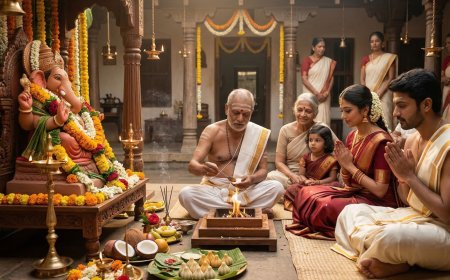
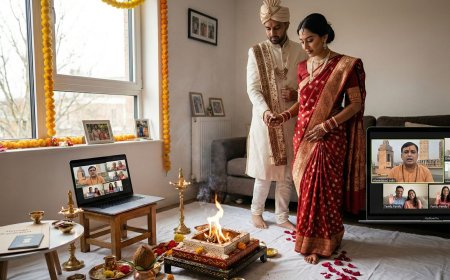
On the morning of the wedding — before the Ganesh Puja, before the Mangala Snanam, before the programme that the coordinator had documented in the shared folder across eleven months of planning — Deepa and Kiran's families gathered in the courtyard of the heritage property and performed the Tarpan. The water and the sesame seeds and the specific, ancient Sanskrit words of the offering that acknowledges the debt and discharges it.
Both families' ancestors. Both lineages. All of them, present in the Pitru Paksha's specific proximity, receiving the offering that acknowledged them.
Then the families turned from the puja to the wedding.
Deepa's mother, who had sent the message at seven-fourteen on a Tuesday evening four months earlier, stood in the courtyard after the Tarpan and looked at her daughter.
"The ancestors are satisfied," she said.
It was not a metaphor. It was not a sentiment. It was the specific, tradition-grounded, philosophically coherent statement of a woman whose tradition had given her the language to describe exactly what had just happened.
The wedding began.
The ancestors were satisfied.
The new branch of the tree could be opened cleanly.
Check the Pitru Paksha dates before any date is communicated to anyone — fifteen minutes of calendar research prevents months of planning disruption. Consult the family's own community pandit rather than a generic resource. Ask specifically whether any days within the Pitru Paksha are permitted in the family's tradition. If the date cannot be changed, discuss the Shraadh Puja first approach with the pandit and the family. Document the family's decision for the next generation. And understand that the ancestors at the Pitru Paksha are not the enemies of the wedding — they are the lineage that produced the couple, and the tradition that asks you to acknowledge them first is asking you to begin the new family with the complete and honest awareness of where it comes from.
The prohibition is not bad luck.
It is the tradition's specific, philosophically coherent request that the debt be paid before the new account is opened.
Pay the debt. Open the account.
Begin the marriage in the full awareness of everything that made it possible.
Published by NRIWedding.com — The Premium Global Platform for Non-Resident Indians Planning Indian Weddings From Abroad.
What's Your Reaction?
 Like
0
Like
0
 Dislike
0
Dislike
0
 Love
0
Love
0
 Funny
0
Funny
0
 Angry
0
Angry
0
 Sad
0
Sad
0
 Wow
0
Wow
0