































































The Ancient Himachali Wedding Invite Carried Door to Door: The Complete NRI Guide to India's Most Personal Invitation Tradition
The Himachali wedding invitation was never a printed card. It was a person at the door — the nyota, carrying rice and deodar and the specific words of the tradition — making each invited household feel not merely informed but genuinely called. This complete guide explores the ancient door-to-door invitation tradition of Himachal Pradesh across its regional variations, from the Kangra valley and Kinnaur to the high communities of Lahaul and Spiti. For every NRI family with Himachali roots planning a wedding abroad, this is the authoritative resource for understanding what the tradition carries, why it cannot be replaced by a WhatsApp announcement, and how it survives the crossing to Edinburgh, Vancouver, and beyond.

The Ancient Himachali Wedding Invite Carried Door to Door
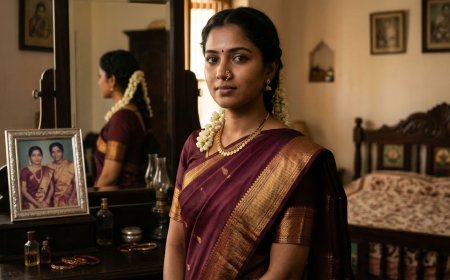
The box arrived at her flat in Edinburgh on a Friday, which was the end of October, which meant the hills above Shimla were already showing the first colour changes — the deodar forests holding their green while the broad-leaved trees around them moved toward the yellows and the ochres that the Himachal autumn produces before the winter comes down from the high passes. Roshni knew this without being there, the way people who grew up in mountain towns know the seasons of home with a physical certainty that no amount of distance diminishes. She had grown up in Rampur Bushahr, in the Sutlej valley, at the point where the river comes down from the high Kinnaur mountains and the valley opens wide enough to hold a town of consequence. She had been in Edinburgh for six years, studying first and then working in the kind of quietly excellent career that the Scottish capital rewards in people who are both capable and persistent.
The box was from her father. It was wooden — not a shipping crate but an actual small wooden box, the kind that is made by hand in the hill workshops where wood is still worked with the patience that the material demands. Inside the box, wrapped in a length of Kinnauri wool in the specific red-and-green pattern of the region, was a sealed envelope. And around the sealed envelope, filling the rest of the box, were three things that her father had placed there with the deliberateness of a man who understood that the objects would arrive before any explanation could: a dried twig of the deodar, a small packet of rice wrapped in cloth, and a card in her father's handwriting that said, in Pahari: This is how your grandfather invited the village to his wedding. Open the envelope last.
Roshni sat on the floor of her Edinburgh flat with the box in her lap. She opened the deodar twig first — it smelled of the forest above Rampur in the way that nothing else in the world smells, the specific resinous cold-forest smell that she had not encountered outside the hills and that arrived now, in her Edinburgh flat in October, with the totality of sense memory, placing her in the hills so completely that the flat receded. She held the rice packet for a moment, feeling the weight of it. Then she opened the envelope.
Inside was a letter, two pages in her father's careful Pahari script, explaining that the family had been discussing her upcoming wedding and that her grandfather — her dada ji, who was eighty-seven and who had been a young man in Rampur Bushahr when the traditions were different and the hills were more themselves — had asked that the wedding invitation go out in the old way. Not the printed card, not the WhatsApp message, not the digital invitation that the modern world provides. The old way. The way that his own father had done it, and his father before him. The way that the hill communities of Himachal Pradesh had been calling their neighbours and their relatives to celebrate with them for longer than any written record could document.
Her grandfather wanted someone to carry the invitation door to door.
This article is for Roshni — and for every NRI family whose grandfather has asked that one thing, at least, be done in the old way.
The Himachali Invitation Tradition: What the Printed Card Cannot Carry
The wedding invitation in the contemporary Indian context — the elaborate printed card, the digital invitation, the WhatsApp announcement with the illustrated couple and the venue details and the QR code that links to the wedding website — is an efficient and often beautiful object. It communicates the necessary information. It does the functional work of telling the invited person when and where the wedding will take place and what the couple's names are. It is, by the standards of contemporary communication, entirely adequate.
It is also, by the standards of the Himachali hill tradition, missing almost everything that matters.
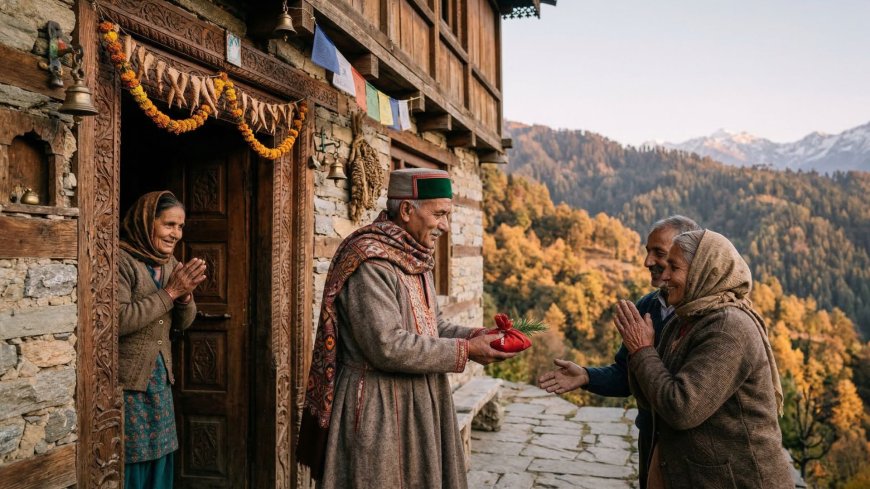
The Himachali wedding invitation in its traditional form is not an object. It is an act. It is the act of a person — the nyota, the designated inviter — going physically to the home of every person being invited and standing at their door and speaking the invitation in person and being received into the home and sharing food or drink or both as the first act of the celebration that is being announced. The invitation is not sent. It is carried. It is not received by a household that reads it in the privacy of its own time. It is delivered to a household that receives the nyota and, in that reception, begins the participation in the wedding that will extend through the event itself.
The difference between these two modes of invitation is not merely logistical. It is the difference between a transaction and a relationship — between the transfer of information and the initiation of participation. The printed card says: you are invited. The nyota at the door says: you are needed. The house that receives the nyota is not receiving information about an event they may or may not attend. They are entering into a reciprocal relationship with the inviting family that the tradition understands as binding — the relationship of the called and the caller, the guest and the host, that is the social foundation of the hill community wedding.
The Etymology and the Deep History
The Pahari word for the invitation tradition varies across the different regions and languages of Himachal Pradesh — the state that encompasses a remarkable diversity of linguistic and cultural communities across its twelve districts, from the Kangra valley in the west to the high Kinnaur and Spiti districts in the east. In many communities, the act of inviting is called the nimantran or the nata, and the person who carries the invitation is the nyota or the nimantrana-carrier. In some Kinnauri traditions, the invitation is referred to in terms that translate roughly as the calling — the act of calling someone toward the celebration, of extending the reach of the family's joy to include the community.
The antiquity of the tradition is not in question even where the written documentation is incomplete. The hill communities of Himachal Pradesh — geographically isolated by the mountain terrain, dependent on each other in ways that the plains communities, with their greater density and their better-connected infrastructure, were not — developed social institutions that were more explicitly reciprocal, more carefully maintained, and more ritually encoded than the institutions of more accessible communities. The wedding invitation carried door to door is one expression of this reciprocity — the understanding that the community is constituted by these acts of reaching out, that the village is not a collection of individual households but a network of relationships that the ritual occasions make visible and reinforce.
The Nyota: The Designated Carrier and the Role That Cannot Be Delegated
At the centre of the Himachali invitation tradition is the nyota — the person designated by the wedding family to carry the invitation to every household on the list. The selection of the nyota is not casual. In the traditional practice, the nyota is a respected member of the community — a man, typically, in the traditions where the public role of going door to door was understood as a male responsibility, though this varies by community and by period — whose social standing is sufficient to represent the inviting family credibly and whose relationships within the community are extensive enough to ensure a warm reception at each door.
The nyota does not simply deliver a message. He represents the family. His reception at each door is, by extension, the reception of the family at that door. The household that receives the nyota warmly is expressing its warmth toward the wedding family. The household that receives him with particular honour — with food, with drink, with conversation that extends beyond the minimum — is expressing a relationship of closeness with the inviting family that the invitation visit has activated and confirmed.
This representational dimension of the nyota's role is one of the most significant things that the printed card cannot replicate. The printed card is sent by the family but received by the household as an object — a piece of paper or card that the household reads privately and responds to privately. The nyota is a person, and the household's response to him is a social act that takes place in public — or at least in the social space of the home — and that communicates something about the relationship between the two households that a response to a printed card cannot communicate with the same precision.
What the Nyota Carries
The nyota in the traditional Himachali practice does not go to the invitee's door empty-handed. He carries, depending on the community and the specific tradition, some combination of the following: a small amount of rice — the grain that is the symbol of abundance and of the agricultural foundation of the hill community's life; a packet of sweets or a small food offering that represents the hospitality of the inviting family being extended across the distance between the two homes; and the verbal invitation itself, delivered in a specific form of words that the tradition provides and that the nyota has learned either by inheritance or by the instruction of the family elders.
In some Kinnauri and upper Himachal traditions, the nyota also carries a small branch of the deodar or of another sacred tree whose presence marks the invitation as sacred — not merely social but ritual, not merely informational but auspicious. The deodar — the tree of the gods, whose Sanskrit name means precisely that — is the most sacred tree of the western Himalayan tradition, and its presence in the invitation act connects the social event of the invitation to the broader sacred geography of the hill community's relationship to the forest and the mountain landscape.
The NRI family planning to honour the Himachali invitation tradition for a wedding abroad — in Edinburgh, in Vancouver, in Sydney — must think carefully about what the nyota carries in the new context. The rice, the sweets, and the deodar twig that Roshni's father sent across the world in a wooden box were not incidental additions to the letter that explained the tradition. They were the tradition itself, translated into the form that the postal service could carry.
The Route and the Reception: The Social Geography of the Invitation Walk
The nyota's route through the community is not random. It follows the social geography of the community — the relationships of closeness and distance, of obligation and affection, that constitute the village's social map. The closest relatives and the most important community members are visited first, because the order of the visits communicates something about the hierarchy of relationships that the invitation is navigating. The most distant or the least closely related households are visited last, not because they matter less but because the tradition understands that the social meaning of the invitation is partly communicated by its sequence.
At each home, the reception follows a pattern that is itself ritually encoded. The nyota is invited inside — not receiving him at the door is a social signal of significance, equivalent in the hill community context to a refusal of the invitation itself, and therefore extremely rare except in cases of genuine conflict or bereavement. Once inside, the household offers the nyota food or drink — the specific offerings vary by time of day, by season, and by the household's resources, but the act of offering is non-negotiable. The invitation is then given, in the specific words that the tradition provides, and the household's acceptance is expressed through words and through the physical act of receiving whatever the nyota has brought.
The conversation that follows the formal invitation exchange is the social substance of the visit — the opportunity for the two households to renew their relationship, to exchange news, to affirm the bonds that the invitation has activated. This is the element of the traditional invitation visit that the printed card most completely fails to replicate and that the digital invitation most completely eliminates. The nyota's visit to each household is a small but genuine social event in itself — a miniature expression of the community hospitality that the wedding will express at full scale.
The Duration of the Invitation Walk
In the traditional hill community context, the nyota's invitation walk could take days — not because the distances between homes were great but because the reception at each home was not a brief exchange. A nyota visiting forty or fifty households over the course of two or three days, spending twenty minutes to an hour at each home, was conducting a sustained social act whose duration was part of its meaning. The time taken was the measure of the seriousness of the invitation — the willingness of the inviting family to invest the time and the social energy in the personal communication of the wedding announcement.
For the NRI family attempting to honour this tradition in a modified form — whether in Himachal Pradesh itself with a reduced but still personal invitation process, or in the diaspora city where the community is dispersed and the distances are measured in tube stops rather than mountain paths — the question of duration is a question of intention. The abbreviated nyota visit — the doorbell rung, the invitation handed over, the conversation declined in the interest of the next stop on the list — misses the point as completely as the printed card. The tradition is not the delivery of an object. It is the making of time for the person being invited.
The Regional Variations Across Himachal's Communities
Himachal Pradesh is a state of extraordinary cultural diversity — the product of its complex mountain geography, which separated communities sufficiently to allow distinct traditions to develop in relative isolation while maintaining enough contact to create a family of related practices rather than entirely unconnected ones. The invitation tradition varies across these communities in ways that the NRI family with Himachali roots must understand specifically for their own community rather than in the general terms that this article can provide.
The Kangra Valley Tradition
The Kangra valley — the most densely populated region of Himachal Pradesh, with a long history of agricultural settlement and cultural production — has its own specific invitation traditions that reflect the valley's relative accessibility and its long exposure to the broader North Indian cultural mainstream. The Kangra wedding invitation tradition has been more influenced by the plains conventions than the higher and more isolated hill communities, and the balance between the personal invitation visit and the printed card has shifted more significantly toward the printed card in the Kangra tradition than in the Kinnauri or the Lahauli traditions.
The personal invitation element persists in the Kangra tradition primarily for the closest relatives and the most important community figures, with the printed card being used for the broader guest list. The specific ritual elements of the nyota's visit — the offerings carried, the specific words used, the sequence of the visits — vary by the sub-community and the family tradition.
The Kinnauri and the High Valley Traditions
The Kinnauri tradition — from the Kinnaur district that borders Tibet and that has maintained, because of its remoteness and its relatively recent integration into the mainstream Indian administrative framework, a cultural distinctiveness that the more accessible regions have not — has some of the most elaborately preserved invitation traditions in Himachal Pradesh. The Kinnauri wedding invitation visit is a formal social act with specific ritual dimensions — the offerings of rice and local grain, the specific words of the invitation, the reception that the invited household is expected to provide, and the obligations that the acceptance of the invitation creates.
The Kinnauri tradition also reflects the community's relationship to the Tibetan Buddhist cultural sphere — the high valley communities of Kinnaur have a distinctive cultural identity that blends the Hindu hill tradition with the Tibetan Buddhist tradition in ways that are visible in the wedding practices, the ritual objects, and the specific forms that the invitation tradition takes.
The Lahaul and Spiti Traditions
The Lahaul and Spiti districts — the highest and most remote parts of Himachal Pradesh, accessible through mountain passes that are closed for several months of the year by snowfall — have wedding traditions that are among the most distinct in the state. The invitation tradition in these communities is shaped by the extreme conditions of the landscape — the long distances between settlements, the severe winter weather that constrains when weddings can take place, and the deep interdependence of the small high-altitude communities that makes the social reciprocity of the invitation visit more rather than less important.
The Lahauli and Spiti invitation traditions have been least studied and least documented outside the communities themselves, and the NRI family with roots in these communities will find that the specific knowledge of their tradition resides primarily with the family elders rather than in any published source.
The Written Invitation and the Oral Tradition: What Was Lost in the Transition
The transition from the oral, personal invitation tradition to the written printed card in the Himachali hill communities is a transition that happened, in most communities, over the course of the twentieth century — accelerated by increased literacy, by better road connections, by the growth of the postal service, and by the influence of the plains wedding conventions that accompanied the gradual integration of the hill communities into the broader Indian administrative and cultural mainstream.
The written card carried the information more efficiently. It could reach more people, more quickly, with less expenditure of the nyota's time and the hosting household's resources. It was, by the metrics of information transfer, an improvement. What it transferred, at the same time, was the personal relationship that the invitation visit had instantiated — the social act of reaching out, of standing at the door, of being received and receiving, of making the invitation a beginning rather than an announcement.
This loss was felt, in the communities where the transition happened, not as a clear diminishment but as a gradual erosion — the kind of change that is only visible in retrospect, when the generation that remembers the old way can compare it to the new and articulate what is missing. Roshni's grandfather, at eighty-seven, was that generation. He had been young when the invitation was carried door to door and old enough to have watched it become the printed card, and he had the clarity of perspective to ask that at least one wedding — his granddaughter's — honour the way that the hills had always done it.
The traditional Himachali invitation was not primarily a method of communication. It was an act of community constitution — the act by which the wedding family made visible and reinforced the network of relationships that made them a community rather than a collection of individual households.
The NRI Dimension: Honouring the Tradition Across Distance
For the NRI family with Himachali roots, the traditional invitation practice presents a specific challenge that is worth engaging with honestly: the community is no longer geographically concentrated in the hill town or the valley village. The relatives are in Edinburgh and Vancouver and Singapore as well as in Rampur and Shimla and Dharamsala. The nyota cannot walk to Edinburgh. The door-to-door invitation cannot literally encompass the diaspora in the form that the tradition originally took.
What the NRI family can do — and what the most thoughtful NRI families with Himachali roots have done — is find the form of the tradition that the contemporary world permits while preserving the spirit that the form was carrying. This does not mean a wholesale substitution of the digital invitation for the personal visit. It means a genuine engagement with the question of what the personal, relational element of the invitation can look like in the specific context of the diaspora family.
The Modified Nyota for the Diaspora Community
For the India-based portion of the guest list — the relatives and community members who are still in Himachal Pradesh or in the Indian cities where the Himachali diaspora has settled — the traditional nyota visit is entirely possible and should be maintained wherever the family tradition supports it. The nyota who walks the lanes of Rampur Bushahr carrying the rice and the deodar twig and the invitation in the specific words of the tradition is not performing an anachronism. He is maintaining a social infrastructure that the community still needs and that the printed card cannot replace.
For the international NRI guest list — the relatives in Edinburgh and Vancouver and Sydney — the modified form of the tradition requires creative engagement. Roshni's father's solution — the wooden box with the deodar twig and the rice and the letter explaining the tradition — was one form of this creative engagement, and it was understood by Roshni as exactly what it was intended to be: not a substitute for the nyota's visit but the best translation of the nyota's visit that the postal service could carry across the distance. The object was not the invitation. The intention was the invitation. The object was the carrier of the intention.
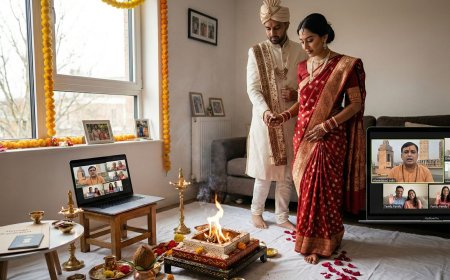
Other forms are possible. The video call that replicates the personal visit — not the WhatsApp announcement but the scheduled call in which the inviting family member speaks the invitation to the relative being invited, and the relative responds, and the conversation that follows is the conversation that the nyota's visit would have produced — is a form that the technology permits and that the tradition's spirit can inhabit. The family elder who records a personal video message for each branch of the family, speaking the invitation in Pahari, sending it with the specific words and the specific warmth that the tradition provides — this is another form.
What the tradition resists, in any of its forms, is the mass broadcast — the single message sent identically to every recipient, the WhatsApp group announcement, the digital invitation that makes no distinction between the closest relative and the most distant acquaintance. The Himachali invitation tradition is, at its core, anti-broadcast. It is the insistence that each person being invited is an individual with a specific relationship to the inviting family, and that the invitation must honour that specificity rather than flatten it into the undifferentiated communication of the mass message.
Common Misunderstandings About the Himachali Invitation Tradition
The first misunderstanding is that the door-to-door invitation is simply a pre-literate practice that was necessary when people could not read printed cards and that became obsolete once literacy made the printed card functional. This misunderstanding reduces the tradition to its least significant dimension — the information transfer — while ignoring its actual function, which is the social and relational act of personal outreach. The tradition was not replaced by the printed card because the printed card did the same thing more efficiently. The printed card does a different and lesser thing more efficiently, and the loss is real even when the efficiency gain is also real.
The second misunderstanding is that the tradition is specific to the wedding invitation and does not extend to other significant occasions in the community's life. The personal invitation visit in the Himachali hill communities is part of a broader culture of relational hospitality that extends to other life-cycle events — the birth, the death, the festivals — and that reflects a general understanding of community life as constituted by the specific, personal acts of reaching out rather than the broadcast communication of the modern social media age.
The third misunderstanding is that the nyota's role is straightforward and can be filled by any family member who is available. The selection of the nyota in the traditional practice is a serious decision that reflects the understanding that the nyota represents the family and that his reception at each door communicates something about the inviting family's standing and their relationship with the invited household. The wrong nyota — someone whose social standing is insufficient, whose relationships in the community are thin, or whose manner does not honour the occasion — is not a neutral choice. He is an active communication about the family's approach to the occasion.
The fourth misunderstanding is that the tradition can be fully replicated in the diaspora by sending a traditional-looking printed card with a Pahari phrase and a small packet of rice. The material elements of the traditional invitation — the rice, the deodar, the sweets — are carriers of the relational intention, not substitutes for it. A beautifully designed printed card with traditional motifs and a small rice packet, sent by courier to the relatives in Edinburgh, is a gesture of respect toward the tradition. It is not the tradition. The tradition is the person at the door. If the person at the door is not possible, the next best thing is the person on the call — the family member who takes the time to speak the invitation personally to each relative, in the words that carry the right weight, in the language that carries the tradition.
The fifth misunderstanding is that honouring the Himachali invitation tradition for a wedding abroad is primarily a matter of cultural performance — of looking traditional, of satisfying the family elders, of adding an authentic element to a wedding that is otherwise modern and internationally oriented. The tradition is worth honouring not for how it looks but for what it does — the way it constitutes the community of the wedding, the way it makes each invited person feel specifically called rather than generally included, the way it begins the wedding not with the event itself but with the relational act of reaching out that the event is the culmination of.
The Complete Reference Table: The Himachali Invitation Tradition Across Contexts
| Element | Traditional Practice | Community / Region | NRI Adaptation | What Must Be Preserved |
|---|---|---|---|---|
| The Nyota | Designated community representative | Pan-Himachali with variations | Trusted family member or respected community elder | Personal representation of the inviting family |
| The Route | Social geography of community; closest first | Hill village tradition | Sequence reflects closeness of relationship | Hierarchy of relationships in invitation order |
| Objects Carried | Rice, sweets, deodar twig, specific ritual items | Kinnauri, Kangra, Lahauli variations | Sent by post or carried personally where possible | Relational intention behind each object |
| The Invitation Words | Specific Pahari oral formula | Community-specific; family tradition | Spoken in person, by video call, or in recorded message | Personal, specific address to each invitee |
| The Reception | Invited inside; food and drink offered | Universal hill tradition | Video call with specific personal exchange | Two-way relationship; not one-way broadcast |
| The Conversation | Social renewal of household relationship | Universal hill tradition | Extended personal call; not a group announcement | Time given to each relationship specifically |
| The Duration | Multiple days for full village invitation | Traditional hill community | Scaled to diaspora; quality over speed | Each invitation is an individual act |
| The Rice | Grain of abundance; agricultural foundation | Pan-Himachali tradition | Sent by post in small cloth packet | Symbol of the inviting family's abundance |
| The Deodar Twig | Sacred tree of the gods; auspicious marker | Western Himalayan tradition | Sent by post if available; symbolic significance explained | Connection to sacred landscape of origin |
| The Sweets | Hospitality of inviting family extended | Pan-Himachali tradition | Local equivalent sent or brought in person | Gesture of the family's generosity |
| The Sequence | Formal obligation sequence by relationship | Community-specific hierarchy | Maintained in diaspora by individual outreach order | Social meaning of invitation order |
| The Refusal | Extremely rare; social significance | Universal hill tradition | Absence from wedding is explanation in diaspora context | Understanding that acceptance is relational |
| The Mass Broadcast | Not part of tradition; antithetical to it | N/A | WhatsApp group announcement is not the tradition | Each invitation is individual and specific |
| The Written Card | Later introduction; information transfer only | Post-literacy transition | Supplement to personal invitation; not substitute | Personal invitation must accompany any card |
| The Elder's Role | Guides the nyota; maintains the tradition | Universal hill tradition | Family elder consulted on specific community practice | Elder knowledge is the living tradition |
What the Invitation Carries That the Wedding Cannot Produce
There is a dimension of the Himachali door-to-door invitation tradition that is easy to miss in the discussion of its specific practices and its social functions, and it is the dimension that Roshni's grandfather was protecting when he asked that one wedding, at least, be done in the old way. The invitation visit is not preparatory to the wedding. It is the beginning of the wedding. The moment the nyota stands at the door of the first household and speaks the invitation in the specific words that the tradition provides — that moment is the first moment of the wedding, the moment at which the community begins to gather before it has physically gathered, the moment at which the network of relationships that the wedding will celebrate is activated and made visible.
The wedding ceremony and reception are the culmination of a social process that the invitation begins. The families who attend the wedding have not simply received information about an event and chosen to participate. They have been called — personally, specifically, in the words of a tradition that their grandparents and great-grandparents also heard — and their participation is the response to that calling. The wedding that they attend is not an event they are visiting. It is a community act that their presence constitutes.
This is the understanding that the mass broadcast invitation — the WhatsApp announcement, the digital card, the social media post — most completely destroys. It reduces the guest to a recipient of information rather than a person being called. It reduces the wedding from a community act to a ticketed event. And it removes from the very beginning of the wedding process the relational work that the invitation visit was designed to do — the making of each person feel specifically known, specifically wanted, specifically necessary to the occasion.
The Himachali invitation carried door to door was not a method of sending information about a wedding. It was the first act of the wedding itself — the act by which the community was constituted in the specific form that the wedding would then celebrate.
Roshni Made the Calls
She had spent a Saturday in November — the Edinburgh winter already fully established, the light lasting only until four in the afternoon — going through the guest list that her parents had sent and making a phone call to every person on it. Not the WhatsApp announcement. Not the group message. Individual calls, each one beginning with the specific Pahari words that her grandfather had written out for her on a separate sheet inside the envelope, words that she had to read carefully the first few times because her Pahari had been shaped by childhood and six years of Edinburgh had not maintained it at the level of ceremonial fluency.
The calls took two days. Some of them lasted ten minutes. Some of them lasted an hour. The aunt in Chandigarh who had not spoken to Roshni's father in three years and who, when Roshni spoke the invitation in Pahari, was quiet for a moment and then said: Your grandfather's family always knew how to call people properly. The cousin in Pune who had not known there was a traditional invitation form and who, by the end of the call, had asked Roshni to send him the Pahari words because he wanted to use them for his own wedding. The old neighbour in Rampur Bushahr — her father's friend from school — who received the call and then called Roshni's father immediately afterward and said: Your daughter called me in Pahari. She said the old words. I am coming from Rampur for this wedding.
The nyota in Edinburgh was a telephone and a sheet of paper with the specific words in her grandfather's handwriting. It was not the door. It was not the deodar twig at the threshold or the rice packet in the outstretched hand or the cup of tea in the kitchen of the hill house. But it was the person — Roshni herself, speaking to each relative and friend and community member individually, in the words that the tradition provided, making each of them feel specifically called rather than generally included.
Her grandfather called her the week before the wedding. He said: I heard you called everyone in the old way. She said: I tried. He said: Your grandmother would have been very pleased. And then, after a pause: The person who carries the invitation carries the first piece of the wedding to every door. You carried it to sixty-three doors. That is sixty-three pieces of the wedding that were already at their places before the wedding began.
Find the words — the specific Pahari words of your community's tradition — from the family elder who still has them. Make the individual calls rather than the group announcement. Spend the two days it takes. Let the calls be as long as they need to be. Send the rice and the deodar twig to the relatives who are too far for the call to reach alone.
And understand that the wedding begins not on the day of the ceremony but on the day the first person is called — and that the calling, done properly, in the words that the tradition provides, is the first and most important thing you will do for the wedding that follows.
Published by NRIWedding.com — The Premium Global Platform for Non-Resident Indians Planning Indian Weddings From Abroad.
What's Your Reaction?
 Like
0
Like
0
 Dislike
0
Dislike
0
 Love
0
Love
0
 Funny
0
Funny
0
 Angry
0
Angry
0
 Sad
0
Sad
0
 Wow
0
Wow
0