










































































Questions to Ask Before Booking Any Banquet Hall in Jalandhar: The NRI Checklist
Every question on the NRI banquet hall checklist exists because someone did not ask it before signing — and discovered its importance only after the deposit was paid and the contract was signed. This comprehensive guide gives NRI couples the complete structured question framework for evaluating every Jalandhar banquet hall before any financial commitment is made. From exclusivity clauses and generator specifications to catering minimum guarantees, vendor access terms, force majeure provisions, and proxy briefing protocols, this is the most detailed and practically intelligent pre-booking checklist available for NRI couples planning Jalandhar weddings remotely from the UK, Canada, Australia, or the UAE.

Questions to Ask Before Booking Any Banquet Hall in Jalandhar — The NRI Checklist
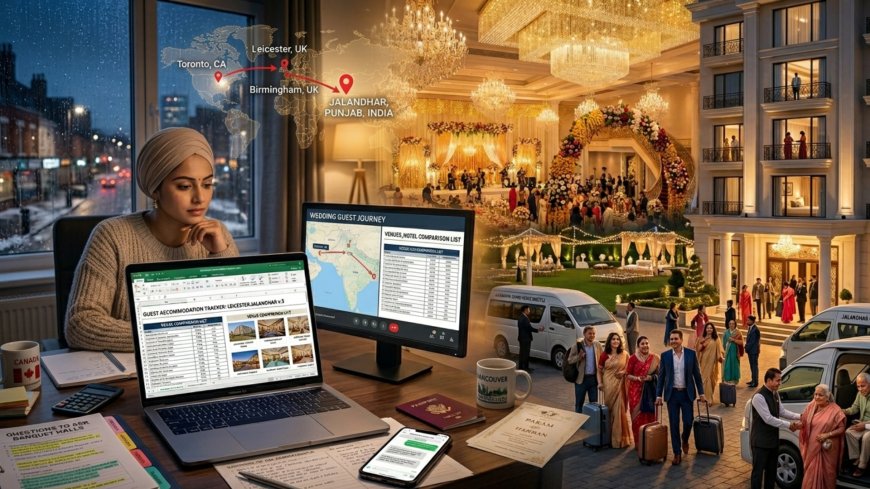
The question that Ravinder wished she had asked was not a complicated one. It was not a question that required legal training or market expertise or the accumulated knowledge of someone who had booked a hundred wedding venues. It was a question so straightforward that its absence from every conversation she had with the hall's owner across four months of planning — four months of phone calls, WhatsApp messages, video tours, and one in-person visit conducted by her cousin Jaspreet whose brief had been comprehensive in every dimension except the one that mattered — seemed, in retrospect, like the kind of oversight that only becomes visible when the thing the question would have revealed becomes a problem.
The question was: is there another event booked at this venue on the same weekend as our wedding?
The answer, which she discovered not from the hall's owner but from her cousin's friend who happened to mention it in passing three weeks before the wedding, was yes. There was another event. A large corporate conference that had been booked into the hall's annexe — the annexe that the family had been told was part of their exclusive booking, whose outdoor space Ravinder had planned to use for the pre-ceremony photography, and whose separate entrance the family had assumed would be available for the baraat's arrival. The conference was on the Saturday. The wedding was on the Saturday. The hall's owner, when Ravinder's father called to discuss the matter, explained with the patient composure of someone who had navigated this conversation before that the annexe booking was a separate booking from the main hall booking, that the family's contract covered the main hall and the main hall only, and that the exclusivity the family had understood to include the full venue was an understanding that the contract did not support.
The conversation had lasted forty minutes and had resolved nothing, because the contract said what it said and the wedding was three weeks away and the alternatives were not alternatives. The baraat had arrived at a venue that was simultaneously hosting a corporate conference. The outdoor space for the pre-ceremony photography had been occupied by conference attendees taking a networking break. The annexe entrance that the family had planned for had been roped off with signage for the conference.
The wedding had happened. It had been, in the aggregate, a beautiful and meaningful event whose photographs did not show the conference attendees in the background and whose guests, for the most part, navigated the divided venue without the experience producing a lasting impression. But Ravinder knew. Her father knew. Her cousin Jaspreet, whose brief had been comprehensive in every dimension except the one that mattered, knew in the specific way that competent people know when they have been undone by a question they did not think to ask.
She had called her friend Priya in Toronto after the wedding. Priya had married in Jalandhar the year before and had navigated the venue booking with what Ravinder had, at the time, considered excessive thoroughness — the questions that seemed redundant, the contract negotiations that seemed paranoid, the checklist that Priya had developed and insisted on working through with every hall she visited. Ravinder had found the checklist intimidating at the time. She understood it now.
She had asked Priya: where did the checklist come from?
Priya had said: from everyone who didn't have one.
This guide is that checklist — expanded, documented, and explained for every NRI family that is standing at the beginning of the Jalandhar banquet hall booking process and that wants to ask every question before the deposit is paid rather than discovering its importance after.
Why the NRI Family Needs a Checklist That the Local Family Does Not
The local Jalandhar family booking a wedding venue has a set of information advantages that the NRI family booking from Toronto or Birmingham does not possess, and the checklist is the tool that partially compensates for the absence of those advantages.
The local family has market knowledge — the accumulated understanding of the Jalandhar banquet hall market's commercial practices, its standard contract terms, its typical pricing structure, and the specific questions that the market's practices make necessary. This knowledge is acquired over years of attending weddings in the city, of watching family members navigate the same booking process, of knowing which halls have which reputations and which owners have which commercial habits. The NRI family that has been living in Toronto for fifteen years does not have this knowledge, and the WhatsApp groups and forum research that partially substitute for it are useful but incomplete.
The local family has the ability to verify claims in person — to visit the hall at multiple times, to speak with families who have recently held events there, to assess the infrastructure through direct observation rather than the owner's video tour and the carefully composed Instagram photographs. The NRI family whose venue assessment is conducted through a single visit by a proxy whose brief is comprehensive but whose independent market knowledge may be limited is assessing on less complete information than the local family's repeated visits and community knowledge produce.
The local family has the relationship accountability that the community context provides — the understanding that the hall owner's commercial practices are visible to the community in which both parties live, and that the reputational consequence of a contractual dispute or a quality failure is borne within a social context that the NRI family's distance removes from the equation. The NRI family is a customer without community accountability in the hall's market, and the checklist's questions are partly a substitute for the accountability that the community relationship would otherwise provide.
The checklist is not a substitute for the in-person visit or the community knowledge or the market expertise. It is the structured question framework that gives the NRI family's proxy visit a thoroughness that compensates for the information gaps that distance creates.
The Questions: Category by Category
The Exclusivity Questions
The exclusivity questions are the category that Ravinder's experience makes the most urgent opening of the checklist. They are the questions whose answers define what the family is actually booking when it signs the contract, and whose absence from the booking conversation produces the situations that the contract's fine print then resolves in the hall's favour.
The first exclusivity question is whether the booking covers the entire venue property or only the specific spaces named in the contract. The Jalandhar banquet hall whose compound includes a main hall, an annexe, a lawn, a garden, and a parking area may be booking each of these spaces independently, and the family that books the main hall has not necessarily booked the annexe or the lawn. The contract should name every space the family expects to use and should specify each as part of the exclusive booking.
The second exclusivity question is whether any other event is booked at the venue on the same date or on the setup dates immediately before the event. The hall that is hosting a corporate conference in its annexe while the family's wedding is in the main hall is the hall that Ravinder booked. The question that prevents this situation is direct: are there any other bookings at this venue on the day of our event, on the day before, and on the day after?
The third exclusivity question is what happens if the venue receives a more commercially attractive booking for the same date after the family's booking has been confirmed. The hall whose deposit structure and cancellation terms create a financial incentive to accommodate a higher-value booking at the expense of the original booking should be identified before the deposit is paid, not after the more attractive event has been accepted.
The fourth exclusivity question is whether the vendor access during the setup period is exclusive to the family's event. The decorator who needs unobstructed access to the hall from the morning of the day before the event cannot work effectively in a space that another event's teardown is simultaneously occupying. The setup exclusivity — the specific hours during which the family's vendors have sole access to the space — should be established and documented before the booking is confirmed.
The Capacity Questions
The capacity questions are the questions that translate the owner's quoted capacity figure into the number that is relevant to the family's specific event configuration, because these two numbers are frequently different in ways that the owner's initial presentation does not make clear.
The first capacity question is the comfortable seated dining capacity for the family's specific seating configuration. The owner's quoted capacity of eight hundred guests is typically the maximum capacity under the most compact seating arrangement — the configuration that fills the space to its legal or physical limit. The comfortable seated dining capacity for a Punjabi wedding — the configuration that allows adequate aisle space, service circulation, and the kind of physical comfort that a four-hour dinner requires — is typically twenty to thirty percent lower than the maximum quoted capacity. The family that books a hall for six hundred guests on the basis of a maximum capacity quote of eight hundred may discover that the comfortable configuration for six hundred guests requires a hall whose maximum capacity is closer to seven-fifty.
The second capacity question is the capacity of the outdoor spaces the family intends to use for the ceremony, the cocktail hour, or the pre-ceremony photography. The lawn capacity that the owner quotes for a standing reception is not the lawn capacity for a seated ceremony with a mandap, a designated aisle, and rows of seating chairs. The outdoor capacity for the family's specific ceremonial configuration should be verified against the actual space dimensions rather than the owner's general capacity description.
The third capacity question is the kitchen's capacity to produce the catering volume the event requires without quality degradation. A kitchen designed for events of three hundred covers may produce adequate food for three hundred covers and inadequate food for the five hundred cover event that the hall's main space accommodates. The kitchen capacity question — how many covers can the kitchen produce at the quality standard the tasting demonstrated — is a question the owner may not be accustomed to answering and whose answer is important.
The Infrastructure Questions
The infrastructure questions are the questions about the physical systems whose adequacy determines whether the hall's basic functions — the climate control, the power, the kitchen, the sound — operate at the standard the event requires.
The generator question requires more than confirmation that a generator exists. The question that produces useful information is: what is the generator's KVA rating, what load does it cover when operating at full capacity, and does that load include the air conditioning, the kitchen equipment, the sound system, and the event lighting simultaneously? The hall whose generator covers the lights but not the air conditioning in May, or the sound system but not the kitchen in February, is a hall whose backup power is inadequate for the event it is hosting. The KVA specification should be in the contract.
The air conditioning question requires verification of the system's capacity for the event load rather than its nominal capacity. The air conditioning system that maintains comfortable temperature during a weekday office visit may not maintain comfortable temperature during a six-hundred-person wedding in March when the dancing has been ongoing for two hours and the body heat of six hundred guests and the cooking heat from the live stations are combining to test the system's capacity. The family should ask whether the air conditioning system has been tested at full event load and whether the owner can provide references from events that have validated its performance.
The water supply question is specific to the catering and sanitation requirements of the event scale. The hall that hosts events of five hundred guests requires water supply capacity for the kitchen, the bar, and the washroom facilities simultaneously, and the supply capacity that is adequate for smaller events may be inadequate for the full event scale. The water supply — municipal, borewell, or tanker-supplemented — should be confirmed as adequate for the event's simultaneous demands.
The parking question requires the family to establish the number of vehicles it expects, the parking capacity of the venue's owned area, the availability and distance of overflow parking, and whether valet service is available and at what cost. The parking that is adequate for the local guest population driving standard vehicles may be inadequate when the NRI wedding's airport transfers, hired coaches, and family vehicles from multiple cities are added to the load.
The Contract Questions
The contract questions are the questions that the family should ask before the document is signed, because the questions that are asked after the signature are the questions whose answers the contract has already provided.
The first contract question is what the cancellation policy covers and at what percentage of the total cost each cancellation window applies. The family should understand the financial exposure of cancellation at every stage — at three months, at six weeks, at two weeks — before committing to the deposit.
The second contract question is what the force majeure clause covers and whether it includes a full refund provision for events beyond the family's control. The Covid-19 period made this question standard in the NRI bride community's booking guidance, and it should be standard in every Jalandhar hall booking conversation.
The third contract question is what happens if the hall is unable to fulfil the booking due to circumstances on its side — a structural problem, a licensing issue, a double-booking that the hall's management must resolve. The family's remedy in this situation — the refund amount, the timeline, the compensation for the disruption — should be specified in the contract rather than left to the goodwill of the resolution conversation.
The fourth contract question is what the payment schedule is in full, including every instalment, every due date, and every condition attached to each payment. The payment schedule that is described as "deposit now, balance on the day" at the booking conversation may contain intermediate instalments that the contract specifies and that the booking conversation did not mention.
The fifth contract question is which of the verbal commitments made during the booking process are reflected in the written contract. Every verbal commitment that the family is relying on — the exclusivity, the catering permissions, the decoration package contents, the staff ratio, the generator specification — should appear in the contract. The verbal commitment that does not appear in the contract is the commitment that the family cannot enforce.
The Catering Questions
The catering questions are the questions that establish what the family is paying for, at what price, and under what conditions, before the minimum guarantee and the per-head rate are committed to in the contract.
The first catering question is whether external caterers are permitted and under what conditions. If an external caterer is permitted under a buyout arrangement, the buyout fee should be established and documented before the venue decision is finalised.
The second catering question is the per-head rate for the specific menu the family intends — not the standard menu whose rate is quoted at the enquiry stage, but the rate for the non-vegetarian additions, the live cooking stations, and the specific dishes that the family's menu planning requires. The difference between the standard menu rate and the rate for the menu the family actually wants should be established before the contract is signed.
The third catering question is the minimum guarantee — the number of covers the family is committing to pay for regardless of attendance — and whether this figure is negotiable. The minimum guarantee that represents seventy percent of the hall's maximum capacity may be negotiable to a figure closer to the family's expected attendance, and the negotiation is most productive before the deposit is paid.
The fourth catering question is the service staff ratio — the number of service personnel per cover — and whether this ratio is specified in the contract. The hall that confirms a staff ratio of one per twenty-five covers in conversation but does not include this specification in the contract is the hall that deploys the ratio its economics prefer on the event day rather than the ratio the family understood was committed to.
The fifth catering question is the quality assurance process — specifically, what the hall's mechanism is for ensuring that the food quality at the event matches the quality at the tasting. The tasting that is conducted by the head chef and the event that is cooked by the standard kitchen team are potentially different quality outcomes, and the family should ask what the head chef's involvement in the event's cooking will be.
The Vendor and Decoration Questions
The vendor and decoration questions establish whether the family's planned vendor team can operate at the venue under the terms that the vendors themselves require, and whether the decoration outcome the family intends is achievable in the space.
The first vendor question is whether external vendors — the decorator, the lighting company, the DJ, the photographer, the florist — are permitted to work at the venue and under what conditions. The hall that requires the family to use its empanelled vendors is the hall whose in-house vendors are a commercial tie-in whose cost and quality should be assessed before the booking is confirmed.
The second vendor question is the setup access — when the decorator can begin installing, how many days before the event the hall is available for setup, and whether the setup access is exclusive to the family's vendors or shared with another event's teardown or a concurrent setup for a different space.
The third vendor question is the ceiling height and the structural fixing points available for the decorator's installation. The decoration brief that involves suspended elements — chandeliers, fabric drapes, hanging floral installations — requires ceiling fixing points whose availability and load capacity should be verified by the decorator before the decoration design is finalised. The ceiling that cannot support the installation the family has planned is the ceiling that the decorator discovers on the setup day if the family has not asked the question before.
The fourth vendor question is the power supply available for the lighting company and the sound system — the dedicated circuits, the amperage, and the earthing quality that professional event equipment requires. The lighting installation that trips the hall's main breaker is the installation that the power supply question would have prevented.
The Accommodation and Guest Experience Questions
The accommodation and guest experience questions establish the practical context in which the family's guests — particularly the international guests whose experience of the wedding begins at the airport and ends at their accommodation — will experience the event.
The first accommodation question is whether the venue has any on-site accommodation or a formal partnership with a nearby hotel, and if so, what the specific terms of that partnership are. The difference between a formal room block agreement and an informal understanding is the difference between guaranteed rooms at a fixed rate and hoped-for availability at a negotiated rate.
The second accommodation question is the distance from the nearest hotel of adequate standard to the venue, and the transfer options between the two. The family that knows this distance and transfer time before selecting the venue can factor it into the total guest experience calculation rather than discovering it after the selection has been made.
The third accommodation question is the parking coordination for guests arriving from the partnership hotel or from independent accommodation in the city. The parking infrastructure that the venue provides for its resident guests is different from the parking infrastructure required by the full out-of-town guest population whose vehicles need to be managed simultaneously.
The Complete NRI Booking Checklist
| Category | Question | Why It Matters | Must Be in Contract |
|---|---|---|---|
| Exclusivity | Is the entire venue exclusively ours on the event date? | Prevents concurrent events in shared spaces | Yes — name every space |
| Exclusivity | Are there any other bookings on our setup or event dates? | Prevents overlap with teardown or concurrent events | Yes |
| Capacity | What is the comfortable seated dining capacity for our configuration? | Owner's quoted capacity overstates usable capacity | Yes — specify configuration |
| Capacity | What is the outdoor ceremony capacity for our specific setup? | Standing and seated capacities differ significantly | Yes |
| Infrastructure | What is the generator's KVA rating and full load coverage? | Partial load coverage fails under event conditions | Yes — specify KVA |
| Infrastructure | Has the air conditioning been tested at full event load? | Nominal capacity differs from event performance | Request references |
| Infrastructure | What is the water supply capacity for simultaneous demands? | Kitchen, bar, and washroom demands combine at peak | Yes |
| Infrastructure | What is the total parking capacity and overflow arrangement? | NRI weddings require more vehicles than local events | Yes — specify overflow |
| Contract | What is the full cancellation policy at each time window? | NRI families face higher rescheduling risk | Yes — all windows |
| Contract | Does the force majeure clause include full refund provision? | Protects against circumstances beyond family control | Yes |
| Contract | What is the complete payment schedule with all instalments? | Hidden instalments affect cash flow planning | Yes — all amounts and dates |
| Catering | Are external caterers permitted and at what buyout fee? | In-house tie-in eliminates preferred caterer option | Yes |
| Catering | What is the per-head rate for the actual planned menu? | Standard menu rate excludes non-veg and live stations | Yes — itemised |
| Catering | What is the minimum guarantee and is it negotiable? | Minimum guarantee determines floor cost regardless of attendance | Yes — fixed figure |
| Catering | What is the service staff ratio per cover? | Understaffed service degrades event experience | Yes — minimum specified |
| Vendors | Are all external vendors permitted and under what conditions? | Empanelled vendor requirements restrict family's choices | Yes |
| Vendors | When does setup access begin and is it exclusive? | Setup conflicts delay decoration installation | Yes — specific times |
| Vendors | What are the ceiling fixing points and load capacity? | Suspended decoration requires structural verification | Request specification |
| Vendors | What dedicated power circuits are available for lighting and sound? | Professional equipment requires dedicated supply | Yes |
| Accommodation | Is there on-site accommodation or a formal hotel partnership? | Determines whether room block agreement is available | Request written terms |
| Accommodation | What is the distance and transfer time to the nearest quality hotel? | Determines guest experience for out-of-town arrivals | Verify independently |
| Noise | What is the permitted noise level and music cutoff time? | Municipal curfews affect DJ and event programme timing | Yes — specific hours |
| Noise | What is the venue's track record for events running to planned timing? | Curfew enforcement varies and affects programme | Request references |
| Staff | What is the minimum management staff deployment for the event? | Senior management presence ensures quality accountability | Yes — specify roles |
| Staff | Will the owner or senior manager be present throughout the event? | Owner presence creates accountability that junior staff cannot | Yes |
How to Use This Checklist From Abroad
The checklist is most useful when it is used as a structured briefing document for the family's proxy rather than as a personal interview guide for a video call with the hall owner. The proxy — the family member, trusted friend, or hired consultant who visits the hall in person — is the person who can ask these questions in the context of the physical space, who can assess the owner's answers against the observable reality of the venue, and who can probe the answers that are vague, incomplete, or inconsistent with what the space itself shows.
The proxy briefing should specify not only which questions to ask but what an adequate answer looks like for each question. The generator question whose adequate answer is a specific KVA figure is a different brief from the generator question whose adequate answer is "yes, we have a generator." The proxy who knows what an adequate answer looks like will identify the inadequate answers that a less specifically briefed proxy might accept.
The questions whose answers should be in writing — the contract questions, the catering rate questions, the exclusivity specifications — should be flagged specifically in the proxy's brief as questions whose verbal answer is insufficient. The proxy who understands that a verbal commitment to an exclusive booking is not an exclusive booking will ask for the written specification rather than accepting the owner's confident confirmation.
The questions whose answers require independent verification — the journey time from the airport, the quality of the partnership hotel, the DJ curfew track record — should be assigned to the proxy as separate verification tasks rather than questions to ask the owner. The owner's answer to "how far is the nearest hotel?" is not independent verification of the distance and quality. The proxy's visit to the hotel is.
Common Mistakes NRI Families Make When Using a Checklist
The first mistake is treating the checklist as a box-ticking exercise rather than a quality assessment tool. The question that receives a confident verbal answer has not been answered in the way that the checklist intends. The checklist's purpose is to produce documented, verifiable, contractually captured answers — not to produce a set of conversations that the owner has navigated many times and whose outcomes he can control with experience. Every question on the checklist has a minimum standard for what an adequate answer looks like, and the family should know that standard before the questions are asked.
The second mistake is not briefing the proxy on the minimum standard for each answer. The proxy who visits the hall and asks the generator question and receives the answer "yes, we have a generator" and marks the question as answered has not completed the checklist. The proxy who has been briefed that the adequate answer includes a specific KVA figure and a confirmation of the load coverage will ask the follow-up question that produces the actual answer.
The third mistake is conducting the checklist conversation with the hall's sales or booking team rather than with the owner or the senior operations manager. The booking team's job is to close the booking, and their answers to the checklist questions will be optimised for that objective. The owner's or operations manager's answers to the same questions will be more operationally specific and more reliably connected to the reality of what the hall can deliver.
The fourth mistake is not following up the checklist conversation with a written summary of the key commitments and asking the hall to confirm them. The email that says "following our conversation, we understand that the following terms apply to our booking" and that lists the exclusivity specification, the generator capacity, the catering terms, and the service staff ratio is the email whose response — or whose lack of response, or whose corrections — tells the family what the hall's actual commitments are and which of the verbal assurances it is willing to put in writing.
The fifth mistake is not updating the checklist with the family's own questions — the specific concerns that the family's particular event configuration generates and that the standard checklist does not cover. The family whose decoration brief involves a specific structural installation should add the structural fixing question. The family whose elderly guests have specific mobility requirements should add the accessibility question. The checklist is a starting point whose completeness is the family's responsibility to ensure.
What Ravinder's Checklist Would Have Changed
She had built the checklist in the months after the wedding. Not for herself — the wedding was over — but for her cousin Harleen, who was planning her own Jalandhar wedding for the following year and whose venue selection process was at the stage where the checklist was useful rather than retrospective.
She had given Harleen the checklist with a specific instruction: the exclusivity questions are the ones you ask first, before you fall in love with the hall. Because once you have fallen in love with the hall, the exclusivity questions become harder to ask and harder to walk away from.
Harleen had asked the exclusivity questions first. The hall that was her first choice had given an answer that was confident and verbal and that had not, when Harleen pressed for the written specification, been reduced to a contract term. The hall had explained that the annexe was sometimes booked separately and that it could not guarantee that the annexe would be part of the family's exclusive booking. Harleen had thanked the owner and moved to the second hall on her list.
The second hall had given the exclusivity specification in writing without being asked twice. The contract had named every space. The setup dates had been confirmed as exclusive. The annexe was included.
Harleen's wedding had a photographer whose pre-ceremony photographs showed an outdoor space that was entirely the family's. No conference attendees. No networking breaks. No rope barriers with event signage.
The checklist was not the wedding. But it was the reason the wedding was the wedding and not the other thing.
Ask the exclusivity questions before falling in love with the hall. Brief the proxy on what an adequate answer looks like, not just what the question is. Follow up every key verbal commitment with a written summary and ask for confirmation. Add the family's specific questions to the standard checklist. Use the checklist as a quality assessment tool, not a box-ticking exercise.
Every question on the list exists because someone did not ask it. Ask it before you become that someone.
Published by NRIWedding.com — The Premium Global Platform for Non-Resident Indians Planning Indian Weddings From Abroad.
What's Your Reaction?
 Like
0
Like
0
 Dislike
0
Dislike
0
 Love
0
Love
0
 Funny
0
Funny
0
 Angry
0
Angry
0
 Sad
0
Sad
0
 Wow
0
Wow
0