


















































Best Areas in Jalandhar to Find Wedding Venues: Cantt, Model Town and GT Road Compared
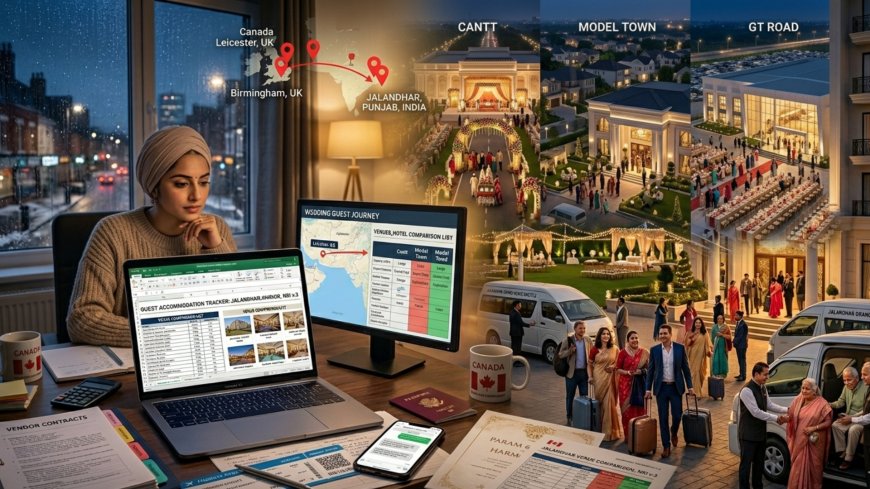
Choosing the right area of Jalandhar for your wedding venue is the prior decision that constrains every subsequent venue choice — and most NRI families make it based on attendance history rather than the specific requirements of the wedding they are actually planning. This comprehensive guide gives NRI couples a complete area-by-area comparison of Jalandhar's main wedding venue zones — the Cantonment, Model Town, GT Road corridor, Phagwara Road, and City Centre — across every dimension that matters for a large NRI wedding, including airport journey times, venue capacity ceilings, vendor ecosystem maturity, accommodation proximity, parking infrastructure, pricing levels, and overall guest experience quality.

Best Areas in Jalandhar to Find Wedding Venues — Cantt, Model Town, GT Road Compared
The argument had begun, as arguments about Jalandhar wedding venues tend to begin among Punjabi families with opinions, not with a disagreement about a specific hall but with a disagreement about a neighbourhood.
Manpreet's father wanted the Cantonment area. He had wanted it from the beginning, from the moment the venue conversation had started in September, and his wanting had the quality of a preference that had already become a conviction before the conversation began. The Cantt was where the family had attended the best weddings he could remember. It was where the roads were wider and the infrastructure was better and the general atmosphere of the event was elevated by the surroundings in a way that he could not quantify but that he felt strongly enough to defend across three family video calls and one in-person conversation that had lasted until midnight. The Cantt, he said, was the right kind of area for the right kind of wedding.
Manpreet's mother wanted Model Town. She had her reasons, which were specific and which she presented with the systematic thoroughness of someone who had been thinking about this longer than anyone else at the table realised. The hall she had identified in Model Town had been recommended by two families whose weddings she had attended in the previous eighteen months. The road access was good. The nearby hotels were adequate for the out-of-town guests. The decorator she wanted to use had worked at the Model Town hall three times and knew its dimensions and its structural fixing points in the way that a decorator who has worked a space multiple times knows it — which is differently, and better, than a decorator encountering it for the first time.
Manpreet's future mother-in-law, who had joined the third video call on the understanding that it was a courtesy inclusion and had stayed to become a participant, had a view about the GT Road corridor that she had been developing since the conversation began and that she introduced at the moment when the Cantt versus Model Town discussion had reached the specific impasse that family conversations about wedding logistics reach when both sides have exhausted their arguments and are repeating their conclusions with increasing emphasis. The GT Road venues, she said, were newer. The infrastructure was more modern. The capacity was larger. The prices were more competitive. And the access from the highway meant that the guests coming from Ludhiana and Amritsar and Delhi did not have to navigate the city centre's traffic to reach the hall.
Manpreet, who was calling from her flat in Amsterdam where it was eleven-thirty at night and who had a presentation to deliver at nine the following morning, had listened to all three positions across forty minutes of video call and had arrived at the conclusion that she needed information rather than opinions — a specific, honest, comparative account of what the different areas of Jalandhar actually offered for wedding venues, how they differed from each other in ways that mattered for the specific event she was planning, and which area's combination of infrastructure, access, vendor ecosystem, accommodation, and atmosphere made it the right choice for her wedding rather than for the convictions her family had formed at other people's weddings.
This guide is the information that the three video calls did not provide — the complete, honest, area-by-area comparison of Jalandhar's main wedding venue zones, written for the NRI family that needs to understand what each area actually delivers rather than which area the family's accumulated wedding attendance has made familiar.
Why the Area Decision Matters as Much as the Venue Decision
The venue selection conversation in most NRI families begins with specific halls — the Grand Imperial, the Maharaja Convention, the farm venue whose photographs have been circulating in the family WhatsApp group since August. It begins with names and photographs and owner conversations and tasting appointments. What it less frequently begins with is the area question — the prior decision about which part of the city the venue should be in — and the area question is the decision that constrains every subsequent venue decision in ways that are worth understanding before the shortlist is built.
The area a venue is in determines its access characteristics — the road network that guests use to arrive, the traffic conditions that govern the journey time from the airport and from the guest accommodation, and the ease with which the baraat's procession can navigate the surrounding streets without the logistical complications that some of Jalandhar's older and more congested zones produce. The area determines the vendor ecosystem — the proximity of the decorators, the caterers, the lighting companies, and the florists whose operations are concentrated in specific parts of the city and whose travel time to a venue affects both their cost and their setup flexibility. The area determines the accommodation options — the hotels and guesthouses within a manageable distance whose quality and availability set the ceiling for the out-of-town guest experience. And the area determines the general atmosphere of the event — the quality of the surroundings, the noise environment, the sense of space or congestion that the venue's neighbourhood produces — in ways that the hall's interior photographs do not capture.
The NRI family that selects a venue without understanding the area it is in is the family that may select an excellent hall in a location whose access characteristics, accommodation proximity, or vendor ecosystem do not serve the event as well as a comparable hall in a better-suited area would. The area decision is not a substitute for the venue decision. It is the context within which the venue decision is made correctly.
The Cantonment Area: Jalandhar's Established Wedding Zone
What the Cantt Offers
The Cantonment area of Jalandhar is the city's most established wedding venue zone, and its reputation among the older generation of Punjabi families — the generation represented by Manpreet's father, whose wedding attendance memories are concentrated in its halls — is a reputation that has been built over decades of events whose quality and atmosphere have set the standard against which other parts of the city are measured.
The Cantt's primary advantage is its infrastructure quality. The area was developed under the disciplined planning standards of the British military administration and has maintained a standard of road quality, green space, and general civic infrastructure that the organically developed civilian zones of the city do not consistently match. The roads in the Cantt are wider than in most other parts of Jalandhar, which matters practically for the baraat's vehicular procession, for the parking logistics of a large event, and for the movement of the vendor vehicles — the decorator's trucks, the lighting company's equipment vans, the catering supply vehicles — whose access to the venue during setup is easier in the Cantt's road environment than in the narrower lanes of the older city zones.
The halls in the Cantt area tend to be larger, more established, and more comprehensively equipped than the average Jalandhar banquet hall, because the area's premium positioning has historically attracted the investment that premium facilities require. The ceiling heights are generally more generous, the parking areas more spacious, the kitchen infrastructure more developed. The Cantt hall is typically the hall that has been hosting five-hundred-plus-guest events for twenty years and whose operational experience shows in the smoothness of the service rather than in the novelty of the aesthetic.
The vendor ecosystem in the Cantt area is the most developed of any zone in Jalandhar. The decorators, lighting companies, caterers, and florists whose best work is concentrated in the premium wedding market have established their operations in proximity to the Cantt's halls, and the decorator who has worked the Cantt's halls twenty times is the decorator whose setup efficiency, spatial familiarity, and structural knowledge produce a different quality of installation than the decorator encountering the space for the first time. For the NRI bride whose decorator of choice is from Jalandhar rather than brought from outside, the probability that her preferred decorator has worked the Cantt halls is higher than for any other zone.
The Cantt's Limitations
The Cantt area's limitations for the NRI wedding's specific requirements are worth naming as honestly as its advantages. The primary limitation is its distance from Adampur Airport — the Cantt's location in the city's mid-to-northern zone means that the airport journey, which enters the city from the south via the NH44, must traverse a significant portion of the urban road network to reach the Cantt's venues. Under wedding season Saturday evening conditions, this journey can approach seventy to ninety minutes, which is the journey time that produces the Balwinder situations the previous guide described.
The second limitation is the accommodation concentration. The hotels of adequate standard nearest to the Cantt are not always the hotels nearest to Adampur Airport, and the NRI wedding whose flying guests need accommodation that is both near the airport and near the venue may find that the Cantt location creates a geometry that places the airport and the venue at inconvenient distances from each other. The guest who is staying at the airport hotel to minimise the airport transfer is the guest who is staying furthest from the Cantt venue.
The third limitation is pricing. The Cantt's premium positioning is reflected in its rental rates, which are typically at the upper end of the Jalandhar market. The family that has a specific budget ceiling will find the Cantt's halls testing that ceiling more consistently than the halls in other zones, and the value-for-money calculation — what the Cantt premium purchases relative to the alternatives — is a calculation the family should make explicitly rather than assuming the premium is automatically justified by the area's reputation.
Model Town: The Contemporary Residential Zone
What Model Town Offers
Model Town is Jalandhar's premium residential development — the planned residential zone whose wide internal roads, consistent civic infrastructure, and relative separation from the commercial congestion of the older city have made it the address of choice for the city's professional and business class. Its wedding venues reflect the residential character of the area: well-maintained, comfortable, and operating at a standard whose consistency is produced by the accountability that the surrounding residential community provides.
The Model Town wedding venue is typically a mid-to-large standalone hall whose design is more contemporary than the Cantt's established facilities and whose operating standards are shaped by the demands of the residential community it serves. The family in Model Town whose hall hosts a poorly-managed event experiences the reputational consequence within the community in which it operates, and this community accountability produces a service standard consistency that is not always present in the venues that serve a transient or commercial clientele rather than a residential one.
The access characteristics of Model Town are its specific advantage over the Cantt for the NRI wedding. Model Town's location in the city's south-central zone places it at a more manageable distance from Adampur Airport than the Cantt, and the road network connecting the airport approach to the Model Town area is more direct than the route to the Cantt. Under normal conditions, the journey from Adampur to Model Town's central areas runs twenty-five to forty minutes — significantly less than the Cantt equivalent — and the differential under peak wedding season conditions is proportionally maintained.
The accommodation near Model Town is good for the NRI wedding's requirements. The zone's residential character has supported the development of mid-range to premium hotels whose quality is adequate for the international guest's expectations, and whose proximity to the Model Town venues — typically within two to five kilometres — produces a manageable transfer for the out-of-town guest population. The family whose out-of-town guests are staying in Model Town's adjacent hotels is the family whose transfer coordination is straightforward rather than complex.
Manpreet's mother's logic — the decorator who knows the hall, the recommended families' positive experiences, the nearby accommodation — was, in its specifics, sound. The Model Town preference was not sentiment. It was the accumulation of practical considerations that the area's characteristics produce.
Model Town's Limitations
The Model Town area's limitation for the very large Punjabi wedding is the capacity ceiling of its halls. The residential character of the zone has historically constrained the development of the very large convention-scale facilities that the eight-hundred-plus-guest Punjabi wedding requires, and the family whose event exceeds five hundred guests may find the Model Town options insufficient in capacity and be forced to look to the Cantt or the GT Road corridor for the scale it needs.
The second limitation is the noise sensitivity of the residential surroundings. Model Town's residential character — the quality that produces the community accountability and the service standard consistency — also produces the noise curfew sensitivity that the late-running Punjabi wedding programme tests. The DJ who is running at full volume at midnight in a Model Town hall is the DJ who is running in a residential neighbourhood whose tolerance for that volume has a specific limit that is lower than the tolerance of the commercial zones where the GT Road corridor's halls operate.
The GT Road Corridor: The New Generation Wedding Zone
What GT Road Offers
The Grand Trunk Road corridor — the NH44 arterial road and its immediate development zone — represents the newest and most rapidly developing wedding venue area in Jalandhar, and its growth over the past decade reflects a specific commercial logic whose advantages for the NRI wedding are real and whose appeal to the younger generation of families — represented by Manpreet's future mother-in-law's argument — is grounded in genuine market development rather than novelty preference.
The GT Road corridor's primary advantage is the scale of its facilities. The land availability on the NH44's development frontage has enabled the construction of the largest purpose-built convention facilities in the Jalandhar market — the halls whose genuine eight-hundred-plus-guest capacity was designed in rather than retrofitted, whose parking infrastructure was built for event volumes rather than residential use, and whose kitchen facilities were specified for the catering volumes that a thousand-cover Punjabi wedding requires. The NRI family whose guest list is large — the family that is genuinely looking for a hall that can comfortably seat seven hundred guests for dinner without the spatial compromises that other zones' halls impose — will find the GT Road corridor's upper-tier facilities the most accommodating in the market.
The airport access advantage of the GT Road corridor is the most practically significant advantage for the NRI wedding. The GT Road is the NH44, and the NH44 is the road from Adampur Airport to Jalandhar city. A venue on or immediately adjacent to the GT Road is a venue that is literally on the airport's approach road, and the journey time from the terminal to a GT Road venue — under normal conditions — is fifteen to twenty-five minutes. This is the best airport proximity of any venue zone in the Jalandhar market, and for the NRI wedding whose flying guest list is large, this proximity has a direct and measurable impact on the guest experience that the Cantt and Model Town zones cannot match.
The pricing in the GT Road corridor reflects the competitive dynamics of a newer market where multiple large facilities are competing for the same high-volume event market. The GT Road hall's rental rates are generally more competitive than the Cantt's equivalent-capacity halls, and the negotiating room is greater because the GT Road's newer venues have not yet established the pricing authority that the Cantt's decades of premium positioning have built.
GT Road's Limitations
The GT Road corridor's limitations are the limitations of a newer development zone whose character is commercial rather than residential or civic. The immediate surroundings of the GT Road venues are typically the commercial and industrial frontage of a major national highway — the truck stops, the petrol stations, the highway commercial development — whose atmosphere is different from the established civic character of the Cantt and the residential quality of Model Town. The NRI family whose sense of the event's atmosphere is shaped by the surroundings as well as by the hall's interior should factor this difference into the area selection.
The vendor ecosystem on the GT Road is developing but not yet as mature as the Cantt's established network. The decorator who has worked the Cantt halls for twenty years has a depth of familiarity with those spaces that the GT Road's newer facilities have not yet had time to generate. The vendor relationships and logistical familiarity that the Cantt's ecosystem provides are advantages that the GT Road corridor is building toward rather than already possessing.
The noise environment of the GT Road is the commercial highway noise that is inherent to the location — the traffic, the trucks, the general activity of a major national artery. The hall whose interior is well-insulated from this noise is the hall that manages the environment effectively, and the family should specifically verify the sound insulation quality of any GT Road venue it is seriously considering.
Other Notable Zones: Phagwara Road and the City Centre
Phagwara Road: The Emerging Alternative
The Phagwara Road zone — the development corridor extending south-east from the city toward Phagwara on the highway connecting Jalandhar to Ludhiana and the wider Punjab — is the emerging alternative for the NRI wedding whose guest profile includes a significant proportion of guests travelling from Ludhiana, Phagwara, and the eastern Punjab districts. The zone's location on the road most used by these guests makes it the most convenient approach for this specific guest population, and several significant new convention facilities have been developed in this zone over the past five years in response to the demand from weddings whose guest geography makes the south-eastern approach the natural convergence point.
The Phagwara Road zone's airport proximity is comparable to the GT Road's — the NH44 and the Phagwara road access both enter the city from the south, and the journey time from Adampur to the Phagwara Road venues is twenty to thirty-five minutes under normal conditions. The facilities in this zone are newer, with the infrastructure advantages that recent construction produces, and their pricing is competitive with or below the GT Road corridor's rates.
The limitation of the Phagwara Road zone is the distance from the city's established vendor ecosystem and the accommodation facilities that the Cantt and Model Town areas have concentrated around them. The decorator whose workshop is in the Cantt is not the decorator who finds the Phagwara Road venue as convenient as a Cantt venue, and the travel time and cost differential affects the decorator's setup flexibility and fee structure in ways that the family should account for.
The City Centre: Convenience With Complications
The city centre venues — the halls in the older commercial and mixed-use zones of central Jalandhar — offer the maximum proximity to the city's commercial infrastructure, the highest concentration of accommodation options within walking distance, and the most direct access from the main bus stands and railway station for guests arriving by intercity transport. For the wedding whose guests include a significant proportion arriving by train or intercity bus — which for a large Punjabi wedding typically means a minority but a meaningful minority — the city centre zone's transport hub proximity has genuine logistical value.
The city centre's limitations are the limitations that urban density produces. The road access in the older city zones is more constrained than in the planned zones of the Cantt and Model Town, and the baraat's vehicular procession in a narrow city centre lane is a different logistical exercise from the baraat's arrival at a Cantt hall on a wide, well-maintained road. The parking constraints are more significant in the city centre than in any other zone, and the family whose guest count is large will find the city centre's parking infrastructure the most consistently inadequate.
The Complete Area Comparison Framework
| Dimension | Cantt | Model Town | GT Road | Phagwara Road | City Centre |
|---|---|---|---|---|---|
| Airport Journey Time (normal) | 45–60 min | 25–40 min | 15–25 min | 20–35 min | 35–50 min |
| Airport Journey Time (peak) | 65–90 min | 40–65 min | 25–45 min | 30–55 min | 55–80 min |
| Maximum Venue Capacity | 800+ | 500–600 | 1000+ | 800+ | 400–600 |
| Road Infrastructure Quality | Excellent | Very good | Good–Variable | Good | Fair–Poor |
| Vendor Ecosystem Maturity | Excellent | Good | Developing | Developing | Good |
| Accommodation Proximity | Good | Very good | Moderate | Moderate | Excellent |
| Parking Adequacy | Very good | Good | Excellent | Good | Poor–Fair |
| Noise Environment | Good | Moderate — residential | Commercial highway | Moderate | Urban congested |
| Pricing Level | Premium | Mid-premium | Competitive | Competitive | Variable |
| Baraat Access | Excellent | Good | Good | Good | Challenging |
| NRI Guest Experience | Very good | Very good | Good — airport advantage | Good | Moderate |
| Best For | Large traditional weddings, established vendor relationships | Mid-size contemporary weddings, residential atmosphere | Very large weddings, maximum airport convenience | East Punjab guest majority, competitive pricing | Transport hub access, accommodation proximity |
How to Match the Area to the Wedding
The area decision is not a universal recommendation whose correct answer is the same for every NRI wedding. It is a matching exercise whose correct answer depends on the specific characteristics of the specific wedding — the guest count, the guest geography, the accommodation requirement, the budget, the aesthetic brief, and the family's own priorities among these considerations.
The large NRI wedding — the wedding of six hundred or more guests, with a significant proportion flying in from abroad and a large number travelling by road from multiple Punjab cities — is the wedding whose area decision most clearly points toward the GT Road corridor. The capacity, the airport proximity, the parking infrastructure, and the competitive pricing of the GT Road's premium facilities serve the large NRI wedding's specific requirements more completely than any other zone.
The mid-size NRI wedding — the wedding of three to five hundred guests, with an aesthetic brief that values the residential atmosphere and the established vendor ecosystem over the maximum capacity and the highway access — is the wedding whose area decision most clearly points toward Model Town. The access from the airport is manageable, the accommodation is good, the vendor relationships are established, and the community accountability produces the service standard consistency that the residential zone's character creates.
The traditional prestige wedding — the wedding whose family has strong connections to the Cantt area, whose decorator and caterer of choice are Cantt-based, and whose guest list includes a proportion of local Jalandhar guests for whom the Cantt's social cachet matters — is the wedding whose area decision most clearly points toward the Cantt. The premium is real, but the established vendor relationships, the infrastructure quality, and the social character of the area produce an event atmosphere that the family whose priorities include these dimensions will find worth the premium.
The wedding whose guest list is dominated by guests travelling from Ludhiana, Phagwara, and the eastern Punjab — the family whose diaspora has concentrated in the cities of the eastern corridor rather than the western Punjab — is the wedding whose area decision most clearly points toward the Phagwara Road zone, where the guest geography's convergence point and the newer facilities' competitive pricing combine most effectively.
Common Mistakes NRI Families Make With the Area Decision
The first mistake is making the area decision on the basis of the family's wedding attendance history rather than the specific requirements of the wedding being planned. The Cantt preference that Manpreet's father brought to the conversation was a preference formed at other people's weddings, in a different decade, with a different guest profile and a different logistical context. The area that was right for those weddings may not be the area that is right for a wedding whose out-of-town guest proportion is sixty percent, whose guests are flying into Adampur from four countries, and whose budget has a ceiling that the Cantt's premium tests.
The second mistake is choosing the area without establishing the venue shortlist for that area and verifying that the area contains venues that meet the family's capacity, catering, and infrastructure requirements. The area decision and the venue shortlist are connected, and the family that commits to an area and then discovers that the area's venues do not meet the specific requirements has made the area decision before completing the information it needed to make it.
The third mistake is not factoring the vendor ecosystem into the area decision. The decorator whose familiarity with the Cantt's halls is twenty years deep is a different proposition from the decorator encountering a newer GT Road venue for the first time, and the area's vendor ecosystem maturity affects the event quality in ways that the hall's own infrastructure does not determine. The family that has a strong preference for a specific decorator should verify that decorator's familiarity with the venues in each area before the area decision eliminates the venues the decorator knows best.
The fourth mistake is treating the area's reputation as a proxy for the specific hall's quality. The Cantt's premium reputation does not guarantee that every hall in the Cantt delivers at the premium standard. The Model Town's residential accountability does not guarantee that every Model Town hall has internalised that accountability into its service delivery. The area provides a context for the venue assessment, not a substitute for it. The checklist that the previous guide described applies to every hall in every area, regardless of the area's general reputation.
The fifth mistake is making the area decision without consulting the family's key vendors — the decorator, the caterer, the lighting company — about their familiarity and preference among the areas under consideration. The vendor whose operation is based in a specific part of the city will perform differently at venues near their operation than at venues that require significant travel and logistical extension. The family that aligns the area decision with the vendor team's operational geography will find the setup logistics smoother and the vendor performance more consistent than the family that selects an area whose geography the vendor team finds challenging.
What Manpreet Decided From Amsterdam
The presentation had gone well. She had delivered it at nine and had been back at her desk by ten-thirty, and by eleven she had been on a call with her mother that had been more productive than the three video calls had been because she had come to it with a framework rather than a preference.
She had asked her mother three questions. The first was: how many of our guests are flying into Adampur? Her mother had said forty-three. The second was: what is the total guest count? Her mother had said five hundred and twenty. The third was: what is the decorator's base of operation and which venues has she worked most recently?
The decorator was based in the Basti Sheikh area. She had worked three weddings in the GT Road corridor in the past eighteen months and two in Model Town. She had not worked in the Cantt for four years.
Manpreet had said: the GT Road corridor or Model Town. Not the Cantt.
Her father had called the following evening. He had presented the Cantt case one more time, with the specific thoroughness of someone making a final argument. Manpreet had listened to the full argument and had then explained the airport journey time differential, the decorator's recent experience, and the capacity requirement for five hundred and twenty guests. She had explained these things calmly and specifically and without diminishing her father's argument, because the argument was not wrong — it was simply answering a different question than the one the wedding required.
Her father had been quiet for a moment. Then he had said: the GT Road halls are bigger now than they were.
Manpreet had said: yes. That is why they are on the shortlist.
He had said: I will look at the shortlist.
It was, for a Punjabi father whose preference had been the Cantt, the closest thing to agreement that the situation was going to produce. Manpreet had counted it as a yes.
Make the area decision before building the venue shortlist. Match the area to the wedding's specific guest geography, capacity, and budget rather than to the family's attendance history. Verify the vendor ecosystem's maturity in each area before committing. Factor the airport journey time into the area assessment with the specific guest proportion flying in. Consult the key vendors about their operational familiarity before the area decision eliminates the venues they know best.
The right area for your wedding is not the area where the family has the best memories. It is the area whose characteristics serve the specific event you are planning — the guests you have, the vendors you need, and the experience you are trying to create.
Published by NRIWedding.com — The Premium Global Platform for Non-Resident Indians Planning Indian Weddings From Abroad.
What's Your Reaction?
 Like
0
Like
0
 Dislike
0
Dislike
0
 Love
0
Love
0
 Funny
0
Funny
0
 Angry
0
Angry
0
 Sad
0
Sad
0
 Wow
0
Wow
0