

































































Sharing Wedding Photos with Guests: Best Platforms and Methods — The Complete NRI Wedding Planning Guide
The photographs arrived in Kavya's inbox on a Tuesday morning, six weeks after the wedding. Four thousand, two hundred and thirty-one images. A download link, a password, and a note from the photographer that said: it was a privilege to document your day. Her mother in Chennai had called three times. His aunt in Toronto had sent a WhatsApp message that said, with the specific impatience of a woman who has been waiting patiently: any news on the photos? Kavya almost sent the link to everyone immediately — then paused. Four thousand photographs. Her grandmother in Chennai, who was eighty-one and used a basic smartphone, would receive four thousand images and have no idea what to do with them. A guest photographed in an unflattering moment at the sangeet would receive that photograph along with the rest. This guide gives NRI couples the complete framework for sharing wedding photographs intelligently — covering curation tiers, platform selection, privacy and consent, the grandmother protocol, timing, communication, and how to preserve the archive for the long term.

Sharing Wedding Photos with Guests: Best Platforms and Methods — The Complete NRI Wedding Planning Guide
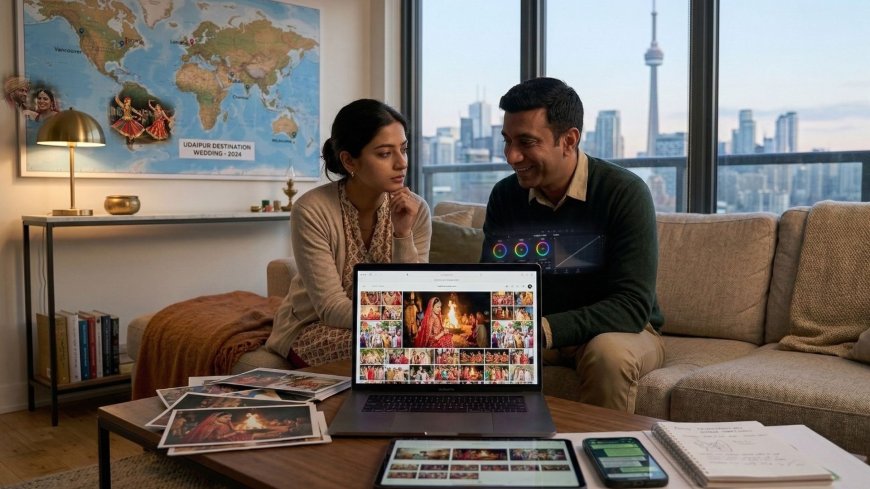
The photographs arrived in Kavya's inbox on a Tuesday morning, six weeks after the wedding. Four thousand, two hundred and thirty-one images. A download link, a password, a note from the photographer that said: it was a privilege to document your day. Kavya opened the gallery on her laptop, looked at the first fifty photographs, and felt the particular overwhelm of someone who has been given something enormous and has no idea what to do with it next.
The wedding had been in Udaipur. The guests had come from eleven countries. Her parents were in Chennai. His parents were in Vancouver. The closest friends were scattered across London, Dubai, Singapore, New York, and Melbourne. Everyone wanted the photographs. Everyone had been asking about the photographs since the week after the wedding. Her mother had called three times. His aunt in Toronto had sent a WhatsApp message that said, with the specific impatience of a woman who has been waiting patiently: any news on the photos? The college friends group chat had gone quiet on the subject in that particular way that means the question is still present but nobody wants to be the one to ask again.
Kavya's instinct was to share everything immediately — to send the download link and the password to everyone and let them find their own photographs. She almost did it. She opened a new WhatsApp broadcast, typed the link, and then paused. Four thousand photographs. Her grandmother in Chennai, who was eighty-one and used a basic smartphone with limited storage, would receive four thousand photographs and have no idea what to do with them. His uncle in Vancouver, who had been photographed in an unflattering moment at the sangeet that Kavya had already noticed and privately decided to address, would receive that photograph along with the rest. The colleague from work who had attended the reception but who Kavya had not invited to the more intimate ceremonies would receive photographs of ceremonies she had not been part of.
The questions multiplied the more she thought about them. Who gets access to everything? Who gets access to a curated selection? How do you share four thousand images with people across eleven countries and twelve different levels of technological comfort? How do you protect the privacy of the photographs — the intimate family moments, the emotional exchanges, the specific images that are meant for the couple and the immediate family rather than the wider circle? How do you make it easy for an eighty-one-year-old grandmother in Chennai to see the photograph of herself at her granddaughter's wedding without requiring her to navigate a password-protected cloud gallery?
These are not small questions. They are the specific questions of the NRI couple whose wedding has produced an archive of several thousand images that must now be distributed intelligently, sensitively, and practically to a dispersed global guest list with wildly varying technological capability, privacy expectations, and emotional investment in the outcome.
Kavya spent three days working it out. She made mistakes. She also, eventually, found the framework. This guide is that framework, assembled before you need it rather than after.
This guide is for every NRI couple sitting in front of four thousand wedding photographs wondering what to do next — for Kavya and every couple like her who deserves the complete framework for sharing wedding photographs intelligently, not just immediately.
Understanding What You Are Actually Distributing
Before selecting a platform or a method, it is worth being precise about what you are actually distributing, because the answer is more complex than "wedding photographs" and the complexity has direct implications for every decision that follows.
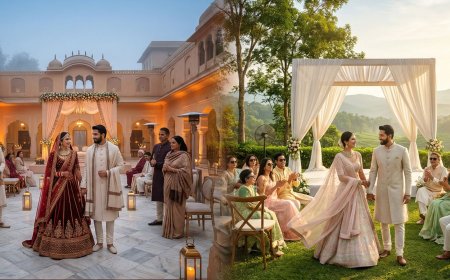
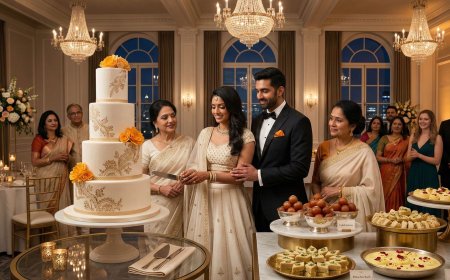
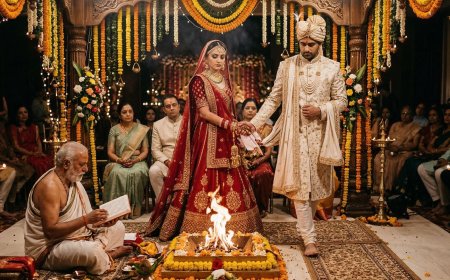
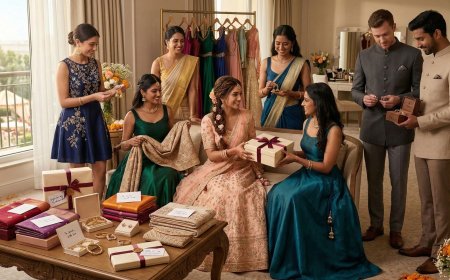
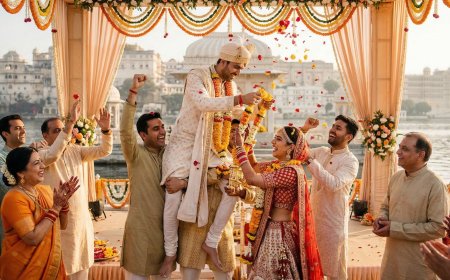
A professional Indian wedding photography archive of four to five thousand images typically contains several distinct categories of content that have different distribution logic. The first category is the formal ceremony photography — the mandap rituals, the pheras, the exchange of garlands, the formal family portraits — which is the content that virtually every guest wants access to and which has the broadest appropriate distribution. The second category is the candid and documentary photography — the unguarded moments, the emotional exchanges, the behind-the-scenes preparation — which is more intimate and which some guests and family members may feel strongly about controlling. The third category is the specific event photography from individual functions — the mehendi, the sangeet, the haldi, the reception — which is relevant primarily to the guests who attended each specific function. The fourth category is the couple's portraits — the pre-wedding shoot, the styled portraits, the intimate couple moments — which are primarily the couple's own content and which many couples prefer to share selectively.
The fundamental error that most couples make is treating all four categories identically — sharing everything with everyone at the same time through the same channel. This approach is the easiest in the short term and the most problematic in the medium term, when the unflattering photograph has already been forwarded, the intimate moment has already been shared beyond the intended circle, and the grandmother's phone has crashed under the weight of four thousand downloads.
The intelligent distribution framework begins by separating these categories and making conscious decisions about who receives what, through which channel, at what time. This is not a complicated process once you have the framework. It takes an afternoon of deliberate curation rather than the thirty seconds of sending a single link — and the difference in outcome is significant.
The Curation Step: Why It Comes Before the Platform Decision
Most wedding photography sharing guides begin with the platform. This one begins with the curation step, because the platform choice is secondary to — and should be informed by — the curation decisions you have already made.
Curation does not mean choosing only the most flattering photographs and suppressing the rest. It means making deliberate decisions about which photographs belong in which distribution tier. A simple three-tier framework serves most NRI couples well.
The first tier is the wide distribution set — the photographs that every guest, regardless of their relationship to the couple or which events they attended, is welcome to see and download. This set is typically two hundred to four hundred photographs, selected for quality, coverage of all the main events and guests, and appropriateness for wide sharing. It is the gallery you send to the WhatsApp broadcast and post on the family Facebook group.
The second tier is the event-specific sets — separate galleries for each function, distributed only to the guests who attended that function. The mehendi gallery goes to the mehendi guests. The sangeet gallery goes to the sangeet guests. The haldi gallery — which often contains photographs that are joyful but informal — goes to the family and closest friends who were present. This tier requires more organisational effort but produces significantly more appropriate sharing.
The third tier is the intimate archive — the full photographer's gallery, including the couple's portraits, the emotional family moments, and the documentary candids. This tier is for the couple, the immediate family, and whoever else the couple specifically chooses to include. It is not for general distribution, and the platform choices for this tier prioritise privacy and control over accessibility.
Platform Guide: What Each Option Actually Does
Google Photos: The Accessible Standard
Google Photos is the most commonly used platform for sharing large photo collections, and for good reason — it is free, widely understood, accessible on any device, and capable of storing and sharing collections of thousands of images without degradation. For NRI wedding sharing, its specific strengths are its accessibility across all device types and operating systems, its ability to create shared albums with specific guest permissions, and its integration with the Google accounts that a significant proportion of your guest list already has.
The shared album function in Google Photos allows you to create a specific album, share it via a link, and control whether recipients can add their own photographs to the album or only view yours. The latter feature — the ability for guests to add their own photographs — is particularly valuable for the NRI wedding, where guests across eleven countries have taken their own images that you will never otherwise see. A shared Google Photos album that guests can contribute to becomes a collaborative archive of the wedding, not just a distribution of the professional photographs.
The limitations of Google Photos for NRI wedding sharing are also worth knowing. The platform requires a Google account for full functionality, which most guests will have but not all. The interface, while straightforward for regular Google users, can be confusing for less technically comfortable guests — the eighty-one-year-old grandmother in Chennai is unlikely to navigate it independently. Download functionality is available but not always intuitively obvious to all users. And the privacy controls, while adequate, are not as granular as some couples require for their more intimate photographs.
Pixieset: The Professional Photographer's Platform
Pixieset is the platform most commonly used by professional wedding photographers to deliver their work to clients, and if your photographer has already delivered the gallery through Pixieset, you are already familiar with its interface. Its specific strengths for NRI wedding sharing are its clean, gallery-style presentation that showcases photographs at their best quality, its robust download management system that allows you to control whether guests can download full-resolution files or only lower-resolution versions, and its password protection that gives you genuine control over who accesses the gallery.
For the NRI couple who wants to share a curated, beautiful gallery with a wide guest list, Pixieset's presentation quality is its primary advantage — the photographs look genuinely good in the Pixieset interface in a way that they do not in a WhatsApp download or a Google Drive folder. The platform also handles the high-resolution file sizes of professional wedding photography without the compression that degrades image quality on some other platforms.
The limitations are cost — Pixieset's paid plans, which are required for galleries of the size that a full wedding produces, start at a monthly subscription that adds up over the months or years the gallery needs to be accessible — and the requirement that guests create an account or enter a password, which adds friction for less technically comfortable guests.
Smash: The Simple, Link-Based Option
For the wide distribution tier — the two hundred to four hundred photograph set that goes to every guest through a WhatsApp broadcast — a simple, friction-free sharing platform is often more appropriate than a full gallery service. Smash, and similar platforms like WeTransfer and Filemail, allow you to upload a collection of files and generate a simple download link that requires no account, no password, and no technical knowledge beyond clicking a link and waiting for a download.
The simplicity is the point. The guest who receives a Smash link in WhatsApp can download the photographs to their phone in three taps, without creating an account or navigating a gallery interface. For the less technically comfortable members of your guest list — and every NRI wedding has them — this simplicity is more respectful of their experience than a beautifully designed but technically demanding gallery platform.
The limitations are the absence of privacy controls, the temporary nature of the download link, and the lack of any collaborative or contribution functionality. Smash links expire after a set period, which means the photographs are not permanently accessible through this channel and guests who do not download promptly may lose access.
Wetransfer: Reliable and Familiar
WeTransfer occupies similar territory to Smash — it is a file transfer service rather than a gallery service — but it has broader name recognition and is trusted by a wider demographic. For the NRI couple whose guest list includes a significant proportion of professionals who use WeTransfer regularly in their working lives, the familiarity reduces friction. The Pro plan allows transfer of larger files and provides more control over the download link, including password protection and link expiry date.
Private Facebook Albums: The Family Network Option
For the extended family network — particularly the older generation in India who may have Facebook accounts but limited comfort with newer platforms — a private Facebook album remains a surprisingly practical distribution method. Most Indian families have established Facebook presences for older members specifically because Facebook was the platform that made social media accessible to the non-tech-native generation, and the private album function is understood by this demographic in a way that Pixieset and Google Photos may not be.
The specific advantage of Facebook for the family distribution tier is that it meets people where they already are. The limitation is privacy — Facebook's data practices and the relative permeability of "private" albums on social platforms mean that this channel is appropriate for the wide distribution tier rather than the intimate archive.
iCloud Shared Albums: The Apple Ecosystem Option
For NRI couples and guest lists that are heavily within the Apple ecosystem — iPhone and Mac users — iCloud Shared Albums provide an elegant, integrated sharing solution that works within the Photos application that Apple users already use for their own photography. The shared album appears directly in the guest's Photos library, photographs download automatically at full resolution, and guests can contribute their own photographs seamlessly.
The limitation is platform specificity — iCloud Shared Albums work well only for Apple users and are either unavailable or significantly degraded in experience for Android and Windows users. For the NRI wedding with a diverse international guest list, this limitation is usually disqualifying for the main distribution tier, though it works well as a supplementary channel for the guests who are in the Apple ecosystem.
Building the Distribution Architecture: The Complete Framework
With the curation tiers and the platform options understood, the distribution architecture for the NRI wedding photograph sharing can be built specifically and deliberately. The following framework serves most NRI couples well and can be adapted to specific circumstances.
Tier One: The Wide Distribution Gallery
Platform recommendation: Google Photos shared album with contribution enabled, supplemented by a Smash or WeTransfer link for guests who prefer direct download over gallery browsing.
Content: Two hundred to four hundred curated photographs covering all main events, all major guest groups, and all ceremony highlights. Reviewed specifically for any images that should not be in wide circulation — unflattering moments of specific guests, intimate family exchanges, any images that a specific guest has asked not to be shared.
Distribution channel: WhatsApp broadcast to all guests, email to guests not on WhatsApp, brief note explaining how to access and download.
Timing: Three to four weeks after the wedding, once the photographer has delivered the full gallery and the couple has had time to curate.
Tier Two: The Event-Specific Galleries
Platform recommendation: Google Photos shared albums, one per function, with contribution enabled for each.
Content: All photographs from each specific function — mehendi, haldi, sangeet, baraat, ceremony, reception — distributed only to guests who attended that function.
Distribution channel: Separate WhatsApp messages or emails to the guest lists for each function.
Timing: Same as Tier One, sent in the same communication with clear labelling of which gallery is which.
Tier Three: The Intimate Archive
Platform recommendation: Pixieset password-protected gallery, or Google Photos shared album with contribution disabled and link shared only with specific people.
Content: The full photographer's gallery, including couple's portraits and all documentary candids.
Distribution channel: Direct message or email to specific individuals — immediate family, closest friends — with the password or link shared individually rather than broadcast.
Timing: Can be shared earlier than the wide distribution tier, as an intimate sharing with the closest circle before the broader distribution.
The Grandmother Protocol
Every NRI wedding has at least one elderly family member whose technological comfort level makes standard platform sharing impractical. The grandmother who does not have a smartphone that can navigate a gallery link deserves to see the photographs of her grandchild's wedding, and the responsibility for making that possible rests with the couple.
The specific solution for the technologically limited guest is a physical print set — a curated selection of twenty to forty photographs, printed at a standard photo print size and sent by post to the guest's address. This is not an expensive or complicated undertaking: online print services in India, the UK, Canada, Australia, and most other countries with significant NRI populations can print and ship a set of photographs for a modest cost within a week. The photograph that arrives in the post, that can be held and placed in an album and shown to neighbours, is a different and in some ways more meaningful gift than a link to a digital gallery. Do not substitute the link for the print when your guest cannot use the link.
Privacy, Consent, and the Questions Most Couples Do Not Ask
The sharing of wedding photographs raises privacy questions that are genuinely important and that the excitement of wanting to share the photographs often causes couples to bypass. These questions deserve to be asked before the distribution link is sent.
The Guest Consent Question
Every photograph in your wedding gallery contains people — your guests — who did not explicitly consent to being photographed and who may have varying expectations about how those photographs will be used and shared. For the wide distribution tier in particular, it is worth considering whether any guest has reason to object to specific photographs being widely shared — a guest going through a difficult personal period who does not want their image circulating on social media, a guest whose attendance at the wedding was not known to certain other guests, a guest who appears in a photograph in a way they would find embarrassing.
The practical approach is not to seek explicit consent from every guest for every photograph, which is neither feasible nor necessary. It is to exercise editorial judgment in the curation step — to ask, for each photograph in the wide distribution set, whether there is any reason a guest in the image might object to its inclusion, and to err on the side of exclusion when the answer is uncertain.
The Social Media Question
The wide distribution tier, by definition, creates photographs that will be shared on social media by the guests who receive them. This is not within your control once the link has been sent. What is within your control is whether you send a clear note with the gallery about your preferences — whether you ask guests not to post specific photographs publicly, whether you ask guests to tag the couple when they share, whether you ask guests to wait until a specific date before posting on public platforms.
Most guests will respect a clear, gracious request. The note that says: we would love for you to share these photographs, and we ask only that you check with us before posting the formal ceremony photographs publicly — that note is received well by most guests and respected by most of them.
The Photographer's Rights
Your photographer retains copyright in the images they have produced unless your contract explicitly transfers copyright to you. This means that the use of the photographs — for personal sharing, for social media, for any commercial purpose — is governed by the terms of your contract with the photographer, and those terms vary significantly between photographers and between contracts.
Most wedding photography contracts permit personal sharing and personal social media use by the couple and guests. Many contracts require credit to the photographer when images are shared publicly. Some contracts restrict specific uses. Read your contract before you distribute the gallery, and if you are uncertain about what the contract permits, ask the photographer directly. A photographer who has delivered a gallery of four thousand images and written that it was a privilege to document your day is not going to object to your family sharing the photographs. They will, however, appreciate being asked about their credit preferences.
Timing and Communication: The Often-Overlooked Dimensions
When to Share
The question of when to share the photographs is more nuanced than it first appears. The impulse is to share as quickly as possible, and guests' requests amplify this impulse. But the best time to share is not the fastest time — it is the time at which the couple has completed the curation step, made the distribution tier decisions, and prepared the communication that accompanies the gallery.
For most NRI couples, this means three to four weeks after the wedding. The photographer's delivery timeline typically aligns with this — most professional wedding photographers deliver the full edited gallery within four to six weeks of the wedding. If your photographer delivers earlier, the limiting factor becomes the couple's bandwidth for curation, which is genuinely limited in the immediate post-wedding period.
The guests who are asking about the photographs within the first week should receive a brief, warm acknowledgment: the photographs are coming, the photographer is editing, you will have them by a specific date. A specific date is more reassuring than "soon." Manage the expectation with precision.
How to Communicate the Sharing
The communication that accompanies the gallery link is not a formality. It is the framing that shapes how guests receive and engage with the photographs, and it deserves the same care as any other significant communication in the wedding process.
A well-crafted gallery communication includes a brief personal note from the couple — not a template, not a generic thank-you, but a specific sentence or two that names what the photographs represent to the couple and what it meant to share the occasion with the people receiving the message. It includes clear, simple instructions for accessing and downloading the gallery. It includes the note about photographer credit and social media preferences if those are relevant. And it includes, for the event-specific galleries, a specific acknowledgment of the function and the guests' presence at it.
The communication that says: here are the photos, enjoy — is technically sufficient and emotionally thin. The communication that says: six weeks ago you flew from Vancouver to Udaipur to be with us, and now here is the record of what that looked like — that communication lands differently, because it is true and specific and it honours the investment the guest made in being there.
Common Mistakes NRI Couples Make With Wedding Photo Sharing
The first mistake is sharing the full unedited photographer's gallery directly with all guests. The full gallery — four to five thousand images, including the test shots, the duplicates, the unflattering candids, and the images the photographer included for the couple's reference rather than for wide sharing — is not the sharing gallery. It is the working archive from which the sharing gallery is curated. Sending the raw full gallery to all guests is an abdication of the curation responsibility and produces a poor experience for everyone who receives it.
The second mistake is using a single platform for all distribution tiers. The platform that works best for the intimate archive — password-protected, high-resolution, beautifully presented — is not the platform that works best for the wide distribution tier, where friction-free accessibility matters more than presentation quality. The platform that works for tech-comfortable guests in their thirties does not work for elderly family members in India. Build the distribution architecture with multiple channels rather than forcing all distribution through a single platform.
The third mistake is failing to address the photographs that should not be widely shared. Every wedding photography archive contains images that are better kept within a smaller circle — the emotional family moment that was photographed unexpectedly, the candid that captures a guest in an unflattering way, the intimate exchange between the couple that the photographer documented beautifully but that the couple may not want in wide circulation. The curation step must specifically address these images, not by deleting them from the archive but by excluding them from the wide distribution tier.
The fourth mistake is not accounting for the file size reality of high-resolution wedding photographs. A gallery of four hundred full-resolution images from a professional wedding photographer represents several gigabytes of data. Guests who receive a link to this gallery and attempt to download it on a mobile data connection, or on a device with limited storage, face a practical problem that prevents them from accessing the photographs. The solution is to offer both full-resolution downloads for guests who want them and web-resolution versions for guests who need a smaller file size. Most gallery platforms support this dual option.
The fifth mistake is not preserving the archive for the long term. The gallery platform subscription lapses. The photographer's delivery link expires. The Google Photos account is linked to an email address that is eventually abandoned. The wedding photographs that were shared beautifully in the months after the wedding become inaccessible five years later because nobody maintained the archive. The couple's responsibility extends beyond the initial sharing to the long-term preservation of the photographic record — backed up in at least two separate locations, on physical media as well as cloud storage, with access credentials documented somewhere accessible to both partners.
The Video Question: Applying the Same Framework
Everything in this guide applies with equal force to wedding videography, which for NRI weddings typically produces multiple hours of footage — highlight films, full ceremony recordings, function films — that must be distributed with the same intelligence and the same care as the still photography.
The specific platform considerations for video differ from still photographs primarily in file size — wedding video files are substantially larger than photograph files, and the distribution platforms that handle photographs well may not handle video files at the same quality. YouTube's unlisted video function — which creates a private video accessible only via a direct link — is among the most practical solutions for wide video distribution, combining the accessibility of a simple link with the streaming quality of YouTube's infrastructure. Vimeo's paid plans offer similar functionality with a more cinematic presentation that most wedding videographers prefer.
The curation principle applies to video as to photographs: the full unedited ceremony recording is not the sharing film. The highlight film — typically three to five minutes, produced by the videographer — is the wide distribution content. The full ceremony recordings are the intimate archive content. Distribute accordingly.
Kavya spent the three days after the gallery arrived building the distribution architecture described in this guide. She did not know it was an architecture at the time — she was working it out by instinct and by the specific logic of the problems she was trying to solve. The grandmother's print set. The separate sangeet gallery. The password-protected intimate archive. The note to guests about photographer credit.
She sent the first gallery link on a Thursday evening, London time. Within two hours, her mother in Chennai had called to say that she had looked at every photograph twice. His aunt in Toronto had sent a voice note that was, judging by the sounds in it, recorded while crying. The college friends group chat, which had gone quiet on the subject, produced forty-seven messages in twenty minutes.
Three weeks later, a photograph arrived in the post at Kavya's parents' house in Chennai. Her grandmother had taken one of the printed photographs — a formal portrait of the three of them together, grandmother and granddaughter and new husband — to a frame shop. It was on the wall of the sitting room, next to the framed photographs of the grandmother's own wedding in 1962 and Kavya's parents' wedding in 1991.
Curate before you distribute. Build the tiers before you choose the platform. Send the grandmother's prints before she asks. Write the note that honours what the guest gave to be there.
The photographs are the record. How you share them is also part of the record.
Published by NRIWedding.com — The Premium Global Platform for Non-Resident Indians Planning Indian Weddings From Abroad.
What's Your Reaction?
 Like
0
Like
0
 Dislike
0
Dislike
0
 Love
0
Love
0
 Funny
0
Funny
0
 Angry
0
Angry
0
 Sad
0
Sad
0
 Wow
0
Wow
0