







































































Nine Hundred Video Calls: The NRI Couple's Complete Guide to Virtual Wedding Planning Tools and Platforms That Actually Work
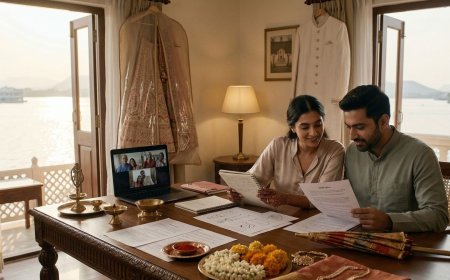
The couple in Toronto planning a wedding in Udaipur across a nine and a half hour time difference, one India visit, and approximately nine hundred video calls, document shares, and fabric swatches photographed against white paper. Remote Indian wedding planning is the most logistically complex sustained project most NRI couples will ever manage — and the difference between the couples who manage it well and those who do not is not the tools they use but the discipline with which they use them. This guide delivers a complete framework covering the sensory and relationship gaps that digital tools cannot fully bridge, the core tools from video calling to shared documents to project management platforms, WedMeGood and Western planning platforms honestly assessed, the structured virtual venue visit, the optimal India visit timing and schedule, the weekly planning rhythm, the decision log, the vendor communication standard, and the honest acknowledgment of where digital tools reach their limits.


Virtual Wedding Planning: Tools and Platforms That Actually Work for NRIs
The NRI couple's complete guide to planning an Indian wedding from another continent — the specific tools, the specific workflows, and the specific discipline that makes remote planning as effective as it can be, and honest about where it cannot fully substitute for being there
The Couple Who Planned Everything From a Kitchen Table in Toronto
The wedding was in Udaipur. The couple lived in Toronto. Between the engagement and the wedding was fourteen months, one visit to India at the eight-month mark, and approximately nine hundred video calls, voice messages, document shares, vendor presentations, fabric swatches photographed against white paper, floral arrangements shown on phone cameras in market stalls, and one memorable forty-five-minute call in which the bride's mother held her phone over a table of saree options while the bride attempted to assess silk quality from a compressed video feed on a laptop screen in a Canadian winter.
The wedding was extraordinary. The planning process was, by the couple's honest assessment afterward, the most logistically complex sustained project either of them had ever managed — more demanding in its coordination requirements than anything they had encountered professionally, sustained over more than a year, conducted almost entirely through digital tools that were not designed for this specific purpose and that they had adapted, improvised, and combined into a workflow that worked better than it had any right to.
The tools they used were not exotic. They were the tools that most knowledge workers use for remote collaboration — video calling, shared documents, cloud storage, project management software, WhatsApp. The skill was not in the tools. It was in using them with the specific discipline and the specific structure that remote planning across a significant time difference requires.
This guide provides that structure. It also provides the honest assessment of where digital tools reach their limits — and what the couple who cannot be physically present needs to acknowledge about what remote planning cannot fully replace.
The Fundamental Challenge of Remote Indian Wedding Planning
The NRI couple planning a wedding in India from abroad faces a specific version of the remote collaboration challenge that is more demanding than most remote work situations for several reasons.
The Sensory Gap
A significant proportion of Indian wedding planning involves sensory assessment that digital tools approximate poorly. The quality of a silk saree. The specific fragrance of the florals in the ceremony space. The acoustic quality of the venue. The weight and texture of the wedding stationery. The color accuracy of the lehenga that looks one shade on a phone camera and is a different shade in natural light.
The digital tool can transmit visual information — imperfectly, with color accuracy that varies by device and lighting — and it cannot transmit texture, weight, fragrance, or the specific quality of presence in a physical space. The remote couple who is making decisions about physical, sensory objects entirely through digital proxies is working with incomplete information and must be honest with themselves about this.
The mitigation: trusted proxies in India — family members, the wedding planner, trusted friends — who have the couple's sensory vocabulary and can make the specific assessments the couple cannot make remotely. The wedding planner who has worked extensively with NRI couples and who understands the specific job of translating sensory experience into information the remote couple can act on is invaluable precisely because they bridge this gap.
The Relationship Gap
Indian wedding planning — more than most event planning — is conducted through relationships. The vendor who gives the best service is often not the vendor with the best website but the vendor whose relationship with the wedding planner or with the family creates the specific accountability and the specific investment in the outcome that produces extraordinary work.
The remote couple who is managing vendor relationships entirely through digital channels — who has never met the mehendi artist, the Pandit, the florist, the catering team — has a different relationship with these vendors than the couple who has sat with them, shared tea, and established the personal connection that Indian vendor relationships are built on.
The mitigation: the India visit, timed to the maximum productive use of limited time in the country. And the wedding planner who is the couple's physical presence in those relationships — whose relationship with each vendor is the substitute for the couple's own.
The Time Zone Tax
The NRI couple in Toronto planning a wedding in India is operating across a nine and a half hour time difference. The window of overlap — the hours when both the couple and their India-based vendors and family are awake and available — is compressed and specific. The mismanagement of this window — the call that was not scheduled, the document that was sent at 11pm India time expecting a response before the day's decisions needed to be made — is a consistent source of friction in remote planning.
The time zone tax is not eliminated by good tools. It is managed by specific scheduling discipline, realistic timelines that account for the reduced daily overlap, and the specific habit of working ahead rather than in the moment.
The Core Tools: What Works and What Does Not
Video Calling: The Workhorse
Video calling — WhatsApp video, Zoom, Google Meet, FaceTime — is the primary communication tool for NRI wedding planning, and its quality has reached the point where a well-run video call can be a genuinely effective planning session rather than an approximation of one.
What works well:
Vendor presentations — the florist who walks the camera through a sample arrangement, the caterer who shows the tasting spread, the venue coordinator who takes the phone on a tour of the event spaces. The combination of visual information and real-time conversation is the closest approximation available to a physical meeting, and for many planning conversations it is adequate.
Family alignment calls — the multi-party calls that bring together the couple in Toronto, the bride's parents in London, and the groom's parents in Mumbai to discuss a specific decision, that would otherwise require multiple sequential conversations with the risk of information distortion.
What does not work well:
Sensory assessment, as described above. Video calls for emotional conversations — the difficult discussion about the budget, the conversation about the guest list, the specific family dynamics that are better navigated in person — where the absence of physical presence removes the specific relational warmth that makes difficult conversations manageable. And large multi-party calls where the communication overhead of managing many people through a video interface obscures rather than facilitates the decisions that need to be made.
The discipline that makes video calls work:
An agenda, shared in advance. A defined duration. A designated note-taker whose notes are shared within twenty-four hours. A clear statement of the decisions made and the actions assigned. The video call that does not have these elements is a social call masquerading as a planning session — and the social call has its value, but it should not be confused with productive planning.
Shared Documents: The Planning Spine
The shared document — the Google Doc or the Notion page or the Airtable database that is accessible to all planning participants simultaneously and that contains the authoritative record of every decision, every vendor contact, every outstanding task — is the most important planning infrastructure the remote couple can invest in.
The shared document's function is to eliminate the information asymmetry that is the primary failure mode of remote planning — the situation where the couple knows something the wedding planner does not, the wedding planner knows something the family does not, and the family knows something the couple does not, and the planning is proceeding on the basis of three different understandings of the current situation.
The documents that work:
The master wedding document — a single, well-organized document that contains: the wedding's key information, the event schedule, the vendor list with contact details and contract summaries, the current status of every outstanding decision, and the action log with assigned responsibilities and deadlines. This document is the single source of truth for the entire planning operation.
The vendor tracker — a spreadsheet that tracks every vendor that has been considered, contacted, and contracted, with their quote, their contract status, their key contacts, and their specific deliverables. The vendor tracker is the operational tool for managing the twelve to thirty vendor relationships that a large NRI wedding involves.
The guest list management document — as described in the RSVP management guide — with response status, dietary requirements, accommodation bookings, and transportation needs for every invited guest.
The budget tracker — the document that tracks every cost, every payment, every outstanding liability, and the current budget status against the original allocation.
The discipline that makes shared documents work:
A single owner for each document — the person responsible for its accuracy and currency. A consistent update protocol — the rule that every decision, every vendor update, and every cost change is entered within twenty-four hours. And the commitment from all planning participants to consult the document before asking the question that the document answers — the commitment that prevents the document owner from spending their time re-answering questions whose answers are already recorded.
Project Management Platforms
For couples who want more structured task management than a shared document provides, project management platforms — Asana, Trello, Monday.com, Notion — offer specific capabilities that the document does not.
What project management platforms add:
Task assignment with specific owners and deadlines. Visual progress tracking — the Kanban board or the Gantt chart that shows the overall project status at a glance. Automated reminders for approaching deadlines. The ability to attach documents, photographs, and vendor files directly to the relevant task.
The honest assessment:
Project management platforms add value when the planning operation is large enough and complex enough to benefit from their structure — typically for weddings with large vendor teams, multiple events, and planning participants distributed across several households. For smaller weddings or for couples who find the platform's overhead more burden than benefit, a well-maintained shared document achieves most of the same function with less setup investment.
The project management platform that is set up in January and abandoned by April because nobody is updating it is worse than the shared document that is consistently maintained — because the abandoned platform creates the illusion of organization without the substance.
Cloud Storage: The Asset Library
Cloud storage — Google Drive, Dropbox, iCloud — serves a specific and essential function in remote Indian wedding planning: the centralized library of every visual asset, every vendor document, every contract, every inspiration image, every fabric swatch photograph, and every event design reference that the planning process generates.
The cloud storage library allows: the couple to access every planning document from any device. The wedding planner to access the couple's vision board and design references without repeated file transfers. The vendor who needs the logo for the wedding stationery to access it without emailing the couple. The family member who needs to see the venue floor plan to access it without waiting for someone to send it.
The organization that makes cloud storage work:
A folder structure established at the beginning of the planning process — not the accumulated files that were dumped into a single folder as they were created. Event-specific folders for each wedding event. Vendor-specific folders for each contracted vendor. A design folder for all visual references. A contracts folder for all signed agreements. A communications folder for important email threads that need to be preserved.
The cloud storage that is organized is the cloud storage that is used. The cloud storage that is a single folder containing two hundred and forty files with names like "photo 2024-11-23" is the cloud storage whose value is entirely theoretical.
WhatsApp: The Informal Layer
WhatsApp is the primary informal communication channel for Indian wedding planning — the platform on which the quick question, the vendor update, the photograph of the floral sample, and the voice message from the bride's mother all travel.
WhatsApp is not a planning tool in the structured sense — it does not create searchable records, it does not assign tasks, it does not track decisions. But it is the communication layer through which most real-time planning information travels, and the attempt to replace it with more structured tools will fail because the vendors, the family members, and the wedding planner are operating on WhatsApp regardless of what the couple prefers.
The WhatsApp discipline that makes it manageable:
Dedicated WhatsApp groups for specific planning functions — one group for the vendor coordination, one for the family planning, one for the wedding planner team — rather than a single group that combines all communication in an unsearchable stream. The habit of transferring decisions and commitments from WhatsApp to the shared document within twenty-four hours — so that the authoritative record is in the structured document rather than buried in a chat history. And the specific discipline of not making final decisions in WhatsApp — of treating WhatsApp as the preliminary conversation and the shared document as the confirmation.
The Specialist Platforms: Tools Built for Wedding Planning
Several platforms have been built specifically for wedding planning and offer specific capabilities that general collaboration tools do not.
Aisle Planner and Joy
Aisle Planner and Joy are wedding planning platforms whose specific design for the planning workflow — vendor management, guest management, budget tracking, and timeline planning in an integrated system — offers advantages over the general tools for couples who want a single dedicated platform.
What they offer:
An integrated system where the guest list, the RSVP tracking, the vendor contacts, and the budget are all in one place rather than in separate documents that must be manually synchronized. A wedding website integrated with the planning tools, so that the guest RSVP and the planning data are automatically connected. Mobile apps that make the planning tools accessible on any device without the friction of document sharing.
The honest assessment for NRI couples:
These platforms are designed primarily for the Western wedding model and have varying degrees of adaptability to the NRI wedding's specific requirements — the multi-event structure, the Indian dietary complexity, the dual cultural guest list. The NRI couple who uses one of these platforms will find some capabilities well-suited and some requiring workarounds. They are worth assessing against the specific requirements described in the NRI wedding context, with the understanding that they are a starting point rather than a complete solution.
WedMeGood
WedMeGood is the Indian-specific wedding planning platform with the broadest adoption in the Indian wedding market — both the vendor directory and the planning tools are specifically designed for the Indian wedding context.
What it offers for remote planning:
A vendor directory with genuine coverage of the major Indian wedding markets, with verified reviews from real couples. A planning tool that understands the Indian wedding's multi-event structure. A budget tracker calibrated to Indian wedding cost structures. And the specific advantage of a platform that vendors in India are already registered on and familiar with — reducing the friction of introducing a new tool to vendors who may not be comfortable with Western platforms.
The honest assessment:
WedMeGood's value is primarily as a vendor discovery and communication platform rather than as a comprehensive project management tool. Its planning tools are useful but less powerful than dedicated project management platforms for couples managing complex planning operations. The combination — WedMeGood for vendor discovery and communication, a shared document or project management platform for operational planning — is the hybrid that most experienced NRI wedding planners use.
The Virtual Venue Visit: Making It Work
The venue decision is among the most consequential decisions in wedding planning — and for the remote couple who cannot make multiple visits to assess competing venues, the virtual venue visit must do as much work as possible.
The Structured Virtual Tour
The virtual venue tour that is most useful to the remote couple is not the venue's promotional video — which shows the venue at its best, in curated lighting, without the honest assessment of its limitations. It is the live, unscripted walkthrough conducted by someone the couple trusts — the wedding planner, a family member — who is physically at the venue with a phone camera and a specific brief.
The specific brief for the virtual venue walkthrough:
Walk every event space in sequence, narrating what the camera is not showing — the acoustic quality of the ceremony space, the specific smell of the heritage property in the afternoon, the view from the bridal suite. Walk the guest experience — from the arrival point, through the transition spaces, to each event space — so the remote couple understands the physical logic of the venue from a guest's perspective. Walk the problems — the service entrance that is visible from the reception space, the parking situation that will affect the baraat, the specific column that will obstruct sightlines in the ceremony space.
The walkthrough that shows the remote couple only the venue's best angles is not a useful assessment tool. The walkthrough that shows them what they need to know to make a good decision is the one worth doing.
The Comparison Framework
The remote couple assessing multiple venues needs a comparison framework — a specific set of criteria against which each venue is assessed in the virtual walkthrough, producing a structured comparison rather than the impressionistic sense of which venue felt best on camera.
The comparison framework: event spaces available and their capacity, the transition between spaces for a multi-event programme, the accommodation situation for international guests, the venue's own catering versus outside caterer policy, the audio and technical provision, the heritage or fire restrictions affecting fireworks and special effects, the vendor access policy, and the venue coordinator's specific responsiveness and competence in the virtual interaction.
The remote couple who has a structured comparison of five venues is making a better decision than the couple who is choosing between five impressions.
The India Visit: Making It Count
For all the capability of digital tools, the India visit — the specific window of physical presence in the wedding planning process — is irreplaceable. The question for the remote couple is not whether to visit but how to structure the visit to extract the maximum planning value from limited time.
The Optimal Visit Timing
The single visit that most NRI couples can manage is most productive at the eight to ten month mark — after the initial vendor research has been conducted remotely and the shortlist of vendors has been established, but with sufficient remaining time to make the decisions the visit produces effective.
At eight to ten months: the venue decision should ideally be complete before or during the visit, so that the visit can focus on the vendors who operate within the confirmed venue. The shortlisted vendors in each category — florals, catering, photography, entertainment — should be scheduled for in-person meetings. The fabric and design decisions — the bridal trousseau, the groom's attire, the décor aesthetic — should be the primary sensory assessment work.
The Visit Schedule
The India visit for planning purposes should be scheduled as a working trip rather than a family visit with planning on the side. The specific conflict between the family's natural desire to have the couple present at every social occasion and the couple's specific need for focused vendor meetings is a conflict that must be managed explicitly rather than allowed to resolve itself through the progressive colonization of the schedule.
The working day structure: mornings for vendor meetings, afternoons for physical assessments — fabric, food tastings, floral samples — and evenings for family time. The schedule shared with the family in advance, with the specific explanation that this structure is the reason the wedding will be what they are hoping for.
What to Prioritize in Person
The bridal and groom attire: The sensory assessment of fabric, the fit consultation, the specific color accuracy that only physical presence provides — these are the decisions most diminished by remote assessment and most improved by physical presence.
The food tasting: The catering decision for a large Indian wedding is partially a logistics assessment and primarily a sensory assessment. The food tasting that happens in person — evaluating the actual food rather than a menu document or a photograph — is the assessment that the remote planning process cannot replicate.
The key vendor relationships: The wedding planner, the florist, the photographer — the vendors whose relationship with the couple will matter most to the outcome — benefit from an in-person meeting that establishes the personal connection that the remote relationship approximates but does not fully achieve.
The décor walkthrough: The physical experience of the venue with the décor team — walking the spaces with the florist and the lighting designer and the wedding planner, making decisions about the physical configuration of the event spaces — is a planning session whose value is significantly higher in person than it is over a video call.
The Remote Planning Disciplines: What Separates the Couples Who Manage Well from Those Who Do Not
The Weekly Planning Rhythm
The remote planning process that works has a specific rhythm — a weekly or fortnightly structure of specific planning activities, reviews, and decisions that creates momentum and prevents the accumulation of unaddressed issues.
The weekly planning rhythm: a standing video call with the wedding planner, a review of the week's vendor updates, a progress check on outstanding decisions, and a plan for the following week's activities. The call that happens every week, without exception, produces a different planning outcome from the call that happens when something needs to be discussed.
The Decision Log
The decision log — a simple record of every significant planning decision, the date it was made, and the person who made it — is the specific tool that prevents the specific problem of decisions being revisited, disputed, or forgotten.
The Indian wedding planning process involves many stakeholders with strong opinions — the couple, the families on both sides, the wedding planner, the key vendors. The decision that was made in a video call and not recorded is the decision that is revisited when a family member who was not on the call forms a different opinion. The decision that is recorded — with the date, the participants, and the specific outcome — is the decision that can be referred to and respected.
The Vendor Communication Standard
The NRI couple's vendor communication should meet a specific standard — not the WhatsApp exchange that is informal and unrecorded, but the email or the shared document that creates a specific, searchable record of what was agreed.
The standard: every significant vendor conversation should conclude with a summary email — "confirming what we discussed today" — that states the specific agreement, the timeline, and the next steps. This email is the shared record that prevents the specific situation where the vendor's understanding of what was agreed differs from the couple's, with no documentary basis for resolving the difference.
Where Digital Tools Reach Their Limits
The Honest Acknowledgment
This guide has been largely optimistic about what remote planning tools can achieve — because good tools, used with discipline, genuinely do achieve a great deal. But the honest conclusion must acknowledge where they do not.
The remote couple who plans their wedding entirely without physical presence in India — without the India visit, without the in-person vendor relationships, without the physical assessments that digital tools approximate — is making a different set of tradeoffs than the couple who is on the ground. The wedding they produce is very likely to be wonderful. It may also have specific elements that would have been different with physical presence — the catering that was good but not the specific catering that the tasting visit would have produced, the venue relationship that was functional but not the specific warmth that the in-person connection creates, the bridal attire whose color was slightly different from the digital approximation.
These are not catastrophic failures. They are the specific costs of remote planning — costs that are worth accepting given the reality of the NRI couple's situation, but that are worth accepting honestly rather than pretending that the digital tools have fully resolved.
The Things That Cannot Be Delegated
The wedding planner can assess the venue on the couple's behalf. A trusted family member can attend the vendor meeting the couple cannot. The digital tools can transmit information across a continent.
But the decisions that involve the couple's deepest personal preferences — the specific shade of the lehenga, the specific feeling of the ceremony space, the specific quality of the relationship with the Pandit who will conduct the ceremony — these decisions benefit from the couple's physical presence in a way that no tool and no proxy fully replaces.
The remote couple who knows what cannot be delegated, and who manages the planning process to ensure that these specific decisions happen during their India visit rather than remotely, has understood the fundamental principle of making digital tools work for the specific occasion they are planning.
Plan remotely. Visit purposefully. Trust the tools where they work and know where they do not.
The wedding in Udaipur is worth the nine hundred video calls.
NRIWedding.com — Expert guidance for Indian weddings planned across borders.
What's Your Reaction?
 Like
0
Like
0
 Dislike
0
Dislike
0
 Love
0
Love
0
 Funny
0
Funny
0
 Angry
0
Angry
0
 Sad
0
Sad
0
 Wow
0
Wow
0