

























































Why Is the Wedding Ring Worn on the Fourth Finger? The History Every NRI Couple Should Know
The tradition of wearing a wedding ring on the fourth finger spans ancient Egypt, Roman medicine, Vedic philosophy, and Christian liturgy — all arriving independently at the same profound instinct: that love must be marked on the body. For NRI couples navigating Hindu, Sikh, Tamil, Bengali, and Punjabi wedding traditions alongside Western ring customs, this in-depth guide explores the history of the Vena Amoris, India's own sacred commitment markers including the mangalsutra, thaali, bichiya, and kara, and how diaspora couples across the UK, Canada, Australia, UAE, and USA are beautifully honouring both traditions at once.


One of the most intimate and universal gestures in human wedding ceremony — the placing of a ring on a specific finger — carries within it a history spanning ancient Egypt, Roman medicine, Indian tradition, and modern neuroscience. For NRI couples navigating the intersection of Indian and Western wedding customs, understanding the deep story behind this small but profound act transforms a borrowed tradition into a consciously chosen one. The fourth finger, it turns out, was never an arbitrary choice.
You have done it without thinking — or watched someone else do it — hundreds of times. The ring slides onto the fourth finger of the left hand and something shifts in the air. It is one of the quietest moments in the loudest day of a person's life. A small gold or platinum circle, a specific finger, a gesture so old that nobody remembers who first made it or why. You simply do it because it has always been done this way.
But you are planning your own wedding now — in London or Houston or Melbourne or Dubai — and you are thinking, perhaps for the first time, about what this gesture actually means. Where it came from. Why that finger. Whether the Indian tradition you grew up with has its own answer to the same question. And what it means to stand at the place where two ancient cultures make the same gesture for completely different reasons and arrive, somehow, at the same moment of love made visible.
The answer reaches back further than you might expect. And it is more beautiful than the gesture alone.
🌟 DID YOU KNOW?
The belief that a vein runs directly from the fourth finger to the heart — known in Latin as the Vena Amoris [Vein of Love] — was documented by the ancient Roman writer Aulus Gellius in the second century AD and accepted as anatomical fact for over a thousand years. Modern anatomy confirms no such dedicated vein exists — but the belief shaped one of the most enduring romantic gestures in human history.
In Indian tradition, the equivalent of the wedding ring — the Bichiya [toe ring] worn by Hindu brides — is placed on the second toe of the left foot, where Ayurvedic medicine identifies a nerve connected to the uterus and reproductive health. Unlike the Western ring tradition, the Indian toe ring carries explicit physiological intention rooted in ancient medical understanding.
Wedding ring traditions vary significantly by country: in Germany, Greece, Norway, Russia, Spain, and India, the wedding ring is traditionally worn on the right hand rather than the left — suggesting that the specific hand matters less across cultures than the specific finger and the specific intention of the gesture.
What Is the Wedding Ring Tradition — and How Old Is It Really?
The exchange of rings as a symbol of marital commitment is one of the oldest continuously practiced wedding customs in recorded human history. The earliest documented evidence comes from ancient Egypt, approximately 3,000 years ago, where rings woven from sedge reeds or hemp were exchanged between partners — the circular form chosen deliberately for its representation of eternity: no beginning, no end, no point at which the commitment could be said to stop.
The Egyptians wore these rings on the fourth finger of the left hand — the finger they called the sha en djedet [finger of the heart] — based on their belief that a special channel ran from this finger directly to the seat of human emotion. When the Romans conquered Egypt and absorbed its customs, they carried this belief forward, giving it the Latin name Vena Amoris [Vein of Love], and embedding it so deeply into Western romantic culture that it survived the discovery that no such vein anatomically exists.
The early Christian church initially resisted ring exchange as a pagan custom, then absorbed and sanctified it — formalising the fourth finger of the left hand as the ring finger during the Council of Nicaea in 325 AD, when the gesture was incorporated into the Christian marriage liturgy. Medieval European wedding ceremonies involved the priest touching the thumb, index finger, and middle finger in turn while reciting the Holy Trinity, then settling the ring on the fourth finger as its permanent home.
The angushthiya [finger ring] tradition in Indian culture has its own ancient genealogy, appearing in Vedic texts and classical Sanskrit literature as a symbol of betrothal and commitment — though its form, placement, and meaning vary significantly across India's communities in ways that illuminate the broader diversity of how different cultures have understood the relationship between love, the body, and the sacred.
Community Comparison: How Different Indian and Global Traditions Mark the Marriage Commitment on the Body
| Tradition/Community | Commitment Marker | Placement on Body | Material | Symbolic Meaning | How NRIs Abroad Navigate Both Traditions |
|---|---|---|---|---|---|
| Hindu (pan-Indian) | Mangalsutra [sacred thread of marriage] | Around the neck | Black beads and gold | Life force protection; husband's wellbeing tied to the wife's wearing of it | Most Hindu NRI brides wear both mangalsutra and Western ring; many commission modern mangalsutra designs that function as necklace jewellery |
| Hindu (South Indian) | Thaali [sacred marriage pendant] | Around the neck, tied by groom | Gold, community-specific design | Soul binding; the thaali's design identifies the bride's community | South Indian NRI brides typically wear thaali as primary marker; Western ring added for professional and social contexts abroad |
| Hindu (pan-Indian) | Bichiya [toe ring] | Second toe, left foot | Silver traditionally | Ayurvedic nerve connection to reproductive health; marks married status visibly | Many NRI brides wear bichiya at the wedding and ceremonially; some wear continuously, others only during Indian cultural events |
| Punjabi Sikh | Ring exchange at Anand Karaj plus Kara [steel bracelet] | Ring finger; wrist | Gold ring; steel kara | Kara represents infinity and the unbroken commitment to Waheguru and to the partner | Sikh NRI couples typically wear both kara and Western wedding band; the kara is the more spiritually significant marker |
| Kashmiri Pandit | Dejhoor [ceremonial earring placed by groom] | Left ear | Gold with coral or stone | The groom's act of adorning the bride marks the transition of her status | NRI Kashmiri Pandit brides wear dejhoor at the ceremony; Western ring added for daily life abroad |
| Bengali Hindu | Shakha Paula [white conch and red coral bangles] | Both wrists | Conch shell and coral | Life, fertility, and married status; a Bengali married woman's most visible identity marker | Bengali NRI brides wear shakha paula at the wedding and often continuously; seen as more significant than the Western ring within the community |
| Marathi Hindu | Jodvi [toe ring] plus Mangalsutra | Second toe; neck | Silver; gold and black beads | Married status and the husband's life force protection | Marathi NRI brides typically wear mangalsutra daily and jodvi ceremonially; Western ring worn for professional contexts |
| Tamil Hindu | Thaali plus Metti [toe ring] | Neck; second toe | Gold thaali; silver metti | Soul binding and physiological connection through Ayurvedic nerve theory | Tamil NRI brides wear thaali as the primary sacred marker; metti worn at home and during cultural events; Western ring for daily use abroad |
| Western Christian | Wedding ring | Fourth finger, left hand | Gold, platinum, or silver | Vena Amoris — love channelled directly to the heart | NRI couples in intercultural marriages often incorporate ring exchange into Indian ceremony or hold a separate civil ceremony for ring exchange |
| Eastern Orthodox / Russian | Wedding ring | Fourth finger, right hand | Gold | The right hand as the hand of action and sacred oath | Highlights that the specific hand is culturally variable even within ring traditions; meaning is in the gesture not the side |
The Meaning Behind the Fourth Finger
The convergence of so many independent cultures — Egyptian, Roman, Indian Ayurvedic, Christian — on the idea that the fourth finger carries a special connection to love, life, and commitment is one of the most remarkable cross-cultural agreements in the history of human symbolism. They arrived at similar conclusions through entirely different routes: the Egyptians through spiritual anatomy, the Romans through medical belief, the Ayurvedic tradition through physiological observation, the Christian tradition through liturgical codification.
What they shared was an instinct that the act of committing to another person in marriage needed to be marked on the body — not just spoken, not just witnessed, but worn. That love required a physical anchor, a daily visible reminder, a point of contact between the interior life of commitment and the exterior world of ordinary days.
The Indian philosophical tradition approaches this through the concept of sthool sharir [the physical body as sacred vessel] — the understanding that the body is not separate from the spiritual life but continuous with it. When the mangalsutra is tied, when the bichiya is placed, when the thaali is knotted, the physical act is not merely symbolic. It is the spiritual reality made material. The body becomes the location of the vow.
The Western ring tradition arrives at the same place through the Vena Amoris — the belief that the physical body contains a direct channel to love. The vein does not exist anatomically. But the instinct that motivated the belief — that love must be anchored somewhere in the body, that commitment needs a physical home — is as real and as universal as anything in human experience.
For any partner from outside the tradition trying to understand why so much meaning is placed on where a ring sits: because the body is not just the container of a person. In most ancient traditions, it is the map of everything that person is connected to.
The Fourth Finger Across Cultures: The Practical Reality for NRI Couples Navigating Two Traditions
For NRI couples, the wedding ring question is rarely purely philosophical. It is practically immediate: do we do a ring exchange, a mangalsutra ceremony, a thaali tying, a bichiya placement — or all of the above? On which hand? In which ceremony? And how do we honour both the Indian tradition we grew up in and the Western context we live inside daily?
The most important thing to understand is that these traditions are not in conflict. They are parallel solutions to the same human need — the need to mark the body with the fact of commitment. NRI couples have been navigating this beautifully for decades, and several patterns have emerged that feel authentic rather than compromised.
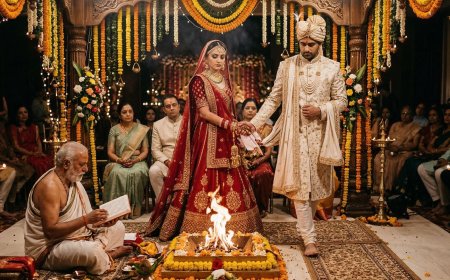
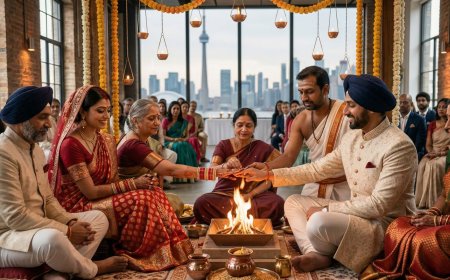
The most common approach among Hindu NRI couples is the dual marker system: the Indian commitment marker — mangalsutra, thaali, bichiya, or shakha paula depending on community — is the primary sacred symbol, exchanged during the religious ceremony with full ritual weight. The Western ring is exchanged either during a civil ceremony conducted separately, or incorporated into the religious ceremony as an additional gesture. Many pandits now include a ring exchange moment within the Hindu ceremony — after the saptapadi [seven sacred steps] — that honours both traditions without diminishing either.
For Sikh NRI couples, the Anand Karaj ceremony does not traditionally include a ring exchange — the commitment is marked by the four laavan [sacred rounds] and the wearing of the kara. Many Sikh NRI couples choose to exchange rings at a separate civil ceremony or during the reception, keeping the Anand Karaj ritually intact while acknowledging the Western context they inhabit.
For intercultural NRI couples — where one partner comes from a Western background — the ring exchange is often the most emotionally resonant shared ritual precisely because it crosses cultural lines. A non-Indian partner placing a ring on the fourth finger is participating in a gesture with three thousand years of human history behind it — most of which has nothing to do with Western tradition and everything to do with the universal human need to say, on the body, what cannot be fully said in words.
In terms of which hand, the guidance from most Hindu religious traditions is the right hand — dakshina hasta [the auspicious right hand] — which is the hand of sacred action in Vedic tradition. This places Indian tradition in alignment with Orthodox Christian, Russian, German, and Spanish practice, and in contrast with the Western Catholic and Protestant tradition of the left hand. For NRI couples, the practical resolution is often this: the Indian commitment markers go on or near the traditionally correct side per their religious tradition; the Western ring goes where it goes — and the meaning is in the gesture, not the geography.
Planning Your Ring Ceremony: What NRI Couples Need to Know
For the religious ceremony, discuss with your pandit or religious officiant whether a ring exchange can be incorporated and at what point in the sequence. Most experienced NRI wedding pandits are entirely comfortable weaving a ring exchange into the ceremony — typically after the saptapadi, when the couple's union has been spiritually formalised. Ask your pandit to include a brief Sanskrit blessing over the rings before the exchange.
For ring design, the growing movement among NRI couples toward rings that carry cultural specificity is one of the most beautiful trends in Indian diaspora jewellery. Rings engraved with Sanskrit mantras, set with stones that carry Ayurvedic significance — navaratna [nine gemstones of the planets] — or designed in motifs drawn from the couple's regional textile tradition are available from Indian fine jewellers in every major diaspora city. In London, Hatton Garden has several Indian jewellers who specialise in culturally hybrid ring design. In Toronto, the Mississauga jewellery district has a deep South Asian specialist community. In Dubai, the Gold Souk in Deira carries Indian-design rings at every price point.
For the mangalsutra, a growing number of NRI brides are commissioning mangalsutra designs that function as contemporary fine jewellery in their daily professional context while retaining full sacred significance. A delicate gold chain with a single small pendant in the traditional form of your community is wearable in any professional or social context and remains spiritually intact. Work with a jeweller who understands your community's specific mangalsutra tradition — a Tamil thaali, a Maharashtrian mangalsutra, and a North Indian mangalsutra are distinct in form and meaning.
What You Need: The Ring and Commitment Marker Checklist
Sacred Markers to Commission or Source Wedding rings for both partners with cultural design elements if desired, mangalsutra or thaali commissioned from a community-specific jeweller, bichiya or metti sourced from a traditional silversmith or Indian jeweller, shakha paula sourced from a Bengali jeweller or specialist supplier, kara if applicable sourced from a Sikh religious supplier.
Ceremony Preparation Discuss ring exchange placement in ceremony sequence with your pandit, prepare a brief Sanskrit or regional language blessing for the rings, decide on right hand versus left hand based on your religious tradition and daily context, arrange for a ring bearer or designated family member to hold the rings during the ceremony.
For Intercultural Ceremonies Prepare a brief written explanation of each commitment marker for non-Indian guests, brief your officiant on the cultural significance of each gesture, consider a bilingual ceremony guide that explains the parallel traditions to guests from both backgrounds.
NRI.Wedding's jewellery partner network includes Indian fine jewellers across the UK, Canada, Australia, UAE, and India who specialise in culturally hybrid wedding jewellery, mangalsutra design, and Sanskrit-engraved wedding rings.
5 Questions NRI Couples Always Ask About Wedding Rings and Indian Traditions
Is it religiously acceptable to do a Western ring exchange within a Hindu wedding ceremony?
Yes — and it is increasingly common. There is no prohibition in Hindu religious texts against the exchange of rings within the ceremony; the tradition simply did not historically include it as a mandated ritual. Most experienced NRI wedding pandits have developed a graceful incorporation of the ring exchange into the ceremony, typically placing it after the saptapadi. Some pandits include a specific mantra blessing over the rings before the exchange, which integrates the gesture into the ceremony's spiritual register rather than appending it as an afterthought. Discuss this with your pandit early in your planning process and confirm their comfort and approach.
My partner is not Indian and their family specifically wants a ring exchange. How do we honour this without it feeling out of place in an Indian ceremony?
The ring exchange is one of the most culturally transferable gestures in any wedding tradition precisely because it is so elemental — a circle, a finger, a visible mark of commitment. Frame it to your non-Indian partner's family as a moment within the larger ceremony where both traditions are simultaneously honoured: the saptapadi formalises the union in the ancient Indian manner; the ring exchange marks it in the manner their family recognises. When presented this way — as convergence rather than concession — the moment typically carries more emotional weight than either gesture would alone.
On which hand should the wedding ring be worn in an Indian context?
In Vedic and Hindu tradition, the right hand is the sacred hand — the hand used for offerings, for oaths, and for auspicious actions. Most traditional Hindu ceremonies, where rings are exchanged, place the ring on the right hand. However, NRI couples living in countries where the left-hand ring tradition is standard often choose the left hand for the Western ring so that it is immediately culturally legible in their daily professional and social context. The most common resolution is to wear any Indian commitment markers — mangalsutra, bichiya, thaali — in their traditional placement, and to place the Western ring on whichever hand feels most natural for daily life. There is no spiritual inconsistency in this; the meaning is in the commitment, not the hand.
We want our wedding rings to reflect our Indian heritage. What design elements work best?
The most meaningful culturally rooted ring designs for NRI couples tend to draw from one of four areas: regional textile motifs translated into metalwork — Phulkari patterns, Kalamkari line work, block-print geometric forms; Sanskrit or regional language engravings of meaningful mantras or family names; navaratna or single-stone settings using gems with Ayurvedic or astrological significance to your community; or traditional Indian metalworking techniques such as Kundan setting, Meenakari [enamel work], or filigree from your region's jewellery tradition. Work with a jeweller who has both fine jewellery technical competence and genuine knowledge of your regional tradition — the best results come from this specific combination.
We are doing a civil ceremony and a religious ceremony on different days. Should the ring exchange happen at both?
No — choose one, and let it be the one that carries more emotional weight for you. Most NRI couples who do both ceremonies treat the civil ceremony as the legal formality it is — conducted quietly with a witness, without the ring as a centrepiece — and reserve the ring exchange for the religious ceremony, where it sits within the full context of the ritual sequence and carries the emotional significance of the day. If your civil ceremony is a genuinely celebratory event in its own right, with family present and emotional weight, then the ring exchange belongs there and need not be repeated at the religious ceremony. What matters is that the exchange happens once, intentionally, in the moment that feels most true.
The Emotional Angle
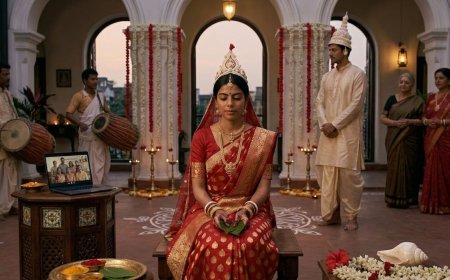
There is a moment at every Indian wedding — sometimes during the mangalsutra tying, sometimes during the ring exchange, sometimes during the saptapadi — when the noise and the colour and the organised beautiful chaos of the day suddenly go very quiet. Not literally. The dhol is probably still playing. The relatives are probably still talking. But internally, something stills.
It is the moment the commitment lands in the body.
For NRI families, this moment carries a weight that is hard to articulate without sounding dramatic — which is perhaps why it so rarely gets articulated at all. Because what is happening is not just two people committing to each other. It is a family's entire journey across oceans arriving at a single point of meaning. All the years of building a life in a country that was not the country you were shaped by. All the private calculations of what to keep and what to let go. All the Sunday afternoons that smelled like your mother's cooking but looked like someone else's suburb. All of it arrives, somehow, in the moment a ring slides onto a finger or a mangalsutra is tied at the neck.
Your grandparents made commitments like this in villages and cities across India, in ceremonies that were rooted in the soil they stood on. You are making yours on different soil, with some of the same gestures and some new ones, in a language that is partly ancient and partly your own invention.
The finger leads to the heart. It always has. Wherever in the world the hand happens to be.
A Moment to Smile
At a Hindu-Western intercultural wedding in Houston in 2022, the pandit — a wonderfully experienced Gujarati priest who had conducted hundreds of NRI ceremonies — had gracefully incorporated the Western ring exchange into the ceremony immediately after the saptapadi.
The groom, who was Australian and had been practicing his Sanskrit phonetics for three weeks, had navigated the entire ceremony with impressive focus. He had circled the fire correctly. He had said the right things at approximately the right times. He had held the correct objects and sat in the correct positions and generally acquitted himself with the kind of determined cultural attentiveness that had clearly taken real effort.
And then came the ring exchange — the moment he had been waiting for, the familiar gesture in an unfamiliar ceremony.
He reached into his sherwani pocket for the ring box.
It was not there.
The look on his face — the specific expression of a man who has successfully completed an ancient Sanskrit fire ceremony and is now undone by a box — was captured perfectly by the photographer. His mother-in-law, seated in the front row, produced the ring box from her own handbag within four seconds. She had been holding it since the morning.
"I knew," she said simply, when asked later.
She was not wrong.
Quotes From the Diaspora
"We exchanged rings after the saptapadi. My pandit said a mantra over them first. My husband — who is Irish — told me later that was the moment the whole ceremony became real for him. Not the fire, not the walking, not the Sanskrit. The ring. Because he finally had something he recognised. I think that is actually beautiful." — Kavitha Nair-O'Brien, Tamil background, currently based in Dublin, Ireland
"I wear my mangalsutra every day. I wear my wedding ring every day. People at work ask me about the mangalsutra more than the ring — they have never seen one. I have explained what it means probably two hundred times. I do not mind. It is two hundred opportunities to say: in my tradition, the commitment lives here, at the throat, close to the voice, close to everything spoken between two people." — Priya Sharma-Goldstein, Punjabi background, currently based in New York, USA
"My grandmother cried when I put on the bichiya. She cried when I put on the ring too, but differently. The bichiya was the cry of recognition. The ring was the cry of relief — that I had found someone, that I was settled, that I was loved. Both cries were real. Both meant everything." — Deepa Iyer-Menon, Tamil Brahmin background, currently based in Melbourne, Australia
The Circle Has No End — And Neither Does the Story
The fourth finger carries the weight of three thousand years of human beings trying to say, with a small circle of metal, what language alone cannot contain. It carries Egyptian reed rings and Roman medical belief and Vedic sacred geometry and Christian liturgy and Ayurvedic nerve theory — all converging on the same instinct: that love must be worn, that commitment needs a body, that the gesture of placing something on a specific finger is one of the most ancient and most honest things a person can do.
NRI.Wedding's jewellery partners, ceremony planning resources, and pandit network are built to help you navigate the beautiful complexity of marking your commitment in a way that honours both the tradition you carry and the life you have built. Whether you are commissioning a mangalsutra that works in a London boardroom, finding a pandit who will bless your rings before the exchange, or simply trying to understand what your grandmother's bichiya means so you can explain it to your partner's family — we are here for all of it.
The circle has no beginning and no end. That was always the point.
Wear it on whichever finger your tradition calls sacred. What matters is that you mean it.
This article explores the history and cultural significance of the wedding ring worn on the fourth finger, covering the Vena Amoris tradition, Indian commitment markers including the mangalsutra, thaali, bichiya, shakha paula, and kara, with guidance for NRI couples in London, Toronto, Houston, Melbourne, and Dubai navigating Hindu, Sikh, Tamil, Bengali, Punjabi, and intercultural wedding traditions.
What's Your Reaction?
 Like
0
Like
0
 Dislike
0
Dislike
0
 Love
0
Love
0
 Funny
0
Funny
0
 Angry
0
Angry
0
 Sad
0
Sad
0
 Wow
0
Wow
0