
































































Shiva–Shakti: The True Purpose of Marriage According to Hindu Mythology and Philosophy — What NRI Couples Need to Know Before They Stand at the Mandap
What is the Hindu wedding ceremony actually for — and what does the mandap do that a six-year relationship has not already done? This complete NRI philosophical guide answers that question through the Shiva-Shakti union, the most foundational mythological and philosophical principle in the Hindu understanding of marriage. Learn the philosophical distinction between Shiva as pure consciousness and Shakti as dynamic energy, the mythology of Sati's devotion and self-immolation, Parvati's tapas and the divine marriage as cosmic template, the Ardhanarishvara icon as the most philosophically precise expression of the union, and the Saptapadi's seven steps as the Shiva-Shakti dynamic enacted as physical movement around the sacred fire. Understand how to conduct the pre-wedding philosophical preparation session with the family pandit, brief the ceremony's key ritual moments for philosophical naming, incorporate the Ardhanarishvara as a meaningful wedding motif rather than a decorative choice, transmit the philosophical framework to diaspora-generation family members and international guests, and use the Shiva-Shakti framework as an ongoing resource for the marriage rather than a one-day ceremony explanation. Understand the transmission gap that the diaspora experience creates, the inter-faith application of the consciousness-energy framework, the Shakti Pitha geography for destination wedding couples, and the five specific mistakes that reduce the Hindu wedding's most profound philosophical offering to a procedure followed without understanding. This is the complete, culturally serious, philosophically grounded guidance that the NRI couple who has asked the most important pre-wedding question deserves.

Shiva–Shakti: The True Purpose of Marriage According to Hindu Mythology and Philosophy — What NRI Couples Need to Know Before They Stand at the Mandap
The question arrived, as the most important questions do, not when it was invited but when the space for it accidentally appeared.
Meera and Dev had been together for six years. They had lived in three cities across two countries. They had navigated visa applications and long-distance winters and the specific, grinding difficulty of building a life in parallel across different time zones. They had, by any reasonable measure, already done the hard work of a marriage before the wedding was planned.
It was a Tuesday evening in Amsterdam. Dev was making tea. Meera was on the sofa with her laptop open to the vendor comparison spreadsheet — caterers, decorators, photographers, the accumulated evidence of eight months of planning organised into cells and columns and colour codes that had become, without anyone quite deciding this, the primary project of both their lives.
Dev brought the tea. He sat beside her. He looked at the spreadsheet.
He said, not critically, genuinely: "What is this for?"
Meera looked at him. "The wedding," she said.
"No," he said. "I mean — what is the wedding for? We are already, in every meaningful sense, married. We live together. We have a shared bank account. We have been through everything that people go through after they are married. So what is the ceremony for? What does the mandap do that the last six years have not already done?"
Meera looked at the spreadsheet. At the caterers and the decorators and the photographers and the eight months of planning.
Then she looked at Dev.
"I don't know," she said. "I think I should know. I think my grandmother knows. I think the pandit knows. I think somewhere in the tradition there is an answer to that question that I have never been given."
She closed the laptop.
"Tell me," Dev said, "if you find it."
She found it. It took time — the conversation with her grandmother, the books her uncle who was a Sanskrit scholar sent her, the specific, patient, careful reading of the Shaiva philosophical tradition that she had been adjacent to her whole life without having been given its framework. She found it, and it was not what she expected, and it was more extraordinary than anything the spreadsheet had been tracking.
What she found was the Shiva-Shakti union — the foundational mythological and philosophical principle of the Hindu understanding of marriage, the cosmological story that gives the human wedding its deepest meaning, the answer to Dev's Tuesday evening question that had been embedded in the tradition all along, waiting to be found by the couple who thought to look.
This guide is for that couple — the ones who have asked Dev's question, or who have not yet asked it but who sense that the answer exists somewhere in the tradition, and who deserve to receive it completely, carefully, and with the philosophical seriousness it has always warranted.
The Question Behind the Ceremony — Why Philosophy Matters for the NRI Wedding
The NRI wedding planning conversation is, by the practical necessity of its circumstances, overwhelmingly oriented toward the logistical. The venue, the vendors, the visa requirements for international guests, the ferry schedules, the coordinator's brief, the weather contingency — these are real and necessary concerns, and this guide series has addressed each of them in full.
But there is a prior question — prior in the philosophical sense, the question whose answer gives all the logistical questions their purpose — that the planning conversation rarely reaches, not because couples are uninterested in it but because the conversation has been structured around the practical rather than the philosophical, and the philosophical has been implicitly designated as the pandit's department rather than the couple's.
This designation is a loss. The couple who stands at the mandap without understanding what the mandap is doing — who undergoes the ceremony as a sequence of prescribed actions without access to the framework that gives the actions their meaning — is participating in a tradition whose deepest offering has not been made available to them.
The Shiva-Shakti union is that framework. It is not the only framework that the Hindu philosophical tradition offers for understanding marriage, but it is the most complete, the most cosmologically ambitious, and the most specifically useful for the contemporary NRI couple who is asking Dev's question — because it does not simply answer what the ceremony is for. It answers what marriage itself is for, in terms that are simultaneously ancient and radically contemporary, simultaneously mythological and phenomenologically exact.
Shiva and Shakti — Who They Are and What They Represent
Before the union can be understood, the two terms must be understood — not as the names of deities in the anthropomorphic sense of divine personalities with specific stories and iconographies, but as philosophical principles, cosmic forces, the two fundamental categories of existence that the Hindu metaphysical tradition identifies as the basis of all reality.
Shiva — in the philosophical tradition of Shaivism and in the broader Hindu metaphysical framework — represents pure consciousness. Not consciousness in the psychological sense of awareness or cognition, but consciousness in the most fundamental ontological sense: the unchanging, absolute, eternal witness, the ground of being that underlies all phenomena, the still centre that is present in all experience without being modified by any of it. Shiva is the Sanskrit term for the auspicious one, but in the Shaiva philosophical tradition, Shiva as principle is better understood as chit — pure awareness, the knowing aspect of reality, the that which is aware.
In the iconographic tradition, Shiva appears as the ascetic yogi of Mount Kailash — still, withdrawn, seated in meditation, covered in ash, eyes half-closed in the specific, inward gaze of the one whose attention is not on the world but on the ground beneath the world. This iconography is the visual representation of the philosophical principle: Shiva as pure consciousness is pure potentiality, pure awareness, complete in itself but, in a specific and important sense, unable to act without its complement.
Shakti — the word means power, energy, force — represents the dynamic principle of reality. Where Shiva is the unchanging witness, Shakti is the force that moves, creates, transforms, and destroys. She is the energy that animates all phenomena, the creative power that produces the universe from its own substance, the dynamic aspect of reality without which the static consciousness of Shiva would remain forever unmanifest. In the Devi Mahatmya and the Tantric philosophical tradition, Shakti is addressed as Mahadevi — the great goddess — who appears in multiple forms corresponding to her multiple functions: as Saraswati she is the creative intelligence, as Lakshmi she is the sustaining abundance, as Kali and Durga she is the transforming and protective power.
The relationship between Shiva and Shakti is the most fundamental philosophical relationship in the Shaiva and Shakta traditions: they are not two separate entities but two aspects of a single reality, temporarily appearing as distinct in order that the drama of creation, sustenance, and dissolution can unfold. Shiva without Shakti is inert — pure awareness with nothing to be aware of, pure potentiality with no means of actualisation. Shakti without Shiva is chaotic — undirected energy without the ground of awareness, power without the still centre from which meaningful action can emerge. Their union — described in the philosophical literature as the recognition of their fundamental non-separation, and in the mythological literature as the sacred marriage — is the state from which creation flows, the condition in which consciousness and energy are in right relationship, the cosmological condition that the human wedding is designed to reflect.
The Mythology of the Divine Marriage
The mythological tradition has preserved the philosophical principles of the Shiva-Shakti union in the form of narrative — the stories that make the abstract concrete, that give the metaphysical the specificity of event and character, that allow the human couple standing at the mandap to understand their own wedding as a reflection of the cosmic drama.
The most significant of these stories is the union of Shiva and Sati — the first form of Shakti — and its continuation in the union of Shiva and Parvati.
The Story of Sati
Sati was the daughter of Daksha, the progenitor, one of the primordial beings of the Hindu cosmology. She was, from her earliest childhood, devoted to Shiva with a devotion that Daksha — proud, hierarchical, concerned with social propriety and cosmic status — found inappropriate and embarrassing. Shiva the ascetic, Shiva the yogi covered in ash who sat in meditation in the cremation grounds, was not the consort that Daksha had envisioned for his daughter.
Sati married Shiva against her father's wishes. Their union was the union of the most devoted, the most knowing, the most completely surrendered aspect of Shakti with the pure consciousness of Shiva — the specific quality of devotion that sees through the surface of things to the ground beneath, that recognises in the ash-covered ascetic the lord of consciousness, that is not misled by the social conventions that Daksha represents.
The crisis came when Daksha organised a great yajna — a sacred fire ritual — and invited all the gods and cosmic beings with the specific, deliberate exception of Shiva and Sati. Sati, whose devotion to her husband was absolute, refused to accept the insult to Shiva and went to the yajna uninvited, demanding her husband's inclusion. Daksha's response was the public humiliation of both Sati and Shiva — the dismissal of Shiva as unworthy, the shaming of Sati for her choice.
Sati's response was to enter the yajna fire and immolate herself — not in defeat, not in despair, but in the specific act of protest that removes the self from the field of dishonour, that refuses to continue to exist in a context that denies what she knows to be sacred. It is one of the most philosophically complex acts in the entire Hindu mythological corpus, and its complexity is worth sitting with: Sati does not die in the conventional sense — she is Shakti, and Shakti cannot die — but she withdraws from the form she has taken, refusing to remain in a world that has dishonoured the divine.
The consequence for Shiva was the grief of absolute loss — the withdrawal of Shakti from the one who is her other half, the experience of pure consciousness in the absence of its complement. Shiva's grief took the form of the wild, destructive, cosmic wandering of the bereft ascetic — carrying Sati's body across the universe, his grief so total that the cosmos itself was threatened by its force, until Vishnu, the preserver, intervened — sending his Sudarshana Chakra to cut Sati's body into pieces as Shiva carried it, so that the grief could be distributed across the earth rather than concentrated in its destroying intensity.
The places where Sati's body fell became the Shakti Pithas — the fifty-one or one hundred and eight sacred sites of the goddess, spread across the Indian subcontinent, each containing a fragment of Sati's body and therefore a concentrated manifestation of Shakti's power. The geography of the Shakti Pithas is the geography of Shiva's grief transformed into sacred landscape — the specific, devotional cartography that emerges from the love that loss reveals.
The Story of Parvati
Sati was reborn as Parvati, the daughter of the mountain king Himavan and his queen Mena. In her new form, she pursued Shiva with the same absolute devotion that had characterised Sati — but this time the devotion took the form of tapas, austerity, the disciplined spiritual practice that is the human means of reaching the divine.
Parvati performed tapas of increasing intensity — standing on one leg in water, in fire, in snow, reducing her food to nothing, her practice so extreme that the gods were alarmed by its power. She was, in the mythological narrative, doing what the devotee does: purifying herself not for Shiva's benefit but for her own transformation, making herself worthy not in the social sense that Daksha had understood worthiness but in the spiritual sense — the sense that requires the dissolution of everything unnecessary.
Shiva, in the form of an old Brahmin, came to test her. He appeared and began to criticise Shiva — listing Shiva's unsuitability as a husband, his ash-covered appearance, his residence in the cremation grounds, his association with outcasts and wanderers. Parvati's response to each criticism was the same: the defence of the one she knows, the refusal to accept the surface reading, the knowledge that sees through the disguise of the inappropriate to the divinity beneath. When the old Brahmin finally revealed himself as Shiva, the test was complete — Parvati's devotion had survived the most direct assault that the one she loves could mount against it.
Their marriage — the Vivaha of Shiva and Parvati, celebrated in the Shiva Purana with an elaboration that encompasses the entire cosmic order's participation — is the mythological template for the Hindu wedding. The gods attend as guests. The seven sages preside. The mountains and the rivers and the sacred fires bear witness. The ceremony is cosmic not in the sense of being large but in the sense of being the moment at which the fundamental principles of consciousness and energy are reunited in the form of two specific, named, particular individuals — two beings who have their own histories, their own devotions, their own specific paths to this moment.
The Philosophical Framework — What the Union Means
The mythology is the story. The philosophy is the meaning, and the meaning is what the NRI couple standing at the mandap can use to understand what the mandap is doing.
The Shiva-Shakti union in the Hindu philosophical tradition expresses a specific understanding of reality: that existence is fundamentally relational, that the two principles which appear as separate — consciousness and energy, awareness and action, the still centre and the dynamic force — are in reality two aspects of a single whole, and that their union is not the merging of two separate things but the recognition of a wholeness that was never actually absent.
This understanding has specific implications for the human couple at the wedding.
The first implication is that the wedding is not the beginning of a relationship. It is the public recognition, the cosmic acknowledgement, the sacred marking of a recognition that the couple has already, in some sense, made. Dev's question — what does the mandap do that the last six years have not already done? — has a specific answer within this framework: the mandap makes the recognition formal, places it within the cosmic order, witnesses it before the elements and the ancestors and the sacred fire, and in doing so gives it a different quality of permanence than the private recognition possesses. The wedding is the world's acknowledgement of what the couple already knows.
The second implication is that the marriage relationship is understood, within this framework, as a spiritual practice rather than simply a social arrangement. The Shiva-Shakti union is not a comfortable domestic partnership — it is the dynamic, sometimes difficult, always transforming relationship between the still centre and the moving force, between the aspect of the self that wants to remain in undisturbed awareness and the aspect that needs to act in the world. Every long-term relationship contains both of these aspects, and the philosophical framework names them and gives them a cosmic dignity that the social understanding of marriage does not.
The third implication — and this is the most specifically useful for the NRI couple who has lived together for six years, who has already navigated the visa applications and the long-distance winters and the shared bank account — is that the Shiva-Shakti framework understands marriage as the relationship in which each person serves as the other's mirror, the other's complement, the force that the other's principle requires in order to fully express itself. Shiva without Shakti does not manifest. Shakti without Shiva does not cohere. The specific person you marry is not interchangeable with any other person — they are the specific complement that your specific principle requires, and the recognition of this specificity is the content of the wedding's sacred dimension.
Ardhanarishvara — The Icon of Union
The most philosophically precise icon of the Shiva-Shakti union is the Ardhanarishvara — the composite form in which Shiva and Parvati are depicted as a single body, the right half Shiva and the left half Parvati, the two principles literally sharing one form.
The Ardhanarishvara is not a mythological curiosity. It is a philosophical statement of the most precise kind, made in the language of iconography rather than the language of prose. What it states is this: the two principles are not two entities in relationship — they are two aspects of a single entity, temporarily appearing as separate for the purposes of the creation and the experience that separation makes possible.
For the NRI couple, the Ardhanarishvara offers a specific and profound wedding image — not as a decorative motif on the invitation but as a philosophical reference point. The couple standing at the mandap is not two individuals who have decided to combine their lives. They are, in the framework of this tradition, two aspects of a single consciousness that has temporarily appeared as two in order to know itself through the experience of love, recognition, and reunion. The wedding is the moment of recognition — the moment at which the two-appearing-as-separate recognise the one-that-is-fundamental.
This is the answer to Dev's question, stated in its fullest form.
The Saptapadi — The Seven Steps as Shiva-Shakti in Action
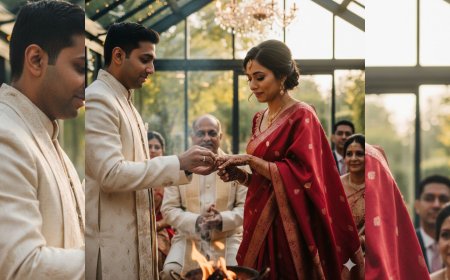
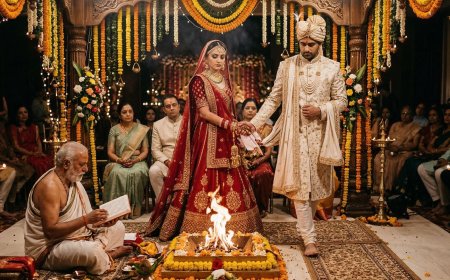
The Saptapadi — the seven steps around the sacred fire that constitute the central ritual act of the Hindu wedding — is the Shiva-Shakti union expressed as physical movement, as lived practice, as the literal stepping-together that enacts what the mythology narrates.
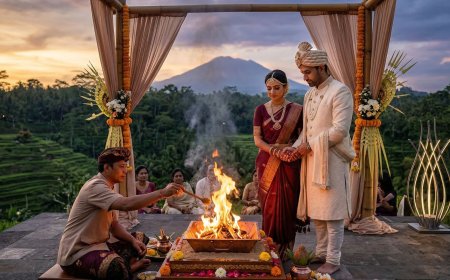
Each step is taken together — the couple moving around the fire, the Agni as the witness, the circumambulation as the embodied expression of the shared journey. The seven steps correspond to the seven dimensions of the shared life: sustenance, strength, prosperity, happiness, family, the seasons of the year, and friendship — the specific, named, ordered dimensions of existence that the couple is agreeing to walk together.
The fire is not decoration. Agni — the fire deity, the sacred fire that the Vedic tradition identifies as the messenger between the human and the divine, the witness whose presence transforms the social contract into the sacred covenant — is the cosmic witness of the Saptapadi. The couple's promises are not made to each other only. They are made in the presence of the fire, which carries them into the cosmic order.
The Shiva-Shakti framework gives the Saptapadi its deepest meaning: each step is the union of the two principles, enacted physically, the still and the moving, the consciousness and the energy, walking together around the source of light. The couple who understands this — who hears the Saptapadi's Sanskrit mantras with the knowledge of what they are naming — is walking with a different awareness than the couple who is following the pandit's instructions without access to the framework.
The NRI Application — Bringing the Philosophy Into the Wedding
The Pre-Wedding Philosophical Conversation
The most valuable single addition any NRI couple can make to their wedding planning process is a dedicated philosophical preparation conversation — a session with the family pandit or with a scholar of the Hindu tradition whose knowledge and communication skills together allow them to explain the Shiva-Shakti framework and the ceremony's philosophical structure to the couple in terms they can receive and use.
This conversation is distinct from the ceremony briefing — the pandit explaining what to do when. It is the explanation of why — the philosophical foundation that gives the what its meaning. It should happen at three to four months before the wedding, when the couple has enough planning settled to give genuine attention to the philosophical dimension, and it should include both partners regardless of their differing backgrounds or levels of prior engagement with the tradition.
The NRI couple who arrives at the mandap having had this conversation is in a fundamentally different position from the couple who arrives without it. The difference is not visible in the ceremony's exterior — the same mantras, the same movements, the same fire. The difference is in what the couple is experiencing as the ceremony proceeds.
The Pandit's Brief
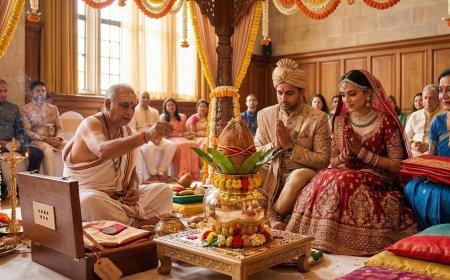
The pandit's brief for an NRI wedding should include the philosophical dimension as explicitly as it includes the procedural one. The best pandits — those with genuine scholarly knowledge of the tradition and the communication skills to make it accessible — understand that the ceremony they are conducting has a philosophical architecture, and they will, if asked, explain it.
The couple should ask. They should ask specifically for the Shiva-Shakti framework to be named during the ceremony — at the Saptapadi, at the moment of the Vara Mala exchange, at the Grihapravesh. The naming does not need to be elaborate. A single sentence of context before the key rituals — this step represents the union of consciousness and energy — gives the participants the vocabulary to receive what the ritual is doing.
The Ardhanarishvara as a Wedding Motif
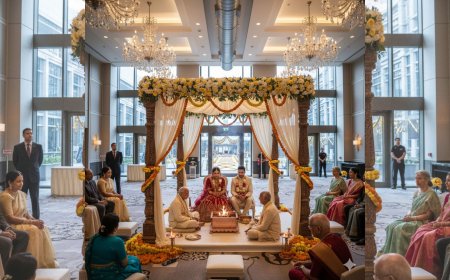
The Ardhanarishvara image can be incorporated into the wedding's visual language as a philosophical statement rather than a decorative choice — in the invitation design, in the mandap's iconographic programme, in the gifting. The couple who uses this image with full knowledge of its philosophical meaning is making a statement that is simultaneously ancient and completely contemporary: we understand what we are doing here, and what we are doing is the recognition of a wholeness that has always been ours.
The NRI Philosophy and Planning Reference Table
| Planning Parameter | Shiva-Shakti Philosophical Detail | NRI Action Required | Recommended Timeline |
|---|---|---|---|
| Philosophical Preparation | Shiva-Shakti framework gives ceremony its deepest meaning; couple's understanding transforms the ceremony's quality of experience | Schedule philosophical preparation session with pandit or tradition scholar at 3–4 months before wedding; both partners attend regardless of background | 3–4 months before wedding |
| Pandit Selection Criterion | Pandit must have both scholarly knowledge and communication ability; philosophical architecture of ceremony must be accessible to diaspora couple | Interview pandit specifically for ability to explain Shiva-Shakti framework; ask about their approach to ceremony explanation for NRI couples | 8–10 months before wedding |
| Ceremony Philosophical Brief | Request pandit to name Shiva-Shakti framework at key ceremony moments; Saptapadi, Vara Mala, Grihapravesh are the primary moments | Prepare written brief for pandit specifying philosophical explanation at each key ritual; confirm pandit's comfort with this approach | 4–6 months before wedding |
| Saptapadi Understanding | Seven steps around sacred fire; each step names a dimension of shared life; Agni as cosmic witness; Shiva-Shakti union enacted as physical movement | Read Saptapadi's seven vows with pandit before ceremony; understand each step's specific meaning; couple should know what they are saying before they say it | 2–3 months before wedding |
| Ardhanarishvara as Motif | Composite form of Shiva-Parvati as single body; most philosophically precise icon of the union; can be incorporated into invitation, mandap, gifting | Commission Ardhanarishvara iconographic element for invitation design or mandap with full knowledge of its philosophical meaning; brief designer on significance | 6–8 months before wedding |
| Sacred Fire Understanding | Agni as cosmic witness transforms social contract into sacred covenant; fire is not decoration; Vedic tradition identifies fire as messenger between human and divine | Brief all ceremony participants on Agni's role as witness; request pandit to explain fire's significance at ceremony opening; treat fire's maintenance as ceremonial priority | 2–3 months before wedding |
| Shakti Pitha Awareness | Fifty-one or one hundred and eight sacred sites where Sati's body fell; geography of Shiva's grief transformed into sacred landscape; relevant for destination weddings at or near Shakti Pithas | Research whether chosen wedding destination is proximate to a Shakti Pitha; if so, incorporate awareness into pre-wedding or post-wedding guest programme | 6–8 months before wedding |
| Mythological Narrative | Sati's devotion and self-immolation; Parvati's tapas and devotion; Shiva's grief as the love that loss reveals; the divine marriage as template for human wedding | Read Shiva Purana's wedding narrative and Devi Mahatmya with partner before wedding; use mythological understanding to contextualise ceremony's specific ritual elements | 2–3 months before wedding |
| Family Philosophical Transmission | Grandparents' generation holds philosophical knowledge; diaspora generation has not received systematic transmission; wedding is opportunity for transmission | Request extended family session with grandmother and pandit specifically to transmit philosophical framework alongside ritual procedure; record session for family archive | 10–12 months before wedding |
| Inter-Faith and Inter-Community Couples | Shiva-Shakti framework is philosophical rather than sectarian; consciousness-energy principle has analogues in most spiritual traditions; can be offered as shared framework | Brief partner from different tradition on Shiva-Shakti as philosophical framework rather than sectarian belief; identify analogous principles in partner's own tradition | 4–6 months before wedding |
| Post-Wedding Philosophy | Shiva-Shakti framework is not only for the wedding day; the marriage is the ongoing practice of the union; the dynamic between still centre and moving force is the lived content of the relationship | Discuss Shiva-Shakti framework as ongoing reference point for the relationship; revisit the mythology at significant anniversaries or turning points | Ongoing |
| Guest Programme | International and diaspora guests may not have access to philosophical framework; brief pre-ceremony explanation enriches guest experience | Prepare a brief, one-page philosophical introduction for the wedding programme booklet; brief the MC or the pandit on providing one-minute context before key rituals | 2–3 months before wedding |
| Sanskrit Accessibility | Saptapadi and key mantras in Sanskrit; diaspora couple may not understand Sanskrit; transliteration and translation essential for philosophical engagement | Request transliteration and translation of all key mantras from pandit; include in wedding programme booklet; read translations before ceremony so meaning is understood during it | 2–3 months before wedding |
| Communication Protocol | Philosophical preparation conversations across IST gap: UK +4.5 hrs, US East +9.5 hrs, Australia East −5.5 hrs | Schedule philosophical sessions at times workable for elderly grandparents and scholars in India; video call with screen sharing for text-based discussion | From planning outset |
| The Question Behind the Ceremony | Dev's question — what does the mandap do? — is the most important pre-wedding question; its answer is the philosophical preparation's content | Make space for Dev's question at the beginning of the planning process; do not defer the philosophical dimension to the pandit alone; own the question as the couple's | First planning conversation |
Common Mistakes NRI Couples Make With the Philosophical Dimension of the Wedding
The first and most consequential mistake is treating the ceremony as a procedure rather than a philosophical event — following the pandit's instructions without understanding what the instructions are enacting. This mistake is not the couple's fault. It is the result of a transmission gap that the diaspora experience has widened over generations: the philosophical framework that gives the ceremony its meaning was transmitted alongside the ceremony itself in the context of an intact, geographically concentrated community, and the diaspora experience has often transmitted the procedure without the philosophy. The couple who treats the ceremony as a set of steps to be correctly executed is not doing the wrong thing — they are doing what they were given. But they are not receiving the ceremony's full offering. The philosophical preparation is the act that recovers the offering.
The second mistake is delegating the philosophical dimension entirely to the pandit without the couple engaging with it independently. The pandit's role is to conduct the ceremony — to recite the mantras, to guide the physical actions, to maintain the ritual's integrity. The couple's role is to understand what the ceremony is doing so that they can be present for it rather than merely going through it. These are different roles, and the pandit cannot perform both simultaneously. The couple who says "the pandit will explain everything on the day" is deferring the most important preparation to the last possible moment, in the most distracting possible context, for the most important event of the day. The philosophical preparation must happen before the ceremony, in the quiet of a dedicated session, not during it.
The third mistake is presenting the philosophical framework to guests only in the aesthetic language — the Ardhanarishvara image on the invitation, the Sanskrit script on the programme — without providing the conceptual context that makes the aesthetic meaningful. The international guest who sees the Ardhanarishvara on the wedding invitation and has no context for it receives a beautiful, exotic image. The same guest who has been given one paragraph of context — that this is the icon of the philosophical principle the wedding enacts, that the two-in-one form expresses the understanding that consciousness and energy are two aspects of a single reality — receives something of genuine philosophical depth. The context is one paragraph. The difference it makes is the difference between aesthetics and meaning.
The fourth mistake is assuming that the Shiva-Shakti framework is only relevant for couples from Hindu backgrounds. The framework is philosophical before it is religious — it addresses the nature of consciousness and energy, the purpose of the committed relationship, the cosmic witness of the sacred fire, in terms that have resonances across traditions. The couple in which one partner comes from a non-Hindu background who has not been offered the philosophical framework because it was assumed to be inaccessible to them has been done a disservice. The philosophical explanation — presented as the Hindu tradition's specific understanding of the universal principles that committed love enacts — is accessible to, and often profoundly received by, partners from other traditions. The invitation to understand the framework should be extended to both partners without assumption.
The fifth mistake is treating the philosophical dimension as a pre-wedding intellectual exercise that ends when the ceremony begins, rather than as the foundation of an ongoing understanding that the marriage is designed to deepen. The Shiva-Shakti framework is not the answer to the question of what the wedding is for. It is the beginning of the answer to the question of what the marriage is for — and the marriage is longer than the wedding, and the Shiva-Shakti dynamic between the still centre and the moving force, between the awareness and the action, between the Shiva and the Shakti aspects of the shared life, is the lived content of the relationship that the ceremony inaugurates. The couple who returns to this framework at the difficult moments of the marriage — the moments when the still centre and the moving force are in tension rather than in union — will find in it a resource of extraordinary depth.
What the Mandap Does
Dev had asked, on a Tuesday evening in Amsterdam: what does the mandap do that the last six years have not already done?
Meera had found the answer. She had found it in the Shiva Purana and in her grandmother's conversation and in the specific, patient reading of the Shaiva philosophical tradition that her uncle's books had given her access to.
The answer was this.
The last six years had built the relationship in the world — in the world of shared apartments and visa applications and long-distance winters and the specific, accumulated, daily practice of choosing each other across the ordinary difficulty of two lives being lived together. This was real and necessary and extraordinary in its own way, and the Shiva-Shakti framework honoured it as exactly what it was: the tapas, the austerity, the practice of devotion that Parvati performed before the divine marriage. The preparation. The proving. The making of oneself worthy not in the social sense but in the sense that the tradition understands worthiness — through the sustained, faithful, difficult practice of love in the world.
What the mandap did was different. What the mandap did was place the recognition at the centre of the cosmic order — witness it before the sacred fire, before the elements, before the ancestors, before the traditions of two families and the philosophy of a civilisation that had been thinking about the purpose of the human union for longer than Amsterdam had been a city. What the mandap did was name the union not in the language of the social contract but in the language of the sacred — the language that said: what you are doing here is not simply a social event. It is the reflection, in the particular and the human, of the most fundamental relationship in the cosmos. The consciousness knowing itself through the energy. The energy finding its direction through the consciousness. The two-appearing-as-separate recognising the one-that-is-fundamental.
What the mandap did was exactly what Parvati's tapas had prepared for: the moment of recognition, witnessed by fire.
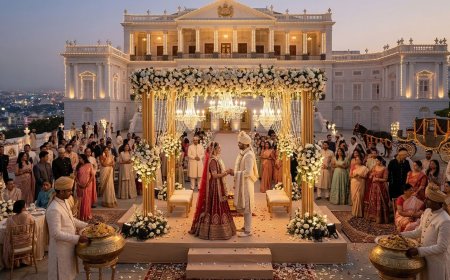
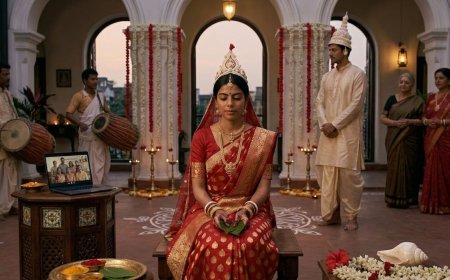
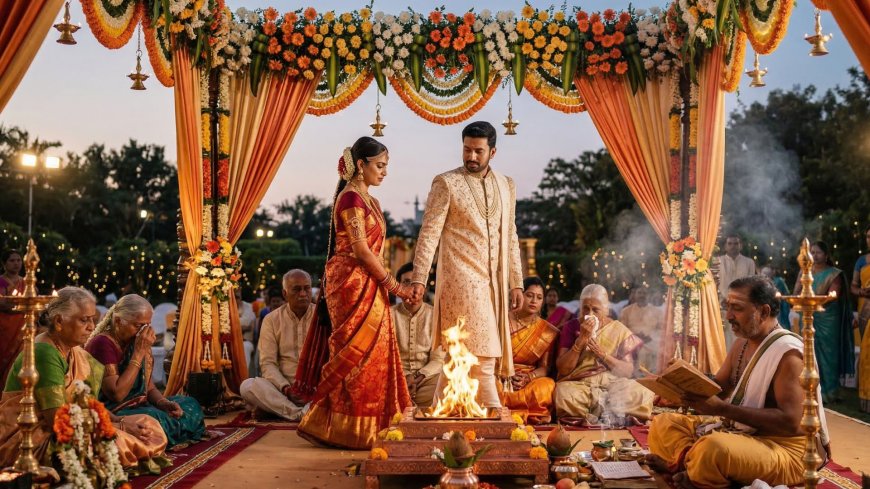
The ceremony was in Mysuru, in a garden under the old trees, in the last light of a December afternoon that went from gold to amber to the specific, still blue of dusk while the Saptapadi was being completed.
When the seventh step was taken, the pandit — who had received the philosophical brief and who had agreed, without hesitation, that the framework should be named — said, in a mixture of Sanskrit and English that addressed both the ceremony's sacred register and its human witnesses:
With this seventh step, the union is complete. Consciousness and energy, awareness and action, the still and the moving — they have walked together around the sacred fire and the fire has witnessed what was already true. They were not two and are now one. They were one and appeared as two in order to know the one through the experience of love.
Dev and Meera stood at the completion of the seventh step.
Dev had asked what the mandap does.
He was, in that moment, no longer asking.
Schedule the philosophical preparation session at three months — not as a briefing but as a conversation. Read the Saptapadi's seven vows with your pandit before the ceremony so you know what you are saying while you are saying it. Ask for the Shiva-Shakti framework to be named at the key moments. Give your international guests one paragraph of context in the programme booklet. Return to the framework at the difficult moments of the marriage — it was made for those moments as much as for this one.
The mandap is the moment at which the cosmic order witnesses what you already know.
Go to it having done the work of knowing.
Published by NRIWedding.com — The Premium Global Platform for Non-Resident Indians Planning Indian Weddings From Abroad.
What's Your Reaction?
 Like
0
Like
0
 Dislike
0
Dislike
0
 Love
0
Love
0
 Funny
0
Funny
0
 Angry
0
Angry
0
 Sad
0
Sad
0
 Wow
0
Wow
0