




























































The Complete Guide to Telugu Wedding Rituals and Traditions — The NRI Wedding Cultural Guide
Priya had attended fourteen weddings. She had never attended a Telugu wedding until she arrived in Hyderabad at one forty-five in the morning, formally dressed, to find the mandap blazing with marigolds and a groom dramatically leaving for Kashi with a walking stick. She spent the next four hours watching something she could not stop watching. This guide gives NRI couples, partners marrying into Telugu families, and wedding guests the complete framework for understanding Telugu wedding rituals — from the Nichithartham engagement to the Kashi Yatra, Jeelakarra Bellam, Mangalasutra, Talambralu, Saptapadi, Arundhati Nakshatram, and the Banthi Bhojanam feast.

The Complete Guide to Telugu Wedding Rituals and Traditions
Priya had attended fourteen weddings in her twenty-nine years — North Indian weddings, Maharashtrian weddings, one Punjabi wedding in Leicester that lasted four days and which she still talked about — but she had never attended a Telugu wedding until her colleague Sravanthi invited her to her brother's wedding in Hyderabad on a December morning that began, improbably, at two in the morning.
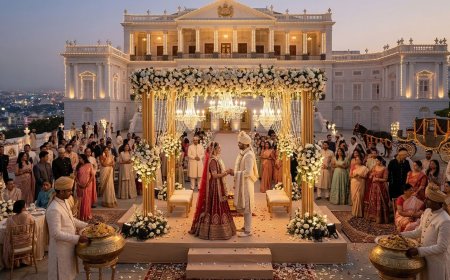
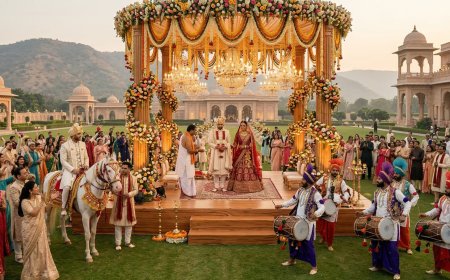
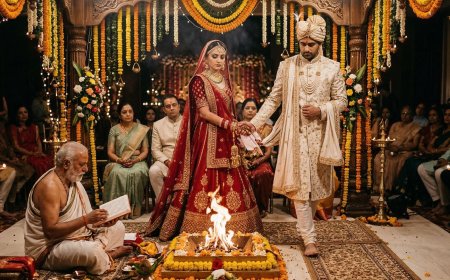
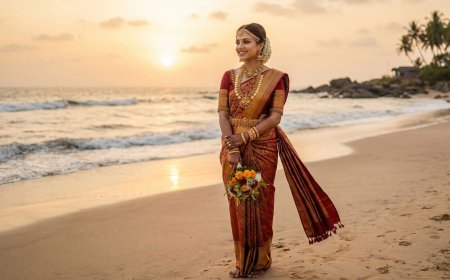
She arrived at the venue at one forty-five, still adjusting to the specific unreality of being formally dressed and socially present at an hour when she was usually deeply asleep, and found the mandap blazing with marigolds and banana leaves and the kind of concentrated ceremonial energy that she had not expected to find at two in the morning in a city she had flown into six hours earlier. The priest was already deep into the rituals. The families were arranged with the specific attentiveness of people for whom this hour was not unusual. The bride was luminous in a silk saree the colour of turmeric, with jasmine woven into her hair, and the groom was performing what appeared to be a dramatic departure from the venue with a walking stick and a small bundle, which Sravanthi leaned over and whispered was entirely intentional and entirely traditional.
Priya spent the next four hours watching something she did not fully understand and could not stop watching — a ceremony so layered, so specifically meaningful in its every gesture and ingredient and timing, that the not-understanding felt less like a gap and more like an invitation. By sunrise, when the feast was served on banana leaves and the dessert — a sweet paan that nobody had warned her about — arrived as the final course, she had decided that she needed to understand what she had witnessed.
This guide is for every NRI couple planning a Telugu wedding from abroad, every partner marrying into a Telugu family, and every guest who has sat in a Hyderabad or Vijayawada or London mandap and felt the depth of what they were witnessing without yet having the complete framework to understand it.
How Telugu Weddings Differ From Other South Indian Celebrations
The South Indian wedding is often spoken of as a single category, and there are genuine commonalities — the banana leaf décor, the yellow flowers, the turmeric, the sacred fire, the mangalsutra — that create a visual and ceremonial family resemblance across Tamil, Malayali, Kannada, and Telugu celebrations. But to treat them as equivalent is to miss the specific character of each, and the Telugu wedding has a specificity that is worth understanding on its own terms before the individual rituals are explored.
The most immediately distinctive element of the Telugu wedding is its timing. While Tamil and Malayali weddings tend toward morning muhurtams, and North Indian weddings dominate the evening and night, the Telugu wedding muhurtam is frequently scheduled at midnight or in the early hours of the morning — and sometimes in the afternoon. This is not eccentricity. It is the product of a specific astrological calculation, the Mahurutam, that identifies the most auspicious moment for the union, and that moment, by the reckoning of Telugu astrology, often falls outside the hours that other traditions consider primary.
The spiritual atmosphere of a Telugu wedding is its other defining quality. Where North Indian weddings lean toward grandeur — the spectacle, the scale, the performed abundance — Telugu weddings prioritise something that wedding planner Jueta Hemdev, founder of Yolo Entertainment and Weddings, describes precisely: a spiritual atmosphere that lingers throughout the festivities. The simplicity is not austerity. It is the specific simplicity of a ceremony that trusts its own ritual depth rather than supplementing it with theatrical scale.
The Arundhati Nakshatram ritual — the pointing out of a specific star in the night sky after the ceremony's conclusion — is a practice specific to Telugu weddings, with no direct equivalent in Tamil or Malayali or Kannada tradition. It is a gesture that places the marriage within the cosmos itself, connecting the newly married couple to the ideal union of the sage Vashista and his wife Arundhati, whose star has been visible in the Indian sky for as long as Telugu couples have been making their vows.
The Pre-Wedding Rituals: Building Toward the Ceremony
Nichithartham: The Official Confirmation
The Telugu wedding begins, formally, with the Nichithartham — the engagement ceremony whose name derives from the Sanskrit Nischay, meaning decided and confirmed. It is the public declaration of the marital union, the moment when what has been agreed between families becomes a social fact.
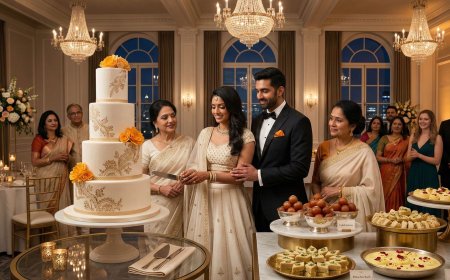
The Nichithartham shares its essential function with the Mangni of North India and the Wagdaan of Western India, but its specific form is distinctly Telugu. Where the Tamil Nischayathartham involves the application of sandalwood paste and vermillion to the bride's forehead — a marking that signifies her transition — the Telugu ceremony centres on the exchange of gifts between the families. This exchange is not merely transactional. It is the formal establishment of the relationship between two families, the first material expression of the bond that the wedding will consecrate.
Godhuma Rayi Pasuppu Danchadam: The Turmeric Grinding
Before the wedding's central rituals begin, the families perform one of its most quietly beautiful preparatory ceremonies — the Godhuma Rayi Pasuppu Danchadam, the grinding of turmeric by the married women of the family. Rayi means stone, Pasuppu Danchadam means the grinding of turmeric, and the ceremony's logic is both practical and deeply symbolic.
Turmeric holds a specific sacred status in Hindu culture through its association with Vishnu, the preserver and sustainer. The turmeric ground by the sumangalis — the married women of the family, whose own marriages make them vehicles of marital blessing — is believed to carry their collective good wishes into the paste that will be applied to the bride and groom. It is the family's love and blessing made physical, ground into the yellow substance that will touch the couple's skin before the ceremony begins.
Pelli Koduku and Kuthuru: The Telugu Haldi
The ceremony most recognisable to guests familiar with North Indian weddings is the Pelli Koduku and Pelli Kuthuru — the groom's and bride's respective pre-wedding ceremonies that correspond broadly to the Haldi but carry their own specific ritual architecture.
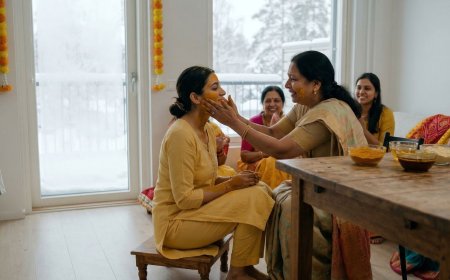
The pandiri — the stage for the ceremony — is decorated with banana tree branches, chosen for their association with Jupiter, the planet of prosperity and abundance. The marigolds are orange and yellow, colours selected to ward off negativity and attract the abundance that the banana leaf invokes. The Naluga — the paste produced from the turmeric of the Godhuma Rayi Pasuppu Danchadam ceremony, combined with aromatic oils — is applied to the couple's skin by family members, transferring the blessings ground into it by the married women of the household.
The Mangala Snanam follows — a ritual bathing in water infused with turmeric and Tulasi leaves. The theological reasoning is specific: turmeric represents Vishnu, the creator; Tulasi is his consort Lakshmi. The water that touches the bride and groom carries the blessings of both.
The ceremony concludes with the Kalyana Thilakam and Dishti Chukka — two traditional Andhra styles of bindi applied to the foreheads of the bride and groom by an elderly family member, to ward off the evil eye — and the application of paarani, turmeric mixed with saffron, to the feet. It is one of the most sensory-rich ceremonies in the Telugu wedding sequence, and one of the most photographed.
Celebrity wedding photographer Ajay Patnaik, who has documented hundreds of Telugu weddings, recalls a Pelli Koduku ceremony that captured perfectly the human warmth within the ritual structure: a groom so delighted by the gifts arriving at the ceremony that he began trying on gold rings on the spot, only to find one stuck on his finger for the better part of an hour, requiring repeated washing before it finally came free. The ritual and the human comedy, as always, entirely coexistent.
The Wedding Day Ceremonies: The Heart of the Telugu Union
Kashi Yatra: The Groom's Theatrical Departure
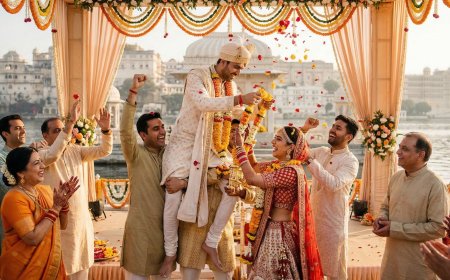
Few wedding rituals across any tradition match the Kashi Yatra for sheer dramatic impact. The groom, dressed and prepared for his wedding, suddenly announces that he has decided against marriage — that he intends to travel to Kashi, the holy city, and spend his life in celibacy and spiritual pursuit. He picks up an umbrella and a walking stick, the traditional accoutrements of the wandering ascetic, and makes as if to leave.
The bride's father and brother give chase. They plead with him. They explain, with the philosophical precision that the ritual requires, that renouncing worldly pleasures does not lead to enlightenment — that the householder's life, with its duties and its relationships and its accumulated karmic responsibilities, is itself a path to salvation. The groom is persuaded. He returns.
This is not theatre for its own sake. It is a ritual that encodes a genuine philosophical argument about the relationship between spiritual pursuit and worldly duty — an argument that runs through Hindu philosophy from the Upanishads onward. The groom who performs the Kashi Yatra is demonstrating that he understands the sacrifice of the ascetic path and has consciously chosen the householder path instead. The wedding begins not with unthinking compliance but with considered choice.
Jeelakarra Bellam: The First Sight
The Jeelakarra Bellam is the Telugu wedding's most intimate pre-ceremony ritual — the moment when the bride and groom first see each other in their wedding finery, mediated by a gesture that contains the entire philosophy of marriage in a single act.
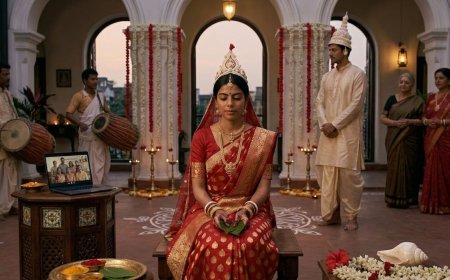
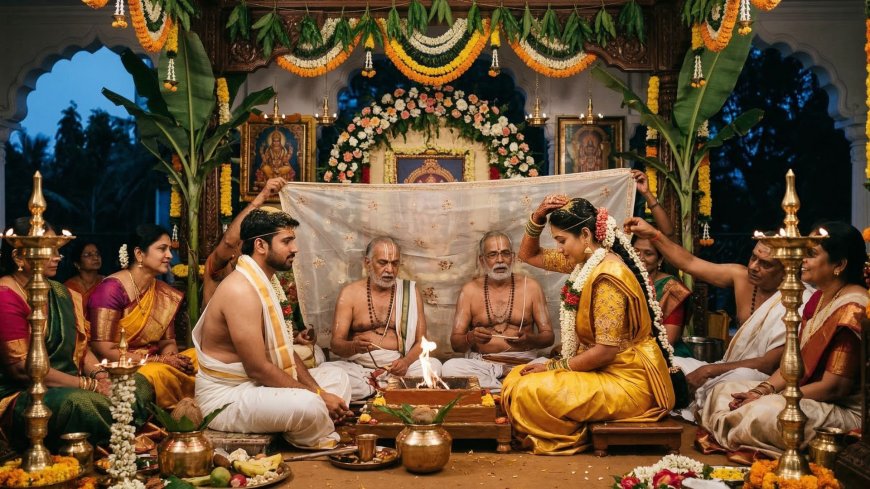
The bride is brought to the wedding altar in the specific manner of Telugu tradition — seated on a woven basket, carried by her maternal uncles — and a curtain is held between her and the groom. The priest applies a paste of cumin and jaggery to both their palms. Then the curtain is removed. They apply the paste to each other's heads, and they see each other.
Cumin is a strong, assertive spice — the representative of hardship, of the times that test a relationship. Jaggery is sweet and yielding — the representative of ease, of the times that are simply good. The application of both to each other's heads, at the first moment of wedding-day sight, is a mutual vow: I will be with you in the cumin times and in the jaggery times. I accept the full range of what marriage means.
Jueta Hemdev notes that modern Telugu couples sometimes adapt this ritual — applying the paste to each other's palms mutually, without the priest's intermediate step — making the ancient gesture more explicitly bilateral, more directly a statement made by both parties to each other rather than through a representative. The spirit is identical. The form is updated.
Mangalasutra: The Three Knots
The tying of the Mangalasutra — the sacred thread, the thalli — is the ceremony's central act of union, and the Telugu Mangalasutra has a specific form and specific significance that distinguishes it from the equivalent ceremony in other South Indian traditions.
The thread is made of nalla possulu — black thread, specifically chosen for its protective properties against the evil eye. Before it is tied, it is passed among all the members of both families, who hold it and offer their blessings into it. The thread that is finally tied around the bride's neck carries not only the groom's commitment but the accumulated goodwill of every person present. It is a community document as much as a personal one.
The three knots are individually meaningful. The first binds the groom to keeping the bride happy through speech — through words, through conversation, through the verbal life of the marriage. The second through action — through the daily, physical acts of care and commitment. The third through dharma — through duty, through the sustained commitment that outlasts feeling and relies on principle. The three knots are a complete philosophy of what sustaining a marriage requires.
Talambralu: The Grain Shower
If the Jeelakarra Bellam is the ritual that carries the philosophical weight of the Telugu wedding, the Talambralu is the ritual that carries its joy. The bride and groom shower each other with pearls and rice mixed with saffron and turmeric — and what was designed as a ceremonial exchange of abundance almost always becomes something closer to a playful contest.
Rice is the staple of Telugu food culture and the grain associated with Lakshmi, the goddess of prosperity. Pearls represent purity and beauty. The shower of both over each other is a mutual gift — prosperity, beauty, and the specific laughter that comes from being publicly playful with the person you are marrying.
Jueta Hemdev has watched this ceremony become a hilarious micro-battle at more than one wedding, most memorably when a bride concealed extra grains in her saree to produce a surprise second volley after the groom believed the ceremony was over. The photographs from that moment, she says, are among the most joyful she has seen from any wedding. The ritual designed as an ice-breaker achieves its purpose every time.
Saptapadi: The Seven Steps
The Saptapadi — the seven steps taken around the sacred fire — is the ritual that most directly parallels the North Indian Saath Phere, and the theological reasoning behind the number seven in Telugu tradition is specific enough to be worth understanding.
The bride and groom together trace a complete circle — 360 degrees — around the fire, taking seven steps. The number seven carries a specific mathematical significance: from one to nine, seven is the only number that does not divide evenly into 360. It is the number that refuses to resolve cleanly into the whole, the number that keeps something irreducible in the relationship. The seven steps are chosen precisely because seven cannot divide their bond — cannot make it come out even, cannot reduce it to a clean quotient. The incompleteness is the point. The marriage is indivisible.
Each step carries its own vow — the seven promises that the couple makes as they circle the fire, covering the full range of what they are committing to: sustenance, strength, prosperity, happiness, progeny, long life, and friendship. The friendship vow, the seventh, is the one that Telugu tradition considers the completion of the union. The couple who has made the friendship vow has made the vow that underlies all the others.
Arundhati Nakshatram: The Cosmic Conclusion
When the ceremony is finished and the feast is done — sometimes in the early hours of the morning, sometimes near dawn — the new couple steps outside. The groom searches the sky for a specific star.
Arundhati — known in Western astronomy as Alcor — is a star in the Ursa Major constellation, visible to the naked eye on a clear Indian night. In Hindu tradition, Arundhati is the wife of the sage Vashista, and their union is considered the ideal marriage — devoted, spiritually aligned, mutually sustaining across eons. By pointing out the Arundhati Nakshatram to his bride, the groom is placing their marriage within the context of the most celebrated marriage in the tradition's cosmology. They seek the blessings of the ideal couple as they begin their own life together.
Ajay Patnaik recalls photographing actor Kiran Abbavaram's wedding, where the festivities ran so late that by the time the Arundhati Nakshatram ritual was complete, the groom was so exhausted that his brother-in-law carried him to his room on his back. The star-gazing and the being carried to bed — the cosmic and the human, always coexisting in the Telugu wedding, always equally real.
The Banthi Bhojanam: The Telugu Wedding Feast
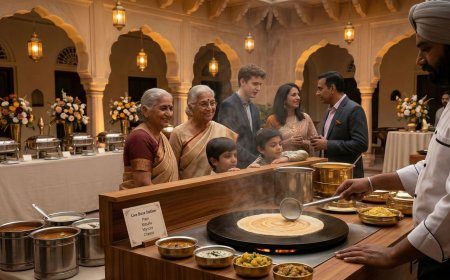
The Telugu wedding feast — the Banthi Bhojanam — is served on banana leaves, begins with dessert, and is entirely vegetarian. In this it shares its essential grammar with the Tamil Virundhu Sapudu and the Kerala Sadhya, but the specific character of the Banthi Bhojanam is shaped by the geography of Telugu-speaking India in ways that produce three distinct regional expressions.
Chef Chalapathi Rao, of the award-winning Hyderabad restaurant Simply South, maps the distinctions with the precision of someone who has cooked across all three regions. In Telangana, historically a dry region with limited water resources, the Banthi Bhojanam incorporates millets prominently — crops that require less water and that have been the foundation of Telangana's food culture for centuries. The feast reflects the landscape that produced it.
In Rayalseema, the driest of the three regions, the solution to limited moisture is not millet but intensity — the fierce heat of Guntur chillies, considered the spiciest in the world, applied to dishes that require the chilli to do the work of making the simple ingredient extraordinary. The Rayalseema Banthi Bhojanam is a feast that does not apologise for its heat. It embraces it as an expression of the region's character.
The dessert that concludes the Banthi Bhojanam — served first, in the South Indian tradition that places sweetness at the beginning of the meal — is the Killi, the sweet paan, which distinguishes it from the Paal Payasam of Tamil weddings and the Ada Pradhaman of Kerala. It is a small, specific detail. It is also the difference between one feast and another, between one community's expression of celebration and the next one's, and it is the kind of detail that makes the Telugu wedding, for all its surface similarities to other South Indian traditions, unmistakably and completely itself.
What the Two in the Morning Was For
Priya flew back to London the day after the wedding. She was at the airport by five in the morning, still in the saree she had worn to the ceremony because she had not had time to change. She had been awake for twenty-two hours. She had watched a groom pretend to leave for a holy city and be coaxed back by a father who explained, with ceremonial seriousness, why marriage was more spiritually valuable than celibacy. She had watched a bride and groom apply cumin and jaggery to each other's heads through a parting curtain. She had watched seven steps around a fire and a grain shower that had turned into a small war and three knots tied with the weight of a community's blessing. She had watched a man point at a star.
At the gate, waiting to board, she opened her phone and searched for Arundhati Nakshatram. She found it — the small companion star to Mizar in the handle of the Big Dipper, visible from anywhere in the Northern Hemisphere on a clear night. She thought about the couple she had just watched getting married, standing in a Hyderabad courtyard at four in the morning, finding that star together at the beginning of everything.
The two in the morning made complete sense now.
Understand the Mahurutam timing before assuming the ceremony schedule is unusual. Know that the Kashi Yatra is philosophical argument, not theatre. Recognise the specific weight of each of the three Mangalasutra knots. Watch the Talambralu with attention — the playfulness is the point. Find the Arundhati Nakshatram before the wedding, so you know what you are watching for when the groom points at the sky.
The Telugu wedding is one of the most spiritually layered ceremonies in the Indian tradition. Every grain of rice, every knot, every star has a reason. Learning the reasons is how a witness becomes a participant.
Published by NRIWedding.com — The Premium Global Platform for Non-Resident Indians Planning Indian Weddings From Abroad.
What's Your Reaction?
 Like
0
Like
0
 Dislike
0
Dislike
0
 Love
0
Love
0
 Funny
0
Funny
0
 Angry
0
Angry
0
 Sad
0
Sad
0
 Wow
0
Wow
0