





























































How to Write Personal Vows That Honor Both Your Cultures — The Complete NRI Couple's Guide
personal vows NRI couple both cultures, writing wedding vows NRI India, NRI couple personal vows guide, Indian wedding personal vows NRI, bilingual wedding vows NRI couple, Hindu wedding personal vows NRI, Nikah personal vows NRI couple, NRI wedding vows both cultures, writing personal vows Indian wedding NRI, NRI couple wedding vows cultural, intercultural wedding vows NRI guide, personal vows Indian diaspora wedding, NRI wedding vow writing tips, NRIWedding.com, NRI couple writing vows Indian wedding


How to Write Personal Vows That Honor Both Your Cultures
The Words That Were Supposed to Come Easily
She had been a writer her whole life. Not professionally — she was a software engineer in Vancouver — but in the specific sense that she had always found language to be the medium through which she understood her own experience. She kept journals. She wrote long emails when other people sent voice notes. She was the person in the friend group who found exactly the right words for the thing everyone else was feeling but couldn't say.
She was also, nine weeks before her wedding, completely stuck on her vows.
Not because she didn't know what she wanted to say. She knew exactly what she wanted to say — she had known for months, in the way that significant things are known before they are articulated, as a feeling rather than a sentence. What she wanted to say was something about growing up between two worlds, about the specific experience of being Indian enough for the homeland and Canadian enough for the country she had made her own, and about finding in her partner someone who understood this specific in-between-ness from the inside because he lived it too.
She wanted to say something true. Something that reflected the actual texture of the life they were building together — the Diwali that happened alongside Thanksgiving, the way they code-switched between languages in the same sentence, the specific tenderness of two people who had each spent years explaining themselves to one world or the other and had finally found someone with whom no explanation was necessary.
What she kept writing instead was generic.
Beautiful, genuinely felt, carefully worded — and generic. The kind of vows that could have been written by any person who loved their partner. Not by her, specifically, for him, specifically, in the specific context of the life they had specifically built.
The specificity was the problem. The specificity was also, she eventually understood, the solution.
This guide is for every NRI couple who knows what they want to say and needs help finding how to say it.
The Core Reality: Why NRI Vows Are a Different Writing Challenge
The Standard Vow Template Does Not Fit
Most wedding vow guidance — the books, the online resources, the AI vow generators — is built around a template that assumes a relatively straightforward cultural context. There is a person. There is a partner. There is a love story. There are promises about the future. The template captures this with competence and occasionally with grace.
What the template does not capture is the specific complexity of the NRI love story — the particular kind of love that develops between two people who each carry multiple cultural identities, who have each navigated the specific negotiations of the diaspora experience, and whose relationship has its own distinctive texture because of rather than despite this complexity.
The NRI couple's love story is not just a love story. It is a love story shaped by the experience of living between cultures — by the specific ways that the homeland's values and the adopted country's values have each shaped the individual, by the particular kind of home that two people from this context build together, and by the specific resonances of finding someone who understands the experience from the inside.
Vows that do not acknowledge this context — that treat the NRI couple's specific experience as background rather than content — miss the most distinctive and most meaningful dimension of the story they are being asked to tell.
The Two Languages of the NRI Heart
Most NRI couples have an emotional vocabulary that exists in more than one language — not necessarily because they are fluent in multiple languages, though many are, but because different aspects of their emotional and cultural life have been experienced and expressed in different languages.
The specific words for the most important things — the words for home, for belonging, for the particular quality of love that is shaped by a specific cultural framework — often exist most fully in the language in which those concepts were first encountered. The Hindi word ghar carries a different specific weight from the English word home — not better, not worse, but different, in a way that the person for whom both words are emotionally alive knows precisely and cannot fully explain to someone for whom only one of them is.
The NRI couple's vows have the opportunity — and perhaps the responsibility — to exist in both languages. Not necessarily in the form of a bilingual speech, though that is one option. But in the sense that the vows should reflect the full emotional vocabulary of the person making them — including the words for things that only exist in one language, and the experiences that only make sense in their specific cultural context.
The Multiple Audience Problem
The NRI wedding ceremony has a specific audience complexity that the standard vow guidance does not address. The assembled guests include people for whom different parts of the vows will resonate differently — the grandparents from India who understand the cultural references from the inside but may not follow the English, the non-Indian friends from the office who are moved by the emotion but may not understand the cultural context, the family members from both communities who each hope to see their specific world reflected in the vows.
The vows that try to serve all of these audiences equally often end up serving none of them fully — explaining cultural references to those who don't need explanation, losing the specificity that makes the vows meaningful in the attempt to make them universally accessible.
The guidance is counterintuitive: Write for the most important audience of one — the partner — rather than for the assembled guests. Vows that are genuinely specific to the relationship, that reflect the actual texture of the shared life rather than the expected template, resonate more powerfully with every person in the room than vows that were designed to be accessible to everyone. Authenticity is universal even when specificity is particular.
The Foundation: What Personal Vows Actually Are
The Distinction Between Vows and Speeches
Personal vows are not speeches about the relationship. They are not testimonials of the partner's qualities. They are not the story of how the couple met, told in the second person.
Personal vows are promises. Specific, first-person, future-tense commitments about what the person making them will do, will bring, will be, in the marriage they are entering. The speech about how wonderful the partner is belongs at the rehearsal dinner. The vows are what the person is committing to — the specific answer to the question that the ceremony is asking: what are you offering?
This distinction is important for NRI couples specifically, because the tendency in NRI vow writing is to lean toward the narrative — the story of the two cultures meeting in the two people, the description of the shared experience of the diaspora, the evocation of the homes left behind and the home being built together. All of this is beautiful material. None of it is a vow until it is transformed from a description into a commitment.
The description: "You understand what it means to grow up between two worlds."
The vow: "I promise to be the person who always understands both of your worlds — the one you were born into and the one you built — and to never ask you to choose between them."
The transformation from description to commitment is the transformation from speech to vow.
What Makes a Vow Specific
The specific vow — the one that could only have been written by this person, for this partner, in this relationship — contains three elements that the generic vow does not.
The first is a specific observation — something the person has noticed about the partner or about the relationship that is true and particular rather than generally applicable. Not "you make me laugh" — which is true of many partners — but the specific thing about the way this partner makes this person laugh, in the specific context of the specific shared life they have.
The second is a specific commitment — a promise that is calibrated to the specific person and the specific relationship rather than drawn from the standard list of marriage promises. Not "I will love you through sickness and health" — which is a beautiful promise and a genuine one — but the specific version of that promise that reflects the actual texture of how this couple supports each other through difficulty.
The third is a specific truth — something the person knows about themselves, about the partner, or about the relationship that is honest and particular and perhaps a little vulnerable. The specific truth is the element that makes vows genuinely moving — the moment when the person saying them reveals something real rather than aspiring to something ideal.
The Writing Process: How to Actually Do It
Step One — The Inventory of Specifics
Before writing a single sentence of the vows, spend an hour with a notebook — or a voice recorder, or whatever medium feels most natural — working through the following prompts. Not editing. Not composing. Just generating material.
The cultural inventory: What are the specific elements of your cultural heritage that have shaped you most — not the general answer, but the specific ones. The specific food. The specific festival. The specific saying your grandmother used. The specific value that your parents' example embedded in you before you had language for it.
What are the specific ways that growing up between cultures has shaped who you are — the specific negotiations, the specific enrichments, the specific loneliness, the specific gifts. Not the general NRI experience but your specific experience of it.
What does your partner understand about your cultural identity that other people have not — the specific things that do not require explanation between you, the moments when you have felt understood in the particular way that only someone who shares the experience from the inside can provide.
The relationship inventory: What are the three most specific things you know about your partner — not their general qualities but specific observations. The specific way they handle difficulty. The specific thing they do when they are happy. The specific habit that initially seemed like a minor quirk and has become one of the things you would miss most.
What has your partner brought into your life that was not there before — specifically. Not love in the general sense but the specific quality of presence or understanding or challenge or comfort that is distinctively theirs.
What is the specific thing about your relationship that you could not have anticipated and would not exchange — the specific surprise of who this person is and who you have become in relation to them.
The future inventory: What are the specific things you are committing to — not the standard list but the ones that are calibrated to this specific relationship. The specific support you are promising. The specific patience you are acknowledging you will need. The specific way you will show up in the specific circumstances of the life you are building together.
What are the specific elements of your shared cultural life that you are committing to maintain, to honour, and to build — the specific festivals, the specific languages, the specific values, the specific traditions that you are choosing to carry forward together.
Step Two — The Cultural Thread
From the material generated in the inventory, identify the cultural thread — the specific element of the dual-culture experience that is most authentically yours and most relevant to the specific relationship.
Not every NRI couple's vows need to be explicitly about the experience of living between cultures. For some couples, the cultural dimension is background context rather than foreground content — the love story is shaped by the NRI experience but is not primarily about it.
For other couples, the dual-culture experience is the specific texture of the relationship — the thing that makes it distinctively theirs, that explains something important about why these two specific people found each other and what they offer each other.
If the cultural thread is central to the vows, it should be treated as specific content rather than general context. Not "we both come from Indian families" — which is context — but "I promise to always know that the phone call to your parents in Hyderabad at the end of a hard day is not an inconvenience but a necessity — the specific kind of grounding that I cannot provide and that I will always make space for" — which is specific and which is a vow.
If the cultural thread is background, the vows may reflect the cultural context in their language choices, in the specific references they draw on, in the values they articulate — without making the dual-culture experience itself the explicit subject.
Step Three — The Language Choice
For NRI couples with genuine fluency in a language other than English, the question of whether to include words or phrases from that language in the vows is a meaningful choice with genuine implications.
The case for including the other language: There are things that are most fully expressed in the language in which they were first felt. If there is a specific word or phrase in Hindi, Urdu, Tamil, Punjabi, Bengali, or another language that captures something the vows need to say — something for which the English translation is less complete — using that word or phrase in the vows is not an affectation. It is the most honest choice.
The specific address — calling the partner by the term of endearment that belongs to the language of home — has an emotional weight that the English equivalent does not. Jaan. Yaar. Kannamma. Shona. These words carry the specific warmth of the language in which the speaker first learned to express love, and their presence in the vows signals something specific about the world the couple is creating together.
The case for staying in English: If the non-English language is not genuinely the speaker's primary emotional language — if the words feel more performed than felt — then including them for cultural representation rather than for emotional truth is the wrong choice. Guests who understand the language will know the difference between language used because it is the most honest choice and language used because it signals cultural identity.
The honest test: does including this word or phrase make the vow more true or more performing? The answer to this question determines the choice.
Step Four — The Structure
Personal vows for NRI couples benefit from a structure that moves through three distinct sections rather than being written as a single extended passage.
The first section — the acknowledgment: One to three sentences that acknowledge something specific and true about the partner, the relationship, or the shared experience of the dual-culture life. This section establishes the specific context of the vows — who these two people are and what has brought them to this moment. It is the specific truth rather than the general sentiment.
The second section — the promises: Three to five specific promises — each a genuine commitment rather than a general aspiration. These are the heart of the vows. Each promise should be specific enough that the partner would immediately recognise it as belonging to their particular relationship rather than to a generic marriage.
The third section — the declaration: One to three sentences that close the vows with the specific expression of the commitment being made. Not "I love you" alone — which is true but not a vow — but the specific declaration of what the love is, what it has produced, and what the person is choosing today in its expression.
The Specific Prompts: Starting Points for NRI Vow Writing
The following prompts are starting points rather than templates — each designed to access a specific dimension of the NRI dual-culture experience that personal vows can honour.
On the experience of belonging: "You are the first person who has made me feel that belonging to more than one world is not a division but a gift. I promise to..."
On the specific understanding: "You understand [specific cultural reference] in the way that I have only ever been able to explain to you, because you have lived it too. I promise to always..."
On the home being built: "The home we are building together will have [specific cultural elements from both traditions]. I promise to honour both, to protect both, and to make space for both even when the world outside does not."
On the specific support: "When you need to [specific culturally informed behaviour — call your family, observe a specific practice, mark a specific occasion], I promise to never make you explain why. I already know."
On the future children or family: "I promise that our children will know [specific cultural heritage]. They will know [specific language or practice or festival or value] because we will teach them — not as an obligation but as a gift we were given and are choosing to give forward."
On the specific negotiation of dual identity: "You have never asked me to choose between who I am here and who I am there. I promise to give you the same freedom — to be all of yourself in our home, to never have to leave any part of yourself at the door."
On the love that transcends explanation: "I have spent much of my life explaining myself — to this country, to that country, to people who only understood half of where I came from. I promise that you will never have to explain yourself to me. I already understand. I have always understood."
The Coordination Question: How to Write Vows Together Without Writing Them Together
The Balance of Length and Tone
NRI couples who are both writing personal vows need to coordinate without copying — ensuring that the vows complement each other in length and tone without being identical in approach or content.
The practical guidance is to agree on the length — typically ninety seconds to two and a half minutes when spoken — and the general tone before writing separately. The length agreement prevents the specific awkwardness of one partner's vows being significantly longer or more elaborate than the other's, which creates an unintended imbalance in the ceremony.
The tone agreement — whether the vows will be primarily solemn, primarily warm, primarily tender, primarily humorous, or some specific blend — ensures that the two sets of vows belong to the same ceremony rather than to two different emotional registers.
The specific agreement: Decide before writing whether the cultural dimension will be explicitly addressed in both sets of vows or in one set and referenced in the other. Two sets of vows that both explicitly address the NRI experience can feel redundant; two sets where one partner explicitly addresses it and the other partner's vows reflect the same values without the explicit framing can be more powerful in combination.
The Surprise Element
Most couples who write personal vows choose not to share them before the ceremony — which creates the specific emotional experience of hearing, for the first time, what the partner has chosen to say. This element of surprise is among the most powerful in the personal vow ceremony, and the specific experience of hearing something genuinely unexpected and genuinely true from the person across the ceremony is one of the things that makes personal vows worth the difficulty of writing them.
For NRI couples who are concerned about the coordination of cultural references — who want to ensure that they are not both saying exactly the same thing — a limited coordination is appropriate: share the general themes without sharing the specific language. Agreeing that one partner's vows will reference the grandmother's kitchen and the other's will reference the first Diwali they celebrated together in the adopted country prevents redundancy without removing the surprise.
The Ceremony Integration: Where the Vows Live
Personal Vows Within a Traditional Hindu Ceremony
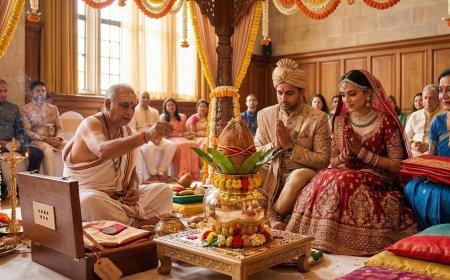
The integration of personal vows into a Hindu wedding ceremony requires conversation with the pandit — specifically, agreement on where in the ceremony the personal vows will be placed and how they will be framed within the ceremony's sacred structure.
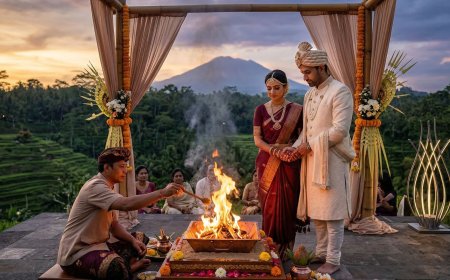
The most common placement for personal vows in a Hindu ceremony is after the Saptapadi — the seven steps — has been completed. The Saptapadi itself constitutes the ceremonial vow structure of the Hindu marriage, and the personal vows in this position become an English-language elaboration of the commitments that the Saptapadi has just made in Sanskrit — a bridge between the ancient ritual and the couple's specific contemporary articulation of it.
Some pandits integrate the personal vows at a different point — between specific rituals, or as a closing element before the Aashirvaad — and the specific placement should be agreed in the pre-ceremony consultation. What matters is that the personal vows are positioned as a genuine element of the ceremony rather than as an addition that interrupts the ceremony's ritual flow.
Personal Vows Within a Nikah
The integration of personal vows into a Nikah ceremony similarly requires consultation with the Qazi or Imam. The Nikah's essential conditions — the Ijab and Qabul, the Wali, the Mahr, the witnesses — are the ceremony's religious requirements and cannot be replaced or modified by personal vows. The personal vows in the context of a Nikah are an addition to the ceremony — an expression of the couple's specific commitments that supplements the religious contract rather than substituting for any element of it.
The placement after the signing of the Nikah Nama — when the contract has been completed and the dua has been made — is the most natural position for personal vows in a Nikah ceremony. In this position, the vows are the couple's own words offered in the immediate aftermath of the ceremony's completion — the specific human expression that follows the sacred covenant.
The Civil Ceremony Context
For NRI couples who are also conducting a civil ceremony — either in India or in the country of residence — personal vows integrate naturally into the civil ceremony's structure, which typically has more flexibility for personalisation than the religious ceremony.
Some NRI couples choose to make their most personal vows in the civil ceremony context — using the religious ceremony for the traditional ritual form and the civil ceremony for the specific, personal, English-language commitments that reflect the full texture of their relationship and their dual-culture life.
The Delivery: How to Say What You Have Written
The Specific Anxiety of Vow Delivery
Most people who have written genuinely personal vows — vows that reflect specific and vulnerable truths rather than aspirational generalities — experience a specific anxiety about delivering them. The anxiety is not about forgetting the words. It is about the exposure. The specific truth that made the vow genuine in the writing is the same specific truth that makes it frightening to say aloud in front of a hundred people.
This anxiety is the correct response. It signals that the vows contain something real. The vows that produce no anxiety are typically the vows that contain nothing particularly vulnerable — and it is the vulnerability that makes them genuinely moving.
The practical guidance: practise the vows aloud, alone, multiple times before the ceremony. Not to memorise them — though familiarity reduces the cognitive load on the wedding morning — but to hear them in your own voice and to become comfortable with the emotional experience of saying them. The first time most people say their vows aloud they cry. The second time they are less surprised by the emotion. By the fifth time they have found a relationship with the content that allows them to be present for the saying rather than managing the emotion of it.
Reading Versus Memorising
For most NRI couples, reading the vows from a card or paper is the more reliable option than attempting full memorisation. The wedding morning is not a stable cognitive environment — the combination of sleep disruption, emotional intensity, and the sustained demands of a multi-day wedding programme creates conditions in which memorised material is more vulnerable than it would be in any other context.
The practical guidance: Write the vows on a card that is small enough to be held without being conspicuous and printed or written in a font large enough to read without difficulty. Some couples have the maid of honour or best man hold the card and hand it at the appropriate moment; others keep it in a pocket of the outfit.
Reading from a card is not a failure of preparation. It is a reasonable logistical decision that ensures the vows are delivered as written rather than as a partially remembered approximation.
The Eye Contact Question
The vows are most powerful when delivered primarily to the partner — with direct eye contact — rather than read from a card in a way that breaks the connection between the person speaking and the person being spoken to.
The practical technique: know the vows well enough to deliver each sentence to the partner with eye contact, dropping the eyes to the card only to remind yourself of the next sentence. This is not memorisation — it is familiarity. The difference between the person who has read their vows five times and the person who has read them fifty times is visible in this specific quality of delivery — the ability to hold the partner's gaze while saying the most important things.
Common Mistakes NRI Couples Make With Personal Vows
The first mistake is writing the vows too late. The vows that are written in the two days before the wedding are typically the vows that fall back on the generic template because there is no time for the specific process — the inventory, the drafting, the revision, the reading aloud, the revision again — that produces genuinely specific vows. Begin the vow writing process at six to eight weeks before the wedding.
The second mistake is writing for the audience rather than for the partner. The vows that are designed to be funny for the guests, or moving for the parents, or impressive for the assembled community are typically the vows that are least genuinely felt by the partner receiving them. Write for the partner. Trust that what is genuine to the relationship will resonate with everyone in the room.
The third mistake is including the cultural references as performance rather than as truth. The Hindi phrase included because it signals cultural identity rather than because it is the most honest expression of what needs to be said is perceptible as performance to anyone who understands the language. Include the other language when it is the truest language for the specific thing being said. Not otherwise.
The fourth mistake is making the vows too long. Personal vows that run longer than three minutes typically contain material that belongs in a speech rather than in a vow — narrative, description, anecdote — rather than the specific commitments that are the vow's purpose. Ninety seconds to two and a half minutes is the appropriate length. The discipline of the limit forces the specificity that makes the vows genuinely moving.
The fifth mistake is not practising the delivery. The vows written beautifully and delivered inaudibly, or with a voice break that never recovers, or with the eyes on the card throughout, do not serve the partner or the ceremony as well as the same vows delivered with presence and with the specific eye contact that makes the saying of them an act of genuine connection.
The Words That Are Only Yours
The Hindu ceremony will include the Saptapadi — the seven steps, the ancient vows, the Sanskrit words that have been spoken at Indian weddings for thousands of years. The Nikah will include the Ijab and Qabul — the solemn covenant, the Arabic phrases, the contract that has united Muslim couples across centuries and continents.
These are extraordinary words. They carry the weight of civilisation. They connect the modern NRI couple to an unbroken chain of human ceremonial life that stretches back further than recorded history.
And then there are your words.
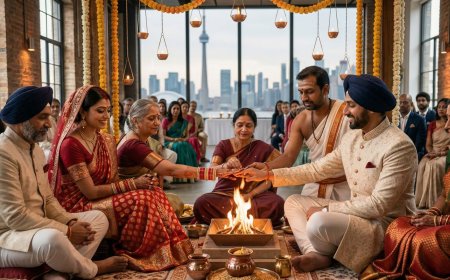
Not ancient. Not universal. Not the words that have been spoken at a thousand other weddings. Your specific words, for this specific person, in the specific context of the specific life you have built together — the life that exists between cultures and encompasses both of them, that speaks two languages and feels fully at home in neither and both simultaneously, that has found in the space between two worlds a home that is entirely its own.
These words matter because they are only yours.
The grandparents who came from India will hear something in them that they recognise — the values, the commitments, the specific quality of love that the culture shaped in you before you had words for it. The friends from the office in Vancouver or London or Sydney will hear something in them that moves them — the specific human truth that transcends the cultural context and lands as genuine regardless of whether the listener shares the reference.
And the partner across the ceremony — the person who has always understood both of your worlds from the inside — will hear the specific words that were written for them, by you, out of the specific truth of what you know and what you feel and what you are choosing.
Write those words. Take the time they deserve. Say them with your eyes open.
They are the most important thing you will say today.
Published by NRIWedding.com — The Premium Global Platform for Non-Resident Indians Planning Indian Weddings From Abroad.
What's Your Reaction?
 Like
0
Like
0
 Dislike
0
Dislike
0
 Love
0
Love
0
 Funny
0
Funny
0
 Angry
0
Angry
0
 Sad
0
Sad
0
 Wow
0
Wow
0