







































































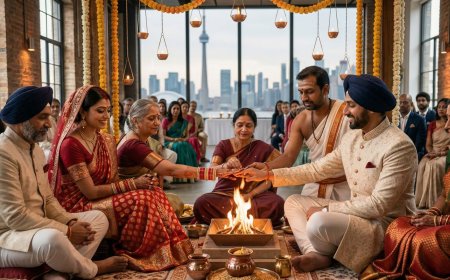



Your First 10 Steps After Getting Engaged as an NRI
Getting engaged as an NRI is the beginning of one of the most complex and rewarding planning experiences of your life. This expert guide outlines the ten essential steps every NRI couple must take immediately after engagement — from protecting your vision and having the honest budget conversation, to shortlisting wedding planners, choosing your wedding city, and building the planning infrastructure that makes remote coordination possible. Designed specifically for NRIs in the USA, UK, Canada, UAE, and Australia, this is the smartest, most structured starting point for planning an authentic Indian wedding from abroad.


The proposal was perfect.
Maybe it happened at a rooftop restaurant in London with the city lit up below you. Maybe it was a quiet Tuesday evening in your Toronto apartment, just the two of you, after months of knowing and waiting. Maybe it happened in India during a family visit, surrounded by generations of people who have loved you your whole life.
For one evening, the world narrowed to a single moment. And it was everything.
Then morning arrived.
You woke up engaged. The ring was real. Three continents were flooding your notifications. Your mother had already called twice before your first coffee. Your future mother-in-law left a voice note that was four minutes and forty seconds long. A cousin you haven't spoken to since 2019 left a comment asking if you'd set a date yet.
And somewhere beneath the genuine, overwhelming joy — a very specific kind of anxiety quietly began to form.
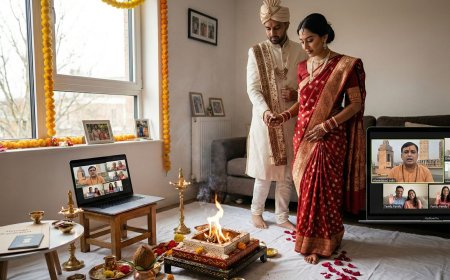
Because you are an NRI. And being an NRI means the most personal moment of your life immediately collides with a logistics reality that most people in your office or neighbourhood have never had to face.
You are not just planning a wedding. You are planning an Indian wedding — across time zones, with vendors you have never met, in a country you do not currently live in, for families whose expectations were shaped long before you had any say in the matter.
Nobody prepared you for this part. But thousands of NRI couples have navigated it — and come out the other side with weddings that were extraordinary, personal, and deeply worth every complicated moment.
This guide gives you the ten foundational steps to take immediately after getting engaged as an NRI. Not a vendor checklist. A real, intelligent, structured starting point.
Why the First Weeks Matter More for NRIs Than Anyone Else
For a couple planning a wedding in the same city they live in, the first few weeks are mostly emotional. Logistics settle naturally into the infrastructure around them.
For NRI couples, those same weeks carry structural weight.
Every decision delayed in the opening phase creates downstream complications that compound quietly over time. A venue decision deferred by three months means your options are already narrowed. A budget conversation avoided for six weeks means family expectations have hardened around numbers that may not reflect reality. A planner not engaged early means the most experienced professionals in your city are already committed to other clients.
Distance is an amplifier. Clarity early reduces everything that distance amplifies. Confusion early magnifies everything distance makes harder.
The couples who navigate NRI wedding planning with grace are not the ones with the largest budgets or the most cooperative families. They are the ones who moved through the first four weeks with intention.
Your First 10 Steps: A Complete Strategic Framework
Step 1: Protect the First 48 Hours
Before the world gets involved — protect your space.
Before the public announcement. Before the extended family calls. Before any planning begins — give yourselves 48 hours that belong only to you.
The moment your engagement becomes visible, especially in Indian families, it becomes a collaboration. Everyone has input. Everyone has suggestions dressed up as congratulations.
Use those 48 hours to have the conversations only you two can have:
- What kind of wedding do you actually want — not what looks good, not what family expects?
- How much family involvement feels right to each of you?
- What timeline genuinely works for your lives and your jobs?
- What are your individual non-negotiables?
These conversations won't be finished in two days. But beginning them before external voices crowd out your own is one of the most quietly powerful things you can do.
Step 2: Announce Thoughtfully — Sequence Matters
Your announcement sets the tone for every family dynamic that follows.
For NRI couples, the announcement order carries real planning implications — not just social ones.
Immediate family on both sides deserves to hear from you directly and personally — a phone call, a video call — before any public post. Families who feel honoured in the announcement become more collaborative partners in the planning. Families who feel like an afterthought carry that quietly into every subsequent conversation.
Also consider: your extended network — particularly international guests — will need significant lead time to plan travel. A thoughtful announcement that includes a rough timeline ("we're thinking late next year") allows people to begin making arrangements before formal invitations ever exist.
Step 3: Have the Budget Conversation — Fully and Honestly
This is the conversation most couples avoid longest. It is also the most consequential.
Budget conversations in NRI families are not purely financial. They are cultural negotiations loaded with expectation, generational pride, and differing ideas about what a wedding represents and who it is for.
Before any vendor research begins, answer these questions explicitly:
- Who is contributing, and what is the realistic total?
- Does financial contribution imply decision-making authority in anyone's mind?
- Are there specific functions any family considers their domain?
- What contingency are you building in — and 15% minimum is not optional for NRI weddings?
Have this conversation with both families within the first two to three weeks. Ambiguity in the budget conversation becomes conflict in the planning conversation — every single time.
Step 4: Define Your Vision Before Anyone Else Does
A couple without a shared vision becomes a committee managed by everyone except themselves.
Before vendor research. Before Instagram mood boards. Before your mother-in-law's third set of references. Create a simple, honest shared vision document.
It does not need to be elaborate. It needs to answer:
- What does the atmosphere of this wedding actually feel like to you both?
- How many functions genuinely excite you versus feel like obligations?
- What are the three to five elements that, if done right, would make this feel completely yours?
- Where are you genuinely indifferent — where family preference can guide without loss?
This document becomes your reference point when the planning noise gets loud. It is the difference between leading your wedding and reacting to everyone else's version of it.
Step 5: Choose Your Wedding City and Season — Now
Everything downstream depends on this decision. Make it early.
Your wedding city determines your entire vendor ecosystem, your venue options, your guest travel logistics, and your budget calibration. It is the highest-leverage early decision you will make.
Consider these layers:
Practical: Metro cities — Mumbai, Delhi, Bangalore, Hyderabad — offer mature, internationally-experienced vendor markets and strong international flight connectivity. Smaller cities offer atmosphere and intimacy but require stronger local support networks.
Cultural: Is this city meaningful? Does it connect to your family story, your heritage, your shared history?
Seasonal: Indian wedding season runs October through February. Premium venues in these windows begin booking 12 to 14 months in advance. Choosing your city and season within six weeks of engagement is not early — it is necessary.
Step 6: Research and Shortlist Wedding Planners Immediately
For NRI couples, a wedding planner is not a luxury. It is the operational mechanism that makes remote planning possible.
Without a professional on the ground, you are coordinating vendors you cannot visit, managing timelines you cannot monitor, and navigating a market you do not have daily access to. A planner is your local representative, your vendor network, your cultural navigator, and your crisis manager.
What to look for:
- Demonstrated NRI client experience — ask specifically what percentage of their clients are based abroad
- Structured communication systems: video call-based briefings, documented revisions, clear timelines
- Cultural and interpersonal intelligence — they will be managing family dynamics, not just logistics
The reality: the best planners in Indian metro cities book 10 to 14 months in advance for peak season. Start conversations within your first four weeks of engagement. Not to decide immediately — to ensure you are choosing from the full field.
Step 7: Build Your On-the-Ground Support Network
Your planner is your professional representative. You also need a personal one.
Identify two to three people in your wedding city who can support the planning process in ways a professional cannot:
The Trusted Family Coordinator — reliable, calm, clear-headed. Not the most enthusiastic family member. The most dependable one. This person attends vendor meetings you cannot join, verifies that the venue looks as it did in the walkthrough video, and communicates with extended family in a way that is warm but structured.
The Cultural Navigator — someone who deeply knows the rituals, regional protocols, and family-specific traditions involved in your ceremonies. This is especially important if partners come from different communities or regions.
The Practical Fixer — someone who knows the city well and can handle on-the-ground logistics: receiving a delivery, sourcing a specific item, troubleshooting a vendor communication gap on short notice.
Define each role explicitly and early. Assumed roles produce gaps. Defined roles produce reliability.
Step 8: Create Your Planning Infrastructure
Build the system before you need it. It will carry you through eighteen months.
Four components, implemented immediately:
Master Planning Document — a shared live document containing budget overview, decisions made and pending, vendor contacts, key dates, and action items with owners. Both partners access and update it consistently. Everything important lives here.
Communication Protocol — decide explicitly how planning communication works with your families. Which updates go where? Who is the point of contact for which vendor categories? Establishing this early prevents the WhatsApp group that becomes a 24-hour opinion stream.
Shared Planning Calendar — all major milestones, decision deadlines, India visit windows, and family events in one visible place.
Decision Log — a simple record of what was decided, when, and by whom. This single document prevents more arguments than anything else in the planning process.
Step 9: Understand the Legal Framework Early
This is the most overlooked step in almost every NRI engagement — and one of the most consequential.
If you need your marriage to be legally recognised in your country of residence — which most NRIs do, for immigration, financial, or administrative purposes — you need to plan for it from the beginning.
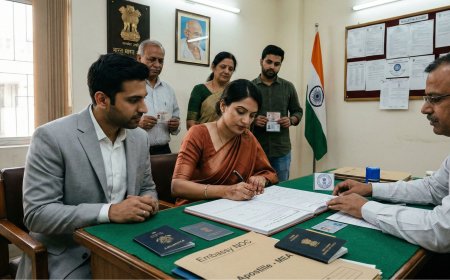
Marriage registration in India involves documentation, timelines, and procedural requirements that vary by state. If you also need a civil ceremony in your country of residence to ensure dual legal recognition, those timelines need to be coordinated with your Indian wedding calendar.
Research your specific legal requirements in the first month of engagement. Discovering this at month nine, with a compressed timeline and a complex documentation process ahead of you, is a situation that is entirely, easily avoidable.
Step 10: Book Your First India Visit with a Clear Agenda
Your India visits are your most finite resource. Use them with intention.
Most NRI couples have two to three planning trips to India before the wedding. How those trips are structured determines the pace and quality of the entire planning experience.
Your first visit — ideally within three to four months of engagement — should accomplish:
- Venue shortlist and ideally venue confirmation — Venue is the most date-sensitive decision in the entire planning process. Walking away without a signed contract or clear shortlist is a costly outcome.
- Initial vendor meetings — introductory sessions with shortlisted photographers, décor professionals, and caterers. Relationship-building, not contract-signing.
- Bridal fashion consultations — Custom Indian bridal wear requires four to six months minimum. The clock starts the moment you begin consultations.
- In-person family alignment — Use the visit to have the conversations that are more productive in person than over video call.
Book the trip before it feels urgent. By the time it feels urgent, your best travel window has usually already closed.
Common Mistakes That Cost NRI Couples the Most
Letting Celebration Delay Structure
The first six weeks of engagement are emotionally elevated — and structurally critical. Couples who spend those weeks entirely in celebration mode without establishing any foundations frequently find themselves under serious time pressure at exactly the wrong moment. Celebration and intentionality are not in conflict. Build both.
Allowing Family Input Before Internal Alignment
When family opinions arrive before the couple has aligned on their own vision, the couple spends the entire planning process responding to external input rather than leading from internal clarity. Establish your alignment first. Then invite family into the areas where their input is genuinely welcome.
Underestimating Bridal Fashion Lead Times
Custom Indian bridal wear from mid-tier designers takes four to six months. Sought-after labels can extend to eight months or more during peak season. Beginning consultations in your second India visit — or three months before the wedding — is not late. It is a crisis.
Treating the Relationship as the Backdrop
Wedding planning surfaces disagreements about values, money, family, and identity that everyday life keeps comfortable and quiet. NRI couples carry an additional layer of pressure. Build in regular check-ins with your partner that are explicitly not about planning. The relationship is not the backdrop for the wedding. It is the reason for it.
The Emotional Layer: What Nobody Mentions Enough
Getting engaged as an NRI is not just a personal milestone. For many people, it is a moment of cultural reckoning.
You have built a life in a country that is not India. Your daily existence — your work, your friendships, your reference points — is shaped by a different culture. Planning an Indian wedding is often the most intensively Indian thing an NRI has done in years. That experience carries complexity.
Questions surface quietly: Am I doing this right? Does this feel authentic or performed? Do I understand what these rituals actually mean?
These are not problems to solve. They are the honest texture of a bicultural life. Let them inform your choices. A wedding that is honest about who you are is more powerful than one that performs a version of identity you do not fully inhabit.
There is also the parental dimension. Your parents may have imagined this wedding for longer than you have. They may experience your choices as reflections on them as well as on you. Hold their feelings with genuine respect while remaining clear about the wedding you are building. That balance — not one or the other, but both — is the thing that most graceful NRI couples carry through this process.
Your First 30 Days: Practical Checklist
Week 1
- Protect 48 hours for private couple conversation
- Call immediate family personally before any public announcement
- Begin initial alignment on city, scale, and vision
Week 2
- Have the full budget conversation with both families
- Create your shared planning document
- Establish your family communication protocol
Week 3
- Draft your vision document together
- Research venue landscape in target city — availability and pricing
- Begin outreach to three to five wedding planners
Week 4
- Interview shortlisted planners
- Confirm target wedding season and city
- Research legal requirements for marriage registration
- Book your first India planning visit
Ongoing
- Weekly partner check-ins that are not about planning logistics
- Consistent update cadence with both families on agreed channel
- Update master planning document after every significant decision
Conclusion: The Beginning Is the Gift You Give Yourself
The quality of your wedding week is almost entirely determined by the quality of the decisions you make in the first month of engagement.
Not the budget. Not the vendor list. Not the décor brief.
The structural decisions — how you communicate, how you involve family, what you prioritise, what systems you build — those are the decisions that determine whether the next twelve to eighteen months feel like momentum or managed chaos.
You are at the beginning of something genuinely significant. Not just a wedding. A chapter. And like every chapter of complexity you have already navigated as someone building a life across two cultures, this one responds to clarity, preparation, and the willingness to lead rather than react.
Start with intention. Plan with structure. And then let the whole beautiful, layered, once-in-a-lifetime thing be exactly what it is.
You are more ready for this than you think.
What's Your Reaction?
 Like
0
Like
0
 Dislike
0
Dislike
0
 Love
0
Love
0
 Funny
0
Funny
0
 Angry
0
Angry
0
 Sad
0
Sad
0
 Wow
0
Wow
0