






































































Griha Pravesh Explained: How Indian Brides Are Welcomed Across the Threshold in Global NRI Weddings
Griha Pravesh, the traditional first entry of a bride into her marital home, remains one of the most symbolically significant rituals in Indian weddings. Rooted in Vedic domestic tradition, the ceremony marks the bride’s transition across lineage, household, and sacred space. From Punjabi and Rajasthani threshold customs to Tamil, Bengali, and Marathi variations, diaspora families in the UK, Canada, UAE, and Australia are actively preserving and adapting these rituals. The growing demand for culturally authentic home-entry ceremonies reflects a broader heritage-driven shift within the global NRI wedding industry.

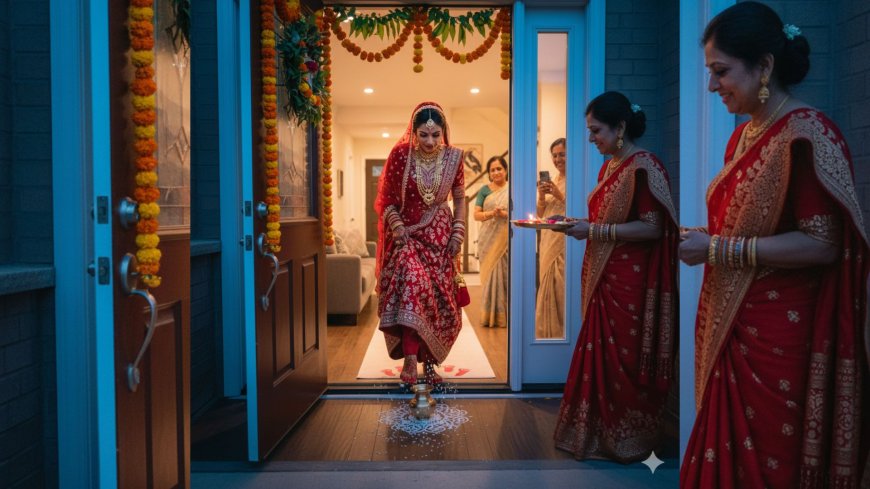
From the rice-filled footprints of a Punjabi bride entering her new home to the lamp she must not let go out in a Bengali household, from the sugarcane archway of a Tamil welcome to the milk vessel she tips with her foot in a Rajasthani doorway — the moment a new bride crosses the threshold is one of the most ritually dense, emotionally layered, and culturally specific events in all of Indian wedding tradition. For NRI couples navigating this transition across oceans, understanding what these first steps actually mean changes everything about how you take them.
You have seen the photographs. The bride at the doorway, head bowed, hands red with alta or henna, one foot raised over the threshold of a home she has never lived in. Behind her, the car that brought her from the ceremony. Ahead of her, a new family, a new kitchen, a new set of rituals she is only beginning to learn. Somewhere in the distance — getting further with every step — the house where she grew up, the bedroom she slept in for twenty or twenty-five years, the mother who is probably still crying in the driveway.
This is Griha Pravesh [the bride's first entry into the marital home]. And it is happening in Mississauga and Southall and Dubai and Melbourne in homes that look nothing like the ancestral havelis or village courtyards where these rituals were born — and yet the emotional weight is identical. The threshold is still the threshold. The first step is still the first step. The rice still spills across the floor in the shape of a new beginning.
What varies — beautifully, extraordinarily — is how each Indian community has chosen to mark this moment. The rituals that surround a new bride's first steps into her marital home are among the most diverse and philosophically rich in all of Indian wedding culture. They carry within them each community's deepest beliefs about womanhood, prosperity, transition, the sacred nature of the domestic space, and what it means to welcome a stranger into the place where your family lives and ask her to become its future.
🌟 DID YOU KNOW?
The threshold rituals surrounding a bride's entry into her new home are among the oldest continuously practised domestic ceremonies in Indian culture, with references to dehalikaa puja [threshold worship] appearing in texts as early as the Grihya Sutras [Vedic household ritual scriptures, circa 300 BC] — predating most contemporary religious wedding ceremonies by centuries.
The bidaai [bride's farewell from her natal home] and Griha Pravesh [bride's arrival at the marital home] are understood in Hindu cosmological tradition as two halves of a single cosmic transition — the bride moving from one gotra [ancestral lineage] to another, a transformation so significant that specific rituals are required to close the departure and open the arrival, or the transition is considered incomplete.
In diaspora communities across the UK, Canada, and Australia, the Griha Pravesh is consistently ranked among the top three most emotionally significant moments of the entire wedding sequence by NRI brides — above even the pheras [circumambulations of the sacred fire] in some surveys — because it is the moment that makes the marriage feel irrevocably, physically real.
What Is Griha Pravesh?
Griha Pravesh [from Sanskrit: griha meaning home, pravesh meaning entry or arrival] is the ritual of a new bride's first entry into her marital home following the wedding ceremony. It is not a single standardised ritual but a sequence of threshold ceremonies that varies significantly by community, region, and family tradition — yet across all its variations, it shares a common philosophical understanding: the domestic space is sacred, the bride is entering it as both a guest and a future guardian, and the transition requires ritual acknowledgement from both the home and the person crossing into it.
The dehalikaa [threshold] has been understood as a sacred boundary in Indian domestic architecture since Vedic times. It is neither fully inside nor fully outside — it is the membrane between the known world and the new one, between the family that was and the family that is being made. Crossing it carelessly, without ceremony, is understood to leave the transition incomplete. Crossing it with the correct ritual sequence — with witness, with blessing, with specific physical acts that mark the body's movement through sacred space — completes the transformation that the wedding ceremony began.
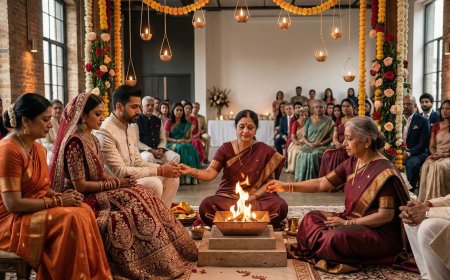
The rituals that accompany Griha Pravesh typically include: the overturning or kicking of a vessel filled with rice or grain at the threshold, symbolising the bride bringing abundance into the home; the bride's first steps being marked in some communities by alta [red dye] footprints that trace her path into the house; the lighting or receiving of a diya [oil lamp] that the bride carries or is responsible for keeping alive; the welcome by the mother-in-law with an aarti [lamp-waving ritual of welcome and protection]; and specific first actions within the home — touching the kitchen stove, placing a coin in a vessel, being shown the household deity — that formally install the bride as the home's new grihini [mistress of the household].
Bidaai [the bride's farewell from her natal home] is the ritual's emotional counterpart and cannot be understood separately from Griha Pravesh. The grief of bidaai — the bride throwing laja [puffed rice] backward over her shoulders as she leaves, her family catching it as a blessing — is the departure that makes the arrival possible. In the Hindu ritual understanding, you cannot truly arrive somewhere new until you have truly left the place you came from. Bidaai and Griha Pravesh are not two separate ceremonies. They are one transition, witnessed at both ends.
Community Comparison: First Steps Traditions Across India
| Community / State | Local Name | Key Threshold Tradition | How NRIs Abroad Adapt It |
|---|---|---|---|
| Punjabi | Griha Pravesh / Pani Warna | Bride kicks a vessel of rice at the threshold with her right foot; mother-in-law performs aarti; bride's first act is to touch the kitchen; red alta footprints mark her path inside | NRI families in Mississauga and Southall recreate at home or apartment entrance; rice vessel sourced from Indian grocery stores; alta applied by family the morning of |
| Rajasthani / Marwari | Griha Praveshwith Kalashritual | Bride tips a kalash [brass pot] filled with rice, coins, and water with her right foot; the spilling of grain and water together is considered especially auspicious; she then touches a grinding stone with her foot as a symbol of household foundation | NRI Rajasthani families in Houston and Dubai source brass kalash from Indian grocery and puja supply stores; grinding stone sometimes substituted with a symbolic flat stone |
| Himachali | Griha Praveshwith regional mountain variations | Bride enters under an arch of sugarcane or pine branches in some valley communities; she is welcomed with curd and honey rather than just sweets; specific Pahari folk songs accompany her entry | NRI Himachali families recreate sugarcane arch at home entrance; curd and honey welcome preserved; Pahari songs played via recording if live singers unavailable |
| Garhwali | Dwarchar[threshold welcome ceremony] | The dwarchar is a distinct Garhwali ceremony in which the bride is formally received at the threshold by the mother-in-law with a thali of ritual items; specific mangal geet are sung exclusively for this moment | Garhwali NRI communities in Vancouver and Toronto consider the dwarchar non-negotiable; elder women are specifically invited to lead the mangal geet |
| Kumaoni | Dwarcharwith Kumaoni additions | Similar to Garhwali but with specific Kumaoni folk songs and the addition of a jhangora [barnyard millet] offering at the threshold; the bride touches a tulsi [holy basil] plant as her first act inside | Kumaoni NRIs in Sydney source jhangora and tulsi plants from Indian grocery stores; the tulsi touch is preserved even in apartments |
| Kashmiri Pandit | Devgonthreshold welcome | The bride enters under a specific arrangement of ritual objects held over the doorway; she is welcomed with sheer chai [Kashmiri pink salt tea] and walnuts; first acts inside the home include touching a copper vessel of water and receiving a blessing from the eldest woman | NRI Kashmiri Pandit families in New Jersey and London source sheer chai ingredients and copper vessels specifically for this ritual |
| Punjabi Sikh | Griha Praveshwith Sikh additions | Similar to Hindu Punjabi but with a Ardas [Sikh prayer of supplication] performed at the threshold; the couple may visit the local Gurdwara before the home entry; Guru Granth Sahib recitation may precede the entry | NRI Sikh families in Brampton and Southall often combine home Griha Pravesh with a Gurdwara visit the following morning |
| Marathi | Griha Praveshwith Aukshan | The aukshan is the Maharashtrian welcome ceremony in which the mother-in-law performs a specific ritual with a nirajan [lamp], rice, and kumkum [vermilion]; the bride enters with her right foot first; she is given milk and honeyto drink as her first act inside | NRI Marathi families in Melbourne and Houston preserve the aukshan with great fidelity; nirajan sourced from Indian grocery stores |
| Tamil | Griha Praveshwith Kalashamwelcome | The bride enters under a toran [mango leaf and flower arch]; she knocks over a vessel of rice with her right foot; the mother-in-law places her hand on the bride's head before she crosses; a kolam [rice flour threshold design] is drawn specifically for her arrival | NRI Tamil families in London and Toronto draw the kolam the morning of the arrival; mango leaves for the toran sourced from Indian grocery stores |
| Bengali | Bou Bhaat and threshold entry | The Bengali bride enters carrying a dhan [paddy] vessel; she must not put down the lamp she carries until she reaches the household deity; specific ululu [Bengali auspicious sound made by women] accompanies her entry; her first major post-wedding ceremony is the Bou Bhaat [the bride's first rice-cooking] | NRI Bengali families in London's Newham and Toronto's Scarborough preserve the lamp-carrying tradition; ululu performed by gathered women |
| Ladakhi | Buddhist blessing entry | The bride is welcomed with khata [white ceremonial scarves] and chang [barley beer]; Buddhist monks may recite blessing prayers at the threshold; the entry is accompanied by community singing | NRI Ladakhi families adapt with khata sourced from Tibetan Buddhist supply stores in diaspora cities |
The Meaning Behind the Ritual
To understand why so much ritual energy is concentrated at the threshold, you need to understand how Indian domestic philosophy understands the home itself.
In Vedic and Hindu cosmological thinking, the home is not simply a building. It is a kshetra [sacred field] — a bounded space that has been consecrated through generations of worship, cooking, birth, death, and daily ritual. The household deity lives here. The ancestors are remembered here. The tulsi plant in the courtyard is tended as a living sacred presence. The kitchen stove is not a cooking appliance — it is an Agni [fire] that mirrors the cosmic fire at the centre of every Hindu ceremony.
Into this consecrated space, a new person is about to enter and become its keeper. The rituals of Griha Pravesh are the home's way of receiving her — and her way of announcing herself to the home's invisible residents. The grain she tips at the threshold is not just a symbol of prosperity. It is an offering to the home itself, a first gift that says: I know what this place is. I come with abundance. I will tend what you have built.
The alta [red dye] footprints she leaves are not decorative. Red in Hindu tradition is the colour of shakti [divine feminine energy], of Lakshmi [the goddess of prosperity and domestic abundance], and of the life-force that a new bride is believed to bring into the home she enters. The footprints say: she was here. She arrived. She marked this house with her presence and it will not be the same again.
The lamp she carries or receives represents Lakshmi's light — the prosperity and illumination that a new bride is understood to bring with her. In Bengali tradition, the instruction that she must not put the lamp down until she reaches the household deity is a beautiful encoding of this idea: the light of her arrival must travel all the way to the divine centre of the home before it can rest.
For anyone trying to explain this to a partner or family member unfamiliar with the tradition: she is not being received as a guest — she is being installed as the future of the home. Everything the family has built is being entrusted to her. The ritual is not a welcome. It is a coronation.
Performing Griha Pravesh Abroad: The Practical Reality
For NRI couples, Griha Pravesh presents a unique set of logistical challenges — because unlike most wedding rituals that happen at a venue, this one happens at home. And home, in diaspora life, is often an apartment on the fourteenth floor of a building in Mississauga, or a terraced house in Southall, or a flat in Dubai Marina.
The first challenge is the threshold itself. Traditional Griha Pravesh rituals are designed for a ground-level home with a clearly defined exterior entrance — a front door that opens directly to the street or courtyard, with a proper dehalikaa[threshold step] that a grain vessel can be placed upon. Many NRI homes have this. Many do not. For apartment dwellers, the adaptation is to use the front door of the apartment unit itself as the threshold — it is the boundary between the public space and the private home, and it is functionally and symbolically valid. The elevator corridor outside becomes, for the purposes of the ritual, the exterior space. This adaptation is widely practised and broadly accepted.
The rice or grain vessel for the threshold-kicking ritual needs to be prepared in advance. Use a brass or copper kalash if available — sourced from Indian grocery and puja supply stores on Gerrard Street East in Toronto, Southall Broadwayin London, Hillcroft Avenue in Houston, or the Meena Bazaar area in Dubai. If a brass vessel is not available, a clay pot or even a stainless steel bowl filled with rice and a few coins works functionally. The grain should be uncooked rice, and many families add a few coins and a betel nut to the vessel as additional symbols of prosperity.
The alta footprints require alta paste — red dye applied to the bride's feet before she enters. Alta is widely available at South Asian cosmetic and grocery stores in all major diaspora cities. Apply it to the soles of the bride's feet approximately fifteen minutes before the entry, allow it to set slightly, and lay a cloth or paper path from the entrance to the first room so the footprints are clearly visible and preserved. Some NRI families take photographs of the footprints before they fade — they are among the most beautiful images of the entire wedding documentation.
The aarti at the threshold requires a nirajan or aarti thali [lamp plate] assembled by the mother-in-law with a lit diya, kumkum, rice grains, and flowers. This is straightforward to assemble from any Indian grocery store's puja supply section. The mother-in-law performs the aarti at the doorway as the bride arrives — circling the lamp before the bride's face three times — before the bride steps inside.
Fire and smoke restrictions do not typically apply to Griha Pravesh, as the diya used is small and produces minimal smoke. However, in apartments with sensitive smoke detectors directly above the front door, have a family member positioned near the detector as a precaution.
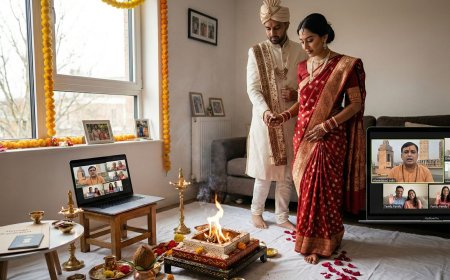
For families whose key members — the mother-in-law, elder women who must perform specific roles — are joining from India, time your Griha Pravesh for when they have arrived. This is non-negotiable for most families, and rightly so. The mother-in-law's role in the threshold welcome is central, not incidental. If she is not physically present due to visa or travel challenges, a video call positioned at the doorway — with her performing the aarti gestures on screen while a present aunt or female relative holds the actual thali — is an increasingly practised adaptation that many families report as genuinely moving rather than a diminished version.
Griha Pravesh as a Destination Wedding Experience in India
For NRI couples marrying in India, Griha Pravesh in its home context is one of the most viscerally beautiful experiences available to them — particularly when the marital home is an ancestral property, a family haveli [traditional mansion], or a village home that carries generations of family history.
Rajasthan offers extraordinary Griha Pravesh contexts: a bride entering a Jaipur haveli under a mango-leaf toran at dusk, tipping a brass kalash of rice and rose petals across a sandstone threshold, is an image that no diaspora home can replicate and no photographer will fail to capture magnificently. Punjab — particularly in families with ancestral homes in Amritsar, Jalandhar, or Ludhiana — offers the full community context, with women gathered in the courtyard singing geetas the bride arrives.
For NRI couples bringing non-Indian guests to an Indian destination wedding, brief them specifically on Griha Pravesh — it is the ceremony that most surprises and moves non-Indian witnesses, because it requires no translation. The combination of the bride's emotional state, the mother-in-law's welcome, the grain spilling across the floor, and the red footprints leading into the home is universally comprehensible as a moment of profound human significance.
Brief your local pandit or ceremony coordinator on any diaspora-specific adaptations your family has incorporated, and ensure the photographer is briefed to capture both the threshold moment and the alta footprints — these are among the most significant documentary images of the entire wedding.
What You Need: The Griha Pravesh Checklist
Ritual Items — a brass or copper kalash filled with uncooked rice and coins, alta paste for the bride's feet, a cloth or paper path from the entrance to the main room, an aarti thali assembled with a diya, kumkum, rice grains, and flowers, a toran [mango leaf and marigold garland] for the doorway, milk and honey or a sweet for the bride's first drink inside the home, and a tulsi plant positioned near the entrance if the family maintains this tradition.
People Required — the bride and groom, the mother-in-law for the aarti and threshold welcome, elder women of the family for the welcoming songs, a designated family member to manage the alta footprint path, and a photographer positioned both at the threshold and inside the home to capture the footprints.
Preparation Steps — prepare and hang the toran on the doorway the morning of the ritual; fill and position the kalash at the threshold; apply alta to the bride's feet fifteen minutes before arrival; lay the cloth path; assemble the aarti thali; brief all family members on their specific roles; and if key family members are joining via video call from India, test the connection in advance and position the phone or tablet at the doorway.
NRI.Wedding's planning checklists, puja supply vendor directory, regional pandit network, and wedding photographers who specialise in ritual documentation are available at nri.wedding.
5 Questions NRI Couples Always Ask About Griha Pravesh
We live in a rented apartment. Can Griha Pravesh still be performed meaningfully at a rented home?
Absolutely — and this question comes up in nearly every NRI wedding consultation. The ritual's sacred significance is not dependent on property ownership. The threshold of any home you live in is your threshold, regardless of whose name is on the lease. The home becomes yours through the ritual of arrival, not through legal title. Many NRI couples perform Griha Pravesh at a rented home and then repeat a simplified version when they move into a permanent home — both are valid, and the first entry always carries the most emotional weight.
My mother-in-law is not able to travel from India. Who should perform the aarti and welcome?
The mother-in-law's role can be performed by any senior woman of the groom's family who is present — his aunt, his grandmother, or a family friend who has been part of his life since childhood. The ritual requires a senior woman of the groom's family to welcome the bride; the specific relationship is less important than the love and authority the woman brings to the moment. If a video-call participation is desired, have the mother-in-law perform the gestures on screen while the present woman holds the actual aarti thali — the dual participation is increasingly common and is understood by most families as a bridge rather than a compromise.
Can we adapt Griha Pravesh for a non-Indian partner who is also entering the home for the first time?
Yes — and some NRI couples have created beautifully hybrid threshold ceremonies that honour both traditions. The core elements of Griha Pravesh — the welcome with light, the first gift of food, the marking of arrival — are universal human gestures that translate across cultural contexts. Brief your non-Indian partner on the significance of each element in advance. Many non-Indian partners report that tipping the rice vessel and seeing the alta footprints they leave behind is one of the most viscerally meaningful moments of their wedding experience.
Is there a specific time of day that is auspicious for Griha Pravesh?
Traditional practice holds that Griha Pravesh should be performed during an muhurta [auspicious time window] calculated by a pandit based on the bride's and groom's birth details and the specific date. For NRI couples, this calculation can be provided remotely by a pandit, and many families use the guidance to schedule the arrival time at the home accordingly. If a specific muhurta is not calculated, morning and early evening are generally considered more auspicious than midday or late night for threshold entries.
Our new home is not yet ready and we are staying temporarily at the in-laws' home. Should we delay Griha Pravesh?
Most families perform Griha Pravesh at the first home the bride enters as a wife — whether that is the in-laws' home temporarily or the couple's own home. If you will be moving into your own home within a few weeks of the wedding, many pandits recommend performing a full Griha Pravesh at the marital home when it is ready, and a simplified welcome ritual at the in-laws' home on the wedding day. Discuss this specifically with your regional pandit, as the guidance varies by community tradition.
The Emotional Angle
Nobody prepares you for the bidaai. Not really.
You have seen it in films. You have watched it happen at cousins' weddings, standing at the back of the crowd, probably a little bored. You thought you knew what it looked like. You did not know what it felt like until you were the one in the car, watching your mother get smaller in the rear window, and you realised with a physical shock that you were not going home tonight. That the house you had lived in your entire life was behind you. That the person who knew where everything was kept, who knew how you took your tea, who had been the first face you saw on every difficult morning of your life — was standing in the driveway getting smaller.
And then the car stops at a new door. And there is a new mother standing there with a lamp in her hands. And there is rice in a brass pot at your feet. And someone has already drawn your footprints in red on the floor inside, waiting for you to step into them.
For NRI brides, this moment is amplified in ways that are almost impossible to articulate. Because the home you are entering is in Mississauga or Southall or Dubai or Melbourne — a city that your natal home is not in, a country that your mother cannot easily visit, a distance that is not measured in kilometres but in time zones and visa applications and the specific grief of knowing that if you need your mother in the middle of the night, she is eight hours away and asleep.
The alta footprints you leave across the floor are yours. This is your home now. You brought abundance to it — the ritual said so. And somewhere in the distance, your mother is already planning her visit.
A Moment to Smile
In Southall, west London, a Punjabi family was preparing for their new daughter-in-law Navneet's Griha Pravesh at their terraced house on a Sunday morning in November. Everything was ready: the toran hung, the kalash positioned, the aarti thali assembled, the alta applied to Navneet's feet in the car on the way over.
What nobody had accounted for was the neighbour's cat, a large and opinionated tabby named Chairman, who had discovered the rice-filled kalash positioned at the front step approximately four minutes before the bridal car arrived.
Chairman was removed. The kalash was repositioned and partially refilled from the emergency rice supply in the kitchen. Navneet arrived, tipped the kalash beautifully, and stepped across the threshold leaving perfect red footprints across the hall floor.
Chairman, having been placed in the back garden, re-entered through the cat flap and followed the alta footprints with tremendous forensic interest all the way to the living room, where the family was gathered for the aarti.
Navneet's mother-in-law declared that Chairman's interest in the footprints meant Lakshmi had truly arrived. Chairman sat in the centre of the aarti circle and accepted this interpretation without comment. He appears in approximately forty percent of the wedding photographs and is considered an unofficial family member.
Quotes from the Diaspora
"I did my Griha Pravesh in a two-bedroom apartment in Mississauga. The toran was on a door that opened into a carpeted hallway. My mother-in-law had flown from Amritsar the week before and spent three days preparing. When I tipped the kalash and walked in and saw the red footprints I had left on the floor, I understood for the first time that I actually lived there now. The apartment became home in that single moment. That is what the ritual does." — Jasleen Gill, Punjabi, Mississauga, Ontario
"My son's wife is from a Telugu family. We are Marathi. We performed both the Maharashtrian aukshan and a small Telugu threshold ceremony together — her mother video-called from Hyderabad and guided the Telugu portion while I performed the aukshan. Two mothers, two traditions, one doorway. I will never forget the look on my daughter-in-law's face when she crossed it." — Sunanda Kulkarni, Marathi, mother-in-law, Melbourne, Australia
"Nobody told me I would cry at the alta footprints. I had been composed through the entire bidaai, through the car journey, through the aarti. And then I looked back and saw the red marks my feet had made leading from the door into the house and I completely fell apart. Because they were mine. I had made them. I had arrived somewhere and left a mark, and it was permanent, and it was mine." — Priya Mehta, Rajasthani, Dubai, UAE
Your Roots Travel With You
The threshold is the same threshold, wherever it stands. It does not matter whether it is sandstone in Jaipur or painted wood in Southall or a glass-panel door in a Dubai apartment building. What matters is the moment — the lamp, the rice, the red feet crossing from the life that was into the life that is beginning. What matters is the woman standing in the doorway with a light in her hands, waiting to welcome the person who is about to make her family complete.
For NRI couples performing Griha Pravesh in cities their grandparents never imagined, this ritual is one of the most powerful acts of cultural continuity available to you. NRI.Wedding's planning resources include Griha Pravesh ritual checklists, puja supply vendor directories for every major diaspora city, regional pandits who know your community's specific threshold traditions, and wedding photographers who understand that the alta footprints and the threshold moment deserve the same careful documentation as the pheras.
Because the first steps she takes as his wife will be recorded in red on the floor of the first home they share. And they should be witnessed properly.
Hang the toran. Fill the kalash. Light the lamp. Let her arrive.
This article explores the cultural significance and ritual practice of Griha Pravesh and related threshold traditions across Punjabi, Rajasthani, Tamil, Bengali, Marathi, Garhwali, Kumaoni, Kashmiri Pandit, and Ladakhi communities, with practical guidance for NRI couples in Toronto, London, Melbourne, Houston, and Dubai.
What's Your Reaction?
 Like
0
Like
0
 Dislike
0
Dislike
0
 Love
0
Love
0
 Funny
0
Funny
0
 Angry
0
Angry
0
 Sad
0
Sad
0
 Wow
0
Wow
0