







































































Where Turmeric Meets the Cross: The Haldi and Roce Ceremony in Konkani Catholic Weddings
The Haldi and Roce ceremony in Konkani Catholic weddings is one of India's most remarkable examples of cultural syncretism — a pre-Christian turmeric ritual preserved across 450 years of colonisation and now carried by NRI families from Goa, Mangalore, and the Karwar coast to cities like Dubai, Toronto, Melbourne, and London. This guide explores the ritual's origins, regional variations, and practical steps for performing it abroad or as a destination wedding in Goa.

In Konkani Catholic weddings, an ancient Hindu-rooted turmeric ceremony has survived centuries of colonisation, conversion, and diaspora — and today, it is one of the most fiercely protected traditions in the community. This article explores how NRI Konkani Catholic families from Goa, Mangalore, and the Karwar coast carry this luminous, syncretic ritual to living rooms in Dubai, basements in Toronto, and garden parties in Melbourne — and why letting go of it has never once been an option.
You grew up watching your mãe [mother] guard a small brass bowl like it held gold. It did, in a way — turmeric paste, coconut oil, and something she said she learned from her mother, who learned it from hers, going back to a Goa that existed before church bells and before borders. You didn't know what to call it then. You just knew it smelled like home.
Now you're in Mississauga, or Sharjah, or somewhere in East London where the fog rolls in off the Thames and nothing smells like anything you recognise. You're planning your wedding. And that brass bowl — its ritual, its meaning, its place in your celebration — is something you refuse to leave behind. Because you are Konkani Catholic, and your faith and your roots have never been in conflict. They have always been in conversation.
This is about that conversation.
🌟 Did You Know?
- The Haldi [turmeric] ceremony performed in Konkani Catholic weddings is a direct cultural inheritance from Goan Hindu communities, preserved through over 450 years of Portuguese colonisation — a period during which many Hindu rituals were officially banned and yet quietly continued inside homes behind closed doors.
- Goa's Catholic community, particularly from the Old Conquests regions of Ilhas, Bardez, and Salcete, retains more pre-Christian folk traditions in their wedding rituals than almost any other Catholic community in Asia — a phenomenon that religious anthropologists have studied extensively as a model of deep cultural syncretism.
- According to community surveys within the Konkani diaspora in the UAE, approximately 78% of Konkani Catholic families living abroad continue to observe some version of the Haldi or Roceceremony, even when holding fully Catholic church weddings — often performing it the evening before the nuptial Mass.
What Is Haldi in a Konkani Catholic Wedding?
In most of India, Haldi is understood as a Hindu pre-wedding ritual. In Konkani Catholic culture, it arrives transformed — absorbed, adapted, and made entirely one's own. Depending on the family's precise region of origin, it may be called Roce(in Goan Catholic tradition) or it may survive as an informal turmeric application folded inside the broader Vojem [pre-wedding ceremony night] celebrations. In Mangalorean Catholic families, variants exist under different names but serve the same luminous purpose.
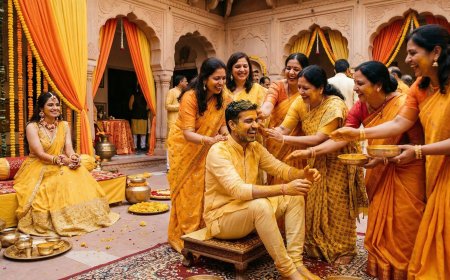
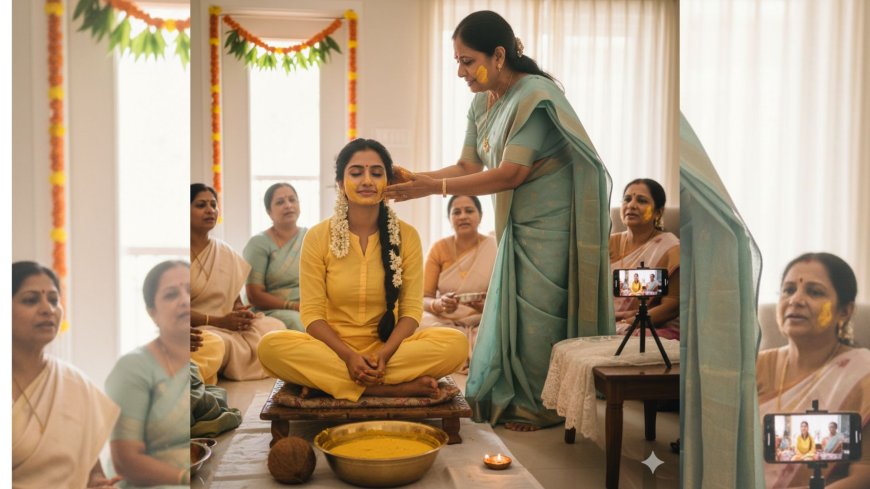
The ceremony typically takes place the evening before the church wedding. The bride and groom, in their respective homes, are seated on a wooden paat [ceremonial low stool] or a decorated chair, surrounded by family. Married women of the family — specifically those whose husbands are living, as the tradition echoes older beliefs about auspiciousness — apply a paste of turmeric, coconut milk, and sometimes rose water to the bride or groom's face, arms, and feet. The application follows a specific order: maternal aunts first, then paternal aunts, then elder women of the community, then friends.
In Goan Catholic homes, this ritual is inseparable from Roce, where coconut milk — the most sacred offering of the coastal Konkan — is poured over the bride's head after the turmeric application. The two rituals are often performed in the same sitting, with Konkani folk songs called mandos or dulpods filling the room, the women swaying, the younger generation recording on their phones, and someone's grandmother weeping quietly in the corner because she has seen this done a hundred times and still cannot believe how fast the children grow.
The theological logic of the Catholic church has never officially endorsed this ceremony. The cultural logic of the Konkani community has never once needed it to.
Community Comparison Table
| Community / Region | Local Name | Key Tradition | How NRIs Abroad Adapt It |
|---|---|---|---|
| Goan Catholic (Old Conquests) | Roce / Haldi | Coconut milk poured over head + turmeric paste applied by married women; mandos sung | Performed at home or rented hall the night before; coconut milk sourced from Indian grocery; video call links in family in Goa |
| Mangalorean Catholic | Tel Phovo / Haldi Night | Turmeric + oil applied; rice flakes (phovo) offered; strong Tulu coastal influence | Condensed into a 2-hour home ceremony; turmeric paste pre-prepared; streamed live for Mangalore relatives |
| Karwar Catholic | Haldi (called directly) | Very close to Hindu Haldi traditions; turmeric paste with neem and sandalwood | Often merged with Roce elements; celebrated with Konkani and Hindi film songs both |
| Goan Hindu (GSB / Saraswat) | Haldi / Ubrein | Formal multi-stage ritual with Sanskrit shlokas; done separately for bride and groom | Pandits sourced through GSB Sabha networks in the UK and UAE |
| Kashmiri Pandit | Lagan Kaur / Maenziraat | Mustard oil and turmeric applied; walnuts and rice distributed | Done in community halls; mustard oil sourced from halal/Indian stores |
| Punjabi (Hindu/Sikh) | Haldi / Vatna | Full-body ubtan [cleansing paste] of turmeric, besan, and mustard oil; loud, musical | Large-scale celebration; bhangra music; streamed to Punjab relatives at IST morning |
| Bengali Hindu | Gaye Holud | Two-ceremony structure: one at bride's home, one at groom's; turmeric brought as gift | Kept as dual-home ceremony even abroad; turmeric from Patel Brothers or T&T stores |
| Tamil (Brahmin / Non-Brahmin) | Nalungu | Ritual games between families using turmeric, flowers, and lamps; less solemn, more playful | Adapted as an interactive ceremony; non-Indian partners love it for its game element |
| Marathi Hindu | Haldi / Halad | Applied by female relatives; combined with ukhana [bride's ritual name-game]; very community-focused | Done morning of wedding day; items sourced from Devon Avenue, Chicago or Gerrard Street, Toronto |
| Rajasthani | Pithi | Sandalwood-based paste; applied over multiple days; elaborate mehendi connection | Compressed to one evening; pithi paste sometimes pre-ordered from India and couriered |
The Meaning Behind the Ritual
Turmeric — haridra in Sanskrit, ollem in Konkani — is not merely a spice in Indian cosmology. It is a living symbol of purification, protection, and transition. In Ayurvedic understanding, turmeric cleanses the blood and brightens the skin. In spiritual understanding, it is believed to repel negative energies and prepare the body and soul for a new chapter of existence. When it is applied to a bride or groom, something older than religion is at work.
The act of married women anointing the soon-to-be-married carries a profound social theology: it is a transfer of blessing from those who have already made the journey into partnership, into the body of one who is about to begin it. It says: we have walked this road. We are placing everything we know about love, endurance, and grace into our hands, and we are placing those hands on you.
For Konkani Catholics, this ritual carries an additional layer — it is the place where their pre-Christian ancestors speak to them through the modern body. The church may govern the soul. The coconut and turmeric govern the home.
For a non-Indian partner trying to explain this to their own family: "It's an ancient blessing ceremony, where the women who love her most prepare her body and spirit for marriage — it's been done in her family for five hundred years, and we're not stopping now."
Doing Roce / Haldi Abroad: The Practical Reality
This is the section your mãe has been waiting for.
The single greatest challenge for Konkani Catholic NRI families performing Roce or Haldi abroad is space and atmosphere. The ritual is intimate and domestic — it belongs in a courtyard, or at least a large hall with the smell of coconut and the sound of women singing. What you often have is a semi-detached house in Wembley or a rental event room in Brampton. The good news is this: the ritual carries its own atmosphere. You bring the people and the paste, and the magic follows.
For sourcing ingredients, every major diaspora city has what you need. In London, Green Street in East Ham and Drummond Street near Euston stock fresh turmeric root, coconut milk, and dried flowers. In Toronto, Gerrard Street East's Little India and the South Asian grocers along Dixie Road in Mississauga will have everything including rose water. In Dubai, Meena Bazaar in Bur Dubai is essentially a one-stop ritual supply shop with Konkani vendors who may even know exactly what you need before you ask. In Sydney, Harris Park in Parramatta has become the go-to for South Asian ritual items, and in Houston, Hillcroft Avenue's South Asian strip will not disappoint.
The pandit problem is real for Hindu-adjacent Catholic ceremonies in an unusual way — you don't need a pandit, but you do need someone who knows the order of the ceremony and the songs. If your family's older women are present, they are your priests. If they are not — if your grandmother is in Mapusa and cannot travel — then this is where technology becomes sacred. Set up a video call. Given that Goa is IST (GMT+5:30), the optimal time for a live-streamed Roce in London is around 4–6 PM, which gives your Goa family a comfortable 9:30–11:30 PM participation window. For Toronto, a morning ceremony works beautifully — 10 AM Toronto time is 8:30 PM in Goa.
For fire and smoke restrictions in UK and Canadian venues: Roce involves no fire whatsoever, which makes it genuinely venue-friendly. The turmeric paste is the only "messy" element — lay down plastic sheeting or a cotton floor covering under the ceremonial chair, warn the venue in advance, and offer a cleaning deposit if needed. Most venues, once they understand this is a cold, paste-based ceremony with no candles or incense, are cooperative.
One more thing: wear old clothes. This cannot be overstated. Turmeric stains are eternal.
Doing Roce / Haldi as a Destination Wedding in Goa
If you can bring your wedding back to its origin, Goa rewards you beyond measure. The Old Conquests villages — Saligão, Chandor, Loutolim, Aldona — carry an architectural and spiritual memory that no overseas venue can replicate. A Roce ceremony performed in a casa grande [ancestral family home] courtyard, with jasmine strung across the doorway and the Arabian Sea audible in the distance, is an experience your guests — Indian and non-Indian alike — will reference for the rest of their lives.
When returning to Goa for a destination wedding Roce, brief your local family coordinator (or NRI.Wedding's on-ground Goa team) on exactly which family's ceremonial song repertoire your family follows. Mando traditions vary by village, and the aunts from your mother's side may sing different verses than those your father grew up with — both are right, and both should be heard.
For non-Indian guests attending the Roce, a one-paragraph cultural card placed at the entrance works beautifully: explain what they're witnessing, invite them to participate in the blessing if they wish, and let the ceremony speak for itself. It always does.
What You Need: Ritual Checklist
Ritual Items: Fresh turmeric root (or high-quality turmeric paste), coconut milk, rose water, a brass or copper bowl, a wooden stool or decorated chair, fresh flowers (marigold, jasmine), a clean white or yellow cotton cloth for the participant to sit on, and a change of old clothes for the bride/groom.
People Required: Married women of the family (minimum three, ideally from both maternal and paternal sides), an elder woman to lead the application sequence, someone responsible for the music (live singers are ideal; a playlist of mandos and dulpods is a reliable backup), and a designated person to manage the video call link for relatives joining from India.
Preparation Steps: Prepare the turmeric paste 24 hours in advance to allow it to rest and deepen. Designate the ceremonial space and lay floor protection. Confirm the order of family members who will apply the paste. Brief non-Konkani family members or non-Indian guests on the ceremony's meaning. Set up the live-stream link and test it with Goa family the day before — do not leave this to ten minutes before the ceremony.
NRI.Wedding connects Konkani Catholic couples with community vendors, Goan and Mangalorean cultural consultants, and photographers who understand syncretic ceremony documentation. Visit our vendor directory to begin.
5 Questions NRI Couples Always Ask
Can we do Roce in a hotel ballroom or does it have to be at home?
A hotel ballroom can absolutely work, but the intimacy of the ceremony calls for thoughtful space design. Request a smaller pre-function room or a partitioned section rather than a cavernous hall. The ceremony is designed for twenty to forty people in close proximity — sound, warmth, and proximity to one another are what create the atmosphere. Brief the hotel that no open flame is involved and that the event involves a natural paste that may require floor protection.
My partner is Irish-Australian and has no Indian background. How do we include them meaningfully in the Roce?
The most beautiful adaptation many mixed-heritage Konkani couples are now choosing is to have the partner's mother or closest female elder participate in the anointing — a moment where two families' traditions of blessing physically converge. This requires no explanation or justification. It is simply love, being applied with turmeric.
How do I find someone who knows authentic Goan or Mangalorean Roce customs abroad?
Formal pandits are not required for the Catholic version of this ceremony. What you need is a knowledgeable elder woman from your community. In cities like Melbourne, Dubai, and Toronto, Konkani Catholic associations and the Goan Overseas Association have community networks through which elders who know the full ceremony can be identified and invited. NRI.Wedding's Konkani community coordinator can also assist with this.
My grandmother in Margao cannot travel. How do we include her meaningfully, not just symbolically?
Give her a specific role, not just a viewing seat. Ask her to lead the first blessing vocally over video — have the family gathered around the screen, and let her speak the blessing and even mime the motion of application. Then have a local aunt physically apply the paste on her behalf, naming her as the one doing so. This is not a workaround. This is an adaptation your grandmother will speak of for years.
We're doing a civil registration in Canada first, then the church wedding and Roce in Goa six months later. Does the sequence matter spiritually?
For the Catholic component of your wedding, this is a pastoral question best directed to your priest. For the Roce, community tradition is flexible — what matters is that the ceremony happens with full intention, full family presence, and full joy. Many NRI Konkani couples celebrate Roce as a complete community event independent of legal timing, and no elder in living memory has ever objected to the reasons.
The Emotional Angle
There is a particular kind of grief that Konkani Catholic NRI families carry that no one talks about enough. It is not dramatic. It does not announce itself. It arrives quietly, usually when someone opens a photograph of their grandparents' wedding, taken in a Goan village that no longer looks the way it does in the picture. The tiled roof. The courtyard. The women in their nine-yard sarees, laughing at something the camera didn't catch.
You are thousands of miles from that courtyard. You have built a life, a career, a home that your grandparents could not have imagined. And still, on the night before your wedding, you sit in a rented space in a foreign city and let a woman dip her fingers in turmeric and press them gently to your cheeks, and something in your body recognises it. Not the room. The gesture. The smell. The sound of an aunt beginning a mando she probably hasn't sung since her own daughter's wedding.
This is what the Roce does. It makes the distance collapse. It makes the coastline of Goa present in a kitchen in Sharjah. It makes your great-grandmother, who never left her village, somehow alive in the room.
You carry more than you know. You always have.
A Moment to Smile
At Priya and Kevin's Roce in Mississauga last October, everything was going beautifully — the turmeric paste was perfect, the mandos were playing from a Bluetooth speaker, twenty-three aunts had driven in from across the GTA. Then Priya's youngest cousin, eight years old and extremely enthusiastic, decided the turmeric bowl looked like something that needed distributing more widely. Within four minutes, three aunts had yellow elbows, Kevin's Irish mother had a small but definitive stripe across her left cheek, and the rented hall's white curtain had been patted by a small turmeric-covered hand in at least two places.
Kevin's mother, bless her, turned to Priya's grandmother and said simply: "Does this mean I'm blessed?" The grandmother, who had been suspicious of Kevin since the beginning, looked at the yellow stripe on the woman's face, considered it, and said: "Yes. I think it does."
The curtain deposit was lost. The memory is priceless.
Quotes From the Diaspora
"My grandmother called me from Saligão the night before my Roce in Dubai and sang the full mando over the phone. I didn't understand every word — my Konkani isn't that good anymore. But I understood every single thing she meant." — Natasha Fernandes, Goan Catholic, Dubai
"We were worried the ceremony would feel small without the big family house, without the courtyard, without all of it. But when my daughter sat down on that stool in our living room in Melbourne and my sister started the application, I looked around and saw twenty-eight women who love her standing in a circle, and I thought — no. This is exactly the right size."— Lorna D'Souza, mother of the groom, Mangalorean Catholic, Melbourne
"Ours was the first Roce in my family where my fiancé's mother — she's from Cork — was included in the blessing. My aunt put turmeric on her hands first and then guided them to my face alongside her own. I have a photograph of that moment. It is the only wedding photograph I will keep forever." — Alisha Lobo, Goan Catholic, London
Your Roots Are Older Than the Ocean Between You
The Roce and Haldi traditions of Konkani Catholic families are not relics or curiosities. They are proof of something extraordinary — that a community can carry its most ancient instincts across centuries of colonial disruption, across oceans, across generations raised on different continents, and still know exactly what to do when a young person is about to step into the rest of their life. Press turmeric to their skin. Sing. Bless them with everything you have.
NRI.Wedding exists to ensure that no couple has to figure this out alone. Our Konkani community vendors, cultural consultants, Goa-based photographers who document syncretic ceremonies with reverence, and our pre-wedding planning checklists are built for exactly this — the beautiful, complicated, magnificent reality of celebrating an Indian wedding from outside India.
Your ancestors hid this ritual behind closed doors for four hundred years so you could perform it freely today. Do not be the generation that lets it go.
This article on the Haldi and Roce ceremony in Konkani Catholic weddings explores syncretic pre-wedding traditions observed by Goan Catholic, Mangalorean Catholic, and Karwar Catholic communities, and how NRI families in Dubai, Toronto, Melbourne, London, and Mississauga preserve and adapt these rituals for diaspora celebrations.
What's Your Reaction?
 Like
0
Like
0
 Dislike
0
Dislike
0
 Love
0
Love
0
 Funny
0
Funny
0
 Angry
0
Angry
0
 Sad
0
Sad
0
 Wow
0
Wow
0