





































































What the Saptapadi's Seven Vows Actually Mean: The Complete NRI Guide to Personalising Each Step of the Hindu Wedding's Most Sacred Ceremony
The saptapadi is not seven items on a ceremony checklist. It is the Hindu wedding's most ancient, most legally significant, and most philosophically rich sequence — the seven steps around the sacred fire that the tradition identifies as the moment the marriage is complete in every sense simultaneously. This complete guide decodes each of the seven steps in full — the Sanskrit, the meaning, the deity invoked, the philosophical depth — and shows how NRI couples across Toronto, London, Melbourne, and beyond are personalising each step with their own words without replacing the tradition's foundation. For every NRI couple who has stood at the agni and deserved to know exactly what they were saying, this is the authoritative guide.

What the Saptapadi's Seven Vows Actually Mean — And How NRI Couples Are Personalising Each Step
The question arrived by email, which was the medium that their priest — a man of sixty-two named Pandit Vishwanath who had been conducting Hindu weddings in the greater Toronto area for twenty-three years and who had strong opinions about the correct sequence of every element of the ceremony — preferred for the substantive questions, because he liked, he had told them, to give substantive answers rather than quick ones. Kavya had sent the email on a Sunday evening in March, three months before the wedding, and she had written it with the specific care of someone who is asking a question they already suspect the answer to but who needs to hear the answer from the right person. She had written: Pandit ji, we would like to understand what the saptapadi's seven steps actually mean — the specific meaning of each mantra, in English, in a way that we can think about and discuss before the ceremony. And we would also like to know whether there is any scope for us to add our own words to each step — not to replace the Sanskrit, but to make the step specific to us.
The reply came on Wednesday. It was four pages long, which was either the sign of a priest who had been waiting for someone to ask this question or the sign of a priest who had been asked it many times and had refined his answer to its current form through the accumulation of those conversations. The answer began with the Sanskrit, the transliteration, and the meaning of each of the seven steps, written with the patience of someone who genuinely wanted to be understood rather than to demonstrate knowledge. It ended with two paragraphs that Kavya read three times before sending it to her fiancé Rohan in Vancouver — he had been based there for the last eight months on a project that was supposed to have ended in February and had not. The two paragraphs said: The saptapadi is the most ancient and the most legally significant element of the Hindu wedding ceremony. The seven steps are the ceremony in the fullest sense — the court in India considers the saptapadi as the moment at which the Hindu marriage is legally complete. To add your own words to each step is not to change the ceremony. It is to bring yourself fully into the ceremony that the tradition has always been waiting for you to inhabit. The Sanskrit mantra is the foundation. Your own words are the house you build on it. I have done this for many couples. Come and meet me when Rohan is next in Toronto.
Kavya forwarded the email to Rohan at ten-thirty PM Toronto time, which was seven-thirty PM Vancouver time. He called her immediately. She answered on the first ring. He said: The foundation and the house. She said: Yes. He said: That is the best thing a priest has ever said to us. She said: I know. When are you next in Toronto?
This article is for Kavya and Rohan — and for every NRI couple who has sat with the saptapadi's Sanskrit and understood that they are standing at the most significant seven steps of their lives and who deserves to know, completely and specifically, what those steps are saying.
The Saptapadi: The Ceremony Within the Ceremony
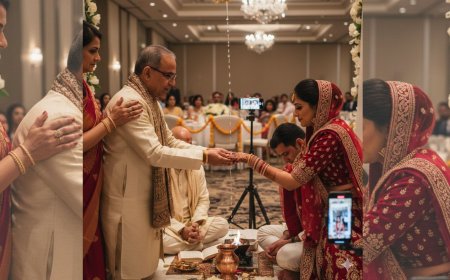
The Hindu wedding is one of the most ritually elaborate ceremonies in the world — a multi-hour sequence of specific acts, specific mantras, and specific ritual objects that constitute together the complete expression of the tradition's understanding of what the marriage is and what it requires. Within this elaborate sequence, the saptapadi — the seven steps taken by the couple together around the sacred fire — is the ceremony within the ceremony, the single sequence of acts that the tradition identifies as the moment of the marriage's completion.
The word saptapadi is a compound of sapta — seven — and padi — steps, from the Sanskrit root for foot, pad. The seven-footed ceremony. The seven steps. The Sanskrit legal tradition — the Dharmashastra — identifies the completion of the seventh step as the moment at which the Hindu marriage is legally and ritually complete. The courts of India, in the majority of their rulings on the question of when a Hindu marriage is solemnised, have treated the saptapadi as the decisive act — the act without which the ceremony is incomplete and with which the ceremony is complete regardless of what else has or has not been performed.
This legal and ritual centrality of the saptapadi is the first thing the NRI couple must understand. The saptapadi is not one element of the ceremony among many. It is the ceremony's heart — the seven steps that the tradition has identified, across millennia of refinement, as the specific acts that constitute the marriage in the fullest sense.
The Fire and the Steps: The Cosmic Geometry
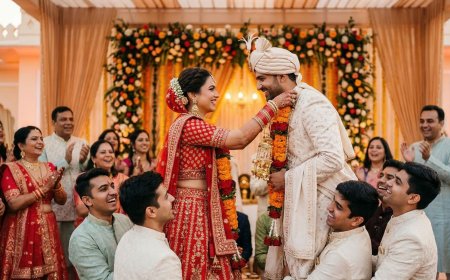
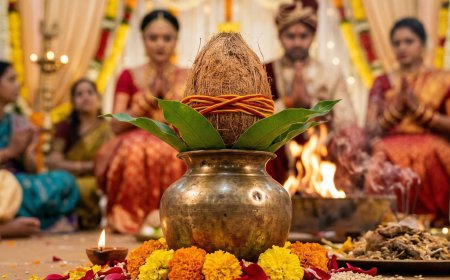
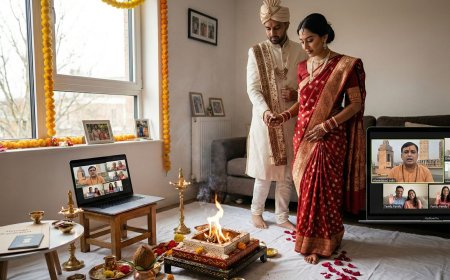
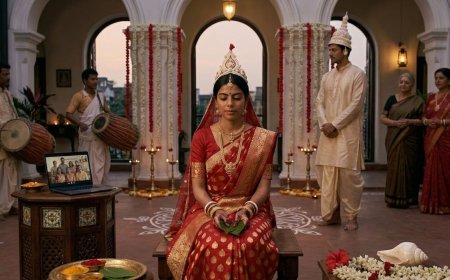
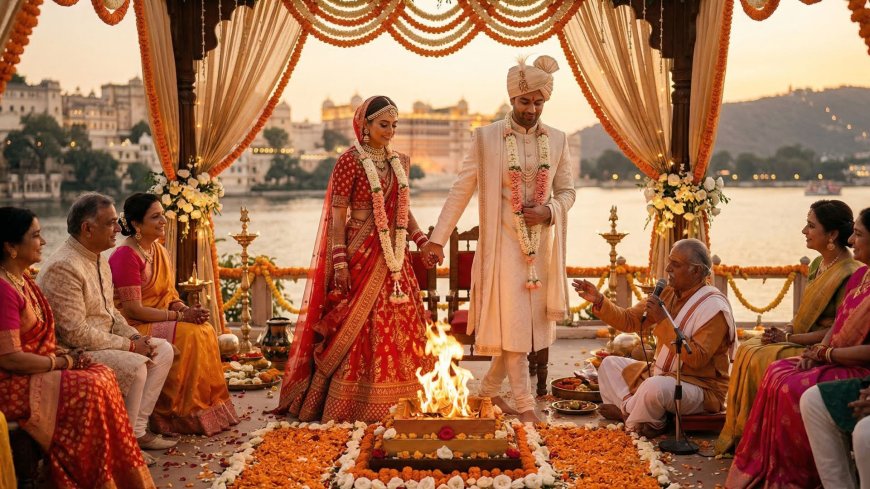
The saptapadi is conducted around the agni — the sacred fire that the tradition understands as the divine witness of the ceremony. The couple walks together around the fire, taking seven steps, each step accompanied by a specific mantra spoken by the priest and a specific intention held by the couple. The circular movement around the fire — the parikrama, the circumambulation — is one of the most fundamental ritual acts in the Hindu tradition, the act of making the sacred object the centre around which the ritual moves.
The geometry of the saptapadi — the couple moving together around the fire, connected by the cloth or the garland that some traditions use to link them during the steps — is the geometry of the marriage itself: two people moving together around a shared centre, the fire of the divine witness, whose presence makes the movement sacred rather than merely circular. The couple who walks the seven steps is enacting, in the most direct physical form, the nature of the union they are forming — the shared movement, the common direction, the specific object at the centre.
The direction of the circumambulation — typically clockwise, the pradakshina direction that the tradition associates with the auspicious — varies slightly by regional tradition, and the priest will specify the correct direction for the specific community tradition. The number of times the couple circles the fire before the seven steps is also community-specific — in some traditions the couple circles the fire a complete time before the steps begin, in others the steps themselves constitute the circumambulation.
The Seven Steps: What Each One Is Actually Saying
The specific content of the seven saptapadi vows varies by regional tradition and by the specific textual source the priest is using. The Rigvedic version, the Grihyasutra versions, and the various regional elaborations of the basic seven-step framework produce slightly different specific content for each step while maintaining the same overall architecture — the progression from the material foundation to the spiritual dimension, from the physical to the philosophical, from the sustenance of the body to the friendship of the soul.
What follows is the synthesis of the most widely used saptapadi vow content across the North Indian, Maharashtrian, and broader Hindu tradition, with the Sanskrit, the traditional meaning, and the philosophical dimension of each step as articulated in the tradition's own terms.
The First Step: Nourishment and the Foundation of Life
Eka misha vishnu stutvaa — With the first step, we seek nourishment.
The first step is the step of food — of the material sustenance that is the most fundamental foundation of the life together. The mantra invokes the goddess of the harvest, the abundance that the earth provides, and the couple's commitment to provide this abundance for each other and for the family they will create. It is the most elemental of the seven steps — the acknowledgment that the marriage begins in the body, in the physical world, in the specific, concrete reality of people who need to eat and who are committing to feed each other.
The philosophical depth of this apparently simple step is the tradition's wisdom about the order of the vows. The saptapadi does not begin with the spiritual. It begins with the material — with food, with the body, with the physical foundation of the shared life. This ordering is a theological statement: the marriage that does not honour the material foundation is a marriage built on an abstraction, and the tradition's understanding of the sacred does not separate the material from the spiritual but recognises the material as the foundation of the spiritual.
For the NRI couple personalising this step, the question is: what does nourishment mean specifically in our life together? The literal food — the cooking, the sharing of meals, the specific foods that carry the family traditions — is the most direct expression. But nourishment also means the emotional sustenance, the intellectual feeding, the specific ways that each partner provides the substance that the other needs to grow. The personalisation of the first step is the specific naming of the nourishment that the couple has identified as the foundation of their particular life together.
The Second Step: Strength and the Protection of the Life
Dwitiya urjaswathi — With the second step, we seek strength.
The second step is the step of strength — of the physical and moral vigour that the life together requires. The mantra invokes the couple's commitment to protect each other, to maintain the health and the strength that the shared life needs, and to stand together against the challenges that the world presents to the family. It is the commitment to be the other person's strength when their own strength is insufficient — the acknowledgment that the marriage is, among other things, a mutual protection society.
The Ayurvedic dimension of this step is significant — the Sanskrit tradition's understanding of health as the dynamic balance of the three doshas, the commitment to the other's health as the commitment to maintain their specific balance, the understanding that the marriage includes the specific care of the other's physical constitution. The second step is the couple's commitment to attend to each other's health with the specific knowledge that their bodies require — not the generic care of the good intention but the specific care of the person who has taken the time to understand what their partner's body needs.
For the NRI couple personalising this step, the question is: how do we specifically protect and strengthen each other? The physical protection — the commitment to the other's health, the specific practices that each partner needs — is one dimension. The moral strength — the commitment to stand together against the pressures, both external and internal, that will challenge the marriage — is the deeper dimension that the second step's personalisation should address.
The Third Step: Prosperity and the Right Relationship to Wealth
Tritiya jaradastaya — With the third step, we seek prosperity.
The third step is the step of wealth — of the material prosperity that the tradition identifies as one of the four legitimate goals of human life. The mantra invokes the couple's commitment to the righteous pursuit of wealth — the Artha that the tradition distinguishes from greed by its insistence that the pursuit of prosperity must be conducted within the framework of the dharmic obligations, the ethical constraints that the tradition places on all commercial and financial activity.
The third step is not simply the commitment to financial success. It is the commitment to the right relationship to financial success — the acknowledgment that the prosperity the couple seeks will be used in the ways that the tradition requires: the support of the family, the contribution to the community, the specific obligations to the parents and the children and the guests and the broader social network that the Indian tradition understands as the dharmic framework of the financial life.
For the NRI couple personalising this step, the specific questions are the questions that the financially active couple needs to have made explicit: how will decisions about money be made in the marriage? What are the specific financial obligations that each partner brings to the union — to parents, to siblings, to the family members who depend on the couple's prosperity? What does prosperity mean in terms of the life the couple wants to build — the specific goals, the specific commitments, the specific understanding of what the financial life of the marriage is in service of?
The Fourth Step: Happiness and the Pursuit of Joy
Chaturtha mayo bhava — With the fourth step, we seek happiness.
The fourth step is the step of joy — the step that is most immediately appealing to the contemporary couple and that carries, within its apparently simple intention, the tradition's deepest wisdom about the relationship between happiness and the conditions that make happiness sustainable. The mantra invokes the couple's commitment to the pursuit of their own happiness and each other's happiness — not the passive hope for happiness but the active creation of the conditions that happiness requires.
The tradition's understanding of happiness — the ananda that is one of the three qualities of the ultimate reality — is not the Western hedonic understanding of happiness as the accumulation of pleasurable experiences. It is the understanding of happiness as the natural state of the consciousness that is in right relationship with itself and with the world — the happiness that the Upanishads describe as the natural quality of the atman, the individual soul, when it is not obscured by the avidya, the ignorance, that the tradition identifies as the fundamental source of suffering.
The fourth step is the couple's commitment to create the conditions in which the other's natural happiness — the happiness that is their birthright as conscious beings — can be expressed rather than suppressed. It is the commitment to be the person in whose presence the other most fully becomes themselves.
For the NRI couple personalising this step, the question is: what are the specific conditions in which each of us is most happy, and how do we commit to creating those conditions for each other? The specific naming of the other's sources of joy — the activities, the relationships, the specific experiences that produce in them the specific quality of happiness that the couple has identified over the course of their partnership — is the most direct personalisation of this step.
The Fifth Step: Children, the Family, and the Future
Panchami pashu palay — With the fifth step, we pray for progeny.
The fifth step is the step of progeny — the children who will continue the family and the cultural lineage, the next generation whose birth the fifth step invokes the divine blessing for. It is the step that most directly engages with the biological and social dimension of the marriage — the understanding that the marriage is not only the union of two people but the foundation of the family that extends beyond them, into the next generation and the generation after that.
The NRI couple's relationship to this step is often the most complex of the seven, because the question of children — whether to have them, when, how many, the specific negotiation between the family's expectations and the couple's own intentions — is one of the most significant and most private of the decisions that the marriage involves. The fifth step's traditional content, with its specific prayer for many children and for the continuation of the family line, may not map directly onto the couple's specific intentions and circumstances.
The tradition's deeper meaning of this step — the meaning that survives the specific prayer for progeny — is the commitment to the future, to the extension of the couple's love and care beyond themselves and into the world, whether that extension takes the form of biological children, of the adoption of children, of the care for the children of the family and the community, or of the specific work that each partner does in the world that constitutes their contribution to the future.
For the NRI couple personalising this step, the most honest approach is the conversation between the couple about what the fifth step means in their specific context — what their intentions are regarding children, what the family's expectations are, and how they articulate, in the personalisation of this step, the commitment to the future that the step was always expressing beneath its specific prayer for progeny.
The Sixth Step: The Seasons, the World, and the Ecological Relationship
Shashtim ritu parivartan — With the sixth step, we pray for the seasons.
The sixth step is the step of the seasons — the prayer for the right relationship to the natural world, the commitment to the ecological and agricultural foundation of the life together. The mantra invokes the six seasons of the Sanskrit calendar — Vasanta, Grishma, Varsha, Sharad, Hemanta, and Shishira — and the couple's prayer for their right passage through each season, for the rains to come in their time and the harvest to be abundant and the world to sustain the life that the marriage creates.
The sixth step is the saptapadi's most ecological vow — the acknowledgment that the marriage is embedded in the natural world and that the natural world's health is the condition of the marriage's health. The tradition that produced this step understood what the contemporary environmental movement is rediscovering: that the human life is not separate from the natural world but dependent on it, and that the marriage's prayer for prosperity must include the prayer for the ecological conditions that prosperity requires.
For the contemporary NRI couple, the sixth step has acquired a dimension that the original mantra could not have anticipated — the specific ecological crisis of the twenty-first century, the specific questions about the couple's relationship to the environment, their choices about consumption and about their ecological footprint, and the specific responsibilities that they understand themselves to have toward the natural world that the sixth step's prayer invokes.
For the NRI couple personalising this step, the ecological dimension is the most direct avenue — the specific commitments the couple is making to the natural world, to the environment in which they are raising their family, to the specific practices of their household that express their understanding of the sixth step's prayer for the seasons.
The Seventh Step: Friendship and the Deepest Foundation
Saptami sakhitvam — With the seventh step, we become friends.
The seventh step is the saptapadi's most significant and most philosophically rich — the step that the tradition identifies as the completion of the ceremony and the foundation of everything else. The mantra invokes the couple's commitment to friendship — the sakha relationship, the bond of the true friend, the relationship of mutual respect and genuine companionship that the tradition identifies as the most durable and the most sustaining foundation of the marriage.
The tradition's elevation of friendship as the supreme quality of the marital relationship is one of the most striking and most modern-feeling aspects of the ancient ceremony. The contemporary understanding of the ideal marriage — the partnership of equals, the relationship of genuine companionship, the union in which each person is fully known and fully accepted by the other — is exactly what the seventh step describes, in the specific Sanskrit vocabulary of the sakha relationship.
The friendship that the seventh step invokes is not the casual friendship of pleasant company or shared interests. It is the friendship of the witness — the person who has seen you completely, including the dimensions that you would prefer to keep hidden, and who has not turned away. The sakha is the friend who knows the truth of you and whose love is not conditional on the performance of the ideal. The seventh step is the couple's commitment to be this friend to each other — to maintain the relationship of genuine witness and genuine acceptance through all of the circumstances that the other six steps describe.
For the NRI couple personalising this step, the seventh step's personalisation is the most important and the most personal of the seven — the specific articulation of what their friendship with each other actually is and what they are committing to maintain. The specific qualities of the other that the friendship values — the specific ways in which each person has been seen and known and accepted by the other — is the substance of the seventh step's personalisation.
How NRI Couples Are Personalising the Saptapadi
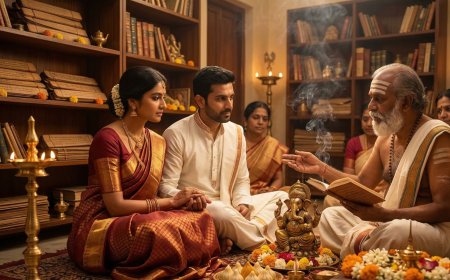
The personalisation of the saptapadi — the addition of the couple's own words and intentions to the traditional Sanskrit framework — is a practice that has been growing among NRI couples in the diaspora context, and that the most thoughtful of the NRI community's priests have been supporting and developing with genuine care. The personalisation takes different forms in different couples' ceremonies, but the underlying approach is consistent: the Sanskrit mantra is spoken by the priest as the foundation, and the couple's own words — spoken by the couple, in the language of their choice, at each step — are the specific, personal expression of the traditional intention.
The Bilingual Approach
The most widely adopted personalisation approach is the bilingual ceremony — the priest speaks the Sanskrit mantra, provides the English translation, and the couple then speaks their own words at each step before moving to the next. This approach maintains the full traditional ceremony while adding the personal dimension that makes each step specific to the couple rather than generic to all couples.
The bilingual approach requires the couple to prepare their own words for each step — the specific, personal articulation of what each step means in the context of their specific partnership. This preparation is itself one of the most valuable elements of the personalisation — the process of thinking carefully about what each step means, of having the conversation with each other about their specific intentions at each of the seven dimensions of the commitment, of arriving at the ceremony with the seven steps already inhabiting the seven specific promises that they are making to each other.
The Personalised Vow Writing Process
The preparation of the personalised saptapadi vows is a distinct and significant element of the NRI wedding planning that deserves dedicated time and dedicated attention. The couple who writes the personalised vows in the week before the wedding, in the midst of the final logistics crisis, is not the couple who writes the personalised vows with the care that the occasion requires. The personalised vows should be written three to six months before the wedding — after the couple has had the conversation with the priest about the traditional content, after they have had the conversation with each other about what each step means in their specific context, and with enough time before the ceremony for the words to be considered, revised, and made genuinely right.
The conversation with the priest — the conversation that Kavya initiated with her email to Pandit Vishwanath — is the starting point. The priest who knows the tradition can provide the couple with the specific meaning of each step in a way that makes the personalisation possible, because the personalisation requires the understanding of what is being personalised. The couple who writes their personalised vows without first understanding the traditional content is personalising something they do not yet know.
The Questions That Generate the Personalised Vows
The seven questions that generate the personalised saptapadi vows — one for each step — are the seven most important questions that the couple can ask themselves in the months before the wedding. Each question takes the traditional step's intention and makes it specific to the couple's actual life and actual relationship.
For the first step: what does nourishment mean in our specific life — what are the specific ways we feed each other, physically, emotionally, intellectually?
For the second step: what are the specific sources of vulnerability in each of us that the other has committed to protect — the specific fears, the specific weaknesses, the specific places where each person needs the other's strength?
For the third step: what are our specific agreements about money — the specific financial obligations, the specific goals, the specific understanding of what prosperity is in service of in our life together?
For the fourth step: what are the specific conditions in which each of us is most fully happy, and what are the specific commitments we are making to create those conditions for each other?
For the fifth step: what is our specific understanding of the future we are building — what does the extension of our love beyond ourselves look like in our specific context?
For the sixth step: what is our specific relationship to the natural world — what are the specific ecological commitments we are making as a couple and a household?
For the seventh step: what is the specific quality of our friendship — what does it mean to be your friend in the deepest sense, and what am I specifically committing to maintain about that friendship through everything that comes?
The Priest's Role in the Personalised Saptapadi
The personalisation of the saptapadi requires the priest's understanding, support, and active participation — it is not a modification that the couple can make unilaterally and present to the priest on the wedding day. The conversation with the priest that Kavya initiated is the model: the early engagement, the honest statement of what the couple wants, and the priest's considered response to whether and how the personalisation can be accommodated.
The priests who are most experienced with NRI weddings — who have been conducting ceremonies in the diaspora for a decade or more, who have encountered the full diversity of the NRI couple's relationship to the tradition — are, in the majority of cases, more open to the personalisation of the saptapadi than the couple expects. The priest who has spent twenty years explaining the saptapadi's content to couples who have never heard it in English knows that the ceremony is more powerful when the couple understands it, and the personalisation is one of the most direct expressions of that understanding.
The priest who refuses any personalisation of the saptapadi — who insists that the Sanskrit alone is the ceremony and that any addition is a deviation — is a priest whose understanding of the tradition's purpose is narrower than the tradition itself supports. The saptapadi has always been the ceremony's invitation to the couple to bring themselves fully into the ritual — the seven steps that require the couple's genuine intention to be what the tradition says they are. The personalisation is the most direct expression of that genuine intention.
Common Misunderstandings About the Saptapadi
The first misunderstanding is that the seven steps are seven separate and distinct vows in the way that the Western wedding vow — the single statement of love and commitment — is a single vow. The saptapadi is not seven separate promises. It is seven dimensions of a single promise — the seven aspects of the committed life that the tradition has identified as requiring specific attention and specific articulation. The couple who hears the seven steps as seven separate items on a list of promises has not heard the saptapadi correctly. The couple who hears them as the seven-dimensional expression of the single commitment to the shared life has.
The second misunderstanding is that the seventh step — friendship — is the least significant because friendship seems like the least romantic and the most ordinary of the seven commitments. The tradition's specific elevation of the seventh step as the most significant reverses this intuition. The romantic feeling that the fourth step's joy expresses is the least durable of the seven dimensions — it is the most dependent on circumstances, the most affected by the changes of time and health and fortune. The friendship that the seventh step expresses is the most durable — the dimension of the commitment that survives when the other six are being tested, that provides the foundation for the return to the other six when they have been lost.
The third misunderstanding is that the Sanskrit of the saptapadi is the ceremony and the translation is a concession to the couple's linguistic limitations. The Sanskrit is the form. The meaning is the ceremony. The couple who has the Sanskrit without the meaning is performing a ceremony they do not inhabit. The couple who has both the Sanskrit and the meaning — who hears the priest speak the mantra and understands in their own interior what is being said — is inhabiting the ceremony fully.
The fourth misunderstanding is that the personalisation of the saptapadi is a recent innovation produced by the diaspora's diluted relationship to the tradition. The tradition of the couple speaking their own intentions at the wedding ceremony is as old as the tradition itself — the Vedic wedding was not conducted only in the priest's words but required the couple's own vocalisation of their intentions. The personalisation is the recovery of this original participatory character of the ceremony rather than a modern departure from it.
The fifth misunderstanding is that the seventh step completes the legal marriage but not the sacred one — that the legal dimension and the sacred dimension of the saptapadi are two separate things that happen to coincide at the same moment. The tradition's understanding is that the legal and the sacred are not two different things at the saptapadi. The completion of the seven steps is the completion of the marriage in every sense simultaneously — legal, ritual, and sacred — because the tradition does not recognise the distinction between the legally binding and the spiritually binding that the Western legal framework requires.
The Complete Reference Table: The Saptapadi's Seven Steps Across Traditions
| Step | Sanskrit Name | Traditional Intention | Deity / Blessing Invoked | Core Commitment | Personalisation Question | Regional Variation |
|---|---|---|---|---|---|---|
| First | Eka / Prathama | Nourishment; food; sustenance | Agni; harvest goddess | Provide food and material sustenance | What does nourishment mean in our specific life? | Some traditions invoke Vishnu at first step |
| Second | Dwitiya | Strength; health; vigour | Vayu; wind deity | Protect and strengthen each other | How do we specifically protect each other's strength? | South Indian traditions emphasise health deity |
| Third | Tritiya | Prosperity; wealth; Artha | Surya; sun deity | Pursue prosperity righteously | What are our specific financial agreements? | Merchant community traditions add commercial vow |
| Fourth | Chaturtha | Happiness; joy; Kama | Chandrama; moon deity | Create conditions for each other's happiness | What conditions make each of us most happy? | Bengali tradition adds specific joy mantra |
| Fifth | Panchami | Progeny; children; family | Indra; sky deity | Commit to the family and the future | What does our commitment to the future look like? | Most variable step across communities |
| Sixth | Shashthi | Seasons; nature; ecology | Ritu; season deities | Honour the natural world and its cycles | What are our ecological commitments as a couple? | South Indian traditions invoke harvest goddess |
| Seventh | Saptami | Friendship; sakha; companionship | All devas as witnesses | Be the truest friend to each other | What is the specific quality of our friendship? | Universally the most significant step |
| Legal significance | Completion at seventh | Hindu Marriage Act recognises saptapadi | N/A | Marriage legally complete at seventh step | N/A | Consistent across all Hindu traditions in India |
| NRI legal note | Additional civil registration | Saptapadi alone may not satisfy foreign law | N/A | Civil registration required for foreign legal validity | Confirm with local registrar | Varies by country of residence |
What Kavya and Rohan Said at Each Step
Pandit Vishwanath had spent three sessions with them before the wedding — one in his home in Scarborough with both of them together, one over video call with Rohan in Vancouver, and one with Kavya alone on the Saturday before the wedding when she had the specific questions that the proximity of the ceremony had produced and that she needed to ask without Rohan present. He had read their personalised words for each step and had made three suggestions, all of which they had accepted, and had left one suggestion unmade because he had looked at the seventh step's words and understood that they were already exactly right and that the priest who changes exactly right words has misunderstood his role.
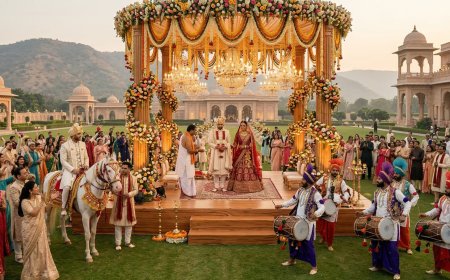
The ceremony was in June, in the Mississauga venue that Kavya's parents had chosen and that had the specific quality of the early summer light that the Great Lakes produce in June — not the dramatic light of the Rajasthan winter or the extraordinary clarity of the Kashmir autumn, but the honest, warm, North American summer light that was the light of Kavya's actual life and that she had stopped apologising for.
At each step, Pandit Vishwanath spoke the Sanskrit. Then he gave the English meaning. Then Kavya and Rohan spoke their own words — the words they had written over three months of Sunday evenings in the Mississauga flat and the Vancouver apartment, across the time zone difference that had made the writing itself a practice in the specific friendship they were about to vow to maintain.
At the seventh step, the step of friendship, Rohan said the words that Kavya had written for him and that he had revised into his own voice. Pandit Vishwanath had not suggested changing them. The guests who were listening understood something in the seventh step that they had not understood in the first six — understood that the ceremony had been building to this moment, that the six steps before it had been the preparation for this specific vow, that the friendship of the seventh step was the thing that made the other six possible and that the ceremony had always known this and had always placed it last for this reason.
Understand the traditional meaning before you write the personal words. Have the three conversations with the priest — the one about the content, the one about the personalisation, and the one that each of you needs to have separately when the proximity of the ceremony has produced the questions you can only ask alone. Write the personalised words three months before the wedding, not the week before. Let the seventh step be last for the reason the tradition has always known.
And at the seventh step, after six steps of the material and the physical and the ecological and the joyful and the prosperous, speak the friendship vow with the understanding that this is the foundation of all the others — the step that makes the marriage survivable, sustainable, and genuinely itself.
Published by NRIWedding.com — The Premium Global Platform for Non-Resident Indians Planning Indian Weddings From Abroad.
What's Your Reaction?
 Like
0
Like
0
 Dislike
0
Dislike
0
 Love
0
Love
0
 Funny
0
Funny
0
 Angry
0
Angry
0
 Sad
0
Sad
0
 Wow
0
Wow
0