











































How Diwali Changes Shape Across India: The Complete NRI Guide to India's Most Diverse Festival
Diwali is not one festival. It is many — each shaped by the specific community, region, and tradition that observes it. This complete guide explores how Diwali changes shape across India's extraordinary diversity — from the North Indian Lakshmi puja and Bengal's Kali Puja to the Sikh Bandi Chhor Divas, the Jain commemoration of Mahavira's nirvana, the Tamil Naraka Chaturdashi oil bath, and Kerala's quieter relationship with the festival. For every NRI who has celebrated Diwali far from home and assumed everyone at the table was remembering the same thing, this is the authoritative guide to understanding what the festival actually is across the subcontinent — and why the diversity is the point.


How Diwali Changes Shape Across India
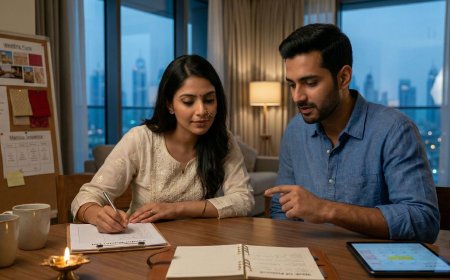
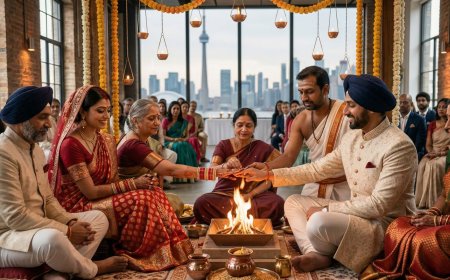
The conversation happened at a dinner table in Toronto, in the particular way that conversations about India happen at dinner tables in Toronto — with the warmth of people who are far from home and who use the names of festivals and foods and rituals as a way of touching home from a distance. There were eight people at the table, all Indian, all from different parts of the subcontinent, and the occasion was Diwali — or rather, the occasion was the Canadian Thanksgiving weekend that had been repurposed, as NRI Diwali celebrations often are, for the nearest Friday that everyone could manage. The food was a negotiated collaboration. The diyas were on the windowsill. Someone had put a Bollywood playlist on that everyone was slightly too polite to object to.
The conversation turned to Diwali itself — to what each person's family had done on the day, to the specific memories that the festival produced in each of them. And what emerged, slowly and then with increasing clarity, was that the eight people at the table had essentially been celebrating eight different festivals that happened to share a name. Anjali from Tamil Nadu had grown up with Diwali as the day her mother made murukku and the family visited the Murugan temple and the primary religious significance was the return of the goddess Lakshmi. Vikram from Bengal had grown up with Kali Puja on the same night — the dark goddess, the cremation ground, the imagery of death and transformation that was as far from the diyas-and-sweets version as it was possible to imagine while still being the same calendar date. Sukhdeep from Punjab had grown up with the Bandi Chhor Divas — the Sikh celebration of the release of Guru Hargobind Ji from Gwalior Fort — which coincided with Diwali and which was, for his family, the primary meaning of the occasion. Meenakshi from Kerala had grown up barely celebrating Diwali at all — the festival in Kerala was observed but was not the central event that it was in the North, and her childhood memories of the night were of fireworks heard from a distance rather than participated in.
The conversation continued for two hours, the food going cold and nobody minding, because the revelation that the festival they had all been celebrating together in Toronto was actually multiple festivals that they had each been celebrating separately, in parallel, with entirely different stories and entirely different ritual practices and entirely different emotional registers, was the kind of revelation that does not exhaust itself quickly.
At the end of the evening, someone said: So which one is the real Diwali? And the table was quiet for a moment. Then Anjali said: All of them. That is the point.
This article is for that Toronto dinner table — and for every NRI who has celebrated Diwali far from home and assumed, until a specific conversation revealed otherwise, that everyone at the table was remembering the same thing.
Diwali as a National Festival and a Regional Multiplicity
Diwali is India's most celebrated festival, observed across the length and breadth of the subcontinent and across the global Indian diaspora with a universality that no other Indian festival quite matches. It has become, in the international imagination, the definitive Indian festival — the festival of lights, the triumph of good over evil, the night of diyas and fireworks and sweets and the goddess Lakshmi and the return of Lord Rama to Ayodhya after fourteen years of exile. This is the version that the international media covers, that the Bollywood films celebrate, that the Diwali greeting cards depict, and that the NRI community in Toronto or London or Sydney performs for its adopted country as the representative expression of Indian cultural identity.
It is also, as the Toronto dinner table discovered, one version among many — perhaps the dominant version, certainly the most widely exported version, but not the complete picture of what Diwali is across the extraordinary diversity of the Indian subcontinent. The festival that falls on the new moon night of the month of Kartik in the Hindu lunar calendar is observed by Hindus, Sikhs, Jains, and some Buddhist communities across India, and each of these communities brings to the same date a different story, a different ritual practice, a different mythology, and a different emotional relationship to the occasion.
The result is not a unified festival with regional variations. It is a family of related festivals — sharing the calendar date, sharing certain surface features like the lighting of lamps and the exchange of sweets, but diverging in their stories, their deities, their ritual practices, and their deepest meanings in ways that make the single word Diwali an umbrella rather than a description.
Why the Diversity Exists
The diversity of Diwali's forms across India is not a historical accident or a modern divergence. It reflects the fundamental character of the Hindu religious tradition, which has always been more a family of practices and stories than a unified doctrine with a central authority. The Hindu tradition does not have a Pope, a council of bishops, or a canonical text whose interpretation is binding on all practitioners. It has a vast and overlapping collection of texts, traditions, communities, and practices that have developed over millennia in dialogue with each other and with the specific cultural, geographic, and social contexts of the communities that practice them.
The new moon of Kartik is a date of sacred significance across this diversity, and different communities have filled it with the stories and the practices that are most meaningful within their specific traditions. The result is a festival of genuine multiplicity — not a confusion but a richness, not a disagreement but a demonstration of the tradition's capacity to accommodate the full diversity of the human religious imagination within the frame of a single calendar occasion.
The North Indian Diwali: Rama, Lakshmi, and the Return
The most widely known version of Diwali — the version that has been most exported, most represented in the national media, and most associated with the festival in the global Indian imagination — is the North Indian tradition centred on two interlocking stories: the return of Rama to Ayodhya and the worship of the goddess Lakshmi.
The Ramayana narrative that underlies the North Indian Diwali celebration tells that Lord Rama, after defeating the demon king Ravana in Lanka and rescuing his wife Sita from captivity, returned to his kingdom of Ayodhya on the new moon night of Kartik after fourteen years of exile. The people of Ayodhya, overjoyed at his return, lit rows of earthen lamps — the diyas — to illuminate the dark night and welcome their king home. The festival of Diwali, in this telling, is the reenactment of that welcome — the lighting of the lamps is the lighting of Ayodhya's welcome, and the darkness of the new moon night is the darkness that Rama's return illuminated.
This narrative is powerful and emotionally resonant, and it organises the North Indian Diwali celebration around the twin poles of the light and the return — the triumph over darkness, the joy of homecoming, the reunion of the righteous king with his people. The diyas on the windowsills and the doorsteps are not decorative. They are the welcome home.
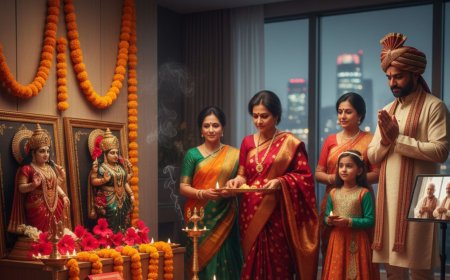
The Lakshmi worship that accompanies the Diwali puja in the North Indian tradition adds the dimension of abundance and prosperity to the occasion. Lakshmi — the goddess of wealth, of beauty, of good fortune — is invited into the home on Diwali night through the specific ritual of the Lakshmi puja, in which the goddess is welcomed with the light of the diyas and the offering of sweets and coins and the opening of account books — the traditional practice of the merchant communities who considered Diwali the beginning of the new financial year and who sought the goddess's blessing on their commercial activities.
The Five Days of North Indian Diwali
The North Indian Diwali is not a single day but a five-day celebration that begins with Dhanteras and ends with Bhai Dooj. Dhanteras — the thirteenth day of the dark fortnight of Kartik — is the day of the purchase of gold and silver, the day of Dhanvantari the divine physician whose connection to the kalash tradition is noted elsewhere in this series. Choti Diwali, or Narak Chaturdashi, follows — the fourteenth day, associated with the defeat of the demon Narakasura by Lord Krishna and with the ritual oil bath taken before dawn. The main Diwali night — the new moon — is the third day. Govardhan Puja follows, celebrating Krishna's lifting of the Govardhan mountain to shelter the people of Vrindavan from Indra's rain. And Bhai Dooj, the fifth day, celebrates the bond between brothers and sisters — the sister applying the tilak on the brother's forehead and praying for his long life.
This five-day structure gives the North Indian Diwali a completeness and a narrative arc that the single-day celebrations of other regions do not replicate. Each day has its own ritual, its own deity, its own story, and its own specific practices — the five days together constitute a total immersion in the festival's many dimensions.
Bengal's Kali Puja: The Dark Goddess on the Night of Diwali
The Diwali night in West Bengal and in the Bengali communities of the Indian diaspora is Kali Puja — the worship of the goddess Kali, the dark mother, the destroyer of evil, the deity whose iconography could not be more different from the golden, lotus-bearing Lakshmi of the North Indian tradition. Kali stands on the chest of the recumbent Shiva, her tongue extended, her garland of severed heads around her neck, her four hands holding the sword, the severed head, the mudra of fearlessness, and the mudra of boons. She is the darkness made sacred — the terrifying aspect of the divine feminine that the Diwali night in Bengal honours with the same reverence that the North Indian tradition honours the beautiful and the auspicious.
The Kali Puja tradition in Bengal is a counterpoint to the Durga Puja that precedes it by a few weeks — where Durga Puja is the great public festival of Bengal, conducted in elaborately constructed pandals across every neighbourhood of every Bengali city and town, Kali Puja is a quieter, more intimate, often domestic occasion. The Kali image is worshipped in the home, or in the neighbourhood pandal, with the midnight puja being the centrepiece — the goddess worshipped at the hour of darkness, the hour that is most specifically hers.
The Bengali Diwali is not the festival of the return of Rama. It is the festival of the goddess who lives in the dark and who is most completely herself at the hour of the new moon night when there is no light but the lamp the worshipper brings to her.
The fireworks of the Diwali night in Bengal are not incidental to the Kali Puja tradition — they are associated with the tumult and the power of the goddess, the sound and the light that accompanies her presence. The Bengali NRI celebrating Diwali in Toronto who lights a diya and says a prayer to Lakshmi is doing something genuinely different from the practice of their tradition, even if the calendar date is shared.
The Kolkata Diwali and the Jagaddhatri Puja
The Bengali festival calendar continues beyond Kali Puja with Jagaddhatri Puja — the worship of the goddess Jagaddhatri, the sustainer of the universe — which is celebrated in Chandernagore and Krishnanagar with the same elaborateness that Durga Puja receives in Kolkata. The continuity of the goddess worship through the autumn festival season in Bengal is itself a statement about the tradition's orientation — the Bengali calendar in the months of Ashwin and Kartik is organised around the worship of the divine feminine in her many forms, and Diwali is one moment in that extended celebration rather than the singular festival that it is in the North Indian context.
The Sikh Bandi Chhor Divas: Freedom on the Night of Lights
The Sikh tradition observes the same new moon night of Kartik as Bandi Chhor Divas — the Day of Liberation — a celebration whose historical basis is entirely distinct from both the Rama return narrative and the Kali Puja tradition, and whose emotional register is the register of freedom rather than the register of cosmic return or divine encounter.
The historical event that Bandi Chhor Divas commemorates took place in 1619, when the sixth Sikh Guru, Guru Hargobind Ji, was released from imprisonment in Gwalior Fort by the Mughal Emperor Jahangir. The Guru had been imprisoned along with fifty-two other princes who were also held captive in the fort. When the order of release came, the Guru insisted that the other princes also be released — and the tradition holds that he arranged for them to be freed by having each prince hold a cord of his robe, so that as the Guru walked out of the fort's narrow gate, the princes walked out with him. The number of cords, and therefore the number of princes freed, is recorded variously in the tradition, but the essential story is consistent: the Guru's freedom was not accepted at the cost of others' captivity.
The people of Amritsar, learning of the Guru's release, lit lamps to welcome him home — and the historical coincidence of this joyful return with the traditional night of lamps created the Sikh festival of Bandi Chhor Divas, which has been observed on the same night as Diwali ever since.
For the Punjabi Sikh NRI at the Toronto dinner table, Diwali night is not primarily the night of Rama or of Lakshmi. It is the night of the Guru's freedom — the night that demonstrates the Sikh principle that liberation is only genuine when it is shared, that the freedom of the one who walks out of the narrow gate is not real freedom if it is purchased at the cost of those who remain behind.
The Jain Diwali: The Nirvana of Mahavira
The Jain tradition observes the Diwali night as the commemoration of the nirvana — the final liberation — of Lord Mahavira, the twenty-fourth Tirthankara of the Jain tradition, who attained moksha on this night in 527 BCE according to the Jain calendar. The Jain Diwali is therefore not a festival of return or of freedom in the political sense but of the ultimate spiritual liberation — the soul's final release from the cycle of birth, death, and rebirth that is the samsara of the Indian religious traditions.
The Jain Diwali has a specific character that distinguishes it from the Hindu and Sikh celebrations of the same night. The Jain tradition — with its strict emphasis on non-violence, on renunciation, and on the accumulation of spiritual merit rather than material wealth — approaches the festival night with a different orientation from the Lakshmi puja of the North Indian tradition. The fireworks, the sweets, and the Lakshmi worship of the Hindu Diwali are not part of the core Jain observance, though the lighting of lamps is shared — the lamps in the Jain tradition representing the light of Mahavira's knowledge that illuminated the path of liberation for his followers.
The Jain business communities of Gujarat and Rajasthan do observe Diwali with some of the commercial elements that the Hindu tradition shares — the opening of new account books, the Lakshmi puja — because the communities are embedded in a social and commercial landscape that shares the calendar with the Hindu majority. But the Jain religious significance of the night is the nirvana of Mahavira, and this is the meaning that the tradition preserves beneath the shared surface of the festival.
South India's Diwali: A Different Relationship to the Festival
The Diwali celebration in South India — across Tamil Nadu, Kerala, Karnataka, and Andhra Pradesh — is a genuinely different relationship to the festival than the North Indian tradition, and understanding this difference is important for the NRI from the South who participates in a Diwali celebration in Toronto or London and finds that the festival being celebrated does not quite match their childhood memory.
Tamil Nadu: Naraka Chaturdashi and the Dawn Bath
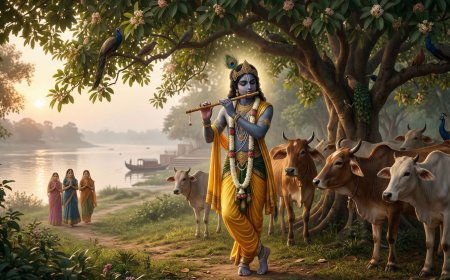
In Tamil Nadu, the primary Diwali observance is not the main festival night but Naraka Chaturdashi — the day before the North Indian Diwali night, associated with the defeat of the demon Narakasura by Lord Krishna and his wife Satyabhama. The Tamil tradition celebrates this day with the ritual ganga snanam — the oil bath taken before dawn, before the sun rises, as an act of purification that symbolises the cleansing that followed Narakasura's defeat.
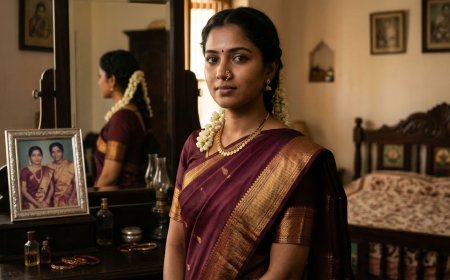
The Tamil Diwali morning begins in darkness — the oil bath before sunrise, the new clothes put on while the stars are still visible, the bursting of a single firecracker that marks the beginning of the celebration. The food prepared for Tamil Diwali is specific to the tradition — the murukku, the mixture, the adhirasam, the specific sweets that Tamil families have been making for this morning since the tradition was established. The festival in Tamil Nadu is a morning festival — by midday it is largely over, the sweets have been distributed, the family has visited the temple, and the day returns to something close to normal.
This is radically different from the North Indian Diwali, which is an evening and night festival — the lamps lit at dusk, the puja conducted after dark, the fireworks at midnight. The Tamil NRI who participates in a North Indian-style Diwali evening celebration in Toronto is participating in something that is recognisably related to but genuinely different from the festival of their childhood.
Kerala: Diwali at the Periphery
Kerala's relationship to Diwali is the most peripheral of any major Indian state — the festival is observed in Kerala but it is not the grand celebration that it is in the North or even the specific morning ritual that it is in Tamil Nadu. Kerala's own festival calendar is organised around Onam, Vishu, and Thrissur Pooram, and Diwali falls in the space between rather than at the centre.
The Diwali that Kerala observes is largely the version imported from the North Indian cultural mainstream through the media — the Bollywood Diwali, the national narrative Diwali — rather than a deeply rooted local tradition with its own specific ritual practices. The Malayalam NRI in Toronto who has strong Diwali memories is likely drawing on a festival experience that was shaped by exposure to the national media version rather than by a deep regional tradition.
Karnataka: The Local Synthesis
Karnataka's Diwali observance is a synthesis of the Naraka Chaturdashi tradition that it shares with the broader South Indian practice and the Lakshmi puja that it shares with the North Indian tradition. The Karnatakas Diwali has its own specific regional character — the Bali Puja, honouring the demon king Bali who is associated with this period of the calendar in the Karnataka tradition — that adds another layer to the festival's meaning in this region.
The Diwali of the Merchant Communities: The Commercial New Year
Across the trading communities of India — the Marwaris and Banias of Rajasthan and the North Indian plains, the Gujarati merchant communities, the Chettiars of Tamil Nadu — Diwali has a specific commercial dimension that is as important to the festival's meaning as its religious and mythological dimensions. The new moon of Kartik is the beginning of the new financial year in the traditional Hindu calendar, and the merchant communities have historically marked this occasion with the closing of the old account books and the opening of the new ones — the Chopda Puja, the worship of the account books that begins the new year's commercial operations under the blessing of Lakshmi and Ganesha.
The Chopda Puja tradition — the ceremonial opening of the new account ledger, the writing of the first entry in the auspicious red ink, the stamping of the book with the swastika and the Shri symbol — is one of the most distinctive expressions of the way the Indian commercial tradition has integrated religious practice into economic life. The account book is not simply a record of transactions. On Diwali night, it is an object of worship — the vessel through which the goddess Lakshmi's blessing on the coming year's commerce is sought and confirmed.
For the NRI from a merchant family background — the Gujarati professional in London, the Marwari businessman in Singapore — Diwali carries this commercial dimension in addition to the religious and mythological dimensions, and the Chopda Puja is a practice that travels with the community into the diaspora in ways that the broader festival does not always carry.
The Diwali of the Diaspora: The Festival That Becomes Unified by Distance
There is a paradox in the way that Diwali functions in the Indian diaspora that the Toronto dinner table conversation was beginning to uncover. In India, the diversity of the festival is visible and acknowledged — the Bengali knows that their Kali Puja is different from the Punjabi's Bandi Chhor Divas, the Tamil knows that their Naraka Chaturdashi morning ritual is different from the North Indian Diwali night. The diversity exists in the social landscape and can be encountered directly.
In the diaspora, the festival tends to consolidate — the regional variations are lost in the pressures of the collective representation, and what emerges is a simplified, synthetic version that borrows primarily from the North Indian tradition because that tradition is the most widely exported and the most media-visible. The diyas and the Lakshmi puja and the Rama return narrative become the representative version of Diwali for the diaspora, and the Bengali Kali Puja and the Tamil oil bath and the Sikh Bandi Chhor Divas recede to the private practice of the communities that observe them.
This consolidation is understandable and has its own value — the shared celebration creates community across the diversity, gives the diaspora a collective identity in relation to the adopted country's cultural landscape, and provides a common occasion for the gathering that the dispersed community needs. But it also involves a loss — the specific richness of each regional tradition, the specific stories and the specific ritual practices and the specific emotional registers that each community brings to the same calendar date.
The most honest Diwali in the diaspora is not the one that performs a generic version of the festival for the adopted country's cameras. It is the one that makes room for Anjali's murukku and Vikram's Kali image and Sukhdeep's Bandi Chhor Divas and Meenakshi's quieter observation — the one that treats the diversity of the festival as its greatest gift rather than its greatest inconvenience.
Common Misunderstandings About Diwali Across India
The first misunderstanding is that the Rama return narrative is the universal foundation of Diwali across all Indian communities. It is the North Indian Hindu tradition's primary narrative, and it has been exported as the representative story through the national media and the Bollywood cultural mainstream. It is not the story that the Bengali worshipping Kali is telling, nor the story that the Sikh celebrating Bandi Chhor Divas is telling, nor the story that the Jain commemorating Mahavira's nirvana is telling. The festival is larger than any single story.
The second misunderstanding is that the fireworks are a universal and uncontested element of Diwali across all traditions. The fireworks are strongly associated with the North Indian and the Punjabi traditions and have become, through the media and the cultural mainstream, the most visible element of Diwali in the public imagination. The Jain tradition has specific concerns about the violence implicit in fireworks. The environmental concerns about air quality and noise pollution have produced significant debate within the Hindu tradition itself about the place of fireworks in the festival. The association of fireworks with Diwali is powerful and widespread but it is not universal and it is not without legitimate contestation within the traditions that observe the festival.
The third misunderstanding is that Diwali is a Hindu festival that Sikhs and Jains observe in modified form. The Sikh Bandi Chhor Divas is not a modification of the Hindu Diwali. It is a Sikh festival that happens to fall on the same night, with its own historical basis, its own story, its own ritual practices, and its own emotional significance that is entirely independent of the Hindu tradition. The coincidence of the calendar date is not the same as the coincidence of the festival.
The fourth misunderstanding is that the South Indian Diwali is simply a less enthusiastic version of the North Indian festival. The Tamil Diwali is a different festival with a different structure — a morning festival rather than an evening one, organised around the Naraka Chaturdashi story rather than the Rama return narrative, with its own specific foods and its own specific rituals. It is not less than the North Indian version. It is different, in ways that reflect the South Indian tradition's different relationship to the mythology and the calendar.
The fifth misunderstanding is that a single Diwali celebration in the diaspora can adequately represent the full diversity of the festival for all the Indian communities that participate in it. The consolidated diaspora Diwali — the Lakshmi puja, the diyas, the North Indian sweets, the Bollywood songs — is a legitimate celebration that has its own value and its own community function. But it does not represent the Bengali's Kali Puja, the Sikh's Bandi Chhor Divas, or the Tamil's oil bath. The diaspora community that acknowledges this honestly is a community that can celebrate together while also celebrating specifically — the shared occasion and the specific tradition both honoured, neither reduced to the other.
The Complete Reference Table: Diwali Across India's Communities and Regions
| Community / Region | Primary Name | Central Narrative | Key Deity | Primary Ritual | Festival Structure | NRI Diaspora Observation |
|---|---|---|---|---|---|---|
| North India (Hindi Belt) | Diwali / Deepavali | Return of Rama to Ayodhya | Rama, Lakshmi, Ganesha | Lakshmi puja; diya lighting; fireworks | Five-day festival; Dhanteras to Bhai Dooj | Most widely practised diaspora version |
| Bengal | Kali Puja | Worship of the dark goddess | Kali | Midnight puja; Kali image worship | Single night; coincides with Diwali | Practised within Bengali community specifically |
| Punjab (Sikh) | Bandi Chhor Divas | Liberation of Guru Hargobind Ji | Guru Hargobind Ji | Gurdwara prayers; lamps at Golden Temple | Single day; full Sikh community observance | Observed distinctly within Sikh NRI community |
| Jain Communities | Diwali (Mahavir Nirvana) | Nirvana of Lord Mahavira | Mahavira | Temple worship; lamp lighting; Chopda Puja | Single night with commercial new year | Observed within Jain community; commercial element strong |
| Gujarat | Diwali / Chopda Puja | Lakshmi worship; commercial new year | Lakshmi, Ganesha | Chopda Puja; account book opening; Lakshmi puja | Five-day festival with commercial emphasis | Strong commercial tradition in diaspora |
| Rajasthan | Diwali | Lakshmi worship; Rama return | Lakshmi, Rama | Lakshmi puja; merchant community rituals | Five-day festival; strong merchant tradition | Merchant community practices travel well |
| Tamil Nadu | Naraka Chaturdashi | Defeat of Narakasura by Krishna | Krishna, Satyabhama | Pre-dawn oil bath; new clothes; morning celebration | Morning festival; largely concluded by midday | Distinct from North Indian evening celebration |
| Kerala | Diwali | National narrative (media-influenced) | Lakshmi (primarily) | Lamp lighting; sweets; limited specific ritual | Single day; peripheral in local calendar | North Indian version adopted in diaspora |
| Karnataka | Diwali / Bali Puja | Naraka Chaturdashi; Bali Puja | Krishna, Bali, Lakshmi | Oil bath; Bali worship; Lakshmi puja | Two-day structure; regional synthesis | Blended tradition in diaspora |
| Andhra Pradesh / Telangana | Deepavali | Naraka Chaturdashi | Krishna, Lakshmi | Oil bath; Lakshmi puja; fireworks | Morning ritual plus evening puja | Combines South and North elements in diaspora |
| Maharashtra | Diwali | Lakshmi puja; Bali Puja | Lakshmi, Bali, Ganesha | Lakshmi puja; Abhyanga snanam; Bali worship | Five-day structure; Narak Chaturdashi emphasis | Strong Maharashtrian tradition in diaspora |
| Odisha | Diwali / Kumar Purnima | Regional goddess worship | Lakshmi, regional deities | Lamp lighting; specific regional rituals | Regional variation; distinct calendar relationship | Less visible in diaspora mainstream |
| Northeast India | Limited observation | Regional traditions dominant | Varies by community | Varies significantly | Not a primary festival in most communities | Regional community practices maintained |
| NRI Diaspora (consolidated) | Diwali | Rama return (North Indian dominant) | Lakshmi, Rama | Lakshmi puja; diyas; fireworks; sweets exchange | Single evening celebration; community gathering | Synthetic version; regional diversity reduced |
What the Toronto Dinner Table Was Actually Celebrating
The eight people at the Toronto dinner table were celebrating something that the single word Diwali could not fully contain. They were celebrating, each of them, the specific version of the festival that their specific community and their specific family had given them — the specific story, the specific ritual, the specific food, the specific emotional relationship to the occasion. And they were also celebrating, collectively, the fact of being Indian in Toronto on a Friday in October when none of them could be at home.
The consolidated diaspora Diwali is not a lesser thing than the specific regional traditions it synthesises. It is a different thing — a festival that the diaspora condition has produced, that serves the diaspora's specific needs for collective identity and collective celebration, and that carries its own genuine meaning even as it loses some of the regional specificity of its component traditions. Anjali's murukku was on the table alongside Vikram's sandesh and Sukhdeep's pinni and Meenakshi's chakli, and the table held all of it without any of it requiring the others to be less than what they were.
The question — which one is the real Diwali? — was answered correctly. All of them. The Kali Puja and the Bandi Chhor Divas and the Naraka Chaturdashi oil bath and the Lakshmi puja and the Mahavira nirvana and the Chopda Puja and the five-day North Indian celebration and the quiet Kerala lamp on the windowsill — all of these are the real Diwali, each within its own tradition, each carrying its own full weight of story and ritual and meaning and memory.
The festival is large enough to hold all of them. It always has been.
Know your own tradition's specific Diwali before you celebrate the consolidated version. Find the story that your community is telling on this night — not the Bollywood version, not the greeting card version, but the specific story from the specific tradition that your family brought to wherever you are. Celebrate the consolidated version with your friends and your adopted community, because that celebration is also real and also valuable. But keep the specific version alive in your own home, in the specific food and the specific ritual and the specific story that your grandmother told.
And at the dinner table in Toronto, or London, or Sydney, when someone asks which one is the real Diwali — tell them what Anjali said. All of them. That is the point.
Published by NRIWedding.com — The Premium Global Platform for Non-Resident Indians Planning Indian Weddings From Abroad.
What's Your Reaction?
 Like
0
Like
0
 Dislike
0
Dislike
0
 Love
0
Love
0
 Funny
0
Funny
0
 Angry
0
Angry
0
 Sad
0
Sad
0
 Wow
0
Wow
0