



























































How Ganesha Became the God of All Beginnings: The Origin Story Every NRI Couple Should Know Before the Wedding Starts
Why does Ganesha go first at every Hindu wedding — and what does the elephant head, the broken tusk, the mouse, and the modak actually mean? This complete NRI philosophical guide tells the full origin story of Ganesha from the Shiva Purana — Parvati's creation of her son from turmeric paste, the catastrophe of Shiva's return, the boy who faithfully guarded the door and lost his head for it, and the cosmic restoration that gave Ganesha the elephant head and authority over all beginnings. Learn the philosophical meaning of the broken tusk as the icon of sacrifice for purpose, the mouse vehicle as the teaching on the ridden mind, and the modak as the divine permission to find sweetness at the centre of every beginning. Understand how to brief the pandit to name the philosophical dimension at each Ganesh Puja moment, why the modak offering must be the actual traditional sweet rather than a decorative representation, how to build the Ganesh Puja muhurtham as the fixed point around which the entire wedding morning programme is arranged, and how to tell the origin story to assembled family and international guests before the puja begins. Understand the regional variation across Shiva Purana, Skanda Purana, and Brahma Vaivarta Purana traditions, the Ardhanarishvara connection to the Shiva-Shakti philosophical framework, and the five specific mistakes that reduce the Hindu wedding's most foundational ritual to a procedural warm-up. This is the complete, culturally serious, mythologically grounded guidance that every NRI couple deserves before they invoke Ganesha at the beginning of the most important beginning of their lives.


How Ganesha Became the God of All Beginnings — The Origin Story Every NRI Couple Should Know Before the Wedding Starts
The question was asked at breakfast.
Ananya's seven-year-old nephew, Arjun, had been brought to Bengaluru from New Jersey for the wedding week, and he had the specific, unfiltered curiosity of a child who has grown up adjacent to a tradition without having been given its explanations. He knew the shapes of things — the elephant head, the broken tusk, the mouse, the modak held in the lower left hand — the way a child knows the shapes of things that have been in the visual field since birth without ever having been formally introduced to their meaning.
He was eating idli. His grandmother was across the table. The Ganesha murti on the pooja shelf above the kitchen counter was, as it always was in this house, garlanded with fresh flowers that his grandmother had placed that morning, the brass vessel of milk and the small clay lamp arranged before it in the specific, daily, unremarkable devotion that had been the rhythm of this kitchen for thirty years.
Arjun pointed at the murti.
"Why does he have an elephant head?" he asked.
His grandmother looked up from her coffee.
"That," she said, "is a long story."
"I want the long story," Arjun said. He was seven. He had nowhere to be.
His grandmother put her coffee down. She settled in her chair. She looked at Arjun with the expression of someone who has been waiting to be asked this question and who has the answer ready, has always had it ready, has been carrying it for the specific purpose of one day being asked.
"Then I will tell you the long story," she said.
Ananya was at the other end of the table, doing something on her phone, half-listening. She was getting married in four days. The planning had been enormous — the venue, the vendors, the guests from seven countries, the coordination that had consumed eighteen months and produced a spreadsheet that she occasionally looked at with the mild, incredulous wonder of someone surveying something they built and can barely believe they built.
She was half-listening, and then she was fully listening, and then she put the phone down, because her grandmother had begun the story, and the story was one that she had heard as a child and that she had not heard properly since childhood, and something about the way her grandmother was telling it — the specific, unhurried, this-is-the-important-part quality of a woman telling a story to a child who has asked and who deserves the real answer — made her put the phone down and be in the room.
Her fiancé Vikram came in from the garden. He stood in the doorway. He listened for a moment. He sat down.
The grandmother told them the story of how Ganesha got his elephant head.
When she finished, Arjun was quiet for a moment. Then he said: "So he died and came back with a different head."
"Yes," the grandmother said.
"And now he is the god of beginnings."
"Yes."
"Because," Arjun said, with the slow, constructive logic of a seven-year-old reasoning toward a conclusion, "he knows what it is like to start over."
The grandmother looked at him for a long moment.
"Yes," she said. "Exactly that. Because he knows what it is like to start over."
Ananya looked at Arjun. At her grandmother. At the murti on the shelf above the counter, the elephant head and the broken tusk and the mouse and the modak, all of it suddenly carrying more weight than it had carried five minutes ago.
She picked up her phone. She put it back down.
In four days she would begin the wedding with the Ganesh Puja — the invocation of Ganesha before any other ritual, the placing of his presence at the beginning before the beginning, the acknowledgement that no auspicious beginning proceeds without him. She had known this was the first ritual. She had not, until this breakfast, understood why.
This guide is for that couple — the ones who will invoke Ganesha at the start of their wedding and who deserve to know, completely and with the depth the story has always carried, who he is, where he came from, and what it means to place him at the beginning of the most important beginning of their lives.
Why the Origin Story Matters for the NRI Couple
The Ganesh Puja that opens every Hindu wedding is, for many NRI couples, the first ritual they participate in with genuine attention — the ceremony has begun, the family is gathered, the pandit is reciting, and something in the specific, present quality of the moment produces a focus that the months of planning did not always have.
But the Ganesh Puja, like every ritual in the Hindu tradition, is most fully received when the story behind it is known. The story is not decoration. It is the meaning — the specific, narrative, mythologically encoded explanation of why Ganesha is invoked before all things, why the broken tusk is present in his iconography, why the mouse is his vehicle, why the modak is his preferred offering, why the remover of obstacles has himself been the subject of the most dramatic obstacle in his own mythology.
The NRI couple who approaches the Ganesh Puja knowing this story — who hears the pandit's invocation with the specific, earned knowledge of what is being invoked — is participating in the ritual differently than the couple who follows the pandit's instructions without access to the framework. The difference is not visible from the outside. It is entirely interior. And it is the difference between performing a ceremony and being present for one.
The origin story of Ganesha is not a single story. It is a constellation of stories — told differently in different Puranas, emphasised differently in different regional traditions, carrying different details in the Shiva Purana, the Skanda Purana, the Brahma Vaivarta Purana, and the oral traditions of the Tamil, Telugu, Kannada, and Maharashtrian communities whose devotion to Ganesha has been the most continuously intense in Indian religious history. This guide draws from the primary Puranic sources and from the interpretive tradition that has developed around them, and it acknowledges where the stories diverge rather than presenting a falsely unified version.
The Creation of Ganesha — Parvati's Child Made from Her Own Body
The most widely told version of Ganesha's creation is found in the Shiva Purana, and it begins not with Shiva but with Parvati — with the goddess's specific, domestic, intensely personal desire for a child who was entirely her own.
Parvati was the wife of Shiva, the mother of the universe, the Shakti whose union with Shiva constitutes the cosmic dynamic that the previous article in this series has described at length. She was, by every measure of cosmic status, among the most powerful beings in existence. She was also, in the specific, human-resonant dimension of the mythological narrative, a wife who had noticed something that she found unsatisfying.
Shiva's attendants — the Ganas, the hosts of beings who served the lord of the universe — were everywhere. They attended to Shiva's needs, guarded his space, served as his retinue. When Parvati was in her private chambers, bathing or at rest, Shiva's Ganas moved freely throughout the palace, entering without announcement, disregarding the boundary between Shiva's space and Parvati's private space because they answered to Shiva and Shiva alone.
This is the intimate, domestic provocation that begins the most important mythological event in Ganesha's story. Not a cosmic battle. Not a divine conspiracy. A woman who wanted a door guard of her own.
Parvati, in the version the Shiva Purana tells, decided to create a child herself — not through the union with Shiva, not through the conventional divine mechanism of birth, but through her own creative power, from her own body. She took the turmeric paste that she had applied to herself during bathing — the same sacred turmeric whose ritual significance pervades the wedding traditions of every South Asian culture — and from this paste, from the substance of her own body's ritual preparation, she shaped a boy. She breathed life into him. She looked at what she had made.
He was, by every account, beautiful — not merely in appearance but in the specific beauty of the being who carries the mother's creative power and nothing else. He was entirely hers. He had no father's Ganas to whose authority he owed allegiance. He had no prior loyalty. He was the guardian she had made for herself, from herself, with the specific intention of having someone who would stand at the door of her private space and answer only to her.
She gave him life and she gave him his duty: stand at this door, and let no one enter without my permission. Not the Ganas. Not the sages. Not anyone.
He stood at the door. He took his duty with the absolute seriousness of the newly created who has been given the first and most important instruction of his existence.
The Catastrophe — When Shiva Came Home
What happened next is the catastrophe that gives the origin story its specific, devastating, ultimately redemptive power — and it is important to sit with the catastrophe fully before moving to the resolution, because the resolution only means what it means because the catastrophe is as terrible as it is.
Shiva returned to his abode. He was the lord of the universe, the god whose authority over all things was absolute, and he found, at the door to his wife's chambers, a boy he had never seen before who was refusing to let him pass.
The boy — who knew only Parvati's instruction, who had been created without knowledge of Shiva, who had no frame of reference for the nature of the being who stood before him demanding entry — did what his mother had told him to do. He refused.
Shiva's Ganas attempted to move the boy by force. The boy defeated them. His power was, after all, Parvati's power — the Shakti of the universe itself, concentrated in the form of a child — and the Ganas, for all their number, could not pass him.
The sages intervened. They attempted to negotiate. The boy would not be negotiated with. His instruction was absolute: no one enters without my mother's permission.
What followed is the sequence that the Shiva Purana records with a directness that does not soften what it is describing: Shiva, whose nature in this context is the transcendent consciousness that is not accustomed to being refused, whose relationship with the concept of limitation is, by the nature of what he is, essentially non-existent — Shiva lost his temper. And when Shiva, the destroyer aspect of the cosmic function, loses his temper, the consequences are not domestic.
He sent his armies. They were defeated by the child.
He sent Vishnu. Vishnu was repelled.
He sent Brahma. Brahma could not pass.
Finally, Shiva himself advanced. There was a battle — the Shiva Purana describes it as a battle of cosmic proportions, the entire divine order engaged, the universe shaken — and in the heat of the battle, in the specific, terrible clarity of the destroyer's absolute force, Shiva severed the child's head.
The boy fell. Parvati's child — made from her body, from her turmeric, from her creative power, given only the duty she had assigned him and the life she had breathed into him — lay without his head.
Parvati's Grief — The Rage of the Mother
The next scene is among the most powerful in the entire Puranic corpus, and it deserves full treatment because it is in Parvati's response to her son's death that the mythological tradition reveals something of extraordinary depth about the nature of power, of love, and of the cosmic accountability that even the lord of the universe is not exempt from.
Parvati's grief was total. But it did not express itself as grief in the passive sense. It expressed itself as Shakti in its fully activated, cosmically dangerous form — the Devi whose love has been violated reaching the limit of what love that has been violated will endure.
She called upon her own full power. She called upon the forms of Shakti that the tradition names as the Sapta Matrikas — the seven mother goddesses — and prepared to bring the complete force of the feminine cosmic principle to bear upon the universe that had killed her child.
The sages were terrified. The gods understood, in that moment, what it meant for Shakti to withdraw her sustaining energy from the cosmos — the universe would cease to be sustained, would dissolve into the chaos that Shakti's presence prevents. This was not a metaphor. This was the cosmic mathematics of the Shiva-Shakti framework: without Shakti, Shiva is inert, and without Shiva's Shakti, the cosmos does not cohere.
Brahma, Vishnu, and the assembled gods came to Parvati. They did not come with justifications. They did not come with explanations of why what had happened was understandable or defensible. They came with contrition — with the specific, absolute acknowledgement that what had been done was wrong, that the child was innocent, that the duty he had been performing was legitimate, and that the only acceptable response was to restore what had been taken.
Shiva, whose transcendent consciousness had, in the heat of the moment, acted without the wisdom that his nature is supposed to embody, understood the same thing. The child had been created by Parvati's power. He had performed the duty he was given with perfect faithfulness. His death was the consequence of a failure of recognition — Shiva's failure to see, in the boy who stood at the door with absolute fidelity to his instruction, not an obstacle but a manifestation of the same Shakti that Shiva himself was inseparable from.
The restoration was promised. But the head was gone.
The Elephant Head — The Resolution and Its Meaning
What followed is the specific, mythological resolution that gives Ganesha his distinctive form and that encodes, in the iconographic fact of the elephant head, the philosophical meaning of the entire origin story.
Shiva sent his Ganas northward — northward because the north, in the Hindu cosmological orientation, is the direction of Kubera's domain, the direction of auspiciousness, the direction from which good things come — with the instruction to bring back the head of the first being they encountered whose head was facing that direction.
The first being they encountered was an elephant. Its head was taken. It was brought back to Shiva.
Shiva placed the elephant's head on the boy's body. He breathed life back into the being. The boy rose — restored, transformed, carrying in his new form the specific, dual nature of the one who has been both created and recreated, both destroyed and restored, both the child of the goddess and the being who has been remade by the god.
Shiva did not stop there. The restoration was not merely physical — it was cosmic, accompanied by the elevation that the Shiva Purana records as the declaration that gives Ganesha his permanent status in the divine order.
Shiva declared: this being shall be worshipped before all others. Before any ritual, any ceremony, any auspicious beginning — he shall be invoked first. He shall be the lord of the Ganas — the leader of all the attendant beings of the divine order. He shall have the power to remove obstacles and, equally, to place them — for the one who has the power to remove must also have the power to create, and the wisdom to know which is required. He shall be called Ganapati — the lord of the Ganas. He shall be called Vighnaharta — the remover of obstacles. He shall be called Ganesha — the lord of all beings.
And he shall be worshipped first. Always. Without exception. Before the gods, before the rituals, before the beginnings of all things.
The Broken Tusk — The Story Within the Story
Ganesha's iconography includes, always, a broken tusk — the right tusk intact, the left tusk broken at the mid-point. The broken tusk has its own origin story, and it is the story of the specific sacrifice that knowledge requires.
The most widely told version involves the Mahabharata's composition. Vyasa — the sage who received the great epic in its fullness and who needed to set it down without pause, without the interruption that any scribe's need for rest or the breaking of a writing instrument would produce — sought a scribe who could write continuously, at the pace of the inspired recitation, without stopping.
Ganesha agreed to serve as the scribe on one condition: that Vyasa would recite continuously, without pause. If Vyasa stopped, Ganesha would stop. The bargain was struck.
Vyasa's condition in return: that Ganesha would not write down anything he did not understand. He must comprehend each verse before committing it to the record.
The recitation proceeded. At one point, the pace of inspiration exceeded the capacity of the writing instrument — the pen broke, and rather than pause the recitation, Ganesha broke his own tusk and used it to continue writing.
The broken tusk is the icon of the willingness to sacrifice oneself — specifically a part of oneself — for the purpose of knowledge, of transmission, of ensuring that the sacred text was set down without interruption. It is the icon of the scribe's absolute commitment: I will not let the limitation of my instrument stop the work. My own body is an instrument, and if that is what is required, that is what I will offer.
For the NRI couple, the broken tusk carries a specific, contemporary resonance: it is the icon of the willingness to give something of yourself — not abstractly, but specifically — to the purpose you have committed to. The marriage is that purpose. The broken tusk says: I will find another way. I will use what I have. I will not let the instrument's limitation stop the commitment.
The Mouse — The Vehicle and Its Meaning
Every deity in the Hindu tradition has a vahana — a vehicle, an animal mount, the creature whose nature embodies something essential about the deity's own nature and whose presence in the iconography encodes a specific philosophical teaching.
Ganesha's vehicle is the mouse — the Mushaka, a small, quick, perpetually moving creature that seems at first consideration to be the most unlikely mount for the most powerful deity in the beginning of things.
The mouse's symbolic function is the philosophical teaching that the choice of the mouse embodies: that the mind — the Mushaka is traditionally identified with the mind in the symbolic vocabulary of the Hindu tradition, the endlessly scurrying, perpetually distracted, never-still quality of the human mind — is not the enemy of wisdom but its vehicle. The mind must be ridden, directed, brought under the gentle authority of the one who is wise enough to use it without being used by it.
Ganesha sits atop the mouse. He is larger than the mouse by an order of magnitude — the enormous, elephant-headed lord of beginnings, carried by the tiny creature that represents the most restless aspect of human consciousness. The visual teaching is the relationship: the wisdom rides the mind, does not suppress it. The mind is not the obstacle — the unridden mind is the obstacle. The mind that has been made the vehicle of wisdom rather than the master of the person is the mind that can carry the one who knows to the beginning of things.
For the NRI couple in the last days before the wedding — the spreadsheet-driven, eighteen-months-of-planning, forty-seven-row, colour-coded organisational intensity of the contemporary destination wedding — the mouse is the specific, personal icon of everything the mind has been doing for a year and a half. The Ganesh Puja says: put the planning mind beneath the wisdom. Let it be the vehicle for today, not the master.
The Modak — The Sweetness at the Centre
The modak — the sweet dumpling, filled with jaggery and coconut or in some traditions with various sweetened fillings, shaped in the specific, pinched, peaked form that the iconographic tradition has made Ganesha's signature offering — is his preferred food, always shown held in one of his lower hands, always offered first at the Ganesh Puja.
The modak's symbolic function is the simplest and the most direct of all Ganesha's iconographic elements: it represents the sweetness that is at the centre of existence, the specific, sensory pleasure that is not a distraction from the spiritual life but an aspect of it. The tradition that gives Ganesha the modak is the tradition that refuses the dualism of sacred and sensory — that refuses to say the spiritual life requires the elimination of pleasure, the denial of the body's delight in sweetness, the transcendence of the ordinary human enjoyment of a good meal.
Ganesha is the lord of beginnings who is also a being who loves sweets. This combination is not incidental. It is the tradition's specific, deliberate statement that the sacred beginning of the auspicious life includes the enjoyment of what is good and sweet and pleasurable, that the divine is not opposed to delight but is its deepest source.
For the NRI couple, the modak at the Ganesh Puja is the permission to enjoy the wedding — the specific, religious, cosmologically grounded permission to find pleasure in the day, to let the sweet things be sweet, to not be so focused on the ceremony's correct execution that the delight of the occasion is missed. The god who is invoked first loves sweets. He has, in this way, understood something about celebration that the planning process sometimes forgets.
Why Ganesha Goes First — The Philosophical Answer
The question that Arjun asked with the simple logic of a seven-year-old — why is he the god of beginnings? — has been circling through the mythology, and now deserves its direct philosophical answer.
Ganesha is the god of beginnings because he has survived the most complete ending.
He was created fully, lived fully, performed his duty completely, was destroyed completely, and was restored to a form that carried both the original and the new. He knows, from the inside of his own experience, what it is to begin again from nothing — or not from nothing, but from the specific, transformed state of the one who has been through the ending and has come back changed.
He is the remover of obstacles because he was the obstacle — the boy at the door, the being whose faithfulness to his purpose appeared, from Shiva's perspective, as the most absolute and infuriating obstacle. The one who knows what an obstacle is from the inside of having been one is the one who most truly understands what removal requires. Not the blunt force that ended him, but the wisdom that sees whether the obstacle is a barrier to be removed or a faithfulness to be honoured, a limitation to be overcome or a boundary that deserves respect.
He is placed at the beginning of all things because every beginning contains within it the possibility of the ending — the door that might not open, the plan that might not work, the relationship that might not survive what it encounters — and the presence of the one who has been through the complete cycle of creation, destruction, and restoration is the presence that says: beginning is possible. It has always been possible. I am the proof.
For the NRI couple beginning their marriage, Ganesha at the start of the ceremony is the specific, mythologically grounded acknowledgement that beginning is the most difficult and most sacred act available to a human being. That every beginning carries risk. That the risk is not a reason to hesitate but a reason to invoke the one who has survived the ending and returned.
The NRI Application — What Arjun's Answer Means for the Wedding
Arjun had said: he knows what it is like to start over.
His grandmother had said: yes, exactly that.
The NRI couple planning the Ganesh Puja at their wedding is planning the invocation of a being who has started over. Who was created, destroyed, and restored in a form that carried both the original and the new. Who was given the authority over all beginnings not despite the catastrophe of his origin but because of it — because the one who has been through the complete cycle is the one whose authority over beginnings is real rather than nominal.
The Ganesh Puja at the NRI wedding is not merely procedural — the ritual that must be performed before the other rituals can begin. It is the specific, conscious, philosophically grounded act of placing the beginning under the protection and the auspices of the one who knows what beginning costs and what it makes possible. It is the acknowledgement that the marriage being begun is a beginning that carries risk, that the risk is real and the beginning is chosen anyway, and that the choice is made in the presence of the one whose own beginning required the most complete surrender and the most complete restoration that the mythology knows.
The Ganesh Puja Brief for the Pandit
The NRI couple should brief the pandit specifically on the philosophical dimension of the Ganesh Puja — not just what to do but what it is doing. The pandit should be asked to name, at the beginning of the puja, the specific quality of Ganesha's authority: that he goes first because he has been through the complete cycle, that his broken tusk is the icon of the sacrifice that purpose requires, that his mouse vehicle is the teaching about the mind that is ridden rather than rider. One sentence at each point. The naming is the transmission.
The Modak as Wedding Offering
The modak should be present at the Ganesh Puja in its traditional form — the actual sweet, prepared by the family or sourced from a confectioner who knows the traditional preparation, not a decorative representation of a modak but the actual food. The offering of the actual sweet — the real jaggery and coconut, the specific form that the tradition has associated with Ganesha's pleasure for centuries — is the act of the genuine offering. The representative modak on a silver plate for photographic purposes is the aesthetics of the offering without its substance.
Arjun's Question as the Pre-Wedding Conversation
The question Arjun asked — why does he have an elephant head? — should be the question asked at the pre-wedding family gathering. Not as a quiz. As an invitation to the story. The grandmother who knows the story should be asked to tell it. The telling of the story the day before the wedding, in the gathering of the family who has come from multiple countries to witness the beginning, is the transmission of the philosophical framework in the most natural and the most powerful possible form: the elder telling the story to the assembled family, the child's question having opened the space that the wisdom needed.
The NRI Planning Reference Table
| Planning Parameter | Ganesha-Specific Detail | NRI Action Required | Recommended Timeline |
|---|---|---|---|
| Philosophical Preparation | Ganesha's origin story encodes the meaning of the Ganesh Puja; couple should know the story before the puja begins | Read the Shiva Purana version of Ganesha's origin with partner before wedding week; discuss the broken tusk, the mouse, and the modak's specific meanings | 2–3 months before wedding |
| Pandit Brief | Ganesh Puja pandit should name philosophical dimension at key moments; origin story as context for invocation | Brief pandit on philosophical naming approach; confirm pandit's knowledge of the Shiva Purana version specifically; request one-sentence context at each iconographic reference | 4–6 months before wedding |
| Modak Offering | Traditional modak in jaggery and coconut form; actual food offering not decorative representation | Source traditional modak from family preparation or reputable confectioner; confirm traditional preparation method with family; bring modak to Ganesh Puja as the first offering | 1–2 weeks before wedding |
| Family Story Session | Grandmother's telling of origin story to assembled family the day before the wedding | Schedule family gathering for origin story telling; ask grandmother or senior family member to tell the complete story; invite Arjun's question as the opening | Day before wedding |
| Iconographic Understanding | Elephant head: survival of complete ending and restoration; broken tusk: sacrifice for purpose; mouse: wisdom that rides the mind; modak: sweetness at the centre | Prepare one-paragraph iconographic guide for wedding programme booklet; brief MC or pandit on context for international guests | 2–3 months before wedding |
| Ganesh Puja Timing | Ganesh Puja is the first ritual of the wedding; muhurtham determines the time; no other ritual begins before it | Confirm Ganesh Puja muhurtham with family jyotishi; build all other ritual timing around this fixed point; communicate timing to all family participants | 6–8 months before wedding |
| Regional Variation Awareness | Shiva Purana version is primary; Skanda Purana, Brahma Vaivarta Purana have variants; Tamil, Telugu, Kannada, Maharashtrian traditions emphasise different elements | Identify family's specific regional tradition; confirm with pandit which Puranic version governs the family's practice; do not assume unified single version | 8–10 months before wedding |
| Ganesha Chaturthi Context | If wedding falls near Ganesha Chaturthi — the festival of Ganesha's birth, celebrated most intensely in Maharashtra — the cultural context is maximally rich | Research Ganesha Chaturthi dates if Maharashtra destination is chosen; if wedding coincides, incorporate festival context into guest programme; confirm vendor availability during festival | 12–14 months before wedding |
| Guest Programme | International and diaspora guests may not know the origin story; brief introduction enriches the Ganesh Puja experience | Include one-paragraph Ganesha origin story summary in wedding programme booklet; brief MC on providing thirty-second context before the puja begins | 2–3 months before wedding |
| Ardhanarishvara Connection | Ganesha is the child of the Shiva-Shakti union; his origin story is inseparable from the Shiva-Shakti philosophical framework of the previous article | Read Ganesha origin story alongside Shiva-Shakti philosophical guide; the two articles form a connected framework for understanding the wedding's opening rituals | 2–3 months before wedding |
| Broken Tusk as Wedding Motif | Broken tusk as icon of sacrifice for purpose; can be incorporated into wedding motif with full philosophical knowledge | If incorporating Ganesha iconography into wedding design, include broken tusk as conscious philosophical choice; brief designer on its specific meaning | 6–8 months before wedding |
| Inter-Faith Application | Ganesha's story is accessible across traditions as the mythology of the one who survives the complete ending and is given authority over beginnings | Present Ganesha origin story to non-Hindu partner or guests as the specific mythology — not as religious requirement but as the story the tradition tells about why we begin with this invocation | 2–3 months before wedding |
| Communication Protocol | Story transmission conversations across IST gap: UK +4.5 hrs, US East +9.5 hrs, Australia East −5.5 hrs | Schedule family story sessions at times workable for elderly grandparents; record grandmother's telling of the origin story for family archive | From planning outset |
| Post-Wedding Application | Ganesha's authority is over all beginnings — not only the wedding; invoke him at every significant beginning of the married life | Establish family practice of Ganesh Puja at significant beginnings — new home, new professional chapter, new family member; transmit this practice to the next generation | Ongoing |
| The Modak's Permission | Modak as permission to enjoy the wedding day; the god who is invoked first loves sweets; delight is not opposed to the sacred | Brief the couple explicitly: the Ganesh Puja is also the permission to enjoy the day; Ganesha's modak says the sweetness is part of the beginning | 1 week before wedding |
Common Mistakes NRI Couples Make With the Ganesh Puja
The first mistake is treating the Ganesh Puja as the procedural beginning of the ceremony rather than its philosophical foundation. The Ganesh Puja is placed first not because the programme requires a warm-up ritual before the main event but because the invocation of Ganesha is the act that consecrates the beginning — that places the beginning under the authority of the one who knows what beginning requires and what it costs. The couple who rushes through the Ganesh Puja to get to the more photographically dramatic elements of the ceremony has misunderstood the order. The order is the philosophy. Ganesha is first because the beginning is first, and the beginning is the most important moment. Not the most visually spectacular — the most important.
The second mistake is offering a representative or decorative modak rather than the actual traditional sweet. The offering is the substance of the offering, not its representation. The modak that sits on a silver plate for photographs without being the actual jaggery-and-coconut traditional preparation is the aesthetics of an offering without the offering itself. The tradition is specific: the modak is Ganesha's preferred food, and the offering of his preferred food is the act of hospitality toward the divine guest who is being invited to the beginning. The actual sweet, prepared in the traditional manner, offered with the specific intention of the genuine gift — this is the Ganesh Puja's modak. The decorative representation is not.
The third mistake is failing to tell the origin story to the assembled family and guests before or during the puja. The story is the meaning, and the meaning is what transforms the ritual from a procedure into an experience. The family that gathers for the Ganesh Puja knowing the origin story of Ganesha — who he is, why his head is as it is, what the broken tusk cost and what it earned, why the mouse is beneath him, what the modak represents — is participating in the ritual as participants rather than as observers. The family that gathers without the story is watching a ceremony they do not have access to. The story is the key. It costs nothing to tell it. It requires only the willingness to make space for it — the grandmother's chair, Arjun's question, fifteen minutes before the puja begins.
The fourth mistake is treating the Ganesh Puja's muhurtham as flexible when other elements of the programme create pressure. The muhurtham — the auspicious time determined by the jyotishi for the Ganesh Puja's beginning — is not a preference. It is the specific moment identified by the astrological calculation as aligned with the auspicious forces, and the puja that begins at that moment is the puja that the tradition says is most powerfully placed at the beginning. The photographer's readiness, the caterer's schedule, the late arrival of a specific family member — none of these considerations outrank the muhurtham. The programme must be built around it, and if it cannot be built around it, the jyotishi should be consulted for the next auspicious window rather than the muhurtham being adjusted to fit the programme.
The fifth mistake is concluding the Ganesh Puja's significance at the wedding rather than transmitting it as a practice for the married life. Ganesha's authority is not only over the wedding's beginning. It is over all beginnings — the new home, the new professional chapter, the birth of the child, the significant transition of every kind that the married life will contain. The couple who establishes the Ganesh Puja as the opening practice of every significant beginning in the married life — who teaches this practice to the children when they come, who transmits the origin story in the way that Arjun's grandmother transmitted it at the breakfast table on the morning of the wedding week — is doing something more significant than preserving a ritual. They are transmitting the understanding that every beginning deserves the presence of the one who has survived the complete ending and who knows what beginning costs and what it makes possible.
Resolution
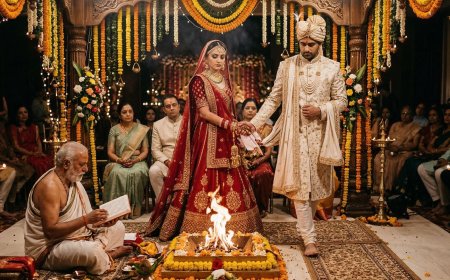
Ananya's wedding began with the Ganesh Puja at six-forty in the morning, at the muhurtham that the family jyotishi had identified and that had been built into the programme at eight months as the fixed point around which everything else was arranged.
Arjun was there. His grandmother had arranged for him to be there specifically — had told his parents that the boy who asked the question deserved to be present when the answer was enacted.
He stood beside his grandmother, in the specific, solemn attention of a seven-year-old who has been told that something important is about to happen and who has decided to take it seriously.
The pandit began. He named Ganesha first — the specific, Sanskrit invocation that the Shiva Purana tradition has preserved, the names layered one upon another: Ganapati, Vighnaharta, the lord of beginnings, the one who goes first.
And then — because the couple had briefed the pandit, because the brief had asked for the story to be named rather than only enacted — the pandit said, in a mixture of Sanskrit and Kannada and the English that would reach the international guests assembled at the edge of the ceremony:
We invoke first the one who was made, destroyed, and restored. Who received the elephant's head as the gift of restoration and became thereby the lord of all things begun. Who carries the broken tusk as the sign of what purpose costs. Who rides the mind rather than being ridden by it. Who holds the sweet at the centre because the beginning that includes delight is the beginning that is whole.
We begin with him because he knows what beginning requires.
We begin.
Arjun looked at the murti. The elephant head, the broken tusk, the mouse, the modak.
He understood what he was seeing.
Later — after the puja, after the ceremony, after the reception, in the quiet of the evening when the family gathered again in the smaller, looser gathering of people who have done something significant together — Arjun found Ananya at the edge of the garden.
He said: "The pandit said what you told Paati."
"Yes," Ananya said.
"Because he knows what it is like to start over."
"Yes."
Arjun thought about this for a moment.
"I think," he said, "I will remember that."
He will. The children who are given the story always do.
Tell the origin story before the puja — to the assembled family, to the international guests, to the seven-year-olds who are asking. Brief the pandit to name the philosophical dimension at each iconographic reference. Offer the actual modak, made in the traditional manner. Build the programme around the muhurtham, not the other way around. Establish the Ganesh Puja as the practice of every significant beginning in the married life, and transmit the origin story to every child who asks.
Ganesha goes first because he has been through the complete ending and has come back.
He is the god of beginnings because he knows what beginning costs.
Begin with him. Begin knowing who he is.
Published by NRIWedding.com — The Premium Global Platform for Non-Resident Indians Planning Indian Weddings From Abroad.
What's Your Reaction?
 Like
0
Like
0
 Dislike
0
Dislike
0
 Love
0
Love
0
 Funny
0
Funny
0
 Angry
0
Angry
0
 Sad
0
Sad
0
 Wow
0
Wow
0