

































































Outdoor vs. Indoor Wedding Venues in India — Weather Considerations Every NRI Must Know by Season and Region
Choosing between an outdoor and indoor wedding venue in India without understanding the specific seasonal and regional weather reality is one of the most common and most expensive planning mistakes NRI couples make. This complete guide breaks down India's weather conditions by region and season — covering North India, Rajasthan, Mumbai, Goa, Chennai, Bengaluru and Kerala — with specific outdoor venue verdicts for every month, the northeast monsoon trap that catches South India couples by surprise, how to structure hybrid outdoor-indoor events for weather risk management, and the seasonal venue decision matrix that gives NRI couples the climate intelligence their venue choice deserves.


The Photograph Nobody Planned For
It arrived in a family WhatsApp group on a Monday morning.
A photograph — shared by a cousin who had attended a wedding in Jaipur the previous weekend — of a wedding reception that had been planned for a rooftop terrace. The terrace was beautiful. The fairy lights were strung. The floral arrangements had been assembled with obvious care and considerable expense. The guests were dressed magnificently.
And it was raining.
Not a light shower that could be absorbed with umbrellas and good humour. A genuine, persistent, determined Rajasthani downpour — in November, a month that every wedding planning guide, every venue brochure, and every family member who had been consulted described as safely dry — that had arrived with no particular regard for the wedding schedule and had converted a carefully planned outdoor reception into a frantic, expensive, partially successful migration to the indoor spaces that the venue had, fortunately, retained as backup.
Fortunately Because not every venue does.
The couple was fine. The wedding was salvaged. The photographs — some of them, the ones taken before the rain — were extraordinary. And the family WhatsApp group was treated, over the following days, to a detailed and occasionally heated discussion of whether the weather could have been predicted, whether the venue should have been different, and whether anyone had actually checked the rainfall data for Jaipur in November before booking a rooftop reception.
Nobody had.
This is the weather conversation that NRI couples consistently do not have — not because they are careless, but because weather in India feels like a variable that cannot be managed, and variables that cannot be managed tend to be mentally filed alongside acts of God and left unaddressed.
But weather in India is not entirely unmanageable It is predictable — in the seasonal, regional, probabilistic sense that allows intelligent planning decisions to be made. The monsoon does not arrive by surprise. The peak summer heat in Rajasthan in May is not a weather event — it is a known condition. The fog in Delhi in January is not an anomaly — it is a regular feature of North Indian winters that affects visibility, travel, and outdoor events with reliable consistency.
The decision between an outdoor and an indoor venue — and the specific weather considerations that should inform that decision — is one of the most consequential and most consistently under-researched venue planning decisions that NRI couples make.
This guide makes that research unnecessary.
It gives you the complete, honest picture of weather conditions across India's major wedding regions, across every season, with the specific implications for outdoor and indoor venue choices — so that the decision you make is informed by climate reality rather than optimistic assumption.
Because the photograph in the family WhatsApp group is a teaching moment. It does not have to be yours.
The Core Reality: India's Weather Is Not One Weather
The Scale of the Subcontinent
India is not a country with a weather. It is a subcontinent with multiple, simultaneous, dramatically different climatic zones — each governed by different seasonal patterns, different rainfall regimes, and different temperature ranges that make weather generalisations not just unhelpful but actively misleading.
The wedding couple planning an outdoor reception in Kerala in February and the couple planning an outdoor reception in Rajasthan in February are planning in entirely different climatic realities. One is in the dry, pleasant interlude between the northeast monsoon and the pre-monsoon heat. The other is in the peak of a desert winter that is cooler than most people expect — and beautiful for outdoor events.
Understanding which climatic zone applies to your specific venue location is the foundation of any intelligent weather-based venue decision.
The Four Major Seasonal Frameworks
India's weather broadly follows four seasonal frameworks that, while overlapping and regionally variable, provide a useful planning structure.
The Cool Season — October to February Broadly the most favourable period for outdoor events across most of India — though with significant regional variation. Northern India experiences genuine cold in December and January. Coastal regions are moderated by maritime influence. South India has its own monsoon pattern that contradicts the national template.
The Pre-Monsoon Heat — March to May Temperatures rise sharply across most of India. Northern and central India experience extreme heat — particularly April and May. Coastal and southern regions are hot and increasingly humid. Outdoor events in afternoon or early evening hours become genuinely hazardous in many regions.
The Monsoon — June to September The southwest monsoon arrives from the Kerala coast and progressively covers the subcontinent. Outdoor events are genuinely high risk across most of India during this period — not because rain is certain on any given day, but because it is unpredictable and can be intense when it arrives.
The Retreating Monsoon — October to November The monsoon withdraws from northwest India first, with the northeast monsoon bringing rainfall to the southeastern coast — Tamil Nadu and parts of Andhra Pradesh — from October through December. This regional reversal catches couples by surprise — planning an outdoor wedding in Chennai in November on the assumption that October marks the end of rain season is a planning error with potentially expensive consequences.
Region by Region: Weather Realities for Outdoor Venues
North India — Delhi, Agra, Jaipur, Lucknow, Chandigarh
North India is the heartland of the Indian wedding calendar — and it has the most dramatic seasonal weather range of any major wedding region.
October to November — The Golden Window
Conditions: Post-monsoon clarity, moderate temperatures, low humidity. Days are warm and pleasant — typically 25°C to 32°C. Evenings cool pleasantly to 15°C to 22°C.
Outdoor venue verdict: ✓ Excellent. The best outdoor wedding weather in North India. Low rainfall risk, comfortable temperatures for evening events, and the particular quality of North Indian autumn light that makes outdoor photographs extraordinary.
The caveat — late November fog: In the final week of November and into December, North India begins its fog season. Morning and evening fog can affect arrival logistics — particularly for guests travelling by road or train — though it rarely affects the event itself in late November.
December to January — The Cold Reality
Conditions: North Indian winters are genuinely cold — more so than most NRI couples from the UK or Canada expect, given the perception of India as uniformly warm. Delhi in January averages 7°C to 8°C at night. Jaipur can reach 4°C to 5°C on cold nights. The daytime is pleasant — 18°C to 22°C — but evenings and nights are cold enough to require serious heating for outdoor events.
Dense fog is a regular feature of Delhi, Agra, and the entire Indo-Gangetic Plain from late December through January. Fog affects flights, trains, road travel, and visibility at outdoor venues. A morning ceremony that requires guests to travel from Delhi hotels to an Agra venue in January fog is a timeline management challenge of significant proportions.
Outdoor venue verdict: ⚠️ Conditional. Daytime outdoor events with adequate heating infrastructure can work well. Evening and night outdoor events require substantial heating — gas heaters, marquee sides, heated flooring — that adds significantly to the event cost. Fog logistics require specific contingency planning for guest travel, particularly for NRI guests arriving by flight.
What NRI couples often miss: The cold in North India in January is dry cold — not the damp cold of London or Toronto — which makes it feel less severe than it is. Elderly guests and guests in traditional Indian wedding attire — which prioritises elegance over warmth — can become genuinely uncomfortable at outdoor events after dark in January.
Practical recommendation: For December-January North Indian outdoor events, budget ₹2–5 lakhs for adequate heating infrastructure. Have an indoor backup space with confirmed capacity. Brief the venue on heating requirements during contract negotiation — not on the week before the wedding.
February to March — The Transition
Conditions: February brings a gradual warming that makes it one of the most reliable outdoor wedding months in North India. Temperatures rise from the January cold toward the pleasant range of 20°C to 28°C. Late February and early March are excellent — warm days, comfortable evenings, minimal rainfall risk.
Late March begins the transition to pre-monsoon heat — temperatures rise noticeably and afternoon events become increasingly uncomfortable.
Outdoor venue verdict: ✓ Very good for February and early March. One of the most underrated outdoor wedding windows in North India.
April to June — The Heat Barrier
Conditions: North Indian summers are extreme. April temperatures regularly reach 38°C to 42°C in Delhi and Rajasthan. May is peak heat — 44°C to 48°C is not unusual in Rajasthan. June is hot and increasingly humid as the pre-monsoon moisture arrives.
Loo — the hot, dry summer wind of the North Indian plains — adds to the discomfort of outdoor events in April and May. Direct sun exposure is hazardous for extended periods.
Outdoor venue verdict: ✗ Not recommended for daytime events. Evening outdoor events — beginning after 7 PM when temperatures have dropped — are possible in April and early May if the venue has adequate cooling infrastructure in all non-outdoor spaces. June outdoor events are not advisable.
What NRI couples often miss: The heat in Rajasthan in May is not the heat of a warm day in the UK. It is a physically significant, health-affecting heat that affects elderly guests, young children, and guests in elaborate outfits with particular intensity. What reads as an acceptable temperature on a weather app — 42°C — is a genuinely extreme environment for a multi-hour celebration.
July to September — The Monsoon
Conditions: The monsoon arrives in Delhi typically around the last week of June or early July. Rainfall is irregular — not constant — but unpredictable and often intense when it arrives. Humidity rises sharply.
Outdoor venue verdict: ✗ High risk. Outdoor events during the North Indian monsoon are not advisable without a complete and fully equipped indoor backup. Even venues that claim to have good drainage can be overwhelmed by heavy monsoon rain. Marquee or tent solutions are not reliable in strong monsoon winds.
Rajasthan — Jaipur, Udaipur, Jodhpur, Jaisalmer
Rajasthan deserves specific treatment because it is one of India's most popular destination wedding locations — and its desert climate creates weather dynamics that differ from the broader North Indian pattern in specific ways.
The Desert Winter Advantage — November to February
Rajasthan's desert climate means clearer skies, lower humidity, and more dramatic temperature swings between day and night than other North Indian locations. Jaipur in December is genuinely cold at night — 5°C to 8°C — but crystal clear. The quality of light in Rajasthan in winter is extraordinary for outdoor photography.
Outdoor venue verdict for Rajasthan winter: ✓ Outstanding for daytime and early evening events — with heating essential for night events.
The November Rainfall Caveat
This is the detail that the Jaipur rooftop wedding photograph illustrated. Rajasthan is officially post-monsoon from October — but late-season rainfall events are not unknown in October and November. They are infrequent, but they are real, and the intensity of rainfall when it does occur can be significant.
Practical recommendation: For October and November Rajasthan outdoor events, confirm that a complete indoor backup is available and contracted — not just theoretically available but specifically allocated and equipped for the full guest count.
Mumbai and Maharashtra
October to February — The Reliable Window
Mumbai's coastal climate moderates both heat and cold. October through February is the most reliable outdoor wedding season — humidity drops from monsoon levels, temperatures are pleasant at 25°C to 32°C, and rainfall is minimal.
Outdoor venue verdict: ✓ Good. Mumbai October-February outdoor events are generally reliable with modest weather risk.
March to May — Rising Heat and Humidity
Mumbai's coastal position means that pre-monsoon heat comes with significant humidity — a combination that is more physiologically challenging than dry heat of the same temperature. March is manageable. April and May become progressively uncomfortable for outdoor events.
Outdoor venue verdict: ⚠️ Evening-only for April and May. Daytime outdoor events in Mumbai in May are not advisable for most guest profiles.
June to September — The Monsoon
Mumbai receives some of the highest monsoon rainfall in India — the western ghats amplify rainfall significantly. The Mumbai monsoon is heavy, reliable, and long. Outdoor events from June through September carry very high weather risk.
What NRI couples often miss: Mumbai's monsoon is not the occasional shower of the North Indian monsoon. It is sustained, heavy rainfall over an extended period. Planning an outdoor event in Mumbai in July is not planning with weather risk — it is planning against weather reality.
Goa
Goa's popularity as a destination wedding location comes with specific weather considerations that its tropical coastal climate creates.
November to February — Peak Season
Goa's dry season aligns with its peak tourist and wedding season. November through February is warm — 25°C to 32°C — with low rainfall and the beach and garden venues that make Goa beautiful at their best.
Outdoor venue verdict: ✓ Excellent. Goa in December and January is one of the best outdoor wedding environments in India. Warm evenings, low humidity relative to the monsoon season, and the particular quality of coastal evening light create outstanding conditions for outdoor celebrations.
The caveat: Peak season Goa is expensive. Venues, accommodation, and travel are at premium pricing from December through February. NRI couples planning Goa destination weddings should book twelve to eighteen months ahead for December and January dates.
March to May — Transitional Heat
March is still pleasant. April and May bring rising heat and humidity — manageable for evening events but increasingly uncomfortable for extended outdoor exposure.
June to October — The Monsoon
The Goa monsoon is long and heavy. Outdoor wedding events from June through September are not advisable.October is technically post-monsoon but residual moisture and occasional late-season rain make it a caution month rather than a reliable outdoor wedding month.
South India — Chennai, Bengaluru, Hyderabad, Kerala
South India requires the most careful regional differentiation of any part of the country — because its monsoon pattern reverses the national template in ways that consistently catch NRI couples by surprise.
The Northeast Monsoon — The Critical Distinction
Tamil Nadu, coastal Andhra Pradesh, and parts of Karnataka receive their primary rainfall from the northeast monsoon — which runs from October through December. This is precisely the period that North Indian wedding planning logic treats as post-monsoon and safe for outdoor events.
Chennai in November is not post-monsoon. It is peak monsoon.
This distinction has produced more surprised couples and more rain-affected outdoor events than any other weather misunderstanding in South Indian wedding planning.
Outdoor venue verdict for Chennai, November-December: ✗ High risk. The northeast monsoon can bring intense rainfall during this period. Outdoor events require full indoor backup.
Bengaluru — The Moderate Exception
Bengaluru's elevated position — approximately 900 metres above sea level — gives it a genuinely moderate climate year-round. The city receives both southwest and northeast monsoon rainfall but in more moderate quantities than coastal South India. Temperatures rarely exceed 35°C even in summer and rarely fall below 15°C in winter.
Bengaluru is one of the most forgiving outdoor wedding climates in India — with the caveat that its extended rainy season means a longer period of elevated rainfall risk than North India.
Outdoor venue verdict for Bengaluru: ✓ Good for January through March and September through October with appropriate caution. Avoid June through August for outdoor events.
Kerala — The Dual Monsoon Challenge
Kerala receives both the southwest monsoon — June through September — and the northeast monsoon — October through December — making its rainfall-free outdoor wedding window genuinely narrow: primarily January through May, with the optimal period being January through early March.
Kerala's January-March outdoor wedding conditions are excellent — warm, humid coastal air moderated by pleasant temperatures, lush post-monsoon greenery, and the backwater and garden venues that make Kerala one of India's most beautiful destination wedding settings.
Outdoor venue verdict for Kerala: ✓ Excellent for January to early March. Exercise caution from late March onward as pre-monsoon heat and humidity build. June through December carries significant rainfall risk.
The Hybrid Solution: When Neither Fully Outdoor Nor Fully Indoor Is Right
The Managed Outdoor-Indoor Structure
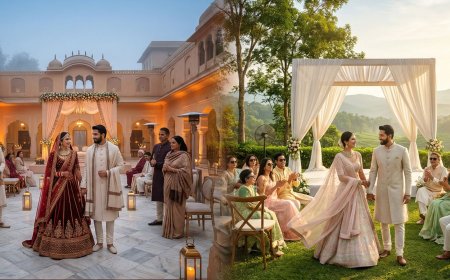
For NRI couples who want the beauty and spaciousness of outdoor venues without full weather vulnerability, a hybrid structure — outdoor for the earlier, photographic portions of the event, indoor for the seated dinner — is the most risk-managed approach.
How it works:
• Cocktail hour and pre-dinner gathering: outdoor, in the venue's garden or terrace
• Ceremony or key rituals:outdoor, during the most photogenically favourable light — typically late afternoon
• Seated dinner and entertainment:indoor, in a climate-controlled space with full capacity
This structure captures the aesthetic value of outdoor settings — the photographs, the ambiance, the expansiveness — while managing the weather risk through the indoor fallback for the portions of the event that are most affected by uncomfortable conditions.
The Marquee and Tent Option
For venues without permanent indoor backup, marquee or tent structures provide weather protection with outdoor aesthetic.
What marquees provide:
• Protection from rain — when properly installed and maintained
• Reduction of direct sun exposure
• Partial wind protection
What marquees do not provide:
• Reliable protection from strong monsoon winds
• Air conditioning equivalent to a permanent structure — though climate-controlled marquees are available at premium cost
• The same aesthetic quality as either a genuine outdoor setting or a designed indoor venue
For North Indian winter events: heated marquees with enclosed sides can extend the usable outdoor period significantly.
For monsoon-adjacent events: marquees without genuine waterproofing and wind anchoring are not reliable weather protection.
Common Mistakes NRI Couples Make About Weather
Using Month Names Rather Than Climate Data
"October is safe" and "November is dry" are month-name generalisations that are true for some parts of India and dangerously wrong for others. Chennai in November. Goa in October. Rajasthan in late November. Each of these is categorically different from the generalisation that covers them.
Correction: Research the specific rainfall and temperature data for the specific city and month of your event — not the national generalisation. India Meteorological Department historical data is publicly available and specific.
Booking an Outdoor Venue Without a Confirmed Indoor Backup
The indoor backup is not optional. It is the risk management infrastructure that converts a weather event from a wedding catastrophe into a manageable inconvenience.
Correction: No outdoor venue contract should be signed without a confirmed, contractually documented indoor backup space with capacity for the full guest count. The backup must be equipped — not just theoretically available.
Not Briefing NRI Guests on Expected Weather
NRI guests flying from the UK, USA, or Canada for an Indian wedding in January North India may pack for what they imagine Indian winter to be — mild and warm. The reality of 5°C nights in Jaipur is not what they packed for.
Correction: Include weather guidance in guest communication — particularly for NRI guests unfamiliar with the specific region's climate. A brief note about expected evening temperatures and appropriate attire prevents the guest experience from being affected by weather they were not prepared for.
Assuming Cloud Cover Means Comfortable Temperature
In South India during the pre-monsoon period — and in coastal areas generally — cloud cover does not reduce humidity or the physiological stress of high temperatures. A cloudy 35°C day in Mumbai in May is not a comfortable outdoor event environment simply because direct sun is absent.
Correction: Assess temperature and humidity together — not temperature alone. The heat index — which combines temperature and humidity to estimate physiological impact — is a more relevant planning metric than air temperature for coastal and tropical venues.
Not Considering the Impact on Elderly and Very Young Guests
Extreme temperatures — both heat and cold — affect elderly guests and very young children more significantly than healthy adults. A temperature that is manageable for a thirty-year-old in wedding attire is potentially distressing for an eighty-year-old grandmother or a two-year-old in a lehenga.
Correction: Plan weather management with your most vulnerable guests as the design standard — not your most resilient ones. A climate-controlled indoor space that is accessible and equipped for elderly guests is not a luxury. It is a basic guest experience requirement.
The Seasonal Venue Decision Matrix
Best Outdoor Wedding Months by Region
North India — Delhi, Agra, Chandigarh:
• ✓ Best: October, November, February, early March
• ⚠️ Conditional:December, January — cold, fog risk; heating essential
• ✗ Avoid outdoors: April, May, June — extreme heat; July, August, September — monsoon
Rajasthan — Jaipur, Udaipur, Jodhpur:
• ✓ Best: November to February — with heating for night events
• ⚠️ Conditional: October — occasional late monsoon rain; March — transitional
• ✗ Avoid outdoors: April through September — extreme heat and monsoon
Mumbai and Maharashtra:
• ✓ Best: November, December, January, February
• ⚠️ Conditional: March — transitional; October — post-monsoon but residual moisture
• ✗ Avoid outdoors: April, May — heat and humidity; June through September — monsoon
Goa:
• ✓ Best: November through February
• ⚠️ Conditional: March — transitional heat; October — late monsoon risk
• ✗ Avoid outdoors: June through September — heavy monsoon
Chennai and Tamil Nadu:
• ✓ Best: January, February, March
• ⚠️ Conditional: April — rising heat; September — transitional
• ✗ Avoid outdoors: October, November, December — northeast monsoon; May, June — extreme heat
Bengaluru:
• ✓ Best: January, February, March, September, October
• ⚠️ Conditional: April — pre-monsoon heat; November — occasional northeast monsoon influence
• ✗ Avoid outdoors: June, July, August — monsoon
Kerala:
• ✓ Best: January, February, early March
• ⚠️ Conditional: March — pre-monsoon building; September — transitional
• ✗ Avoid outdoors: June through August — southwest monsoon; October through December — northeast monsoon
The Weather You Plan for Is the Weather You Manage
The rooftop in Jaipur was beautiful before the rain arrived. And it was beautiful in the photographs taken before the rain arrived. And the wedding was salvaged because the venue had an indoor space and the couple had people around them who managed the transition with speed and good humour.
But it did not have to be salvaged It could have been planned differently — with a venue choice informed by the specific rainfall risk of November in Rajasthan, with a confirmed indoor backup space, with a weather contingency protocol that the coordinator had rehearsed rather than improvised.
The decision between outdoor and indoor venues in India is not a decision between beautiful and adequate. Some of India's most stunning indoor venues are more beautiful than most outdoor ones It is a decision between informed and uninformed — between choosing a venue with full understanding of the weather reality it exists within, and choosing one on the basis of a video tour that was filmed in December and does not reveal what July looks like.
Know the climate. Know the season. Know the region Know what the India Meteorological Department's historical data says about rainfall probability for your specific month in your specific city. Know what the temperature will be at 9 PM in Jaipur in January and whether your guests are dressed for it.
And then make the venue choice that serves your guests, your programme, your photographs, and your peace of mind — in the specific climatic reality of where and when your wedding will actually take place.
The photograph nobody planned for does not have to be yours.
Plan for the weather. Let it be the one thing your wedding day did not have to manage.
Published by NRIWedding.com — The Premium Global Platform for Non-Resident Indians Planning Indian Weddings From Abroad.
What's Your Reaction?
 Like
0
Like
0
 Dislike
0
Dislike
0
 Love
0
Love
0
 Funny
0
Funny
0
 Angry
0
Angry
0
 Sad
0
Sad
0
 Wow
0
Wow
0