











































































Every Hand That Applies the Paste Is a Prayer: The Ancient Truth of Pithi in Gujarati Weddings
Pithi — the ancient Gujarati ritual of anointing the bride and groom with a sacred paste of turmeric, sandalwood, chickpea flour, and rose water — is not a pre-wedding beauty treatment. It is a four-thousand-year-old purification ceremony of profound spiritual depth, a community act of love, laughter, and prayer that marks the true beginning of the wedding. Practiced separately at both homes simultaneously, with songs passed down through generations and paste exchanged between families, Pithi turns everything it touches gold. For Gujarati NRIs across the US, UK, Canada, UAE, and Australia, this is your complete cultural and practical guide.


Before the mandap is erected, before the shehnai plays, before a single guest arrives — there is Pithi. The ancient Gujarati ritual of anointing the bride and groom with a paste of turmeric, sandalwood, and rose water is not a pre-wedding beauty treatment dressed in cultural clothing. It is a purification ceremony of profound spiritual depth, a community act of love and laughter and prayer, and the moment a Gujarati family declares to the universe: the wedding has begun. For Gujarati NRIs from Ahmedabad to Auckland, from Surat to Surrey, from Vadodara to Vancouver, Pithi is the ritual their mothers will wake up at four in the morning to prepare.
You know the colour before you know the word. That specific, luminous yellow — not the pale yellow of a lemon or the sharp yellow of a marigold but the deep, ancient, sacred yellow of turmeric mixed with oil and love — on someone's face at a wedding. You saw it first at a cousin's wedding in Gujarat, or at a community celebration in a temple hall in Leicester or in a relative's house in Scarborough, and you understood without explanation that something important was happening. Something that smelled of earth and ceremony and the specific warmth of a family gathered around one of its own.
You are planning your own wedding now. You are in an apartment in New Jersey or a house in Harrow or a flat in Brampton, and your mother is on the phone from Ahmedabad or Surat or Rajkot saying, "The Pithi must happen at home, not at the venue, and your maasi must apply the first paste, and we need the right haldi — not supermarket haldi, the good one." She means every word. Because Pithi without the right turmeric is like a Gujarati wedding without the dandiya — technically possible, spiritually incomplete.
This is Pithi. And it turns everything it touches gold.
🌟 DID YOU KNOW?
- Turmeric — haldi in Hindi and Gujarati — has been used in Indian wedding rituals for over four thousand years, with its earliest documented ceremonial use appearing in Vedic texts dating to approximately 2000 BCE. Its use in pre-wedding purification rituals is mentioned in the Atharvaveda, one of the four sacred Vedic texts, where it is described as a purifying and auspicious substance that wards off negative energy and prepares the body for sacred transition.
- The Pithi paste in Gujarati tradition is not simply turmeric and water — it is a specific mixture of haldi(turmeric), chandan (sandalwood paste), besan (chickpea flour), rose water, and oil (traditionally mustard oil or coconut oil depending on regional family tradition), each ingredient carrying its own Ayurvedic and spiritual significance. The chickpea flour acts as a gentle exfoliant, the sandalwood cools and perfumes, the rose water softens, and the turmeric purifies and illuminates.
- In the Gujarati diaspora, Pithi has evolved into one of the most socially celebrated pre-wedding events — replacing or supplementing the traditional intimate family ritual with a larger gathering that often includes music, garba dancing, coordinated outfits in yellow and orange, and professionally catered food. A 2022 survey of Gujarati NRI weddings in the UK found that Pithi events had grown larger than Mehendi nights in terms of guest count in over 60% of cases surveyed.
What Is Pithi?
Pithi — the word itself is Gujarati, referring to the paste (pīthi) of ground chickpea flour, turmeric, and other ingredients that is the centrepiece of the ritual — is the pre-wedding purification and blessing ceremony performed separately for the bride at her family's home and for the groom at his family's home, typically on the morning of the wedding day or the day before. The two ceremonies happen in parallel, in different locations, simultaneously blessing both individuals before they come together at the mandap.
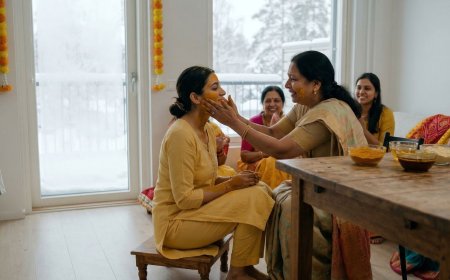
What physically happens is this: the bride or groom is seated on a low wooden paat (ceremonial seat) or on the floor on a clean white cloth, dressed in new clothes — traditionally yellow or a bright auspicious colour — surrounded by the women of their family. The Pithi paste — prepared fresh that morning by the women of the household, typically led by the bride's or groom's mother or the senior-most woman of the family — is applied to the face, neck, arms, and sometimes the feet of the bride or groom by each family member in turn, starting with the most senior.
The application is not perfunctory. Each family member takes a handful of paste and applies it with both hands, often while saying a prayer or a blessing or simply while holding the weight of everything they feel in that moment. Grandmothers apply it with hands that remember their own Pithi. Aunties apply it while telling stories. Cousins apply it while laughing. Small children apply it enthusiastically and imprecisely. The paste goes everywhere. This is correct. This is the point.
In many Gujarati families, the Pithi paste from the bride's ceremony is sent to the groom's home — and vice versa — so that both are anointed with paste that has touched the other. This exchange, simple as it sounds, is one of the most tender gestures in the entire wedding sequence: before they have seen each other on their wedding day, they have already touched each other through the paste. The turmeric travels between two homes and connects two people who are not yet married but are already, in some essential sense, becoming one.
The ceremony is accompanied by Pithi na geet — traditional Gujarati wedding songs sung by the women of the family, specific to this ritual, that are passed down through generations and sung from memory rather than from a screen. These songs — playful, emotional, full of the specific humour and love of Gujarati women celebrating their own — are as much a part of Pithi as the paste itself.
The ritual concludes with the family showering the bride or groom with akshata (turmeric-dusted rice) and flowers, and the groom or bride is typically kept at home after the Pithi — not to be seen by the spouse before the wedding — until the ceremony begins.
Community Comparison Table
| Community / State | Local Name | Key Tradition | How NRIs Abroad Adapt It |
|---|---|---|---|
| Gujarati (Hindu) | Pithi | Turmeric-sandalwood-besan paste; women of family apply; Pithi geet sung; separate ceremonies for bride and groom | Paste prepared fresh at home; diaspora city turmeric sourced from Indian stores; family singing preserved |
| Gujarati (Jain) | Pithi / Haldi | Similar to Hindu Pithi with Jain prayers; priest may offer blessing; strictly vegetarian context | Jain community elder or priest involved; ritual preserved fully in diaspora |
| Rajasthani | Haldi Ceremony | Turmeric paste applied by family; simultaneous at both homes; ubtan (herbal paste) used | Ubtan ingredients sourced from Indian stores; family gathering preserved |
| Punjabi | Haldi Ceremony | Turmeric paste applied; women sing specific Haldi songs; often boisterous and celebratory | Haldi songs played or sung; yellow outfits coordinated; large diaspora gatherings common |
| Marathi | Haldi | Turmeric paste applied by married women only (suvasinis); specific songs sung | Suvasini participation preserved; songs played from recordings if not remembered |
| Bengali | Gaye Holud | Elaborate two-day turmeric ceremony; both families celebrate separately and together; fish and sweets exchanged | Hilsa fish sourced from Bengali stores; ceremony preserved across two days if possible |
| Tamil | Nalungu | Turmeric and oil applied in playful ritual; games between families; bride and groom taunted affectionately | Games preserved; nalungu songs played; Tamil community celebration |
| Telugu | Nalugu | Turmeric paste applied; rice and flowers showered; separate ceremonies | Full ritual preserved; Telugu songs played; family gathering at home |
| Himachali | Ubtan Ceremony | Herbal paste including turmeric applied by female elders; mountain herbs traditionally included | Mountain herbs replaced with available alternatives; elder women's role preserved |
| Kashmiri Pandit | Liyun / Henna & Turmeric | Walnut oil and turmeric applied; specific Kashmiri songs sung; women-only gathering | Walnut oil sourced from specialty stores; women's gathering preserved |
| Malayalam (Hindu) | Eliyathe / Turmeric Ritual | Turmeric applied before wedding; coconut oil base rather than mustard oil | Coconut oil universally available; ritual adapted to home setting abroad |
The Meaning Behind the Ritual
To understand why turmeric — a root, a spice, a kitchen ingredient — holds the sacred position it does in Gujarati and broader Indian wedding culture, you need to step outside the modern understanding of food and ingredient and enter the Vedic understanding of dravya (substance as carrier of cosmic property).
In Ayurvedic philosophy, which underpins the spiritual logic of most Indian ritual practice, haldi (turmeric) is classified as a substance of extraordinary tridoshic balance — it harmonises all three of the body's fundamental energies (vata, pitta, and kapha), making it uniquely suited to moments of major transition when the body and spirit are in a state of heightened vulnerability and openness. The period immediately before a wedding is precisely such a moment — the individual is leaving one state of being (unmarried, belonging to the family of origin) and entering another (married, beginning a new family). The body at this threshold is considered by Vedic tradition to be both more open to blessing and more susceptible to negative influence. Turmeric applied to the skin creates a kavach (protective shield) while simultaneously shodhana (purifying) the body for the sacred acts ahead.
The chandan (sandalwood) in the Pithi paste adds the quality of shanti (peace and cooling) — sandalwood in Indian ritual tradition is the substance of divine calm, used to anoint deities and devotees alike at moments of sacred transition. The besan (chickpea flour) is both practical — it cleanses and exfoliates — and symbolic: chickpea is anna (sacred food, sustenance), and to be cleaned with food is to acknowledge that the body being prepared belongs to the cycle of nourishment and care.
The rose water is prem — love made liquid, fragrance made ritual. It does not need a deeper explanation. It is rose water.
Together, these substances create a paste that is simultaneously a beauty treatment, an Ayurvedic preparation, a spiritual purification, and a family blessing — all of which are, in the Gujarati understanding, the same thing.
For a non-Indian partner or family member seeking the simplest truth: the family is using the earth's most sacred substances to prepare their child for the most important day of their life, and every hand that applies the paste is a prayer.
Doing Pithi Abroad: The Practical Reality
Here is the truth about planning Pithi abroad that nobody tells you until three days before: the logistics are almost entirely manageable, the ingredients are entirely findable, and the one thing that cannot be sourced from any store — the women of your family gathered around you singing the songs your grandmother taught them — is the only thing that actually matters.
The Pithi paste ingredients are available in every major diaspora city without exception. Turmeric — and for Pithi you want the good quality, deep-coloured variety rather than the pale supermarket version — is available at Indian grocery stores everywhere. In London, the Indian grocery stores of Southall Broadway and Wembley carry high-quality turmeric in bulk. In Houston, Patel Brothers on Hillcroft and the stores along Harwin Drive are your first stops. In Toronto and Mississauga, the Indian grocery stores in Brampton and on Gerrard Street East carry several grades of turmeric — ask specifically for Rajapuri or Sangli turmeric if you want the variety closest to what is used in Gujarat. In Sydney, Harris Park in Parramatta. In Dubai, the Indian grocery stores in Meena Bazaar and Karama. Sandalwood paste is available at Indian puja supply stores in all of these areas. Chickpea flour, rose water, and coconut or mustard oil are universally available.
The paste preparation is an act that belongs to the senior women of the family and should not be delegated to a caterer or a beauty professional, no matter how convenient that might seem. The preparation of the Pithi paste is itself part of the ritual — the grandmother or mother measuring and mixing, the daughters and sisters crowding around, the discussion about whether there is enough chandan, the argument about the right consistency. This is not chaos. This is the ritual beginning before the ritual begins. Prepare the paste the morning of the Pithi ceremony in the family home or in the hotel suite where the family is staying, in a large bowl, and keep it covered with a clean cloth until the ceremony begins.
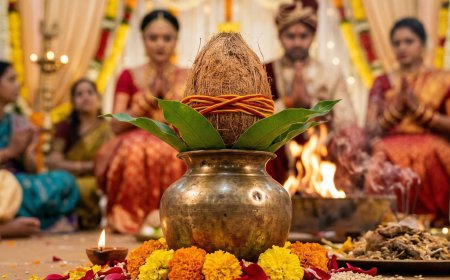
The venue for Pithi abroad is the family home — full stop, wherever possible. Pithi is not designed for a banquet hall or a hotel ballroom. It is designed for the kitchen table, the backyard, the living room floor. It is designed for the space where the family actually lives, where the photographs on the wall know the person being anointed, where the smell of the house is the smell of home. If a hotel room is the only option — because the family is visiting from another city or country — arrange the largest suite available, bring the family in, lay a white cloth on the floor, set up the brass puja lamp, and make the hotel suite the home for the morning. It works. Families do it every week in diaspora cities around the world. The paste does not know it is in a Marriott.
The Pithi geet — the traditional songs — are the element that most NRI families struggle with in diaspora settings, because the songs are oral tradition rather than written, and the generation that knew them by heart is shrinking. There are several solutions. The first and best is to ask the oldest woman in your family — your grandmother, your great-aunt, your naani — to sing even one verse of even one Pithi geet, and have someone record it. That recording will be played at every family Pithi for the next thirty years. The second solution is to search specifically for Gujarati Pithi geet or Haldi na geet on YouTube or music streaming platforms — there are recorded versions of traditional songs that many NRI families play during the ceremony when live singing is not possible. The third solution is to engage a Gujarati folk musician or singer through the Gujarati cultural associations in your city — many diaspora cities have Gujarati cultural organisations that can connect you with folk musicians who know the traditional songs.
The yellow outfit coordination that has become a hallmark of the NRI Pithi celebration is entirely optional from a ritual standpoint but deeply beloved from a community standpoint. If your family wants to coordinate yellow or orange outfits for the Pithi gathering — and most Gujarati NRI families do — brief guests at least three weeks before through the family WhatsApp group. A Pithi where everyone is wearing yellow and the turmeric paste is flying and the singing has started and the bride or groom is sitting in the middle of it all turning gold — this is the photograph that ends up in the most frames in the most living rooms.
Coordinating the Pithi with family in India by video call requires specific planning. If both the bride's Pithi and the groom's Pithi are happening simultaneously in different cities or countries, set up a shared video call that connects both households — so the bride's family in Toronto can see the groom's family in Ahmedabad applying the paste, and vice versa. This is not a logistics trick — it is the digital version of the traditional paste exchange, and it produces one of the most joyful moments of the entire wedding week.
Doing Pithi as a Destination Wedding in Gujarat
To have your Pithi in Gujarat — in the house your family has lived in for generations, in the courtyard where your grandmother had her own Pithi, with the morning light of a Gujarati dawn coming through the windows and the smell of fresh turmeric mixing with the smell of home — is to understand why the ritual was designed for exactly this setting.
The most resonant destination wedding locations for a full traditional Gujarati Pithi are the old family homes and heritage havelis of Ahmedabad's walled city, the pols (traditional neighbourhood clusters) of which have been the setting for Gujarati weddings for centuries. The Surat and Vadodara regions, with their strong Gujarati wedding traditions and established haveli properties, are equally meaningful. For couples who want the desert grandeur of Gujarat's landscape, the Rann of Kutch and the heritage properties of Bhuj offer a setting of extraordinary beauty.
For non-Indian guests attending a Pithi in Gujarat, the morning ceremony in a Gujarati home is one of the most accessible and immediately joyful Indian wedding rituals to witness — the laughter, the colour, the singing, the specific chaos of a family applying turmeric paste to someone they love creates an atmosphere that transcends any language barrier. Brief your international guests in advance but do not over-explain. Let the joy be its own introduction.
What You Need: The Pithi Ritual Checklist
Ritual Items High-quality haldi (turmeric — Rajapuri or Sangli variety preferred), besan (chickpea flour), chandan(sandalwood paste — available at Indian puja stores), gulab jal (rose water — available at Indian grocery stores), coconut oil or mustard oil (depending on family tradition), a large mixing bowl (brass or steel preferred), a clean white cloth for the bride or groom to sit upon, a low wooden paat (ceremonial seat — available at Indian furniture stores or can be a simple wooden stool), fresh marigold flowers for decoration, a nilavilakku or diya (oil lamp) to consecrate the space, akshata (turmeric-dusted rice) for showering at the end, and yellow and orange flower garlands for decoration.
People Required The senior-most woman of the family to prepare and apply the first paste (typically the grandmother or mother), all female relatives and close family friends for the application, a designated family member to lead or coordinate the Pithi geet singing, a family photographer or professional photographer briefed on the key moments, and a designated family member to manage the video call connection with the other household (bride's family connecting to groom's, or India family connecting to diaspora family).
Preparation Steps Source all paste ingredients at least one week before. Prepare the paste fresh the morning of the ceremony — do not prepare it the night before as turmeric paste loses its freshness and fragrance. Set up the ceremony space the morning of the Pithi with the white cloth, the paat, the oil lamp, and the flower decorations. Brief all attending family members on the singing and application sequence. Set up and test the video call connection with the corresponding household at least thirty minutes before the ceremony begins. Brief the photographer on the key moments — first application by grandmother, the paste exchange moment, and the final showering of akshata.
NRI.Wedding connects Gujarati couples abroad with verified Pithi ceremony coordinators, Indian grocery suppliers, Gujarati folk musicians, and wedding photographers experienced in capturing the full joy and colour of the Pithi ceremony. Begin planning at NRI.Wedding.
5 Questions NRI Couples Always Ask
Can we do Pithi at a hotel if nobody in our family has a home large enough for the gathering?
Absolutely, and many NRI families do exactly this. The key is to transform the hotel space into something that feels like a home rather than a function room. Book the largest suite available and arrange it the night before — lay the white cloth on the floor, set up the puja lamp and flower decorations, bring the brass bowl for the paste, and hang marigold garlands if possible. The hotel's housekeeping team will appreciate a conversation in advance about the turmeric — be transparent that some yellow staining of towels may occur and offer to pay for any replacements needed. Most hotels in diaspora cities with significant Indian communities are familiar with pre-wedding turmeric ceremonies and handle this gracefully. What makes a Pithi is not the ceiling above it but the people gathered beneath it.
My partner is not Indian and their family will be attending the Pithi. How do we include them meaningfully?
The Pithi is one of the most naturally inclusive Indian wedding rituals for non-Indian guests precisely because its language is physical rather than linguistic — everyone understands what it means to have the people who love you apply something golden and fragrant to your face while they are laughing and crying at the same time. Include your partner's family in the application queue — after the senior family members have applied the paste in the traditional order, invite the non-Indian family members to apply theirs. Brief them in advance on what to say or feel — or simply tell them: put your hands in the paste, put it on their face, say whatever you want to say. Whatever they say will be right. Then apply the paste to them in return — a reciprocal gesture that transforms witnesses into participants and participants into family. Many non-Indian in-laws later describe their Pithi application as the most unexpectedly moving moment of the entire wedding week.
How do we preserve the Pithi geet tradition when none of the younger generation knows the songs?
This is the most culturally urgent question in Gujarati NRI wedding planning and it deserves a direct answer. Begin before the wedding, not at it. Call the oldest woman in your family — your naani, your dadi, your great-aunt — and ask her to sing you the Pithi geet she remembers, and record it on your phone. Do this even if the recording is imperfect, even if she only remembers two verses, even if she says she has forgotten. She has not fully forgotten. The act of being asked will bring something back. That recording is now your family's archive. Share it with every cousin and sibling before the Pithi so that at least some of them can join in. If no one in the family remembers the songs, the Gujarati cultural associations in your city — particularly in Leicester, London, Toronto, and the San Francisco Bay Area — often have folk musicians and cultural educators who know the traditional Pithi geet and will come to your ceremony to lead the singing. This is worth every penny it costs.
We are planning the Pithi and the Mehendi on the same day to reduce the number of pre-wedding events. Is this acceptable?
It is done frequently in NRI weddings, particularly when guests are travelling from other cities and the wedding calendar needs to be compressed. The traditional preference is for Pithi and Mehendi to be separate events — Pithi in the morning (as a purification and family ritual) and Mehendi in the evening (as a celebration open to a wider circle of friends). If combining them, keep the Pithi portion as its own distinct moment at the beginning of the day — the intimate family gathering, the paste, the songs, the application — before transitioning to the larger, more social Mehendi event. The Pithi should not be absorbed into the Mehendi or treated as its opening act. It is its own complete ritual and deserves its own complete attention, even if that attention lasts only an hour.
We want to do the traditional paste exchange between the bride's and groom's households. How does this work when they are in different cities?
The paste exchange between households is a beautiful tradition and it is entirely possible across distances with a little planning. The simplest approach is for each family to prepare a small portion of their Pithi paste, place it in a sealed container, and courier or hand-carry it to the other family's household. Timing matters — the paste should be prepared fresh and transferred quickly so it retains its fragrance and texture. The more modern approach, which many NRI families have adopted with great warmth, is to do the paste exchange via video call — the bride's mother holds up her bowl of paste to the camera and the groom's mother holds up hers, and they describe the ingredients to each other, and the families watch and bless each other across the screen. It is not the same as the physical exchange. It is something different, and sometimes something more.
The Emotional Angle
There is a particular kind of Gujarati mother who does not allow herself to cry until the Pithi. She has been managing everything — the catering negotiations, the invitation list arguments, the flower supplier who suddenly doubled their prices, the relative from Ahmedabad who needs airport pickup at 4am. She has been the logistical spine of this entire wedding for six months and she has done it without visible emotion because the emotion, she has decided, is for later.
The Pithi is later.
She prepared the paste herself, this morning, in a bowl that has been in her kitchen since she arrived in this country twenty-five years ago. She used the turmeric her sister sent from Gujarat in the last suitcase of the last relative to visit, because the turmeric here is not quite right and she knew this day was coming and she planned for it. She mixed the besan with her hands the way her own mother mixed it. She added the rose water by smell rather than by measure because that is how you know it is right.
And now she is sitting beside her child — her child who was born in this country, who grew up in this country, who speaks Gujarati with an accent that makes the relatives smile — and she is applying the paste to their face with both hands, and she is saying something under her breath that is not quite a prayer and not quite a blessing and not quite a goodbye but contains all three.
Her child is turning gold under her hands. The colour of auspiciousness. The colour of everything she crossed oceans to give them. The colour of turmeric and sandalwood and rose water and twenty-five years of a mother's love in a country far from home.
She is crying now. She promised herself she would not cry until later. This is later.
A Moment to Smile
At a Gujarati wedding in Harrow, west London, in the summer of 2022, the Pithi was proceeding magnificently — the paste was the right consistency, the singing had started, the bride was turning a satisfying shade of gold — when the bride's four-year-old cousin, who had been given a small bowl of paste and told he could apply it, misunderstood the spatial boundaries of the assignment.
He did not apply it only to the bride.
He applied it to the bride. To the bride's mother. To the sofa. To his own face, comprehensively. To the family dog, who had entered the room at an inopportune moment and was now the most auspiciously yellow dog in west London.
The grandmother, who had been singing a Pithi geet with great feeling, stopped mid-verse. She looked at the dog. She looked at the boy. She looked at the sofa.
Then she handed him more paste.
"If you are going to do something," she said, in Gujarati, "do it properly."
The dog was bathed three times. The sofa recovered. The grandmother's Pithi geet was recorded on someone's phone during the second verse and has been played at every family function since.
Quotes from the Diaspora
"My mother brought the turmeric from Ahmedabad in her hand luggage. She said the turmeric in London is not the same. She is right. It is not the same. When she mixed the paste and I smelled it — that specific smell, the one from every Pithi I attended as a child — I was in Gujarat for a moment. Completely. Just for a moment. That is enough. That is everything."— Priya Patel, Gujarati Hindu community, London, UK
"My daughter-in-law is from Ireland. When it was her turn to receive the Pithi paste, she sat on the paat and put her hands in her lap and looked at me — really looked at me — and I thought: she is not performing this. She is receiving it. There is a difference. I applied the paste with both hands and I meant every word I said over it." — Bhanuben Shah, Gujarati Jain community, mother of the groom, Toronto, Canada
"We almost did not do the Pithi because we thought it would be too complicated in a hotel in New Jersey. Then my naani called from Surat and said four words: Pithi toh karvi j padse. The Pithi must happen. We did it in the hotel suite. My naani watched on video call from Surat and sang the entire first geet from memory. She is eighty-three years old. She did not miss a single word." — Nisha Desai, Gujarati Hindu community, New Jersey, USA
Your Roots Travel With You
Your mother brought the turmeric from Gujarat in her hand luggage because the turmeric here is not the same and she knew this day was coming and she planned for it. Your grandmother sang the Pithi geet from memory, all three verses, in a hotel suite in Harrow with marigold garlands hanging from the curtain rail and a brass bowl of paste on a white cloth on the floor.
And when the paste touched your face — when that specific, ancient, golden smell filled the room and your mother's hands were on your cheeks and the singing was around you and the people who have loved you your whole life were gathered in this small, imperfect, perfect space — you were not in a hotel in London. You were home. You were in every Pithi that every person in your family ever had, going back further than any of you can remember, and the turmeric was the same turmeric and the love was the same love and the yellow on your skin was the yellow of four thousand years of knowing exactly who you are.
NRI.Wedding is here for every golden moment of that journey — from connecting you with Gujarati folk musicians who know the Pithi geet to sourcing your ritual ingredients, from planning your pre-wedding ceremony timeline to finding photographers who know that the most important frame of any Gujarati wedding week is a grandmother's hands on a grandchild's face.
Your roots traveled with you. Today, they turned you gold.
This article explores Pithi, the sacred turmeric and oil pre-wedding ritual at the heart of Gujarati Hindu and Jain weddings, its Vedic and Ayurvedic origins, regional community variations, and complete practical guidance for Gujarati NRI couples planning Pithi ceremonies in the US, UK, Canada, UAE, and Australia — and as a destination wedding in Gujarat.
What's Your Reaction?
 Like
0
Like
0
 Dislike
0
Dislike
0
 Love
0
Love
0
 Funny
0
Funny
0
 Angry
0
Angry
0
 Sad
0
Sad
0
 Wow
0
Wow
0