








































































The Kalash as the Divine Vessel of Life: The Complete NRI Guide to India's Most Sacred Wedding Symbol
The kalash is not a decorative element of the Indian wedding. It is the ritual centre of every auspicious occasion in the Hindu tradition — the divine vessel of life, abundance, and the presence of the sacred. This complete guide explores the purna kalasha across its Vedic origins, Puranic mythology, regional traditions, and wedding ritual functions — from the mandap sthapana and the griha pravesh to the family heirloom kalash sent across the world in red cloth. For every NRI family planning a wedding abroad, this is the authoritative resource for understanding what the kalash carries, why it cannot be substituted, and how the tradition survives the crossing.

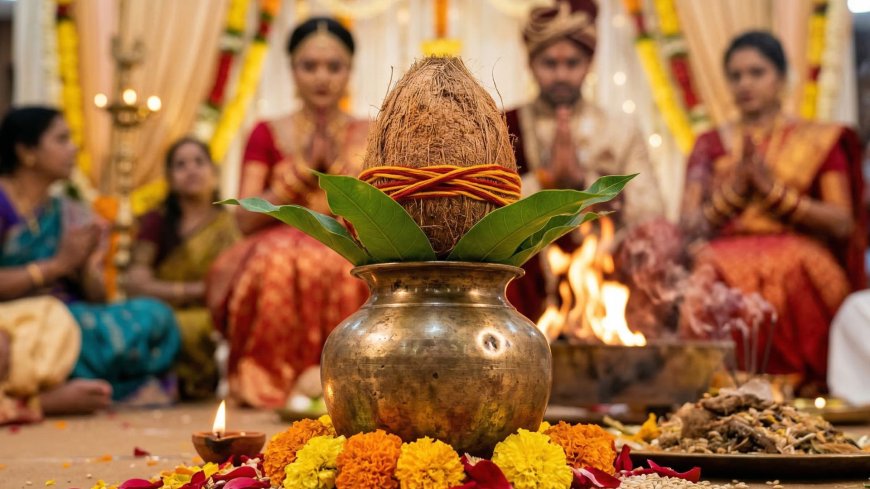
The Kalash as the Divine Vessel of Life
The package arrived on a Wednesday morning in Auckland, wrapped in brown paper and taped with the particular thoroughness of someone who has never entirely trusted the postal service. Priya knew, from the handwriting on the label — her mother's careful cursive, the letters slightly larger than necessary as though the importance of the contents had affected the size of the script — that it was something significant. She opened it at the kitchen table while her coffee brewed, peeling back the brown paper to find a layer of red cloth, and inside the red cloth, wrapped further in tissue that smelled faintly of the camphor that her mother kept in the puja room, a small brass kalash.
It was her grandmother's. She knew this before she unwrapped it fully — knew it from the specific weight of it, which she had felt once as a child when she had been allowed to hold it during a puja that she had been too young to understand but old enough to remember. The kalash was perhaps twenty centimetres tall, the brass worn to a particular warmth at the places where hands had held it most — the base, the widest point of the body, the rim. There was a small dent on one side, old enough to have been polished into the general patina of the piece rather than standing out as damage. The opening at the top was wide enough to hold the mango leaves and the coconut that the kalash required to be complete.
Her mother had written a note, tucked inside the red cloth. It said, in three lines: Your nani kept this for fifty years. I kept it for thirty. It is yours now. Use it at the wedding. Bring it home after.
Priya sat at the Auckland kitchen table for a long time with the kalash in her hands. She had been planning her wedding for four months — the venue in the Waitakere Ranges, the caterer, the priest who was flying from Wellington, the mehendi artist who was coming from Sydney. She had thought about most of the elements with varying degrees of attention and care. She had not, until this moment, understood that the element she had been thinking about least carefully was the one that her mother considered most important. That the wedding could happen without the perfect venue or the perfect caterer and still be a wedding. That the wedding without the kalash — her grandmother's kalash, the one that had been present at every significant rite in the family for eighty years — would be missing something that no amount of decoration could replace.
She called her mother that evening. She said: It arrived. It is beautiful. Her mother said: It is not beautiful. It is alive.And Priya understood, with the completeness that the right sentence in the right moment produces, that her mother was not speaking metaphorically.
This article is for Priya — and for every NRI family that has sent a brass vessel wrapped in red cloth across the world, understanding that the wedding cannot begin without it.
The Kalash in Indian Tradition: The Vessel That Is Not Empty
The kalash — also spelled kalasha, also called the purna kalasha, the mangal kalasha, the mangal ghata — is one of the most ancient and most pervasive sacred objects in the Indian religious tradition. It appears in the Rigveda, the oldest of the Vedic texts, as a vessel of abundance and of divine presence. It appears in the iconography of virtually every Hindu deity — held in the hand of Vishnu, at the base of Shiva's form, in the hands of the goddess in her many manifestations. It appears at the entrance to the temple, at the top of the temple's gopuram, at the beginning of every significant rite of passage, at the threshold of every new beginning that the tradition marks as sacred.
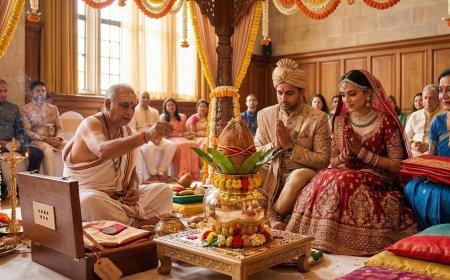
The kalash is, in its physical form, simple: a vessel — traditionally of gold, silver, or brass — with a wide base, a body that curves outward and then narrows at the neck, and an opening at the top into which specific items are placed to complete its ritual function. The items are precise: the vessel is filled with water or milk or both, mango leaves are placed around the rim with their tips pointing upward, and a coconut is placed on top of the mango leaves with its eyes facing a specific direction. In some traditions, a betel nut, coins, and specific grains are also added. A red thread is tied around the neck of the vessel. The whole, assembled with the correct intention and the correct ritual knowledge, constitutes the purna kalasha — the complete, full vessel — which is one of the most powerful auspicious symbols in the entire Hindu visual and ritual vocabulary.
The word purna means full, complete, whole — not merely full in the physical sense of containing liquid, but full in the metaphysical sense of containing everything that is necessary, of lacking nothing. The purna kalasha is the vessel of completeness — the form that represents the state of abundance and wholeness that every auspicious occasion is intended to invoke and to embody.
The Symbol and Its Layered Meanings
The kalash is one of those symbols whose meaning cannot be reduced to a single layer without falsifying the tradition that produced it. It carries, simultaneously, multiple registers of meaning that have accumulated over the millennia of its use and that interact with each other in ways that make the whole more than the sum of its parts.
The most immediate layer is the water. The kalash contains water — and in the Indian symbolic imagination, water is life, is purification, is the primordial substance from which existence emerges. The Vedic cosmology begins with the primordial waters. The great rivers of India — the Ganga, the Yamuna, the Saraswati, the Godavari, the Kaveri — are themselves sacred precisely because water is sacred. The kalash that holds water is holding the substance of life itself, the most fundamental and most necessary of the elements.
The second layer is the vessel as womb. The shape of the kalash — wide at the base, narrowing at the neck, with the opening at the top — is in the Sanskrit commentarial tradition described as analogous to the womb: the vessel that holds and nourishes life before it emerges into the world. The kalash in this reading is the body of the goddess, the material form of the feminine principle of creation. The water inside is the amniotic fluid of the cosmos. The coconut on top is the emerging consciousness, the point of contact between the enclosed sacred space and the external world.
The third layer is the presence of the deity. The purna kalasha, properly constituted, is understood in the ritual tradition not as a symbol of the deity but as the actual seat of the deity — the vessel into which the divine presence is invited to descend and reside during the ritual. This is the avaahana — the invocation — that transforms the physical object into the divine presence. The priest who performs the avaahana is not making a gesture. He is conducting a genuine transaction between the human and the divine, establishing the conditions under which the sacred can be present in the space of the ritual.
The Kalash in the Vedic and Puranic Traditions
The antiquity of the kalash in the Indian textual tradition is one of the most striking things about it — not merely that it appears in the Vedas, which would be significant enough, but that it appears in the Vedas with a familiarity that suggests it was already an established and understood symbol at the time the texts were composed. The Rigvedic reference to the vessel of the soma — the sacred ritual drink — as a kalasha is one of the earliest written references to the object, and the context makes clear that the vessel's sacred character was not being introduced but assumed.
The Puranic tradition elaborates the kalash mythology in the story of the samudra manthan — the churning of the cosmic ocean — in which the gods and the asuras use the cosmic serpent Vasuki as the churning rope and the mountain Meru as the churning staff to extract the amrita, the nectar of immortality, from the primordial waters. The amrita emerges in a vessel — a kalash — held by Dhanvantari, the divine physician, who rises from the churned ocean carrying the nectar that will confer immortality on the gods. This story places the kalash at the literal origin of the most precious substance in the cosmos — the vessel that holds the amrita is the kalash, and the kalash is therefore, in the deepest Puranic sense, the vessel of immortality and of life beyond death.
The connection to Dhanvantari — the deity of Ayurveda and of medicine — also establishes the kalash's relationship to healing, to health, and to the sustaining of life that is one of its central symbolic registers. The kalash is not only the vessel of the auspicious occasion. It is the vessel of the life-sustaining principle, the container of the substance that keeps existence going.
The Ashta Mangala: The Kalash Among the Eight Auspicious Symbols
In the Hindu, Jain, and Buddhist traditions of South and Southeast Asia, the kalash appears as one of the ashta mangala — the eight auspicious symbols whose presence marks an occasion or a space as sacred and blessed. The specific composition of the ashta mangala varies across traditions, but the kalash is among the most consistently included elements, appearing alongside the conch, the lotus, the swastika, the full vase, and other symbols whose antiquity reaches back to the pre-Vedic period.
The inclusion of the kalash in the ashta mangala is significant because it places it within a specific symbolic vocabulary of auspiciousness — the vocabulary that the tradition uses to mark the sacred from the ordinary, the blessed from the neutral, the ritually charged from the everyday. To place the kalash at the entrance to the wedding venue, at the threshold of the home being entered for the first time, at the beginning of the ritual sequence — is to use the most ancient and most trusted vocabulary of the tradition to say: this is a sacred moment, this space is charged with the presence of the auspicious, this occasion is under the protection and the blessing of the divine.
The Kalash at the Wedding: Every Function, Every Placement
The Indian wedding is the most significant and most ritually dense occasion in the Hindu life cycle, and the kalash appears at multiple points throughout the wedding sequence with a consistency that reflects its centrality to the tradition's understanding of what makes an occasion auspicious and complete.
The Entrance and the Threshold
The first appearance of the kalash at the wedding is typically at the entrance — the threshold of the wedding venue, the gate through which the guests and the family pass. This placement reflects the kalash's function as the marker of sacred space — the indicator that what lies beyond the threshold is not ordinary space but ritually transformed space, space that has been dedicated to the sacred occasion and that carries the blessings of the divine presence. The kalash at the entrance is not decoration. It is the announcement.
In the domestic tradition — the wedding that takes place in the family home or that has elements conducted at the family home — the kalash at the entrance has a specific relationship to the griha pravesh tradition, the ritual of entering the home, and to the understanding that the threshold is one of the most liminal and most significant spaces in the domestic architecture. The kalash at the threshold guards the transition, marks it as sacred, and ensures that what passes through it does so under the blessing of the auspicious.
The Mandap and the Ritual Centre
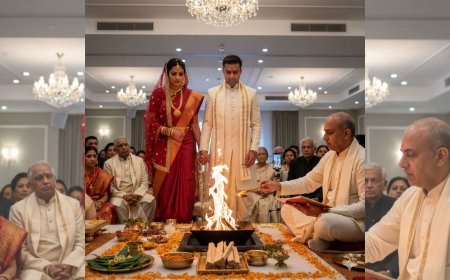
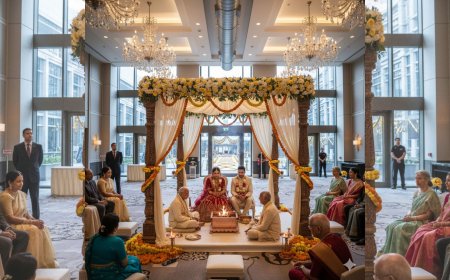
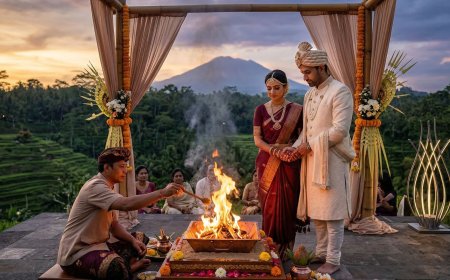
The most significant placement of the kalash at the wedding is within the mandap — the wedding canopy under which the central rites take place. The purna kalasha within the mandap is the seat of the deity, the presence that the ritual is conducted in the witness of. It is placed with specific attention to the directions — the cardinal directions having specific sacred associations in the Hindu cosmological framework — and it is the object that the priest addresses in the invocation, that the couple circumambulates as part of the ritual sequence, and that anchors the sacred geometry of the mandap as a whole.
The kalash within the mandap is not one element among many. It is the element around which the others are organised — the ritual centre of gravity that makes the mandap a sacred space rather than a decorated canopy.
The specific ritual that constitutes the purna kalasha sthapana — the establishment of the full vessel — is one of the most carefully observed moments of the wedding preparation. The priest oversees the filling of the vessel, the placement of the mango leaves, the positioning of the coconut, the tying of the red thread, and the invocation that transforms the physical object into the divine presence. The couple is present for this; in many traditions, the bride's mother or the couple's mothers participate in the sthapana, placing their hands on the vessel during the invocation in an act of physical participation in the establishment of the sacred.
The Griha Pravesh and the New Home
The kalash appears again at the griha pravesh — the ritual of entering the new home for the first time after the wedding. The bride enters the new home for the first time by overturning a vessel of rice with her right foot at the threshold — the auspicious beginning of her presence in the new home, the gesture of abundance and plenty with which she marks her arrival. In many traditions, she also carries or is accompanied by the purna kalasha, which is placed in the new home's puja space and which constitutes the beginning of the domestic sacred geography of the new household.
The kalash that moves from the wedding mandap to the new home's puja space is carrying the continuity between the wedding ritual and the domestic ritual — it is the vessel that has been present at the founding of the new family unit and that now takes its place in the ongoing domestic sacred life. In the families where a specific kalash has been used for generations — like the one that Priya's mother sent to Auckland wrapped in red cloth — this continuity is literal: the same vessel that was present at the grandmother's wedding and the mother's wedding is present at the daughter's wedding and will be present in her home.
The Regional Traditions of the Kalash
The kalash tradition, like almost everything in the Indian cultural landscape, manifests differently across the subcontinent's regional and community traditions, with each variation carrying its own specific practices and its own specific layers of meaning.
The North Indian Traditions
In the North Indian Hindu traditions — across Uttar Pradesh, Bihar, Rajasthan, Punjab, and the broader Hindi belt — the kalash is central to virtually every significant ritual, from the satyanarayan katha to the navratri puja to the wedding sequence. The Gangajal — the water of the Ganga — is the most auspicious filling for the kalash in these traditions, and the specific water used in the kalash at the wedding is often sourced from a pilgrimage site — the Ganga at Haridwar, the Yamuna at Mathura, or another sacred water source whose specific character adds to the power of the vessel.
The North Indian wedding kalash is often accompanied by a specific set of ritual objects — the five gems, the nine grains, the specific metals — that are placed within the vessel before the water is added. These additions reflect the kalash's function as the vessel of completeness, of the fullness that includes all the elements of the auspicious and the abundant.
The South Indian Traditions
In the Tamil, Telugu, Kannada, and Malayalam traditions, the kalash — often called the kumbha in the South Indian context — is equally central to the wedding ritual but takes specific forms that reflect the regional traditions. The Tamilian tradition uses the kumbha at the entrance to the wedding hall, at the mandap, and at specific moments of the wedding ritual sequence that are specific to the community's tradition.
The South Indian kalash is often made of silver in the families that can afford it, or of brass in the standard domestic tradition. The specific arrangement of the mango leaves — their number, their placement, their relationship to the coconut — follows community-specific conventions that the priest will know and that the NRI couple planning a South Indian wedding in Auckland or London must communicate to the priest with enough specificity to ensure that the tradition is observed correctly.
The Bengali and Eastern Indian Traditions
The Bengali tradition has its own specific kalash practices, most visibly in the Durga Puja tradition where the ghata — the Bengali term for the kalash — is the vessel into which the goddess is invoked at the beginning of the festival. The Durga Puja ghata is a sight of particular beauty — the brass vessel wrapped in red cloth, the mango leaves arranged with precision, the specific coconut whose eyes must face the correct direction — and it is managed by the tradition's specific practitioners with an attention to detail that reflects the understanding that the ghata is not a symbol of the goddess but the goddess herself, present in the vessel.
The Bengali wedding kalash tradition follows the same fundamental structure but with the specific regional and community variations that the priest of the relevant tradition will know and observe. The NRI couple from a Bengali family planning a wedding in Sydney must ensure that the priest they engage is familiar with the Bengali tradition specifically rather than with a generic Hindu wedding practice that may not observe the community's specific conventions.
The Coconut and the Mango Leaves: The Kalash's Companion Elements
The kalash is never complete without its companions — the mango leaves arranged around the rim and the coconut placed on top — and these elements carry their own specific symbolic significance that is worth understanding as part of the whole rather than treating as decorative accessories.
The mango leaves — typically five or seven or eleven, depending on the tradition, placed around the rim with their tips pointing upward — are among the most auspicious botanical elements in the Hindu ritual vocabulary. The mango tree is sacred across multiple Indian traditions, associated with Kamadeva, the deity of love, and with the broader symbolism of fertility, abundance, and the sweetness of life. The leaves at the rim of the kalash frame the opening — the point of contact between the sacred contents of the vessel and the external world — and create the specific visual form of the purna kalasha that is one of the most immediately recognisable sacred images in the Indian tradition.
The coconut placed on top of the mango leaves is, in the Hindu symbolic tradition, the equivalent of the head — the seat of consciousness and intelligence — placed on the body of the vessel. The coconut is one of the most sacred offerings in the Hindu tradition, described as the fruit that represents the complete human being — the outer husk representing the ego, the shell representing the mind, the white flesh representing the higher mind, and the water inside representing the atman, the individual soul. The coconut on the kalash places the complete human being — in symbolic form — in the position of the offering, the gift to the divine that is the fundamental gesture of the puja tradition.
Common Misunderstandings About the Kalash
The first misunderstanding is that the kalash is a decorative element of the Indian wedding — a traditional aesthetic choice that can be substituted, modified, or omitted without affecting the ritual validity of the wedding. This misunderstanding is understandable in the context of the contemporary wedding industry, which tends to treat every element of the wedding aesthetic as a design variable. The kalash is not a design variable. It is a ritual requirement whose presence or absence is not a matter of aesthetic preference but of the tradition's understanding of what constitutes a complete and auspicious occasion.
The second misunderstanding is that any vessel can serve as the kalash — that the tradition is flexible about the material and the form as long as the basic shape is approximated. The tradition has its own view on material — gold for the highest ritual purposes, silver for the next level, copper for the standard domestic ritual, brass as the widely used everyday option — and the NRI couple who substitutes a decorative vase from a homewares shop is not honoring the tradition. They are using a different object and calling it by the same name.
The third misunderstanding is that the kalash can be set up by anyone with a general understanding of the Hindu tradition and a template from the internet. The sthapana — the establishment of the kalash — is a ritual act that requires the specific knowledge and the specific intention of the trained priest. The invocation that transforms the physical vessel into the seat of the divine is a technical act of ritual practice, not a general awareness of its significance. The NRI couple who sets up the kalash without the priest's avaahana has a beautiful brass vessel with mango leaves and a coconut. They do not have the purna kalasha in its ritual sense.
The fourth misunderstanding is that the kalash's significance is purely symbolic — that it is a representation of the divine rather than, as the tradition understands it, the actual presence of the divine. The distinction matters because it affects how the kalash is handled, where it is placed, who may touch it, and what happens to it after the ritual is complete. The tradition's understanding is not that the kalash symbolises the presence of the divine. It is that the properly constituted kalash, with the avaahana performed, is the presence of the divine — the seat into which the deity has been invited to descend and in which the deity resides for the duration of the ritual.
The fifth misunderstanding is that the specific vessel — the family kalash, the one passed down through generations — is replaceable by any new vessel of the same form. Priya's mother understood something that this misunderstanding misses: that the object that has been used in ritual for eighty years, that has been present at the marriages and the births and the deaths and the festivals of three generations of a family, carries in its worn brass and its old patina a specific history that a new vessel cannot replicate. The tradition values both the correct form and the living continuity. The family kalash is the living continuity made material.
The Complete Reference Table: The Kalash Across Indian Traditions and Occasions
| Occasion / Context | Specific Name | Primary Material | Key Components | Ritual Function | Regional Variation |
|---|---|---|---|---|---|
| Wedding Mandap | Purna Kalasha | Brass or silver | Water, mango leaves, coconut, red thread | Seat of deity; ritual centre of mandap | Present across all Hindu regional traditions |
| Wedding Entrance | Mangal Kalasha | Brass | Water, mango leaves, coconut | Marker of sacred space; auspicious threshold | North and South Indian traditions |
| Griha Pravesh | Griha Kalasha | Brass or copper | Water, mango leaves, coconut | Foundation of domestic sacred space | Pan-Indian with regional variations |
| Durga Puja | Ghata | Brass | Water, mango leaves, coconut, specific ritual items | Seat of goddess during festival | Bengali and eastern Indian traditions |
| Satyanarayan Puja | Kalasha | Brass | Water, Gangajal, mango leaves, coconut | Ritual presence during puja | North Indian tradition primarily |
| Navratri | Navratri Kalasha | Brass or clay | Water, mango leaves, coconut, nine grains | Goddess invocation for nine nights | Pan-Indian with community variations |
| Ganesha Chaturthi | Puja Kalasha | Brass or copper | Water, mango leaves, coconut | Ritual preparation and invocation | Maharashtra and South India primarily |
| Griha Arambha | Foundation Kalasha | Copper | Water, specific grains, gems, metals | Auspicious beginning of construction | Pan-Indian Vastu tradition |
| Kumbhabhishekam | Kumbha | Gold or silver | Consecrated water, specific ritual items | Temple tower consecration | South Indian temple tradition |
| Samudra Manthan | Amrita Kalasha | Mythological | Amrita, nectar of immortality | Divine vessel of immortality | Puranic mythology; pan-Indian |
| Dhanvantari Worship | Dhanvantari Kalasha | Gold or brass | Medicinal waters, specific herbs | Ayurvedic healing invocation | Pan-Indian Dhanvantari tradition |
| Death Rites | Ritual Kalasha | Earthen or brass | Ritual water for purification | Purification and transition | Pan-Indian with community variations |
| Temple Gopuram | Architectural Kalasha | Stone or metal | Solid; architectural | Auspicious crown of sacred architecture | South Indian temple tradition primarily |
| Family Heirloom | Kula Kalasha | Brass, typically | Water, mango leaves, coconut | Continuity of family sacred tradition | Domestic tradition across communities |
The Kalash in the NRI Home: Continuity Across Distance
For the NRI family — the family that has left India and built its life in Auckland or Vancouver or Amsterdam — the kalash raises a specific question that the domestic tradition in India does not need to address: how does the continuity of the sacred object survive the crossing? How does the family puja room in the Auckland apartment maintain its relationship to the tradition of the family home in Coimbatore? How does the kalash that was used at the grandmother's wedding in 1974 get to the granddaughter's wedding in the Waitakere Ranges in 2024?
The answer, in the case of Priya's family, was the postal service and brown paper wrapping and red cloth and a note in three lines. This is not a trivial answer. The act of sending the family kalash — wrapping it in the cloth that is itself sacred in colour and in intention, trusting it to the postal infrastructure of the modern world, writing the note that transfers the custody of the object from one generation to the next — is itself a ritual act, even if it does not look like one. It is the tradition finding the form that the contemporary world provides for the transmission that the tradition requires.
The NRI family that has not inherited the family kalash — whose parents and grandparents did not send it, whose connection to the domestic puja tradition was broken by the migration in ways that the next generation is now trying to repair — is in a different position, and the question of how to establish the kalash tradition in the new home is one worth addressing with the same seriousness that the tradition itself demands. The answer is not to acquire an antique or to find the most elaborate vessel available. It is to find a priest who can properly constitute a new purna kalasha, who can perform the sthapana with the correct ritual knowledge, and who understands that the beginning of a new family's kalash tradition is as sacred as the continuation of an old one.
Priya Placed the Kalash in the Mandap
The priest had flown from Wellington. The mehendi artist had come from Sydney. The venue in the Waitakere Ranges was everything she had planned it to be — the native bush, the morning light, the specific quality of the New Zealand winter sky that the Indian wedding aesthetic had never before been asked to negotiate with and that negotiated, as it turned out, very well.
But the thing that her guests spoke about afterward — the thing that appeared in the photographs with a presence that she had not anticipated when she set it among the flowers and the marigolds and the diya — was the kalash. Her grandmother's kalash, worn to warmth at the base and the rim, the small dent on one side catching the morning light in the way that old brass catches light. The priest had performed the sthapana with the attention of someone for whom the act was not ceremonial but real, and the kalash in the mandap had been, from the moment the invocation was complete, something different from the vessel that had arrived in brown paper wrapping. It had been the centre of the ritual space — the thing around which everything else was organised, the object whose presence made the mandap not a canopy but a temple.
She had called her mother after the wedding. Her mother had asked: The kalash — was it present? Not whether the venue was beautiful or the food was good or whether the guests had enjoyed themselves. Whether the kalash was present. Priya had said: It was present. Her mother had said: Then the wedding was complete.
Understand that the kalash is not decoration before you treat it as decoration. Find the family vessel if the family has one, and if it needs to cross the world in brown paper wrapping, let it cross. Find the priest who knows the sthapana, not the one who will approximate it. Place the kalash in the mandap with the intention that the tradition requires, not the intention that the event schedule permits.
And when the avaahana is complete and the priest has spoken the invocation and the coconut is in place above the mango leaves and the red thread is tied at the neck of the vessel, understand that the wedding has begun — not when the guests arrive, not when the music starts, but in this moment, when the divine is present in the brass and the water and the leaves, and the family line that the vessel carries is continuous, and the grandmother in Coimbatore who said it was alive was, as she always was, entirely right.
Published by NRIWedding.com — The Premium Global Platform for Non-Resident Indians Planning Indian Weddings From Abroad.
What's Your Reaction?
 Like
0
Like
0
 Dislike
0
Dislike
0
 Love
0
Love
0
 Funny
0
Funny
0
 Angry
0
Angry
0
 Sad
0
Sad
0
 Wow
0
Wow
0