



























































A Same-Week Wedding Story: Short Engagement, Big Celebration — The Complete NRI Wedding Planning Guide
Meera found out on a Monday. Her grandmother in Coimbatore — eighty-one, significant cardiac deterioration, travel inadvisable — might not make it to a wedding in eighteen months. That evening Meera called Arjun. She said: I want to get married before anything changes. He said: how soon. She said: eight weeks. What followed was fifty-four days. Not a compromise ceremony. A full Tamil Brahmin wedding, seventy guests, a family courtyard, six friends from London, and a grandmother in the front row in the silk saree she had worn to her own daughter's wedding. This guide gives NRI couples the complete framework for planning a full Indian wedding on a compressed timeline — covering the non-negotiable identification, vendor sprint, family venue logistics, international guest management, and why the short engagement sometimes produces the truest wedding.


A Same-Week Wedding Story: Short Engagement, Big Celebration
Meera found out on a Monday. Not the wedding — she had known about the wedding for three years, in the way that people who are deeply in love and practically minded know these things without a formal question having been asked. She found out on a Monday that her grandmother, who was eighty-one and who lived in Coimbatore and who had been the fixed point around which the entire maternal side of her family orbited, had been given a diagnosis that changed the timeline of everything.
The diagnosis was not immediately terminal. It was the kind of diagnosis that the doctors described with the careful, qualified language of people who have learned not to make predictions — significant cardiac deterioration, limited mobility, the recommendation that stressful travel be avoided. Her grandmother was not dying on a schedule. But she was also, the family understood without anyone saying it directly, not going to be able to travel to London for a wedding in eighteen months. And a wedding in Coimbatore in eighteen months, given what the doctors had said about stress and travel and the unpredictability of cardiac conditions in octogenarians, was a wedding that carried a specific, unspoken risk: that the grandmother who had been asking about the wedding since Meera was twenty-four might not be there for it.
Meera called Arjun on the Monday evening. He was in his flat in Hackney, making dinner, and she was in her flat in Brixton, not making dinner, sitting on the floor with her back against the sofa in the specific posture of someone who has received news that requires processing before action. She told him what the doctors had said. He listened without interrupting. When she finished there was a pause and he said: what do you want to do.
She said: I want to get married before anything changes. He said: then let's do that. She said: I mean soon. He said: how soon. She said: eight weeks. There was a pause longer than the first one. Then he said: okay. Tell me what we need to do.
That was the conversation. Not careful, not planned, not the product of the spreadsheets and vendor research and budget workshops that the wedding planning industry designs its entire infrastructure around. It was a decision made on a Monday evening in September, driven not by impatience or impracticality but by love — the specific, directional love of wanting the people who matter most to witness something before the window closes.
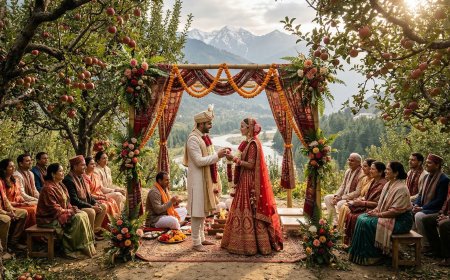
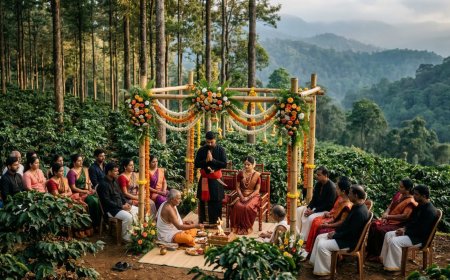
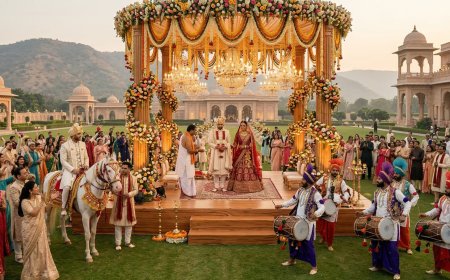
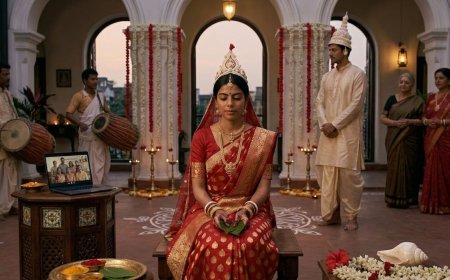
What followed was fifty-four days. Not the eighteen months that the wedding planning industry considers the minimum. Not the twelve months that the more optimistic guides describe as achievable with effort. Fifty-four days between the Monday evening conversation and the Saturday afternoon in Coimbatore when Meera and Arjun stood under the mandap that had been assembled in her grandmother's courtyard, with her grandmother in the front row in the silk saree she had worn to her own daughter's wedding thirty-seven years earlier, watching.
The grandmother was there. She was in the front row. She wept, which the doctors had also said was inadvisable, and which nobody tried to prevent.
This is the story of how fifty-four days became a wedding. Not a compromised wedding, not a placeholder ceremony to be followed by the real celebration later, not the stripped-down acknowledgment of logistical constraints that the wedding planning industry would have predicted given the timeline. A real wedding. A full wedding. A wedding that was, in the specific ways that matter most, exactly what Meera and Arjun had always wanted — partly because of the constraint and partly despite it, and partly for reasons that neither of them could have articulated before the fifty-four days began.
This guide is for every NRI couple who is facing a compressed timeline — whether from family health, visa circumstances, career timing, or the simple human decision that waiting is not the right choice — and who needs the complete, honest framework for planning a full Indian wedding in eight weeks or less.
Understanding the Short Engagement: Why It Happens and What It Means
The compressed wedding timeline is more common among NRI couples than the wedding planning industry's default assumptions suggest, and the reasons for it are more varied and more legitimate than the cultural shorthand of "rushed wedding" implies.
The Family Health Timeline
The most emotionally urgent form of compressed timeline is the one Meera and Arjun faced — the diagnosis, the prognosis, the window that is open now and may not be open in eighteen months. For NRI couples with elderly family members in India, this situation arises with a frequency that the diaspora experience makes structurally more likely. The grandparent in Chennai or Amritsar or Pune who would not be able to travel to London for a wedding might be able to attend a wedding in their own city if the wedding happens soon. The decision to bring the wedding to the family member, rather than waiting for the family member to come to the wedding, is an act of love that carries its own planning logic.
The Visa and Immigration Timeline
For NRI couples navigating visa applications, residency renewals, or immigration processes, the timing of a wedding can have direct legal and administrative implications. A wedding that happens before a specific visa deadline, or that supports a spousal visa application that needs to be filed within a particular window, is a wedding with a timeline set by bureaucratic reality rather than planning preference. The couple in this situation is not choosing a compressed timeline — they are working within the constraints of a system that does not accommodate the leisurely eighteen-month engagement.
The Career and Relocation Timeline
The NRI professional life is characterised by a mobility that creates its own wedding timing pressures. A job relocation to a new city or country, a contract that begins on a specific date, a professional certification that requires intensive preparation for the following year — any of these can create a window for the wedding that is shorter than the default planning timeline and that the couple chooses to use rather than defer the wedding indefinitely.
The Simple Decision
And sometimes the compressed timeline is simply the product of a decision — the recognition that waiting serves no purpose, that the relationship is ready, that the family is ready, and that the eighteen-month planning industry timeline is a commercial convenience rather than a genuine requirement. Some couples compress the timeline because they want to, and this is a legitimate and sufficient reason.
The Fifty-Four Day Framework: What Meera and Arjun Actually Did
The framework that made Meera and Arjun's fifty-four-day wedding possible was not luck, though luck played a role. It was a specific set of decisions, made in a specific order, that concentrated effort where it mattered most and released effort where it did not.
Day One to Five: The Foundation Decisions
The first five days were not about vendors. They were about the three decisions that everything else depended on: the location, the scale, and the non-negotiables.
The location decision was made in the first conversation. Coimbatore, where the grandmother lived, where Meera's mother's family had been for three generations, where the courtyard of the family house was large enough for a ceremony and where the family network would provide a logistical support infrastructure that no hired vendor team could replicate. The location was not chosen for its wedding infrastructure. It was chosen for its meaning. This choice had immediate practical implications — Coimbatore is not Chennai or Bangalore, the vendor ecosystem is smaller, the options at each vendor category are fewer — but the meaning of the choice outweighed the logistical constraints in a way that Meera never questioned.
The scale decision came next. Not five hundred guests. Not two hundred. The constraint of fifty-four days, combined with the constraint of a grandmother who should not be subjected to the managed chaos of a large Indian wedding, pointed clearly toward an intimate celebration. They decided on seventy guests. Seventy people who were specifically, individually important to Meera and Arjun — not the obligatory invitations, not the social reciprocity invitations, not the business associate invitations that inflate guest lists at longer-planned weddings. Seventy people who would understand, without explanation, why the wedding was happening on this timeline and in this place, and who would be honoured to be among them.
The non-negotiables were the third foundation decision. Every wedding has non-negotiables — the elements that are essential, that define the wedding's character, that cannot be compromised without the wedding becoming something other than what it is meant to be. For Meera, the non-negotiables were the ceremony in the grandmother's courtyard, the traditional Tamil Brahmin rituals conducted in full, and the specific silk saree that her mother had worn at her own wedding and which had been waiting in a box in the Coimbatore house for the occasion. For Arjun, the non-negotiables were the specific group of six friends from London who had to be there, a proper dinner that reflected the food culture of both families, and a photographer who could work with the light of a South Indian morning.
Everything else — the décor, the entertainment, the stationery, the favours, the reception structure — was secondary. Secondary did not mean unimportant. It meant that when a choice had to be made between a non-negotiable and a secondary element, the non-negotiable won without discussion.
Day Six to Fifteen: The Vendor Sprint
The vendor sprint — ten days of intensive research, outreach, and confirmation — was the operational centre of gravity of the entire planning process. In a fifty-four-day timeline, there is no room for the sequential vendor selection process that longer-planned weddings use. Every vendor category must be researched simultaneously, outreached simultaneously, and confirmed as quickly as the vendor's availability and the couple's judgment permit.
Meera's mother, who was in Coimbatore and who had been the first person Meera called after Arjun on the Monday evening, became the on-ground operational partner for the vendor sprint. She had the local knowledge — the caterer who had done her niece's wedding, the decorator who had transformed the community hall for a relative's sixtieth birthday, the priest who had the specific Iyengar tradition knowledge that the ceremony required. She had the relationships — the ability to call these people directly, explain the situation, and ask for their availability and their cooperation with a warmth and a social currency that no amount of money could replicate.
The photographer was the one vendor category where Meera refused to compromise on quality regardless of the timeline. She spent two full days of the vendor sprint — days seven and eight — on nothing but photographer research, going through portfolios, reading reviews, sending enquiries, and conducting video calls. The photographer she found was based in Chennai, not Coimbatore, and was willing to travel for the wedding. He had shot twelve weddings in the previous year. His portfolio showed a specific sensitivity to the light of South Indian morning ceremonies that was exactly what Meera had imagined. He was available. She confirmed him on day nine.
The caterer was confirmed on day eleven, through her mother's referral network. The priest was confirmed on day seven — the first call her mother made, because the ceremony date and time were dependent on the muhurat that the priest would calculate, and no other planning could be finalised until the muhurat was known. The decorator was confirmed on day twelve. The musician — a nadaswaram and tavil ensemble for the ceremony — was confirmed on day thirteen through a reference from the priest himself, who knew a family in Coimbatore whose son performed for weddings.
By day fifteen, every primary vendor was confirmed. Not all the details were resolved. Not all the contracts were signed. But the confirmed availability of the people who would make the wedding happen was established, and the planning could move from the sprint phase to the execution phase.
Day Sixteen to Thirty-Five: The Execution Architecture
The middle twenty days of the fifty-four-day timeline were the days of detail — the decisions within the confirmed framework that would determine the specific quality of the wedding experience.
The ceremony structure was detailed in days sixteen to twenty, in a series of conversations between Meera, her mother, Arjun, and the priest. The Tamil Brahmin wedding ceremony — the oonjal, the kashi yatra, the muhurtham, the saptapadi — has a specific ritual structure that the priest would conduct, and the detailing required was not the ritual itself but its physical staging: where the mandap would be positioned in the grandmother's courtyard to capture the morning light, how the seating would be arranged to ensure that the grandmother's view was unobstructed, what the flower arrangement would be on the mandap and who would be responsible for it.
The catering menu was detailed in days twenty-one to twenty-five. A South Indian wedding feast for seventy guests — the traditional menu of rice, sambar, rasam, kootu, poriyal, papad, pickle, payasam, and the specific regional specialties that Meera's family considered essential — was within the caterer's standard repertoire, and the detailing was less about the menu itself than about the service style, the banana leaf presentation that both families considered the only appropriate format for a traditional ceremony meal, and the accommodation of the six London guests whose palates had been softened by years of British Indian restaurant food and who might find the authentic heat of Coimbatore cooking challenging.
The accommodation for the London guests — Arjun's six friends and two of Meera's London colleagues who made the journey — was arranged through a combination of the family house, two rooms in a relative's house three streets away, and a small heritage hotel in Coimbatore's older quarter that had been recommended by Meera's cousin and that turned out to be one of the most charming accommodations any of the London guests had stayed in anywhere.
Day Thirty-Six to Fifty-Four: The Final Coordination
The final eighteen days of the fifty-four-day timeline were the days of confirmation, contingency, and the management of the specific intensity that all Indian weddings generate in their final approach.
Arjun flew to Coimbatore on day forty. Not for the wedding — it was still two weeks away — but because the planning had reached the stage where his physical presence in the location was more valuable than his remote participation. He and Meera were together for the first time since the Monday evening conversation, in the city where the wedding was going to happen, which was also the city where his future grandmother-in-law was waiting to meet him properly for the first time. She received him in the front room of the family house with the specific formality of a Tamil matriarch who has been anticipating this meeting for several years. She served him filter coffee. She asked him four questions about his family, his work, and his intentions. She appeared satisfied with the answers. This was, Meera said later, the most important event of the entire pre-wedding period.
The final week — day forty-eight to fifty-four — was the specific controlled chaos of the Indian wedding final stretch, compressed from the usual ten to fourteen days into seven. The mandap was assembled on day fifty-two. The flowers were delivered on the morning of day fifty-three, which was the mehendi evening — a small, intimate gathering of the women of both families and Meera's closest friends, in the grandmother's front room, with a mehendi artist whose work Meera had seen on a relative's hands at a family function three years earlier and whose number she had kept in her phone for exactly this purpose. The morning of day fifty-four was the wedding.
The Grandmother's Courtyard: What a Venue Without a Venue Team Looks Like
The decision to hold the wedding in the grandmother's courtyard rather than a formal venue was one of the most consequential decisions of the fifty-four-day planning process, and it shaped every other decision in ways that were sometimes constraining and more often liberating.
The Advantages of the Family Venue
A family venue — a house, a courtyard, an ancestral property — provides things that no commercial venue can. It provides meaning: the specific weight of a place that has held the family's important moments across generations. It provides flexibility: no venue coordinator setting rules about vendor access and noise curfews and furniture placement. It provides a social infrastructure: the extended family who will arrive three days before the wedding and who will, without being asked, take responsibility for the logistics that a hired event team would otherwise manage.
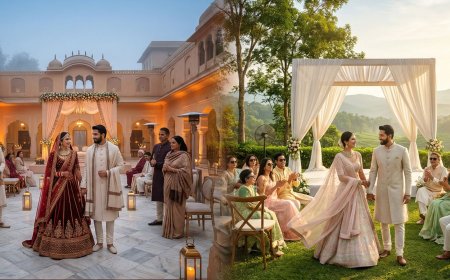
Meera's grandmother's courtyard had hosted three weddings before Meera's — her mother's, an aunt's, and a cousin's fifteen years ago. The courtyard knew how to be a wedding venue in the specific sense that places absorb the ceremonies they have held. The mandap went where the mandap had always gone. The seating arrangement was the arrangement that the courtyard's geometry naturally suggested. The morning light came from the east, over the compound wall, and fell exactly on the spot where the ceremony would take place, as it had for every other ceremony the courtyard had held.
The Challenges of the Family Venue
The family venue requires a logistical management that the commercial venue's professional team provides by default. The electricity supply must be assessed and supplemented if necessary — the mandap lighting, the catering equipment, and the sound system for the ceremony music together draw more power than a residential connection typically provides, and a generator must be arranged. The parking for seventy guests must be coordinated with the neighbours, which in Coimbatore's older residential quarters is a matter of community relationships rather than a parking facility contract.
The kitchen infrastructure of a residential house is not the kitchen infrastructure of a catering operation, and the caterer must either bring their own equipment — burners, vessels, service stations — or work within the constraints of what the house provides. Meera's caterer brought his own equipment, which he had done for residential weddings before and which he managed with a competence that suggested the residential venue was not an unusual context for a Coimbatore wedding caterer of his experience.
The London Guests: Managing International Attendance on a Compressed Timeline
The six London guests — Arjun's closest friends, the people he had known longest and who knew him best — received their invitations on day eight. Not printed invitations. WhatsApp messages, personal, specific, and direct. Not "we are getting married, save the date." But: we are getting married in seven weeks in Coimbatore, we want you there, we understand completely if the timeline makes it impossible, and we love you regardless.
The Flight and Logistics Reality
Seven weeks is at the outer edge of the window in which transatlantic and Europe-to-India flights can be booked at reasonable prices. At eight weeks, economy return fares between London and Coimbatore — routing through Chennai or Bangalore — were between four hundred and seven hundred pounds. By the time the London guests were booking, in days eight to twelve, some of those fares had moved. Three of the six friends found fares under five hundred pounds. Two found fares between five hundred and six hundred. One, who had a work commitment that prevented travel until two days before the wedding, paid close to eight hundred.
Meera and Arjun made a decision that they had not planned to make and that they do not regret: they contributed to the flight costs for the three guests for whom the combined flight and time cost represented a genuine financial strain. Not the full cost — the contribution was a gesture of acknowledgment rather than a subsidy — but enough to make the message clear: your presence matters enough that we want to remove the cost as a barrier. Two of the three guests declined the contribution. One accepted it with a grace that made the offer feel like the right thing to have made.
The Guest Experience Management
The London guests arrived in Coimbatore having never been to a Tamil Brahmin wedding. For three of the six, it was their first time in South India. For two, it was their first time in India at all. Arjun had anticipated this and had prepared, on the flight from London, a document that he shared with all six guests via WhatsApp before they landed — a specific, warmly written guide to what they would experience: the muhurat timing and why it mattered, the rituals they would witness and their meaning, the food they would eat and how to eat it, the appropriate dress, and the specific protocol for interacting with Meera's grandmother, who was the person whose presence at the wedding was the reason the wedding was happening on this timeline.
The document was two pages. It was not comprehensive. It was enough. The London guests arrived knowing what they were walking into, which meant that the ceremony itself could be received with understanding rather than confusion, and which meant that the photographs of Arjun's friends from their English secondary school and his years at UCL show six people who were present, genuinely present, in the way that only understanding enables.
The Ceremony: What Actually Happened on Day Fifty-Four
The muhurat was at seven forty-two in the morning. This is a time that Tamil Brahmin weddings have in common — the morning ceremony, the specific auspiciousness of the early hours, the light that the priest calculates as propitious and that the photographer knows as golden. By six in the morning the courtyard was already transformed. The mandap of fresh flowers — jasmine, marigold, banana flower — had been assembled the previous afternoon and had spent the night drawing in the cool Coimbatore air. The banana leaves for the ceremony meal were stacked in the kitchen. The nadaswaram player was warming up somewhere in the interior of the house.
Meera's grandmother was dressed and in her chair at six fifteen. She had woken before anyone else in the house. She had dressed without assistance, in the silk saree, in the jewellery that she wore only for occasions of significance, and she was sitting in her chair in the front room with her hands in her lap and her eyes bright and clear in the way that the diagnosis had not changed, when Meera came in to check on her at six twenty.
Meera stood in the doorway and looked at her grandmother and understood, with the specific clarity that important moments sometimes provide, that this was what the fifty-four days had been for. Not the mandap, not the photographer, not the London guests who were sleeping in the heritage hotel three streets away. This woman in this chair, in this saree, on this morning, was the reason.
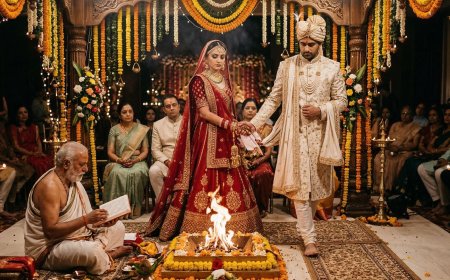
The ceremony lasted two and a half hours. The nadaswaram played throughout. The priest conducted the rituals with the unhurried deliberateness of a man who understood that the ceremony was not a performance for the guests but an act with its own integrity. Arjun cried during the saptapadi. Meera had not expected this and would not have predicted it, but looking at the photographs later she was glad it was in the record.
The grandmother was in the front row for all of it. She wept at the muhurtham. Nobody tried to prevent it.
What the Compressed Timeline Made Possible That Eighteen Months Would Not Have
This is the unexpected finding of the fifty-four days, and it deserves its own section because it contradicts the assumption that a compressed timeline produces a lesser wedding.
The compressed timeline eliminated every non-essential decision. There was no time for the extended deliberation over stationery options, décor concepts, entertainment acts, and favour designs that consumes a significant portion of longer-planned wedding energy. Every decision was made against the criterion of necessity: does this serve the wedding, or does it serve the planning? Most of the decisions that fill the spreadsheets of eighteen-month wedding plans fall into the second category. The compressed timeline made this visible in a way that the longer timeline obscures.
The compressed timeline concentrated the family. Because there was no time for the extended pre-wedding season of functions and parties that larger-planned weddings produce, every family member who came to Coimbatore came specifically for the wedding, and they were there for the wedding's entirety rather than distributed across a schedule of pre-events. The quality of family presence — the specific attention and emotional availability of people who are not managing a function schedule — was higher than any of them had experienced at a larger, longer-planned wedding.
The compressed timeline made the guest list honest. Seventy people, selected in five days, with the criterion of genuine importance rather than social obligation, produced a room on the wedding day that was filled entirely with people who specifically wanted to be there. There was not a single guest at Meera and Arjun's wedding who was there out of obligation. There was not a single guest whose presence was managed rather than welcomed. This is a rarer quality in Indian weddings than it should be, and it was a direct product of the constraint.
Common Mistakes NRI Couples Make Planning a Short-Engagement Wedding
The first mistake is trying to compress an eighteen-month plan into eight weeks rather than designing a new plan specifically for the compressed timeline. The couple who takes a standard wedding planning checklist and simply accelerates it will find themselves spending time and energy on decisions — stationery design, favour selection, entertainment booking — that the timeline does not permit to be done well and that the wedding does not require to be done at all. The compressed timeline requires a new plan, built around the non-negotiables and willing to release everything else.
The second mistake is not identifying the on-ground operational partner in the first twenty-four hours. The NRI couple planning a compressed-timeline wedding in India cannot manage the vendor sprint from abroad without a local partner who has the relationships, the local knowledge, and the availability to move at the speed the timeline requires. This partner — a parent, a senior family member, a trusted local friend, or a professional wedding planner with short-notice availability — is the most important resource in the entire planning process and must be identified and confirmed before any vendor outreach begins.
The third mistake is not communicating the timeline to guests with specificity and warmth in the first week. Guests who receive a compressed-timeline invitation deserve to understand, briefly and honestly, why the timeline is what it is. Not an extensive explanation — a sentence or two that conveys the reason and the importance. Guests who understand the reason will move mountains to attend. Guests who receive a compressed-timeline invitation without context will make their own assumptions, and those assumptions are often less generous than the reality.
The fourth mistake is not protecting the photographer booking above every other vendor decision. In a compressed timeline, every vendor category is constrained by availability, but the photographer is the vendor whose quality most directly determines the permanent record of the wedding. Compromising on the photographer because the timeline is short and the obvious candidates are unavailable produces a consequence that outlasts the planning stress by decades. The photographer search should begin in the first week, should be prioritised above every other vendor search, and should extend to the adjacent cities and markets if the local options do not meet the required standard.
The fifth mistake is treating the compressed timeline as a source of shame rather than a source of clarity. The short-engagement wedding is not a failure to plan properly. It is a decision to prioritise what matters most over what the wedding industry considers standard. Couples who internalise the shame framework spend their planning energy managing other people's perceptions rather than building the wedding that their specific circumstances require and deserve. The decision to marry in fifty-four days because the grandmother needs to be there is a decision that deserves to be made without apology and planned without compromise on the things that genuinely matter.
Meera's Grandmother, Three Months Later
Three months after the wedding, Meera's grandmother had a second cardiac event. It was managed at home, with the family around her, and she recovered to a degree that the doctors described with the same careful, qualified language as before — stable, for now, with the same recommendation about stressful travel and the same honest uncertainty about the longer timeline.
Meera called Arjun from the hospital waiting room, not because there was anything he needed to do but because he was the person she called when something important happened. He answered on the second ring. She told him what had happened and he listened without interrupting, the way he had listened on the Monday evening in September. When she finished he said: she was there. She said: she was there. He said: that's what we did it for.
It was. It was exactly what they had done it for.
Identify the non-negotiables in the first forty-eight hours and build everything around them. Find the on-ground operational partner before any vendor outreach begins. Start the photographer search on day one and protect it above everything else. Communicate the reason for the timeline to guests with warmth and honesty in the first week. Design a new plan for the compressed timeline rather than compressing the standard plan.
The window that is open now will not always be open. The wedding that happens in fifty-four days, built around the people and the moments that matter most, is not a lesser wedding. It is sometimes the truest one.
Published by NRIWedding.com — The Premium Global Platform for Non-Resident Indians Planning Indian Weddings From Abroad.
What's Your Reaction?
 Like
0
Like
0
 Dislike
0
Dislike
0
 Love
0
Love
0
 Funny
0
Funny
0
 Angry
0
Angry
0
 Sad
0
Sad
0
 Wow
0
Wow
0