








































Samode Palace — India's Most Intimate Frescoed Palace Wedding: The Complete NRI Guide — The Complete NRI Wedding Planning Guide
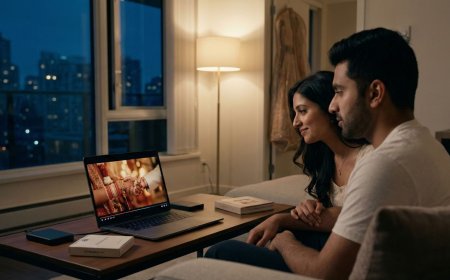
Neel found the photograph in the architecture section of a design magazine on a flight from London to Delhi that he had boarded thinking about something else entirely. The magazine had been in the seat pocket. He turned to a page that showed a single room in a palace he had never heard of — the Sheesh Mahal of Samode Palace, covered entirely in thousands of hand-cut mirrors set into intricate painted plasterwork, every surface from floor to ceiling luminous as though the room itself were the source of light rather than its recipient. He photographed the page and sent it to his fiancée Preethi in Singapore. She replied in four minutes: where is this? He replied: a place called Samode. I've never heard of it. She replied: find out if we can get married there. Fourteen months later, eighty-four guests arrived from nine countries to a five-hundred-year-old Rajput palace in the Aravalli foothills, forty-five kilometres from Jaipur, that most destination wedding planners had never put on their shortlists. This guide gives NRI couples the complete framework for marrying at Samode Palace — covering the full history, every event space with detailed pricing, the exclusive buyout case, the Jaipur connection, photography in fresco and mirror mosaic interiors, and the specific mistakes that separate the Samode wedding that is extraordinary from the one that merely takes place in an extraordinary building.


Samode Palace — India's Most Intimate Frescoed Palace Wedding: The Complete NRI Guide — The Complete NRI Wedding Planning Guide
Neel found the photograph in the architecture section of a design magazine he had never read before, on a flight from London to Delhi that he had boarded thinking about something else entirely. The magazine had been in the seat pocket. He had picked it up without intention. He had turned to a page that showed a room — a single room, in a palace he had never heard of, in a place he had never visited — and he had stopped turning pages.
The room was the Sheesh Mahal of Samode Palace, and it was covered, entirely, in mirrors. Not the flat, uniform mirrors of a decorator's installation, but the small, irregular, hand-cut mirrors of traditional Rajasthani mirror mosaic work — thousands of them, set into a ground of intricate painted plasterwork in the specific deep colours of Rajput palace decoration, covering every surface of the room from floor to ceiling in a composition of such density and such beauty that the overall effect was not reflective in the way a mirror is reflective but luminous, as though the room itself were the source of light rather than its recipient.
He photographed the page. He sent it to his fiancée Preethi, who was in Singapore. She replied in four minutes: where is this? He replied: a place called Samode. It's in Rajasthan. I've never heard of it. She replied: find out if we can get married there.
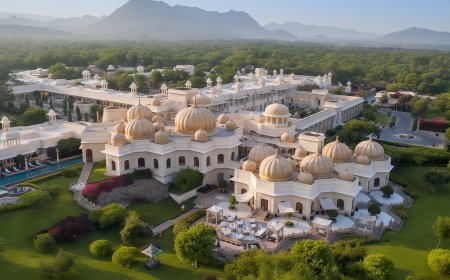
It took him the remainder of the flight to find the information he needed, and what he found was this: Samode Palace was a five-hundred-year-old Rajput palace in the village of Samode, approximately forty-five kilometres from Jaipur, in the Aravalli foothills. It had been owned and occupied by the Samode royal family — the Rawals of Samode — without interruption since its construction in the sixteenth century. It had been converted into a heritage hotel by the current generation of the family while remaining a family home, in the specific tradition of the living palace hotel where the history is not curated but inhabited. It had thirty-two rooms. It had four distinct palace buildings connected by courtyards and terraces, each decorated in the fresco and mirror mosaic tradition of the finest Rajput palace architecture. And it was not on the itinerary of most destination wedding planners, because most destination wedding planners pointed their NRI clients toward the more visible, more marketed venues of Jaipur, Udaipur, and Jodhpur.
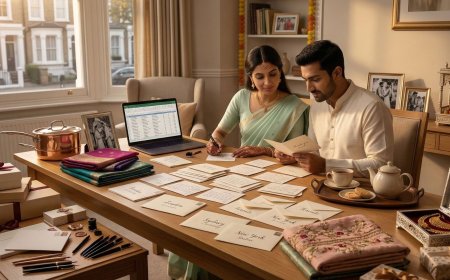
Preethi arrived in London three weeks later for a planning visit. They sat at the kitchen table and looked at every photograph they could find of Samode Palace. Then Preethi said: this is not the most famous palace in Rajasthan. Neel said: no. She said: it might be the most beautiful. He said: I think it might be. She said: let's find out if it is.
Fourteen months later, eighty-four guests arrived in the village of Samode from nine countries to find out with them.
This guide is for every NRI couple who wants the extraordinary rather than the expected — for Neel and Preethi and every couple who deserves the complete framework for the most intimate and most frescoed palace wedding in India.
Understanding Samode Palace: Five Centuries of Inhabited History
The difference between Samode Palace and the better-known destination wedding palaces of Rajasthan is not merely a matter of scale or fame. It is a matter of character — a specific quality that comes from five hundred years of continuous family habitation and that cannot be manufactured or replicated by any amount of restoration or renovation.
The palace was built in the sixteenth century by the ancestors of the current Samode royal family, who served as ministers and nobles in the Jaipur court and whose principal residence was this village in the Aravalli foothills. The construction and elaboration of the palace continued across multiple generations, each adding to the complex — another courtyard, another range of chambers, another sequence of painted rooms — in the specific incremental way that palaces grow when they are genuinely lived in rather than built as statements. The result is a palace that feels like what it is: a home that has been becoming more beautiful for five hundred years.
The frescoes and the mirror mosaic work that cover the palace's interior are the defining characteristic of the Samode aesthetic and the element that distinguishes it from every other wedding venue in India. The fresco tradition of Rajput palace decoration reached its peak in the nineteenth century, when the finest practitioners of the art were employed by the Rajput nobility to cover their palaces in the specific narrative and decorative vocabulary of the tradition — the courtly scenes, the mythological narratives, the floral and geometric borders, the portraits of the nobility in contemporary dress, all executed in mineral pigments on the wet plaster of newly constructed walls. The Samode frescoes are among the best preserved and most extensive examples of this tradition in any private palace in Rajasthan.
The Sheesh Mahal — the mirror palace — that stopped Neel on his London to Delhi flight is the most celebrated room in the complex, but it is far from the only extraordinary space. The Diwan-i-Khas, the hall of private audience, is covered in frescoes of courtly and mythological scenes of exceptional quality. The Diwan-i-Aam, the hall of public audience, is the grandest of the reception spaces, with painted arches and a formal geometry that makes it the natural choice for ceremonies and dinners. The private chambers of the upper palace retain their original decoration — the painted alcoves, the mirrored ceilings, the specific quality of a room that has been beautiful for two hundred years and knows it.
The palace is managed as a heritage hotel by Rawal Yaduvendra Singh and his family, who live in the palace complex and who are present during the hotel's operation in the way that the family members of a living palace are present — not as proprietors managing a business but as inhabitants sharing their home. This quality of inhabited grandeur is the most specific and the most unteachable quality of the Samode Palace experience, and it is the quality that most consistently appears in the accounts of guests who have stayed there or married there: the sense of being genuinely inside a family's home rather than inside a curated recreation of one.
Why Samode Is Specifically Right for the NRI Couple
The NRI couple planning a destination wedding in Rajasthan typically encounters the same shortlist of venues: the major palace hotels of Jaipur, the lake palaces of Udaipur, the blue city venues of Jodhpur. These are extraordinary venues, each with their own guide in this series. But the NRI couple for whom a guest list of sixty to one hundred people is the right size, who values intimacy over spectacle, who is drawn to the authentic over the marketed, and who wants their wedding to feel genuinely discovered rather than chosen from a catalog — that couple may find that Samode Palace offers something that none of the better-known venues can provide.
The intimacy is the first specific advantage. With thirty-two rooms and a maximum guest capacity that makes an exclusive buyout genuinely feasible for a wedding of sixty to one hundred guests, Samode Palace offers a quality of exclusive possession that the larger palace hotels cannot provide at any price. The couple who books Samode on an exclusive basis has the entire palace — all the frescoed chambers, all the terraced courtyards, the rooftop terrace with its view across the village and the Aravalli foothills, the private pool — as their own for the duration of the wedding. Not a shared property with non-wedding guests occupying adjacent rooms and adjacent spaces. Their own.
The authenticity is the second specific advantage. The frescoes at Samode are not reproductions or restorations in the sense of being recreated. They are the original work, maintained across two centuries by the family that commissioned them, touched up where necessary by craftsmen working in the same tradition as their predecessors. The mirror mosaic of the Sheesh Mahal is the mirror mosaic that was placed there by Rajput craftsmen two centuries ago. The sense of being inside something genuinely old and genuinely beautiful — not a reproduction of old beauty but the actual thing — is specific to Samode in the Rajasthan wedding venue landscape.
The discovery quality is the third specific advantage, and it is the one that matters most to the NRI couple whose guests are coming from London and Singapore and Toronto and Sydney. These are guests who have been to many weddings and who have seen many beautiful things. The guest who arrives at Samode Palace for the first time — who drives through the Aravalli foothills to the village of Samode, passes through the village, and sees the palace rising at the end of the road — experiences a specific quality of surprise and wonder that the more famous venues, however extraordinary, cannot produce in the same form because they are already known. The guest who has seen a thousand photographs of the Taj Lake Palace arrives at Udaipur with expectations. The guest who arrives at Samode arrives without them.
The Palace Architecture: A Room-by-Room Guide for the Wedding Couple
The Diwan-i-Aam: The Grand Ceremony Hall
The Diwan-i-Aam — the hall of public audience — is the largest and most formally configured indoor space in the palace complex. Its painted arches, formal axial geometry, and the specific quality of the natural light that enters through the arched openings on multiple sides make it the natural choice for ceremonies and formal dinners. The space accommodates up to one hundred and twenty guests for a seated event with a central ceremony structure, and up to one hundred and eighty for a standing reception.
The frescoes in the Diwan-i-Aam are among the most legible in the palace — the large scale of the space allowed the painters to work at a scale that makes the narrative content of the scenes clearly visible from across the room. The mythological scenes, the courtly processions, the formal floral borders that frame each painted panel — these are not background decoration at the scale of the Diwan-i-Aam. They are the architectural event, the thing the room is organised around and that every guest in it is aware of.
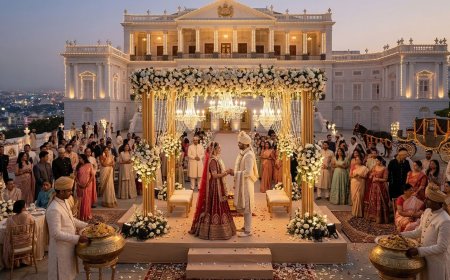
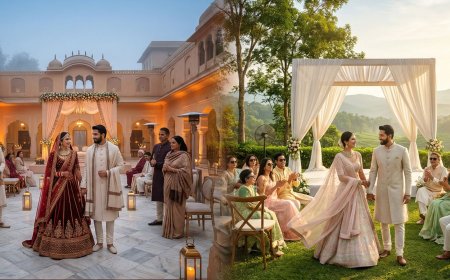
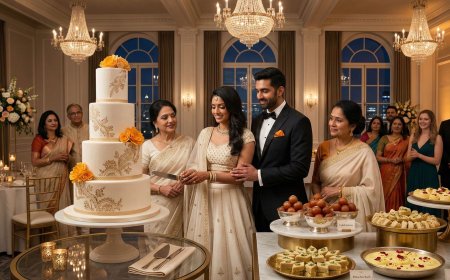
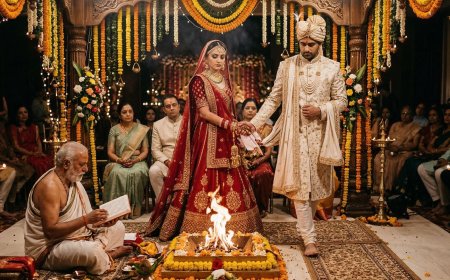
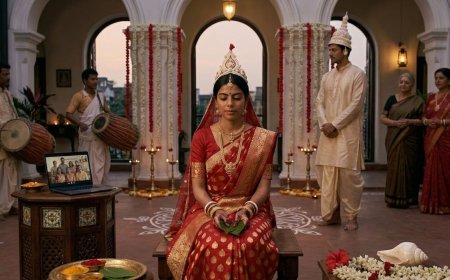
For the NRI couple whose ceremony will take place in this room, the mandap is positioned within the painted architecture rather than against it — the ceremony structure becoming part of the painted world rather than standing separate from it. The photographs from a ceremony in the Diwan-i-Aam, where the traditional Indian mandap and the traditional Rajput fresco are in the same frame, are among the most extraordinary wedding images produced at any venue in India.
The Sheesh Mahal: The Mirror Palace Cocktail Space
The Sheesh Mahal — the room that stopped Neel on his London to Delhi flight — is too intimate for large-seated events but perfect for the cocktail reception, the post-ceremony gathering, the small group experience that allows the room's extraordinary character to be fully felt rather than diluted by numbers. The space accommodates up to sixty guests standing and produces a quality of visual experience — the thousands of hand-cut mirrors reflecting candlelight from every surface — that is genuinely unlike anything else available at any wedding venue in India.
The specific quality of the Sheesh Mahal at candlelight is what every account of the space returns to. The mirrors, which in daylight produce a cool, fractured reflection of the room, in candlelight produce a warm, multiply-reflected glow that makes the entire surface of the room appear to be lit from within. The effect is, in the most literal sense, overwhelming — the space is so visually rich, so completely covered in reflecting light, that guests typically stop speaking when they enter it for the first time and stand for a moment simply experiencing it.
For the NRI couple who wants to give their guests a single moment of pure visual astonishment within the wedding program, the Sheesh Mahal cocktail reception is the instrument.
The Sultan Mahal Courtyard: The Outdoor Ceremony Space
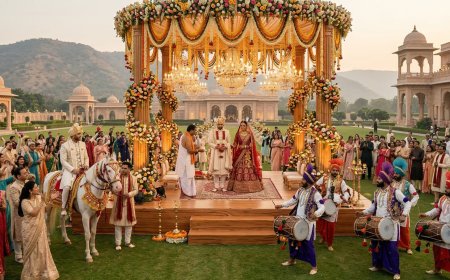
The Sultan Mahal Courtyard — a formal courtyard within the palace complex — is the primary outdoor ceremony space and the option for couples who want the open-air ceremony with the palace architecture as the enclosing frame. The courtyard is surrounded on three sides by the palace's painted facades, with carved marble screens and painted arched openings providing the architectural vocabulary, and the open sky above creating the specific quality of the outdoor-indoor space that characterises the finest Rajput architecture.
The courtyard accommodates up to one hundred and fifty guests for a seated ceremony and is at its most extraordinary in the morning and early afternoon hours, when the light enters from the open top and reflects off the painted plasterwork in the specific warm tones of the Rajasthani stone and pigment palette. The evening courtyard, lit by torches and lanterns against the painted walls, produces a different and equally extraordinary quality of light.
The Rooftop Terrace: The Sundowner and Intimate Dinner Space
The rooftop terrace of the palace is the space that most consistently appears in the accounts of Samode Palace guests as the place where they fully understood what they were inside. The view from the terrace — across the village of Samode, across the terraced fields of the Aravalli foothills, to the ridgeline of the hills themselves — is the view that has been available from this exact position for five hundred years, and the quality of time compressed into it is immediately legible.
The terrace accommodates up to eighty guests for a standing reception and up to fifty for a seated dinner. It is the natural setting for the sundowner event — the pre-dinner gathering at which guests arrive on the terrace as the sun descends behind the Aravalli hills and the sky performs its evening sequence. The view and the light together produce an experience that requires no additional decoration and no additional entertainment. The evening itself is the event.
The Garden and Pool Area: The Daytime Event Space
The palace's garden and pool area — a formal garden on the lower level of the complex with a pool surrounded by traditional Rajasthani plantings — provides the daytime event space that the interior and the rooftop terrace do not. The mehendi ceremony, the haldi, the morning welcome breakfast for arriving guests — these are the events that the garden and pool area is best suited for, and the combination of the palace's architecture visible above the garden and the specific quality of the Rajasthani garden planting creates a setting of considerable beauty for the less formal events of the wedding program.
Comprehensive Pricing and Planning Reference
| Event Space | Seated Capacity | Standing Capacity | Approximate Venue Hire Per Event | Best Suited For |
|---|---|---|---|---|
| Diwan-i-Aam (Grand Hall) | Up to 120 | Up to 180 | ₹5,00,000–₹10,00,000 | Ceremony, formal dinner, reception |
| Sheesh Mahal (Mirror Palace) | Up to 30 | Up to 60 | ₹3,00,000–₹6,00,000 | Cocktail reception, intimate gathering |
| Sultan Mahal Courtyard | Up to 150 | Up to 200 | ₹6,00,000–₹10,00,000 | Outdoor ceremony, evening reception |
| Rooftop Terrace | Up to 50 | Up to 80 | ₹3,00,000–₹5,00,000 | Sundowner, intimate dinner |
| Garden and Pool Area | Up to 80 | Up to 120 | ₹2,50,000–₹4,50,000 | Mehendi, haldi, daytime events |
| Full Palace Exclusive Buyout | All spaces combined | All spaces combined | ₹25,00,000–₹50,00,000 per day | Complete exclusive possession; recommended for all weddings |
| Budget Category | Approximate Range | Notes |
|---|---|---|
| Accommodation — Standard Heritage Room per night | ₹15,000–₹25,000 | Frescoed rooms; courtyard or garden facing |
| Accommodation — Deluxe Room per night | ₹22,000–₹35,000 | Enhanced decoration; superior position |
| Accommodation — Suite per night | ₹40,000–₹80,000 | Palace suites with original decoration |
| Accommodation — Full Palace Buyout (32 rooms, per night) | ₹6,00,000–₹10,00,000 | Exclusive possession; all rooms |
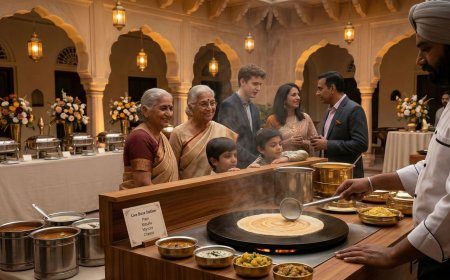
| Catering per cover — multi-course dinner | ₹3,500–₹6,000 | Traditional Rajasthani and contemporary Indian |
| Catering per cover — lunch or daytime event | ₹2,000–₹3,500 | Full service; al fresco options available |
| Décor and florals per event | ₹5,00,000–₹20,00,000 | Complement the frescoes; restraint advised |
| Photography and videography | ₹3,00,000–₹10,00,000 | Fresco-experienced photographers essential |
| Sound and lighting per event | ₹1,50,000–₹4,00,000 | Sensitive to historic surfaces; specialist required |
| Entertainment per event | ₹1,00,000–₹5,00,000 | Folk performers; classical musicians |
| Wedding planner fee | ₹5,00,000–₹12,00,000 | Samode-experienced planner strongly preferred |
| Transport — Jaipur to Samode per vehicle | ₹3,000–₹6,000 | 45 minutes; coordinate as group transfers |
| Total three-day wedding (80 guests, full buyout) | ₹80,00,000–₹1,50,00,000 | Inclusive of accommodation and catering |
| Total three-day wedding (100 guests, full buyout) | ₹1,00,00,000–₹2,00,00,000 | Full program; peak season premium applies |
The Jaipur Connection: Integrating the City Into the Wedding Program
Samode's location forty-five kilometres from Jaipur is one of its specific advantages for the NRI couple whose guests need the infrastructure of a major city — the international airport, the five-star hotel accommodation for overflow guests, the shopping and sightseeing that international guests appreciate in the days around a destination wedding — without the wedding itself taking place in the city.
The standard planning approach for a Samode Palace wedding is to use Jaipur as the arrival hub and the overflow accommodation base while keeping the wedding events at the palace. International guests fly into Jaipur's Sanganer Airport, which has direct flights from Dubai, Singapore, and other major hubs with significant Indian diaspora populations, as well as connections from Delhi and Mumbai. They are then transported to Samode for the wedding events, either staying at the palace on the full buyout arrangement or returning to Jaipur hotels for overnight accommodation.
The forty-five minute drive from Jaipur to Samode through the Aravalli foothills is itself a beautiful experience — the landscape changes from the city's urban density to the specific open, rocky terrain of the Aravallis, with the occasional fort or temple visible on the ridgelines and the village of Samode appearing at the end of the road with the palace above it. The drive is not a transfer to be managed but an experience to be designed. Coaches with commentary, convoy arrivals at sunset, the coordination of the group transport so that the first view of the palace is shared collectively rather than scattered across individual car arrivals — these are the planning details that transform a logistics solution into a guest experience.
For guests who want to spend additional days around the wedding exploring Rajasthan, Jaipur is one of the richest bases available. The Amber Fort, the Hawa Mahal, the City Palace of Jaipur, the textile and jewellery markets of the old city — the NRI couple who provides their international guests with a curated guide to Jaipur's best experiences is giving those guests the context to understand Rajasthan more fully and to appreciate the specific character of Samode Palace more deeply. The palace that is understood as the intimate, family-owned counterpart to Jaipur's more famous monuments is a more meaningful experience than the palace visited in isolation.
The Family Experience: What Makes Samode Different From a Hotel
The quality that most distinguishes Samode Palace from the larger palace hotel venues of Rajasthan is the quality that is hardest to describe in a planning guide but that every guest who has stayed there describes immediately: the sense of being in someone's home.
The Samode royal family's continued residence in the palace complex means that the palazzo is inhabited in the way that only continuous family occupation produces. The objects in the public rooms — the old photographs, the hunting trophies, the family portraits, the decorative objects accumulated across generations — are not installations or curatorial choices. They are the accumulated evidence of a family's life, present in the rooms because they have always been there, meaning what they mean because of the specific family history that brought them to this specific place.
Rawal Yaduvendra Singh and his family are known, among guests and wedding couples who have worked with them, for the specific quality of welcome that comes from genuine hospitality rather than professional service — the welcome of a family that is genuinely pleased to have guests in their home and that brings to the hosting relationship a personal investment that no amount of five-star training can replicate. For NRI couples who want their wedding to feel like it was held in a home rather than a hotel, the Samode family's presence is the most important element of the venue choice.
This quality is also relevant to the practical management of the wedding. The Samode management team's knowledge of the palace — every room, every surface, every operational detail — is the knowledge of people who have lived in and managed a complex building for generations, not the knowledge of a professional hotel management team that has been trained on a property. When the NRI couple's wedding planner needs to understand what is and is not possible within the palace's spaces, the conversation with the Samode management team is the conversation with the people who know the building most deeply. This produces a different quality of practical intelligence than most venue relationships provide.
Photography at Samode: The Fresco as the Frame
The photographic opportunity at Samode Palace is specific and extraordinary, and the NRI couple who has invested in exceptional photography will find that this venue rewards that investment more generously than almost any other.
The frescoes are the primary photographic element — not as backgrounds for portraits but as the context that gives the portraits their specific meaning. The couple standing in the Diwan-i-Aam with the painted mythological scenes behind them, the guests gathered in the Sheesh Mahal with the mirror mosaic reflecting them infinitely in every direction, the ceremony in the Sultan Mahal Courtyard with the painted arches framing the mandap — these are compositions that the venue provides rather than the photographer constructs. The photographer's role is to be in the right position to receive them.
The photographer for a Samode Palace wedding must have specific experience with fresco and mirror mosaic interiors. The exposure challenges of the Sheesh Mahal — a space that produces both very high and very low contrast within the same frame — require specific technical knowledge. The colour calibration required to accurately represent the mineral pigment palette of the Rajput fresco tradition requires post-processing skill that not all destination wedding photographers have developed. The morning light in the Sultan Mahal Courtyard, which changes character in fifteen-minute increments as the sun moves across the open sky above, requires the specific awareness of light quality that only a photographer who has worked in this space before fully possesses.
Ask prospective photographers not just for portfolio images from Samode but for a conversation about how they would approach the Sheesh Mahal technically. The answer to that question is the most reliable indicator of whether they have the specific knowledge the venue requires.
Common Mistakes NRI Couples Make With the Samode Palace Wedding
The first mistake is not doing the exclusive buyout. The Samode Palace wedding that shares the property with non-wedding guests is a diminished experience — not because non-wedding guests are intrusive but because the specific quality of inhabiting the palace as your own is the quality that the wedding is built around. At thirty-two rooms and a guest list of sixty to eighty, the exclusive buyout is affordable in the context of the overall wedding budget and is the single most important planning decision the Samode couple can make. Do not compromise on this.
The second mistake is over-decorating. The frescoes and the mirror mosaic work of Samode Palace are among the finest decorative achievements of the Rajput tradition. The decorator who covers them, competes with them, or installs elements that distract from them is not enhancing the venue — they are diminishing it. The Samode wedding décor must be designed around a single principle: every decorative choice should make the palace more visible, not less. Flowers in the colours of the fresco palette. Lighting that illuminates the painted surfaces rather than replacing them with event lighting. Structural elements — the mandap, the dinner table design — that work within the painted vocabulary rather than asserting a separate aesthetic.
The third mistake is not visiting before booking. Samode Palace is not visually comprehensible from photographs in the way that some venues are. The photographs can show the Sheesh Mahal and the frescoes and the courtyard, but they cannot convey the scale, the specific quality of the atmosphere, the inhabited quality of the palace, or the specific relationship between the spaces that makes the multi-day wedding program work. The site visit is essential and should be scheduled before any deposit is committed.
The fourth mistake is not using the village context. The village of Samode, which surrounds the palace, is a living Rajasthani village with its own temples, its own markets, its own daily rhythms that are as specific and as beautiful as the palace above it. The NRI couple who designs their wedding program to include the village — a morning walk through the bazaar, a visit to the local temple, a folk performance by village musicians in the palace courtyard — is giving their international guests an encounter with Rajasthan that no amount of palace interior can provide by itself. The village is not a backdrop. It is the world in which the palace has always been embedded, and engaging with it makes the palace experience more complete.
The fifth mistake is not telling the guests the story. Samode Palace is not famous in the way the Taj Lake Palace is famous. Most of the NRI couple's international guests will arrive without context — without knowing that the frescoes are five hundred years of accumulated royal patronage, that the mirror mosaic was placed by craftsmen who learned the technique in an unbroken line from its Rajput origins, that the family who welcomes them has inhabited these rooms without interruption since the palace was built. Give them the story. The guest who knows the story inhabits the palace more fully than the guest who merely sees it.
Neel and Preethi's eighty-four guests arrived at Samode Palace on a Friday afternoon in February, in a convoy of coaches from Jaipur airport that had been coordinated by their wedding planner to arrive simultaneously so that the first view of the palace — at the end of the village road, rising above the rooftops of the Aravalli foothills village — would be shared. The coaches stopped. Every window was filled with faces. Nobody said anything for a moment.
Then someone in the back of the third coach said, loudly enough to be heard across all three vehicles: where has this place been?
The answer, of course, is that it had been here. Five hundred years. Waiting for the couples who were looking for something other than the expected. The NRI couple who finds Samode Palace has found something that most people never find — not because it is hidden but because the obvious venues are so obviously extraordinary that most couples never look past them.
Do the exclusive buyout from the first planning conversation. Visit before you sign anything. Brief the decorator on the fresco principle. Appoint a photographer who has worked in mirror mosaic interiors specifically. Tell your guests the story before they arrive.
The palace will show them the rest. It has been showing people for five hundred years. It knows how.
Published by NRIWedding.com — The Premium Global Platform for Non-Resident Indians Planning Indian Weddings From Abroad.
What's Your Reaction?
 Like
0
Like
0
 Dislike
0
Dislike
0
 Love
0
Love
0
 Funny
0
Funny
0
 Angry
0
Angry
0
 Sad
0
Sad
0
 Wow
0
Wow
0