









































































What Ganesha's Story Actually Teaches NRI Couples About Starting Their Wedding Right — The Complete Guide
Planning an Indian wedding from abroad and wondering what the Ganesh Puja that opens every ceremony is actually trying to teach you — beyond the origin story and the elephant head? This complete NRI guide takes the seven practical teachings that Ganesha's origin story contains and translates them directly into the NRI couple's specific, distance-managed, cross-cultural, multi-family wedding context. Learn why the beginning is not the preparation for the important work but is itself the important work — and why the planning culture's tendency to rush the Ganesh Puja to reach the photography session has the tradition's foundational insight exactly backwards. Understand the destruction teaching — why the new creation that the marriage represents will necessarily encounter conflict with the existing order, why this conflict is not the sign that something has gone wrong but the proof that something genuinely new has been created, and why the restoration that follows the catastrophe produces something better suited for the continuing journey than the original creation was. Discover what the elephant head actually means for the marriage's daily practice — the accumulated memory of how the relationship has navigated its previous conflicts as the most valuable practical asset the couple carries into the ceremony. Learn the mouse-riding test that distinguishes the couple who is directing the planning mind from the couple the planning mind is directing, why the actual hand-made modak with jaggery and coconut is the practice of the marriage's most essential skill rather than a culinary detail, and why Ganesha as Vighnakarta — the creator of obstacles as well as their remover — reframes every planning difficulty the NRI couple has encountered as the lord of beginnings' specific testing of the couple's readiness. Understand how to give the muhurtham its non-negotiable status, prepare the assembled family with the origin story's practical teachings before the puja begins, brief the pandit on the philosophical teaching request rather than only the procedural one, establish the Ganesh Puja as the ongoing practice of every significant beginning in the married life, and convert the seven teachings into the specific, actionable pre-wedding preparation programme that the tradition has always intended them to produce. Understand the five specific mistakes that cause NRI couples to treat the Ganesh Puja as a procedural warm-up, receive the destruction teaching only after the first marital conflict rather than before it, confuse the modak's teaching with generic attentiveness, misread Vighnakarta's obstacles as protection failures, and complete the wedding puja without establishing the ongoing beginning-aware practice the tradition intends. This is the complete, philosophically grounded, practically translated, NRI-specifically applicable guidance that every couple who wants to start their wedding right deserves.

What Ganesha's Story Actually Teaches NRI Couples About Starting Their Wedding Right: The Complete Guide
The question came from an unexpected direction.
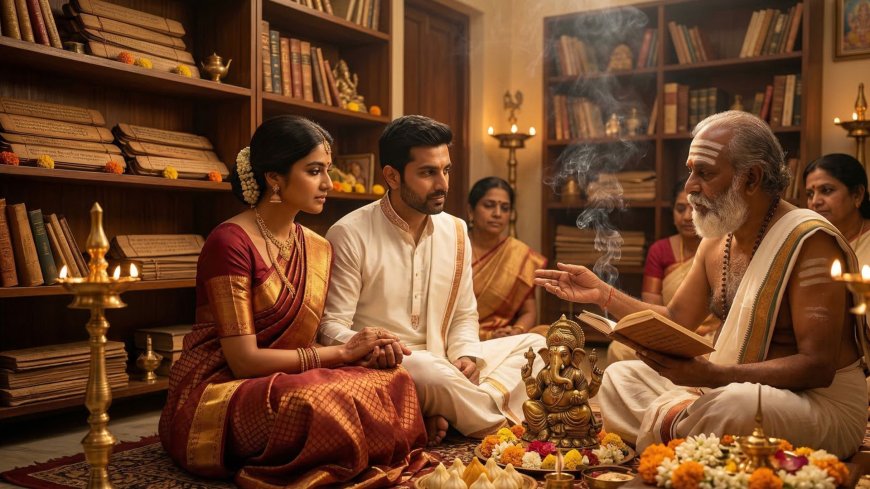
They had been sitting in the pandit's study in Chennai — Ananya and Vikram, in from London and Toronto respectively, both of them in the specific, slightly formal, this-is-an-important-conversation posture of people who have traveled to be here and who want to use the time well. The pandit was Pandit Krishnamurthy, seventy-one, a man whose scholarly depth and whose patience with the questions of diaspora couples his coordinator had specifically recommended him for.
They had spent forty minutes on the ceremony sequence. The muhurtham. The Ganesh Puja. The Saptapadi. The mangalsutra. All of it mapped, explained, documented in Ananya's notebook with the specific, comprehensive care of the person who has flown eleven hours to sit in this study and who is not leaving without the complete picture.
Then Vikram had asked the question that was not on the list.
"The Ganesh Puja is first," he said. "We know that. We have read about it. We have read about why Ganesha goes first — the origin story, the elephant head, the restoration." He paused. "But what I want to understand is what the story is actually teaching us. Not the mythology. The lesson. The practical lesson that the origin story contains for two people who are about to start something."
Pandit Krishnamurthy looked at him for a moment.
Then he smiled. Not the polite, this-is-a-good-question smile of the teacher performing encouragement. The genuine smile of the teacher who has been asked the question he most wants to answer.
"Most people," he said, "ask me what to do. You are asking me what it means. This is a different conversation."
He put down his pen.
"Let me tell you what Ganesha's story is actually teaching," he said. "Not the mythology. The lesson."
He talked for fifty minutes.
Ananya's notebook ran out of space. She started typing on her phone.
This guide is what Pandit Krishnamurthy said — extended, applied, and specifically translated into the NRI couple's context, for every couple who wants to start their wedding right and who deserves to understand, with full depth and full precision, what the tradition that starts with Ganesha is actually asking them to do.
The First Teaching — The Beginning Is the Most Important Moment
Pandit Krishnamurthy's first statement was the one that reoriented everything that followed.
"We invoke Ganesha first," he said, "because the tradition understands something that modern planning culture has forgotten: the beginning is not the preparation for the important thing. The beginning is the important thing. The first action, the first intention, the first orientation of the occasion — these determine everything that follows, not because the cosmos is mechanically programmed to respond to them, but because the human being is. How you begin shapes what you do. What you do shapes what you create. The beginning is not the warm-up. The beginning is the act."
This teaching — deceptively simple in its statement, radical in its implication — is the foundational principle behind every element of the wedding's opening rituals, and it is the principle that the NRI couple most consistently undervalues in the planning process.
The planning culture of the contemporary NRI wedding treats the beginning as the problem to be solved before the main event: the Ganesh Puja is completed, the muhurtham is observed, the sacred fire is lit, and now the real business of the day can begin. This framing inverts the tradition's understanding entirely. In the tradition's framework, the Ganesh Puja is not the problem before the main event. It is the main event's foundation — the specific, conscious, intention-setting act that determines the quality of everything built upon it.
The NRI couple who rushes through the Ganesh Puja to get to the photography session has not understood this teaching. The couple who gives the Ganesh Puja the full attention, the full presence, the full quality of conscious beginning that the tradition prescribes — who arrives at the Ganesh Puja having read the origin story, having understood what is being invoked, having prepared the offering and confirmed the muhurtham and gathered the family — is beginning differently. The difference is not visible in the ceremony's exterior. It is entirely in the interior quality of the act. And the interior quality of the act is precisely what the tradition is designed to protect.
For the NRI couple managing a wedding from London and Toronto, the beginning teaching has a specific practical implication: the planning that goes into the first moments of the ceremony — the muhurtham confirmation, the Ganesh Puja preparation, the family gathering in the correct hour — deserves at least as much planning attention as the vendor coordination and the programme logistics. The beginning is the most important moment. Plan it as if it is.
The Second Teaching — Destruction Is Part of Creation
The specific sequence of Ganesha's origin story — the creation, the catastrophe, the destruction, the restoration — is not a narrative arc that happens to have ended well. It is the tradition's deliberate, structurally essential teaching about the relationship between creation and destruction, and its application to the couple beginning a marriage is more direct and more practical than the mythological framing suggests.
Parvati created Ganesha from her own body. He was created completely, animated fully, given his duty, and performed it faithfully. Then he was destroyed. Not because he had failed. Because the situation contained a conflict — the new creation's faithful performance of its duty came into direct, unavoidable conflict with the established order. The result was destruction.
Pandit Krishnamurthy's reading of this sequence was specific: "The origin story is not the story of a mistake that was made. It is the story of what creation necessarily involves. When you create something genuinely new — a marriage, a family, a shared life — the new creation will necessarily come into conflict with the existing order. Parvati's act of creation created a being who, by faithfully performing his duty, blocked the lord of the universe. This was not a failure of the creation. This was the creation working exactly as it was designed to work."
The teaching for the couple beginning a marriage is this: the marriage is a new creation. It will necessarily come into conflict with elements of the existing order — the existing family dynamics, the existing individual identities, the existing social structures within which both people have been living. This conflict is not the sign that something has gone wrong. It is the sign that something genuinely new has been created. The faithfully-performing new creation encounters the resistance of the established order. This is what creation does.
The question the origin story answers is not whether the conflict will come — it will — but how it will be navigated. Shiva's initial response was force: the armies, the battle, the beheading. It resolved nothing and created the greatest possible catastrophe. The resolution came not through force but through the cosmic acknowledgement of what the creation was, what it had faithfully done, and what the appropriate response to a faithful creation's conflict with the existing order actually was.
For the NRI couple whose marriage is creating a genuinely new thing — a new family, a new cross-cultural unit, a new set of relationships that has never existed before — the Ganesha teaching is the most practically relevant piece of wisdom in the entire wedding's philosophical programme. The new thing you are creating will encounter resistance. The resistance is not the problem. The resistance is the proof that you have created something real. The question is how you navigate it — with the wisdom that honours the creation's faithfulness, or with the force that destroys before restoring.
The Third Teaching — The Catastrophe Is Not the End
The specific moment in the origin story when Ganesha's head is severed — when the creation that has been faithfully performing its duty is destroyed — is the mythology's most direct and most uncomfortable teaching about what creation involves, and its most important lesson for the NRI couple.
The head is severed. This is not metaphor. This is the tradition's specific, unflinching, looked-at-directly acknowledgment that the new creation, in the course of its faithful performance, will sometimes be completely destroyed. Not damaged, not impaired, not set back — destroyed. The thing that was created is gone. The catastrophe is real.
And then comes the teaching's core: the catastrophe is not the end.
Pandit Krishnamurthy's treatment of this moment was the most specifically applicable part of the entire conversation: "The couple who begins a marriage believing that the beginning's energy will sustain indefinitely, that the sacred fire's warmth will never be interrupted, that the new creation's beauty will never encounter the moment of destruction — this couple has not been told the true story. The true story includes the severing. The true story includes the moment when the thing you created, the specific, faithfully-performing, genuinely-new thing that the marriage is, is destroyed by the conflict with the existing order. This will happen. Not perhaps. It will happen. The tradition is not hiding this from you. It is putting it in the first ritual so that you will know, from the wedding's first moment, that the restoration is possible."
The elephant head is the restoration. Not the return to what was — Ganesha after the restoration is not the same as Ganesha before. He is different: he has the elephant's wisdom, the elephant's memory, the elephant's specific, enormous, particular quality of the being who carries the weight of knowing. The restoration produces someone better suited for the role of the lord of beginnings than the original creation was — someone who has been through the complete cycle and who therefore knows what beginning actually costs.
For the NRI couple, the third teaching is the most specifically important teaching about the marriage's life rather than the wedding's day: the marriage that you begin today will include its catastrophes. The tradition is telling you this. Not to discourage you — to prepare you. The preparation is the knowledge that the catastrophe is not the end. The restoration is possible. The restoration produces something better suited for the continuing journey than the original creation was. The couple who knows this, who has been told this, who has received this teaching at the first ritual of the wedding, is the couple who will not mistake the catastrophe for the conclusion.
The Fourth Teaching — What the Elephant Head Actually Means for Your Marriage
The fourth teaching emerges from the specific, chosen quality of Ganesha's restoration — the fact that Shiva did not simply restore the original head. He sent his Ganas north, in the direction of auspiciousness, with the instruction to bring back the head of the first being whose head was facing north. The first being was an elephant.
Why an elephant?
Pandit Krishnamurthy's answer was specific: "The elephant is the animal of memory. The elephant never forgets. This is not a pleasant metaphor — it is a crucial quality for the lord of beginnings. The being who is charged with governing all beginnings must have the memory of all the beginnings that have come before, including the catastrophic ones. The elephant's memory is the lord of beginnings' primary qualification. You do not want a lord of beginnings who has forgotten what happened to the previous beginning. You want the lord who carries every beginning in the memory of the previous ones."
The elephant's wisdom — the specific, accumulated, memory-constituted wisdom of the being who has not forgotten — is the quality that every NRI couple's marriage most directly requires, and the quality that the planning culture of the contemporary wedding most consistently undervalues.
The elephant's memory for the marriage means: the couple who remembers what worked in the difficult periods, who carries the specific, accumulated knowledge of how this relationship has navigated its previous conflicts, who does not require each new difficulty to be solved from first principles because the memory of the previous resolution is available — this couple has the elephant's wisdom. The couple who has forgotten the resolution of the previous conflict, who approaches each new difficulty as if it is the first, who has not accumulated the specific, relational memory that the elephant's head represents — this couple is missing the most important practical tool that the marriage requires.
The broken tusk — the specific sacrifice of the ivory that Ganesha made to continue the Mahabharata's transcription — extends this teaching: the memory is valuable enough to sacrifice for. The knowledge is worth the cost of what its preservation requires. For the NRI couple, the broken tusk is the specific acknowledgment that maintaining the marriage's memory — the deliberate, active, this-is-worth-the-effort practice of remembering how the relationship has navigated its difficulties — requires sacrifice. The time spent in the conversation that revisits the resolution of the previous conflict. The willingness to engage with the history rather than moving past it. The broken tusk says: this is worth the ivory.
The Fifth Teaching — The Mouse Must Be Ridden, Not Suppressed
The mouse — Ganesha's vehicle, the scurrying, perpetually-active, never-still representation of the human mind — is the origin story's final practical teaching, and for the NRI couple managing a wedding from a distance across multiple time zones, it is the teaching with the most immediate daily application.
The planning mind is the mouse. The spreadsheet, the vendor comparison, the timeline, the budget tracking, the fifteen-tab Google Sheet — all of this is the mouse's activity: useful, necessary, energetic, perpetually in motion, always finding the next thing to track and the next decision to document. The planning mind is not wrong. The planning mind is, for the NRI couple managing the complexity of a multi-country, multi-vendor, multi-family destination wedding, absolutely essential.
The teaching is not that the planning mind should be suppressed. The mouse is not killed. The mouse is ridden. The wisdom sits atop the planning mind and directs it — toward the beginning, toward the meaning, toward the questions that the planning cannot answer. The wedding coordinator's excellence, the vendor's quality, the programme's detail — these are the mouse's domain. The understanding of what the ceremony is doing, the preparation for the beginning, the conscious, meaning-filled engagement with the tradition's offering — these are the wisdom's domain. The wisdom must ride the mouse. The mouse must not ride the wisdom.
Pandit Krishnamurthy had said, with the specific, gentle directness of the teacher who has seen many couples: "When I meet the NRI couple, I can tell within ten minutes whether the mouse is riding them or whether they are riding the mouse. The couple who begins our meeting by telling me the programme schedule is the couple whose mouse is riding them. The couple who begins our meeting by asking what the ceremony means is the couple who is riding the mouse. Both couples will have the ceremony. Only one of them will be present for it."
The NRI couple who has read this guide, who has spent time in the philosophical preparation that the pandit recommended, who has had the conversations about meaning rather than only the conversations about logistics — this couple is riding the mouse. The planning is happening. The vendors are engaged. The programme is documented. And the wisdom is directing all of it toward the beginning that the beginning is actually for.
The Sixth Teaching — The First Offering Changes the Relationship
The modak — the sweet offered to Ganesha at the Ganesh Puja — is the origin story's most specific and most practically applicable teaching about the relationship between the human and the sacred, and it is the teaching that the NRI couple most consistently misses because its significance appears to be merely culinary.
The modak is Ganesha's preferred food. This is not incidental. The tradition's specific designation of the offering — not any sweet, but this specific sweet, the jaggery and coconut inside the rice flour shell, the specific form and the specific ingredients of the Ganesha offering — is the tradition's teaching about the relationship between the giver and the receiver: the offering that is most welcome is the offering that is specific to the recipient rather than convenient to the giver.
Pandit Krishnamurthy's treatment of this was precise: "The modak teaches the couple something about every relationship they will maintain in the marriage. The offering that works — the gesture, the act of giving, the specific attention you bring to another person — is the offering that is specific to the recipient. Not the generic gift. Not the convenient gesture. The specific thing that this specific person most wants, offered because you have paid enough attention to know what that is."
The NRI couple who prepares the actual traditional modak — the hand-made, jaggery-and-coconut, this-is-what-Ganesha-prefers modak — is practicing the marriage's most essential skill: the specific attentiveness to the specific person's specific preference, expressed in the most direct possible form. The couple who places the decorative modak on the silver plate for photographs has missed the practice.
For the NRI couple whose wedding involves navigating multiple family preferences, multiple cultural expectations, multiple vendor requirements, and the specific, individual, this-person-needs-this-specific-thing complexity of managing a large event from a distance — the modak teaching is the most practically applicable teaching in the entire Ganesh Puja. The offering that is specific to the recipient. Not the generic. The specific.
The Seventh Teaching — The Lord of Beginnings Is Also the Lord of Obstacles
The final and most paradoxical of the teachings is the one that the origin story's surface reading most easily misses: Ganesha is both Vighnaharta — the remover of obstacles — and Vighnakarta — the creator of obstacles. He has both titles. He holds both functions. He can remove the obstacle and he can place it.
The tradition does not resolve this paradox. It presents it as the essential truth of the lord of beginnings: the being who has the power to remove an obstacle necessarily has the power to create one. You cannot have the remover without the creator. They are the same power, differently directed.
Pandit Krishnamurthy's application of this teaching to the NRI couple was the most unexpected of the session: "When you invoke Ganesha at the beginning, you are not only asking him to remove the obstacles from your wedding and your marriage. You are also acknowledging that he has the power to place them. This is the most honest invocation available in the entire tradition — the acknowledgement that the being you are asking for help is the same being who has the authority to test you. The Ganesh Puja is not the magical removal of difficulty. It is the relationship with the one who decides what difficulty is necessary."
The NRI couple whose wedding planning has included its obstacles — the visa that was delayed, the vendor who cancelled at three months, the venue that lost the booking, the family member whose health created the travel question — has already been in relationship with Vighnakarta. The obstacles were not the absence of Ganesha's grace. They were the presence of Ganesha's testing. The couple who navigated them — who found the alternative visa route, who replaced the vendor, who managed the venue crisis, who supported the family member — has already demonstrated the qualities that the lord of beginnings was testing for.
The Ganesh Puja at the wedding beginning is the acknowledgement: we know you. We have met you in the planning. We are not surprised by the obstacle. We are grateful for it, because it showed us what we are made of. Now we begin.
The NRI Planning Reference Table
| Planning Parameter | Ganesha Teaching Detail | NRI Action Required | Recommended Timeline |
|---|---|---|---|
| Beginning Quality Investment | The beginning is the most important moment; Ganesh Puja preparation deserves as much planning attention as vendor coordination | Allocate specific planning time to the Ganesh Puja's preparation — muhurtham confirmation, family gathering, modak preparation, pandit briefing — not as an afterthought | 4–6 months before wedding |
| Pandit Philosophical Briefing | Request pandit to teach the origin story's practical lessons before the ceremony; the teaching before the ceremony changes the experience of the ceremony | Brief pandit on the philosophical teaching request at the pre-wedding consultation; confirm pandit's willingness to provide meaning-context before the ritual | 4–6 months before wedding |
| Destruction Preparation | The marriage will encounter its catastrophes; knowing this before the beginning produces a different quality of beginning | Discuss with partner the specific, predictable challenges the marriage will face — the family dynamics, the cultural negotiations, the distance management — and prepare specifically for each | 2–3 months before wedding |
| Elephant Memory Practice | The accumulated memory of how the relationship has navigated its previous conflicts is the marriage's most valuable asset | Create the shared record of the relationship's navigations before the wedding — the conflicts resolved, the crises managed, the specific resolutions that worked; this is the elephant memory | 2–3 months before wedding |
| Mouse-Riding Assessment | Assess whether the planning mind is directing the wisdom or the wisdom is directing the planning mind; the couple that begins the ceremony knowing what it means is riding the mouse | Conduct one dedicated conversation, with no planning agenda, specifically about the ceremony's meaning; if this conversation has not happened, it must happen before the wedding week | 2–3 months before wedding |
| Actual Modak Preparation | Traditional hand-made modak with jaggery and coconut; not decorative representation; the specific offering to the specific recipient is the teaching | Source traditional modak from family preparation or specialist confectioner; confirm traditional preparation method; bring to Ganesh Puja as the first and most specific offering | 1–2 weeks before wedding |
| Obstacle Acknowledgement | The planning obstacles encountered were Vighnakarta's testing; their navigation was the couple's demonstration of readiness | Name the specific obstacles the planning encountered and how they were navigated; share this account with the pandit as the context for the Ganesh Puja's specific intention | 1–2 weeks before wedding |
| Origin Story Transmission | The origin story should be told to the assembled family before the Ganesh Puja; the grandmother's telling is the preferred form | Confirm who will tell the origin story at the family gathering; prepare the seven practical teachings as the story's concluding framing | Day before wedding |
| Muhurtham Non-Negotiability | The Ganesh Puja's muhurtham is the most non-negotiable timing element of the entire wedding day; all other programme elements adjust around it | Confirm muhurtham timing with jyotishi at 6 months; build entire wedding morning programme around the muhurtham rather than adjusting the muhurtham for the programme | 6 months before wedding |
| Family Gathering Confirmation | The Ganesh Puja's power is proportional to the family's presence; the immediate family must be gathered at the muhurtham hour | Confirm immediate family arrival timing against the muhurtham; international family members must arrive at least one day before Ganesh Puja; adjust arrival programme accordingly | 6–8 months before wedding |
| Philosophical Preparation Session | One dedicated session with pandit or tradition scholar specifically on the Ganesha origin story's practical teachings | Schedule philosophical preparation session separate from ceremony briefing; this is the meaning conversation, not the procedure conversation | 3–4 months before wedding |
| Programme Booklet Teaching | One page in the programme booklet on the Ganesh Puja's seven practical teachings for the assembled guests | Write the programme booklet's Ganesha page as the seven practical teachings in accessible language; brief MC on providing one-minute context before the puja begins | 2–3 months before wedding |
| Post-Ceremony Reflection | The Ganesh Puja's teachings are most fully received when the couple reflects on them after the ceremony as well as before it | Plan a specific, quiet reflection time in the wedding week — the morning after the ceremony, before the programme begins — to sit with what the beginning has set in motion | Wedding week planning |
| Ongoing Vighnakarta Relationship | The lord of obstacles continues to place and remove them throughout the marriage; the Ganesh Puja inaugurates an ongoing relationship, not a one-time protection | Establish the practice of the Ganesh Puja at each significant beginning in the married life — new home, new chapter, new family member; the relationship is ongoing | Post-wedding practice |
| Communication Protocol | Philosophical preparation conversations across IST gap: UK +4.5 hrs, US East +9.5 hrs, Australia East −5.5 hrs | Schedule philosophical sessions at dedicated times; these are not planning conversations and should not be combined with vendor management or logistics discussions | 3–4 months before wedding |
Common Mistakes NRI Couples Make With the Ganesha Teaching
The first and most consequential mistake is treating the Ganesh Puja as the ceremony's procedural beginning rather than its substantive foundation — the ritual completed as the condition for the main event rather than the main event's most essential act. This mistake is produced by the planning culture's tendency to front-load the procedural and treat the philosophical as optional, and it produces a Ganesh Puja that is physically present and spiritually absent. The family is gathered, the pandit is reciting, the offering is on the plate — and the couple's attention is on the photographer's position and the programme's next element. The Ganesh Puja's teaching is not available to the couple who is present at it bodily but absent from it in consciousness. The presence must be genuine, and genuine presence requires the preparation that this guide has attempted to provide.
The second mistake is applying the destruction teaching only in retrospect rather than in advance preparation. The teaching that the new creation will encounter the conflict with the existing order is most valuable before the conflict arrives — when it can inform the specific preparation, the specific conversations, the specific relational practices that will allow the couple to navigate the conflict with wisdom rather than with force when it comes. The couple who receives this teaching after the first major conflict in the marriage has received it too late for the preparation. The couple who receives it at the wedding's beginning has the advance knowledge that changes how the conflict will be approached when it arrives.
The third mistake is confusing the modak's teaching with the generic principle of attentiveness and missing its specific, practice-demanding application. The teaching is not "be attentive to your partner." The teaching is "the offering that is most welcome is the offering that is specific to this specific recipient." The practice is the daily, deliberate, effortful identification of what this specific person most wants, most needs, most values — and the offering of that specific thing, in the specific form that most directly addresses it. This practice requires the knowledge that comes from genuine attention, and the genuine attention is the elephant's memory applied to the person you are married to. The couple who knows their partner's specific equivalent of the modak — the specific gesture, the specific form of acknowledgment, the specific offering that is most welcome — and offers it consistently is practicing the most essential skill the marriage requires.
The fourth mistake is treating Vighnakarta's obstacles as the failures of the Ganesh Puja's protection rather than as the lord of beginnings' testing of the couple's readiness. The NRI couple whose planning encountered significant obstacles — and every NRI couple's planning encounters significant obstacles — sometimes experiences those obstacles as the evidence that something has gone wrong, that the planning has failed, that the tradition's protection has been inadequate. The Vighnakarta teaching reframes this entirely: the obstacles were not the failure of the protection. They were the presence of the testing. The couple who navigated them has already demonstrated, before the Ganesh Puja has even been performed, the qualities that the beginning requires. The Ganesh Puja at the wedding is not the request for protection from future obstacles. It is the acknowledgment of the testing that has already happened, and the relationship with the one who will continue to test and to guide.
The fifth mistake is completing the wedding's Ganesh Puja without establishing the Ganesh Puja as the ongoing practice of every significant beginning in the married life. The origin story's teaching — that Ganesha's authority is over all beginnings, not only the wedding's — is the most practical and the most long-term applicable teaching in the entire Ganesha corpus, and the couple who receives it only for the wedding day has received only a fraction of its value. The Ganesh Puja that opens the new home, that begins the new professional chapter, that inaugurates the new family member's arrival, that marks the significant transition of every kind — this is the ongoing practice of the relationship with the lord of beginnings that the wedding Ganesh Puja inaugurates. The tradition does not intend for the relationship to end when the ceremony does. The relationship is the ongoing practice of the beginning-aware life.
What Pandit Krishnamurthy Said at the End
The conversation had gone fifty minutes when Pandit Krishnamurthy made the specific gesture of the teacher who has said the main things and is now arriving at the summary.
He said: "You asked me what the story is teaching. I have told you seven things. But the seven things are one thing, said in seven ways."
He paused.
"The one thing," he said, "is this: the beginning is not the preparation for the important work. The beginning is the important work. Ganesha is first because the first act — the quality of the first act, the consciousness of the first act, the specific, fully-present, meaning-aware quality of the first intention — determines everything that follows. Not mechanically. Not like a machine. But really. The way a seed determines the tree. The tree is not forced to be what the seed was. But the seed is the beginning of what the tree will be."
He looked at them both.
"You have come a long way," he said. "London. Toronto. You have planned for a long time. You have managed many things well. Now comes the beginning. The beginning is not another thing to manage. The beginning is the moment to be fully present. The Ganesh Puja is the invitation to presence. The modak is the offering of specificity. The origin story is the acknowledgment that you know what you are beginning and what beginning costs."
He paused.
"Begin well," he said. "The tradition has given you everything you need to begin well. Use it."
Vikram looked at Ananya. She looked at him. The notebook was full. The phone's notes were full. They had been in the study for fifty minutes and they had, in the specific, cumulative, not-all-at-once way of fifty minutes well-spent, understood something they had not understood when they arrived.
The pandit stood. The consultation was complete.
Vikram said: "One more question."
The pandit sat back down.
"The mouse," Vikram said. "How do you know when you are riding it versus when it is riding you?"
The pandit smiled. The genuine smile again.
"When you are riding it," he said, "you are here, in this study, asking what the ceremony means. When it is riding you, you are checking the vendor email on your phone while I am talking."
Vikram looked at Ananya.
She looked at him.
They had not checked their phones once in fifty minutes.
"Good," the pandit said. "Then you have already begun."
Give the Ganesh Puja the planning attention of the most important moment rather than the procedure before the main event. Prepare for the destruction that the new creation will encounter — it is coming, and the tradition has told you so. Practice the elephant's memory by keeping the record of the navigations. Offer the actual modak. Name the planning's obstacles as Vighnakarta's testing and acknowledge them at the puja's beginning. And establish the Ganesh Puja as the practice of every significant beginning in the married life, not only the wedding's.
The beginning is the important work.
Begin with the full quality of consciousness that the important work deserves.
The tradition has given you everything you need.
Use it.
Published by NRIWedding.com — The Premium Global Platform for Non-Resident Indians Planning Indian Weddings From Abroad.
What's Your Reaction?
 Like
0
Like
0
 Dislike
0
Dislike
0
 Love
0
Love
0
 Funny
0
Funny
0
 Angry
0
Angry
0
 Sad
0
Sad
0
 Wow
0
Wow
0