

























































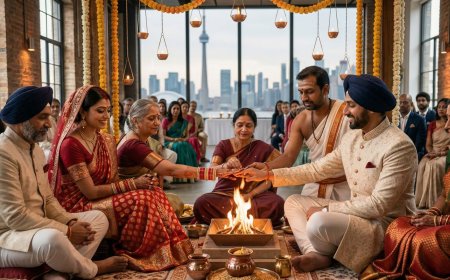



The Mark That Says Welcome to the Family: What the Tilak Ceremony Really Means for NRI Families
The Tilak ceremony — the formal acceptance of the groom by the bride's family through a sacred forehead mark — is one of the most significant pre-wedding rituals in Indian tradition. For NRI families across the US, UK, Canada, UAE, and Australia, this intimate ceremony requires careful preparation, community-specific materials, and the right pandit. This guide covers regional variations from Rajasthani Tika to Gujarati Chandlo, sourcing ritual items in diaspora cities, shagun gift traditions, and the ceremony's profound cultural meaning.


The Tilak ceremony is the moment the bride's family stops evaluating the groom and starts embracing him — a formal, public declaration that this man is welcome, accepted, and worthy of the most precious person in their household. For NRI families performing this ancient ritual across continents, the Tilak is not simply a pre-wedding formality — it is the first act of a new family being built, witnessed by everyone who matters.
You remember the atmosphere of a Tilak ceremony before you remember the details. The particular formality of it — the way the men sat differently than they did at other gatherings, straighter, more conscious of being watched. The way the bride's father moved through the room with a gravity that was different from his everyday self. The brass thali carried by someone's aunt, the sandalwood paste, the sweets being offered with two hands. The groom sitting very still in the centre of it all, receiving something he understood was significant even if no one had explained it to him yet.
Now it is your family's turn. Your son is to be received by his bride's family in a ceremony that formalises what has been decided in private — makes it public, makes it sacred, makes it real. Or you are the groom, sitting in a house in Mississauga or Melbourne that will become part of your extended family, waiting for hands you do not yet fully know to mark your forehead with the red of acceptance.
This guide is for every family navigating this ceremony — in a diaspora city, across two continents, with a guest list arriving from three countries and a tradition that deserves to be understood completely before it is performed.
🌟 DID YOU KNOW?
The Tilak [the sacred mark applied to the forehead] derives from the Sanskrit Tilaka, meaning a mark or spot, and its use in ritual contexts appears in the Rigveda and Atharvaveda — making it one of the most ancient sacred gestures in Hindu tradition, predating the formalised wedding ceremony itself and originally used to mark warriors, kings, and divine emissaries as set apart for sacred purpose.
The Tilak ceremony as a pre-wedding ritual is specifically a North and Central Indian tradition in its formalised form, but the act of applying a sacred mark to welcome and honour a guest appears in some form across virtually every Indian regional community — making it one of the most universally present gestures in Indian cultural life, even when its specific wedding context varies significantly.
Among NRI families in the UK, US, Canada, UAE, and Australia, the Tilak ceremony has seen a significant revival as a standalone pre-wedding event, with many diaspora families who previously compressed all pre-wedding rituals into a single day now choosing to give the Tilak its own dedicated occasion — recognising it as the formal alliance-sealing moment that deserves to be experienced without competition from other ceremonies.
What Is the Tilak Ceremony?
Tilak [the sacred forehead mark, from Sanskrit meaning spot or mark] is a pre-wedding ceremony in which the bride's family formally accepts the groom as the chosen husband for their daughter, applying a tilak [sacred mark] to his forehead as a gesture of welcome, approval, and blessing. Known by various names across regions — Tilak, Sagai Tilak, Tika, or Vara Puja [worship of the groom] — the ceremony typically occurs weeks or months before the wedding, though in some families it takes place just days before, serving as a formal counterpart to the engagement.
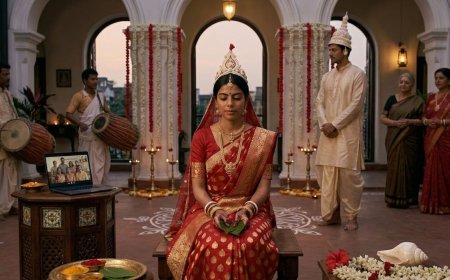
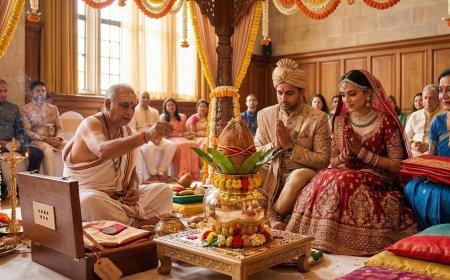
The ceremony begins with the arrival of the groom at the bride's home or the designated ceremony venue, accompanied by his family — the Barat [groom's party] in its pre-wedding form. The bride's family receives them formally, beginning with the Swagat [formal welcome], in which the groom is seated in a position of honour — typically on a decorated chair or platform that elevates him physically and symbolically as a respected guest being elevated to family.
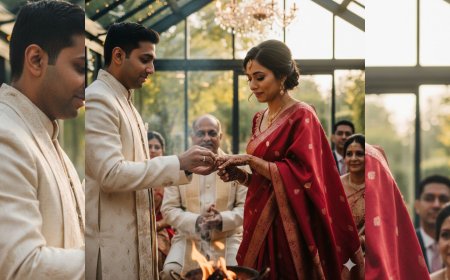
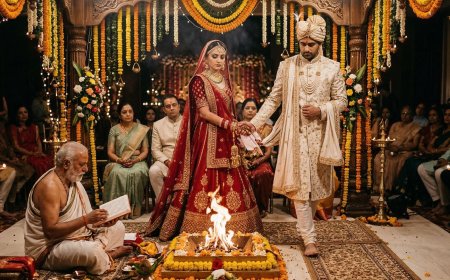
The Tilak application itself is performed by the bride's father, or in his absence by the senior male elder of the bride's family, using a mixture of chandan [sandalwood paste], kumkum [vermilion], and akshat [unbroken rice grains]. The mixture is applied carefully to the groom's forehead — in many traditions, a circular mark first with sandalwood, then a central point of kumkum — accompanied by the recitation of mantras [sacred verses] or in some families simply by the elder's heartfelt spoken blessing.
Following the tilak application, the bride's family presents the groom with shagun [auspicious gifts] — typically new clothing, sweets, dry fruits, and in many traditions a significant monetary offering in a decorated envelope. The groom's family reciprocates with gifts for the bride, and the assembled families share sweets as the formal announcement of the alliance is made before witnesses.
A pandit may or may not preside depending on the family's tradition, but the Tilak is understood across all communities as the formal seal of the families' agreement — the moment at which a private decision becomes a public commitment.
Community Comparison Table
| Community/State | Local Name | Key Tradition | How NRIs Abroad Adapt It |
|---|---|---|---|
| North Indian (General Hindu) | Tilak / Sagai Tilak | Bride's father applies tilak; shagun gifts exchanged; pandit may preside; community witness essential | Home or hall ceremony; pandit sourced through community network; gifts ordered locally or brought from India |
| Punjabi | Tilak / Kurmai Tilak | Formal tilak by bride's father; dhol played; women sing folk songs; sweets distributed to community | Dhol player hired; Punjabi folk songs played; community members invited; ceremony often combined with Roka |
| Rajasthani | Tilak / Tika | Elaborate ceremony; entire groom's family formally received; specific Rajasthani gifts including pagdi [turban] gifted to groom | Pagdi sourced from Indian stores or brought from Jaipur; Rajasthani community pandit engaged; community sabha members invited as witnesses |
| Gujarati | Tilak / Chanlo | Bride's family applies chandlo [Gujarati tilak mark]; specific Gujarati sweet offerings; Gol Dhana [jaggery and coriander] distributed | Chandlo applied with kumkum; Gol Dhana sourced from Indian stores; Gujarati community pandit presides |
| Marathi | Tilak / Sakhar Puda Tilak | Tilak applied as part of formal engagement; specific Marathi elder roles; sakhar [sugar] gifted | Sugar gift tradition maintained; Marathi community pandit engaged; elder roles preserved |
| Bengali (Hindu) | Paka Dekha / Ashirwad Tilak | Less formalised tilak; emphasis on formal family meeting and elder blessings; sweets exchanged | Mishti [Bengali sweets] exchanged; elder blessings central; ceremony adapted to intimate family gathering |
| Tamil (Hindu) | Nichayathamboolam / Vara Puja | Betel leaves and areca nuts exchanged; formal family alliance declaration; less tilak-specific | Betel leaves sourced from Tamil stores; Tamil pandit presides; streamed for Chennai family |
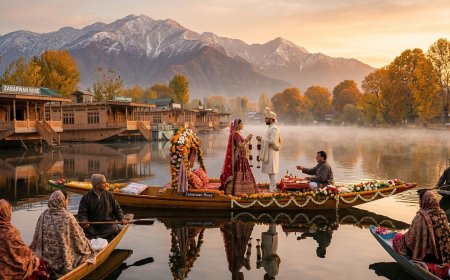
| Kashmiri Pandit | Tilak / Kuth | Specific Kashmiri Pandit tilak tradition; walnuts and dry fruits central to gift exchange | Walnuts sourced from Indian stores; Kashmiri Pandit community pandit essential; ceremony maintains specific sequence |
| Himachali / Garhwali | Tilak / Shagun Tilak | Community elders apply tilak; local deity invoked; folk music accompanies | Community Pahadi elders in diaspora city invited; deity invocation via video call with village pandit |
| Sindhi | Tilak / Lagan Tilak | Formal tilak by bride's father; specific Sindhi gift exchange tradition; community celebration follows | Sindhi community invited; gifts sourced locally; ceremony maintains formal structure |
The Meaning Behind the Ritual
In the ancient Indian understanding of social life, the home is a sacred space and the family is a sacred unit. For a new person to enter that unit — to cross the threshold from stranger to family — requires a ceremony of formal acknowledgement. The Tilak is that ceremony.
The tilak mark applied to the groom's forehead is not merely decorative — it is an act of abhisheka [sacred anointing], the same gesture used to consecrate kings, deities, and sacred objects. By applying the tilak to the groom's forehead, the bride's father is performing a gesture of profound respect: he is treating the groom as someone worthy of being consecrated, someone elevated from ordinary status to sacred significance within the family's world.
Sandalwood [chandan] is the substance of cooling, clarity, and auspiciousness in the Vedic tradition — applied to the forehead, it is understood to clarify the mind and invite wisdom. Kumkum [vermilion] at the centre adds the energy of Shakti [divine power] and Mangal [auspiciousness]. The akshat [unbroken rice] symbolises completeness and abundance — unbroken grains representing a life that has not yet been diminished, offered as a prayer for the wholeness of the alliance being formed.
The shagun gifts that follow are not transactional — they are declarations. When the bride's father gives the groom new clothing, he is saying: you will be dressed by us, cared for by us, considered ours. When he gives sweets, he is expressing the wish that everything that follows will be sweetened by this alliance.
The Tilak says: you came to us as the person our daughter chose, and we are marking you as the person we choose too.
Doing the Tilak Ceremony Abroad: The Practical Reality
The Tilak is one of the most adaptable Indian pre-wedding ceremonies for diaspora settings — it requires no fire, no complex venue infrastructure, and its essential materials are universally available. The complexity lies in the preparation, the sourcing of specific regional items, and — most importantly — ensuring the ceremony carries the formal gravity it deserves rather than being absorbed into a general pre-wedding party.
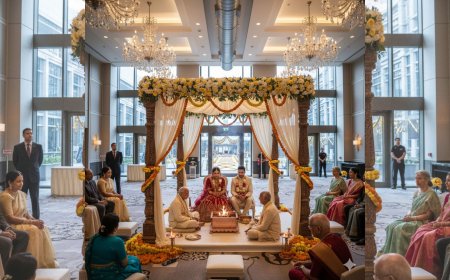
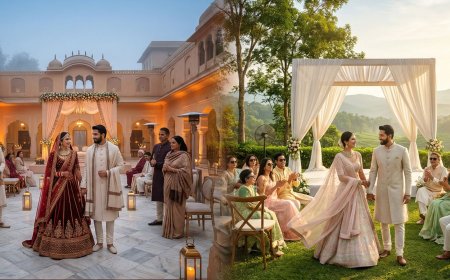
The venue for a Tilak ceremony should reflect its nature: formal, intimate, family-centred. The bride's family home is the ideal setting and remains the choice of most NRI families who have the space. A living room transformed by decoration — fresh flowers, a decorated chair for the groom, a clean cloth on the floor beneath the ceremony space — creates exactly the right atmosphere at no great expense. If guest numbers require a larger venue, choose a community hall or smaller Indian event space rather than a large banquet hall — the Tilak's intimacy is part of its meaning, and a room that is too large dilutes it.
Sourcing tilak materials is straightforward in any major diaspora city. The essential items — sandalwood paste or powder, kumkum, unbroken rice grains, a decorated thali, sweets, dry fruits, and flowers — are available year-round at Indian grocery and puja supply stores in all major NRI cities. In London, Wembley's Ealing Road and Southall's Lady Margaret Road carry everything you need. In Toronto, Gerrard Street East and the stores along Brampton's Dixie Road are fully stocked. In Houston, Hillcroft Avenue is your destination. In Sydney, Harris Park in Parramatta carries full puja supplies. In Dubai, Meena Bazaar in Bur Dubai stocks sandalwood paste and kumkum reliably year-round.
Community-specific items require more planning. For Rajasthani families, the pagdi [ceremonial turban] gifted to the groom is an essential element that must be sourced from a Rajasthani textile specialist — in London, stores in Wembleycarry Rajasthani textiles; online suppliers from Jaipur who ship internationally are also a reliable option with six weeks lead time. For Gujarati families, the specific chandlo mark and the Gol Dhana distribution require advance preparation of the jaggery and coriander mixture. Brief your pandit on your community's specific gift sequence when booking.
The pandit question depends on your family's tradition. Many Tilak ceremonies are conducted entirely by the bride's father and senior family elders without a pandit, particularly in North Indian traditions where the ceremony is more family-led. However, families who want Sanskrit mantras recited during the tilak application, or who follow specific ritual sequences, should engage a community-specific pandit. Book at least six to eight weeks in advance, specifying your regional tradition. NRI.Wedding's pandit directory lists verified priests by community tradition across all major diaspora cities.
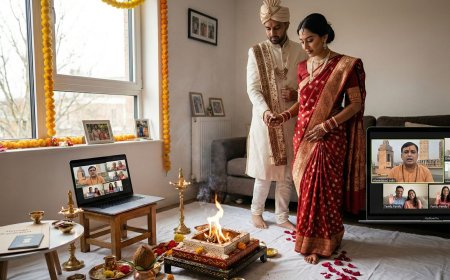
For coordinating with India via video call, the Tilak ceremony is relatively compact and its key moment — the tilak application itself — is visually clear and brief enough to be captured effectively on screen. Set up a dedicated device on a stable stand positioned to show the groom's face and the bride's father's hands clearly. The India family's collective gasp and clapping at the moment of application, audible through the speaker, is one of those diaspora wedding moments that everyone in the room will remember.
Doing the Tilak as a Destination Ceremony in India
For NRI families returning to India specifically for the Tilak, the ceremony gains an additional dimension of cultural authenticity that diaspora settings cannot fully replicate — particularly when held in the family's ancestral home or city of origin.
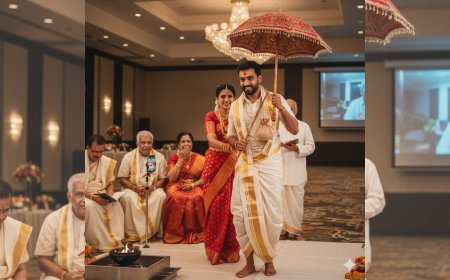
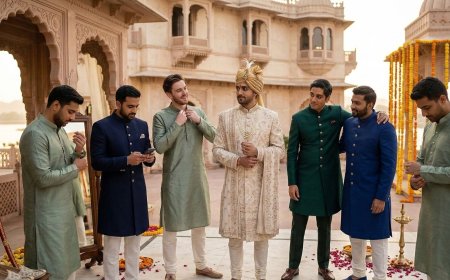
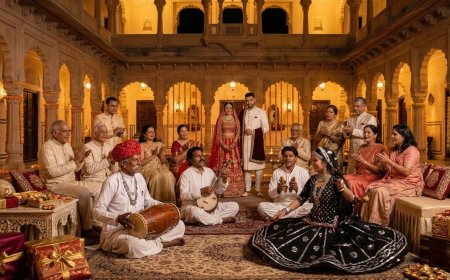
For North Indian and Rajasthani families, the Tilak ceremony in Jaipur or Jodhpur — held in a family haveli or a traditional venue — carries the full weight of Rajasthani hospitality culture, with the groom received as a honoured guest in the most elaborate tradition of the region. Delhi and Lucknow both have strong Tilak ceremony cultures with experienced vendors and pandits fully equipped for NRI returnee families. For Gujarati families, Ahmedabad and Suratoffer venues and pandits experienced in the specific Gujarati Tilak sequence. For Punjabi families, Amritsar and Chandigarh provide the cultural context within which the Tilak ceremony has its deepest community resonance.
When briefing your local pandit in India as an NRI returnee family, provide a written note of your specific community tradition, your family's mantra preferences, and the gift sequence your family follows. For non-Indian guests attending the Tilak in India, prepare a simple printed explanation of the ceremony's meaning — the formal acceptance gesture resonates universally once explained, and international guests consistently find it deeply moving.
What You Need: Tilak Ceremony Checklist
Ritual Items Decorated puja thali [ritual plate] lined with fresh flowers, sandalwood paste or powder, kumkum, unbroken rice grains [akshat], fresh marigold flowers, a small diya, incense, a decorated chair or platform for the groom, shagun sweets [fresh mithai — minimum two varieties], dry fruits [cashews, almonds, raisins], a decorated shagun envelope for monetary gift, new clothing for the groom [typically a shawl, kurta, or dhoti depending on community tradition], and community-specific gifts per your regional tradition.
People Required The bride's father or senior male elder of the bride's family to apply the tilak, a pandit if your tradition includes formal mantras, senior elders from both families as witnesses, a designated family member to manage the video call for India relatives, and a photographer — this moment deserves proper documentation and the ceremony's intimacy makes it one of the most beautifully photographable of all pre-wedding rituals.
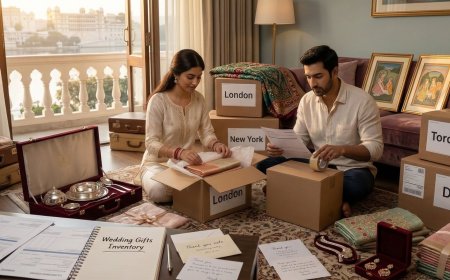
Preparation Steps Confirm ceremony date with both families at minimum six weeks in advance. Source all ritual items two weeks before. Order community-specific items such as pagdi or specific textiles four to six weeks before. Engage your pandit six to eight weeks before if required. Prepare shagun envelopes and gifts one week before. Set up and test your video call device the day before. Brief the bride's father or officiating elder on the specific sequence your family tradition follows.
NRI.Wedding's vendor directory, regional pandit network, and Tilak ceremony planning checklists connect you to verified professionals across the UK, US, Canada, UAE, and Australia — ensuring your ceremony carries the formal dignity and cultural integrity it deserves.
5 Questions NRI Couples Always Ask About the Tilak
Is the Tilak ceremony the same as the Sagai or Roka? Do we need to do all three?
These three ceremonies are related but distinct, and whether you need all three depends on your community tradition and family preference. The Roka[literally "stopping"] is the informal family-level agreement that formally ends the search for a match — the private decision made public within the immediate family. The Sagai [engagement] is the ring exchange ceremony that formalises the couple's commitment. The Tilak is specifically the bride's family's formal acceptance of the groom, marked by the sacred forehead application. In many families, these ceremonies are combined or compressed — a Tilak-Sagai in one event, for example, is common. In other traditions, all three are distinct occasions. Consult your family's senior members about which ceremonies your tradition specifically observes and which are considered essential.
My partner's family is not Indian. How do we explain the Tilak ceremony to them and help them participate meaningfully?
The Tilak translates beautifully to non-Indian families once its meaning is explained clearly. Prepare a simple written guide — one page is sufficient — explaining that the ceremony is the bride's family's formal welcome and acceptance of the groom, and that the sacred mark applied to his forehead is an act of blessing and consecration, elevating him from guest to family. Assign a bilingual family member to sit with the non-Indian family during the ceremony and narrate each element as it unfolds. Consider inviting the non-Indian family to offer their own form of blessing at the conclusion — a spoken welcome, a family gift — creating a meaningful point of participation that honours both traditions.
Can the Tilak be performed at the same event as the Haldi or Sangeet?
It can — but combining it with high-energy events like the Sangeet significantly dilutes its impact. The Tilak is a formal, intimate ceremony that requires a specific register of seriousness and attention. If you must combine events, hold the Tilak as a standalone ceremony at the beginning of the event, with a clear beginning and end, before transitioning to the more celebratory portions of the evening. Many NRI families find that giving the Tilak its own hour within a combined event — with the room appropriately set, the guests seated and attentive — preserves its meaning without requiring a separate occasion.
How do we find a pandit who knows our community's specific Tilak mantra sequence?
The Tilak mantra — where one is recited — is community-specific and in some regional traditions quite brief while in others it is part of a longer ritual sequence. When booking your pandit, specify your community and ask explicitly what they will recite during the tilak application. An experienced, community-specific pandit will answer this clearly and in detail. Personal referrals from your regional community network — Rajasthani sabha members, Punjabi cultural associations, Gujarati samaj — are the most reliable route to finding a pandit who knows your tradition precisely. NRI.Wedding's regional pandit directory is organised by community tradition to support exactly this search.
What is the appropriate scale for a Tilak ceremony? How many guests should we invite?
The Tilak is fundamentally a family ceremony, and its most authentic form is intimate — both immediate families, close family friends, and community elders who serve as witnesses. Many NRI Tilak ceremonies are beautifully conducted with twenty to forty guests. The ceremony does not require a large gathering to carry weight — in fact, a smaller, more attentive room often creates a more powerful atmosphere than a large one. If your families are large and extended, consider an intimate Tilak ceremony with core family followed by a broader celebration — a lunch or high tea — to which the wider community is invited. The ceremony itself should remain focused and formal regardless of the celebration that follows.
The Emotional Angle
There is a particular moment in the Tilak ceremony that nobody fully prepares you for — not the groom, not the bride's father, not anyone who has done this before. It is the moment the sandalwood paste touches the groom's forehead and the bride's father's hand is steady and the room is completely silent and everyone present understands simultaneously that something has been decided, formally, permanently, before witnesses.
For the bride's father, this moment is one of the most complex emotional experiences of his life. He is marking a man he may have known for months or years, a man his daughter chose, a man he has assessed and considered and finally accepted — and in this moment, all of that assessment falls away and what remains is simply the gesture: his thumb on this young man's forehead, the red of kumkum, the ancient sandalwood smell, and the knowledge that after this moment, everything is different. His daughter has a family now that includes this family. His home has grown.
For NRI families, this moment carries an additional layer. Because the bride's father who is performing the tilak in a living room in Harrow or a hall in Houston is the same man who left India twenty or thirty years ago carrying a specific vision of what his daughter's wedding would look like. He imagined it in a family home in Lucknow or Jaipur or Ahmedabad, surrounded by the neighbours and relatives and community members who had watched his daughter grow. Instead he is here, in a different country, with a modified guest list and a decorated thali sourced from a shop three postcodes away.
And yet. His thumb is on this young man's forehead. The kumkum is the same red. The sandalwood smells exactly as it should. His daughter is watching from the doorway with the expression he will carry in his heart for the rest of his life.
The distance did not change the gesture. It only made it more deliberate.
A Moment to Smile
At a Tilak ceremony in Houston last year, the bride's father — a meticulous man who had prepared for this moment for weeks — arrived at the ceremony with everything perfectly organised: the decorated thali, the sandalwood paste sourced from a specialist supplier, the kumkum in the correct container, the akshat rice measured precisely. He had even practised the tilak application gesture on a cushion the evening before.
What he had not practised was the consistency of the sandalwood paste, which turned out to be considerably more liquid than the version he had used in India thirty years earlier. The first application went somewhat beyond the traditional circular mark and extended, gracefully, toward the groom's right eyebrow.
The groom sat perfectly still with the expression of a man who had decided, wisely, that this was not the moment for commentary. The bride's mother handed her husband a tissue with the resigned efficiency of someone who has been managing situations for thirty-five years. The tilak was gently corrected. The kumkum was applied. The ceremony continued with full dignity.
The photographs from that moment are the bride's father's favourite photographs from the entire wedding week. The groom's expression in them is, by all accounts, magnificent.
Quotes From the Diaspora
"My father applied the tilak to my husband's forehead and I watched his hands — the hands that taught me to write, that held mine on my first day of school in England, that have always been the steadiest thing in my life — and they were completely steady. He didn't hesitate for a moment. That steadiness was the most eloquent thing I have ever seen him do."— Pooja Sharma, North Indian bride, originally from Lucknow, now in Birmingham
"My son's bride's father is a quiet man — not someone who expresses things easily. When he applied the tilak to my son's forehead, he said something quietly in Hindi that I couldn't hear from where I was sitting. Afterwards I asked my son what he said. He told me: welcome to the family. That was all. Three words. My son said it was the most important thing anyone said to him that entire week." — Rekha Agarwal, North Indian mother of the groom, originally from Delhi, now in Mississauga
"We did the Tilak in our garden in Melbourne in February. My father had brought the sandalwood paste from Chennai in his check-in luggage specifically — he said Australian sandalwood paste would not be correct. I don't know if that is true. What I know is that when he applied it to my husband's forehead and said the blessing, it smelled exactly like every sacred moment of my entire childhood. That smell is home. He brought home with him in his luggage." — Divya Krishnaswamy, Tamil bride, originally from Chennai, now in Melbourne
Your Welcome Travels With You
The Tilak ceremony is the moment a groom stops being a guest and starts being family — and for NRI families performing this ancient gesture in living rooms and community halls across the diaspora world, the mark made on that forehead carries every ounce of its original meaning. The sandalwood is the same. The kumkum is the same. The steadiness required of the hand that applies it is the same. Only the postcode has changed.
NRI.Wedding supports families across the UK, US, Canada, UAE, and Australia with verified regional pandits for every community's Tilak tradition, vendor directories for sourcing ritual items and community-specific gifts in diaspora cities, experienced NRI wedding photographers who understand the ceremony's intimate register, and planning checklists built specifically for diaspora families who want to do this properly and with full cultural integrity.
Decorate your thali. Prepare your shagun. Steady your hand.
The mark you make on his forehead says: you are ours now — and that is the most generous thing a family can say.
This article explores the Tilak ceremony — the formal acceptance of the groom by the bride's family — across Indian communities including North Indian, Rajasthani, Punjabi, Gujarati, Marathi, Bengali, Tamil, and Kashmiri Pandit traditions, with practical planning guidance for NRI families in the US, UK, Canada, UAE, and Australia.
What's Your Reaction?
 Like
0
Like
0
 Dislike
0
Dislike
0
 Love
0
Love
0
 Funny
0
Funny
0
 Angry
0
Angry
0
 Sad
0
Sad
0
 Wow
0
Wow
0