

























































North-East Indian Christian Wedding Traditions: The Complete NRI Guide to Nagaland, Mizoram, and Meghalaya
North-East India's Christian wedding traditions — from Nagaland's tribal shawls to Mizoram's community choirs and Meghalaya's matrilineal Khasi ceremonies — represent one of the most unique and least documented wedding cultures in the world. For NRI couples from these hill states, planning a wedding abroad means carrying mountains of identity, faith, and community across oceans. This guide covers everything from sourcing tribal cloth internationally to building a diaspora choir, making it essential reading for every North-East Indian NRI couple planning their wedding at home or abroad.

In the mist-covered hills of India's North-East, Christianity took root more than a century ago and grew into something entirely its own — woven through with tribal music, ancestral cloth, forest flowers, and a communal spirit that the modern wedding industry has barely begun to understand. For NRI couples from Nagaland, Mizoram, and Meghalaya, planning a wedding abroad means carrying mountains in their hearts.
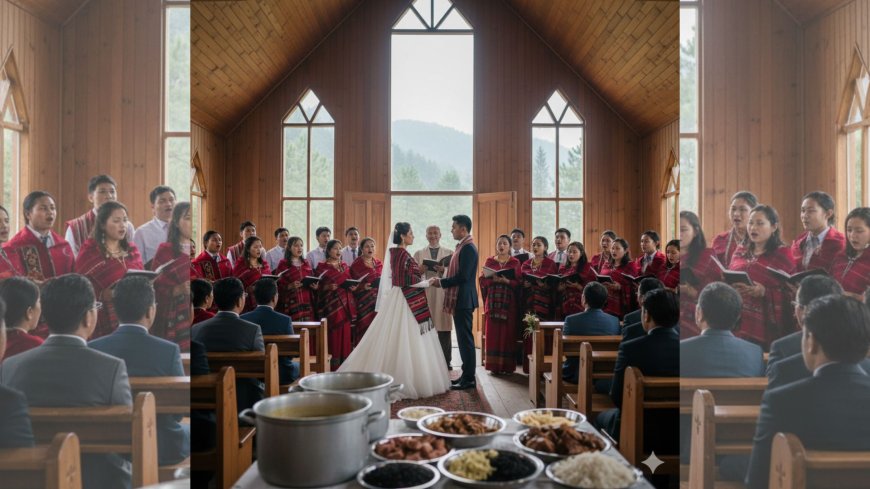
You grew up with a church that smelled like pine wood and old hymnbooks. Sunday mornings meant your mother in her best puanchei [traditional Mizo wraparound cloth], your father with his Bible worn soft at the corners, and a choir that could shake the roof off any building it chose to inhabit. The food after the service was always communal — enormous pots, everyone serving everyone, no one leaving hungry.
You're in Sydney now, or Dallas, or somewhere in the East Midlands, and you're planning your wedding. You want the choir. You want the cloth. You want the feeling of your grandmother's village wrapped around you on the most important day of your life. But nobody around you quite understands what you're describing. The wedding planning websites don't have a category for this. The vendors have never heard of Nagaland.
This article has been written specifically for you.
🌟 DID YOU KNOW?
Nagaland, Mizoram, and Meghalaya are among the most Christian-majority states in all of Asia — Mizoram alone is approximately 87% Christian, with a church attendance rate that rivals any nation in the world. Christianity arrived via Welsh Baptist missionaries in Mizoram in 1894 and transformed not just religion but music, literacy, and community structure within a single generation.
The choral tradition of the North-East is internationally recognised — Mizo choirs have performed at international competitions across Europe and Asia, and the state has been called "the land of songs." Wedding choirs in Mizoram are not hired performers — they are the couple's actual community, rehearsing for weeks before the ceremony.
The Khasi people of Meghalaya follow one of the few surviving matrilineal traditions in the world, where property, family name, and ancestral lineage pass through the mother's side. This makes Khasi Christian weddings unique in their structure — the groom traditionally moves into the bride's family home, and the youngest daughter holds special ceremonial significance.
What Is a North-East Indian Christian Wedding?
To understand a wedding from Nagaland, Mizoram, or Meghalaya, you must first understand that Christianity in these states is not an imported religion sitting uncomfortably on top of tribal culture. It has been absorbed, transformed, and made entirely indigenous over more than a hundred and twenty years. The result is a form of Christian worship and celebration that carries the DNA of the hills — the communal values, the love of music, the reverence for weaving and cloth, the deep-rooted belief that a celebration belongs to the whole village, not just the family.
A typical wedding from this region begins days before the ceremony itself. In Nagaland, the tenyidie [common Naga language used across tribes] tradition of community contribution means neighbours and extended family arrive to help with cooking, decoration, and preparation as a matter of course — not as a favour but as a shared responsibility. The church ceremony follows a standard Protestant or Baptist format: scripture readings, hymns, the exchange of vows, the blessing of rings, and a sermon that is often specific to the couple and their families.
What makes these weddings extraordinary is everything that surrounds that ceremony. The bride's cloth is not a purchased gown in most traditional families — it is woven fabric specific to her tribe and community, worn as a shawl or wrapped garment over or alongside a white dress. In Mizoram, the puanchei worn by the bride and her female relatives is a handwoven cotton cloth in deep red, black, and white geometric patterns that carries centuries of craft tradition. In Nagaland, each tribe — the Angami, the Ao, the Lotha, the Sumi — has its own specific naga shawl patterns that identify community and status. These are not decorative choices. They are identity worn on the body.
The feast that follows is vast, communal, and deeply specific to the region. Smoked pork [a staple across North-East weddings], bamboo shoot curry, black sesame rice, and fermented soybean chutney appear on tables that serve hundreds. The eating is communal, the singing continues through the meal, and the dancing — in Mizo weddings especially — is joyful, inclusive, and goes on for hours.
Community Comparison Table
| Community/State | Local Name for Wedding Ceremony | Key Tradition | How NRIs Abroad Adapt It |
|---|---|---|---|
| Mizo (Mizoram) | Inkhelh (wedding ceremony) | Full church ceremony, community choir, puanchei cloth, communal feast with smoked pork and bamboo shoot | Find Mizo church communities abroad, source puanchei from Aizawl via family, form small community choir from local Mizo diaspora |
| Naga — Angami (Nagaland) | Church wedding + tribal blessing | Angami shawl worn by bride, traditional feast, community contribution system | Bring Angami shawl from Kohima, connect with Naga Students Federation chapters in diaspora cities |
| Naga — Ao (Nagaland) | Church wedding + tsungrem [ancestral acknowledgement] | Ao shawl gifting, church vows, elaborate pork feast | Source Ao shawl via family in Mokokchung, recreate feast with community members |
| Khasi (Meghalaya) | Kamai ia ka tip briew tip Blei [ceremony of human and divine acknowledgement] | Matrilineal structure, groom welcomed into bride's home, church ceremony, traditional jainsem [Khasi dress] | Bride wears jainsem for reception, involve maternal elders prominently in ceremony |
| Garo (Meghalaya) | Church wedding + A·chik [Garo community gathering] | Garo traditional dress, community feast, church vows | Garo community associations in Delhi and diaspora maintain gathering traditions |
| Bodo (Assam) | Church or traditional ceremony | Dokhna [Bodo wraparound cloth] worn by bride, rice beer traditionally offered though many Christian Bodos substitute | Source dokhna from Kokrajhar via family, substitute rice beer with juice in Christian ceremony |
| Manipuri Christian | Church wedding | Phi [Manipuri woven cloth] worn as shawl, hymns in Meitei language | Meitei Christian diaspora communities in UK and US maintain church groups |
| Tripuri Christian | Church wedding + tribal elements | Rignai [Tripuri cloth] worn by bride, community singing | Source rignai from Agartala via family network |
| Punjabi | Anand Karaj | Sikh ceremony with laavaan, langar feast | Conduct at local Gurdwara worldwide |
| Bengali Christian | Church wedding + Aashirwad | Elder blessing at home, church ceremony, Bengali sweets | Recreate at home or hotel before main ceremony |
The Meaning Behind the Ritual
The North-East Indian Christian wedding carries a philosophy that the wider world has rarely paused to examine: that faith and identity are not in competition, that you can sing a Baptist hymn and wear a handwoven tribal shawl and both acts are expressions of the same truth about who you are.
The community contribution model that defines these weddings — where the entire neighbourhood participates in preparation — is rooted in an understanding of personhood that is fundamentally different from Western individualism. In these hill cultures, a person is not a self-contained unit. A person is a node in a network of relationships, obligations, and shared histories. The wedding is therefore not a private celebration. It is a community event that happens to centre on two individuals.
The cloth worn at these weddings is not fashion. Every pattern in a Naga shawl or a Mizo puanchei carries meaning — patterns that indicate which community you belong to, what your family's history is, sometimes what your social standing is. To wear your tribe's cloth at your wedding is to say: I know who I am, I know where I come from, and I am entering this new chapter fully, not partially.
The singing that runs through every North-East wedding is the community's way of praying together without stopping. It is the sound of belonging made audible.
For any non-Indian partner or guest trying to understand these weddings, the simplest truth is this: in these hills, your wedding day is the day your whole community tells you that you matter to them, and you tell them the same back.
Doing a North-East Indian Christian Wedding Abroad: The Practical Reality
This is the section you have been waiting for, and it deserves complete honesty: planning a North-East Indian Christian wedding abroad is genuinely more challenging than planning most other Indian weddings, because the community is smaller, the vendors are fewer, and the traditions are less documented. But it is absolutely achievable, and the NRI communities from these states are among the most tightly connected diaspora networks in the world.
The Church: Baptist and Presbyterian churches are the dominant denominations across Mizoram and Nagaland. Most major diaspora cities have Baptist or Presbyterian congregations that will welcome you. In the UK, the Baptist Union of Great Britain has hundreds of member churches and the process for booking a wedding is straightforward for baptised members. In the US, look for Baptist churches with South Asian or international congregations in cities like Dallas, Houston, and the Washington DC metro area, which has a significant North-East Indian population. In Australia, Sydney and Melbourne both have North-East Indian church communities that meet regularly.
The Choir: This is the heart of the ceremony and the element NRI couples feel most anxious about recreating. The solution is simpler than you fear: contact your state's diaspora association first. The Mizo Community in UK, the Naga Students Federation chapters in London and Edinburgh, and the Khasi-Jaintia Hills Association in various cities are active organisations that maintain cultural programmes. Within these communities you will almost always find people who sing, who have sung at weddings before, and who will be honoured to sing at yours. Give them as much notice as possible — four to six months is ideal.
The Cloth: The puanchei, the Naga shawl, the Khasi jainsem — these must come from home, and your family in Aizawl, Kohima, or Shillong will understand this without explanation. Order early, specify the occasion, and if possible describe the colour palette of your venue so the cloth complements it. Many weavers in these states now ship internationally via courier services, and diaspora WhatsApp groups regularly facilitate these purchases. Do not substitute with a printed approximation — the real cloth is the point.
The Feast: Smoked pork and bamboo shoot curry are the non-negotiables, and they are achievable abroad. In London, the North-East Indian community around Woolwich and parts of East London has informal networks of home cooks who cater community events. In the US, Asian grocery stores in cities with South-East Asian populations often carry bamboo shoots; smoked pork can be sourced from specialist butchers or smoked at home. For fermented soybean products, Korean grocery stores carry close equivalents. The honest truth is that the feast will require your aunties — real or adopted — and some advance planning. It is worth every bit of effort.
Time Zones for India Family: For live-streaming to Kohima or Aizawl, aim for a ceremony start between 4 PM and 6 PM local time in the UK or Australia, which corresponds to comfortable morning hours IST. For the US East Coast, a late morning ceremony works best. Assign one dedicated person to manage the video connection throughout — not someone who also has a role in the ceremony.
Doing a North-East Indian Christian Wedding as a Destination Wedding in India
For NRI couples choosing to marry in India, the North-East offers some of the most breathtaking and spiritually resonant wedding settings on the subcontinent — and some of the most underutilised by the wider Indian wedding industry.
Kohima, the capital of Nagaland, offers dramatic highland scenery, a deeply Christian community atmosphere, and the extraordinary backdrop of the Naga heritage landscape. A wedding held here, in a traditional church with a community choir, will be unlike anything your non-Indian guests have ever witnessed or will ever forget. Shillong, known as the Scotland of the East, is perhaps the most accessible North-East destination for a wedding — the city has established hospitality infrastructure, a thriving music culture, and a beauty that photographs in every direction. Aizawl in Mizoram, dramatically draped across a series of ridgelines, offers an intimate community feel and the possibility of a genuinely traditional Mizo wedding with full community participation.
When briefing local planners and pastors, be specific about your family's tribal background — a Mizo wedding and an Angami Naga wedding are not the same thing, and a good local planner will understand the distinction. Prepare a written brief including your church denomination, your tribal community, which cloth traditions you want represented, and your food requirements. NRI.Wedding can connect you with planners who specialise in these states and understand these distinctions.
What You Need: Ritual Checklist
Ritual Items: Church flowers and decorations in keeping with your denomination, wedding rings, tribal cloth for bride (puanchei, Naga shawl, jainsem, or equivalent specific to your community), white wedding dress if worn underneath or alongside, choir hymn selections prepared in advance, wedding feast ingredients including smoked pork, bamboo shoots, black sesame rice, fermented soybean condiments, wedding cake, community contribution dishes if following traditional format.
People Required: Baptist, Presbyterian, or relevant denomination pastor, community choir (minimum six to eight voices), tribal elder for any ancestral acknowledgement, family members designated for feast preparation, best man and bridesmaids, AV team for India live-stream, photographer familiar with or briefed on tribal cloth and community significance.
Preparation Steps: Book church or venue twelve months ahead. Contact diaspora community association for choir coordination six months ahead. Order tribal cloth from home state four to five months ahead. Source feast ingredients and identify community cooks three months ahead. Prepare hymn list and share with choir two months ahead. Set up video streaming test one week before. Prepare guest information card explaining tribal traditions for non-community guests.
NRI.Wedding connects couples from Nagaland, Mizoram, and Meghalaya with diaspora community vendors, pastors, tribal cloth suppliers, and photographers who understand exactly what they are documenting. You do not have to explain yourself to us.
5 Questions NRI Couples Always Ask
Can we hold the wedding in a non-Baptist or non-Presbyterian church if our denomination isn't available in our city?
Yes, and most couples from these communities do exactly this abroad. The vows, the scripture, the blessing of rings — these elements are shared across Protestant denominations and any welcoming pastor will conduct them. What matters more is the community around the ceremony: the choir, the feast, the cloth. Focus your energy on those elements and the denomination of the building becomes secondary. That said, if your faith tradition is specifically important to your family, Baptist and Presbyterian churches are present in virtually every major city in the UK, US, Australia, and Canada.
My partner is not from the North-East and has never encountered any of these traditions. How do I help them understand without making the wedding feel like a cultural lecture?
The best approach is personal storytelling rather than explanation. Instead of briefing your partner with facts about Mizo weaving traditions, show them photographs of your mother wearing her puanchei, tell them the story of where it came from, let them feel the cloth. Instead of explaining the community choir tradition abstractly, play them a recording of a Mizo wedding choir and watch their face. People understand through feeling, not information. Let your partner fall in love with your traditions the way you fell in love with them — through lived experience, not a syllabus.
How do I find other North-East Indians in my city who might form a choir or help with the feast?
Start with state-specific associations: the Mizo Community UK, the Nagaland Community Association, Khasi diaspora groups on Facebook and WhatsApp. North-East Indian students' associations at universities are another reliable network — many cities with large student populations have active NE Indian groups. The North-East Indian community is known for its hospitality and cultural solidarity; once you make contact with one family, you will typically find yourself connected to many more within days.
Our wedding is in the UK and my grandmother in Kohima is too frail to travel. How do we make sure she feels truly present at the ceremony?
Beyond the standard video call setup, consider giving her a specific role: ask her to say a blessing aloud during the ceremony that the congregation hears via the speakers. Ask the pastor to address her directly during the service and invite her to pray. Send her the hymn list in advance so she can sing along from her chair in Kohima. These small gestures transform a screen into a genuine presence, and the memory of your grandmother's voice blessing your marriage from her hill town will stay with you for the rest of your life.
Should we do our civil registry separately before the church wedding, or can they happen together?
In the UK and Australia, a registered minister can legally solemnise a marriage, meaning the church ceremony and legal registration can occur simultaneously. Check whether your church and pastor are registered for this purpose — many Baptist and Presbyterian churches are. In the US, marriage law varies by state but the same principle often applies. If your pastor is not registered, complete the civil registry quietly beforehand — many NRI couples do this at the registry office with just two witnesses — and treat the church ceremony as the wedding your family and community will recognise and remember.
The Emotional Angle
There is something that happens to people from the North-East when they leave India that is rarely spoken about outside the community. You carry a triple displacement: you are Indian, but mainland India has not always made you feel Indian. You are Christian, but the church you grew up in is unlike any church abroad. You are tribal, but the world has no comfortable category for that identity in a diaspora context.
And then you plan your wedding, and something extraordinary occurs. You call home and your mother starts listing the dishes for the feast before you have finished your sentence. Your cousin WhatsApps you a photograph of the shawl she has already started setting aside. Someone in your city's NE Indian group offers to sing. The network activates, because this community has always survived through its networks, through its choirs, through its stubborn insistence that the traditions will continue wherever the people go.
You stand at the altar — in a church in Edinburgh or a hired hall in Dallas — wearing your grandmother's cloth over your white dress, listening to eight people from your community sing a hymn in your mother tongue that makes the whole room go quiet, and you realise that the mountains came with you. They were always coming with you. You just needed a wedding to make you look.
A Moment to Smile
At a Mizo wedding in Woolwich, South-East London two years ago, the community choir — ten people who had been rehearsing in someone's living room for six Sundays — arrived at the hired church hall to discover the sound system had completely failed. No microphones, no speakers, nothing. The groom's uncle, an electrician by trade, spent forty-five minutes attempting repairs that were definitively unsuccessful.
The choir sang anyway. Unamplified, in a bare church hall in South-East London on a grey February afternoon, ten Mizo voices filled that room with something that had no business existing in Woolwich and existed there anyway, completely and magnificently. Three of the non-Indian guests cried before the vows had even started. The sound engineer sent a formal apology and a partial refund. Nobody cared in the slightest.
Quotes From the Diaspora
"Everyone kept asking me why I wasn't just wearing a white dress. I tried to explain the puanchei but eventually I gave up explaining and just wore it. When I walked in, my mum put her hand over her mouth. That was the only answer I needed."— Lalnunmawii Pachuau, Mizo Baptist, currently residing in Edinburgh
"My daughter-in-law is from Meghalaya, Khasi community. I didn't know anything about their traditions before the wedding. But when her maternal aunties stood up during the ceremony to give their blessing — the way they spoke about her, what she meant to their line — I understood something about family that I had never understood before." — Remlalliana Sailo, Mizo, resident of Hounslow for nineteen years, mother of the groom
"We had our wedding in Houston. Fourteen Naga people in that entire city and all fourteen of them came and helped. Someone brought pork they had smoked themselves. Someone else made the rice. I don't know how to explain to people outside the community what that means — that fourteen strangers became your village for a day." — Asenla Jamir, Angami Naga, Houston
Your Mountains Came With You
The North-East Indian Christian wedding tradition is one of the most beautiful and least celebrated in the entire Indian wedding landscape. It deserves to be seen, documented, honoured, and carried forward — across oceans, across generations, across every diaspora city where a family from the hills has made a new home without forgetting the old one.
If you are planning your wedding from Nagaland, Mizoram, or Meghalaya — at home or abroad — NRI.Wedding is here to help you do it with full cultural integrity. From pastors who understand your denomination and your tribal background, to photographers who know how to document the cloth and the choir and the communal feast, to planning checklists built for communities the mainstream wedding industry has ignored for too long, we are here.
Order the shawl. Book the choir. Call your mother about the pork.
Your mountains came with you. Let them be seen.
This article covers North-East Indian Christian wedding traditions from Nagaland, Mizoram, and Meghalaya, including Mizo, Naga, Khasi, and Garo communities, with practical planning guidance for NRI couples in the UK, US, Australia, and Canada.
What's Your Reaction?
 Like
0
Like
0
 Dislike
0
Dislike
0
 Love
0
Love
0
 Funny
0
Funny
0
 Angry
0
Angry
0
 Sad
0
Sad
0
 Wow
0
Wow
0