











































































Booking a Banquet Hall in Jalandhar from the UK, Canada or Australia: The Remote Booking Guide
Booking a Jalandhar banquet hall from the UK, Canada or Australia means making a significant financial commitment across thousands of kilometres with incomplete information, mediated representations, and no ability to simply walk through the door on a Saturday afternoon. This comprehensive remote booking guide gives NRI couples the complete verification framework for researching, assessing, depositing, contracting, and managing a Jalandhar venue relationship entirely from abroad. From live video walkthrough protocols and reference call strategies to deposit negotiation, contract clause protection, proxy site visits, remote tasting solutions, and ongoing cross-timezone vendor relationship management, this is the most detailed remote venue booking resource available for NRI couples planning Jalandhar weddings from abroad.

Booking a Banquet Hall in Jalandhar from the UK, Canada or Australia: The Remote Booking Guide
The Call That Changed Everything About How You Thought This Would Work
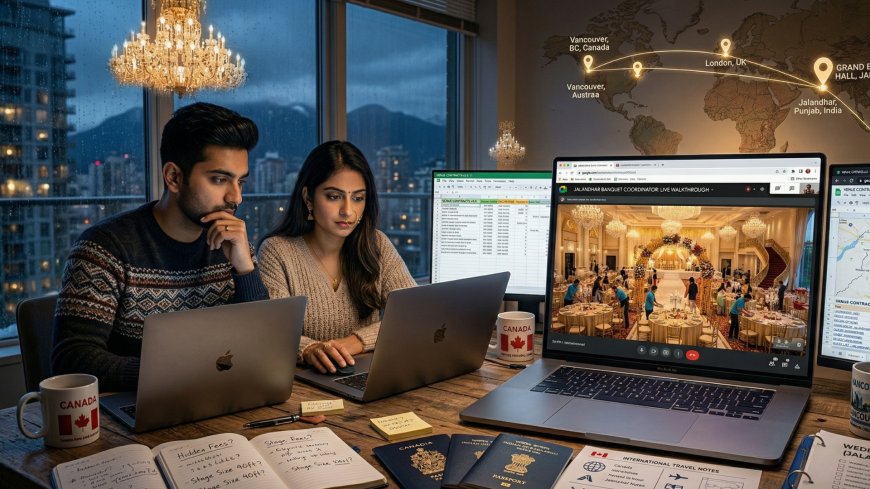
It is 11:15 PM on a Thursday in Vancouver.
You have been on the phone for forty-five minutes with the coordinator of a banquet hall in Jalandhar that came highly recommended by three separate family members, two of whom attended weddings there in the last eighteen months and described it in terms that made it sound like the obvious answer to every venue question you had been wrestling with for the past two months.
The conversation started well. The coordinator was warm, enthusiastic, and impressively fluent in the vocabulary of NRI wedding expectations. The capacity sounded right. The catering package sounded comprehensive. The pricing sounded reasonable. You were, by the thirty-minute mark, feeling the particular relief of a planning decision that appears to be resolving itself cleanly and without further anguish.
And then you asked about visiting the venue before confirming the booking.
The coordinator's tone shifted almost imperceptibly. Of course you can visit, he said. Whenever you are next in India. But — and this was the part that changed the energy of the conversation entirely — for your dates, he would need a booking confirmation within the next two weeks to guarantee availability. Peak season, he explained. Very high demand. Two other inquiries for the same weekend already. If you wanted to hold the dates, a deposit would be required.
You are in Vancouver. The wedding is in Jalandhar. You have not seen this venue in person. You have seen four photographs on a website that appears to have last been updated in 2019. You have a family recommendation of genuine but ultimately anecdotal value. And you are being asked to place a significant financial deposit on a venue you have never physically entered, managed by people you have never met, in a city you visit once every two or three years, based on a forty-five-minute phone call at 11:15 PM on a Thursday.
This is the remote booking reality for NRI couples planning Jalandhar weddings from the UK, Canada, and Australia. And it is more navigable than this scenario makes it feel — but only if you approach it with the right framework, the right verification process, and the right understanding of exactly what you need to confirm before any deposit changes hands.
This guide is the complete remote booking resource for NRI couples. It covers every aspect of booking a Jalandhar banquet hall from abroad — from initial research and remote verification to deposit management, contract review, ongoing vendor relationship management across time zones, and the specific safeguards that protect your investment when you cannot be physically present to manage it yourself.
The Core Reality: Why Remote Venue Booking Is Genuinely Risky — And Genuinely Manageable
The risk in remote venue booking is real and should not be minimized. You are making a significant financial commitment — typically involving a non-refundable or partially refundable deposit of several lakh rupees — based on incomplete information, mediated representations, and the assessment of people whose interests are not perfectly aligned with yours.
The venue coordinator wants to close the booking. The family member who recommended the venue wants to be helpful and wants their recommendation to be validated. The vendor ecosystem around the booking process has no particular incentive to ensure that your expectations are accurately calibrated to the reality you will encounter when you arrive.
This structural information asymmetry is the root of most remote booking problems. It does not mean that remote venue booking always goes wrong — the majority of NRI couples who book Jalandhar venues remotely do so successfully. But the ones who encounter problems almost universally did so because they relied on representations and assurances that were not independently verified.
The solution is a structured verification process that closes the information gap as completely as possible before any financial commitment is made — using the tools, the contacts, and the professional resources available to you from your location abroad.
What remote booking cannot replicate:
The physical experience of standing in the venue and assessing its spatial quality, its atmosphere, and its operational condition with your own senses. This is the irreducible limitation of remote venue booking and should be acknowledged honestly. No video call, no walkthrough, no photograph can fully substitute for the judgment you form by being physically present in a space.
What remote booking can achieve with the right process:
A highly reliable assessment of the venue's actual functioning capacity, catering quality, infrastructure adequacy, operational track record, contract fairness, and suitability for your specific wedding requirements — sufficient to make a well-informed booking decision with confidence and appropriate contractual protection.
The Strategic Framework: A Complete Remote Booking Process for Jalandhar Venues
Phase 1 — Build Your Longlist from Multiple Independent Sources
The starting point for any remote venue search is building a longlist from sources whose independence and reliability you can assess critically.
Family and community recommendations: These are valuable but not sufficient as standalone sources. A family recommendation tells you that someone had a positive experience at a venue at a specific point in time. It does not tell you whether the venue's management, catering contractor, or operational quality has changed since that experience. It does not tell you whether the venue is appropriate for your specific scale, season, and NRI guest profile. Use family recommendations as an entry point into your research — not as a conclusion.
NRI wedding community forums and groups: Online communities — Facebook groups for NRI Punjabi diaspora, WhatsApp communities for UK or Canada-based wedding planners, Reddit communities for South Asian wedding planning — contain a volume of first-hand experience that no single family network can match. Search specifically for recent experiences with Jalandhar venues — within the last twelve to eighteen months — and pay particular attention to accounts from NRI couples whose planning circumstances are similar to yours.
Professional wedding planning directories: India-based wedding planning platforms and directories provide venue listings with reviews, capacity information, and contact details. Use these as a research resource but treat the reviews with appropriate skepticism — platform reviews are subject to incentive distortions that make them less reliable than independently sourced references.
Local wedding planner intelligence: A Jalandhar-based wedding planner with active professional experience in the local venue market has more current, more reliable, and more practically useful knowledge of the venue landscape than any combination of online research and family recommendation can provide. Investing in a single paid consultation with a reputable local planner — even if you are not planning to hire them for full wedding coordination — to get their assessment of your shortlisted venues is one of the highest-return planning investments available to an NRI couple at this stage of the process.
Phase 2 — Build Your Assessment Brief Before Any Venue Contact
Before you make a single call or send a single inquiry to any venue, build a structured assessment brief that specifies exactly what you need to know to make your venue decision. This brief serves two purposes: it disciplines your own information-gathering process, and it signals to venue coordinators that they are dealing with a well-prepared, serious couple whose questions require substantive rather than promotional answers.
Your assessment brief should cover:
Confirmed functioning capacity for your specific guest count with your specific event configuration — dance floor, DJ or live entertainment setup, full buffet service, bar station. This figure must be supported by a floor plan layout, not just a verbal assurance.
Catering infrastructure details — kitchen capacity, staffing model, live counter capability, menu flexibility for NRI dietary requirements, and the process for a remote food tasting or tasting-by-proxy arrangement.
Power infrastructure specification — generator KVA capacity, activation time, and most recent load test results.
Climate control specification — air conditioning system capacity for your guest count and wedding month.
External vendor policy — what restrictions, if any, apply to décor teams, photographers, entertainment, and supplementary catering.
Accommodation — whether the venue has on-site accommodation or a formal partnership with nearby hotels, and what the coordination and rate structure looks like.
Cancellation and postponement terms — the complete financial exposure at each stage of the payment timeline.
References — contact details for a minimum of three couples who held weddings of comparable scale at this venue within the last eighteen months, at least one of whom was an NRI couple planning from abroad.
Phase 3 — Conduct the Remote Venue Assessment
With your assessment brief in hand, you are ready to conduct the remote assessment process. This involves multiple tools and multiple contacts — not a single phone call or video walkthrough.
The live video walkthrough:
Request a live video walkthrough — not a pre-recorded video tour, but a live call during which you can ask questions and direct the person conducting the walkthrough to show you specific areas. The walkthrough should cover every function space you plan to use, the kitchen facilities, the generator and electrical infrastructure, the parking area, the washroom facilities, and the accommodation if applicable.
Conduct the walkthrough at the time of day that corresponds to your planned function timing — if your reception will be an evening event, request the walkthrough at evening time so you can assess the lighting conditions, the ambient atmosphere, and the venue's operational readiness in the context closest to your actual event.
Ask the coordinator to show you the venue during setup for a comparable event if timing allows — seeing the venue being prepared for a real wedding gives you far more operational intelligence than seeing it in its empty, unprepared state.
The reference call protocol:
References are the most valuable verification tool available in the remote booking process and the most consistently underutilized by NRI couples who feel awkward about calling strangers to ask about their wedding experience.
Call every reference the venue provides. Prepare a specific set of questions before each call — not a general inquiry about whether they were happy, but specific questions about catering quality under serving pressure, infrastructure reliability, operational professionalism, discrepancy between what was promised and what was delivered, and whether they would book the venue again knowing what they know now.
If the venue provides references who are uniformly enthusiastic and unable to identify any single area of improvement or disappointment, treat this with mild skepticism. Real wedding experiences almost always have at least one element that was imperfect. References who describe a flawless experience may be genuine — or may have been selected specifically because they can be relied upon to provide promotional rather than honest feedback.
Request at least one reference contact from an NRI couple who planned their wedding remotely from outside India. Their experience of the remote booking process and the gap between remote expectations and on-ground reality is directly relevant to your situation in a way that domestically planned wedding references are not.
The proxy site visit:
If it is at all possible to arrange a physical site visit by a trusted local contact — a family member, a friend, a local wedding planner engaged specifically for this purpose — before confirming a booking, do it. Brief your proxy with your complete assessment checklist. Provide them with specific questions to ask the venue coordinator and specific things to observe and document. Ask them to video every area of the venue with running commentary during their visit.
A well-briefed proxy site visit conducted by a reliable person is the closest substitute available for your own physical assessment of the venue — and for high-value bookings, it is worth the effort of identifying and briefing the right person to conduct it.
Phase 4 — The Remote Tasting Problem and How to Solve It
Food quality at a large Jalandhar wedding is the single element of the event experience that your guests will most directly and most immediately notice and remember. And it is the element that is most difficult to verify through remote assessment alone.
The standard solution — attending a food tasting at the venue before confirming the booking — is not available to NRI couples who are planning from abroad and cannot travel to Jalandhar specifically for a tasting visit.
Remote tasting solutions:
Tasting by trusted proxy — identify a family member or trusted friend in Jalandhar whose food judgment you genuinely respect, who has extensive experience of the quality standards expected at premium NRI weddings, and who is willing to attend a venue tasting on your behalf with a specific evaluation brief. The brief should cover each dish in terms of flavor authenticity, temperature management, presentation quality, and portion generosity. Video documentation of the tasting helps — seeing the dishes as they are presented alongside the proxy's verbal assessment gives you substantially more information than a written report alone.
Plan a tasting into your India visit schedule — most NRI couples planning Jalandhar weddings make at least one planning trip to India during the twelve to eighteen months before their wedding. If the venue shortlist is confirmed early enough, a tasting visit can be scheduled as a specific component of this planning trip rather than requiring a separate dedicated journey.
Request a tasting for your local Jalandhar family — some venues will conduct a complimentary tasting for the couple's immediate family members who are based in Jalandhar as a goodwill gesture toward a serious prospective booking. This is worth requesting explicitly.
Phase 5 — Managing the Deposit Decision
The deposit request is the moment of maximum vulnerability in the remote booking process. It is the point at which you are being asked to convert a provisional intention into a financial commitment — and the point at which the information asymmetry between you and the venue is most consequential.
The principles governing the remote deposit decision:
Never pay a deposit before the reference calls are complete. References must be called and assessed before any financial commitment is made. A venue that pressures you to deposit before references are verified is a venue that is prioritizing its own booking security over your legitimate due diligence requirements.
Never pay a deposit before reviewing the contract. The deposit contract must specify the exact amount, the exact refund terms at each stage of the cancellation timeline, the exact event specifications being committed to, and the dispute resolution mechanism. A venue that requests an informal deposit before a formal contract is prepared is a venue operating outside professional standards.
Understand the banking mechanics before transferring funds. International bank transfers to Indian accounts involve currency conversion, transfer fees, and processing timelines that must be understood before initiating any payment. Confirm the venue's bank details through a secondary verification channel — not just through the coordinator who requested the payment — to protect against fraud.
Use a payment method that provides some transaction documentation and recourse. Bank transfers to verified venue accounts are preferable to cash payments made through intermediaries.
Negotiating deposit terms for remote bookings:
NRI couples booking from abroad have a legitimate basis for requesting modified deposit terms that reflect the additional risk they carry as remote planners. A reasonable negotiating position: a smaller initial deposit to hold the dates, with the larger commitment deferred until after a physical site visit — either your own or a well-briefed proxy — has been completed and the venue has been assessed against your assessment brief in person.
Many professional Jalandhar venues will accommodate this request from NRI couples planning from abroad. A venue that refuses to consider any modification of its standard deposit terms for international clients who cannot physically visit before committing deserves additional scrutiny.
Phase 6 — The Contract: What Must Be In It
The contract governing a Jalandhar banquet hall booking for a large NRI wedding is the primary legal protection available to couples who cannot be physically present to manage the vendor relationship through informal, relationship-based accountability mechanisms.
Every material commitment made during the booking process must be documented in the contract. Not summarized. Not referenced by verbal agreement. Documented specifically and completely.
Non-negotiable contract elements:
Event specifications — dates, function times, guest count range, specific spaces allocated to each function, catering program summary with key menu commitments, entertainment and external vendor access terms, and parking and accommodation arrangements.
Financial terms — total contract value, payment schedule with specific due dates and amounts, deposit amount and refund terms at each stage of the cancellation timeline, and any circumstances under which the venue can seek additional payment beyond the contracted amount.
Infrastructure commitments — generator backup capacity, air conditioning specification, power supply continuity commitment, and any other infrastructure element that was material to your venue selection decision.
Force majeure provisions — what happens if the venue is unable to fulfill its obligations due to circumstances beyond its control, and what financial protection you have in that scenario.
Dispute resolution — the mechanism for resolving disputes, the governing law of the contract, and the jurisdiction in which disputes will be heard. For NRI couples contracting from abroad, this clause has practical significance that warrants specific attention.
Getting the contract reviewed:
Have the contract reviewed by a legal professional before signing. This does not need to be an expensive exercise — a one-hour consultation with an India-based lawyer familiar with commercial event contracts is sufficient to identify problematic clauses, confirm that your key commitments are adequately protected, and advise on any modifications worth requesting.
For a booking commitment of several lakh rupees, the cost of a one-hour legal consultation is a negligible insurance premium.
Building and Managing the Ongoing Vendor Relationship Across Time Zones
Booking the venue is the beginning of a vendor relationship that will span twelve to eighteen months and involve dozens of planning decisions, specification revisions, and coordination touchpoints conducted entirely across international time zones.
Managing this relationship effectively from the UK, Canada, or Australia requires deliberate communication infrastructure and clear accountability mechanisms.
Establishing the communication protocol:
Agree on a primary communication channel at the outset of the relationship — and ensure it is one that creates a written record of every material decision and commitment. Email is preferable to WhatsApp for formal communications because it creates a more durable and more searchable record. WhatsApp is appropriate for operational coordination and quick clarifications, but any decision or commitment made via WhatsApp should be confirmed in writing via email.
Establish a regular check-in cadence — a scheduled call or video meeting every four to six weeks during the planning period — that keeps the relationship active, maintains your visibility with the venue team, and creates structured opportunities to address emerging questions before they become problems.
Managing the time zone gap:
The time difference between Jalandhar and Vancouver is approximately thirteen and a half hours. Between Jalandhar and London, it is four and a half hours during British Summer Time and five and a half hours during winter. Between Jalandhar and Sydney, it is approximately four and a half hours in the opposite direction.
These time differences mean that real-time communication with Jalandhar venue teams requires deliberate scheduling — either from your end, by working outside your standard business hours, or by establishing agreed communication windows with the venue team that accommodate both sides of the time zone gap.
Be explicit about your communication expectations at the outset of the relationship. If you need a response to a planning question within 48 hours, say so. If you will be unreachable during specific periods — holiday travel, professional commitments, family obligations — communicate this in advance rather than allowing unresponsiveness to be interpreted as disengagement.
Deputizing local management:
For NRI couples who cannot make regular India visits during the planning period, identifying a trusted local contact who can attend periodic in-person meetings with the venue team on your behalf is a meaningful relationship management investment. This contact — a parent, a trusted family friend, a local wedding planner — provides a physical presence in the relationship that remote management alone cannot replicate. Their role is not to make decisions on your behalf, but to maintain the relationship's human warmth and to flag any emerging concerns that are visible on the ground but not apparent from remote communication.
The Planning Visit: Making Your India Trip Count
Most NRI couples planning Jalandhar weddings will make at least one dedicated planning visit to India during the twelve months before their wedding. This visit is your most valuable planning resource — the opportunity to close every information gap that remote assessment cannot fully bridge.
Making the planning visit count:
Schedule the visit at least eight to ten months before the wedding date — early enough that discoveries made during the visit can be acted upon with sufficient lead time. A planning visit at three months out leaves minimal runway to address problems identified.
Build a comprehensive visit agenda that covers every open vendor and venue question. The visit should include a physical venue walkthrough at evening light conditions, a food tasting at every shortlisted or confirmed catering vendor, in-person meetings with your key vendors — décor team, photographer, entertainment coordinator — and a review meeting with your wedding planner if you have engaged one.
Document everything during the visit — video every venue space, photograph every décor sample and catering presentation, take written notes at every vendor meeting, and review your assessment brief against what you have observed before leaving each venue. The intelligence gathered during a well-structured planning visit is the foundation of confident remote management for the months that follow.
Common Mistakes NRI Couples Make in the Remote Booking Process
Mistake 1: Over-Relying on Family Recommendations Without Independent Verification Family recommendations are a starting point, not a conclusion. The aunt who raves about a venue may have attended a wedding there two years ago under different management, at a different scale, with different catering standards. Always conduct independent verification regardless of how strong or how numerous the family recommendations are.
Mistake 2: Conducting Only One Video Walkthrough A single video walkthrough with the venue coordinator — who is simultaneously trying to close the booking — provides a curated, promotional view of the venue rather than an objective assessment. Supplement the coordinator walkthrough with an independent walkthrough conducted by a proxy who has no booking incentive and can assess the venue candidly.
Mistake 3: Accepting Verbal Assurances Without Written Documentation Everything a venue coordinator assures you of verbally during the booking process — capacity, catering quality, infrastructure, vendor access, cancellation terms — must be documented in writing before any deposit is paid. Verbal assurances that are not documented in the contract are assurances that cannot be enforced.
Mistake 4: Not Calling References References are the most underutilized verification tool in the remote booking process. The discomfort of calling strangers to ask about their wedding is a small price for the quality of intelligence that a well-conducted reference call provides. Call every reference. Ask specific questions. Take notes.
Mistake 5: Making the Deposit Transfer Without Verifying Banking Details International transfers to Indian accounts create a fraud risk that domestic transactions do not carry to the same degree. Verify the venue's banking details through a secondary channel — a phone call to the venue's main number, a confirmation from your local family contact who has met the venue management in person — before initiating any international wire transfer.
Mistake 6: Not Planning the India Visit Early Enough A planning visit at three months before the wedding provides very limited opportunity to act on what you discover. Plan your India visit at eight to ten months out — early enough that every discovery made during the visit has sufficient runway to be addressed before the wedding.
The Emotional Reality: The Specific Anxiety of Planning From Far Away
There is a particular quality of anxiety that NRI couples experience when planning major logistical decisions from abroad that has no precise equivalent in the experience of couples planning domestically.
It is the anxiety of incomplete information. Of knowing that you are making significant financial and experiential commitments based on representations rather than direct experience. Of being unable to simply drive to the venue on a Saturday afternoon and walk around for an hour. Of depending on the reliability, the honesty, and the professional integrity of people you have never met in person and will not meet until the months immediately before your wedding.
This anxiety is legitimate. It reflects a real information asymmetry and a real dependence on intermediaries whose reliability you cannot fully assess from a distance.
The antidote is not reassurance — it is process. A structured, thorough, well-documented verification process that closes the information gap as completely as the tools available to you allow. References called. Contracts reviewed. Proxies briefed. Deposits deferred until verification is complete. Communication protocols established. Planning visits scheduled.
When you have done everything within the remote planning process to verify your decisions as rigorously as the constraints of distance allow, the residual uncertainty is genuinely small — and the confidence that rigorous process produces is a much more reliable source of calm than hope and assurance alone.
Remote Booking Checklist for NRI Couples
Research and Longlist
- Build longlist from minimum three independent source types
- Consult local Jalandhar wedding planner for current venue landscape intelligence
- Research recent NRI community reviews for shortlisted properties
- Identify proxy contacts available for on-ground verification
Remote Assessment
- Build comprehensive assessment brief before any venue contact
- Conduct live video walkthrough at evening event light conditions
- Request floor plan layout for your specific guest count and event configuration
- Assess kitchen facilities through dedicated kitchen walkthrough
- Confirm generator KVA capacity and air conditioning specification
- Verify external vendor policy explicitly and in writing
Reference Verification
- Request minimum three references including at least one NRI remote planner
- Prepare specific question set before each reference call
- Document reference feedback in writing immediately after each call
- Weight recent references more heavily than older ones
Deposit and Contract
- Complete all reference calls before any deposit payment
- Review full contract with India-based legal professional before signing
- Confirm all verbal commitments are documented in contract specifically
- Verify banking details through secondary channel before wire transfer
- Negotiate modified deposit terms appropriate for remote booking circumstances
Ongoing Relationship Management
- Establish primary written communication channel from day one
- Schedule regular check-in cadence for full planning period
- Identify and brief local deputy contact for in-person relationship management
- Plan India visit at eight to ten months before wedding date
- Build comprehensive visit agenda covering all open vendor questions
The Confidence That Rigorous Process Builds
Booking a banquet hall in Jalandhar from Vancouver or Birmingham or Sydney is not the same as booking one from Jalandhar. The information asymmetry is real. The risk is real. The dependence on intermediaries whose reliability you cannot fully assess is real.
But it is not unmanageable. Hundreds of NRI couples successfully navigate this process every year — booking venues from abroad, building vendor relationships across time zones, and arriving in Jalandhar weeks before their wedding to find that the reality matches the promise closely enough to make the months of remote planning feel fully vindicated.
The difference between the couples who navigate it successfully and the ones who encounter costly surprises is almost entirely a matter of process. The verification steps taken. The references called. The contracts reviewed. The proxies briefed. The deposits deferred until due diligence was complete.
This guide has given you that process in complete detail. Use it without compromise. Apply every step with the thoroughness it deserves.
And then, when you finally walk through the doors of the Jalandhar banquet hall you booked from your apartment in Vancouver at 11:15 PM on a Thursday fourteen months ago — and the space is everything it was represented to be, and the catering team is ready, and the lighting is coming on, and your family is beginning to arrive — you will know that the confidence you feel in that moment was not luck.
It was the result of planning done right, from exactly where you were, with exactly the tools available to you.
That is what rigorous remote planning delivers. And your wedding deserves nothing less.
What's Your Reaction?
 Like
0
Like
0
 Dislike
0
Dislike
0
 Love
0
Love
0
 Funny
0
Funny
0
 Angry
0
Angry
0
 Sad
0
Sad
0
 Wow
0
Wow
0