






































When the Shehnai Sounds, the Cosmos Listens: The Complete Guide to Rajasthani Wedding Music for NRI Families
Dhol Baaje — the living musical tradition of Rajasthani weddings encompassing Shehnai, Dhol, Nagada, Sarangi, and the hereditary Manganiyar and Langa musician communities — is the sonic soul of every Rajasthani ceremony. For NRI families across the US, UK, Canada, UAE, and Australia, sourcing authentic Rajasthani folk musicians requires six months of advance planning and deep community connections. This guide covers every instrument's ceremonial role, how to find Manganiyar and Langa musicians abroad, venue sound management, and the music's profound cultural meaning.


Rajasthani wedding music is not background — it is the wedding itself, the living architecture of sound within which every ritual, every procession, and every moment of celebration finds its meaning. From the haunting strings of the Sarangi to the thundering call of the Dhol, from the devotional cry of the Shehnai to the acrobatic percussion of the Dhol Baaje, the music traditions of Rajasthan represent one of the most extraordinary sonic heritages in the world. For NRI families carrying this tradition across oceans, bringing authentic Rajasthani wedding music to a hall in Houston or a venue in Harrow is not merely an aesthetic choice — it is the sound of home.
You grew up hearing about Rajasthani weddings the way you hear about all the most magnificent things — in superlatives, in stories that seemed impossible until you experienced the reality and discovered the stories had actually undersold it. Your father describing the Shehnai player who began at sunset and did not stop until dawn. Your grandmother's face when she spoke about the Dhol Baaje — the hereditary musicians who arrived at the village carrying instruments older than anyone present, playing rhythms that had been in their families for three hundred years.
Now it is your wedding. Or your child's wedding. You are in a banquet hall in Mississauga or a venue in Melbourne, and you are trying to figure out how to bring the music of Rajasthan into a room that has never heard it — how to fill a space that does not know the Shehnai with the sound that makes a Rajasthani wedding real, that makes the air vibrate in the specific way that tells your body: this is the ceremony. This is actually happening.
This guide is for that family. For the NRI Rajasthani household that knows the music is not decoration — it is the ceremony's nervous system, the living pulse without which the rituals are forms without feeling.
🌟 DID YOU KNOW?
The Dhol Baaje [literally "the dhol speaks" or "the dhol sounds"] refers not merely to a drum but to an entire hereditary tradition of professional musicians known as Dholi or Naubati communities, whose families have performed exclusively at weddings and royal ceremonies in Rajasthan for over five hundred years — making Rajasthani wedding music one of the oldest continuously practiced professional performance traditions in the world, passed from father to son across generations with the same instruments, the same compositions, and the same sacred understanding of music as ceremonial service.
The Shehnai [the double-reed wind instrument central to North Indian wedding music] was listed by UNESCO as part of India's intangible cultural heritage specifically because of its inseparable association with auspicious ceremonies — it is considered so sacred in the Hindu tradition that it may only be played at celebrations of life and never at funerals, making it the single instrument most specifically dedicated to joy in the entire South Asian musical tradition.
Among NRI Rajasthani families in the UK, US, Canada, UAE, and Australia, authentic Rajasthani wedding music has become one of the most actively sought-after elements of diaspora Indian weddings — with professional Rajasthani folk musicians increasingly touring diaspora cities specifically to serve NRI wedding demand, and several Rajasthani musician families now maintaining permanent bases in cities like London, Toronto, and Dubai to serve the growing market of NRI families who understand that no DJ set can replicate what a live Manganiyar or Langa musician brings to a wedding.
What Is Dhol Baaje?
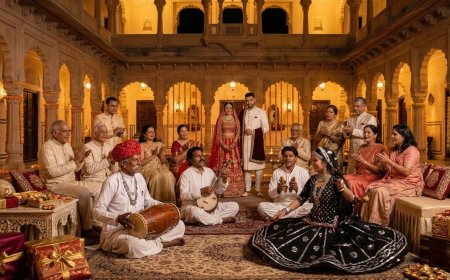
Dhol Baaje [from Rajasthani/Hindi, meaning the sounding or speaking of the dhol — the auspicious moment when the ceremonial drum announces the wedding's sacred events] is the broader term for the musical traditions that animate every stage of a Rajasthani wedding, from the first pre-wedding ceremony through the baraat procession, the wedding rituals themselves, and the post-wedding celebrations. It encompasses not merely the Dhol [the large double-headed ceremonial drum] but the full ensemble of Rajasthani wedding instruments and the hereditary musician communities who play them.
The primary instruments of Rajasthani wedding music form a specific ensemble. The Shehnai [the double-reed wind instrument, the auspicious voice of celebration] is considered the most sacred — its sound announces sacred events and is believed to invite divine attention to the ceremony. The Dhol [the large ceremonial drum played with two different sticks — the dagga producing the bass note and the thili the treble] provides the rhythmic foundation of the baraat and all procession music. The Nagada [large kettle drums, typically played in pairs] are the instruments of royal and ceremonial processional music, their thundering sound carrying across great distances. The Sarangi [the bowed string instrument with a haunting, human-like voice] is the instrument of Rajasthani folk music, Ghoomar [the traditional women's circular dance], and the intimate music of celebration. The Algoza [double flute played simultaneously] and Morchang [jaw harp] add the specifically folk dimension of Rajasthani musical identity.
The hereditary musician communities of Rajasthan — principally the Manganiyar and Langa communities — have served as the custodians of this wedding music tradition for centuries. These communities possess a repertoire of hundreds of wedding-specific compositions, each associated with a specific ritual moment — the music played when the baraat departs is different from the music played when it arrives, which differs from the music played during the pheras, which differs from the music played when the bride departs her family home in the Doli [the ceremonial palanquin or departure procession]. Each piece of music is itself a ritual object, as specific to its moment as the mantra recited by the pandit.
Community Comparison Table
| Community/State | Local Name | Key Musical Tradition | How NRIs Abroad Adapt It |
|---|---|---|---|
| Rajasthani | Dhol Baaje / Shehnai Vadana | Full live ensemble — Shehnai, Dhol, Nagada, Sarangi; Manganiyar and Langa musicians; ceremony-specific compositions | Live Rajasthani musicians hired; Manganiyar/Langa artists touring diaspora cities engaged; recorded Rajasthani folk music as supplement |
| Punjabi | Dhol / Giddha Music | Dhol central to all celebrations; folk songs sung live; Boliyan and Suhag performed | Professional dhol player hired; folk song recordings shared; live singers for Sangeet |
| Gujarati | Garba / Dhol-Tasha | Garba music with dhol and tasha percussion; folk instruments for pre-wedding | Garba DJ and live dhol; community Garba night organised; folk instruments sourced |
| Marathi | Dhol-Tasha / Lezim | Dhol-tasha percussion ensemble for baraat; Lezim [rhythmic sticks] for group performance | Dhol-tasha players hired; lezim performance organised; Marathi folk music played |
| Bengali (Hindu) | Dhak / Shanai | Dhak [large drum] and Shanai played at ceremonies; Rabindra Sangeet and folk songs | Dhak player sourced from Bengali community; Bengali songs live or recorded; community singers invited |
| Tamil (Hindu) | Nadaswaram / Parai | Nadaswaram [South Indian double reed] for auspicious moments; Parai drum for specific ceremonies | Tamil Nadaswaram player hired; Carnatic wedding music played; streamed for Chennai family |
| Kashmiri Pandit | Shehnai / Tumbaknari | Shehnai and Tumbaknari [goblet drum] for wedding music; specific Kashmiri compositions | Kashmiri Pandit musician community contacted; Kashmiri wedding music recordings used |
| Himachali / Garhwali | Dhol-Damau / Nati music | Dhol-Damau [Pahadi drum pair] for processions; Nati folk music for celebrations | Pahadi community musicians in diaspora city engaged; Nati music played; community folk dance organised |
| Sindhi | Shehnai / Wedding music | Shehnai and traditional instruments for ceremony; Sindhi folk songs performed | Sindhi community musicians invited; Sindhi wedding songs played; folk music recordings used |
| North Indian (General) | Shahnai / Band Baja | Brass band for baraat; Shehnai for ceremony; folk songs for pre-wedding events | Brass band hired for baraat; Shehnai player for ceremony; DJ for reception |
The Meaning Behind the Music
In the Hindu philosophical tradition, Nada [sacred sound] is not merely vibration — it is a form of Brahman [the universal creative principle], the primordial sound from which all existence emerged. When the Shehnai sounds at a Rajasthani wedding, it is not announcing the ceremony to the assembled guests — it is announcing it to the cosmos, calling divine attention to the sacred threshold being crossed by two people in the fire's presence.
The Dhol's specific rhythm for wedding ceremonies is not a performance choice — it is a composition that has been transmitted without change for centuries precisely because its specific sonic qualities are understood to generate Mangalya Shakti [auspicious energy] in the space where it is played. The Manganiyar and Langa musicians who play these rhythms understand themselves not as performers but as Sewaks [servants] of the ceremony — their music is an offering, as sacred as the ghee poured into the Havan Kund.
The Sarangi's role in Rajasthani wedding music carries its own deep significance. Its voice is the closest any instrument comes to the human singing voice — it speaks where words are insufficient, carries emotion that language cannot contain, and fills the spaces in the ceremony where what is happening is too significant for speech. When the bride departs her family home in the Doli procession, it is the Sarangi that gives sound to what everyone present is feeling.
The tradition of hereditary musician communities — families who have served the same landowning and merchant families for generations — represents a specific Indian understanding of music as Seva [sacred service], as a gift given rather than a commodity sold, as a relationship between musician and family that extends across lifetimes.
Rajasthani wedding music says: this moment is so significant that it requires the oldest sounds we know — the sounds that have announced joy at this latitude for five hundred years.
Doing Dhol Baaje Abroad: The Practical Reality
Bringing authentic Rajasthani wedding music to a diaspora venue requires more advance planning than almost any other element of the wedding — but the results are transformative in a way that no amount of DJ sophistication can replicate.
Finding authentic Rajasthani musicians is the most critical task and requires beginning the search at minimum six months before the wedding. The ideal scenario is engaging musicians from the Manganiyar or Langa communities — several families from these communities now maintain permanent or touring presences in the UK, US, Canada, UAE, and Australia specifically to serve NRI wedding demand. The search begins with your Rajasthani community network — Rajasthani samaj and cultural association members in your diaspora city are the most reliable source of recommendations for authentic folk musicians who have performed at Rajasthani weddings before. NRI.Wedding's vendor directory lists verified Rajasthani folk musicians across major diaspora cities.
For a Shehnai player specifically — which many NRI Rajasthani families consider the single non-negotiable musical element of a Rajasthani wedding ceremony — search through Indian classical and folk music societies in your city. In London, the Southall and Wembley areas have networks of South Asian musicians; contact Indian music academies and folk music societies for Shehnai player referrals. In Toronto, the South Asian arts community based around Bramptonand Mississauga has established Rajasthani folk music connections. In Houston, the Indian classical music community along the Westheimer corridor can provide referrals. In Dubai, the Indian cultural community is large and well-organised with connections to touring Rajasthani musicians.
The Dhol player for the baraat is a separate hire from the ceremony musicians and should be sourced with specific attention to Rajasthani wedding rhythm knowledge — a Punjabi dhol player, however skilled, plays different rhythms from a Rajasthani one, and the difference is immediately apparent to any Rajasthani family member present. Be specific when booking about the Rajasthani baraat rhythms you require.
Venue sound management is the primary practical challenge for live Rajasthani wedding music. The Nagada and Dhol are among the loudest acoustic instruments in the world — purpose-built for outdoor village ceremonies. Discuss your live music plans with your venue manager before booking and establish clearly what instruments will be played, for how long, and at what times. Many UK venues have specific decibel limits that restrict live percussion after certain hours — plan your Dhol Baaje timing accordingly, with the loudest instruments in the early evening before any curfew applies.
For recorded Rajasthani folk music as a supplement or primary musical layer, curate a playlist of authentic Manganiyar and Langa recordings, Ghoomar music, Rajasthani folk wedding songs, and Shehnai compositions at least six weeks before the wedding and work with your DJ to understand how to use this material. High-quality recordings of Manganiyar artists including the celebrated Komal Kothari archive, and Langa recordings from the Rajasthan recording tradition, are available on streaming platforms and should form the musical foundation of any Rajasthani wedding playlist regardless of whether live musicians are also present.
For coordinating with India family via video call during the musical ceremonies, ensure strong audio capture — the point is for India family to hear the Shehnai, not just see the ceremony. A dedicated microphone positioned near the Shehnai player, feeding into the live stream, will allow India grandparents to hear the instrument that marked every auspicious occasion of their own lives.
Dhol Baaje as a Destination Wedding in India
For NRI Rajasthani families returning to India for the wedding, the musical possibilities are extraordinary — and Jaisalmer, Jodhpur, and Jaipur each offer distinct musical contexts that no diaspora venue can replicate.
Jaisalmer is the heartland of the Manganiyar community — a destination wedding here gives NRI families direct access to musicians whose families have performed wedding music in this landscape for three centuries, in a desert setting of breathtaking beauty under night skies uncorrupted by city light. The sound of a Manganiyar ensemble in the Thar Desert at sunset, with the golden stone of a Jaisalmer haveli as backdrop, is one of the most extraordinary musical experiences available anywhere in the world.
Jodhpur offers the RIFF [Rajasthan International Folk Festival] connections — the city has become a global centre for Rajasthani folk music performance, and wedding musicians of the highest calibre are available through the networks established by this festival's two decades of cultural work. Jaipur provides the most complete vendor infrastructure for NRI returnee families, with experienced Rajasthani wedding coordinators who understand both the musical traditions and the specific requirements of families arriving from multiple international locations.
When briefing local musicians in India as an NRI returnee family, provide advance notice of the specific compositions you want for each ceremony moment — if your family has particular Rajasthani folk songs associated with specific rituals, share these with the musicians before the wedding. Most professional Rajasthani wedding musicians are accustomed to specific family requests and will incorporate them without difficulty.
What You Need: Dhol Baaje Checklist
Musical Elements Required A Shehnai player for the wedding ceremony [booked minimum six months before], a Rajasthani Dhol player for the baraat procession [booked minimum four months before], a Sarangi player or folk ensemble for the Sangeet and reception if budget allows, Nagada players for the baraat arrival if desired and venue permits, a curated Rajasthani folk music playlist for DJ supplement, Ghoomar music specifically for any dance performances, and a high-quality live stream audio setup to share the music with India family.
People Required The musicians themselves booked well in advance, a designated family music coordinator who knows which composition belongs at which ceremony moment, a sound engineer if live musicians require amplification in a large venue, a DJ experienced with South Asian wedding music who understands how to complement rather than compete with live folk instruments, and a videographer with experience capturing live folk music at weddings.
Preparation Steps Begin musician search minimum six months before the wedding. Confirm Shehnai player at minimum five months before. Confirm Dhol player at minimum four months before. Discuss venue sound management with venue manager at minimum three months before. Curate Rajasthani folk music playlist at minimum six weeks before. Brief DJ on Rajasthani music integration at minimum four weeks before. Set up and test live stream audio minimum one day before. Prepare a written brief of ceremony-specific music requirements for all musicians one week before.
NRI.Wedding's vendor directory lists verified Rajasthani folk musicians, Shehnai players, Dhol players, and wedding music coordinators across the UK, US, Canada, UAE, and Australia.
5 Questions NRI Couples Always Ask About Dhol Baaje
Is it possible to find authentic Manganiyar or Langa musicians outside India?
Yes — and more readily than most NRI families expect. Several Manganiyar and Langa families now maintain touring and residency presences in UK, US, and UAE cities specifically because NRI wedding demand has made it economically viable. The search requires specificity and advance planning. Begin by contacting Rajasthani cultural associations in your city — they maintain the most current knowledge of which musicians are available and have performed at Rajasthani weddings successfully. Indian classical and folk music societies in cities like London, Toronto, and Houston also have musician networks that can provide referrals. NRI.Wedding's verified musician directory is another direct route. What you should avoid is booking a generic "Indian folk music" performer who does not specifically know Rajasthani wedding music — the difference in the ceremony's atmosphere is immediate and significant.
What is the difference between the music played at the baraat and the music played during the wedding ceremony itself?
The distinction is fundamental and every element of the music changes between these two contexts. Baraat music— the processional music played as the groom's party arrives — is characterised by high energy, strong percussion, and the specific dhol rhythms designed to generate excitement, announce arrival, and create the particular atmosphere of a groom's procession. The Dhol and Nagada are the primary instruments, often accompanied by a brass band in contemporary Rajasthani wedding tradition. Ceremony music — played during the Saat Pheras, the Sindoor Daan, and the ritual sequence — is the domain of the Shehnai, which plays specific auspicious compositions associated with each ritual moment. The Sarangi may accompany the ceremony's more intimate moments. The transition from baraat music to ceremony music is itself a defined moment in the wedding's sonic architecture — the dhol falls silent as the Shehnai begins, and every Rajasthani family member present recognises the shift as the announcement that the sacred has begun.
How do we teach Ghoomar to guests for the Sangeet if most of them have never done it before?
Ghoomar — the traditional Rajasthani women's circular dance in which the ghaghra [skirt] fans out as the dancer spins — is one of the most learnable of all Indian classical folk dances for guests with no prior experience, because its basic structure is a repeated spin with specific hand movements that can be taught in thirty minutes. The most effective approach is to hire a Rajasthani folk dance instructor to run a thirty-minute workshop for willing guests at the beginning of the Sangeet evening before the main celebration begins. This transforms guests from observers into participants and creates the communal Ghoomar performance that is the ceremony's most visually spectacular element. For NRI families, sharing tutorial videos with guests four to six weeks before the Sangeet allows those who want to prepare to do so. The beauty of Ghoomar is that imperfect communal participation is more authentic to the folk tradition than polished individual performance.
Our venue has a noise curfew at 10 p.m. How do we fit the Dhol Baaje into this constraint?
Sequencing is the answer. Plan your baraat arrival for the early evening — a 6:00 or 6:30 p.m. arrival allows the full Dhol and Nagada baraat experience before any curfew becomes relevant. The Shehnai for the wedding ceremony, which is significantly quieter than the baraat percussion, can continue later into the evening and typically falls within acceptable decibel ranges even at venues with noise restrictions. The Sangeet folk music — Sarangi, Manganiyar ensemble, or Rajasthani folk DJ set — can continue until the curfew. Brief your musicians specifically on the curfew timing when booking and ask them to advise on the optimal scheduling of their performance segments. Experienced diaspora wedding musicians are entirely familiar with curfew constraints and will have specific suggestions for your situation.
How do we create an authentic Rajasthani musical atmosphere if we cannot find live folk musicians?
A thoughtfully curated recorded music programme, managed by a DJ who understands Rajasthani folk music, can create a genuinely meaningful musical atmosphere even without live musicians. The key is specificity — not generic "Bollywood wedding music" but authentic recordings of Manganiyar, Langa, and Rajasthani folk artists for the ceremony and pre-wedding events, with Bollywood and contemporary music reserved for the reception dancing. Share specific artist and track recommendations with your DJ well in advance — artists including Komal Kothari's recorded archives, the Manganiyar Seduction project recordings, and traditional Ghoomar and Maand [a classical Rajasthani musical form associated with weddings] recordings should form the core of your ceremony and Sangeet music. Even a single live Shehnai player at the ceremony, combined with high-quality recorded folk music elsewhere, creates an authenticity that a fully recorded programme cannot replicate.
The Emotional Angle
There is a specific quality of silence that follows the first note of the Shehnai at a Rajasthani wedding. Not the silence of absence — the silence of arrival. The silence of a room that has been waiting for this sound without knowing it was waiting, that recognises the note before the mind does because the body has heard it at every sacred moment of its life.
For NRI Rajasthani families, this moment carries a weight that cannot be described to anyone who has not grown up with the Shehnai as the sound of significance. You are in a venue in Melbourne or a hall in Mississauga, and the Shehnai player you found through three months of searching and four phone calls and a referral from a Rajasthani samaj uncle you had not spoken to in two years begins to play, and something in your chest recognises it before you do. Your mother's hand tightens on yours. Your father, who does not show emotion easily, is very still in a specific way that means he is not going to be still for very much longer.
Because the Shehnai does not merely play music. It calls. It calls across every distance — across the ocean between Rajasthan and this room, across the years between childhood and this wedding, across the gap between the person you were in India and the person you have become in this country. It calls the part of you that is still standing in a courtyard in Jaipur or Jodhpur or the family village, listening to this same sound at someone else's wedding, not yet knowing that one day it would be yours.
The Shehnai sounds. The ceremony is real. You are home.
A Moment to Smile
At a Rajasthani wedding in Houston three years ago, the family had managed, through extraordinary effort and a network of contacts that stretched from Houston to Jodhpur to a Manganiyar musician in New Jersey, to secure a live Sarangi and Dhol ensemble for the baraat arrival. The musicians were magnificent. The baraat was spectacular. The Dhol was played with a commitment to its purpose that the entire neighbourhood understood immediately.
What the family had not fully anticipated was the enthusiasm of their next-door neighbour — a seventy-year-old Texan gentleman named Dale who had been watching the preparations from his porch for three days with increasing curiosity and who had, upon hearing the Dhol begin, decided that whatever was happening in the street in front of his neighbour's house was something he needed to be part of.
Dale emerged from his house in a plaid shirt and boots. He walked to the edge of the procession. He listened to the Dhol for approximately thirty seconds. He then began to dance — a movement that bore no relationship to any known dance tradition but communicated, with absolute clarity, that Dale was fully present and entirely joyful.
He was given a garland. He wore it for the rest of the evening. He tells everyone he knows about the Rajasthani wedding he attended. The family considers him family now. The Dhol made him one of theirs in thirty seconds, which is, on reflection, exactly what the Dhol has always done.
Quotes From the Diaspora
"My father cried when the Shehnai player began at our ceremony in Mississauga. He has not cried at anything in my memory — not once in thirty years in Canada. He told me afterwards that the last time he heard a Shehnai was at his own wedding in Jaipur forty-one years ago. He said: I did not know I had been carrying the absence of that sound for forty-one years until it came back. That is what music does. It holds time inside it." — Priya Rathore, Rajasthani bride, originally from Jaipur, now in Mississauga
"My son's wife is from the UK — her family are English. When the Manganiyar musicians began at the Sangeet in Birmingham, her mother turned to me and said: what is that instrument? I said: it is the Sarangi. It speaks like a human voice. She listened for a while and then she said: it is not like a human voice. It is like a human feeling. I have been thinking about that description ever since. She understood it immediately, without any background. That is what great music does." — Savita Sharma, Rajasthani mother of the groom, originally from Jodhpur, now in Birmingham
"We had a Manganiyar musician at our wedding in Melbourne — one singer and one Sarangi player, found through the Rajasthani community in Sydney after two months of searching. When they began the first song, I watched my grandmother on the video call from Jodhpur. She closed her eyes. She did not open them for the entire first song. When she opened them, she said one word in Marwari that means: correct. That single word from her was worth every phone call it took to find those musicians." — Ananya Singhvi, Rajasthani bride, originally from Jodhpur, now in Melbourne
Your Music Travels With You
Rajasthani wedding music is the oldest sound of celebration in your family's history — the Shehnai that announced your grandparents' wedding, the Dhol that led your parents' baraat, the Sarangi that carried the feeling of every departure and every arrival your family has ever made. For NRI families bringing these sounds to diaspora wedding venues across the world, the search for authentic musicians is demanding, the planning is considerable, and the result is irreplaceable. No digital playlist, however carefully curated, carries in its electrons what a living musician carries in their hands and breath and three-hundred-year inheritance of knowing exactly what sound belongs at exactly this moment.
NRI.Wedding supports Rajasthani families across the UK, US, Canada, UAE, and Australia with a verified Rajasthani folk musician directory including Shehnai players, Manganiyar and Langa artists, Dhol players, and Sarangi musicians, alongside experienced NRI wedding coordinators who understand the specific musical architecture of a Rajasthani ceremony and can help build your wedding's sonic landscape from the first pre-wedding ritual to the final reception dance.
Find your Shehnai player. Book your Dhol. Let the music announce what words cannot.
When the Dhol speaks, every Rajasthani heart in the room remembers where it comes from.
This article explores the Dhol Baaje and music traditions of Rajasthani weddings — including Shehnai, Sarangi, Nagada, Manganiyar and Langa folk music, and Ghoomar — alongside wedding music traditions from Punjabi, Bengali, Tamil, Kashmiri Pandit, and Himachali communities, with practical planning guidance for NRI families in the US, UK, Canada, UAE, and Australia.
What's Your Reaction?
 Like
0
Like
0
 Dislike
0
Dislike
0
 Love
0
Love
0
 Funny
0
Funny
0
 Angry
0
Angry
0
 Sad
0
Sad
0
 Wow
0
Wow
0