



























































She Left Her Father's House in a Throne of Flowers — and the World Stopped to Watch Her Go
The Doli and Palkhi — the bride's ceremonial departure in a decorated palanquin — is the most visually magnificent farewell in all of Indian wedding tradition. For NRI families across London, Toronto, Dubai, Sydney, and Houston, this ancient ritual transforms the Vidaai into something the entire room will remember forever. This complete guide covers the historical origins of the bridal palanquin, regional Doli traditions across ten Indian communities, and practical guidance for hiring Dolis, planning procession routes, and performing this breathtaking ceremony authentically abroad or as a destination wedding in India.


The Doli and Palkhi — the bride's departure in a decorated palanquin — is the most visually magnificent and emotionally complete farewell in all of Indian wedding tradition. It is the moment the Vidaai becomes visible to the world: the bride, adorned and tearful and luminous, carried forward by the men who love her into the life that awaits her. For NRI families across London, Toronto, Dubai, Sydney, and Houston, the Doli is the image that lives longest in memory — the one that makes grandparents in Punjab weep when they see the photographs, because it is the image they know in their bones, the one that has not changed in five hundred years.
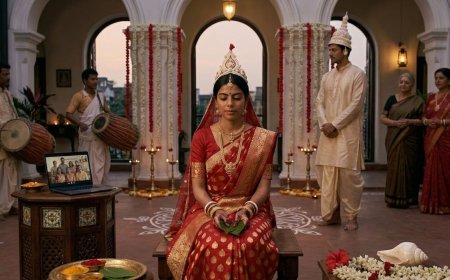
You have seen it in films and in old family photographs and in the stories your grandmother told when she was in the mood for telling. The carved wooden frame hung with marigolds. The red curtains. The bride inside, face half-hidden, hands full of the flowers she was given to hold so she would have something to do with the grief. The brothers at the front of the poles and the uncles at the back, walking slowly because nobody wanted to walk fast, because fast meant it was real.
You are planning a wedding now — in Mississauga, in Birmingham, in Melbourne, in Abu Dhabi — and someone has mentioned the Doli. Not as a logistical suggestion but as a longing. Your mother, perhaps. Or his mother. Or the aunt who always cries first at weddings and is never ashamed of it. "We should have a Doli," they said. "A proper one. Like it used to be."
You are here because you want to know how. This article will tell you everything.
🌟 DID YOU KNOW?
The palanquin as a bridal conveyance has been documented in Indian texts and art for over two thousand years — the Arthashastra [the ancient Indian treatise on statecraft and social organisation attributed to Chanakya, circa 300 BCE] contains specific regulations governing the construction and use of palanquins for weddings, suggesting the Doli was already a formalised institution by the third century BCE.
The word Palkhi [the Marathi and Hindi term for palanquin, used interchangeably with Doli in many communities] shares its root with the Sanskrit palyanika — a word that also carries the meaning of "that which carries forward" — encoding within the object's very name the understanding that the bride is not merely being transported but propelled forward into her next life.
Among NRI South Asian families in the UK and Canada who were surveyed about wedding traditions they most wished to revive, the Doli consistently ranked in the top three — above many more logistically simple traditions — because of its unique capacity to make the Vidaai [bride's farewell] visually complete. Families described it as the tradition that made the departure real in a way that simply walking to a car did not.
What Is the Doli and Palkhi?
Doli [from Hindi/Punjabi: the decorated palanquin in which the bride is carried from her parents' home at the time of Vidaai, her ceremonial farewell] — also known as Palkhi [the Marathi and wider Hindi equivalent] or palki in some regional traditions — is the bridal palanquin: a curtained, decorated, carried litter in which the bride makes her departure from her family home as the final act of the wedding. It is simultaneously a vehicle, a throne, a sanctuary, and a statement.
The Doli's place in the wedding sequence is at the very end — after the saat phere [seven sacred circumambulations of the sacred fire], after the sindoor daan [the groom's application of vermillion to the bride's hair parting], after the Kanyadaan [the father's formal offering of the daughter] and after the Vidaai rice-throwing. The Doli is how the Vidaai becomes physical and complete. The bride has thrown the rice. She has crossed the threshold. Now she is carried — not walking, not driving, but borne forward by the arms of the men who have loved her longest.
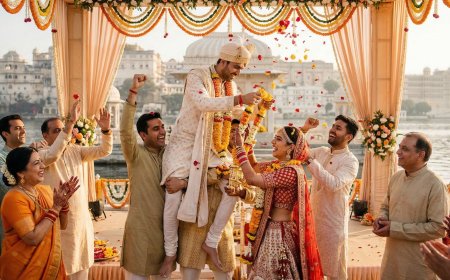
The traditional Doli is a rectangular frame of carved or decorated wood, suspended on two long poles carried on the shoulders of four to six men — typically the bride's brothers, male cousins, and maternal uncles. The frame is hung with curtains — red or pink in most North Indian traditions — and decorated with marigold garlands, rose chains, and strings of jasmine. The interior is cushioned and fragrant. The bride sits inside, visible to the gathered crowd through the parted curtains or half-drawn fabric, her face carrying the specific expression that Doli photographs are known for: grief and beauty and something that is not quite either, something that belongs only to thresholds.
The groom's side waits. The bride is carried toward them, toward the baraat [the groom's wedding procession] or the decorated wedding vehicle that will take her to her new home. The carrying is slow. Deliberate. The men do not rush. The crowd watches.
In Punjabi tradition, ghorian [wedding songs for the departing groom, adapted here for the departing bride] are sung. In Rajasthani tradition, maand [a classical folk music style of Rajasthan] fills the air. In Marathi tradition, the Palkhi is decorated with specific floral arrangements and accompanied by dhol-tasha [the paired drum and cymbal ensemble of Maharashtrian tradition]. In Bengali tradition, the Bidai is accompanied by dhak [the large ceremonial drum] and the sound of shankha [conch shells] blown as the bride is carried forward.
The Doli does not merely transport the bride. It declares her. It says to everyone watching: look at her. Look at what this family is sending into the world.
Community Comparison: Doli and Palkhi Traditions Across India
| Community / State | Local Name | Key Tradition | How NRIs Abroad Adapt It |
|---|---|---|---|
| Himachali | Doli | Bride carried in decorated Doli by brothers and male cousins; nati [Himachali folk dance] performed around the Doli as it moves; specific Pahari farewell songs | Doli hired or constructed from decorated chair frame; nati performed by family; Pahari songs played via speaker during procession |
| Garhwali | Doli | Maternal uncle [mama] holds a position of honour in the carrying; hulaki [farewell songs] sung by women of the village along the procession route | Mama given ceremonial front-pole position; hulaki recordings played; procession route mapped through venue corridor or garden |
| Kumaoni | Doli / Palkhi | Bride carried to the sound of dhol and damau[traditional Kumaoni drum pair]; specific flower varieties used for decoration including rhododendron where available | Dhol player hired; rhododendron substituted with red roses; procession performed through venue with family lining the route |
| Ladakhi | Adapted Doli | Urban Ladakhi families follow North Indian Doli traditions; traditional Ladakhi departure involved community gathering at village boundary | Community gathering recreated at venue exit; both Ladakhi folk songs and North Indian traditions incorporated |
| Kashmiri Pandit | Doli / Ruksati | Bride departs to specific Kashmiri farewell songs called wanwun [traditional Kashmiri women's songs sung at key wedding moments]; Doli decorated with specific Kashmiri floral arrangements | Wanwun sung by female family members or played as recording; Kashmiri floral style briefed to florist; Kashmiri pandit recites departure mantras |
| Punjabi | Doli | Among the most elaborate Doli traditions; brothers carry Doli with dhol playing; ghorian sung continuously; the Doli procession can be the longest and most theatrical element of the entire wedding | Dhol player essential; brothers trained in carrying position; ghorian sung live or played; procession through venue with full family participation |
| Marathi | Palkhi | Dhol-tasha ensemble accompanies Palkhi; bride holds betel leaves and looks back at the home three times before entering; specific Marathi farewell prayers | Dhol-tasha group hired from Marathi community associations; betel leaves sourced from Indian grocers; three-look-back tradition observed at venue exit |
| Tamil | Pirivu Doli | Less common in contemporary Tamil weddings but historically significant; bride carried in decorated chair by brothers; Tamil farewell songs accompany departure | Decorated chair Doli used; Tamil farewell songs played; mama [maternal uncle] given primary carrying role as per Tamil tradition |
| Bengali | Doli / Bidai Palkhi | Dhak player accompanies Doli; conch shells blown as bride is carried; bride holds betel leaves over her face and is not supposed to look back | Dhak player hired from Bengali community associations in London, Toronto, and Melbourne; conch shells blown; betel leaves sourced |
| Rajasthani | Doli / Palkhi | Most elaborate Doli tradition in India; carved wooden Doli with silver or gold decorative elements; maandmusic played live; procession can involve dozens of family members | Carved decorative Doli hired or constructed; Rajasthani folk musicians hired; maand recordings used where live musicians unavailable |
The Meaning Behind the Ritual
The Doli encodes something that no other element of the Indian wedding does quite so completely: the understanding that departure is not failure. In most of the world's cultures, leaving is associated with loss — the person who leaves is diminished by the leaving, the home they leave is diminished by their absence. The Doli refuses this understanding entirely.
The bride does not walk away from her home. She is carried. And she is carried not by servants or strangers but by the men who love her most — her brothers, who grew up beside her; her uncles, who watched her grow; her cousins, who know her in the specific way that only those who share childhood memories can know a person. She is carried by love, literally and without metaphor.
The height of the Doli above the ground is not incidental. She is elevated. She departs at a level above the ordinary — above the dust of the street, above the daily life of the home she is leaving. She departs as someone worth carrying. Someone whose departure deserves ceremony. Someone whose arrival at her new home is anticipated rather than simply received.
The curtains of the Doli are also significant — they give the bride a private space within the public ceremony. Inside the Doli, she is permitted to feel whatever she actually feels without performing it for the crowd. This is one of the rare moments in the entire wedding when the bride is not required to be seen.
For a non-Indian partner or family member: this is how we say goodbye to someone we love — not by watching her walk away, but by carrying her forward ourselves, because she deserves to leave like royalty.
Doing the Doli Abroad: The Practical Reality
The Doli is the Hindu wedding tradition that NRI families most frequently describe as "impossible to do properly abroad" — and then do properly abroad, because it turns out that love finds a way and the human capacity for creative adaptation is enormous. Here is what actually works.
Sourcing a Doli: A full traditional carved wooden Doli is hireable in cities with large South Asian populations. In London, wedding prop hire companies serving the Southall and Wembley markets carry Dolis — search specifically for "Indian wedding palanquin hire London" and contact suppliers at least three to four months ahead, as Dolis are limited inventory items that book out. In Toronto and Mississauga, South Asian wedding prop hire companies along the Dixie Road corridor and through Brampton-based wedding vendors carry Dolis — again, book early. In Sydney, specialist Indian wedding prop companies in the Parramatta area have begun stocking Dolis for the growing demand among NRI families. In Houston, Indian wedding prop hire along the Hillcroft corridor includes Doli options. In Dubai, the South Asian wedding industry in Bur Dubai and Deira includes Doli hire as a standard offering.
The Alternative Doli: If a traditional wooden Doli is unavailable or prohibitively expensive in your city, the most widely used and genuinely beautiful alternative is a floral throne chair — a heavily decorated high-backed chair, draped in marigold and rose garlands, carried on a flat platform by four family members. This achieves the essential elements of the Doli — the elevation, the carrying, the decorated enclosure, the bride's enthronement — without requiring the specific wooden structure. Many NRI families now prefer this option for its flexibility and the extraordinary photographs it produces. Discuss this with your wedding decorator and florist at least six weeks ahead.
The Carrying: The brothers must actually be able to carry the bride safely and with dignity. This sounds obvious but requires practical planning. Confirm that the Doli or chair platform has handles at the correct height for your family's specific brothers and cousins — most Doli hire companies provide adjustable pole lengths. Do a brief practice run at the venue the day before or the morning of the wedding, without the bride, to confirm the logistics. Assign a coordinator — typically the most practically-minded cousin — to manage the procession speed and direction on the day.
The Music: The Doli procession without music is a body without a heartbeat. A dhol player hired for the procession is the single highest-impact addition to any Doli ceremony abroad — the sound of the dhol transforms a corridor in a hotel or a garden path at a venue into something that feels genuinely ceremonial. Dhol players are bookable through gurdwara networks and South Asian wedding vendor platforms in London, Toronto, Sydney, Houston, and Dubai. Confirm the procession route with the venue and brief the dhol player on the length and pace.
Venue Logistics: Most venues accommodate a Doli procession with advance notice. The key requirements are a clear path of sufficient width for four carriers plus the Doli structure — typically at least six feet of clearance — and a designated start and end point. Map this route with your venue coordinator two weeks before the wedding. If the venue has stairs between the ceremony space and the exit, plan the route to avoid them or arrange a ramp if available.
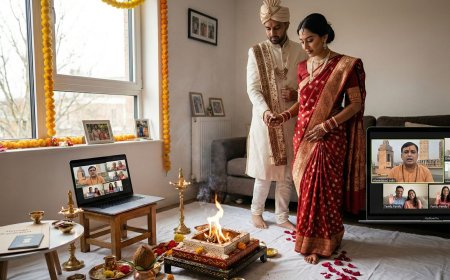
Coordinating with India: For grandparents watching from India, the Doli procession is the single most visually complete moment of the entire wedding to share via video call — it is moving, it is musical, it is impossible to misunderstand. Position a tablet on a tripod at the side of the procession route so relatives can see the full width of the Doli and the carriers. For families joining from Punjab or Rajasthan, an early evening Doli — around 6:00pm local venue time — corresponds to comfortable late-night viewing hours in India. Assign a dedicated person on each side to manage the connection.
Doing the Doli as a Destination Wedding in India
If your wedding is a destination event in India, the Doli returns to the landscape that invented it — and the experience is categorically different from anything a diaspora city can provide.
In Rajasthan, a Doli procession through the courtyard of a haveli in Jaipur or Udaipur — with a carved wooden Doli decorated with silver fittings, maand musicians playing in the gallery above, and the extended family lining the route — is among the most visually extraordinary wedding experiences available anywhere on earth. Rajasthani wedding Dolis can be sourced through destination wedding companies in Jaipur with extraordinary quality and historical authenticity.
In Punjab, a Doli procession through the grounds of a farmhouse wedding venue in Amritsar or Ludhiana — with dhol players, ghorian being sung by the women of the family, and the full baraat waiting at the gates — is the complete, unreduced original. For Maharashtrian families, a Palkhi procession with a live dhol-tasha ensemble in a traditional Pune or Nashik wedding setting is equally magnificent.
When briefing local coordinators on the specific Doli tradition of your community, provide written notes on the musical tradition, the carrying order [who holds which pole], the specific floral decoration style, and any family-specific departures from standard practice. For non-Indian international guests, the Doli procession requires no explanation — it is one of the most viscerally beautiful things a human being can witness at a wedding, in any culture, anywhere.
What You Need: Doli and Palkhi Ritual Checklist
Ritual Items The Doli or decorated platform chair, confirmed and booked with hire company; marigold garland decoration for the Doli frame [coordinated with your florist]; rose chains and jasmine strings for interior decoration; red or pink curtain fabric if not provided by the hire company; a cushioned interior lining for the bride's comfort; fresh flower petals for scattering along the procession route; and alta [red lac dye] footprints if the bride has not already had these applied at the Griha Pravesh.
People Required Four to six male family members — brothers, cousins, maternal uncles — confirmed and briefed on carrying positions and procession pace; a dhol player booked separately for the procession; a designated coordinator to manage the procession route and timing; the bride's mother and female relatives for the farewell songs; a designated family member to manage the video call for India-based relatives; and a photographer and videographer both specifically briefed that the Doli procession is among the most important sequences of the entire wedding.
Preparation Steps Book the Doli hire company three to four months ahead. Confirm procession route with venue coordinator two weeks before. Brief carrying family members one week before and conduct a practice run the day of or morning before the wedding. Book dhol player two months ahead. Coordinate Doli decoration with your florist four weeks ahead. Set up and test the video call connection one hour before the scheduled procession. Brief the photographer on the full procession sequence including the moment the bride is seated and the moment the procession begins moving.
NRI.Wedding's vendor network includes verified Doli hire companies, dhol players, and wedding decorators across the UK, Canada, UAE, and Australia. Let us connect you to the right people so that when the brothers step forward to lift the poles, everything is already in place.
5 Questions NRI Couples Always Ask
We cannot find a traditional wooden Doli for hire in our city. What is the best alternative?
The floral throne chair is the most widely used and genuinely beautiful alternative — a heavily decorated high-backed chair on a carrying platform, draped with marigold and rose garlands, elevated on a flat frame with poles. This achieves every essential element of the Doli and photographs magnificently. Discuss this specifically with your wedding decorator at least six weeks ahead — most experienced South Asian wedding decorators in diaspora cities have done this many times and have preferred suppliers for the platform and chair. The floral decoration transforms an ordinary chair into something that looks, in photographs, entirely ceremonial.
My brothers are not physically strong enough to carry the Doli for any significant distance. How do we manage this practically?
This is the most common practical concern and the solution is straightforward: the carrying brothers are supplemented by additional male family members — cousins, friends of the family, groomsmen — who share the weight. Most Dolis are designed for six carriers rather than four, which distributes the weight significantly. The procession distance should be planned to be manageable — typically between twenty and fifty metres from the ceremony space to the venue exit. If the distance is longer or the Doli particularly heavy, four primary carriers at the front and back can be supported by two additional carriers in the middle for the longer stretches. Brief and practice this arrangement the morning of the wedding.
My partner is not Indian. How do we explain the Doli to their family and guests?
Include a brief explanation in your wedding programme — two to three sentences describing the Doli's significance, the role of the brothers in carrying, and what the procession represents. Most non-Indian guests who witness a Doli procession describe it as one of the most visually spectacular and emotionally moving things they have ever seen at a wedding — the explanation deepens their experience but is not strictly necessary. The image of a bride being carried by her brothers, elevated and adorned, speaks a language that transcends cultural specificity.
Can the Doli procession happen inside the venue rather than outside?
Absolutely — and most NRI Doli processions happen entirely inside the venue, from the ceremony space through a corridor or ballroom to the main exit. The key requirements are sufficient ceiling height for the Doli structure [confirm this with your venue and Doli hire company], sufficient corridor width for four to six carriers plus the Doli frame [typically six feet minimum], and a clear path free of obstacles. Many NRI families actually prefer the indoor procession for weather reliability and the acoustic effect of the dhol in an enclosed space — the sound is extraordinary.
Should the Doli happen at the end of the ceremony or at the end of the reception?
This varies by regional tradition and family preference. In most North Indian traditions, the Doli follows immediately after the Vidaai at the end of the ceremony — the rice is thrown, the threshold is crossed, and the bride enters the Doli as the final ceremonial act. In some families, the reception follows the ceremony and the Doli closes the entire celebration, with the bride departing from the reception venue at the end of the evening. The latter is increasingly common among NRI families who want to give guests the full reception experience before the farewell, and who find that the Doli as a closing act gives the entire wedding day a complete and magnificent ending. Discuss the sequencing with your pandit, your venue coordinator, and your photographer and build it into the official running order.
The Emotional Angle
There is something that happens to brothers at the Doli that happens nowhere else in the wedding. They have been present all day — joking, managing, helping, being useful in the practical way that brothers are useful. They have kept their composure through the ceremony, through the Kanyadaan, through the Vidaai rice-throwing. They have been the strong ones because someone has to be the strong ones.
Then they step forward to lift the poles.
And the weight of it — the actual, physical weight of their sister in the Doli, the weight they are choosing to carry, the weight of knowing that when they set the Doli down at the other end of this procession they will step back and she will go forward without them — arrives in their hands and travels upward and does not stop until it reaches somewhere behind the sternum where the important things live.
NRI brothers carry an additional weight that their counterparts in India do not always carry. They grew up as their sister's protectors in countries that were sometimes indifferent or unkind, in schools where her name was mispronounced, in cities where their family was the only Indian family on the street. They were her people in the specific way that only siblings in the diaspora can be each other's people — not just family, but fellow travellers, fellow translators, fellow navigators of a world that did not always make space for them.
They lift her now. They carry her forward. They walk slowly because they always knew this was coming and they are still not ready.
She is elevated. She is adorned. She is carried by love.
They set her down. They step back. She goes forward.
This is what brothers are for.
A Moment to Smile
At a wedding in Melbourne three years ago, the bride's three brothers had been training for the Doli carrying with the seriousness of competitive athletes. They had practiced the lifting. They had discussed formation. They had, apparently, watched several YouTube videos of Doli processions to study technique.
What they had not studied was the turning radius required to navigate the corner between the ceremony hall and the main corridor while carrying a fully decorated floral throne chair with their sister inside it.
The corner was tight. The chair was wider than anticipated. The eldest brother, leading the procession, assessed the geometry at the last moment and said, with complete calm, the single word: "Rotate."
What followed was thirty seconds of extremely focused sibling negotiation, conducted in hushed but intense Punjabi, while the dhol player gamely continued playing and the guests watched with the specific delight of people witnessing something going slightly wrong in real time.
The corner was navigated. The procession continued. The bride, inside the chair, was laughing so hard her dupatta was shaking.
The photographer captured all of it. The corner negotiation photographs are, by unanimous family agreement, the best of the entire wedding.
Quotes from the Diaspora
"When my brothers lifted the Doli, I understood something I had not understood before. I had thought the Doli was about me — about my departure, my feelings, my farewell. It was not. It was about them. About what they were willing to carry for me. I will think about their faces at that moment for the rest of my life." — Ravneet Kaur Gill, Punjabi Sikh community, Toronto
"My daughter-in-law's brothers carried her Doli at the wedding in our garden in Southall. They are not particularly large men. They are very determined men. They carried that Doli from the back of the garden to the front gate — forty metres — without stopping, without asking for help, without putting her down once. When they set the Doli down and stepped back, the eldest one turned away from the crowd for a moment. I pretended not to notice. Some things are private even at weddings." — Surinder Kaur Bains, Punjabi community, Southall
"We used a floral throne chair because we could not find a traditional Doli for hire in Houston at the time. My florist covered it in three hundred marigolds and two hundred roses and a jasmine garland along the top. When my brothers lifted it and began walking and the dhol started — I looked out from inside the flowers and I saw my father's face. He was not crying. He was smiling the way people smile when something is exactly right. That is the image I carry." — Preethi Sharma, Punjabi Hindu community, Houston
Your Roots Travel With You
Somewhere right now, four brothers are lifting poles in a venue corridor in Mississauga or a garden in Southall or a hotel ballroom in Dubai. The dhol is playing. The women are singing. Inside a throne of flowers, a bride is looking out at the people who made her — her mother at the door, her father standing slightly apart, the aunties who have known her since before she could walk — and she is carrying everything they gave her forward into what comes next.
NRI.Wedding exists so that this moment — ancient, magnificent, irreplaceable — happens with every element it deserves. Our vendor network includes verified Doli hire companies, floral throne specialists, and dhol players across the UK, Canada, UAE, and Australia. Our planning checklists ensure the procession route is mapped, the carrying team is briefed, and the photographer knows exactly where to stand.
The Doli is ready. The brothers are ready. The world is watching.
She leaves like royalty because she always was.
What's Your Reaction?
 Like
0
Like
0
 Dislike
0
Dislike
0
 Love
0
Love
0
 Funny
0
Funny
0
 Angry
0
Angry
0
 Sad
0
Sad
0
 Wow
0
Wow
0