





































































The Invisible Thread: Why Gotra Matching Still Matters in Hindu Weddings
The Gotra system — one of Hinduism's oldest patrilineal clan frameworks — remains a decisive factor in Hindu marriage compatibility across communities worldwide. Tracing descent from Vedic sages, this ancient lineage system governs exogamy rules that millions of NRI families observe from Houston to Melbourne. This guide explains the Gotra system's origins, community variations, and practical implications for diaspora couples navigating Hindu wedding traditions across cultures and time zones.

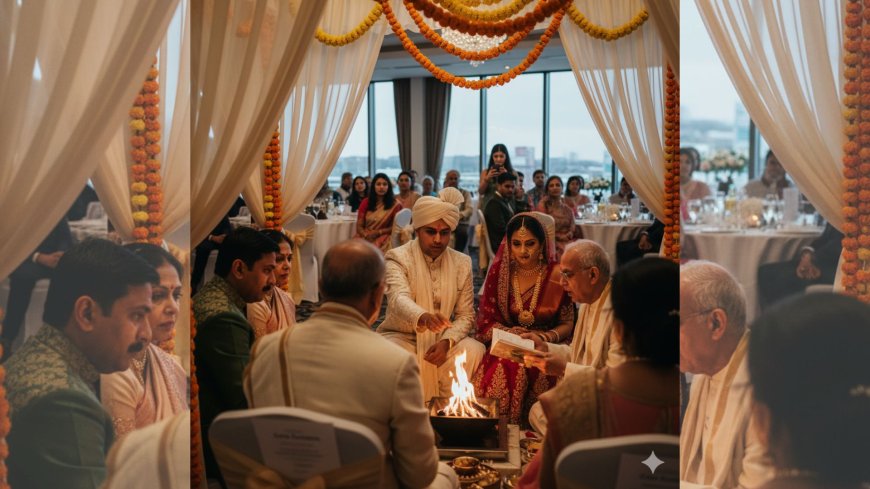
The ancient system of clan lineage that governs Hindu marriage compatibility is older than most civilisations still standing — and for NRI couples planning weddings from Houston to Melbourne, it remains one of the most misunderstood, most debated, and most quietly decisive factors in whether a family says yes. Rooted in Vedic tradition and carried across oceans by the Indian diaspora, the Gotra [patrilineal clan lineage traced to a Vedic sage] system is not a relic. It is a living framework that continues to shape marriage decisions in millions of Hindu families worldwide. Understanding it — its origins, its logic, its community variations, and its practical implications for modern NRI couples — is essential for anyone planning a Hindu wedding with integrity and family harmony.
You grew up knowing your Gotra the way you knew your grandmother's cooking — present in the background of everything, rarely explained, always assumed. At family gatherings someone would mention it in passing. At temple, the pandit would ask for it before a prayer. You filed it somewhere in the back of your memory alongside the name of your ancestral village and the particular way your family ties a particular knot.
And then you met someone. And everything was wonderful. And then someone asked the question.
You are in Vancouver now, or in Dubai, or in the East Midlands, and your parents are on a video call with his parents, and the conversation has been warm and full of laughter and then someone says the words — what is your Gotra? — and suddenly the room goes very quiet and you realise you are about to learn something about your family, your history, and the ancient system of genetic wisdom that your ancestors built, that you never quite learned in school.
🌟 DID YOU KNOW?
• The Gotra system identifies patrilineal descent from one of the original Sapta Rishis [seven Vedic sages] — Gautama, Bharadvaja, Vishvamitra, Jamadagni, Vasishtha, Kashyapa, and Atri — with additional lineages added as the tradition expanded across centuries and communities.
• Modern genetic research has found surprising correlations between traditional Indian Gotra boundaries and Y-chromosome genetic markers, suggesting that the ancient system may have functioned as an effective tool for preventing inbreeding across generations — a form of population genetics encoded in ritual practice thousands of years before the science existed.
• In the Indian diaspora, Gotra records are increasingly being preserved through community organisations and digital genealogy platforms — with Gujarati, Tamil Brahmin, and Telugu communities in the UK, US, and Canada leading significant efforts to document lineage data that might otherwise be lost across generations of migration.
What Is the Gotra System?
The Gotra system is one of the oldest continuously functioning kinship classification systems in the world. Derived from the Sanskrit roots go [cow] and tra [shelter or protection] — originally meaning a cowpen or enclosure — the term evolved to mean a lineage group, a clan enclosed within a shared ancestral identity. Every Hindu family belonging to the twice-born Dvija [the three upper varnas of Brahmin, Kshatriya, and Vaishya who undergo the sacred thread ceremony] communities traditionally carries a Gotra that traces its male lineage back to a specific Vedic sage.
In practice, the Gotra functions as a marker of exogamy — the principle that marriage must occur outside one's own clan. A man and woman who share the same Gotra are considered Sagotra [of the same lineage] and therefore symbolically siblings, descended from the same ancient patriarch. Marriage between Sagotra individuals is traditionally prohibited in most Hindu communities, considered equivalent to a form of incest regardless of how distantly the actual biological relationship may extend.
The Gotra is determined exclusively through the paternal line and is passed from father to children. A woman takes her husband's Gotra upon marriage, which is why the Gotra is formally stated during wedding ceremonies — the bride's transition from her father's Gotra to her husband's is itself a ritual act of transformation, marking her entry into a new lineage.
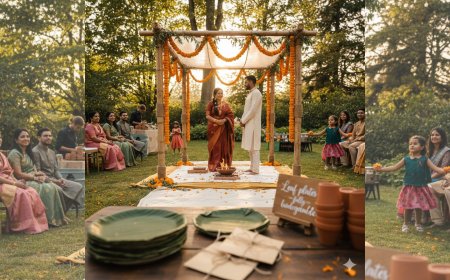
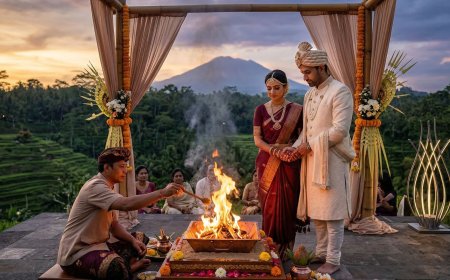
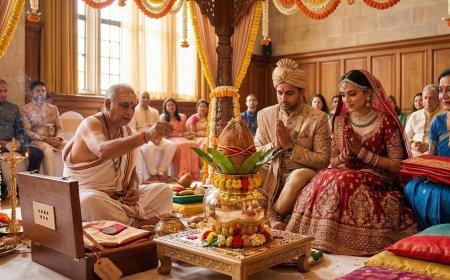
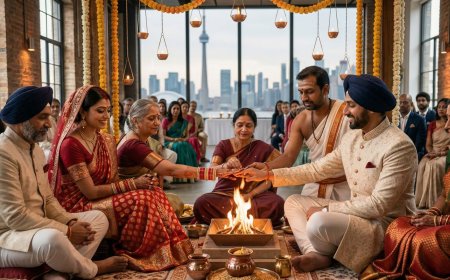
During the wedding ceremony, the Pandit [the officiating priest] will formally declare both Gotras during the Vivah Puja[the wedding ritual], and the act of the bride receiving her husband's Gotra is embedded within the Saptapadi [the seven sacred steps] and related rituals. The Gotra declaration is not ceremonial decoration — it is a formal statement of lineage transition witnessed by the sacred fire.
Community Comparison Table
| Community / State | Local Name | Key Tradition | How NRIs Abroad Adapt It |
|---|---|---|---|
| North Indian Brahmin | Gotra | Strict Sagotra prohibition; Pravara [ancestral lineage recitation] also matched | Gotra verified via family elders; pandit confirms during ceremony |
| Punjabi Hindu | Gotra | Gotra exogamy observed; additionally, maternal uncle's and maternal grandmother's Gotra also avoided | Punjabi community associations and pandits in Southall and Brampton maintain records |
| Rajasthani | Gotra / Khamp | Extended exogamy rules; up to seven generations of maternal lineage also avoided | Family elders consulted; Rajasthani community organisations in Leicester and Houston assist |
| Gujarati | Gotra / Ekda | Community-specific clan groupings (Ekda) function alongside Gotra | Gujarati mandals in Leicester, Edison NJ, and Parramatta maintain Ekda and Gotra records |
| Marathi Brahmin | Gotra | Sagotra marriage prohibited; Pravara matching also observed | Maharashtra mandals in Melbourne and Toronto consult records; pandits verify |
| Tamil Brahmin | Gotra / Kothiram | Strict Gotra exogamy; cross-cousin marriage traditionally permitted in contrast to North Indian practice | Tamil temple priests in Harrow, Scarborough, and Parramatta hold community records |
| Telugu Brahmin | Gotra | Sagotra prohibition observed; maternal lineage Gotra also considered | Telugu associations in New Jersey, Sydney, and Dubai maintain Gotra databases |
| Bengali Brahmin | Gotra | Sagotra prohibition; additionally Pravara compatibility considered | Bengali cultural societies in Mississauga and Melbourne maintain records |
| Kashmiri Pandit | Gotra / Kram | Kram [family surname system] functions alongside Gotra; both considered for compatibility | KP community networks in Delhi and diaspora cities provide remote guidance |
| Himachali / Garhwali / Kumaoni | Gotra | Gotra exogamy strictly observed in hill Brahmin communities; village exogamy sometimes additionally observed | Community elders and hill-region pandits consulted remotely; diaspora networks in UK active |
The Meaning Behind the Ritual
The Gotra system encodes a profound understanding of human community that predates modern genetics by millennia. At its deepest level, it is not merely a prohibition — it is a philosophy of connection. The Vedic sages who established the Gotra lineages understood that human communities require both closeness and diversity to flourish: closeness for cultural continuity, diversity for biological vitality. The Gotra system creates a framework that enforces this balance at the level of the most intimate human institution — marriage.
The spiritual logic is equally rich. When a Pandit recites the Pravara [the three to five ancestral sages of a Gotra lineage] during the wedding ceremony, he is not performing bureaucratic record-keeping. He is summoning the ancestral witnesses — calling the sages of both lineages to be present at the moment their descendants are joined. The wedding fire is understood to carry the declaration to the cosmos. The two Gotras present at the ceremony are understood to be entering a relationship as significant as the couple themselves.
For the bride, the Gotra transition is among the most profound ritual transformations of the wedding — a symbolic death and rebirth, the release of one ancestral identity and the receiving of another. It is the moment the tradition marks as her truest passage into her new life.
The simplest way to explain it to someone from outside the tradition: the Gotra system is how Hindu families remember that they are all, in some sense, family — and honour the ancient wisdom that some families should not marry each other.
Navigating the Gotra System Abroad: The Practical Reality
For NRI couples, the Gotra question arrives at a specific moment in the relationship's progression — usually after the families have met, after warmth has been established, and before the formal commitment is made. And in diaspora settings, it arrives with a particular complication: many young NRIs in their late twenties and thirties do not actually know their Gotra with certainty.
This is more common than anyone admits. The Gotra is typically transmitted orally within families, and in the second and third generation of diaspora settlement, that oral transmission often breaks down. Parents may remember imprecisely; grandparents may no longer be alive to ask; family records, if they exist at all, may be in India with relatives who are not immediately contactable.
The first practical step is to establish your Gotra with certainty before the question becomes urgent. Call your oldest living paternal relative — a grandparent, a granduncle, a great-aunt who married into the family and would know. If the answer is not available through family, the temple your family has traditionally attended in India will often have records, as will the Jyotishi [Vedic astrologer] or Pandit who conducted ceremonies for your parents or grandparents. In major diaspora cities, community organisations maintain Gotra databases — the Gujarati community associations of Leicester, the Telugu Cultural Association of New Jersey, the Tamil temple networks of Harrow and Scarborough, and the Punjabi community organisations of Brampton and Southall are all active in this preservation work.
Once both Gotras are established, the compatibility question is straightforward in most cases — same Gotra means the match is traditionally not permitted, different Gotra means this particular hurdle is cleared. Where it becomes more complex is in communities with extended exogamy rules — Rajasthani families who avoid multiple maternal lineage Gotras, Punjabi families who consider three or four Gotra prohibitions rather than one, communities where Pravaramatching is also required alongside Gotra matching.
For these complex cases, the remote pandit consultation — a video call with a qualified priest in India — is the most reliable path. When booking this consultation, ensure you are connecting with a pandit familiar with your specific community tradition. A North Indian Brahmin pandit may not be equipped to advise on Tamil Kothiram matching; a Telugu priest may not be familiar with Kashmiri Pandit Kram traditions. NRI.Wedding maintains a directory of community-specific pandits available for remote consultation across diaspora cities from Houston to Dubai to Melbourne.
For sourcing any ritual items needed for Gotra-related ceremonies, the Indian grocery and supply streets of major diaspora cities are well stocked. In London, Ealing Road in Wembley and the South Hall Broadway carry a full range of Puja[ritual worship] materials. In Toronto, Gerrard Street East and the Mississauga Dixie Road corridor serve the community well. In Sydney, Harris Park in Parramatta is the primary Indian supply hub. In Houston, Hillcroft Avenue carries comprehensive ritual supplies. In Dubai, Meena Bazaar in Bur Dubai is the established source for Indian ritual materials.
The Gotra System in a Destination Wedding in India
For NRI couples planning a destination wedding in India, the Gotra verification and ceremony integration is significantly more straightforward — local pandits will be thoroughly familiar with the system and will manage the ritual declarations as a matter of course. The primary task for the couple is to arrive with both Gotras confirmed and to brief the coordinating pandit on any community-specific variations in their families' traditions.
Destination wedding locations in Rajasthan — Jaipur, Udaipur, Jodhpur — are served by pandit networks with deep familiarity with North Indian Gotra traditions, making them natural choices for couples from Brahmin and Kshatriya backgrounds. For South Indian communities, destination weddings in Kerala and Tamil Nadu allow access to priests thoroughly versed in the Kothiram and regional Pravara traditions. Goa's destination wedding venues, increasingly popular with contemporary NRI couples, maintain connections with pandits who travel to conduct ceremonies at resort and heritage properties.
When briefing non-Indian guests about the Gotra declaration during the ceremony, a short explanatory note in the wedding booklet — describing the Gotra as the ancestral clan lineage of each family, and the ceremony as the formal welcoming of the bride into her husband's lineage — is both accurate and accessible. Most non-Indian guests find this element of the ceremony genuinely moving once they understand what they are witnessing.
What You Need: Ritual Checklist
For Gotra Verification: Confirmed Gotra of both bride and groom from paternal lineage, Pravara details if your community requires it, confirmation that Gotras are different, community-specific extended exogamy rules checked with family elders or pandit.
People Required: Officiating pandit familiar with your community's Gotra traditions, both sets of parents or senior family members who can formally state the Gotra, witnesses for the Gotra declaration during the ceremony.
Preparation Steps: Establish both Gotras at least three months before the wedding, consult a community-specific pandit if extended exogamy rules apply, brief the officiating pandit on both families' Gotra and Pravara details before the ceremony, prepare a short Gotra explanation for any non-Indian guests attending, confirm how the bride's Gotra transition will be formally marked in your specific community's ceremony.
NRI.Wedding connects couples with verified, community-specific pandits who understand the full Gotra declaration and transition ritual — for weddings in diaspora cities across the UK, US, Canada, UAE, and Australia, and for destination weddings across India.
5 Questions NRI Couples Always Ask
What happens if we share the same Gotra but our families are not aware of any actual blood relationship for many generations?
The traditional prohibition on Sagotra marriage is not contingent on demonstrated biological relationship — it is categorical. The shared Gotra is understood as establishing symbolic kinship regardless of how many generations have passed. In practice, some families in extraordinary circumstances do proceed with Sagotra marriages after consulting a senior pandit and performing specific Graha Shanti [planetary pacification] and Dosha Nivaran [ritual remediation] ceremonies — but this is the exception rather than the rule, and it requires genuine religious guidance rather than simply a pragmatic workaround. The honest answer is to address this with your family pandit as early as possible rather than hoping it will be overlooked.
My partner is not Hindu. Does the Gotra system apply to our wedding, and how do we handle the Gotra declaration?
For intercultural weddings where one partner is non-Indian and non-Hindu, the Gotra question is typically resolved by the officiating pandit in consultation with the family. Some pandits will declare only the Hindu partner's Gotra; others will perform a symbolic Gotra Grahan [Gotra adoption] by which the non-Hindu partner is given a ceremonial Gotra — often that of a respected sage — for the purposes of the ritual. This is a beautiful and inclusive solution that maintains the ceremony's integrity while honouring the reality of the couple's situation. Discuss this with your pandit well in advance.
How do I find a pandit abroad who knows my specific community's Gotra and Pravara traditions?
This is the most common practical challenge NRI couples face, and it is real — a Brahmin pandit from Uttar Pradesh may not be familiar with the Pravara recitation traditions of a Kashmiri Pandit family, or the Kothiram conventions of a Tamil Brahmin family. The most reliable path is to ask your family temple in India for a recommendation, or to use the community-specific pandit networks maintained by NRI.Wedding, which include priests from North Indian Brahmin, Tamil Brahmin, Telugu Brahmin, Gujarati, Bengali, Kashmiri Pandit, and Marathi traditions available for remote consultation and diaspora ceremony travel.
Can the Gotra declaration and transition be conducted over video call for relatives in India who cannot attend?
The Gotra declaration is performed during the wedding ceremony itself and requires the physical presence of the officiating pandit and the couple — it cannot be delegated remotely. However, the ceremony can absolutely be streamed so that relatives in India can witness the moment in real time. Given India's time zone, a morning ceremony in the UK, Canada, or Australia will align reasonably well with Indian evening hours — coordinate the streaming link in advance and test the connection before the ceremony day.
Our families have different community backgrounds with different Gotra traditions. Whose system do we follow?
When bride and groom come from different Hindu communities — a North Indian Brahmin family and a South Indian Tamil Brahmin family, for example — the Gotra traditions and exogamy rules may differ significantly. The practical resolution is to satisfy both families' requirements: ensure the Gotras are different under both systems, and discuss with both families' pandits how the ceremony will handle the declaration and transition. A pandit with experience in intercommunity Hindu weddings — increasingly common in diaspora cities — will know how to navigate this with sensitivity and ritual authority.
The Emotional Angle
There is something that happens when you say your Gotra aloud for the first time in a formal setting — in front of the fire, with the pandit's voice carrying it into the ceremony. Something shifts. The word that had lived abstractly in the back of your consciousness for years becomes suddenly, unexpectedly, real.
You are not just yourself in that moment. You are the end of a very long line — a line that stretches back through your father and his father and his father before him, back through migration and partition and famine and joy and ordinary daily life, back through generations whose faces you will never see and whose names you will never know, all the way back to a sage sitting in the forest a very long time ago, watching the stars and understanding something about how human beings should live together.
That is what you carry when you carry your Gotra. That is what you are declaring when you say it aloud. That is what you are giving to your children when you pass it forward.
For NRI families, this moment carries an additional weight — the knowledge that you have kept the thread unbroken across oceans, that the lineage your ancestors protected across millennia has survived your own migration intact. Your grandparents left everything behind. But they carried this. And now, at this fire in Birmingham or Brampton or Brisbane, so do you.
A Moment to Smile
At a wedding in Southall three years ago, the groom — a software architect who had confidently told his fiancée he knew his Gotra — discovered forty minutes before the ceremony began that he had been confusing his Gotra with his maternal grandfather's village name for his entire adult life.
The resulting phone chain — groom to father to uncle in Jalandhar to great-uncle in Ludhiana to the family pandit in Chandigarh, all conducted via a WhatsApp group called "Emergency Gotra Situation" — was resolved with eleven minutes to spare.
The correct Gotra was established, the ceremony proceeded without incident, and the WhatsApp group, its members having bonded intensely across three time zones in forty minutes of crisis, continues to this day as one of the most active family chat groups in the history of the extended family.
The groom now knows his Gotra. He also knows his Pravara. He has, his wife notes, memorised it with an enthusiasm that suggests some lessons are best learned under pressure.
Quotes From the Diaspora
"My mother-in-law asked for our Gotra within the first ten minutes of meeting my parents. I remember thinking — this is the real interview. The chai was just the warm-up. When our Gotras came back different, the whole room exhaled at once. It was the most relieved I've ever seen four parents simultaneously." — Ananya Krishnamurthy, Tamil Brahmin, Houston
"My son's Gotra was something I made sure he knew from the time he was twelve. It is not just a tradition — it is his identity. It is who he comes from. When his wife received his Gotra at the wedding, I felt something pass from our family into their future. I cannot explain it better than that." — Sudha Mehrotra, North Indian Brahmin, Leicester
"We are a mixed family — my father is Gujarati Brahmin, my mother is Punjabi Hindu. Working out whose Gotra rules applied to my wedding was genuinely complicated. In the end, our pandit simply said: we will honour both families' wisdom. That felt right." — Riya Kapoor-Shah, intercommunity family, Melbourne
Your Roots Travel With You
The Gotra system is one of the most ancient gifts your ancestors carried forward for you — a thread of identity so durable that it has survived thousands of years, dozens of migrations, and the complete transformation of the world around it. When you declare your Gotra at your wedding, you are not performing an obligation. You are accepting an inheritance.
NRI.Wedding connects couples with community-specific pandits who understand the full depth of the Gotra declaration and transition ritual, as well as the extended exogamy rules that vary across Hindu communities. Our pandit network covers North Indian Brahmin, Tamil Brahmin, Telugu, Gujarati, Bengali, Marathi, Kashmiri Pandit, and Punjabi traditions — available for remote consultation and for ceremony travel to diaspora cities across the UK, US, Canada, UAE, and Australia, and to destination wedding venues across India.
Find your pandit. Declare your lineage. Carry it forward.
Your Gotra travelled across oceans to reach this moment. Let it be spoken with pride.
This article covers the Gotra system in Hindu weddings, including Sagotra prohibition, Pravara matching, and Gotra transition rituals across North Indian Brahmin, Tamil Brahmin, Telugu, Gujarati, Bengali, Marathi, Kashmiri Pandit, Himachali, Rajasthani, and Punjabi communities, with practical guidance for NRI couples in the UK, US, Canada, UAE, and Australia.
What's Your Reaction?
 Like
0
Like
0
 Dislike
0
Dislike
0
 Love
0
Love
0
 Funny
0
Funny
0
 Angry
0
Angry
0
 Sad
0
Sad
0
 Wow
0
Wow
0